Reinste Nano Ventures Pvt. Ltd.
Designed to deliver the purest…..
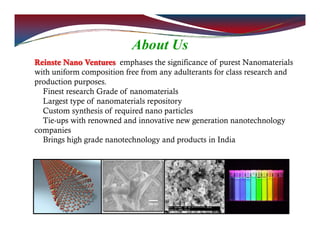
Nanotechnology Applications
in
Energy Sector
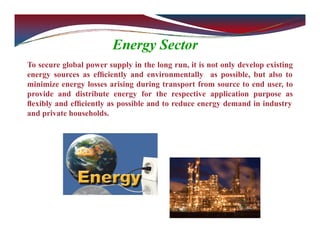
Reinste Nano Ventures emphases the significance of purest Nanomaterials
with uniform composition free from any adulterants for class research and
production purposes.
Finest research Grade of nanomaterials
Largest type of nanomaterials repository
Custom synthesis of required nano particles
Tie-ups with renowned and innovative new generation nanotechnology
companies
Brings high grade nanotechnology and products in India
About Us
Energy Sector
To secure global power supply in the long run, it is not only develop existing
energy sources as efficiently and environmentally as possible, but also to
minimize energy losses arising during transport from source to end user, to
provide and distribute energy for the respective application purpose as
flexibly and efficiently as possible and to reduce energy demand in industry
and private households.
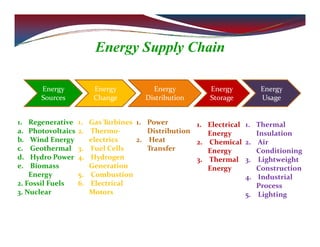
Energy Supply Chain
Energy
Sources
Energy
Change
Energy
Distribution
Energy
Storage
Energy
Usage
1. Regenerative
a. Photovoltaics
b. Wind Energy
c. Geothermal
d. Hydro Power
e. Biomass
Energy
2. Fossil Fuels
3. Nuclear
1. Gas Turbines
2. Thermo‐
electrics
3. Fuel Cells
4. Hydrogen
Generation
5. Combustion
6. Electrical
Motors
1. Power
Distribution
2. Heat
Transfer
1. Electrical
Energy
2. Chemical
Energy
3. Thermal
Energy
1. Thermal
Insulation
2. Air
Conditioning
3. Lightweight
Construction
4. Industrial
Process
5. Lighting
Energy Sector and Nanotechnology
Nanotechnology provides essential improvement potentials for the
development of both conventional energy sources (fossil and nuclear
fuels) and Renewable energy sources like geothermal energy, sun, wind,
water, tides or biomass.
Breakthroughs in nanotechnology open up the possibility of moving
beyond our current alternatives for energy supply by introducing
technologies that are more efficient, inexpensive, and environmentally
sound.
According to the authors, nanotechnologies provide the potential to
enhance energy efficiency across all branches ofi ndustry and to
economically leverage renewable energy production through new
technological solutions and optimized production technologies.
Nanotechnology innovations could impact each part of the value-added
chain in the energy sector.
Potentials of Nanotechnology in Energy
Sector
Nanotechnology has shown the possibility of fulfilling everyone’s dream of
getting cheap and clean energy through its strategic applications. Its
intersection with energy is going to change the way energy was hitherto
being generated, stored, transmitted, distributed and managed.
Nanotechnology impact each part of the value-added chain in the
energy sector
Energy Sources
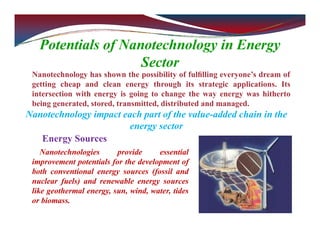
Nanotechnologies provide essential
improvement potentials for the development of
both conventional energy sources (fossil and
nuclear fuels) and renewable energy sources
like geothermal energy, sun, wind, water, tides
or biomass.
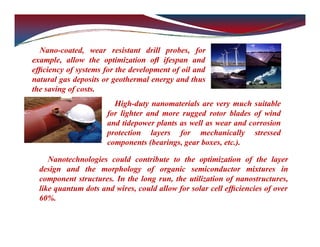
Nano-coated, wear resistant drill probes, for
example, allow the optimization ofl ifespan and
efficiency of systems for the development of oil and
natural gas deposits or geothermal energy and thus
the saving of costs.
High-duty nanomaterials are very much suitable
for lighter and more rugged rotor blades of wind
and tidepower plants as well as wear and corrosion
protection layers for mechanically stressed
components (bearings, gear boxes, etc.).
Nanotechnologies could contribute to the optimization of the layer
design and the morphology of organic semiconductor mixtures in
component structures. In the long run, the utilization of nanostructures,
like quantum dots and wires, could allow for solar cell efficiencies of over
60%.
Energy Conversion
The conversion of primary energy sources into
electricity, heat and kinetic energy requires
utmost efficiency. Efficiency increases, especially
in fossil-fired gas and steam power plants, could
help avoid considerable amounts of carbon
dioxide emissions
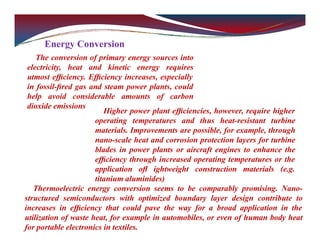
Higher power plant efficiencies, however, require higher
operating temperatures and thus heat-resistant turbine
materials. Improvements are possible, for example, through
nano-scale heat and corrosion protection layers for turbine
blades in power plants or aircraft engines to enhance the
efficiency through increased operating temperatures or the
application ofl ightweight construction materials (e.g.
titanium aluminides)
Thermoelectric energy conversion seems to be comparably promising. Nano-
structured semiconductors with optimized boundary layer design contribute to
increases in efficiency that could pave the way for a broad application in the
utilization of waste heat, for example in automobiles, or even of human body heat
for portable electronics in textiles.
Energy Distribution
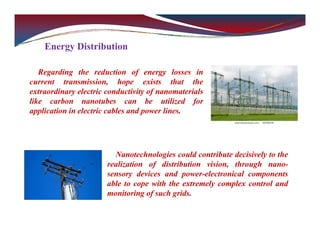
Regarding the reduction of energy losses in
current transmission, hope exists that the
extraordinary electric conductivity of nanomaterials
like carbon nanotubes can be utilized for
application in electric cables and power lines.
Nanotechnologies could contribute decisively to the
realization of distribution vision, through nano-
sensory devices and power-electronical components
able to cope with the extremely complex control and
monitoring of such grids.
Energy Storage
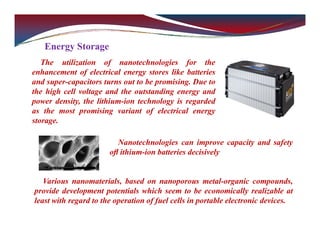
The utilization of nanotechnologies for the
enhancement of electrical energy stores like batteries
and super-capacitors turns out to be promising. Due to
the high cell voltage and the outstanding energy and
power density, the lithium-ion technology is regarded
as the most promising variant of electrical energy
storage.
Nanotechnologies can improve capacity and safety
ofl ithium-ion batteries decisively
Various nanomaterials, based on nanoporous metal-organic compounds,
provide development potentials which seem to be economically realizable at
least with regard to the operation of fuel cells in portable electronic devices.
Energy Usage
The reduction of fuel consumption in automobiles through lightweight
construction materials on the basis of nanocomposites, the optimization in
fuel combustion through wear-resistant, lighter engine components and
nanoparticular fuel additives or even nanoparticles for optimized tires with
low rolling resistance are some of the examples of nanotechnology
development.
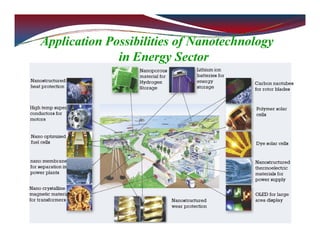
Application Possibilities of Nanotechnology
in Energy Sector
Total Range of Products
We Have
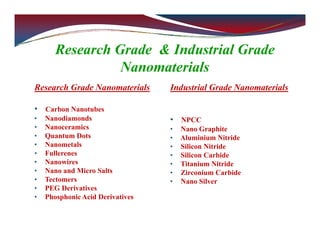
Research Grade Nanomaterials
• Carbon Nanotubes
• Nanodiamonds
• Nanoceramics
• Quantum Dots
• Nanometals
• Fullerenes
• Nanowires
• Nano and Micro Salts
• Tectomers
• PEG Derivatives
• PhosphonicAcid Derivatives
Industrial Grade Nanomaterials
• NPCC
• Nano Graphite
• Aluminium Nitride
• Silicon Nitride
• Silicon Carbide
• Titanium Nitride
• Zirconium Carbide
• Nano Silver
Research Grade & Industrial Grade
Nanomaterials
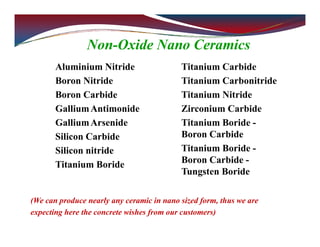
Non-Oxide Nano Ceramics
(We can produce nearly any ceramic in nano sized form, thus we are
expecting here the concrete wishes from our customers)
Aluminium Nitride
Boron Nitride
Boron Carbide
GalliumAntimonide
GalliumArsenide
Silicon Carbide
Silicon nitride
Titanium Boride
Titanium Carbide
Titanium Carbonitride
Titanium Nitride
Zirconium Carbide
Titanium Boride -
Boron Carbide
Titanium Boride -
Boron Carbide -
Tungsten Boride
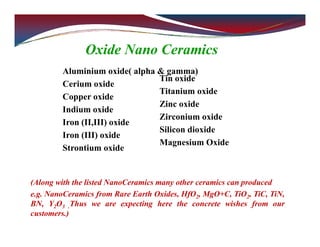
Oxide Nano Ceramics
(Along with the listed NanoCeramics many other ceramics can produced
e.g. NanoCeramics from Rare Earth Oxides, HfO2, MgO+C, TiO2, TiC, TiN,
BN, Y2O3 .Thus we are expecting here the concrete wishes from our
customers.)
Aluminium oxide( alpha & gamma)
Cerium oxide
Copper oxide
Indium oxide
Iron (II,III) oxide
Iron (III) oxide
Strontium oxide
Tin oxide
Titanium oxide
Zinc oxide
Zirconium oxide
Silicon dioxide
Magnesium Oxide
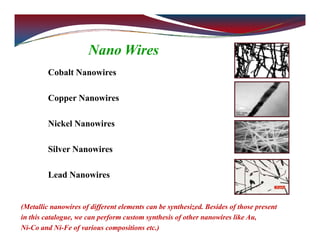
Nano Wires
(Metallic nanowires of different elements can be synthesized. Besides of those present
in this catalogue, we can perform custom synthesis of other nanowires like Au,
Ni-Co and Ni-Fe of various compositions etc.)
Cobalt Nanowires
Copper Nanowires
Nickel Nanowires
Silver Nanowires
Lead Nanowires
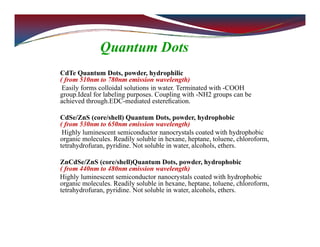
Quantum Dots
CdTe Quantum Dots, powder, hydrophilic
( from 510nm to 780nm emission wavelength)
Easily forms colloidal solutions in water. Terminated with -COOH
group.Ideal for labeling purposes. Coupling with -NH2 groups can be
achieved through.EDC-mediated esterefication.
CdSe/ZnS (core/shell) Quantum Dots, powder, hydrophobic
( from 530nm to 650nm emission wavelength)
Highly luminescent semiconductor nanocrystals coated with hydrophobic
organic molecules. Readily soluble in hexane, heptane, toluene, chloroform,
tetrahydrofuran, pyridine. Not soluble in water, alcohols, ethers.
ZnCdSe/ZnS (core/shell)Quantum Dots, powder, hydrophobic
( from 440nm to 480nm emission wavelength)
Highly luminescent semiconductor nanocrystals coated with hydrophobic
organic molecules. Readily soluble in hexane, heptane, toluene, chloroform,
tetrahydrofuran, pyridine. Not soluble in water, alcohols, ethers.
Coating Materials we have for Energy
Sector
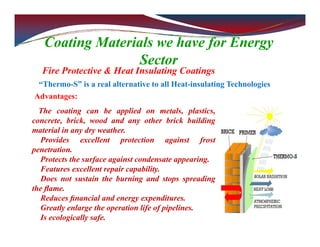
Fire Protective & Heat Insulating Coatings
“Thermo-S” is a real alternative to all Heat-insulating Technologies
The coating can be applied on metals, plastics,
concrete, brick, wood and any other brick building
material in any dry weather.
Provides excellent protection against frost
penetration.
Protects the surface against condensate appearing.
Features excellent repair capability.
Does not sustain the burning and stops spreading
the flame.
Reduces financial and energy expenditures.
Greatly enlarge the operation life of pipelines.
Is ecologically safe.
Advantages:
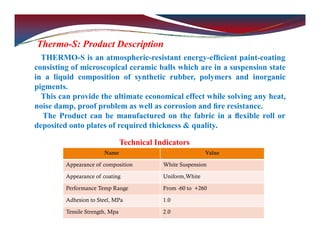
Thermo-S: Product Description
THERMO-S is an atmospheric-resistant energy-efficient paint-coating
consisting of microscopical ceramic balls which are in a suspension state
in a liquid composition of synthetic rubber, polymers and inorganic
pigments.
This can provide the ultimate economical effect while solving any heat,
noise damp, proof problem as well as corrosion and fire resistance.
The Product can be manufactured on the fabric in a flexible roll or
deposited onto plates of required thickness & quality.
Technical Indicators
Name Value
Appearance of composition White Suspension
Appearance of coating Uniform,White
Performance Temp Range From -60 to +260
Adhesion to Steel, MPa 1.0
Tensile Strength, Mpa 2.0
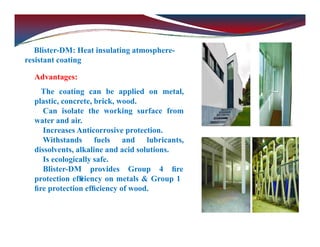
Blister-DM: Heat insulating atmosphere-
resistant coating
Advantages:
The coating can be applied on metal,
plastic, concrete, brick, wood.
Can isolate the working surface from
water and air.
Increases Anticorrosive protection.
Withstands fuels and lubricants,
dissolvents, alkaline and acid solutions.
Is ecologically safe.
Blister-DM provides Group 4 fire
protection effi
ciency on metals & Group 1
fire protection efficiency of wood.
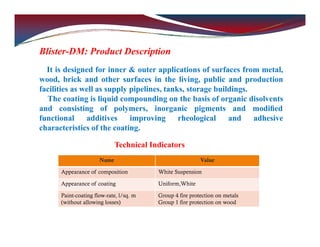
Blister-DM: Product Description
It is designed for inner & outer applications of surfaces from metal,
wood, brick and other surfaces in the living, public and production
facilities as well as supply pipelines, tanks, storage buildings.
The coating is liquid compounding on the basis of organic disolvents
and consisting of polymers, inorganic pigments and modified
functional additives improving rheological and adhesive
characteristics of the coating.
Technical Indicators
Name Value
Appearance of composition White Suspension
Appearance of coating Uniform,White
Paint-coating flow-rate, l/sq. m
(without allowing losses)
Group 4 fire protection on metals
Group 1 fire protection on wood
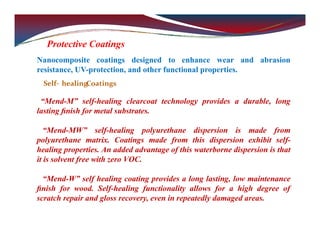
Protective Coatings
Nanocomposite coatings designed to enhance wear and abrasion
resistance, UV-protection, and other functional properties.
Self‐ healingCoatings
“Mend-M” self-healing clearcoat technology provides a durable, long
lasting finish for metal substrates.
“Mend-MW” self-healing polyurethane dispersion is made from
polyurethane matrix. Coatings made from this dispersion exhibit self-
healing properties. An added advantage of this waterborne dispersion is that
it is solvent free with zero VOC.
“Mend-W” self healing coating provides a long lasting, low maintenance
finish for wood. Self-healing functionality allows for a high degree of
scratch repair and gloss recovery, even in repeatedly damaged areas.
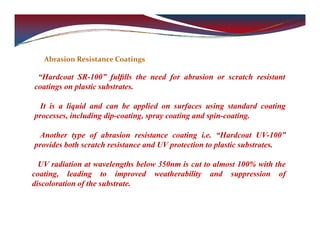
Abrasion Resistance Coatings
“Hardcoat SR-100” fulfills the need for abrasion or scratch resistant
coatings on plastic substrates.
It is a liquid and can be applied on surfaces using standard coating
processes, including dip-coating, spray coating and spin-coating.
Another type of abrasion resistance coating i.e. “Hardcoat UV-100”
provides both scratch resistance and UV protection to plastic substrates.
UV radiation at wavelengths below 350nm is cut to almost 100% with the
coating, leading to improved weatherability and suppression of
discoloration of the substrate.
Thank you
Reinste Nano Ventures
Designed to deliver the purest…
A-118, 1st Floor, Sector-63, Noida, India-201301
Contacts: +91-120-4781213/230, +91-9810662669
info@reinste.com
www.reinste.com

Nanotechnology in Energy.pdf

  • 1.
    Reinste Nano VenturesPvt. Ltd. Designed to deliver the purest….. Nanotechnology Applications in Energy Sector
  • 2.
    Reinste Nano Venturesemphases the significance of purest Nanomaterials with uniform composition free from any adulterants for class research and production purposes. Finest research Grade of nanomaterials Largest type of nanomaterials repository Custom synthesis of required nano particles Tie-ups with renowned and innovative new generation nanotechnology companies Brings high grade nanotechnology and products in India About Us
  • 3.
    Energy Sector To secureglobal power supply in the long run, it is not only develop existing energy sources as efficiently and environmentally as possible, but also to minimize energy losses arising during transport from source to end user, to provide and distribute energy for the respective application purpose as flexibly and efficiently as possible and to reduce energy demand in industry and private households.
  • 4.
    Energy Supply Chain Energy Sources Energy Change Energy Distribution Energy Storage Energy Usage 1.Regenerative a. Photovoltaics b. Wind Energy c. Geothermal d. Hydro Power e. Biomass Energy 2. Fossil Fuels 3. Nuclear 1. Gas Turbines 2. Thermo‐ electrics 3. Fuel Cells 4. Hydrogen Generation 5. Combustion 6. Electrical Motors 1. Power Distribution 2. Heat Transfer 1. Electrical Energy 2. Chemical Energy 3. Thermal Energy 1. Thermal Insulation 2. Air Conditioning 3. Lightweight Construction 4. Industrial Process 5. Lighting
  • 5.
    Energy Sector andNanotechnology Nanotechnology provides essential improvement potentials for the development of both conventional energy sources (fossil and nuclear fuels) and Renewable energy sources like geothermal energy, sun, wind, water, tides or biomass. Breakthroughs in nanotechnology open up the possibility of moving beyond our current alternatives for energy supply by introducing technologies that are more efficient, inexpensive, and environmentally sound. According to the authors, nanotechnologies provide the potential to enhance energy efficiency across all branches ofi ndustry and to economically leverage renewable energy production through new technological solutions and optimized production technologies. Nanotechnology innovations could impact each part of the value-added chain in the energy sector.
  • 6.
    Potentials of Nanotechnologyin Energy Sector Nanotechnology has shown the possibility of fulfilling everyone’s dream of getting cheap and clean energy through its strategic applications. Its intersection with energy is going to change the way energy was hitherto being generated, stored, transmitted, distributed and managed. Nanotechnology impact each part of the value-added chain in the energy sector Energy Sources Nanotechnologies provide essential improvement potentials for the development of both conventional energy sources (fossil and nuclear fuels) and renewable energy sources like geothermal energy, sun, wind, water, tides or biomass.
  • 7.
    Nano-coated, wear resistantdrill probes, for example, allow the optimization ofl ifespan and efficiency of systems for the development of oil and natural gas deposits or geothermal energy and thus the saving of costs. High-duty nanomaterials are very much suitable for lighter and more rugged rotor blades of wind and tidepower plants as well as wear and corrosion protection layers for mechanically stressed components (bearings, gear boxes, etc.). Nanotechnologies could contribute to the optimization of the layer design and the morphology of organic semiconductor mixtures in component structures. In the long run, the utilization of nanostructures, like quantum dots and wires, could allow for solar cell efficiencies of over 60%.
  • 8.
    Energy Conversion The conversionof primary energy sources into electricity, heat and kinetic energy requires utmost efficiency. Efficiency increases, especially in fossil-fired gas and steam power plants, could help avoid considerable amounts of carbon dioxide emissions Higher power plant efficiencies, however, require higher operating temperatures and thus heat-resistant turbine materials. Improvements are possible, for example, through nano-scale heat and corrosion protection layers for turbine blades in power plants or aircraft engines to enhance the efficiency through increased operating temperatures or the application ofl ightweight construction materials (e.g. titanium aluminides) Thermoelectric energy conversion seems to be comparably promising. Nano- structured semiconductors with optimized boundary layer design contribute to increases in efficiency that could pave the way for a broad application in the utilization of waste heat, for example in automobiles, or even of human body heat for portable electronics in textiles.
  • 9.
    Energy Distribution Regarding thereduction of energy losses in current transmission, hope exists that the extraordinary electric conductivity of nanomaterials like carbon nanotubes can be utilized for application in electric cables and power lines. Nanotechnologies could contribute decisively to the realization of distribution vision, through nano- sensory devices and power-electronical components able to cope with the extremely complex control and monitoring of such grids.
  • 10.
    Energy Storage The utilizationof nanotechnologies for the enhancement of electrical energy stores like batteries and super-capacitors turns out to be promising. Due to the high cell voltage and the outstanding energy and power density, the lithium-ion technology is regarded as the most promising variant of electrical energy storage. Nanotechnologies can improve capacity and safety ofl ithium-ion batteries decisively Various nanomaterials, based on nanoporous metal-organic compounds, provide development potentials which seem to be economically realizable at least with regard to the operation of fuel cells in portable electronic devices.
  • 11.
    Energy Usage The reductionof fuel consumption in automobiles through lightweight construction materials on the basis of nanocomposites, the optimization in fuel combustion through wear-resistant, lighter engine components and nanoparticular fuel additives or even nanoparticles for optimized tires with low rolling resistance are some of the examples of nanotechnology development.
  • 12.
    Application Possibilities ofNanotechnology in Energy Sector
  • 13.
    Total Range ofProducts We Have
  • 14.
    Research Grade Nanomaterials •Carbon Nanotubes • Nanodiamonds • Nanoceramics • Quantum Dots • Nanometals • Fullerenes • Nanowires • Nano and Micro Salts • Tectomers • PEG Derivatives • PhosphonicAcid Derivatives Industrial Grade Nanomaterials • NPCC • Nano Graphite • Aluminium Nitride • Silicon Nitride • Silicon Carbide • Titanium Nitride • Zirconium Carbide • Nano Silver Research Grade & Industrial Grade Nanomaterials
  • 15.
    Non-Oxide Nano Ceramics (Wecan produce nearly any ceramic in nano sized form, thus we are expecting here the concrete wishes from our customers) Aluminium Nitride Boron Nitride Boron Carbide GalliumAntimonide GalliumArsenide Silicon Carbide Silicon nitride Titanium Boride Titanium Carbide Titanium Carbonitride Titanium Nitride Zirconium Carbide Titanium Boride - Boron Carbide Titanium Boride - Boron Carbide - Tungsten Boride
  • 16.
    Oxide Nano Ceramics (Alongwith the listed NanoCeramics many other ceramics can produced e.g. NanoCeramics from Rare Earth Oxides, HfO2, MgO+C, TiO2, TiC, TiN, BN, Y2O3 .Thus we are expecting here the concrete wishes from our customers.) Aluminium oxide( alpha & gamma) Cerium oxide Copper oxide Indium oxide Iron (II,III) oxide Iron (III) oxide Strontium oxide Tin oxide Titanium oxide Zinc oxide Zirconium oxide Silicon dioxide Magnesium Oxide
  • 17.
    Nano Wires (Metallic nanowiresof different elements can be synthesized. Besides of those present in this catalogue, we can perform custom synthesis of other nanowires like Au, Ni-Co and Ni-Fe of various compositions etc.) Cobalt Nanowires Copper Nanowires Nickel Nanowires Silver Nanowires Lead Nanowires
  • 18.
    Quantum Dots CdTe QuantumDots, powder, hydrophilic ( from 510nm to 780nm emission wavelength) Easily forms colloidal solutions in water. Terminated with -COOH group.Ideal for labeling purposes. Coupling with -NH2 groups can be achieved through.EDC-mediated esterefication. CdSe/ZnS (core/shell) Quantum Dots, powder, hydrophobic ( from 530nm to 650nm emission wavelength) Highly luminescent semiconductor nanocrystals coated with hydrophobic organic molecules. Readily soluble in hexane, heptane, toluene, chloroform, tetrahydrofuran, pyridine. Not soluble in water, alcohols, ethers. ZnCdSe/ZnS (core/shell)Quantum Dots, powder, hydrophobic ( from 440nm to 480nm emission wavelength) Highly luminescent semiconductor nanocrystals coated with hydrophobic organic molecules. Readily soluble in hexane, heptane, toluene, chloroform, tetrahydrofuran, pyridine. Not soluble in water, alcohols, ethers.
  • 19.
    Coating Materials wehave for Energy Sector Fire Protective & Heat Insulating Coatings “Thermo-S” is a real alternative to all Heat-insulating Technologies The coating can be applied on metals, plastics, concrete, brick, wood and any other brick building material in any dry weather. Provides excellent protection against frost penetration. Protects the surface against condensate appearing. Features excellent repair capability. Does not sustain the burning and stops spreading the flame. Reduces financial and energy expenditures. Greatly enlarge the operation life of pipelines. Is ecologically safe. Advantages:
  • 20.
    Thermo-S: Product Description THERMO-Sis an atmospheric-resistant energy-efficient paint-coating consisting of microscopical ceramic balls which are in a suspension state in a liquid composition of synthetic rubber, polymers and inorganic pigments. This can provide the ultimate economical effect while solving any heat, noise damp, proof problem as well as corrosion and fire resistance. The Product can be manufactured on the fabric in a flexible roll or deposited onto plates of required thickness & quality. Technical Indicators Name Value Appearance of composition White Suspension Appearance of coating Uniform,White Performance Temp Range From -60 to +260 Adhesion to Steel, MPa 1.0 Tensile Strength, Mpa 2.0
  • 21.
    Blister-DM: Heat insulatingatmosphere- resistant coating Advantages: The coating can be applied on metal, plastic, concrete, brick, wood. Can isolate the working surface from water and air. Increases Anticorrosive protection. Withstands fuels and lubricants, dissolvents, alkaline and acid solutions. Is ecologically safe. Blister-DM provides Group 4 fire protection effi ciency on metals & Group 1 fire protection efficiency of wood.
  • 22.
    Blister-DM: Product Description Itis designed for inner & outer applications of surfaces from metal, wood, brick and other surfaces in the living, public and production facilities as well as supply pipelines, tanks, storage buildings. The coating is liquid compounding on the basis of organic disolvents and consisting of polymers, inorganic pigments and modified functional additives improving rheological and adhesive characteristics of the coating. Technical Indicators Name Value Appearance of composition White Suspension Appearance of coating Uniform,White Paint-coating flow-rate, l/sq. m (without allowing losses) Group 4 fire protection on metals Group 1 fire protection on wood
  • 23.
    Protective Coatings Nanocomposite coatingsdesigned to enhance wear and abrasion resistance, UV-protection, and other functional properties. Self‐ healingCoatings “Mend-M” self-healing clearcoat technology provides a durable, long lasting finish for metal substrates. “Mend-MW” self-healing polyurethane dispersion is made from polyurethane matrix. Coatings made from this dispersion exhibit self- healing properties. An added advantage of this waterborne dispersion is that it is solvent free with zero VOC. “Mend-W” self healing coating provides a long lasting, low maintenance finish for wood. Self-healing functionality allows for a high degree of scratch repair and gloss recovery, even in repeatedly damaged areas.
  • 24.
    Abrasion Resistance Coatings “HardcoatSR-100” fulfills the need for abrasion or scratch resistant coatings on plastic substrates. It is a liquid and can be applied on surfaces using standard coating processes, including dip-coating, spray coating and spin-coating. Another type of abrasion resistance coating i.e. “Hardcoat UV-100” provides both scratch resistance and UV protection to plastic substrates. UV radiation at wavelengths below 350nm is cut to almost 100% with the coating, leading to improved weatherability and suppression of discoloration of the substrate.
  • 25.
    Thank you Reinste NanoVentures Designed to deliver the purest… A-118, 1st Floor, Sector-63, Noida, India-201301 Contacts: +91-120-4781213/230, +91-9810662669 info@reinste.com www.reinste.com