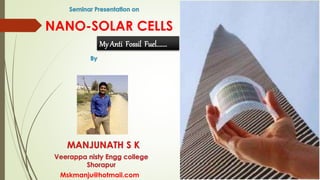
NANO-SOLAR CELLS
My Anti Fossil Fuel.......
Mskmanju@hotmail.com
STRUCTURE OF PRESENTATION
INTRUDUCTION
SOLAR PV CELLS
DRAWBACK OF SOLAR PV CELLS
NANO-TECHNOLOGY IN SOLAR CELLS
APPLICATIONS OF NANO SOLAR CELLS
COMPARISION
CONCLUSION
Now a days with the growing population, the energy
demand is increasing day by day. we have the present
energy resources are fossil fuels such as coal, oil, wood.
but even this stock may not longer than a few decades.
INTRODUCTION
Renewable energy sources are freely available on the
earth in abundant quantity and which will not finish.
Thus the energy contained by these sources in any form can
be converted to electrical energy which is essential for
human
So what is our future energy sources………?
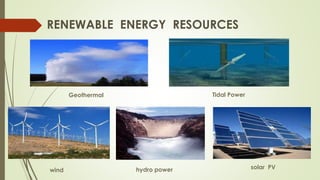
RENEWABLE ENERGY RESOURCES
solar PV
Tidal Power
hydro power
Geothermal
wind
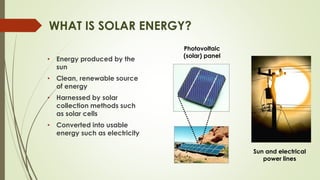
WHAT IS SOLAR ENERGY?
• Energy produced by the
sun
• Clean, renewable source
of energy
• Harnessed by solar
collection methods such
as solar cells
• Converted into usable
energy such as electricity
Photovoltaic
(solar) panel
Sun and electrical
power lines
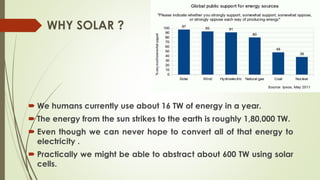
WHY SOLAR ?
 We humans currently use about 16 TW of energy in a year.
 The energy from the sun strikes to the earth is roughly 1,80,000 TW.
 Even though we can never hope to convert all of that energy to
electricity .
 Practically we might be able to abstract about 600 TW using solar
cells.
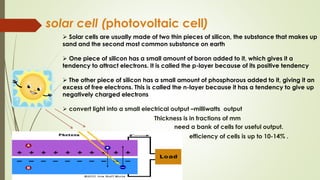
solar cell (photovoltaic cell)
 Solar cells are usually made of two thin pieces of silicon, the substance that makes up
sand and the second most common substance on earth
 One piece of silicon has a small amount of boron added to it, which gives it a
tendency to attract electrons. It is called the p-layer because of its positive tendency
 The other piece of silicon has a small amount of phosphorous added to it, giving it an
excess of free electrons. This is called the n-layer because it has a tendency to give up
negatively charged electrons
 convert light into a small electrical output –milliwatts output
Thickness is in fractions of mm
need a bank of cells for useful output.
efficiency of cells is up to 10-14% .

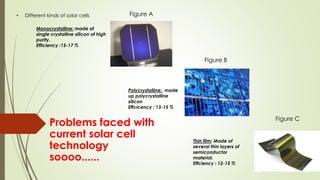
• Different kinds of solar cells
Monocrystalline: made of
single crystalline silicon of high
purity.
Efficiency :15-17 %
Polycrystalline:, made
up polycrystalline
silicon
Effcicency : 13-15 %
Thin film: Made of
several thin layers of
semiconductor
material.
Effciency : 12-15 %
Figure A
Figure B
Figure C
Problems faced with
current solar cell
technology
soooo......
DRAWBACK OF SOLAR PV CELLS
 Less efficient and high manufacturing cost
 Like chloroplast in plant, solar cells can only absorbs the specific wavelength of
light
 Payback period is more
 Extra energy is wasted in heat form
 Most times incoming photons or light have less band gap energy Because of less
band energy electrons doesn’t knock out.
 Manufacturing procedures are complicated by clean rooms and vacuum
chambers due to their quire purity of the silicon
 Since photovoltaic solar cells are made out of silicon, they are very expensive to
manufacture
 As a result the maximum efficiency of any photovoltaic cell is only around 30%, and
in practice only 10 to 20 % are achieved
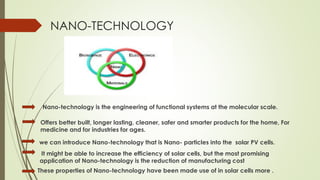
NANO-TECHNOLOGY
Nano-technology is the engineering of functional systems at the molecular scale.
Offers better built, longer lasting, cleaner, safer and smarter products for the home, For
medicine and for industries for ages.
we can introduce Nano-technology that is Nano- particles into the solar PV cells.
It might be able to increase the efficiency of solar cells, but the most promising
application of Nano-technology is the reduction of manufacturing cost
These properties of Nano-technology have been made use of in solar cells more .
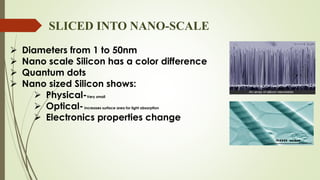
SLICED INTO NANO-SCALE
 Diameters from 1 to 50nm
 Nano scale Silicon has a color difference
 Quantum dots
 Nano sized Silicon shows:
 Physical-Very small
 Optical-increases surface area for light absorption
 Electronics properties change
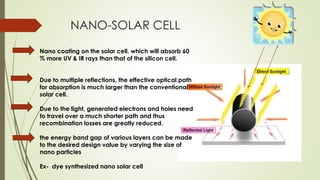
NANO-SOLAR CELL
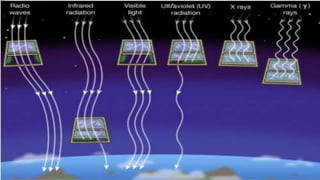
Nano coating on the solar cell, which will absorb 60
% more UV & IR rays than that of the silicon cell.
Due to multiple reflections, the effective optical path
for absorption is much larger than the conventional
solar cell.
Due to the light, generated electrons and holes need
to travel over a much shorter path and thus
recombination losses are greatly reduced.
the energy band gap of various layers can be made
to the desired design value by varying the size of
nano particles
Ex- dye synthesized nano solar cell
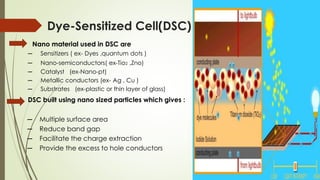
Dye-Sensitized Cell(DSC)
Nano material used in DSC are
─ Sensitizers ( ex- Dyes ,quantum dots )
─ Nano-semiconductors( ex-Tio2 ,Zno)
─ Catalyst (ex-Nano-pt)
─ Metallic conductors (ex- Ag , Cu )
─ Substrates (ex-plastic or thin layer of glass)
DSC built using nano sized particles which gives :
─ Multiple surface area
─ Reduce band gap
─ Facilitate the charge extraction
─ Provide the excess to hole conductors
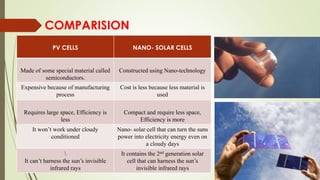
COMPARISION
PV CELLS NANO- SOLAR CELLS
Made of some special material called
semiconductors.
Constructed using Nano-technology
Expensive because of manufacturing
process
Cost is less because less material is
used
Requires large space, Efficiency is
less
Compact and require less space,
Efficiency is more
It won’t work under cloudy
conditioned
Nano- solar cell that can turn the suns
power into electricity energy even on
a cloudy days

It can’t harness the sun’s invisible
infrared rays
It contains the 2nd generation solar
cell that can harness the sun’s
invisible infrared rays
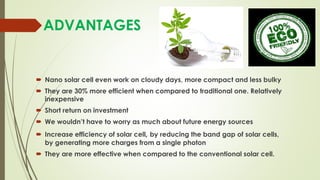
ADVANTAGES
 Nano solar cell even work on cloudy days, more compact and less bulky
 They are 30% more efficient when compared to traditional one. Relatively
inexpensive
 Short return on investment
 We wouldn’t have to worry as much about future energy sources
 Increase efficiency of solar cell, by reducing the band gap of solar cells,
by generating more charges from a single photon
 They are more effective when compared to the conventional solar cell.
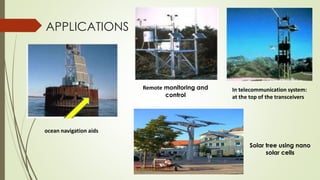
APPLICATIONS
ocean navigation aids
Remote monitoring and
control
In telecommunication system:
at the top of the transceivers
Solar tree using nano
solar cells
CONCLUSION
 Nanotechnology films used in solar cells promise to increase .
SOLAR ENERGY CONSERVATION.
REDUCE MANUFACTURING COST.
CAPABLE OF SUPPLYING LOW POWER DEVICES.
FUTURE ENERGY SOURCE FOR MANKIND.
PRESERVE THE ENVIRONMENT.
HELPS TO DEVELOPING COUNTRIES TO PROVIDE ELECTRICITY.
AT LAST,NANOTECHNOLOGY IS BOON TO HUMAN SOCIETY.
Nano solar cells
Nano solar cells

Nano solar cells

  • 1.
    NANO-SOLAR CELLS My AntiFossil Fuel....... Mskmanju@hotmail.com
  • 2.
    STRUCTURE OF PRESENTATION INTRUDUCTION SOLARPV CELLS DRAWBACK OF SOLAR PV CELLS NANO-TECHNOLOGY IN SOLAR CELLS APPLICATIONS OF NANO SOLAR CELLS COMPARISION CONCLUSION
  • 3.
    Now a dayswith the growing population, the energy demand is increasing day by day. we have the present energy resources are fossil fuels such as coal, oil, wood. but even this stock may not longer than a few decades. INTRODUCTION Renewable energy sources are freely available on the earth in abundant quantity and which will not finish. Thus the energy contained by these sources in any form can be converted to electrical energy which is essential for human So what is our future energy sources………?
  • 4.
    RENEWABLE ENERGY RESOURCES solarPV Tidal Power hydro power Geothermal wind
  • 5.
    WHAT IS SOLARENERGY? • Energy produced by the sun • Clean, renewable source of energy • Harnessed by solar collection methods such as solar cells • Converted into usable energy such as electricity Photovoltaic (solar) panel Sun and electrical power lines
  • 6.
    WHY SOLAR ? We humans currently use about 16 TW of energy in a year.  The energy from the sun strikes to the earth is roughly 1,80,000 TW.  Even though we can never hope to convert all of that energy to electricity .  Practically we might be able to abstract about 600 TW using solar cells.
  • 7.
    solar cell (photovoltaiccell)  Solar cells are usually made of two thin pieces of silicon, the substance that makes up sand and the second most common substance on earth  One piece of silicon has a small amount of boron added to it, which gives it a tendency to attract electrons. It is called the p-layer because of its positive tendency  The other piece of silicon has a small amount of phosphorous added to it, giving it an excess of free electrons. This is called the n-layer because it has a tendency to give up negatively charged electrons  convert light into a small electrical output –milliwatts output Thickness is in fractions of mm need a bank of cells for useful output. efficiency of cells is up to 10-14% . 
  • 8.
    • Different kindsof solar cells Monocrystalline: made of single crystalline silicon of high purity. Efficiency :15-17 % Polycrystalline:, made up polycrystalline silicon Effcicency : 13-15 % Thin film: Made of several thin layers of semiconductor material. Effciency : 12-15 % Figure A Figure B Figure C Problems faced with current solar cell technology soooo......
  • 9.
    DRAWBACK OF SOLARPV CELLS  Less efficient and high manufacturing cost  Like chloroplast in plant, solar cells can only absorbs the specific wavelength of light  Payback period is more  Extra energy is wasted in heat form  Most times incoming photons or light have less band gap energy Because of less band energy electrons doesn’t knock out.  Manufacturing procedures are complicated by clean rooms and vacuum chambers due to their quire purity of the silicon  Since photovoltaic solar cells are made out of silicon, they are very expensive to manufacture  As a result the maximum efficiency of any photovoltaic cell is only around 30%, and in practice only 10 to 20 % are achieved
  • 10.
    NANO-TECHNOLOGY Nano-technology is theengineering of functional systems at the molecular scale. Offers better built, longer lasting, cleaner, safer and smarter products for the home, For medicine and for industries for ages. we can introduce Nano-technology that is Nano- particles into the solar PV cells. It might be able to increase the efficiency of solar cells, but the most promising application of Nano-technology is the reduction of manufacturing cost These properties of Nano-technology have been made use of in solar cells more .
  • 11.
    SLICED INTO NANO-SCALE Diameters from 1 to 50nm  Nano scale Silicon has a color difference  Quantum dots  Nano sized Silicon shows:  Physical-Very small  Optical-increases surface area for light absorption  Electronics properties change
  • 13.
    NANO-SOLAR CELL Nano coatingon the solar cell, which will absorb 60 % more UV & IR rays than that of the silicon cell. Due to multiple reflections, the effective optical path for absorption is much larger than the conventional solar cell. Due to the light, generated electrons and holes need to travel over a much shorter path and thus recombination losses are greatly reduced. the energy band gap of various layers can be made to the desired design value by varying the size of nano particles Ex- dye synthesized nano solar cell
  • 14.
    Dye-Sensitized Cell(DSC) Nano materialused in DSC are ─ Sensitizers ( ex- Dyes ,quantum dots ) ─ Nano-semiconductors( ex-Tio2 ,Zno) ─ Catalyst (ex-Nano-pt) ─ Metallic conductors (ex- Ag , Cu ) ─ Substrates (ex-plastic or thin layer of glass) DSC built using nano sized particles which gives : ─ Multiple surface area ─ Reduce band gap ─ Facilitate the charge extraction ─ Provide the excess to hole conductors
  • 15.
    COMPARISION PV CELLS NANO-SOLAR CELLS Made of some special material called semiconductors. Constructed using Nano-technology Expensive because of manufacturing process Cost is less because less material is used Requires large space, Efficiency is less Compact and require less space, Efficiency is more It won’t work under cloudy conditioned Nano- solar cell that can turn the suns power into electricity energy even on a cloudy days It can’t harness the sun’s invisible infrared rays It contains the 2nd generation solar cell that can harness the sun’s invisible infrared rays
  • 16.
    ADVANTAGES  Nano solarcell even work on cloudy days, more compact and less bulky  They are 30% more efficient when compared to traditional one. Relatively inexpensive  Short return on investment  We wouldn’t have to worry as much about future energy sources  Increase efficiency of solar cell, by reducing the band gap of solar cells, by generating more charges from a single photon  They are more effective when compared to the conventional solar cell.
  • 17.
    APPLICATIONS ocean navigation aids Remotemonitoring and control In telecommunication system: at the top of the transceivers Solar tree using nano solar cells
  • 18.
    CONCLUSION  Nanotechnology filmsused in solar cells promise to increase . SOLAR ENERGY CONSERVATION. REDUCE MANUFACTURING COST. CAPABLE OF SUPPLYING LOW POWER DEVICES. FUTURE ENERGY SOURCE FOR MANKIND. PRESERVE THE ENVIRONMENT. HELPS TO DEVELOPING COUNTRIES TO PROVIDE ELECTRICITY. AT LAST,NANOTECHNOLOGY IS BOON TO HUMAN SOCIETY.