Laser Ignition in
Internal Combustion
Engines
By Jignesh Parmar
WHAT IS A LASER ?
•A laser is a device that emits electromagnetic radiation through
a process of optical amplification based on the stimulated
emission of photons.
•The term ‘laser’ is an acronym for Light Amplification by
Stimulated Emission of Radiation
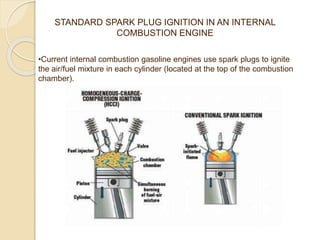
STANDARD SPARK PLUG IGNITION IN AN INTERNAL
COMBUSTION ENGINE
•Current internal combustion gasoline engines use spark plugs to ignite
the air/fuel mixture in each cylinder (located at the top of the combustion
chamber).
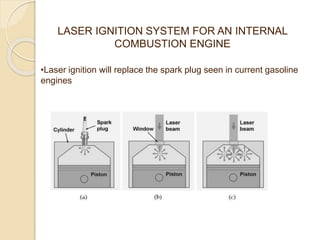
LASER IGNITION SYSTEM FOR AN INTERNAL
COMBUSTION ENGINE
•Laser ignition will replace the spark plug seen in current gasoline
engines
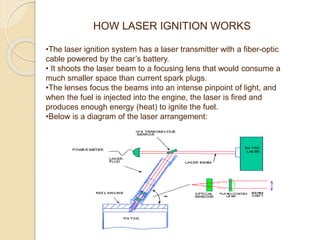
•The laser ignition system has a laser transmitter with a fiber-optic
cable powered by the car’s battery.
• It shoots the laser beam to a focusing lens that would consume a
much smaller space than current spark plugs.
•The lenses focus the beams into an intense pinpoint of light, and
when the fuel is injected into the engine, the laser is fired and
produces enough energy (heat) to ignite the fuel.
•Below is a diagram of the laser arrangement:
HOW LASER IGNITION WORKS
WHY LASER IGNITION?
1. Regulations on NOx emissions are pushing us toward leaner
air/fuel ratios (higher ratio of air to fuel).
•These leaner air/fuel ratios are harder to ignite and require higher ignition
energies.
• Spark plugs can ignite leaner fuel mixtures, but only by increasing spark
energy.
•Unfortunately, these high voltages erode spark plug electrodes so fast,
the solution is not economical. By contrast, lasers, which ignite the air-fuel
mixture with concentrated optical energy, have no electrodes and are not
affected.
2. Natural gas is more difficult to ignite than gasoline due to the strong
carbon to hydrogen bond energy.
• Because of the requirement for an increase in ignition energy, spark
plug life will decrease for natural gas engines.
• Lasers are monochromatic, so it will be much easier to ignite natural
gases and direct the laser beam to an optimal ignition location.
3. Ignition sites for spark plugs are at a fixed location at the top of the
combustion chamber that only allows for ignition of the air/fuel
mixture closest to them.
• Lasers can be focused and split into multiple beams to give multiple
ignition points, which means it can give a far better chance of
ignition.
WHY LASER
IGNITION?
4. The laser also produces more stable combustion so you need to
put less fuel into the cylinder, therefore increasing efficiency.
5. Optical wire and laser setup is much smaller than the current
sparkplug model, allowing for different design opportunities.
6. Lasers can reflect back from inside the cylinders relaying
information such as fuel type and level of ignition creating optimum
performance.
WHY LASER IGNITION?
Future Research Needs
1. Cost
2. Concept proven, but no commercial system
yet available.
3. Stability of optical window
4. Beam Delivery/Laser induced optical damage
5. Particle Deposits
6. Intelligent control
7. Laser Distribution
8. Multiple pulse ignition
9. Multiple point ignition
1. Single Point Ignition:
•Timing optimization (phasing) vs Thermal Efficiency
•NOx tradeoffs
•Knock margin
2. Multipoint Ignition:
•Higher flame speed may provide additional knock margin
as well as a higher burn rate.
3. Multipulse Ignition:
•May provide improved ignition, leaner combustion, and lower
emissions.
SHORTCOMINGS
Thank you

Laser ignition system technology

  • 1.
    Laser Ignition in InternalCombustion Engines By Jignesh Parmar
  • 2.
    WHAT IS ALASER ? •A laser is a device that emits electromagnetic radiation through a process of optical amplification based on the stimulated emission of photons. •The term ‘laser’ is an acronym for Light Amplification by Stimulated Emission of Radiation
  • 3.
    STANDARD SPARK PLUGIGNITION IN AN INTERNAL COMBUSTION ENGINE •Current internal combustion gasoline engines use spark plugs to ignite the air/fuel mixture in each cylinder (located at the top of the combustion chamber).
  • 4.
    LASER IGNITION SYSTEMFOR AN INTERNAL COMBUSTION ENGINE •Laser ignition will replace the spark plug seen in current gasoline engines
  • 5.
    •The laser ignitionsystem has a laser transmitter with a fiber-optic cable powered by the car’s battery. • It shoots the laser beam to a focusing lens that would consume a much smaller space than current spark plugs. •The lenses focus the beams into an intense pinpoint of light, and when the fuel is injected into the engine, the laser is fired and produces enough energy (heat) to ignite the fuel. •Below is a diagram of the laser arrangement: HOW LASER IGNITION WORKS
  • 6.
    WHY LASER IGNITION? 1.Regulations on NOx emissions are pushing us toward leaner air/fuel ratios (higher ratio of air to fuel). •These leaner air/fuel ratios are harder to ignite and require higher ignition energies. • Spark plugs can ignite leaner fuel mixtures, but only by increasing spark energy. •Unfortunately, these high voltages erode spark plug electrodes so fast, the solution is not economical. By contrast, lasers, which ignite the air-fuel mixture with concentrated optical energy, have no electrodes and are not affected.
  • 7.
    2. Natural gasis more difficult to ignite than gasoline due to the strong carbon to hydrogen bond energy. • Because of the requirement for an increase in ignition energy, spark plug life will decrease for natural gas engines. • Lasers are monochromatic, so it will be much easier to ignite natural gases and direct the laser beam to an optimal ignition location. 3. Ignition sites for spark plugs are at a fixed location at the top of the combustion chamber that only allows for ignition of the air/fuel mixture closest to them. • Lasers can be focused and split into multiple beams to give multiple ignition points, which means it can give a far better chance of ignition. WHY LASER IGNITION?
  • 8.
    4. The laseralso produces more stable combustion so you need to put less fuel into the cylinder, therefore increasing efficiency. 5. Optical wire and laser setup is much smaller than the current sparkplug model, allowing for different design opportunities. 6. Lasers can reflect back from inside the cylinders relaying information such as fuel type and level of ignition creating optimum performance. WHY LASER IGNITION?
  • 9.
    Future Research Needs 1.Cost 2. Concept proven, but no commercial system yet available. 3. Stability of optical window 4. Beam Delivery/Laser induced optical damage 5. Particle Deposits 6. Intelligent control 7. Laser Distribution 8. Multiple pulse ignition 9. Multiple point ignition
  • 10.
    1. Single PointIgnition: •Timing optimization (phasing) vs Thermal Efficiency •NOx tradeoffs •Knock margin 2. Multipoint Ignition: •Higher flame speed may provide additional knock margin as well as a higher burn rate. 3. Multipulse Ignition: •May provide improved ignition, leaner combustion, and lower emissions. SHORTCOMINGS
  • 11.