CONVEYOR	BELT	
PROJECT	REPORT	
	
Reported	to	Dr.	Michel	E.	Whittenberg,	VP	of	Operation.	


Group	29	
Choudhary,	Divyang	(1001391003)	
Doshi,	Deep	(1001359475)	
Hopper,	Derrek	(1001359949)	
Nimkar,	Lukesh	(1001345883)		
Patel,	Harsh	(1001509230)	
Submission	Date:		
12th	December	2017
1	


Table	of	Contents	
	
• Table	of	Figures	 	 	 	 	 	 	 	 2	
	
• Introduction	 	 	 	 	 	 	 	 	 3	
	
• Phase	One:	Defining	/	Initiating		 	 	 	 	 	 3	
	
• Phase	Two:	Planning	 	 	 	 	 	 	 	 6	
	
• Phase	Three:	Executing	 	 	 	 	 	 	 10	
	
• Phase	Four:	Closing	 	 	 	 	 	 	 	 15	
	
• Conclusion	 	 	 	 	 	 	 	 	 18	
	
• References		 	 	 	 	 	 	 	 	 19	
	
• Appendices		 	 	 	 	 	 	 	 	 20
2	


Table	of	Figures	and	Tables	
	
Figure	1:	Project	Scope	Statement	 	 	 	 	 	 	 3	
Figure	2:	Project	Priority	Matrix	(PPM)	 	 	 	 	 	 	 4	
Figure	3:	WBS	/	OBS	cross	reference	 	 	 	 	 	 	 5	
Figure	4:	Coded	WBS	 	 	 	 	 	 	 	 	 6	
Figure	5:	Gantt	Schedule	Table	 	 	 	 	 	 	 	 7	
Figure	6:	Budget	Reserve	 	 	 	 	 	 	 	 7	
Figure	7:	Risk	Assessment	Form		 	 	 	 	 	 	 8	
Figure	8:	Risk	Response	Matrix	 	 	 	 	 	 	 	 9	
Figure	9:	Resources	allocated	to	the	project	 	 	 	 	 	 9	
Figure	10:	Cumulative	Trend	Analysis	 	 	 	 	 	 	 10	
Table	1:	1st	quarter	status	report		 	 	 	 	 	 	 10	
Table	2:	2nd	quarter	status	report		 	 	 	 	 	 	 11	
Table	3:	3rd	quarter	status	report		 	 	 	 	 	 	 11	
Table	4.1:	4th	Quarter	Status	Report		 	 	 	 	 	 	 12	
Table	4.2:	Revised	4th	Quarter	Status	Report		 	 	 	 	 	 12	
Figure	11:	Project	closure	deliverables	 	 	 	 	 	 	 15	
Figure	12:	Feedback	survey	 	 	 	 	 	 	 	 17
3	
	
Introduction	
	 The	 purpose	 of	 this	 report	 is	 to	 provide	 management	 with	 a	 revised	 status	 of	 the	 Super	
Conveyer	Belt	project.	The	report	is	organized	by	the	four	phases	of	the	project	life	cycle	which	include	
Defining	 /	 Initiating,	 Planning,	 Executing,	 and	 closing.	 The	 first	 phase,	 Defining,	 will	 incorporate	 high	
level	 activities	 such	 as	 goals,	 specifications,	 identifying	 key	 tasks,	 and	 roles	 and	 responsibilities.	 The	
second	phase,	Planning,	includes	creating	schedules,	defining	budgets,	determining	resources	available	
and	 requirements,	 assessing	 risks	 and	 staffing	 the	 team.	 The	 third	 phase,	 executing,	 involves	 the	
development	 of	 status	 reports,	 dealing	 with	 change,	 ensuring	 quality,	 and	 forecasting.	 All	 activities	
associated	 with	 “closing”	 will	 be	 projections	 as	 that	 phase	 has	 not	 yet	 occurred.	 Closure	 activities	
include,	training	the	customer,	transferring	documents,	release	of	resources,	evaluations	and	lessons	
learned.		
Phase	One:	Defining	/	Initiating.	
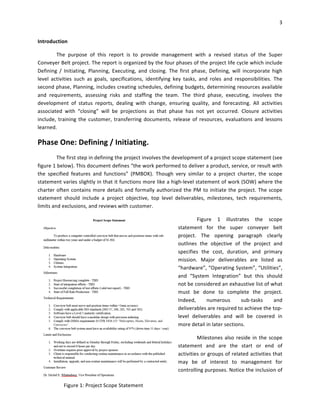
The	first	step	in	defining	the	project	involves	the	development	of	a	project	scope	statement	(see	
figure	1	below).	This	document	defines	“the	work	performed	to	deliver	a	product,	service,	or	result	with	
the	 specified	 features	 and	 functions”	 (PMBOK).	 Though	 very	 similar	 to	 a	 project	 charter,	 the	 scope	
statement	varies	slightly	in	that	it	functions	more	like	a	high-level	statement	of	work	(SOW)	where	the	
charter	often	contains	more	details	and	formally	authorized	the	PM	to	initiate	the	project.	The	scope	
statement	 should	 include	 a	 project	 objective,	 top	 level	 deliverables,	 milestones,	 tech	 requirements,	
limits	and	exclusions,	and	reviews	with	customer.		
Figure	 1	 illustrates	 the	 scope	
statement	 for	 the	 super	 conveyer	 belt	
project.	 The	 opening	 paragraph	 clearly	
outlines	 the	 objective	 of	 the	 project	 and	
specifies	 the	 cost,	 duration,	 and	 primary	
mission.	 Major	 deliverables	 are	 listed	 as	
“hardware”,	“Operating	System”,	“Utilities”,	
and	 “System	 Integration”	 but	 this	 should	
not	be	considered	an	exhaustive	list	of	what	
must	 be	 done	 to	 complete	 the	 project.	
Indeed,	 numerous	 sub-tasks	 and	
deliverables	are	required	to	achieve	the	top-
level	 deliverables	 and	 will	 be	 covered	 in	
more	detail	in	later	sections.		
Milestones	also	reside	in	the	scope	
statement	 and	 are	 the	 start	 or	 end	 of	
activities	or	groups	of	related	activities	that	
may	 be	 of	 interest	 to	 management	 for	
controlling	purposes.	Notice	the	inclusion	of	
Figure	1:	Project	Scope	Statement
4	
	
all	 elements	 listed	 above	 as	 well	 as	 the	 “high”	 level	 nature	 of	 the	 deliverables	 outside	 of	 the	 main	
specifications	of	less	than	1mm	accuracy.	Other	specifications	listed	are	relevant	laws	and	standards	
pertaining	to	conveyer	belt	systems	as	well	as	an	internal	requirement	for	availability.	The	limits	and	
exclusions	paragraphs	emphasize	when	we	can	work,	how	long,	and	the	limit	of	our	responsibilities	on	
maintenance.		
The	 charter	 on	 the	 other	 hand,	 should	 include	 the	 scope	 statement	 as	 well	 as	 a	 narrative	
description	of	the	products	or	services	to	be	delivered	(SOW)	and	the	formal	business	case	outlining	the	
projects	worth	considering	the	necessary	investments.	The	basis	of	the	business	case	may	include	but	is	
not	 limited	 to	 the	 following:	 market	 demand,	 organizational	 need,	 or	 customer	 request.	 For	 the	
conveyer	belt	project,	a	charter	was	not	necessary	and	instead,	the	project	scope	statement	was	used	as	
a	charter.	
When	 defining	 the	 goals	 and	 specifications	 of	 the	 project,	 all	 PMs	 should	 be	 aware	 of	 the	
dangers	 of	 scope	 creep.	 Over	 time,	 there	 is	 a	 tendency	 for	 the	 project	 scope	 to	 expand	 beyond	 the	
original	 intent	 which	 can	 have	 major	 consequences	 on	 cost	 and	 schedule	 if	 not	 managed	 correctly.	
Moreover,	changing	priorities,	specification	and	entire	requirements	may	contribute	to	scope	creep	and	
result	 in	 projects	 that	 took	 on	 too	 much,	 too	 quickly	 and	 ultimately	 failed.	 Overall	 leadership	 and	
management	challenges	will	be	covered	in	more	detail	during	the	phase	III	discussion,	but	it	is	important	
to	note	that	leaders	should	be	actively	engaging	these	challenges	throughout	the	project	life	cycle.	
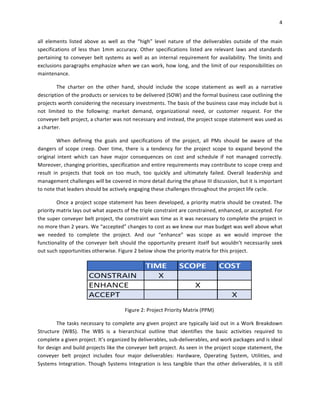
Once	a	project	scope	statement	has	been	developed,	a	priority	matrix	should	be	created.	The	
priority	matrix	lays	out	what	aspects	of	the	triple	constraint	are	constrained,	enhanced,	or	accepted.	For	
the	super	conveyer	belt	project,	the	constraint	was	time	as	it	was	necessary	to	complete	the	project	in	
no	more	than	2	years.	We	“accepted”	changes	to	cost	as	we	knew	our	max	budget	was	well	above	what	
we	 needed	 to	 complete	 the	 project.	 And	 our	 “enhance”	 was	 scope	 as	 we	 would	 improve	 the	
functionality	of	the	conveyer	belt	should	the	opportunity	present	itself	but	wouldn’t	necessarily	seek	
out	such	opportunities	otherwise.	Figure	2	below	show	the	priority	matrix	for	this	project.		
	
Figure	2:	Project	Priority	Matrix	(PPM)	
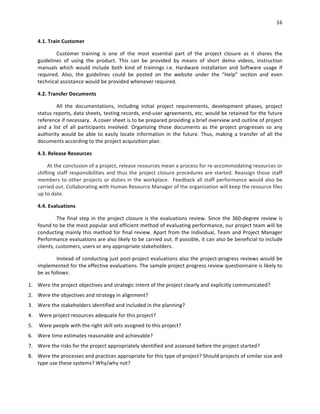
The	tasks	necessary	to	complete	any	given	project	are	typically	laid	out	in	a	Work	Breakdown	
Structure	 (WBS).	 The	 WBS	 is	 a	 hierarchical	 outline	 that	 identifies	 the	 basic	 activities	 required	 to	
complete	a	given	project.	It’s	organized	by	deliverables,	sub-deliverables,	and	work	packages	and	is	ideal	
for	design	and	build	projects	like	the	conveyer	belt	project.	As	seen	in	the	project	scope	statement,	the	
conveyer	 belt	 project	 includes	 four	 major	 deliverables:	 Hardware,	 Operating	 System,	 Utilities,	 and	
Systems	Integration.	Though	Systems	Integration	is	less	tangible	than	the	other	deliverables,	it	is	still
5	
	
listed	separately	as	the	nature	of	the	work	is	unique	as	compared	to	the	other	three	and	involves	solving	
all	the	interoperability	issues	required	to	make	the	whole	system	work.		
The	strength	of	the	WBS	resides	in	its	ability	to	help	the	PM	see	the	magnitude	of	the	project	as	
well	as	form	the	basis	of	the	WBS	and	OBS	integration	(cost	accounts)	which	will	be	the	foundation	of	
the	 Earned	 Value	 Management	 System	 and	 other	 monitor	 and	 controlling	 activities	 throughout	 the	
project.	Moreover,	the	development	of	the	WBS	is	critical	to	creating	bottom	up	estimates	of	both	cost	
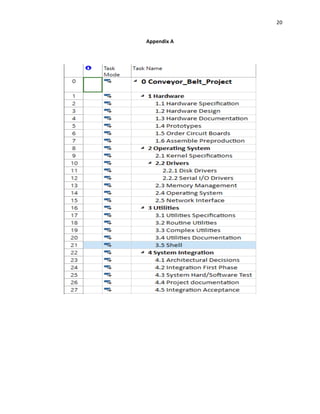
and	schedule	early	in	the	project.	Appendix	A	shows	a	basic	WBS	from	the	conveyer	belt	project.	Notice	
the	lack	of	start	dates	and	resourcing	as	these	elements	are	not	added	until	later	in	the	project.	The	
purpose	of	the	WBS	at	this	phase	is	simply	to	outline	the	major	deliverables	and	the	sub-tasks	necessary	
for	completion	of	the	deliverables.	Later,	durations,	start	dates,	end	dates,	resources,	and	dependencies	
will	be	added	to	each	WBS	element.	
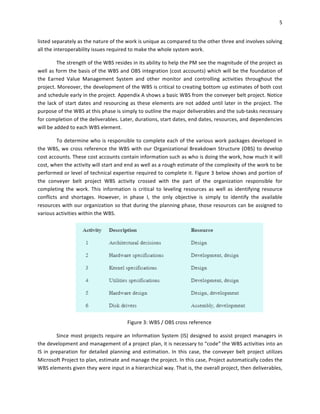
To	determine	who	is	responsible	to	complete	each	of	the	various	work	packages	developed	in	
the	WBS,	we	cross	reference	the	WBS	with	our	Organizational	Breakdown	Structure	(OBS)	to	develop	
cost	accounts.	These	cost	accounts	contain	information	such	as	who	is	doing	the	work,	how	much	it	will	
cost,	when	the	activity	will	start	and	end	as	well	as	a	rough	estimate	of	the	complexity	of	the	work	to	be	
performed	or	level	of	technical	expertise	required	to	complete	it.	Figure	3	below	shows	and	portion	of	
the	 conveyer	 belt	 project	 WBS	 activity	 crossed	 with	 the	 part	 of	 the	 organization	 responsible	 for	
completing	 the	 work.	 This	 information	 is	 critical	 to	 leveling	 resources	 as	 well	 as	 identifying	 resource	
conflicts	 and	 shortages.	 However,	 in	 phase	 I,	 the	 only	 objective	 is	 simply	 to	 identify	 the	 available	
resources	with	our	organization	so	that	during	the	planning	phase,	those	resources	can	be	assigned	to	
various	activities	within	the	WBS.	
	
Figure	3:	WBS	/	OBS	cross	reference	
Since	most	projects	require	an	Information	System	(IS)	designed	to	assist	project	managers	in	
the	development	and	management	of	a	project	plan,	it	is	necessary	to	“code”	the	WBS	activities	into	an	
IS	in	preparation	for	detailed	planning	and	estimation.	In	this	case,	the	conveyer	belt	project	utilizes	
Microsoft	Project	to	plan,	estimate	and	manage	the	project.	In	this	case,	Project	automatically	codes	the	
WBS	elements	given	they	were	input	in	a	hierarchical	way.	That	is,	the	overall	project,	then	deliverables,
6	
	
then	sub-deliverables	were	all	input	into	the	WBS	in	a	hierarchical	way.	The	final	coded	WBS	elements	
contain	 unique	 numerical	 identifiers	 which	 allow	 reports	 to	 be	 consolidated	 at	 any	 level	 in	 the	 WBS	
structure.	Figure	4	below	shows	a	coded	WBS	as	described	above.	
	
Figure	4:	Coded	WBS	
	 Having	 identified	 the	 goals	 and	 objectives	 of	 the	 program,	 determined	 priorities,	
developed	a	WBS	and	OBS,	and	coded	our	activities	into	our	chosen	IS,	the	team	was	able	begin	the	
process	of	developing	detailed	plans	for	the	project.	Throughout	all	phases,	the	PM’s	ability	to	lead	and	
manage	 the	 team	 will	 be	 critical.	 Without	 strong	 leadership,	 scope	 creep,	 internal	 conflict,	 external	
conflict,	senior	management	priority	changes,	or	declining	morale	
Phase	Two:	Planning	
According	to	PMBOK,	project	plan	is	a	formal,	approved	document	used	to	guide	both	project	
execution	 and	 project	 control.	 Project	 planning	 helps	 in	 several	 crucial	 activities	 such	 as	 establishing	
directions	 for	 the	 project	 team,	 supporting	 objectives	 of	 parent	 organization,	 making	 allowances	 for	
possible	risks	and	putting	control	on	planned	work	[Chapter	4	Slide	7,	2017].	In	this	phase	of	project,	
level	of	effort	is	increased	compared	to	defining	phase.	The	planning	phase	of	project	involves	five	main	
phases:	Schedules,	Budgets,	Resources,	Risks	and	Staffing	
A.	Schedules	
The	 initial	 estimation	 for	 complete	 date	 of	 Conveyor	 Belt	 project	 was	 530	 work	 days,	 with	 a	
delivery	date	of	February	1,	2018.	The	critical	path	for	the	project	was	determined	to	be:	
Architectural	 Design	 ->	 Hardware	 Specification	 ->	 Hardware	 Design	 ->	 Hardware	 Documentation	 ->	
Integration	 First	 Phase	 ->	 Serial	 I/0	 Drivers	 ->	 System	 Hard/Software	 Test	 ->	 Network	 Interface	 ->	
Integration	Acceptance	Testing.
7	
	
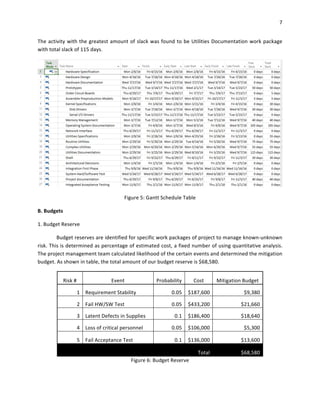
The	activity	with	the	greatest	amount	of	slack	was	found	to	be	Utilities	Documentation	work	package	
with	total	slack	of	115	days.	
	
Figure	5:	Gantt	Schedule	Table	
B.	Budgets	
1.	Budget	Reserve	
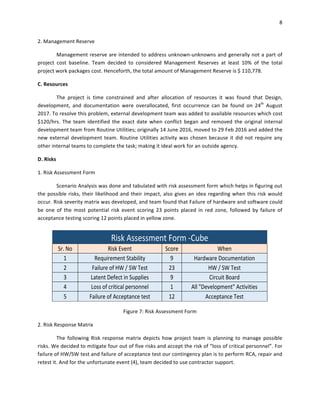
Budget	reserves	are	identified	for	specific	work	packages	of	project	to	manage	known-unknown	
risk.	This	is	determined	as	percentage	of	estimated	cost,	a	fixed	number	of	using	quantitative	analysis.	
The	project	management	team	calculated	likelihood	of	the	certain	events	and	determined	the	mitigation	
budget.	As	shown	in	table,	the	total	amount	of	our	budget	reserve	is	$68,580.	
Risk	#	 Event	 Probability	 Cost	 Mitigation	Budget	
1	 Requirement	Stability	 0.05	 $187,600	 $9,380	
2	 Fail	HW/SW	Test	 0.05	 $433,200	 $21,660	
3	 Latent	Defects	in	Supplies	 0.1	 $186,400	 $18,640	
4	 Loss	of	critical	personnel	 0.05	 $106,000	 $5,300	
5	 Fail	Acceptance	Test	 0.1	 $136,000	 $13,600	
Total	 $68,580	
Figure	6:	Budget	Reserve
8	
	
2.	Management	Reserve	
Management	reserve	are	intended	to	address	unknown-unknowns	and	generally	not	a	part	of	
project	 cost	 baseline.	 Team	 decided	 to	 considered	 Management	 Reserves	 at	 least	 10%	 of	 the	 total	
project	work	packages	cost.	Henceforth,	the	total	amount	of	Management	Reserve	is	$	110,778.	
C.	Resources	
The	 project	 is	 time	 constrained	 and	 after	 allocation	 of	 resources	 it	 was	 found	 that	 Design,	
development,	 and	 documentation	 were	 overallocated,	 first	 occurrence	 can	 be	 found	 on	 24th
	 August	
2017.	To	resolve	this	problem,	external	development	team	was	added	to	available	resources	which	cost	
$120/hrs.	 The	 team	 identified	 the	 exact	 date	 when	 conflict	 began	 and	 removed	 the	 original	 internal	
development	team	from	Routine	Utilities;	originally	14	June	2016,	moved	to	29	Feb	2016	and	added	the	
new	external	development	team.	Routine	Utilities	activity	was	chosen	because	it	did	not	require	any	
other	internal	teams	to	complete	the	task;	making	it	ideal	work	for	an	outside	agency.	
D.	Risks	
1.	Risk	Assessment	Form	
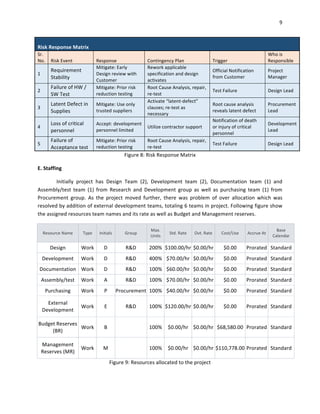
Scenario	Analysis	was	done	and	tabulated	with	risk	assessment	form	which	helps	in	figuring	out	
the	possible	risks,	their	likelihood	and	their	impact,	also	gives	an	idea	regarding	when	this	risk	would	
occur.	Risk	severity	matrix	was	developed,	and	team	found	that	Failure	of	hardware	and	software	could	
be	 one	 of	 the	 most	 potential	 risk	 event	 scoring	 23	 points	 placed	 in	 red	 zone,	 followed	 by	 failure	 of	
acceptance	testing	scoring	12	points	placed	in	yellow	zone.	
	
Figure	7:	Risk	Assessment	Form	
2.	Risk	Response	Matrix	
The	 following	Risk	response	matrix	depicts	how	project	team	is	planning	to	manage	possible	
risks.	We	decided	to	mitigate	four	out	of	five	risks	and	accept	the	risk	of	“loss	of	critical	personnel”.	For	
failure	of	HW/SW	test	and	failure	of	acceptance	test	our	contingency	plan	is	to	perform	RCA,	repair	and	
retest	it.	And	for	the	unfortunate	event	(4),	team	decided	to	use	contractor	support.	
	
Risk	Assessment	Form	-Cube	
Sr.	No	 Risk	Event	 Score	 When	
1	 Requirement	Stability	 9	 Hardware	Documentation	
2	 Failure	of	HW	/	SW	Test	 23	 HW	/	SW	Test	
3	 Latent	Defect	in	Supplies	 9	 Circuit	Board	
4	 Loss	of	critical	personnel	 1	 All	"Development"	Activities	
5	 Failure	of	Acceptance	test	 12	 Acceptance	Test
9	
	
Figure	8:	Risk	Response	Matrix	
E.	Staffing	
Initially	 project	 has	 Design	 Team	 (2),	 Development	 team	 (2),	 Documentation	 team	 (1)	 and	
Assembly/test	 team	 (1)	 from	 Research	 and	 Development	 group	 as	 well	 as	 purchasing	 team	 (1)	 from	
Procurement	 group.	 As	 the	 project	 moved	 further,	 there	 was	 problem	 of	 over	 allocation	 which	 was	
resolved	by	addition	of	external	development	teams,	totaling	6	teams	in	project.	Following	figure	show	
the	assigned	resources	team	names	and	its	rate	as	well	as	Budget	and	Management	reserves.	
Resource	Name	 Type	 Initials	 Group	
Max.	
Units	
Std.	Rate	 Ovt.	Rate	 Cost/Use	 Accrue	At	
Base	
Calendar	
Design	 Work	 D	 R&D	 200%	 $100.00/hr	$0.00/hr	 $0.00	 Prorated	 Standard	
Development	 Work	 D	 R&D	 400%	 $70.00/hr	 $0.00/hr	 $0.00	 Prorated	 Standard	
Documentation	 Work	 D	 R&D	 100%	 $60.00/hr	 $0.00/hr	 $0.00	 Prorated	 Standard	
Assembly/test	 Work	 A	 R&D	 100%	 $70.00/hr	 $0.00/hr	 $0.00	 Prorated	 Standard	
Purchasing	 Work	 P	 Procurement	 100%	 $40.00/hr	 $0.00/hr	 $0.00	 Prorated	 Standard	
External	
Development	
Work	 E	 R&D	 100%	 $120.00/hr	$0.00/hr	 $0.00	 Prorated	 Standard	
Budget	Reserves	
(BR)	
Work	 B	
	
100%	 $0.00/hr	 $0.00/hr	 $68,580.00	 Prorated	 Standard	
Management	
Reserves	(MR)	
Work	 M	
	
100%	 $0.00/hr	 $0.00/hr	$110,778.00	Prorated	 Standard	
Figure	9:	Resources	allocated	to	the	project	
Risk	Response	Matrix	
Sr.	
No.	 Risk	Event	 Response	 Contingency	Plan	 Trigger	
Who	is	
Responsible	
1	
Requirement	
Stability	
Mitigate:	Early	
Design	review	with	
Customer	
Rework	applicable	
specification	and	design	
activates	
Official	Notification	
from	Customer	
Project	
Manager	
2	
Failure	of	HW	/	
SW	Test	
Mitigate:	Prior	risk	
reduction	testing	
Root	Cause	Analysis,	repair,	
re-test	
Test	Failure	 Design	Lead	
3	
Latent	Defect	in	
Supplies	
Mitigate:	Use	only	
trusted	suppliers	
Activate	“latent-defect”	
clauses;	re-test	as	
necessary	
Root	cause	analysis	
reveals	latent	defect	
Procurement	
Lead	
4	
Loss	of	critical	
personnel	
Accept:	development	
personnel	limited	
Utilize	contractor	support	
Notification	of	death	
or	injury	of	critical	
personnel	
Development	
Lead	
5	
Failure	of	
Acceptance	test	
Mitigate:	Prior	risk	
reduction	testing	
Root	Cause	Analysis,	repair,	
re-test	
Test	Failure	 Design	Lead
10	
	
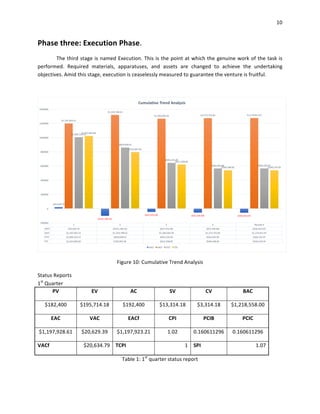
Phase	three:	Execution	Phase.	
The	third	stage	is	named	Execution.	This	is	the	point	at	which	the	genuine	work	of	the	task	is	
performed.	 Required	 materials,	 apparatuses,	 and	 assets	 are	 changed	 to	 achieve	 the	 undertaking	
objectives.	Amid	this	stage,	execution	is	ceaselessly	measured	to	guarantee	the	venture	is	fruitful.	
	
	
Figure	10:	Cumulative	Trend	Analysis	
Status	Reports	
1st
	Quarter	
PV	 EV	 AC	 SV	 CV	 BAC	
$182,400		 $195,714.18		 $192,400		 $13,314.18		 $3,314.18		 $1,218,558.00		
EAC	 VAC	 EACf	 CPI	 PCIB	 PCIC	
$1,197,928.61		 $20,629.39		 $1,197,923.21		 1.02	 0.160611296	 0.160611296	
VACf	 $20,634.79		 TCPI	 1	 SPI	 1.07	
Table	1:	1st
	quarter	status	report
11	
	
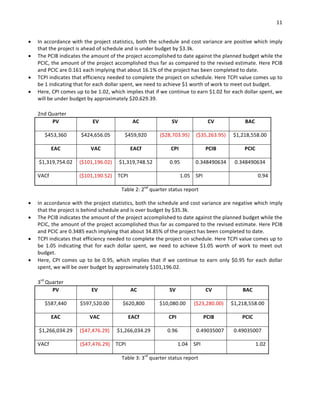
• In	accordance	with	the	project	statistics,	both	the	schedule	and	cost	variance	are	positive	which	imply	
that	the	project	is	ahead	of	schedule	and	is	under	budget	by	$3.3k.	
• The	PCIB	indicates	the	amount	of	the	project	accomplished	to	date	against	the	planned	budget	while	the	
PCIC,	the	amount	of	the	project	accomplished	thus	far	as	compared	to	the	revised	estimate.	Here	PCIB	
and	PCIC	are	0.161	each	implying	that	about	16.1%	of	the	project	has	been	completed	to	date.	
• TCPI	indicates	that	efficiency	needed	to	complete	the	project	on	schedule.	Here	TCPI	value	comes	up	to	
be	1	indicating	that	for	each	dollar	spent,	we	need	to	achieve	$1	worth	of	work	to	meet	out	budget.	
• Here,	CPI	comes	up	to	be	1.02,	which	implies	that	if	we	continue	to	earn	$1.02	for	each	dollar	spent,	we	
will	be	under	budget	by	approximately	$20.629.39.	
	
2nd	Quarter	
PV	 EV	 AC	 SV	 CV	 BAC	
$453,360		 $424,656.05		 $459,920		 ($28,703.95)	 ($35,263.95)	 $1,218,558.00		
EAC	 VAC	 EACf	 CPI	 PCIB	 PCIC	
$1,319,754.02		 ($101,196.02)	 $1,319,748.52		 0.95	 0.348490634	 0.348490634	
VACf	 ($101,190.52)	 TCPI	 1.05	 SPI	 0.94	
Table	2:	2nd
	quarter	status	report	
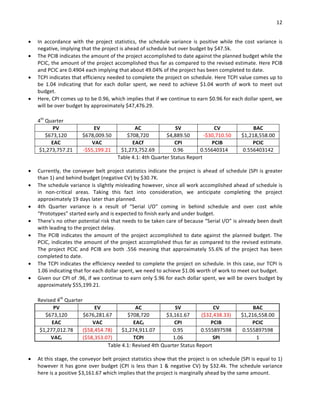
• In	accordance	with	the	project	statistics,	both	the	schedule	and	cost	variance	are	negative	which	imply	
that	the	project	is	behind	schedule	and	is	over	budget	by	$35.3k.	
• The	PCIB	indicates	the	amount	of	the	project	accomplished	to	date	against	the	planned	budget	while	the	
PCIC,	the	amount	of	the	project	accomplished	thus	far	as	compared	to	the	revised	estimate.	Here	PCIB	
and	PCIC	are	0.3485	each	implying	that	about	34.85%	of	the	project	has	been	completed	to	date.	
• TCPI	indicates	that	efficiency	needed	to	complete	the	project	on	schedule.	Here	TCPI	value	comes	up	to	
be	 1.05	 indicating	 that	 for	 each	 dollar	 spent,	 we	 need	 to	 achieve	 $1.05	 worth	 of	 work	 to	 meet	 out	
budget.	
• Here,	CPI	comes	up	to	be	0.95,	which	implies	that	if	we	continue	to	earn	only	$0.95	for	each	dollar	
spent,	we	will	be	over	budget	by	approximately	$101,196.02.	
	
3rd
	Quarter	
PV	 EV	 AC	 SV	 CV	 BAC	
$587,440		 $597,520.00		 $620,800		 $10,080.00		 ($23,280.00)	 $1,218,558.00		
EAC	 VAC	 EACf	 CPI	 PCIB	 PCIC	
$1,266,034.29		 ($47,476.29)	 $1,266,034.29		 0.96	 0.49035007	 0.49035007	
VACf	 ($47,476.29)	 TCPI	 1.04	 SPI	 1.02	
Table	3:	3rd
	quarter	status	report
12	
	
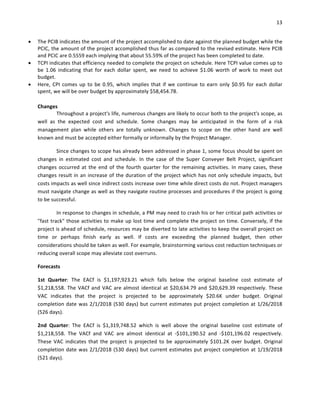
• In	 accordance	 with	 the	 project	 statistics,	 the	 schedule	 variance	 is	 positive	 while	 the	 cost	 variance	 is	
negative,	implying	that	the	project	is	ahead	of	schedule	but	over	budget	by	$47.5k.	
• The	PCIB	indicates	the	amount	of	the	project	accomplished	to	date	against	the	planned	budget	while	the	
PCIC,	the	amount	of	the	project	accomplished	thus	far	as	compared	to	the	revised	estimate.	Here	PCIB	
and	PCIC	are	0.4904	each	implying	that	about	49.04%	of	the	project	has	been	completed	to	date.	
• TCPI	indicates	that	efficiency	needed	to	complete	the	project	on	schedule.	Here	TCPI	value	comes	up	to	
be	 1.04	 indicating	 that	 for	 each	 dollar	 spent,	 we	 need	 to	 achieve	 $1.04	 worth	 of	 work	 to	 meet	 out	
budget.	
• Here,	CPI	comes	up	to	be	0.96,	which	implies	that	if	we	continue	to	earn	$0.96	for	each	dollar	spent,	we	
will	be	over	budget	by	approximately	$47,476.29.	
	
4th
	Quarter	
PV	 EV	 AC	 SV	 CV	 BAC	
$673,120		 $678,009.50		 $708,720		 $4,889.50		 -$30,710.50	 $1,218,558.00		
EAC	 VAC	 EACf	 CPI	 PCIB	 PCIC	
$1,273,757.21		 -$55,199.21	 $1,273,752.69		 0.96	 0.55640314	 0.556403142	
Table	4.1:	4th	Quarter	Status	Report	
• Currently,	the	conveyer	belt	project	statistics	indicate	the	project	is	ahead	of	schedule	(SPI	is	greater	
than	1)	and	behind	budget	(negative	CV)	by	$30.7K.		
• The	schedule	variance	is	slightly	misleading	however,	since	all	work	accomplished	ahead	of	schedule	is	
in	 non-critical	 areas.	 Taking	 this	 fact	 into	 consideration,	 we	 anticipate	 completing	 the	 project	
approximately	19	days	later	than	planned.		
• 4th	 Quarter	 variance	 is	 a	 result	 of	 “Serial	 I/O”	 coming	 in	 behind	 schedule	 and	 over	 cost	 while	
“Prototypes”	started	early	and	is	expected	to	finish	early	and	under	budget.		
• There’s	no	other	potential	risk	that	needs	to	be	taken	care	of	because	“Serial	I/O”	is	already	been	dealt	
with	leading	to	the	project	delay.		
• The	PCIB	indicates	the	amount	of	the	project	accomplished	to	date	against	the	planned	budget.	The	
PCIC,	indicates	the	amount	of	the	project	accomplished	thus	far	as	compared	to	the	revised	estimate.	
The	project	PCIC	and	PCIB	are	both	.556	meaning	that	approximately	55.6%	of	the	project	has	been	
completed	to	date.		
• The	TCPI	indicates	the	efficiency	needed	to	complete	the	project	on	schedule.	In	this	case,	our	TCPI	is	
1.06	indicating	that	for	each	dollar	spent,	we	need	to	achieve	$1.06	worth	of	work	to	meet	out	budget.		
• Given	our	CPI	of	.96,	if	we	continue	to	earn	only	$.96	for	each	dollar	spent,	we	will	be	overs	budget	by	
approximately	$55,199.21.		
	
Revised	4th
	Quarter	
PV	 EV	 AC	 SV	 CV	 BAC	
$673,120	 $676,281.67	 $708,720	 $3,161.67	 ($32,438.33)	 $1,216,558.00	
EAC	 VAC	 EACf	 CPI	 PCIB	 PCIC	
$1,277,012.78	 ($58,454.78)	 $1,274,911.07	 0.95	 0.555897598	 0.555897598	
VACf	 ($58,353.07)	 TCPI	 1.06	 SPI	 1	
Table	4.1:	Revised	4th	Quarter	Status	Report	
• At	this	stage,	the	conveyor	belt	project	statistics	show	that	the	project	is	on	schedule	(SPI	is	equal	to	1)	
however	it	has	gone	over	budget	(CPI	is	less	than	1	&	negative	CV)	by	$32.4k.	The	schedule	variance	
here	is	a	positive	$3,161.67	which	implies	that	the	project	is	marginally	ahead	by	the	same	amount.
13	
	
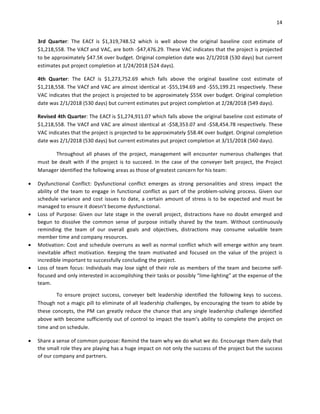
• The	PCIB	indicates	the	amount	of	the	project	accomplished	to	date	against	the	planned	budget	while	the	
PCIC,	the	amount	of	the	project	accomplished	thus	far	as	compared	to	the	revised	estimate.	Here	PCIB	
and	PCIC	are	0.5559	each	implying	that	about	55.59%	of	the	project	has	been	completed	to	date.	
• TCPI	indicates	that	efficiency	needed	to	complete	the	project	on	schedule.	Here	TCPI	value	comes	up	to	
be	 1.06	 indicating	 that	 for	 each	 dollar	 spent,	 we	 need	 to	 achieve	 $1.06	 worth	 of	 work	 to	 meet	 out	
budget.	
• Here,	CPI	comes	up	to	be	0.95,	which	implies	that	if	we	continue	to	earn	only	$0.95	for	each	dollar	
spent,	we	will	be	over	budget	by	approximately	$58,454.78.	
	
Changes	
Throughout	a	project's	life,	numerous	changes	are	likely	to	occur	both	to	the	project's	scope,	as	
well	 as	 the	 expected	 cost	 and	 schedule.	 Some	 changes	 may	 be	 anticipated	 in	 the	 form	 of	 a	 risk	
management	 plan	 while	 others	 are	 totally	 unknown.	 Changes	 to	 scope	 on	 the	 other	 hand	 are	 well	
known	and	must	be	accepted	either	formally	or	informally	by	the	Project	Manager.		
Since	changes	to	scope	has	already	been	addressed	in	phase	1,	some	focus	should	be	spent	on	
changes	 in	 estimated	 cost	 and	 schedule.	 In	 the	 case	 of	 the	 Super	 Conveyer	 Belt	 Project,	 significant	
changes	occurred	at	the	end	of	the	fourth	quarter	for	the	remaining	activities.	In	many	cases,	these	
changes	result	in	an	increase	of	the	duration	of	the	project	which	has	not	only	schedule	impacts,	but	
costs	impacts	as	well	since	indirect	costs	increase	over	time	while	direct	costs	do	not.	Project	managers	
must	navigate	change	as	well	as	they	navigate	routine	processes	and	procedures	if	the	project	is	going	
to	be	successful.		
In	response	to	changes	in	schedule,	a	PM	may	need	to	crash	his	or	her	critical	path	activities	or	
"fast	track"	those	activities	to	make	up	lost	time	and	complete	the	project	on	time.	Conversely,	if	the	
project	is	ahead	of	schedule,	resources	may	be	diverted	to	late	activities	to	keep	the	overall	project	on	
time	 or	 perhaps	 finish	 early	 as	 well.	 If	 costs	 are	 exceeding	 the	 planned	 budget,	 then	 other	
considerations	should	be	taken	as	well.	For	example,	brainstorming	various	cost	reduction	techniques	or	
reducing	overall	scope	may	alleviate	cost	overruns.	
Forecasts	
1st	 Quarter:	 The	 EACf	 is	 $1,197,923.21	 which	 falls	 below	 the	 original	 baseline	 cost	 estimate	 of	
$1,218,558.	The	VACf	and	VAC	are	almost	identical	at	$20,634.79	and	$20,629.39	respectively.	These	
VAC	 indicates	 that	 the	 project	 is	 projected	 to	 be	 approximately	 $20.6K	 under	 budget.	 Original	
completion	date	was	2/1/2018	(530	days)	but	current	estimates	put	project	completion	at	1/26/2018	
(526	days).	
2nd	 Quarter:	 The	 EACf	 is	 $1,319,748.52	 which	 is	 well	 above	 the	 original	 baseline	 cost	 estimate	 of	
$1,218,558.	 The	 VACf	 and	 VAC	 are	 almost	 identical	 at	 -$101,190.52	 and	 -$101,196.02	 respectively.	
These	 VAC	 indicates	 that	 the	 project	 is	 projected	 to	 be	 approximately	 $101.2K	 over	 budget.	 Original	
completion	date	was	2/1/2018	(530	days)	but	current	estimates	put	project	completion	at	1/19/2018	
(521	days).
14	
	
3rd	 Quarter:	 The	 EACf	 is	 $1,319,748.52	 which	 is	 well	 above	 the	 original	 baseline	 cost	 estimate	 of	
$1,218,558.	The	VACf	and	VAC,	are	both	-$47,476.29.	These	VAC	indicates	that	the	project	is	projected	
to	be	approximately	$47.5K	over	budget.	Original	completion	date	was	2/1/2018	(530	days)	but	current	
estimates	put	project	completion	at	1/24/2018	(524	days).	
4th	 Quarter:	 The	 EACf	 is	 $1,273,752.69	 which	 falls	 above	 the	 original	 baseline	 cost	 estimate	 of	
$1,218,558.	The	VACf	and	VAC	are	almost	identical	at	-$55,194.69	and	-$55,199.21	respectively.	These	
VAC	indicates	that	the	project	is	projected	to	be	approximately	$55K	over	budget.	Original	completion	
date	was	2/1/2018	(530	days)	but	current	estimates	put	project	completion	at	2/28/2018	(549	days).	
Revised	4th	Quarter:	The	EACf	is	$1,274,911.07	which	falls	above	the	original	baseline	cost	estimate	of	
$1,218,558.	The	VACf	and	VAC	are	almost	identical	at	-$58,353.07	and	-$58,454.78	respectively.	These	
VAC	indicates	that	the	project	is	projected	to	be	approximately	$58.4K	over	budget.	Original	completion	
date	was	2/1/2018	(530	days)	but	current	estimates	put	project	completion	at	3/15/2018	(560	days).	
Throughout	 all	 phases	 of	 the	 project,	 management	 will	 encounter	 numerous	 challenges	 that	
must	be	dealt	with	if	the	project	is	to	succeed.	In	the	case	of	the	conveyer	belt	project,	the	Project	
Manager	identified	the	following	areas	as	those	of	greatest	concern	for	his	team:	
• Dysfunctional	 Conflict:	 Dysfunctional	 conflict	 emerges	 as	 strong	 personalities	 and	 stress	 impact	 the	
ability	of	the	team	to	engage	in	functional	conflict	as	part	of	the	problem-solving	process.	Given	our	
schedule	variance	and	cost	issues	to	date,	a	certain	amount	of	stress	is	to	be	expected	and	must	be	
managed	to	ensure	it	doesn’t	become	dysfunctional.	
• Loss	of	Purpose:	Given	our	late	stage	in	the	overall	project,	distractions	have	no	doubt	emerged	and	
begun	 to	 dissolve	 the	 common	 sense	 of	 purpose	 initially	 shared	 by	 the	 team.	 Without	 continuously	
reminding	 the	 team	 of	 our	 overall	 goals	 and	 objectives,	 distractions	 may	 consume	 valuable	 team	
member	time	and	company	resources.	
• Motivation:	Cost	and	schedule	overruns	as	well	as	normal	conflict	which	will	emerge	within	any	team	
inevitable	 affect	 motivation.	 Keeping	 the	 team	 motivated	 and	 focused	 on	 the	 value	 of	 the	 project	 is	
incredible	important	to	successfully	concluding	the	project.	
• Loss	of	team	focus:	Individuals	may	lose	sight	of	their	role	as	members	of	the	team	and	become	self-
focused	and	only	interested	in	accomplishing	their	tasks	or	possibly	“lime-lighting”	at	the	expense	of	the	
team.		
To	 ensure	 project	 success,	 conveyer	 belt	 leadership	 identified	 the	 following	 keys	 to	 success.	
Though	not	a	magic	pill	to	eliminate	of	all	leadership	challenges,	by	encouraging	the	team	to	abide	by	
these	concepts,	the	PM	can	greatly	reduce	the	chance	that	any	single	leadership	challenge	identified	
above	with	become	sufficiently	out	of	control	to	impact	the	team’s	ability	to	complete	the	project	on	
time	and	on	schedule.	
• Share	a	sense	of	common	purpose:	Remind	the	team	why	we	do	what	we	do.	Encourage	them	daily	that	
the	small	role	they	are	playing	has	a	huge	impact	on	not	only	the	success	of	the	project	but	the	success	
of	our	company	and	partners.
15	
	
• Make	effective	use	of	individual	talents	and	expertise:	Don’t	let	people	get	bogged	down	doing	the	same	
repetitive	tasks	over	and	over.	Know	their	natural	gifts	and	educational	and	professional	backgrounds	to	
ensure	they	are	being	challenged	and	effectively	used	as	a	member	of	the	team.	
• Maintain	a	problem-solving	focus:	The	problem	is	the	problem,	not	the	people.	As	tempers	flare	and	
emotions	 rise	 keep	 the	 team	 focused	 on	 the	 problems	 we	 are	 solving,	 not	 the	 people	 solving	 them.	
Nothing	 will	 hurt	 the	 team	 more	 than	 individuals	 at	 each	 other’s	 throats	 while	 the	 real	 issues	 go	
unresolved.	
• Encourage	risk	taking	and	creativity:	Avoid	the	pitfall	of	believing	that	“the	way	we	used	to	do	it”	is	the	
best	 way	 to	 do	 it.	 Keep	 people	 thinking	 critically	 by	 challenging	 assumptions	 and	 asking	 for	 multiple	
courses	of	action	when	solving	major	problems.	Give	them	limits	but	only	broad	limits	and	allow	their	
creativity	to	spark.	
Phase	Four:	Closing	
Project	 comes	 to	 an	 end	 with	 completing	 all	 the	 deliverables	 and	 owner	 would	 ready	 to	 be	
transferred.	 Closing	 a	 project	 incorporates	 an	 overwhelming	 number	 of	 tasks.	 The	 responsibility	 of	
closing	a	project	is	have	been	parsed	among	project	manager,	project	teams,	project	office,	an	oversight	
“review	committee”,	and	an	independent	retrospective	facilitator.		
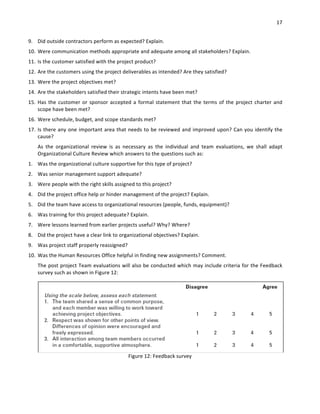
The	three	major	deliverables	that	comes	under	project	closure	are	as	shown	in	Figure	11:	
1. Wrapping	up	the	project		
2. Project	Audit	
3. Evaluation	of	performance	and	management	of	the	project		
	
Figure	11:	Project	closure	deliverables	
The	project	team	expects	this	project	will	undergo	a	normal	project	closure	where	no	extraordinary	risk	
measures	should	be	attempted	to	closing	the	project.	
The	following	tasks	which	are	yet	to	completed	are	as	follows:	
• Hardware	(71%	complete)		
• Operating	system	(56%	complete)	
• Utilities	(78%	complete)	
• System	Integration	(37%	complete)
16	
	
4.1.	Train	Customer	
Customer	 training	 is	 one	 of	 the	 most	 essential	 part	 of	 the	 project	 closure	 as	 it	 shares	 the	
guidelines	 of	 using	 the	 product.	 This	 can	 be	 provided	 by	 means	 of	 short	 demo	 videos,	 instruction	
manuals	 which	 would	 include	 both	 kind	 of	 trainings	 i.e.	 Hardware	 installation	 and	 Software	 usage	 if	
required.	 Also,	 the	 guidelines	 could	 be	 posted	 on	 the	 website	 under	 the	 “Help”	 section	 and	 even	
technical	assistance	would	be	provided	whenever	required.		
4.2.	Transfer	Documents	
All	 the	 documentations,	 including	 initial	 project	 requirements,	 development	 phases,	 project	
status	reports,	data	sheets,	testing	records,	end-user	agreements,	etc.	would	be	retained	for	the	future	
reference	if	necessary.		A	cover	sheet	is	to	be	prepared	providing	a	brief	overview	and	outline	of	project	
and	 a	 list	 of	 all	 participants	 involved.	 Organizing	 those	 documents	 as	 the	 project	 progresses	 so	 any	
authority	would	be	able	to	easily	locate	information	in	the	future.	Thus,	making	a	transfer	of	all	the	
documents	according	to	the	project	acquisition	plan.	
4.3.	Release	Resources	
At	the	conclusion	of	a	project,	release	resources	mean	a	process	for	re-accommodating	resources	or	
shifting	staff	responsibilities	and	thus	the	project	closure	procedures	are	started.	Reassign	those	staff	
members	to	other	projects	or	duties	in	the	workplace.		Feedback	all	staff	performance	would	also	be	
carried	out.	Collaborating	with	Human	Resource	Manager	of	the	organization	will	keep	the	resource	files	
up	to	date.	
4.4.	Evaluations	
The	final	step	in	the	project	closure	is	the	evaluations	review.	Since	the	360-degree	review	is	
found	to	be	the	most	popular	and	efficient	method	of	evaluating	performance,	our	project	team	will	be	
conducting	mainly	this	method	for	final	review.	Apart	from	the	Individual,	Team	and	Project	Manager	
Performance	evaluations	are	also	likely	to	be	carried	out.	If	possible,	it	can	also	be	beneficial	to	include	
clients,	customers,	users	or	any	appropriate	stakeholders.	
Instead	of	conducting	just	post-project	evaluations	also	the	project-progress	reviews	would	be	
implemented	for	the	effective	evaluations.	The	sample	project	progress	review	questionnaire	is	likely	to	
be	as	follows:	
1. Were	the	project	objectives	and	strategic	intent	of	the	project	clearly	and	explicitly	communicated?	
2. Were	the	objectives	and	strategy	in	alignment?	
3. Were	the	stakeholders	identified	and	included	in	the	planning?	
4. 	Were	project	resources	adequate	for	this	project?	
5. 	Were	people	with	the	right	skill	sets	assigned	to	this	project?	
6. Were	time	estimates	reasonable	and	achievable?	
7. Were	the	risks	for	the	project	appropriately	identified	and	assessed	before	the	project	started?	
8. Were	the	processes	and	practices	appropriate	for	this	type	of	project?	Should	projects	of	similar	size	and	
type	use	these	systems?	Why/why	not?
17	
	
9. Did	outside	contractors	perform	as	expected?	Explain.	
10. Were	communication	methods	appropriate	and	adequate	among	all	stakeholders?	Explain.	
11. Is	the	customer	satisfied	with	the	project	product?	
12. Are	the	customers	using	the	project	deliverables	as	intended?	Are	they	satisfied?	
13. Were	the	project	objectives	met?	
14. Are	the	stakeholders	satisfied	their	strategic	intents	have	been	met?	
15. Has	the	customer	or	sponsor	accepted	a	formal	statement	that	the	terms	of	the	project	charter	and	
scope	have	been	met?	
16. Were	schedule,	budget,	and	scope	standards	met?	
17. Is	there	any	one	important	area	that	needs	to	be	reviewed	and	improved	upon?	Can	you	identify	the	
cause?	
As	 the	 organizational	 review	 is	 as	 necessary	 as	 the	 individual	 and	 team	 evaluations,	 we	 shall	 adapt	
Organizational	Culture	Review	which	answers	to	the	questions	such	as:	
1. Was	the	organizational	culture	supportive	for	this	type	of	project?	
2. Was	senior	management	support	adequate?	
3. Were	people	with	the	right	skills	assigned	to	this	project?	
4. Did	the	project	office	help	or	hinder	management	of	the	project?	Explain.	
5. Did	the	team	have	access	to	organizational	resources	(people,	funds,	equipment)?	
6. Was	training	for	this	project	adequate?	Explain.	
7. Were	lessons	learned	from	earlier	projects	useful?	Why?	Where?	
8. Did	the	project	have	a	clear	link	to	organizational	objectives?	Explain.	
9. Was	project	staff	properly	reassigned?	
10. Was	the	Human	Resources	Office	helpful	in	finding	new	assignments?	Comment.	
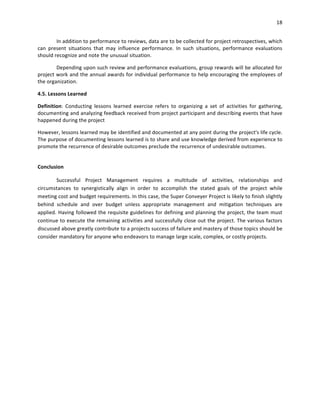
The	post	project	Team	evaluations	will	also	be	conducted	which	may	include	criteria	for	the	Feedback	
survey	such	as	shown	in	Figure	12:	
	
Figure	12:	Feedback	survey
18	
	
In	addition	to	performance	to	reviews,	data	are	to	be	collected	for	project	retrospectives,	which	
can	 present	 situations	 that	 may	 influence	 performance.	 In	 such	 situations,	 performance	 evaluations	
should	recognize	and	note	the	unusual	situation.	
Depending	upon	such	review	and	performance	evaluations,	group	rewards	will	be	allocated	for	
project	work	and	the	annual	awards	for	individual	performance	to	help	encouraging	the	employees	of	
the	organization.		
4.5.	Lessons	Learned	
Definition:	 Conducting	 lessons	 learned	 exercise	 refers	 to	 organizing	 a	 set	 of	 activities	 for	 gathering,	
documenting	and	analyzing	feedback	received	from	project	participant	and	describing	events	that	have	
happened	during	the	project	
However,	lessons	learned	may	be	identified	and	documented	at	any	point	during	the	project's	life	cycle.	
The	purpose	of	documenting	lessons	learned	is	to	share	and	use	knowledge	derived	from	experience	to	
promote	the	recurrence	of	desirable	outcomes	preclude	the	recurrence	of	undesirable	outcomes.		
	
Conclusion	
Successful	 Project	 Management	 requires	 a	 multitude	 of	 activities,	 relationships	 and	
circumstances	 to	 synergistically	 align	 in	 order	 to	 accomplish	 the	 stated	 goals	 of	 the	 project	 while	
meeting	cost	and	budget	requirements.	In	this	case,	the	Super	Conveyer	Project	is	likely	to	finish	slightly	
behind	 schedule	 and	 over	 budget	 unless	 appropriate	 management	 and	 mitigation	 techniques	 are	
applied.	Having	followed	the	requisite	guidelines	for	defining	and	planning	the	project,	the	team	must	
continue	to	execute	the	remaining	activities	and	successfully	close	out	the	project.	The	various	factors	
discussed	above	greatly	contribute	to	a	projects	success	of	failure	and	mastery	of	those	topics	should	be	
consider	mandatory	for	anyone	who	endeavors	to	manage	large	scale,	complex,	or	costly	projects.
19	
	
References	
1. Larson,	Erik	W.,	“Project	Management”,	7th
	edition.	New	York,	NY:	Macgraw	Hill	
Education	[2017].	
2. Lecture	Notes.	Presented	by	Dr.	Michel	E.	Whittenberg.	Found:	Notes	
3. Microsoft	Project	Tutorials.	Found:	Tutorials
20	
	
Appendix	A

CONVEYOR BELT PROJECT REPORT

  • 1.
  • 2.
    1 Table of Contents • Table of Figures 2 • Introduction 3 • Phase One: Defining / Initiating 3 • Phase Two: Planning 6 • Phase Three: Executing 10 • Phase Four: Closing 15 • Conclusion 18 • References 19 • Appendices 20
  • 3.
    2 Table of Figures and Tables Figure 1: Project Scope Statement 3 Figure 2: Project Priority Matrix (PPM) 4 Figure 3: WBS / OBS cross reference 5 Figure 4: Coded WBS 6 Figure 5: Gantt Schedule Table 7 Figure 6: Budget Reserve 7 Figure 7: Risk Assessment Form 8 Figure 8: Risk Response Matrix 9 Figure 9: Resources allocated to the project 9 Figure 10: Cumulative Trend Analysis 10 Table 1: 1st quarter status report 10 Table 2: 2nd quarter status report 11 Table 3: 3rd quarter status report 11 Table 4.1: 4th Quarter Status Report 12 Table 4.2: Revised 4th Quarter Status Report 12 Figure 11: Project closure deliverables 15 Figure 12: Feedback survey 17
  • 4.
    3 Introduction The purpose of this report is to provide management with a revised status of the Super Conveyer Belt project. The report is organized by the four phases of the project life cycle which include Defining / Initiating, Planning, Executing, and closing. The first phase, Defining, will incorporate high level activities such as goals, specifications, identifying key tasks, and roles and responsibilities. The second phase, Planning, includes creating schedules, defining budgets, determining resources available and requirements, assessing risks and staffing the team. The third phase, executing, involves the development of status reports, dealing with change, ensuring quality, and forecasting. All activities associated with “closing” will be projections as that phase has not yet occurred. Closure activities include, training the customer, transferring documents, release of resources, evaluations and lessons learned. Phase One: Defining / Initiating. The first step in defining the project involves the development of a project scope statement (see figure 1 below). This document defines “the work performed to deliver a product, service, or result with the specified features and functions” (PMBOK). Though very similar to a project charter, the scope statement varies slightly in that it functions more like a high-level statement of work (SOW) where the charter often contains more details and formally authorized the PM to initiate the project. The scope statement should include a project objective, top level deliverables, milestones, tech requirements, limits and exclusions, and reviews with customer. Figure 1 illustrates the scope statement for the super conveyer belt project. The opening paragraph clearly outlines the objective of the project and specifies the cost, duration, and primary mission. Major deliverables are listed as “hardware”, “Operating System”, “Utilities”, and “System Integration” but this should not be considered an exhaustive list of what must be done to complete the project. Indeed, numerous sub-tasks and deliverables are required to achieve the top- level deliverables and will be covered in more detail in later sections. Milestones also reside in the scope statement and are the start or end of activities or groups of related activities that may be of interest to management for controlling purposes. Notice the inclusion of Figure 1: Project Scope Statement
  • 5.
    4 all elements listed above as well as the “high” level nature of the deliverables outside of the main specifications of less than 1mm accuracy. Other specifications listed are relevant laws and standards pertaining to conveyer belt systems as well as an internal requirement for availability. The limits and exclusions paragraphs emphasize when we can work, how long, and the limit of our responsibilities on maintenance. The charter on the other hand, should include the scope statement as well as a narrative description of the products or services to be delivered (SOW) and the formal business case outlining the projects worth considering the necessary investments. The basis of the business case may include but is not limited to the following: market demand, organizational need, or customer request. For the conveyer belt project, a charter was not necessary and instead, the project scope statement was used as a charter. When defining the goals and specifications of the project, all PMs should be aware of the dangers of scope creep. Over time, there is a tendency for the project scope to expand beyond the original intent which can have major consequences on cost and schedule if not managed correctly. Moreover, changing priorities, specification and entire requirements may contribute to scope creep and result in projects that took on too much, too quickly and ultimately failed. Overall leadership and management challenges will be covered in more detail during the phase III discussion, but it is important to note that leaders should be actively engaging these challenges throughout the project life cycle. Once a project scope statement has been developed, a priority matrix should be created. The priority matrix lays out what aspects of the triple constraint are constrained, enhanced, or accepted. For the super conveyer belt project, the constraint was time as it was necessary to complete the project in no more than 2 years. We “accepted” changes to cost as we knew our max budget was well above what we needed to complete the project. And our “enhance” was scope as we would improve the functionality of the conveyer belt should the opportunity present itself but wouldn’t necessarily seek out such opportunities otherwise. Figure 2 below show the priority matrix for this project. Figure 2: Project Priority Matrix (PPM) The tasks necessary to complete any given project are typically laid out in a Work Breakdown Structure (WBS). The WBS is a hierarchical outline that identifies the basic activities required to complete a given project. It’s organized by deliverables, sub-deliverables, and work packages and is ideal for design and build projects like the conveyer belt project. As seen in the project scope statement, the conveyer belt project includes four major deliverables: Hardware, Operating System, Utilities, and Systems Integration. Though Systems Integration is less tangible than the other deliverables, it is still
  • 6.
    5 listed separately as the nature of the work is unique as compared to the other three and involves solving all the interoperability issues required to make the whole system work. The strength of the WBS resides in its ability to help the PM see the magnitude of the project as well as form the basis of the WBS and OBS integration (cost accounts) which will be the foundation of the Earned Value Management System and other monitor and controlling activities throughout the project. Moreover, the development of the WBS is critical to creating bottom up estimates of both cost and schedule early in the project. Appendix A shows a basic WBS from the conveyer belt project. Notice the lack of start dates and resourcing as these elements are not added until later in the project. The purpose of the WBS at this phase is simply to outline the major deliverables and the sub-tasks necessary for completion of the deliverables. Later, durations, start dates, end dates, resources, and dependencies will be added to each WBS element. To determine who is responsible to complete each of the various work packages developed in the WBS, we cross reference the WBS with our Organizational Breakdown Structure (OBS) to develop cost accounts. These cost accounts contain information such as who is doing the work, how much it will cost, when the activity will start and end as well as a rough estimate of the complexity of the work to be performed or level of technical expertise required to complete it. Figure 3 below shows and portion of the conveyer belt project WBS activity crossed with the part of the organization responsible for completing the work. This information is critical to leveling resources as well as identifying resource conflicts and shortages. However, in phase I, the only objective is simply to identify the available resources with our organization so that during the planning phase, those resources can be assigned to various activities within the WBS. Figure 3: WBS / OBS cross reference Since most projects require an Information System (IS) designed to assist project managers in the development and management of a project plan, it is necessary to “code” the WBS activities into an IS in preparation for detailed planning and estimation. In this case, the conveyer belt project utilizes Microsoft Project to plan, estimate and manage the project. In this case, Project automatically codes the WBS elements given they were input in a hierarchical way. That is, the overall project, then deliverables,
  • 7.
    6 then sub-deliverables were all input into the WBS in a hierarchical way. The final coded WBS elements contain unique numerical identifiers which allow reports to be consolidated at any level in the WBS structure. Figure 4 below shows a coded WBS as described above. Figure 4: Coded WBS Having identified the goals and objectives of the program, determined priorities, developed a WBS and OBS, and coded our activities into our chosen IS, the team was able begin the process of developing detailed plans for the project. Throughout all phases, the PM’s ability to lead and manage the team will be critical. Without strong leadership, scope creep, internal conflict, external conflict, senior management priority changes, or declining morale Phase Two: Planning According to PMBOK, project plan is a formal, approved document used to guide both project execution and project control. Project planning helps in several crucial activities such as establishing directions for the project team, supporting objectives of parent organization, making allowances for possible risks and putting control on planned work [Chapter 4 Slide 7, 2017]. In this phase of project, level of effort is increased compared to defining phase. The planning phase of project involves five main phases: Schedules, Budgets, Resources, Risks and Staffing A. Schedules The initial estimation for complete date of Conveyor Belt project was 530 work days, with a delivery date of February 1, 2018. The critical path for the project was determined to be: Architectural Design -> Hardware Specification -> Hardware Design -> Hardware Documentation -> Integration First Phase -> Serial I/0 Drivers -> System Hard/Software Test -> Network Interface -> Integration Acceptance Testing.
  • 8.
    7 The activity with the greatest amount of slack was found to be Utilities Documentation work package with total slack of 115 days. Figure 5: Gantt Schedule Table B. Budgets 1. Budget Reserve Budget reserves are identified for specific work packages of project to manage known-unknown risk. This is determined as percentage of estimated cost, a fixed number of using quantitative analysis. The project management team calculated likelihood of the certain events and determined the mitigation budget. As shown in table, the total amount of our budget reserve is $68,580. Risk # Event Probability Cost Mitigation Budget 1 Requirement Stability 0.05 $187,600 $9,380 2 Fail HW/SW Test 0.05 $433,200 $21,660 3 Latent Defects in Supplies 0.1 $186,400 $18,640 4 Loss of critical personnel 0.05 $106,000 $5,300 5 Fail Acceptance Test 0.1 $136,000 $13,600 Total $68,580 Figure 6: Budget Reserve
  • 9.
    8 2. Management Reserve Management reserve are intended to address unknown-unknowns and generally not a part of project cost baseline. Team decided to considered Management Reserves at least 10% of the total project work packages cost. Henceforth, the total amount of Management Reserve is $ 110,778. C. Resources The project is time constrained and after allocation of resources it was found that Design, development, and documentation were overallocated, first occurrence can be found on 24th August 2017. To resolve this problem, external development team was added to available resources which cost $120/hrs. The team identified the exact date when conflict began and removed the original internal development team from Routine Utilities; originally 14 June 2016, moved to 29 Feb 2016 and added the new external development team. Routine Utilities activity was chosen because it did not require any other internal teams to complete the task; making it ideal work for an outside agency. D. Risks 1. Risk Assessment Form Scenario Analysis was done and tabulated with risk assessment form which helps in figuring out the possible risks, their likelihood and their impact, also gives an idea regarding when this risk would occur. Risk severity matrix was developed, and team found that Failure of hardware and software could be one of the most potential risk event scoring 23 points placed in red zone, followed by failure of acceptance testing scoring 12 points placed in yellow zone. Figure 7: Risk Assessment Form 2. Risk Response Matrix The following Risk response matrix depicts how project team is planning to manage possible risks. We decided to mitigate four out of five risks and accept the risk of “loss of critical personnel”. For failure of HW/SW test and failure of acceptance test our contingency plan is to perform RCA, repair and retest it. And for the unfortunate event (4), team decided to use contractor support. Risk Assessment Form -Cube Sr. No Risk Event Score When 1 Requirement Stability 9 Hardware Documentation 2 Failure of HW / SW Test 23 HW / SW Test 3 Latent Defect in Supplies 9 Circuit Board 4 Loss of critical personnel 1 All "Development" Activities 5 Failure of Acceptance test 12 Acceptance Test
  • 10.
    9 Figure 8: Risk Response Matrix E. Staffing Initially project has Design Team (2), Development team (2), Documentation team (1) and Assembly/test team (1) from Research and Development group as well as purchasing team (1) from Procurement group. As the project moved further, there was problem of over allocation which was resolved by addition of external development teams, totaling 6 teams in project. Following figure show the assigned resources team names and its rate as well as Budget and Management reserves. Resource Name Type Initials Group Max. Units Std. Rate Ovt. Rate Cost/Use Accrue At Base Calendar Design Work D R&D 200% $100.00/hr $0.00/hr $0.00 Prorated Standard Development Work D R&D 400% $70.00/hr $0.00/hr $0.00 Prorated Standard Documentation Work D R&D 100% $60.00/hr $0.00/hr $0.00 Prorated Standard Assembly/test Work A R&D 100% $70.00/hr $0.00/hr $0.00 Prorated Standard Purchasing Work P Procurement 100% $40.00/hr $0.00/hr $0.00 Prorated Standard External Development Work E R&D 100% $120.00/hr $0.00/hr $0.00 Prorated Standard Budget Reserves (BR) Work B 100% $0.00/hr $0.00/hr $68,580.00 Prorated Standard Management Reserves (MR) Work M 100% $0.00/hr $0.00/hr $110,778.00 Prorated Standard Figure 9: Resources allocated to the project Risk Response Matrix Sr. No. Risk Event Response Contingency Plan Trigger Who is Responsible 1 Requirement Stability Mitigate: Early Design review with Customer Rework applicable specification and design activates Official Notification from Customer Project Manager 2 Failure of HW / SW Test Mitigate: Prior risk reduction testing Root Cause Analysis, repair, re-test Test Failure Design Lead 3 Latent Defect in Supplies Mitigate: Use only trusted suppliers Activate “latent-defect” clauses; re-test as necessary Root cause analysis reveals latent defect Procurement Lead 4 Loss of critical personnel Accept: development personnel limited Utilize contractor support Notification of death or injury of critical personnel Development Lead 5 Failure of Acceptance test Mitigate: Prior risk reduction testing Root Cause Analysis, repair, re-test Test Failure Design Lead
  • 11.
    10 Phase three: Execution Phase. The third stage is named Execution. This is the point at which the genuine work of the task is performed. Required materials, apparatuses, and assets are changed to achieve the undertaking objectives. Amid this stage, execution is ceaselessly measured to guarantee the venture is fruitful. Figure 10: Cumulative Trend Analysis Status Reports 1st Quarter PV EV AC SV CV BAC $182,400 $195,714.18 $192,400 $13,314.18 $3,314.18 $1,218,558.00 EAC VAC EACf CPI PCIB PCIC $1,197,928.61 $20,629.39 $1,197,923.21 1.02 0.160611296 0.160611296 VACf $20,634.79 TCPI 1 SPI 1.07 Table 1: 1st quarter status report
  • 12.
    11 • In accordance with the project statistics, both the schedule and cost variance are positive which imply that the project is ahead of schedule and is under budget by $3.3k. • The PCIB indicates the amount of the project accomplished to date against the planned budget while the PCIC, the amount of the project accomplished thus far as compared to the revised estimate. Here PCIB and PCIC are 0.161 each implying that about 16.1% of the project has been completed to date. •TCPI indicates that efficiency needed to complete the project on schedule. Here TCPI value comes up to be 1 indicating that for each dollar spent, we need to achieve $1 worth of work to meet out budget. • Here, CPI comes up to be 1.02, which implies that if we continue to earn $1.02 for each dollar spent, we will be under budget by approximately $20.629.39. 2nd Quarter PV EV AC SV CV BAC $453,360 $424,656.05 $459,920 ($28,703.95) ($35,263.95) $1,218,558.00 EAC VAC EACf CPI PCIB PCIC $1,319,754.02 ($101,196.02) $1,319,748.52 0.95 0.348490634 0.348490634 VACf ($101,190.52) TCPI 1.05 SPI 0.94 Table 2: 2nd quarter status report • In accordance with the project statistics, both the schedule and cost variance are negative which imply that the project is behind schedule and is over budget by $35.3k. • The PCIB indicates the amount of the project accomplished to date against the planned budget while the PCIC, the amount of the project accomplished thus far as compared to the revised estimate. Here PCIB and PCIC are 0.3485 each implying that about 34.85% of the project has been completed to date. • TCPI indicates that efficiency needed to complete the project on schedule. Here TCPI value comes up to be 1.05 indicating that for each dollar spent, we need to achieve $1.05 worth of work to meet out budget. • Here, CPI comes up to be 0.95, which implies that if we continue to earn only $0.95 for each dollar spent, we will be over budget by approximately $101,196.02. 3rd Quarter PV EV AC SV CV BAC $587,440 $597,520.00 $620,800 $10,080.00 ($23,280.00) $1,218,558.00 EAC VAC EACf CPI PCIB PCIC $1,266,034.29 ($47,476.29) $1,266,034.29 0.96 0.49035007 0.49035007 VACf ($47,476.29) TCPI 1.04 SPI 1.02 Table 3: 3rd quarter status report
  • 13.
    12 • In accordance with the project statistics, the schedule variance is positive while the cost variance is negative, implying that the project is ahead of schedule but over budget by $47.5k. • The PCIB indicates the amount of the project accomplished to date against the planned budget while the PCIC, the amount of the project accomplished thus far as compared to the revised estimate. Here PCIB and PCIC are 0.4904 each implying that about 49.04% of the project has been completed to date. • TCPI indicates that efficiency needed to complete the project on schedule. Here TCPI value comes up to be 1.04 indicating that for each dollar spent, we need to achieve $1.04 worth of work to meet out budget. • Here, CPI comes up to be 0.96, which implies that if we continue to earn $0.96 for each dollar spent, we will be over budget by approximately $47,476.29. 4th Quarter PV EV AC SV CV BAC $673,120 $678,009.50 $708,720 $4,889.50 -$30,710.50 $1,218,558.00 EAC VAC EACf CPI PCIB PCIC $1,273,757.21 -$55,199.21 $1,273,752.69 0.96 0.55640314 0.556403142 Table 4.1: 4th Quarter Status Report • Currently, the conveyer belt project statistics indicate the project is ahead of schedule (SPI is greater than 1) and behind budget (negative CV) by $30.7K. • The schedule variance is slightly misleading however, since all work accomplished ahead of schedule is in non-critical areas. Taking this fact into consideration, we anticipate completing the project approximately 19 days later than planned. • 4th Quarter variance is a result of “Serial I/O” coming in behind schedule and over cost while “Prototypes” started early and is expected to finish early and under budget. • There’s no other potential risk that needs to be taken care of because “Serial I/O” is already been dealt with leading to the project delay. • The PCIB indicates the amount of the project accomplished to date against the planned budget. The PCIC, indicates the amount of the project accomplished thus far as compared to the revised estimate. The project PCIC and PCIB are both .556 meaning that approximately 55.6% of the project has been completed to date. • The TCPI indicates the efficiency needed to complete the project on schedule. In this case, our TCPI is 1.06 indicating that for each dollar spent, we need to achieve $1.06 worth of work to meet out budget. • Given our CPI of .96, if we continue to earn only $.96 for each dollar spent, we will be overs budget by approximately $55,199.21. Revised 4th Quarter PV EV AC SV CV BAC $673,120 $676,281.67 $708,720 $3,161.67 ($32,438.33) $1,216,558.00 EAC VAC EACf CPI PCIB PCIC $1,277,012.78 ($58,454.78) $1,274,911.07 0.95 0.555897598 0.555897598 VACf ($58,353.07) TCPI 1.06 SPI 1 Table 4.1: Revised 4th Quarter Status Report • At this stage, the conveyor belt project statistics show that the project is on schedule (SPI is equal to 1) however it has gone over budget (CPI is less than 1 & negative CV) by $32.4k. The schedule variance here is a positive $3,161.67 which implies that the project is marginally ahead by the same amount.
  • 14.
    13 • The PCIB indicates the amount of the project accomplished to date against the planned budget while the PCIC, the amount of the project accomplished thus far as compared to the revised estimate. Here PCIB and PCIC are 0.5559 each implying that about 55.59% of the project has been completed to date. • TCPI indicates that efficiency needed to complete the project on schedule. Here TCPI value comes up to be 1.06 indicating that for each dollar spent, we need to achieve $1.06 worth of work to meet out budget. • Here, CPI comes up to be 0.95, which implies that if we continue to earn only $0.95 for each dollar spent, we will be over budget by approximately $58,454.78. Changes Throughout a project's life, numerous changes are likely to occur both to the project's scope, as well as the expected cost and schedule. Some changes may be anticipated in the form of a risk management plan while others are totally unknown. Changes to scope on the other hand are well known and must be accepted either formally or informally by the Project Manager. Since changes to scope has already been addressed in phase 1, some focus should be spent on changes in estimated cost and schedule. In the case of the Super Conveyer Belt Project, significant changes occurred at the end of the fourth quarter for the remaining activities. In many cases, these changes result in an increase of the duration of the project which has not only schedule impacts, but costs impacts as well since indirect costs increase over time while direct costs do not. Project managers must navigate change as well as they navigate routine processes and procedures if the project is going to be successful. In response to changes in schedule, a PM may need to crash his or her critical path activities or "fast track" those activities to make up lost time and complete the project on time. Conversely, if the project is ahead of schedule, resources may be diverted to late activities to keep the overall project on time or perhaps finish early as well. If costs are exceeding the planned budget, then other considerations should be taken as well. For example, brainstorming various cost reduction techniques or reducing overall scope may alleviate cost overruns. Forecasts 1st Quarter: The EACf is $1,197,923.21 which falls below the original baseline cost estimate of $1,218,558. The VACf and VAC are almost identical at $20,634.79 and $20,629.39 respectively. These VAC indicates that the project is projected to be approximately $20.6K under budget. Original completion date was 2/1/2018 (530 days) but current estimates put project completion at 1/26/2018 (526 days). 2nd Quarter: The EACf is $1,319,748.52 which is well above the original baseline cost estimate of $1,218,558. The VACf and VAC are almost identical at -$101,190.52 and -$101,196.02 respectively. These VAC indicates that the project is projected to be approximately $101.2K over budget. Original completion date was 2/1/2018 (530 days) but current estimates put project completion at 1/19/2018 (521 days).
  • 15.
    14 3rd Quarter: The EACf is $1,319,748.52 which is well above the original baseline cost estimate of $1,218,558. The VACf and VAC, are both -$47,476.29. These VAC indicates that the project is projected to be approximately $47.5K over budget. Original completion date was 2/1/2018 (530 days) but current estimates put project completion at 1/24/2018 (524 days). 4th Quarter: The EACf is $1,273,752.69 which falls above the original baseline cost estimate of $1,218,558. The VACf and VAC are almost identical at -$55,194.69 and -$55,199.21 respectively. These VAC indicates that the project is projected to be approximately $55K over budget. Original completion date was 2/1/2018 (530 days) but current estimates put project completion at 2/28/2018 (549 days). Revised 4th Quarter: The EACf is $1,274,911.07 which falls above the original baseline cost estimate of $1,218,558. The VACf and VAC are almost identical at -$58,353.07 and -$58,454.78 respectively. These VAC indicates that the project is projected to be approximately $58.4K over budget. Original completion date was 2/1/2018 (530 days) but current estimates put project completion at 3/15/2018 (560 days). Throughout all phases of the project, management will encounter numerous challenges that must be dealt with if the project is to succeed. In the case of the conveyer belt project, the Project Manager identified the following areas as those of greatest concern for his team: • Dysfunctional Conflict: Dysfunctional conflict emerges as strong personalities and stress impact the ability of the team to engage in functional conflict as part of the problem-solving process. Given our schedule variance and cost issues to date, a certain amount of stress is to be expected and must be managed to ensure it doesn’t become dysfunctional. • Loss of Purpose: Given our late stage in the overall project, distractions have no doubt emerged and begun to dissolve the common sense of purpose initially shared by the team. Without continuously reminding the team of our overall goals and objectives, distractions may consume valuable team member time and company resources. • Motivation: Cost and schedule overruns as well as normal conflict which will emerge within any team inevitable affect motivation. Keeping the team motivated and focused on the value of the project is incredible important to successfully concluding the project. • Loss of team focus: Individuals may lose sight of their role as members of the team and become self- focused and only interested in accomplishing their tasks or possibly “lime-lighting” at the expense of the team. To ensure project success, conveyer belt leadership identified the following keys to success. Though not a magic pill to eliminate of all leadership challenges, by encouraging the team to abide by these concepts, the PM can greatly reduce the chance that any single leadership challenge identified above with become sufficiently out of control to impact the team’s ability to complete the project on time and on schedule. • Share a sense of common purpose: Remind the team why we do what we do. Encourage them daily that the small role they are playing has a huge impact on not only the success of the project but the success of our company and partners.
  • 16.
    15 • Make effective use of individual talents and expertise: Don’t let people get bogged down doing the same repetitive tasks over and over. Know their natural gifts and educational and professional backgrounds to ensure they are being challenged and effectively used as a member of the team. • Maintain a problem-solving focus: The problem is the problem, not the people. As tempers flare and emotions rise keep the team focused on the problems we are solving, not the people solving them. Nothing will hurt the team more than individuals at each other’s throats while the real issues go unresolved. • Encourage risk taking and creativity: Avoid the pitfall of believing that “the way we used to do it” is the best way to do it. Keep people thinking critically by challenging assumptions and asking for multiple courses of action when solving major problems. Give them limits but only broad limits and allow their creativity to spark. Phase Four: Closing Project comes to an end with completing all the deliverables and owner would ready to be transferred. Closing a project incorporates an overwhelming number of tasks. The responsibility of closing a project is have been parsed among project manager, project teams, project office, an oversight “review committee”, and an independent retrospective facilitator. The three major deliverables that comes under project closure are as shown in Figure 11: 1. Wrapping up the project 2. Project Audit 3. Evaluation of performance and management of the project Figure 11: Project closure deliverables The project team expects this project will undergo a normal project closure where no extraordinary risk measures should be attempted to closing the project. The following tasks which are yet to completed are as follows: • Hardware (71% complete) • Operating system (56% complete) • Utilities (78% complete) • System Integration (37% complete)
  • 17.
    16 4.1. Train Customer Customer training is one of the most essential part of the project closure as it shares the guidelines of using the product. This can be provided by means of short demo videos, instruction manuals which would include both kind of trainings i.e. Hardware installation and Software usage if required. Also, the guidelines could be posted on the website under the “Help” section and even technical assistance would be provided whenever required. 4.2. Transfer Documents All the documentations, including initial project requirements, development phases, project status reports, data sheets, testing records, end-user agreements, etc. would be retained for the future reference if necessary. A cover sheet is to be prepared providing a brief overview and outline of project and a list of all participants involved. Organizing those documents as the project progresses so any authority would be able to easily locate information in the future. Thus, making a transfer of all the documents according to the project acquisition plan. 4.3. Release Resources At the conclusion of a project, release resources mean a process for re-accommodating resources or shifting staff responsibilities and thus the project closure procedures are started. Reassign those staff members to other projects or duties in the workplace. Feedback all staff performance would also be carried out. Collaborating with Human Resource Manager of the organization will keep the resource files up to date. 4.4. Evaluations The final step in the project closure is the evaluations review. Since the 360-degree review is found to be the most popular and efficient method of evaluating performance, our project team will be conducting mainly this method for final review. Apart from the Individual, Team and Project Manager Performance evaluations are also likely to be carried out. If possible, it can also be beneficial to include clients, customers, users or any appropriate stakeholders. Instead of conducting just post-project evaluations also the project-progress reviews would be implemented for the effective evaluations. The sample project progress review questionnaire is likely to be as follows: 1. Were the project objectives and strategic intent of the project clearly and explicitly communicated? 2. Were the objectives and strategy in alignment? 3. Were the stakeholders identified and included in the planning? 4. Were project resources adequate for this project? 5. Were people with the right skill sets assigned to this project? 6. Were time estimates reasonable and achievable? 7. Were the risks for the project appropriately identified and assessed before the project started? 8. Were the processes and practices appropriate for this type of project? Should projects of similar size and type use these systems? Why/why not?
  • 18.
    17 9. Did outside contractors perform as expected? Explain. 10. Were communication methods appropriate and adequate among all stakeholders? Explain. 11.Is the customer satisfied with the project product? 12. Are the customers using the project deliverables as intended? Are they satisfied? 13. Were the project objectives met? 14. Are the stakeholders satisfied their strategic intents have been met? 15. Has the customer or sponsor accepted a formal statement that the terms of the project charter and scope have been met? 16. Were schedule, budget, and scope standards met? 17. Is there any one important area that needs to be reviewed and improved upon? Can you identify the cause? As the organizational review is as necessary as the individual and team evaluations, we shall adapt Organizational Culture Review which answers to the questions such as: 1. Was the organizational culture supportive for this type of project? 2. Was senior management support adequate? 3. Were people with the right skills assigned to this project? 4. Did the project office help or hinder management of the project? Explain. 5. Did the team have access to organizational resources (people, funds, equipment)? 6. Was training for this project adequate? Explain. 7. Were lessons learned from earlier projects useful? Why? Where? 8. Did the project have a clear link to organizational objectives? Explain. 9. Was project staff properly reassigned? 10. Was the Human Resources Office helpful in finding new assignments? Comment. The post project Team evaluations will also be conducted which may include criteria for the Feedback survey such as shown in Figure 12: Figure 12: Feedback survey
  • 19.
    18 In addition to performance to reviews, data are to be collected for project retrospectives, which can present situations that may influence performance. In such situations, performance evaluations should recognize and note the unusual situation. Depending upon such review and performance evaluations, group rewards will be allocated for project work and the annual awards for individual performance to help encouraging the employees of the organization. 4.5. Lessons Learned Definition: Conducting lessons learned exercise refers to organizing a set of activities for gathering, documenting and analyzing feedback received from project participant and describing events that have happened during the project However, lessons learned may be identified and documented at any point during the project's life cycle. The purpose of documenting lessons learned is to share and use knowledge derived from experience to promote the recurrence of desirable outcomes preclude the recurrence of undesirable outcomes. Conclusion Successful Project Management requires a multitude of activities, relationships and circumstances to synergistically align in order to accomplish the stated goals of the project while meeting cost and budget requirements. In this case, the Super Conveyer Project is likely to finish slightly behind schedule and over budget unless appropriate management and mitigation techniques are applied. Having followed the requisite guidelines for defining and planning the project, the team must continue to execute the remaining activities and successfully close out the project. The various factors discussed above greatly contribute to a projects success of failure and mastery of those topics should be consider mandatory for anyone who endeavors to manage large scale, complex, or costly projects.
  • 20.
  • 21.