LASER IGNITION SYSTEM 
By, 
Avinash Bhagawati 
Divyang Choudhary 
Rishav Raj 
6th SEM 
Mechanical 
Engineering
INTRODUCTION 
It's widely accepted that the internal combustion engines 
will continue to power our vehicles. 
Hence, as the global mobilisation of people and goods 
increases, advances in combustion and after-treatment 
are needed to reduce the environmental impact of the 
continued use of IC engine vehicles. 
To meet environmental legislation requirements, 
automotive manufacturers continue to address two 
critical aspects of engine performance, fuel economy and 
exhaust gas emissions. 
New engines are becoming increasingly complex, with 
advanced combustion mechanisms that burn an 
increasing variety of fuels to meet future goals on 
performance, fuel economy and emissions. 
The spark plug has remained largely unchanged since its 
invention, yet its poor ability to ignite highly dilute air-fuel 
mixtures limits the potential for improving 
combustion efficiency. 
With
INTRODUCTION CONTINUED... 
Spark ignition (SI) also restricts engine design, 
particularly in new engines, since the spark position is 
fixed by the cylinder head location of the plug, and the 
protruding electrode disturbs the cylinder geometry and 
may quench the combustion flame kernel. 
So, many alternatives are being sought after to counter 
these limitations. 
One of the alternative is the laser ignition system (LIS) 
being described here. 
Compared to a conventional spark plug, a LIS should be 
a favourable ignition source in terms of lean burn 
characteristics and system flexibility. 
So, in this paper we'll be discussing the implementation 
and impact of LIS on IC engines.
PROCESSES & MECHANISMS 
Spark Ignition System 
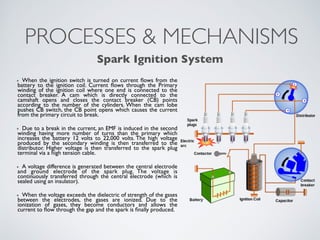
When the ignition switch is turned on current flows from the 
battery to the ignition coil. Current flows through the Primary 
winding of the ignition coil where one end is connected to the 
contact breaker. A cam which is directly connected to the 
camshaft opens and closes the contact breaker (CB) points 
according to the number of the cylinders. When the cam lobe 
pushes CB switch, the CB point opens which causes the current 
from the primary circuit to break. 
Due to a break in the current, an EMF is induced in the second 
winding having more number of turns than the primary which 
increases the battery 12 volts to 22,000 volts. The high voltage 
produced by the secondary winding is then transferred to the 
distributor. Higher voltage is then transferred to the spark plug 
terminal via a high tension cable. 
A voltage difference is generated between the central electrode 
and ground electrode of the spark plug. The voltage is 
continuously transferred through the central electrode (which is 
sealed using an insulator). 
When the voltage exceeds the dielectric of strength of the gases 
between the electrodes, the gases are ionized. Due to the 
ionization of gases, they become conductors and allows the 
current to flow through the gap and the spark is finally produced.
LASER Ignition System 
LI requires certain conditions to be met for two basic steps to take place, spark formation (generally limited 
by breakdown intensity) and subsequent ignition (generally limited by a minimum ignition energy or MIE). 
For example it's possible to provide sufficient energy for ignition with no spark formation or provide 
insufficient energy with spark formation. 
There are four mechanisms by virtue of which LI is able to ignite the air-fuel mixture. 
They are, 
1. Thermal initiation (TI) 
2. Non-resonant breakdown (NRB) 
3. Resonant breakdown (RB) 
4. Photo chemical ignition (PCI) 
Amongst the above mentioned mechanisms NRB is used the most.
SO, NOW WHAT'S THE 
PROBLEM? 
The following are the drawbacks of SI: 
1. Location of spark plug is not flexible as it require shielding of plug from immense 
heat and fuel spray. 
2. It is not possible to ignite inside the fuel spray. 
3. It require frequent maintenance to remove carbon deposits. 
4. Leaner mixtures cannot be burned efficiently. 
5. Degradation of electrodes at high pressure and temperature. 
6. Flame propagation is slow. 
7. Multi point fuel ignition is not feasible. 
8. Higher turbulence levels are required. 
To overcome the above mentioned disadvantages LIS is being sought after.
NON RESONANT BREAKDOWN 
In NRB, the focused laser beam creates an electric field of sufficient intensity to cause dielectric breakdown of the air-fuel 
mixture. 
The process begins with multi-photon ionisation of few gas molecules which releases electrons that readily absorb more 
photons via the inverse bremsstrahlung process to increase their kinetic energy. 
Electrons liberated by this means collide with other molecules and ionise them, leading to an electron avalanche, and 
breakdown of the gas. 
Multi-photon absorption processes are usually essential for the initial stage of breakdown because the available photon 
energy at visible and near IR wavelengths is much smaller than the ionisation energy. 
For very short pulse duration (few picoseconds) the multi photon processes alone must provide breakdown, since there 
is insufficient time for electron-molecule collision to occur. 
Thus this avalanche of electrons and resultant ions collide with each other producing immense heat hence creating plasma 
which is sufficiently strong to ignite the fuel.
NOW, HOW DOES IT WORK? 
The laser ignition system has a laser transmitter with a fibre-optic cable powered by the car’s 
battery. It shoots the laser beam to a focusing lens that would consume a much smaller space than 
current spark plugs. The lenses focus the beams into an intense pinpoint of light by passing through 
an optical window, and when the fuel is injected into the engine, the laser is fired and produces 
enough energy (heat) to ignite the fuel.
NOW, HOW DOES IT 
WORK?...CONTINUED 
The laser beam is passed through a convex lens, this convex 
lens diverge the beam and make it immensely strong and 
sufficient enough to start combustion at that point. Hence 
the fuel is ignited, at the focal point, with the mechanism 
shown above. The focal point is adjusted where the ignition 
is required to have. 
The plasma generated by the Laser beam results in two of 
the following actions : 
1. Emission of high energy photons 
2. Generation of shock waves 
The high energy photons, heat and ionise the charge 
present in the path of laser beam which can be seen from 
the propagation of the flame which propagates longitudinally 
along the laser beam. 
The shock waves carry energy out wards from the laser 
beam and thus help in propagation of flame as shown in the 
above figure.
ADVANTAGES OF LIS 
The following are the advantages of using a LIS: 
1. Location of laser is flexible as it does not require shielding from immense heat and fuel spray and 
focal point can be made anywhere in the combustion chamber from any point it is possible to ignite 
inside the fuel spray as there is no physical component at ignition location. 
2. It does not require maintenance to remove carbon deposits because of the fact that whole system is 
isolated. 
3. Leaner mixtures can be burned as fuel ignition inside combustion chamber is also possible here 
certainty of fuel presence is very high. 
4. High pressure and temperature does not affect the performance allowing the use of high 
compression ratios. 
5. Flame propagation is fast as multipoint fuel ignition is also possible. 
6. Higher turbulence levels are not required due to above said advantages.
NOX EMISSIONS IN DIFFERENT 
IGNITION SYSTEMS IN MG/NM3
1. SI 
2. LI
CONCLUSION 
Research to date on LI in engines has demonstrated improvements in combustion stability. With 
proper control, these improvements can enable engines to be run under leaner conditions, with 
higher Exhaust Gas Recirculation (EGR) concentrations, or at lower idle speeds without increasing the 
noise, vibration and harshness characteristics of a vehicle. 
LI gives significantly shorter power duration compared to SI. With the recent development of higher 
average power and higher pulse frequency lasers, it is expected that a multi-strike LI system and 
associated combustion control can reduce the probability of misfires under high levels of dilution. 
The prospects for LI are also particularly exciting from a control perspective, from optical sensing of 
the in-cylinder combustion, to the array of possible ignition activation and control mechanisms. 
It is anticipated that this, combined with the capability to control the ignition location and timing, will 
play a significant role in optimisation of future engines by dynamic feedback control. 
The only limitations of the LIS is it's highly expensive setup.
REFERENCES 
[1] Lackner, M., Winter, F., What is ignition? Combustion File 256, IFRF Online Combustion Handbook, ISSN 
1607-9116, International Flame Research Foundation, Ijmuiden, The Netherlands, (2004). 
[2] H. Kopecek, M. Lackner, F. Winter, E. Wintner, Laser ignition of methane air mixtures at pressures up to 4 MPa, 
Journal of Laser Physics 13 (11), 1365 (2003). 
[3] Kopecek, H., Lackner, M., Wintner, E., Winter, F., Laser-Stimulated Ignition in a Homogeneous Charge Compression 
Ignition Engine, SAE 2004 World Congress, paper No 2004-01-0937, Detroit, MI, USA (2004). 
[4] J. D. Dale, M. D. Checkel, P. R. Smy, Application of High Energy Ignition Systems to Engines, Prog. Energy Combust. 
Sci. 23, 379-398 (1997). 
[5] Ronney P.D., Laser versus conventional ignition of flames, Optical Engineering 33(2),510 (1994). 
[6] Phuoc T.X., White F.P., Laser-induced spark ignition of CH4/air mixtures, Combustion and Flame 119, 203-216 
(1999). 
[7] Radziemski L.J., Cremers D.A., Laser-induced plasmas and applications, New York-Basel: Marcel Dekker Inc., 
(1989).
QUERIES, ANYONE?
LASER Ignition System

LASER Ignition System

  • 1.
    LASER IGNITION SYSTEM By, Avinash Bhagawati Divyang Choudhary Rishav Raj 6th SEM Mechanical Engineering
  • 2.
    INTRODUCTION It's widelyaccepted that the internal combustion engines will continue to power our vehicles. Hence, as the global mobilisation of people and goods increases, advances in combustion and after-treatment are needed to reduce the environmental impact of the continued use of IC engine vehicles. To meet environmental legislation requirements, automotive manufacturers continue to address two critical aspects of engine performance, fuel economy and exhaust gas emissions. New engines are becoming increasingly complex, with advanced combustion mechanisms that burn an increasing variety of fuels to meet future goals on performance, fuel economy and emissions. The spark plug has remained largely unchanged since its invention, yet its poor ability to ignite highly dilute air-fuel mixtures limits the potential for improving combustion efficiency. With
  • 3.
    INTRODUCTION CONTINUED... Sparkignition (SI) also restricts engine design, particularly in new engines, since the spark position is fixed by the cylinder head location of the plug, and the protruding electrode disturbs the cylinder geometry and may quench the combustion flame kernel. So, many alternatives are being sought after to counter these limitations. One of the alternative is the laser ignition system (LIS) being described here. Compared to a conventional spark plug, a LIS should be a favourable ignition source in terms of lean burn characteristics and system flexibility. So, in this paper we'll be discussing the implementation and impact of LIS on IC engines.
  • 4.
    PROCESSES & MECHANISMS Spark Ignition System When the ignition switch is turned on current flows from the battery to the ignition coil. Current flows through the Primary winding of the ignition coil where one end is connected to the contact breaker. A cam which is directly connected to the camshaft opens and closes the contact breaker (CB) points according to the number of the cylinders. When the cam lobe pushes CB switch, the CB point opens which causes the current from the primary circuit to break. Due to a break in the current, an EMF is induced in the second winding having more number of turns than the primary which increases the battery 12 volts to 22,000 volts. The high voltage produced by the secondary winding is then transferred to the distributor. Higher voltage is then transferred to the spark plug terminal via a high tension cable. A voltage difference is generated between the central electrode and ground electrode of the spark plug. The voltage is continuously transferred through the central electrode (which is sealed using an insulator). When the voltage exceeds the dielectric of strength of the gases between the electrodes, the gases are ionized. Due to the ionization of gases, they become conductors and allows the current to flow through the gap and the spark is finally produced.
  • 5.
    LASER Ignition System LI requires certain conditions to be met for two basic steps to take place, spark formation (generally limited by breakdown intensity) and subsequent ignition (generally limited by a minimum ignition energy or MIE). For example it's possible to provide sufficient energy for ignition with no spark formation or provide insufficient energy with spark formation. There are four mechanisms by virtue of which LI is able to ignite the air-fuel mixture. They are, 1. Thermal initiation (TI) 2. Non-resonant breakdown (NRB) 3. Resonant breakdown (RB) 4. Photo chemical ignition (PCI) Amongst the above mentioned mechanisms NRB is used the most.
  • 6.
    SO, NOW WHAT'STHE PROBLEM? The following are the drawbacks of SI: 1. Location of spark plug is not flexible as it require shielding of plug from immense heat and fuel spray. 2. It is not possible to ignite inside the fuel spray. 3. It require frequent maintenance to remove carbon deposits. 4. Leaner mixtures cannot be burned efficiently. 5. Degradation of electrodes at high pressure and temperature. 6. Flame propagation is slow. 7. Multi point fuel ignition is not feasible. 8. Higher turbulence levels are required. To overcome the above mentioned disadvantages LIS is being sought after.
  • 7.
    NON RESONANT BREAKDOWN In NRB, the focused laser beam creates an electric field of sufficient intensity to cause dielectric breakdown of the air-fuel mixture. The process begins with multi-photon ionisation of few gas molecules which releases electrons that readily absorb more photons via the inverse bremsstrahlung process to increase their kinetic energy. Electrons liberated by this means collide with other molecules and ionise them, leading to an electron avalanche, and breakdown of the gas. Multi-photon absorption processes are usually essential for the initial stage of breakdown because the available photon energy at visible and near IR wavelengths is much smaller than the ionisation energy. For very short pulse duration (few picoseconds) the multi photon processes alone must provide breakdown, since there is insufficient time for electron-molecule collision to occur. Thus this avalanche of electrons and resultant ions collide with each other producing immense heat hence creating plasma which is sufficiently strong to ignite the fuel.
  • 8.
    NOW, HOW DOESIT WORK? The laser ignition system has a laser transmitter with a fibre-optic cable powered by the car’s battery. It shoots the laser beam to a focusing lens that would consume a much smaller space than current spark plugs. The lenses focus the beams into an intense pinpoint of light by passing through an optical window, and when the fuel is injected into the engine, the laser is fired and produces enough energy (heat) to ignite the fuel.
  • 9.
    NOW, HOW DOESIT WORK?...CONTINUED The laser beam is passed through a convex lens, this convex lens diverge the beam and make it immensely strong and sufficient enough to start combustion at that point. Hence the fuel is ignited, at the focal point, with the mechanism shown above. The focal point is adjusted where the ignition is required to have. The plasma generated by the Laser beam results in two of the following actions : 1. Emission of high energy photons 2. Generation of shock waves The high energy photons, heat and ionise the charge present in the path of laser beam which can be seen from the propagation of the flame which propagates longitudinally along the laser beam. The shock waves carry energy out wards from the laser beam and thus help in propagation of flame as shown in the above figure.
  • 10.
    ADVANTAGES OF LIS The following are the advantages of using a LIS: 1. Location of laser is flexible as it does not require shielding from immense heat and fuel spray and focal point can be made anywhere in the combustion chamber from any point it is possible to ignite inside the fuel spray as there is no physical component at ignition location. 2. It does not require maintenance to remove carbon deposits because of the fact that whole system is isolated. 3. Leaner mixtures can be burned as fuel ignition inside combustion chamber is also possible here certainty of fuel presence is very high. 4. High pressure and temperature does not affect the performance allowing the use of high compression ratios. 5. Flame propagation is fast as multipoint fuel ignition is also possible. 6. Higher turbulence levels are not required due to above said advantages.
  • 11.
    NOX EMISSIONS INDIFFERENT IGNITION SYSTEMS IN MG/NM3
  • 12.
  • 13.
    CONCLUSION Research todate on LI in engines has demonstrated improvements in combustion stability. With proper control, these improvements can enable engines to be run under leaner conditions, with higher Exhaust Gas Recirculation (EGR) concentrations, or at lower idle speeds without increasing the noise, vibration and harshness characteristics of a vehicle. LI gives significantly shorter power duration compared to SI. With the recent development of higher average power and higher pulse frequency lasers, it is expected that a multi-strike LI system and associated combustion control can reduce the probability of misfires under high levels of dilution. The prospects for LI are also particularly exciting from a control perspective, from optical sensing of the in-cylinder combustion, to the array of possible ignition activation and control mechanisms. It is anticipated that this, combined with the capability to control the ignition location and timing, will play a significant role in optimisation of future engines by dynamic feedback control. The only limitations of the LIS is it's highly expensive setup.
  • 14.
    REFERENCES [1] Lackner,M., Winter, F., What is ignition? Combustion File 256, IFRF Online Combustion Handbook, ISSN 1607-9116, International Flame Research Foundation, Ijmuiden, The Netherlands, (2004). [2] H. Kopecek, M. Lackner, F. Winter, E. Wintner, Laser ignition of methane air mixtures at pressures up to 4 MPa, Journal of Laser Physics 13 (11), 1365 (2003). [3] Kopecek, H., Lackner, M., Wintner, E., Winter, F., Laser-Stimulated Ignition in a Homogeneous Charge Compression Ignition Engine, SAE 2004 World Congress, paper No 2004-01-0937, Detroit, MI, USA (2004). [4] J. D. Dale, M. D. Checkel, P. R. Smy, Application of High Energy Ignition Systems to Engines, Prog. Energy Combust. Sci. 23, 379-398 (1997). [5] Ronney P.D., Laser versus conventional ignition of flames, Optical Engineering 33(2),510 (1994). [6] Phuoc T.X., White F.P., Laser-induced spark ignition of CH4/air mixtures, Combustion and Flame 119, 203-216 (1999). [7] Radziemski L.J., Cremers D.A., Laser-induced plasmas and applications, New York-Basel: Marcel Dekker Inc., (1989).
  • 15.