
Mycobacterium tuberculosis Dr Kamran Afzal Asst Prof Microbiology
Tuberculosis  - The Captain of Death
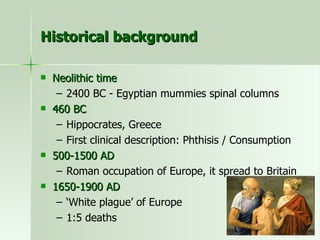
Historical background Neolithic time 2400 BC - Egyptian mummies spinal columns 460 BC   Hippocrates, Greece First clinical description: Phthisis / Consumption  500-1500 AD Roman occupation of Europe, it spread to Britain 1650-1900 AD ‘ White plague’ of Europe 1:5 deaths
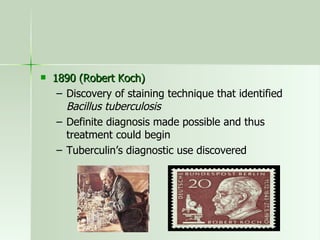
1890 (Robert Koch) Discovery of staining technique that identified  Bacillus tuberculosis Definite diagnosis made possible and thus treatment could begin Tuberculin’s diagnostic use discovered
1908-1920  Vaccine (BCG)  1943 (Selman Abraham Waksman)   Streptomycin discovered Injections dramatically recovered TB patients
Mycobacteria The name mycobacterium means “fungus bacterium” due to fungus-like pellicle formed by  Mycobacterium tuberculosis  in liquid media
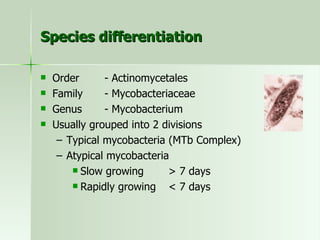
Species differentiation Order  - Actinomycetales Family - Mycobacteriaceae Genus - Mycobacterium Usually grouped into 2 divisions  Typical mycobacteria (MTb Complex) Atypical mycobacteria Slow growing  > 7 days Rapidly growing  < 7 days
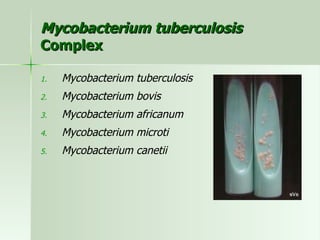
Mycobacterium tuberculosis  Complex Mycobacterium tuberculosis Mycobacterium bovis Mycobacterium africanum Mycobacterium microti Mycobacterium canetii
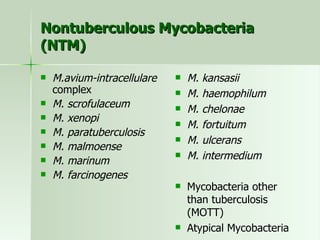
M.avium-intracellulare  complex   M. scrofulaceum   M. xenopi M. paratuberculosis M. malmoense M. marinum M. farcinogenes M.  k ansasii M. haemophilum   M. chelonae M. fortuitum M. ulcerans M. intermedium Mycobacteria other than tuberculosis (MOTT) Atypical Mycobacteria Nontuberculous Mycobacteria (NTM)
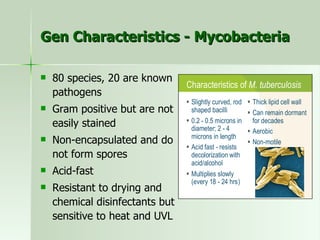
Gen Characteristics - Mycobacteria  80  species, 20 are known pathogens  Gram positive but are not easily stained Non-encapsulated and do not form spores Acid-fast Resistant to drying and chemical disinfectants but sensitive to heat and UVL
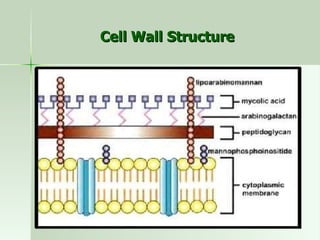
Lipids (60% of the cell wall weight) Mycolic acid – responsible for acid fastness Phospholipids – induce caseation necrosis Cord factor (trehaloses) Present in virulent strains that grow in a cord like pattern It inhibits migration of leukocytes Causes chronic granulomas Components of cell wall
Protein Tuberculin reaction Elicit formation of antibodies Granuloma formation Lipopolysaccharides (Lipoarabinomannan LAM) Inhibition of macrophage activation by IFN Release of cytokines (TNF  ) from macrophages which causes fever, weight loss and tissue damage
Cell Wall Structure
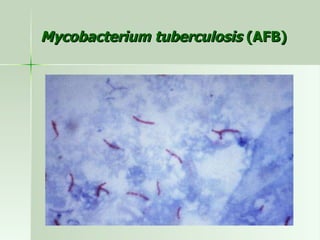
Mycobacterium tuberculosis  (AFB)

Mycobacterium tuberculosis

  • 1.
    Mycobacterium tuberculosis DrKamran Afzal Asst Prof Microbiology
  • 2.
    Tuberculosis -The Captain of Death
  • 3.
    Historical background Neolithictime 2400 BC - Egyptian mummies spinal columns 460 BC Hippocrates, Greece First clinical description: Phthisis / Consumption 500-1500 AD Roman occupation of Europe, it spread to Britain 1650-1900 AD ‘ White plague’ of Europe 1:5 deaths
  • 4.
    1890 (Robert Koch)Discovery of staining technique that identified Bacillus tuberculosis Definite diagnosis made possible and thus treatment could begin Tuberculin’s diagnostic use discovered
  • 5.
    1908-1920 Vaccine(BCG) 1943 (Selman Abraham Waksman) Streptomycin discovered Injections dramatically recovered TB patients
  • 6.
    Mycobacteria The namemycobacterium means “fungus bacterium” due to fungus-like pellicle formed by Mycobacterium tuberculosis in liquid media
  • 7.
    Species differentiation Order - Actinomycetales Family - Mycobacteriaceae Genus - Mycobacterium Usually grouped into 2 divisions Typical mycobacteria (MTb Complex) Atypical mycobacteria Slow growing > 7 days Rapidly growing < 7 days
  • 8.
    Mycobacterium tuberculosis Complex Mycobacterium tuberculosis Mycobacterium bovis Mycobacterium africanum Mycobacterium microti Mycobacterium canetii
  • 9.
    M.avium-intracellulare complex M. scrofulaceum M. xenopi M. paratuberculosis M. malmoense M. marinum M. farcinogenes M. k ansasii M. haemophilum M. chelonae M. fortuitum M. ulcerans M. intermedium Mycobacteria other than tuberculosis (MOTT) Atypical Mycobacteria Nontuberculous Mycobacteria (NTM)
  • 10.
    Gen Characteristics -Mycobacteria 80 species, 20 are known pathogens Gram positive but are not easily stained Non-encapsulated and do not form spores Acid-fast Resistant to drying and chemical disinfectants but sensitive to heat and UVL
  • 11.
    Lipids (60% ofthe cell wall weight) Mycolic acid – responsible for acid fastness Phospholipids – induce caseation necrosis Cord factor (trehaloses) Present in virulent strains that grow in a cord like pattern It inhibits migration of leukocytes Causes chronic granulomas Components of cell wall
  • 12.
    Protein Tuberculin reactionElicit formation of antibodies Granuloma formation Lipopolysaccharides (Lipoarabinomannan LAM) Inhibition of macrophage activation by IFN Release of cytokines (TNF  ) from macrophages which causes fever, weight loss and tissue damage
  • 13.
  • 14.