RK Goit, Lecturer
Department of Physiology
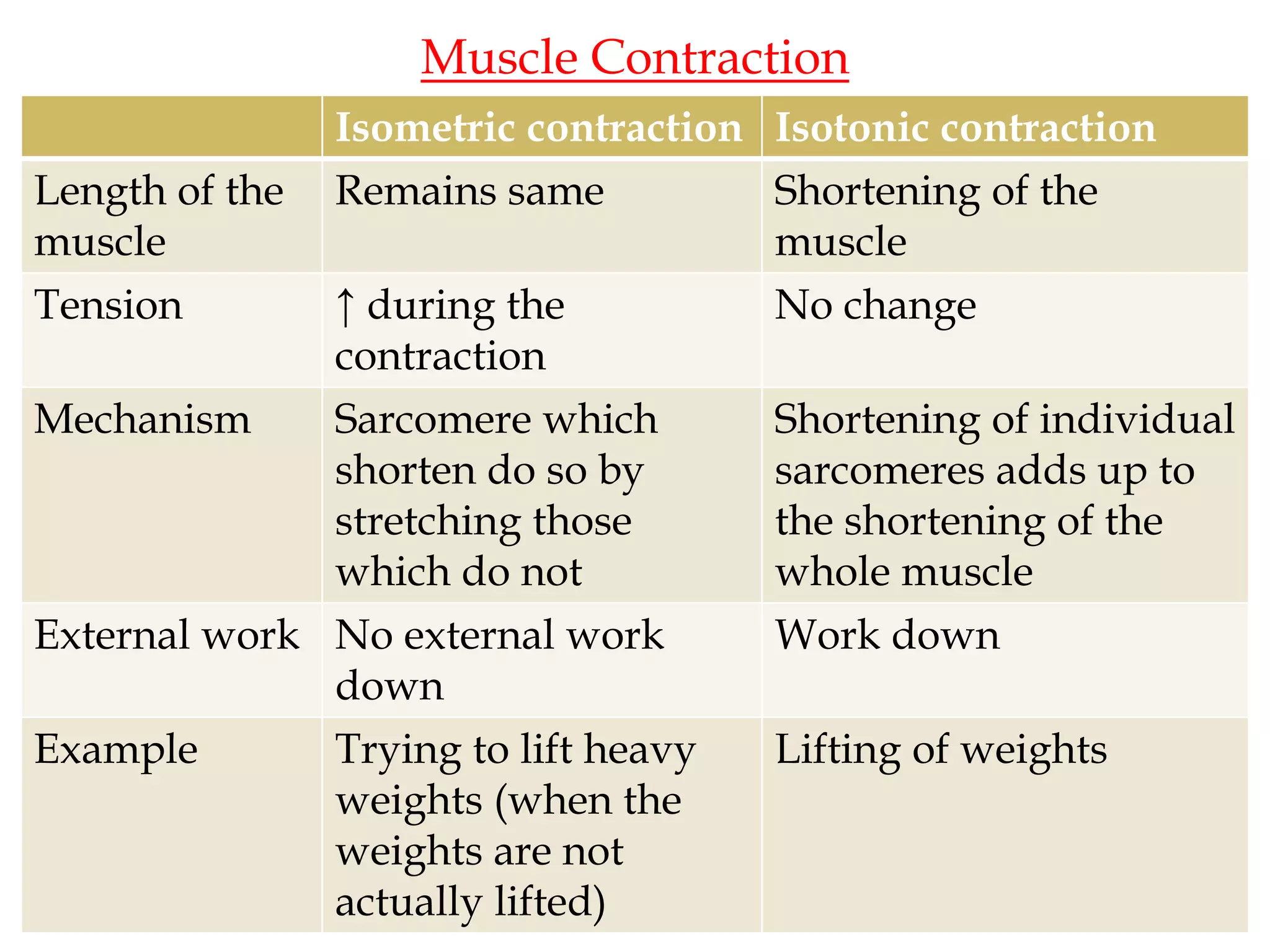
Muscle Contraction
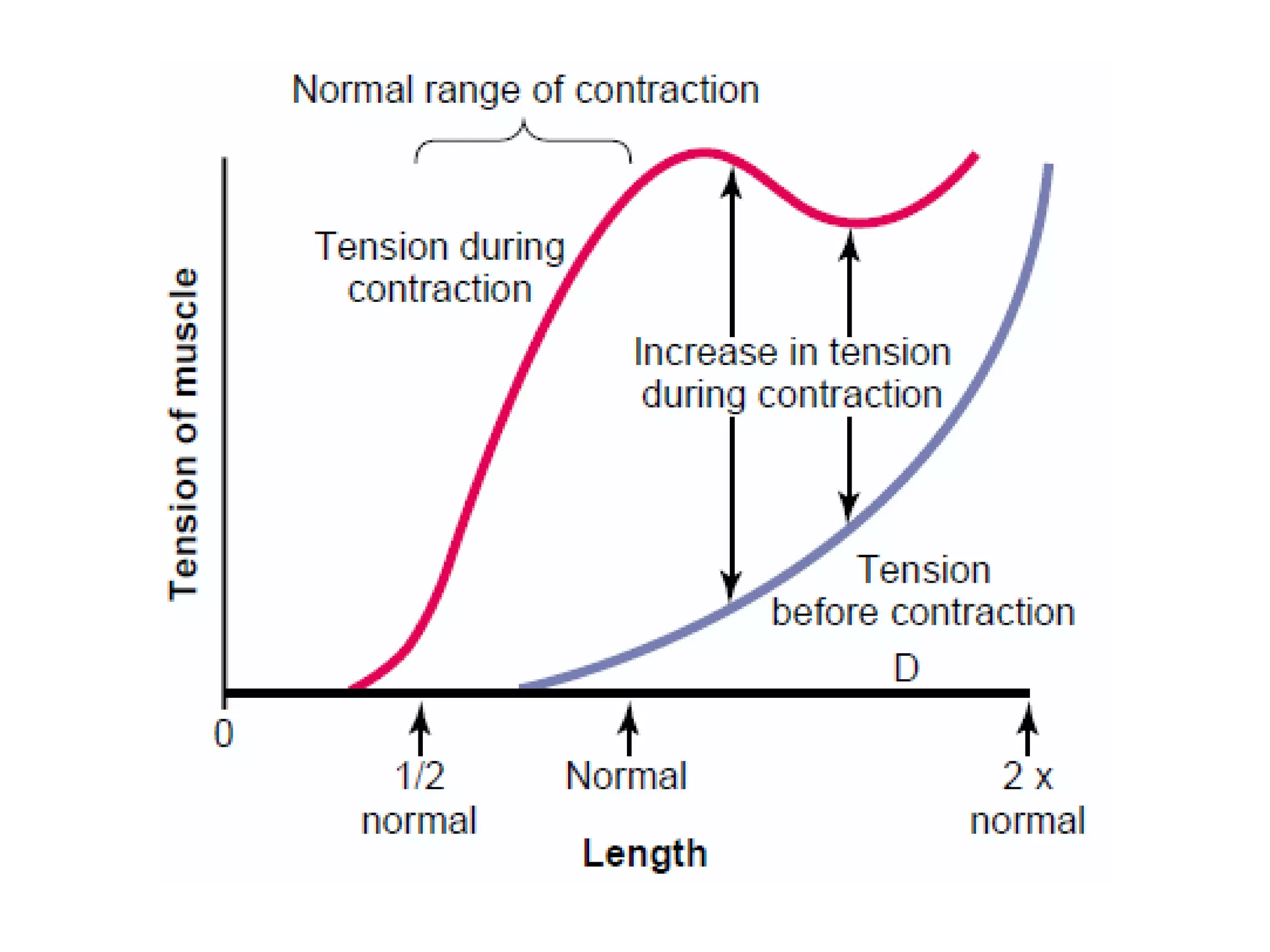
Isometric contraction Isotonic contraction
Length of the
muscle
Remains same Shortening of the
muscle
Tension ↑ during the
contraction
No change
Mechanism Sarcomere which
shorten do so by
stretching those
which do not
Shortening of individual
sarcomeres adds up to
the shortening of the
whole muscle
External work No external work
down
Work down
Example Trying to lift heavy
weights (when the
weights are not
actually lifted)
Lifting of weights
Energetics of Muscle Contraction
 when a muscle contracts against a load, it performs
work
 energy is transferred from the muscle to the
external load to lift an object
 energy required to perform the work is derived
from the chemical reactions in the muscle cells
during contraction
 muscle contraction depends on energy supplied by
ATP
 required to actuate the walk-along mechanism
 pumping Ca++ from sarcoplasm into SR
 pumping Na+ & K+
 concentration of ATP in muscle fiber is sufficient to
maintain full contraction for only 1 to 2 s
 ADP is rephosphorylated to form new ATP within
another fraction of a second
 There are several sources of the energy for this
rephosphorylation.
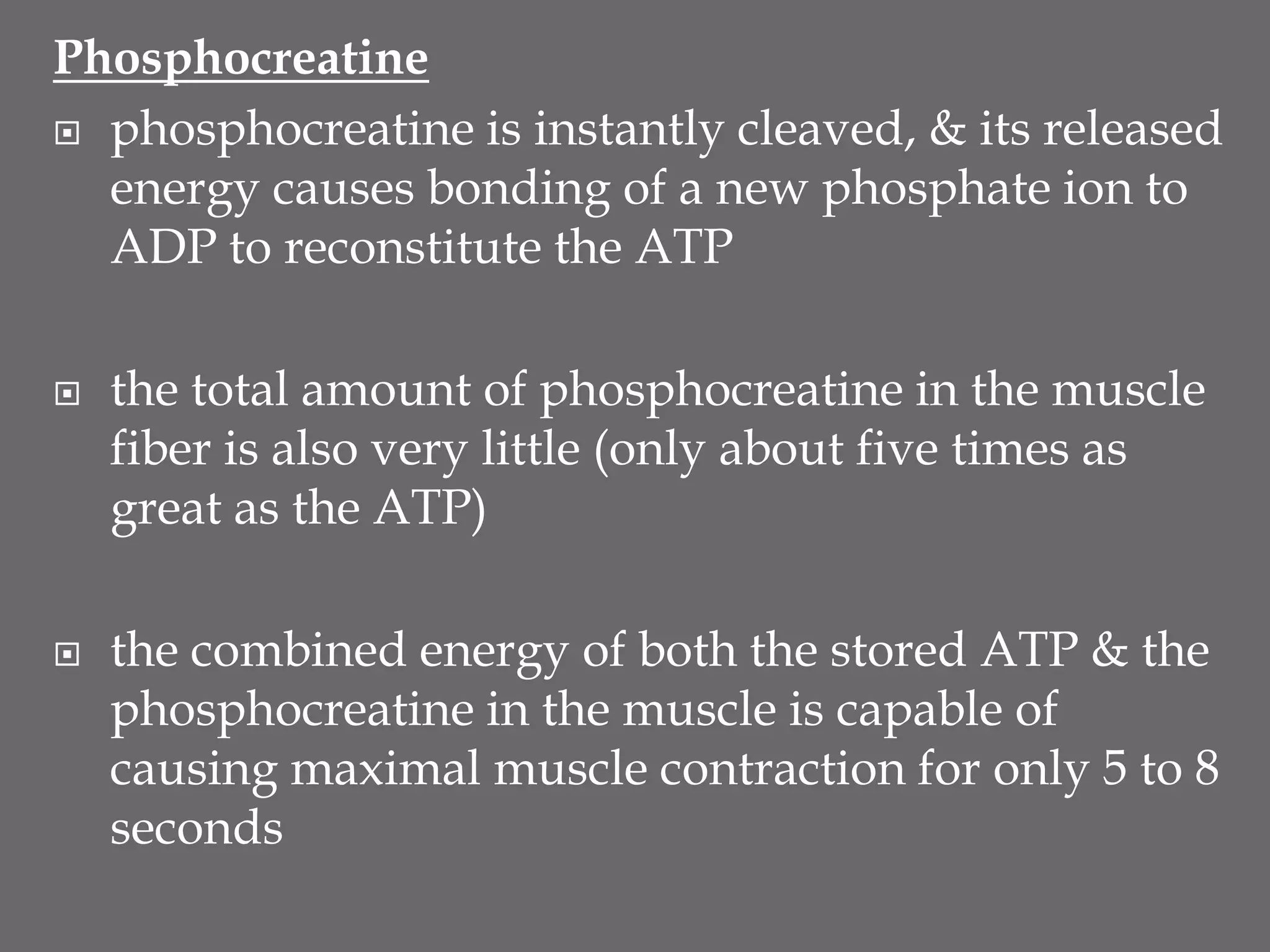
Phosphocreatine
 phosphocreatine is instantly cleaved, & its released
energy causes bonding of a new phosphate ion to
ADP to reconstitute the ATP
 the total amount of phosphocreatine in the muscle
fiber is also very little (only about five times as
great as the ATP)
 the combined energy of both the stored ATP & the
phosphocreatine in the muscle is capable of
causing maximal muscle contraction for only 5 to 8
seconds
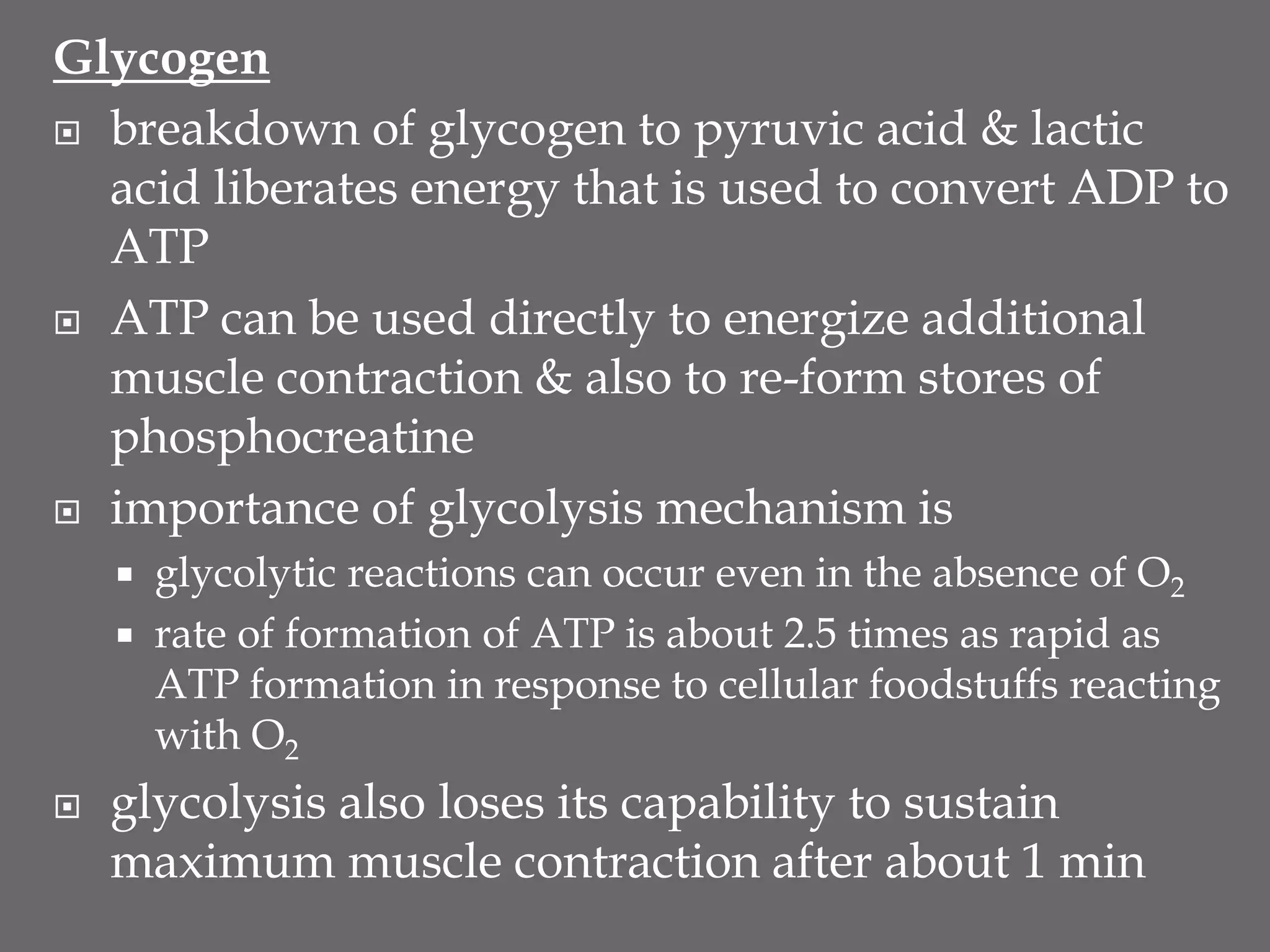
Glycogen
 breakdown of glycogen to pyruvic acid & lactic
acid liberates energy that is used to convert ADP to
ATP
 ATP can be used directly to energize additional
muscle contraction & also to re-form stores of
phosphocreatine
 importance of glycolysis mechanism is
 glycolytic reactions can occur even in the absence of O2
 rate of formation of ATP is about 2.5 times as rapid as
ATP formation in response to cellular foodstuffs reacting
with O2
 glycolysis also loses its capability to sustain
maximum muscle contraction after about 1 min
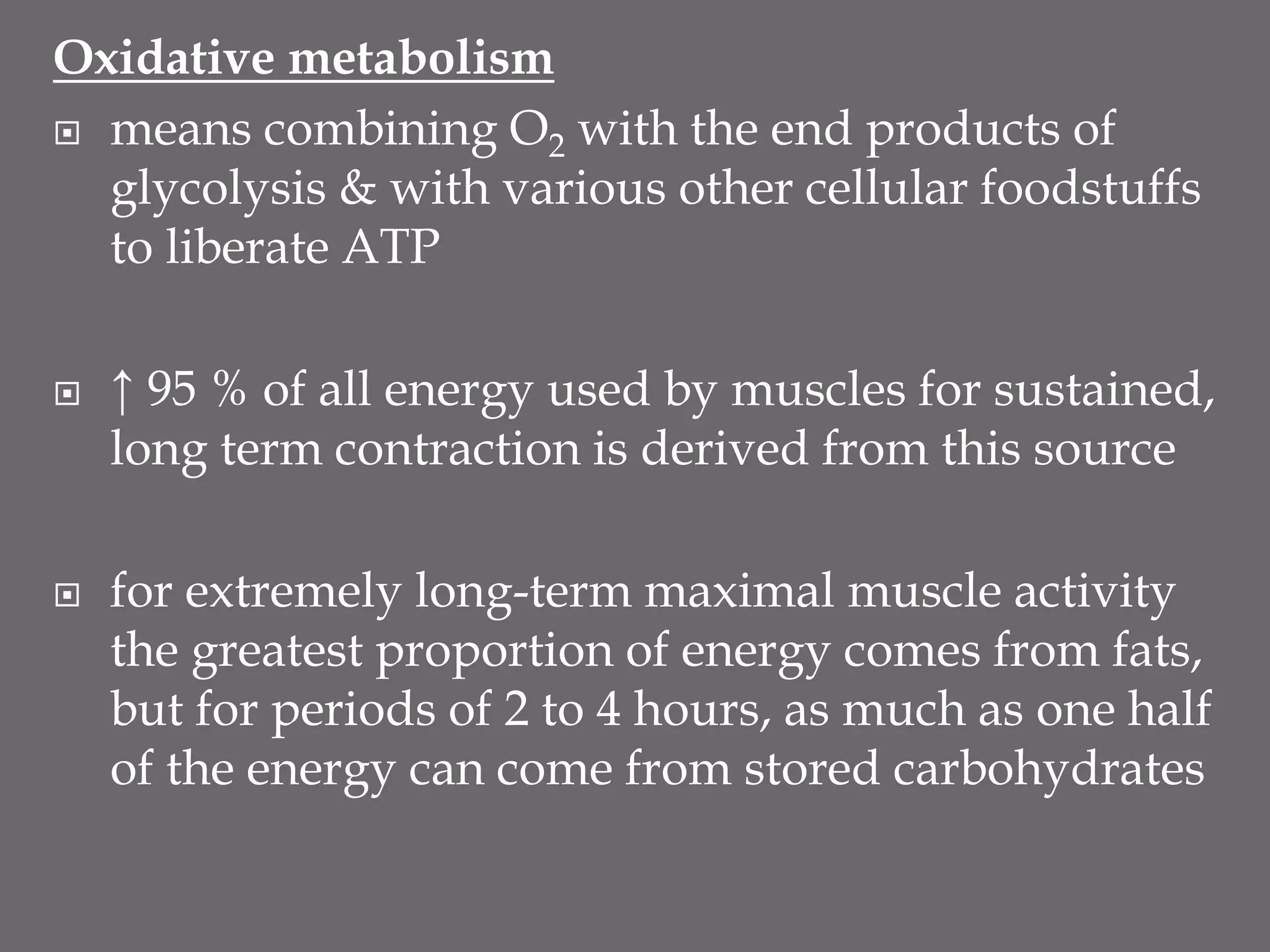
Oxidative metabolism
 means combining O2 with the end products of
glycolysis & with various other cellular foodstuffs
to liberate ATP
 ↑ 95 % of all energy used by muscles for sustained,
long term contraction is derived from this source
 for extremely long-term maximal muscle activity
the greatest proportion of energy comes from fats,
but for periods of 2 to 4 hours, as much as one half
of the energy can come from stored carbohydrates
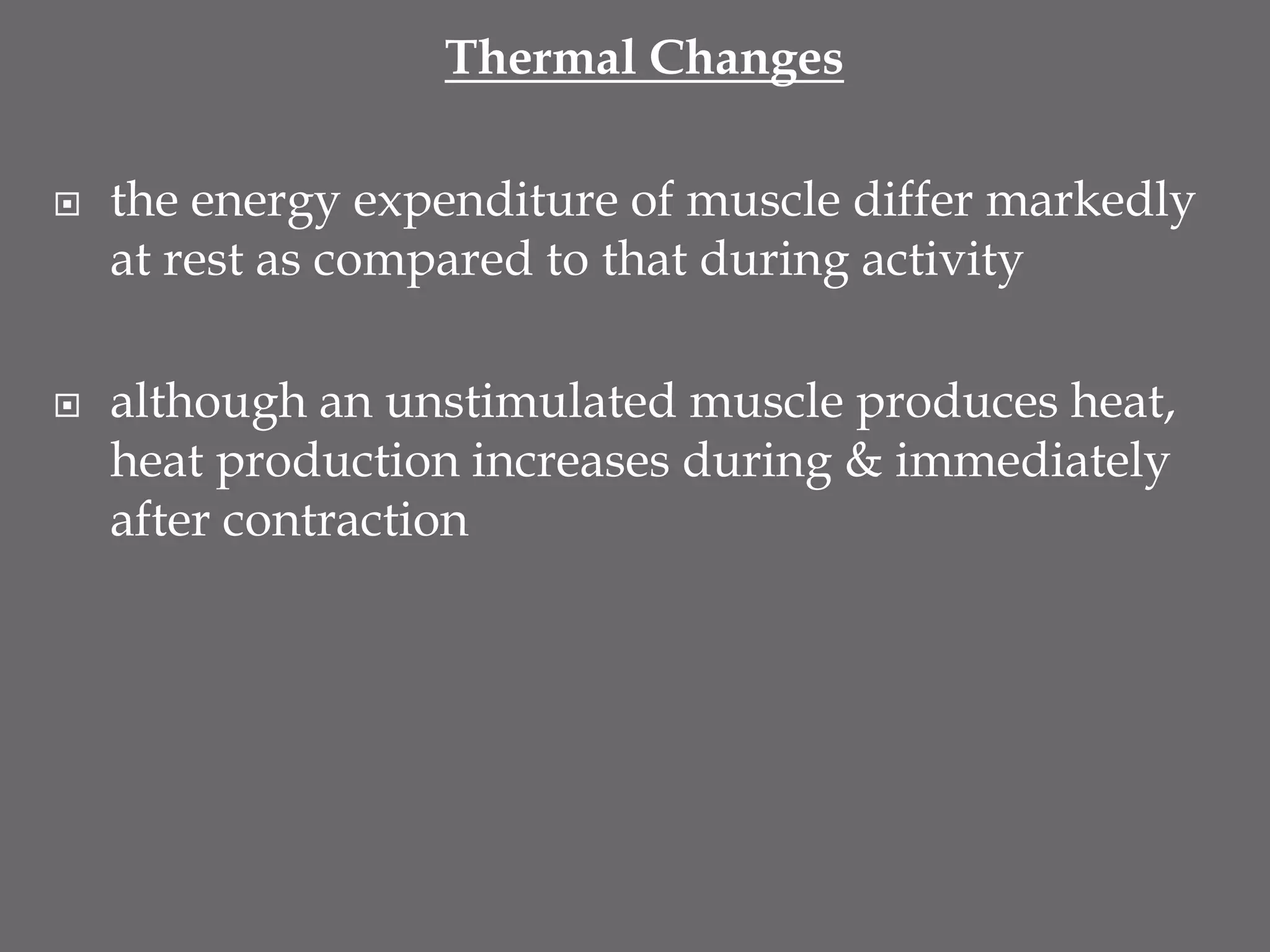
Thermal Changes
 the energy expenditure of muscle differ markedly
at rest as compared to that during activity
 although an unstimulated muscle produces heat,
heat production increases during & immediately
after contraction
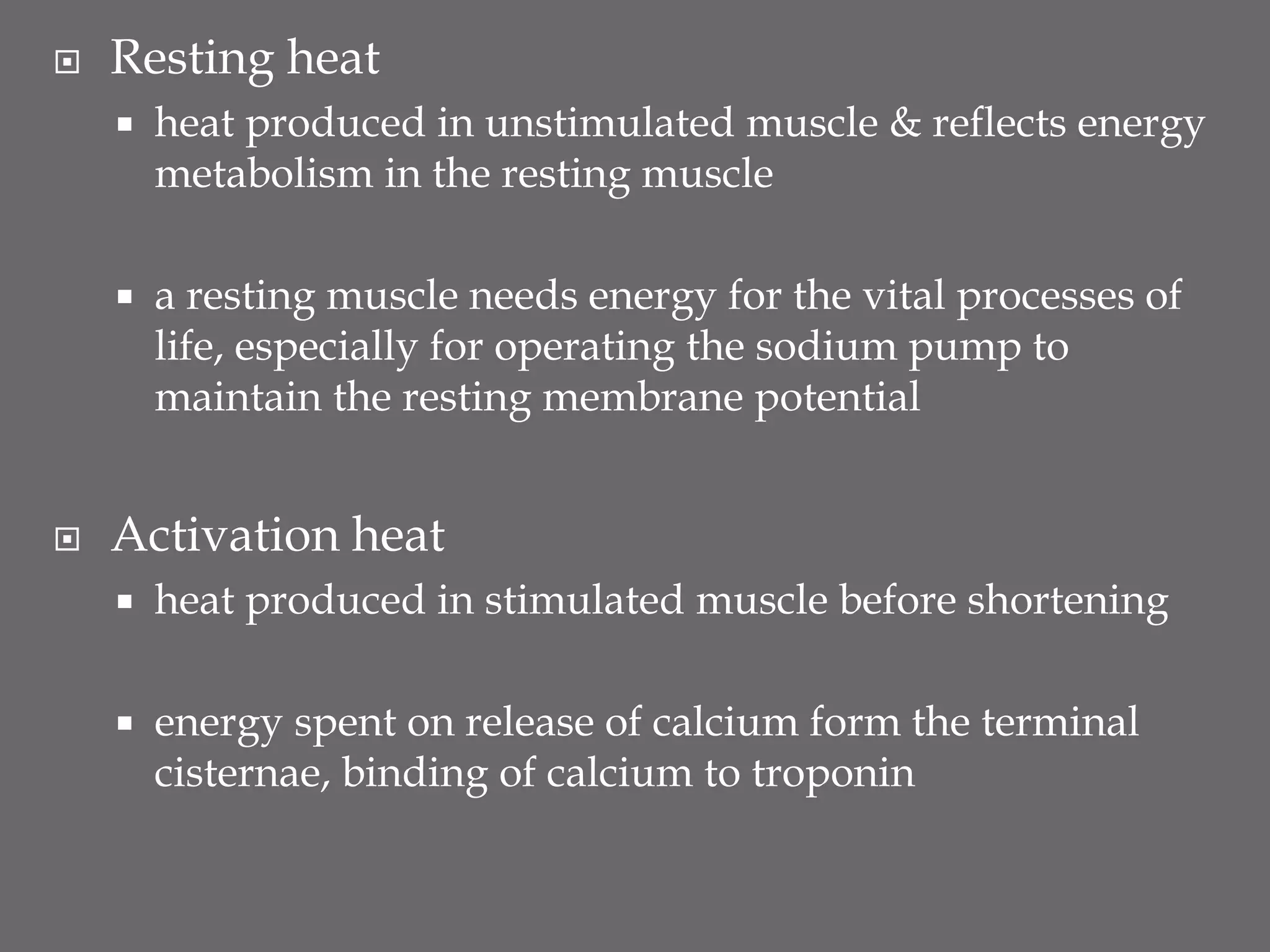
 Resting heat
 heat produced in unstimulated muscle & reflects energy
metabolism in the resting muscle
 a resting muscle needs energy for the vital processes of
life, especially for operating the sodium pump to
maintain the resting membrane potential
 Activation heat
 heat produced in stimulated muscle before shortening
 energy spent on release of calcium form the terminal
cisternae, binding of calcium to troponin
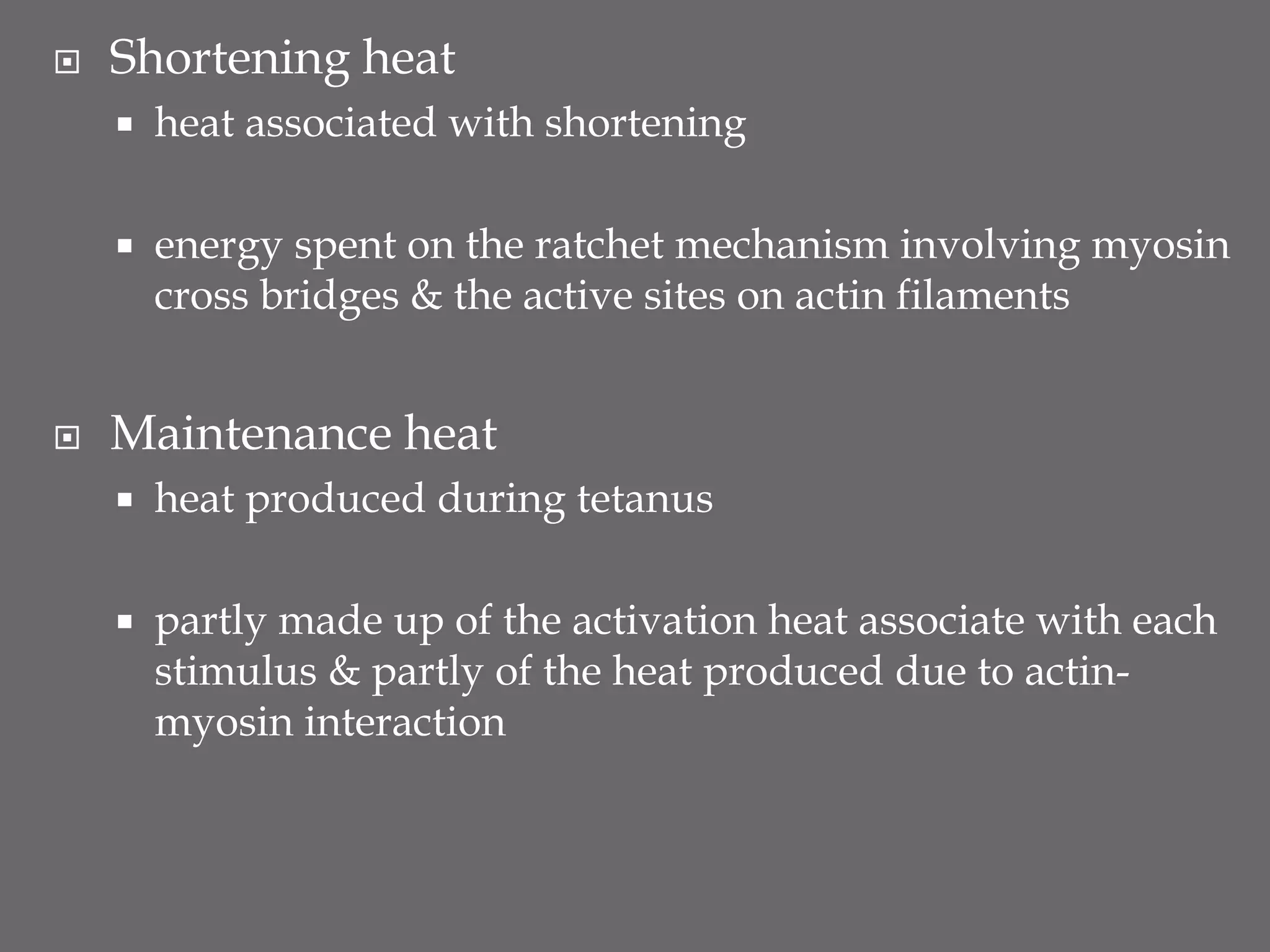
 Shortening heat
 heat associated with shortening
 energy spent on the ratchet mechanism involving myosin
cross bridges & the active sites on actin filaments
 Maintenance heat
 heat produced during tetanus
 partly made up of the activation heat associate with each
stimulus & partly of the heat produced due to actin-
myosin interaction
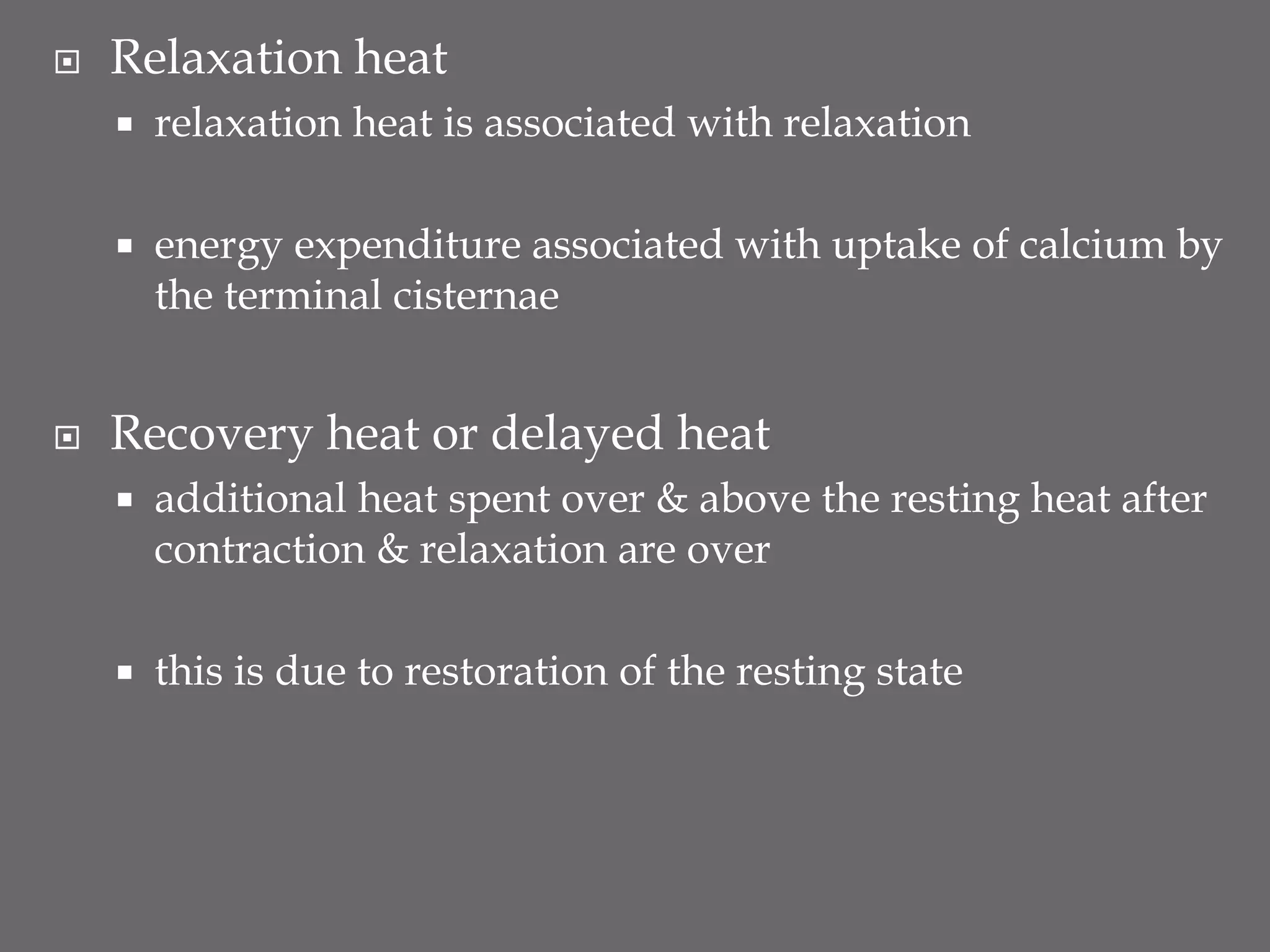
 Relaxation heat
 relaxation heat is associated with relaxation
 energy expenditure associated with uptake of calcium by
the terminal cisternae
 Recovery heat or delayed heat
 additional heat spent over & above the resting heat after
contraction & relaxation are over
 this is due to restoration of the resting state
References
 Textbook of Medical Physiology, 12/E Guyton &
Hall
 Understanding Medical Physiology, 4/E Bijlani &
Manjunatha
Thank You

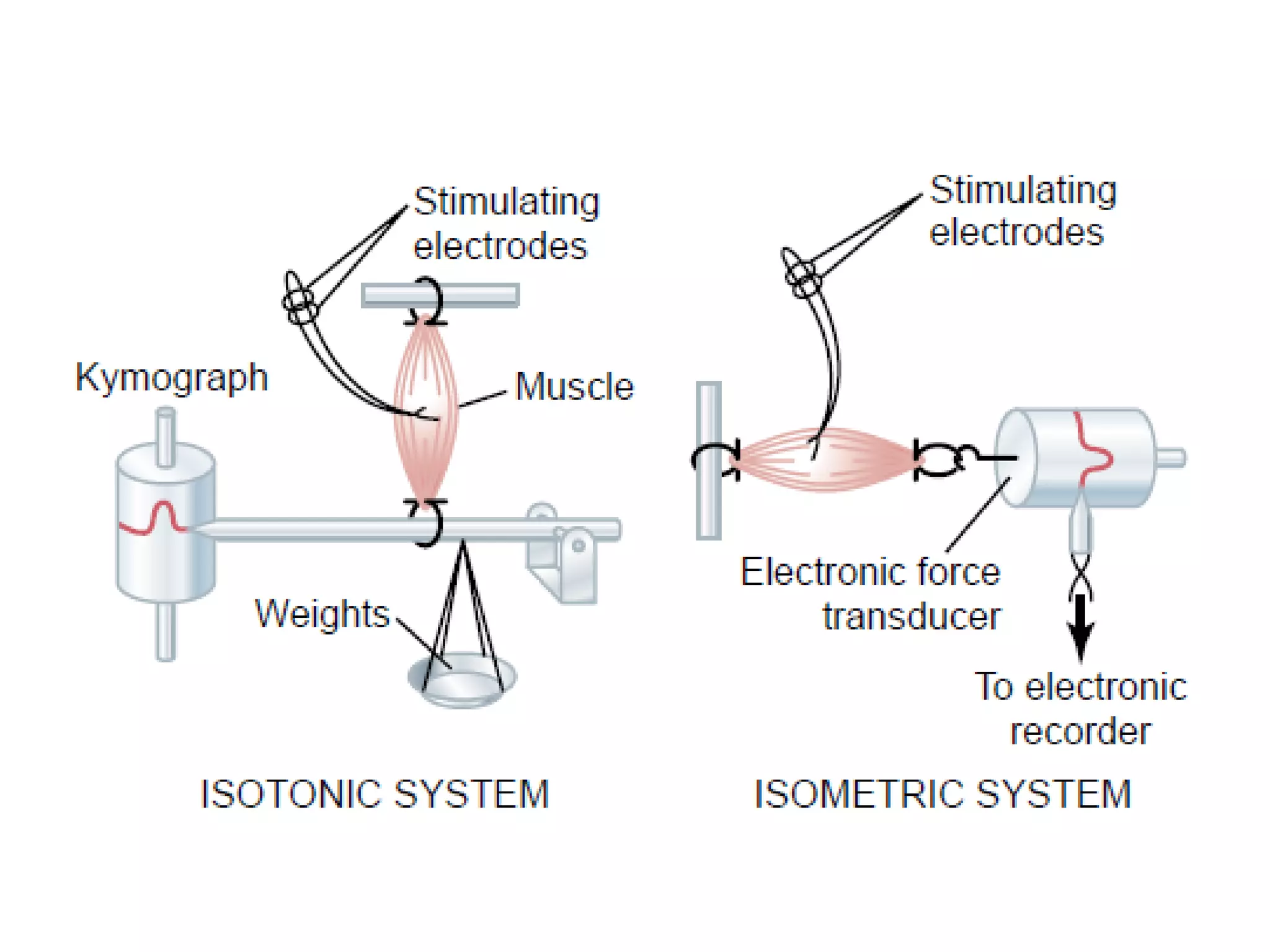
Isotonic & isometric contraction

  • 1.
  • 2.
    Muscle Contraction Isometric contractionIsotonic contraction Length of the muscle Remains same Shortening of the muscle Tension ↑ during the contraction No change Mechanism Sarcomere which shorten do so by stretching those which do not Shortening of individual sarcomeres adds up to the shortening of the whole muscle External work No external work down Work down Example Trying to lift heavy weights (when the weights are not actually lifted) Lifting of weights
  • 7.
    Energetics of MuscleContraction  when a muscle contracts against a load, it performs work  energy is transferred from the muscle to the external load to lift an object  energy required to perform the work is derived from the chemical reactions in the muscle cells during contraction
  • 8.
     muscle contractiondepends on energy supplied by ATP  required to actuate the walk-along mechanism  pumping Ca++ from sarcoplasm into SR  pumping Na+ & K+  concentration of ATP in muscle fiber is sufficient to maintain full contraction for only 1 to 2 s  ADP is rephosphorylated to form new ATP within another fraction of a second  There are several sources of the energy for this rephosphorylation.
  • 9.
    Phosphocreatine  phosphocreatine isinstantly cleaved, & its released energy causes bonding of a new phosphate ion to ADP to reconstitute the ATP  the total amount of phosphocreatine in the muscle fiber is also very little (only about five times as great as the ATP)  the combined energy of both the stored ATP & the phosphocreatine in the muscle is capable of causing maximal muscle contraction for only 5 to 8 seconds
  • 10.
    Glycogen  breakdown ofglycogen to pyruvic acid & lactic acid liberates energy that is used to convert ADP to ATP  ATP can be used directly to energize additional muscle contraction & also to re-form stores of phosphocreatine  importance of glycolysis mechanism is  glycolytic reactions can occur even in the absence of O2  rate of formation of ATP is about 2.5 times as rapid as ATP formation in response to cellular foodstuffs reacting with O2  glycolysis also loses its capability to sustain maximum muscle contraction after about 1 min
  • 11.
    Oxidative metabolism  meanscombining O2 with the end products of glycolysis & with various other cellular foodstuffs to liberate ATP  ↑ 95 % of all energy used by muscles for sustained, long term contraction is derived from this source  for extremely long-term maximal muscle activity the greatest proportion of energy comes from fats, but for periods of 2 to 4 hours, as much as one half of the energy can come from stored carbohydrates
  • 12.
    Thermal Changes  theenergy expenditure of muscle differ markedly at rest as compared to that during activity  although an unstimulated muscle produces heat, heat production increases during & immediately after contraction
  • 13.
     Resting heat heat produced in unstimulated muscle & reflects energy metabolism in the resting muscle  a resting muscle needs energy for the vital processes of life, especially for operating the sodium pump to maintain the resting membrane potential  Activation heat  heat produced in stimulated muscle before shortening  energy spent on release of calcium form the terminal cisternae, binding of calcium to troponin
  • 14.
     Shortening heat heat associated with shortening  energy spent on the ratchet mechanism involving myosin cross bridges & the active sites on actin filaments  Maintenance heat  heat produced during tetanus  partly made up of the activation heat associate with each stimulus & partly of the heat produced due to actin- myosin interaction
  • 15.
     Relaxation heat relaxation heat is associated with relaxation  energy expenditure associated with uptake of calcium by the terminal cisternae  Recovery heat or delayed heat  additional heat spent over & above the resting heat after contraction & relaxation are over  this is due to restoration of the resting state
  • 16.
    References  Textbook ofMedical Physiology, 12/E Guyton & Hall  Understanding Medical Physiology, 4/E Bijlani & Manjunatha
  • 17.