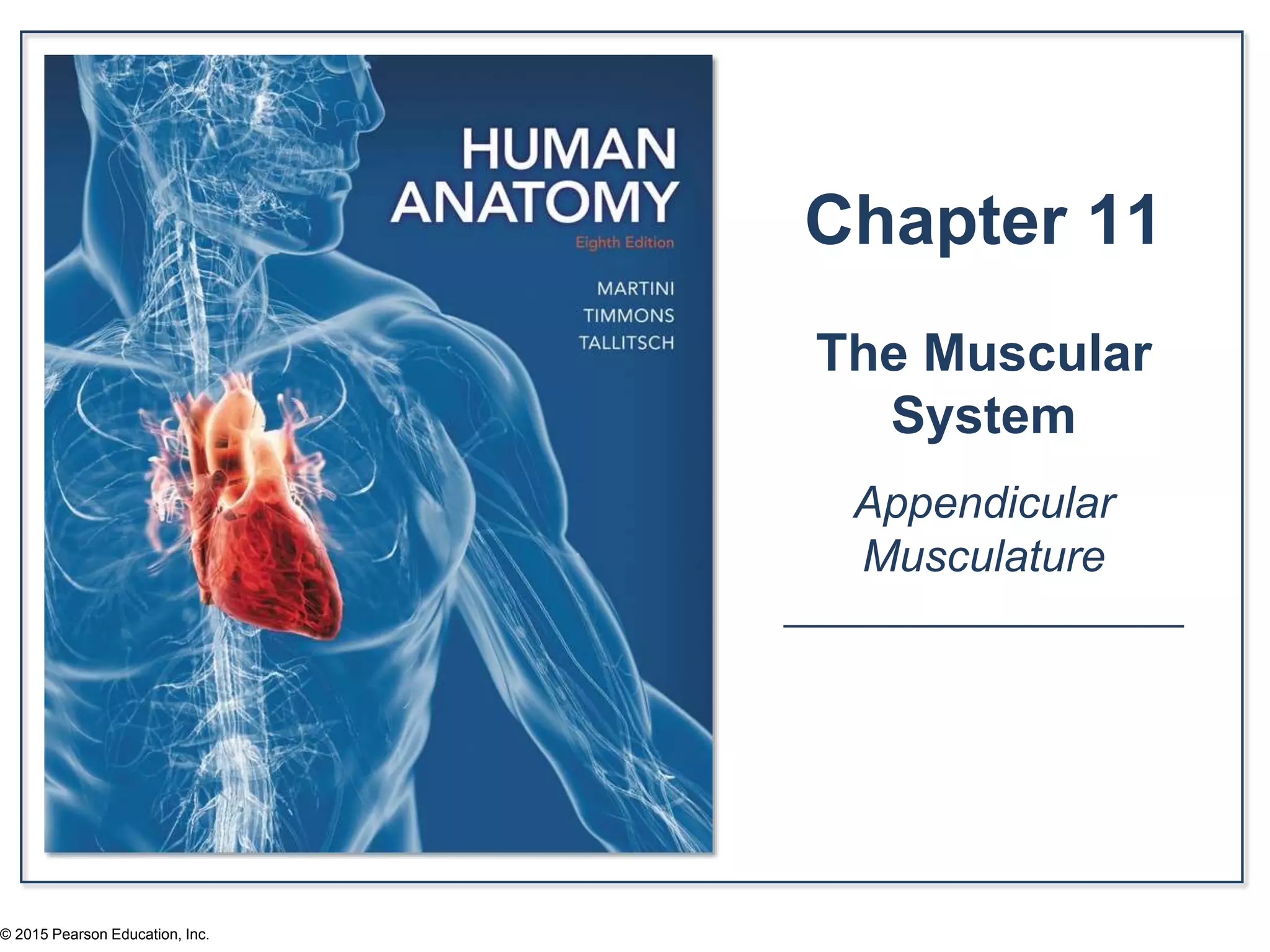
Chapter 11
The Muscular
System
Appendicular
Musculature
© 2015 Pearson Education, Inc.
Introduction
• Appendicular Musculature
• Appendicular muscles are responsible for:
• Stabilizing the pectoral and pelvic girdles
• Moving the upper and lower limbs
• Absorbing shocks and jolts as you walk, run, or jump
• Aiding in strengthening the joint area
© 2015 Pearson Education, Inc.
Introduction
• Two Major Groups of Appendicular Muscles
• The muscles of the pectoral girdle and upper limbs
• The muscles of the pelvic girdle and lower limbs
© 2015 Pearson Education, Inc.
Factors Affecting Appendicular Muscle
Function
• Action Lines of the Muscle
• Flexion and extension at the shoulder joint
• Adduction and abduction at the shoulder joint
• Medial and lateral rotation at the shoulder joint
• Action lines at the hip joint
• Spurt and Shunt Muscles
© 2015 Pearson Education, Inc.
Figure 11.2 Factors Affecting Appendicular Muscle Function (7 of 7)
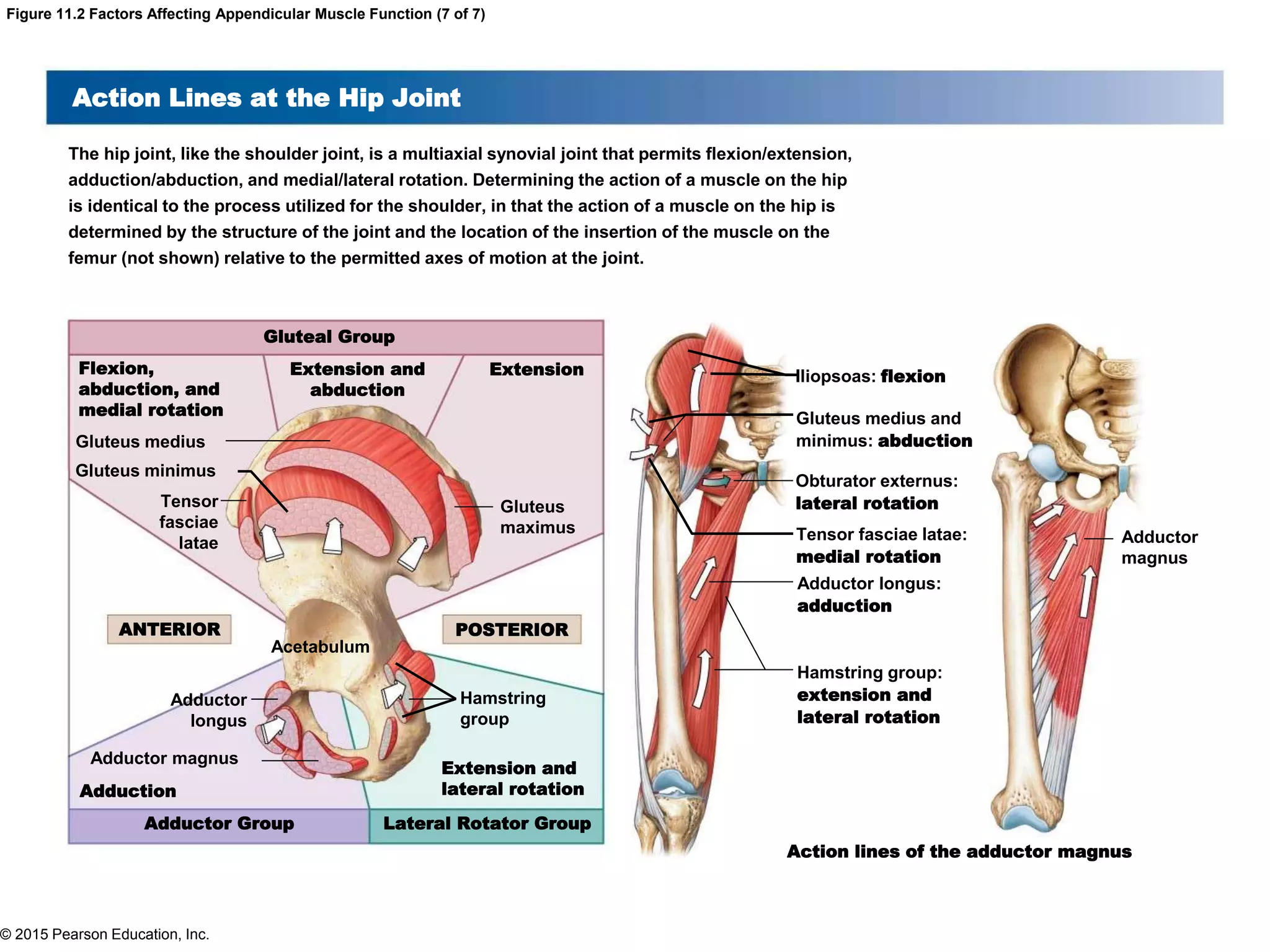
Action Lines at the Hip Joint
The hip joint, like the shoulder joint, is a multiaxial synovial joint that permits flexion/extension,
adduction/abduction, and medial/lateral rotation. Determining the action of a muscle on the hip
is identical to the process utilized for the shoulder, in that the action of a muscle on the hip is
determined by the structure of the joint and the location of the insertion of the muscle on the
femur (not shown) relative to the permitted axes of motion at the joint.
Adductor
magnus
Iliopsoas: flexion
Gluteus medius and
minimus: abduction
Obturator externus:
lateral rotation
Tensor fasciae latae:
medial rotation
Adductor longus:
adduction
Hamstring group:
extension and
lateral rotation
Action lines of the adductor magnus
Gluteal Group
ExtensionExtension and
abduction
Flexion,
abduction, and
medial rotation
Lateral Rotator GroupAdductor Group
Extension and
lateral rotationAdduction
ANTERIOR POSTERIOR
Gluteus
maximus
Gluteus medius
Gluteus minimus
Tensor
fasciae
latae
Acetabulum
Hamstring
group
Adductor
longus
Adductor magnus
© 2015 Pearson Education, Inc.
Figure 11.2 Factors Affecting Appendicular Muscle Function (6 of 7)
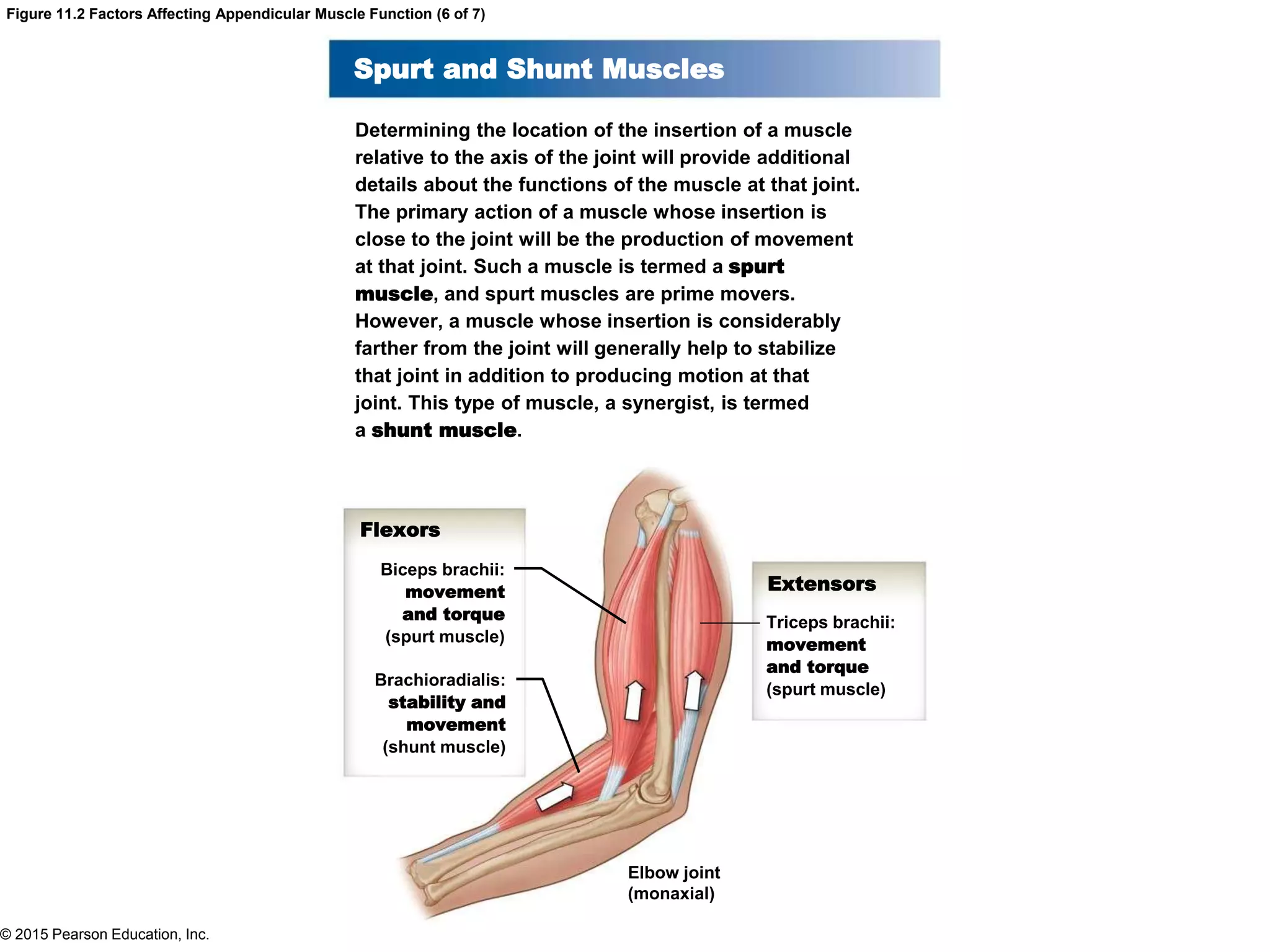
Spurt and Shunt Muscles
Determining the location of the insertion of a muscle
relative to the axis of the joint will provide additional
details about the functions of the muscle at that joint.
The primary action of a muscle whose insertion is
close to the joint will be the production of movement
at that joint. Such a muscle is termed a spurt
muscle, and spurt muscles are prime movers.
However, a muscle whose insertion is considerably
farther from the joint will generally help to stabilize
that joint in addition to producing motion at that
joint. This type of muscle, a synergist, is termed
a shunt muscle.
Biceps brachii:
movement
and torque
(spurt muscle)
Triceps brachii:
movement
and torque
(spurt muscle)
Brachioradialis:
stability and
movement
(shunt muscle)
Extensors
Flexors
Elbow joint
(monaxial)
© 2015 Pearson Education, Inc.
Muscles of the Pectoral Girdle and Upper
Limbs
• Muscles associated with the pectoral girdle and
upper limbs can be divided into four groups
• Muscles that position the pectoral girdle
• Muscles that move the arm
• Muscles that move the forearm and hand
• Muscles that move the hand and fingers
© 2015 Pearson Education, Inc.
Muscles of the Pectoral Girdle and Upper
Limbs
• Muscles That Position the Pectoral Girdle
• These muscles also coordinate with the muscles that
move the arm
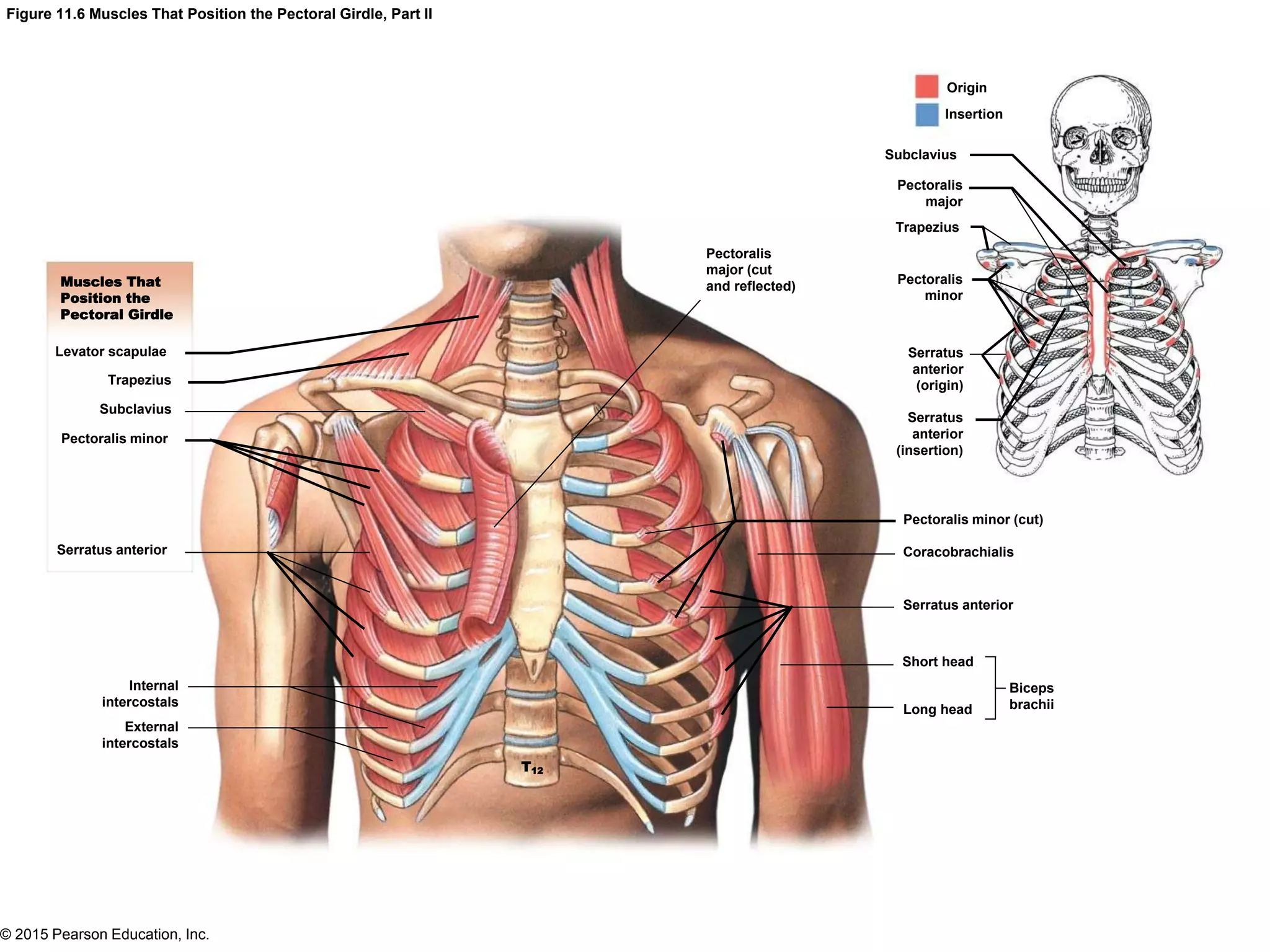
• Levator scapulae
• Elevates the scapula
• Pectoralis minor
• Protracts the shoulder
© 2015 Pearson Education, Inc.
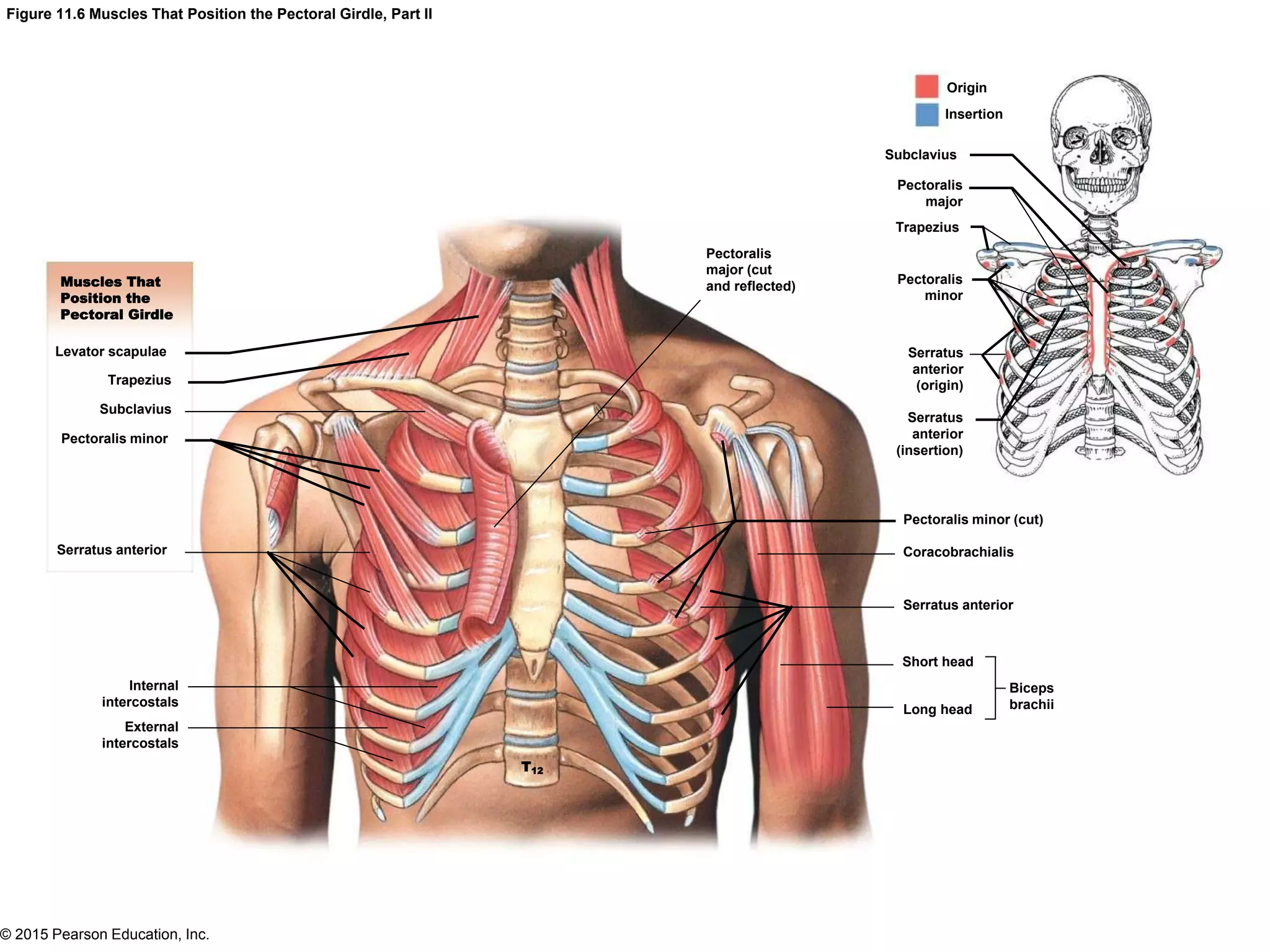
Figure 11.6 Muscles That Position the Pectoral Girdle, Part II
Muscles That
Position the
Pectoral Girdle
Levator scapulae
Trapezius
Subclavius
Pectoralis minor
Serratus anterior
Internal
intercostals
External
intercostals
T12
Short head
Long head
Biceps
brachii
Serratus anterior
Coracobrachialis
Pectoralis minor (cut)
Serratus
anterior
(insertion)
Serratus
anterior
(origin)
Pectoralis
minor
Trapezius
Pectoralis
major
Subclavius
Pectoralis
major (cut
and reflected)
Origin
Insertion
© 2015 Pearson Education, Inc.
Muscles of the Pectoral Girdle and Upper
Limbs
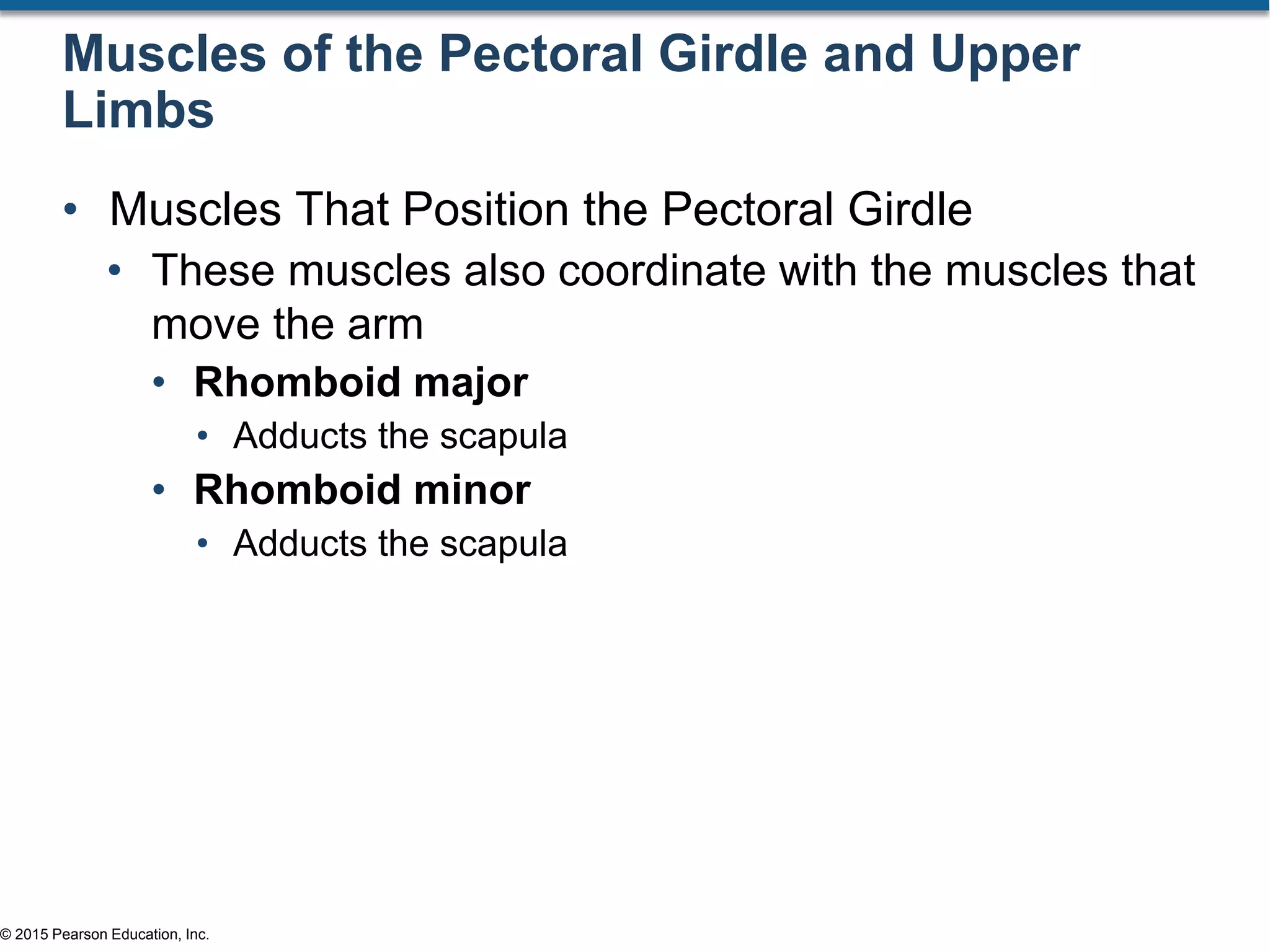
• Muscles That Position the Pectoral Girdle
• These muscles also coordinate with the muscles that
move the arm
• Rhomboid major
• Adducts the scapula
• Rhomboid minor
• Adducts the scapula
© 2015 Pearson Education, Inc.
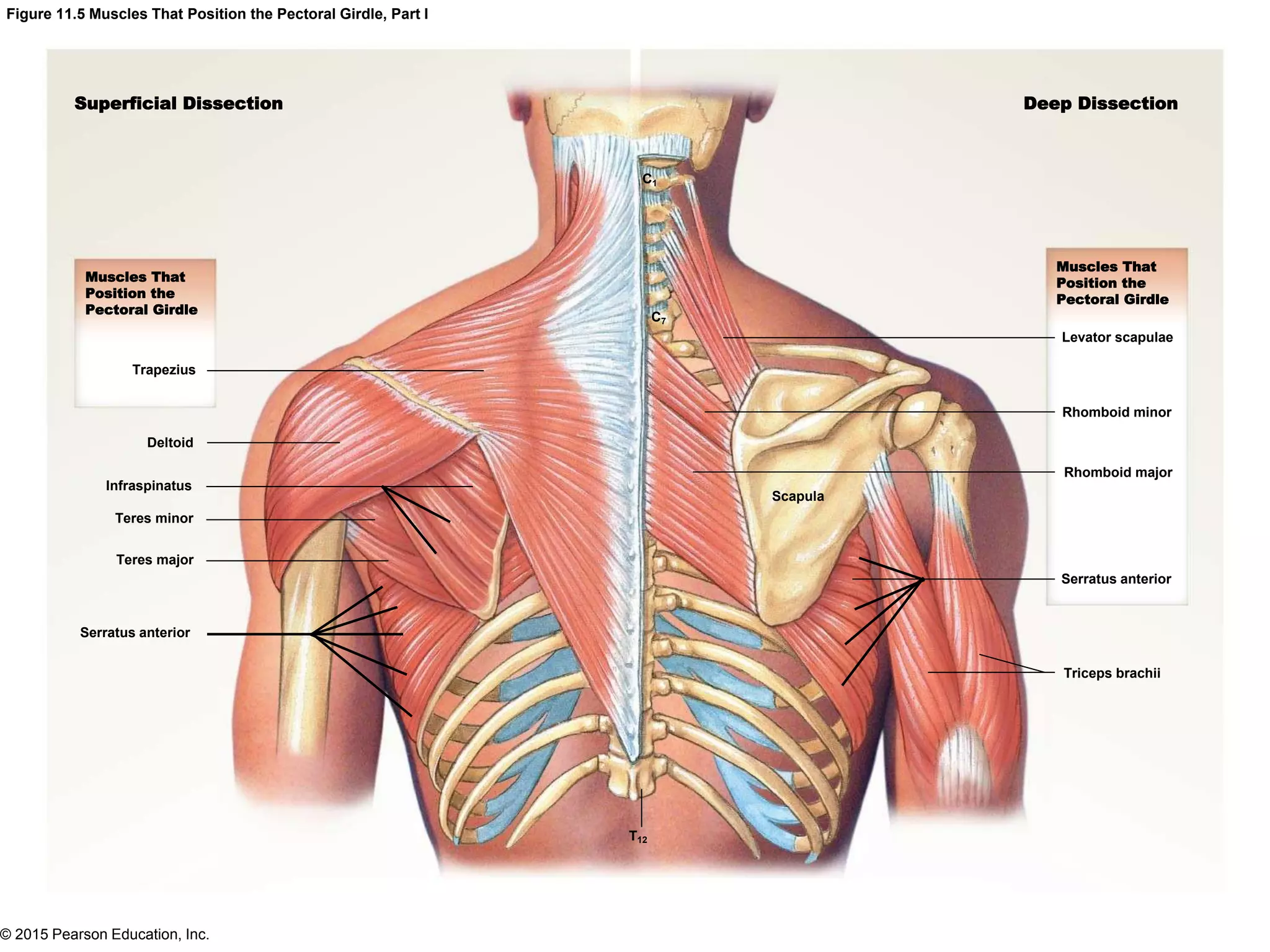
Figure 11.5 Muscles That Position the Pectoral Girdle, Part I
Superficial Dissection Deep Dissection
Muscles That
Position the
Pectoral Girdle
Muscles That
Position the
Pectoral Girdle
Levator scapulae
Rhomboid minor
Rhomboid major
Serratus anterior
Triceps brachii
Scapula
C1
C7
Trapezius
Deltoid
Infraspinatus
Teres minor
Teres major
Serratus anterior
T12
© 2015 Pearson Education, Inc.
Muscles of the Pectoral Girdle and Upper
Limbs
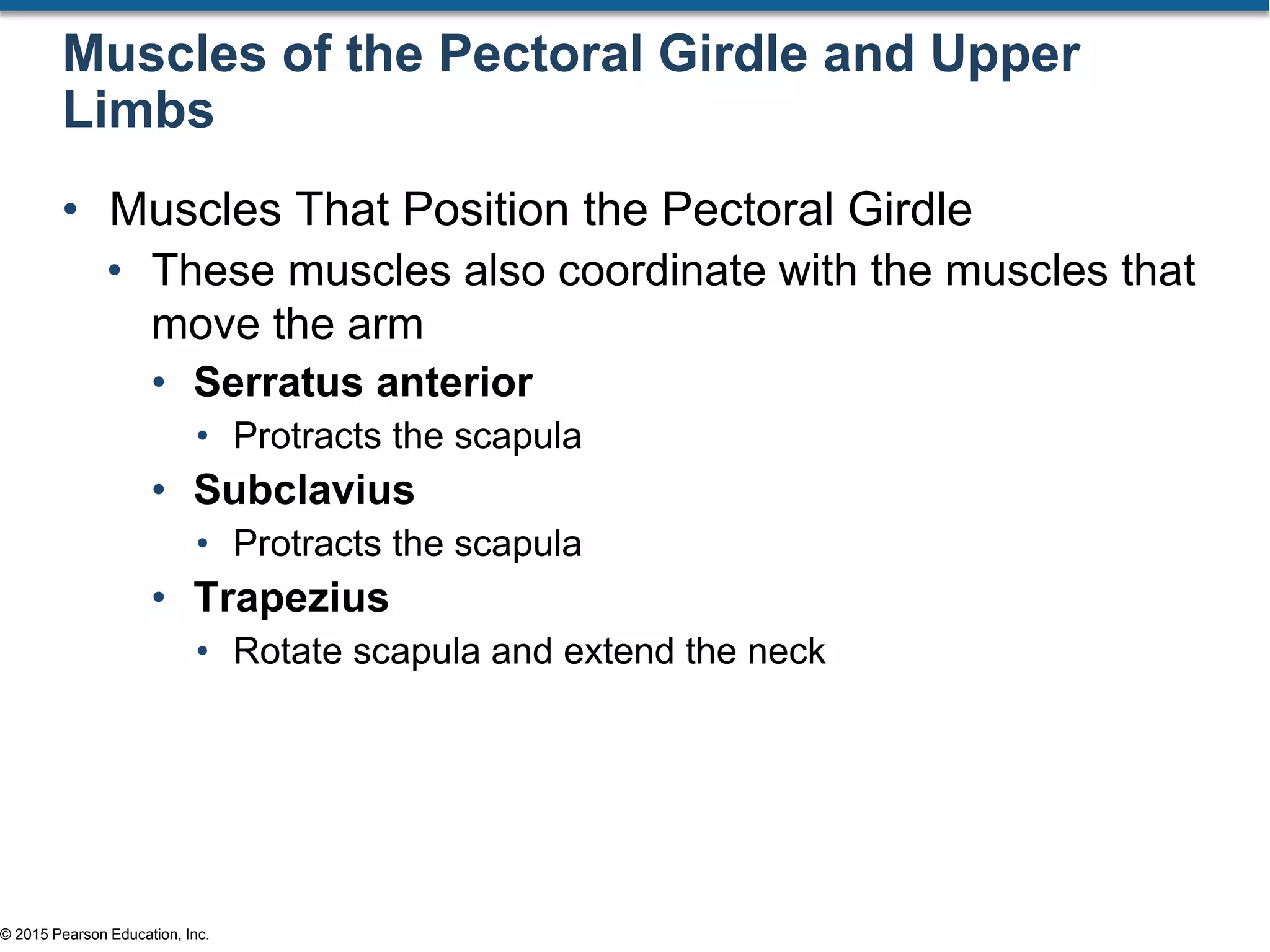
• Muscles That Position the Pectoral Girdle
• These muscles also coordinate with the muscles that
move the arm
• Serratus anterior
• Protracts the scapula
• Subclavius
• Protracts the scapula
• Trapezius
• Rotate scapula and extend the neck
© 2015 Pearson Education, Inc.
Figure 11.6 Muscles That Position the Pectoral Girdle, Part II
Muscles That
Position the
Pectoral Girdle
Levator scapulae
Trapezius
Subclavius
Pectoralis minor
Serratus anterior
Internal
intercostals
External
intercostals
T12
Short head
Long head
Biceps
brachii
Serratus anterior
Coracobrachialis
Pectoralis minor (cut)
Serratus
anterior
(insertion)
Serratus
anterior
(origin)
Pectoralis
minor
Trapezius
Pectoralis
major
Subclavius
Pectoralis
major (cut
and reflected)
Origin
Insertion
© 2015 Pearson Education, Inc.
Muscles of the Pectoral Girdle
and Upper Limbs
© 2015 Pearson Education, Inc.
A&P Flix: Muscles of the Pectoral Girdle (a)
© 2015 Pearson Education, Inc.
A&P Flix: Muscles of the Pectoral Girdle (b)
© 2015 Pearson Education, Inc.
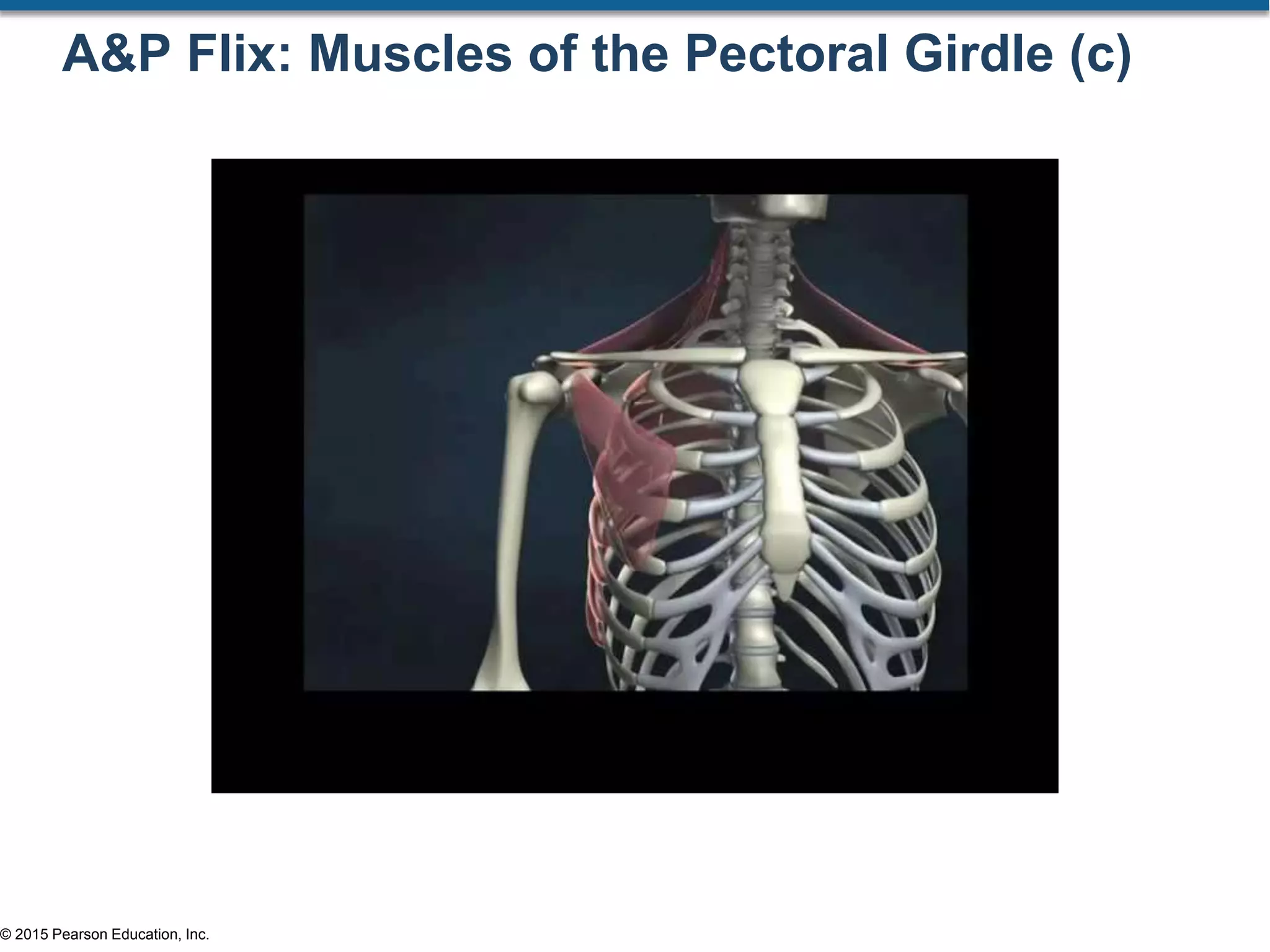
A&P Flix: Muscles of the Pectoral Girdle (c)
© 2015 Pearson Education, Inc.
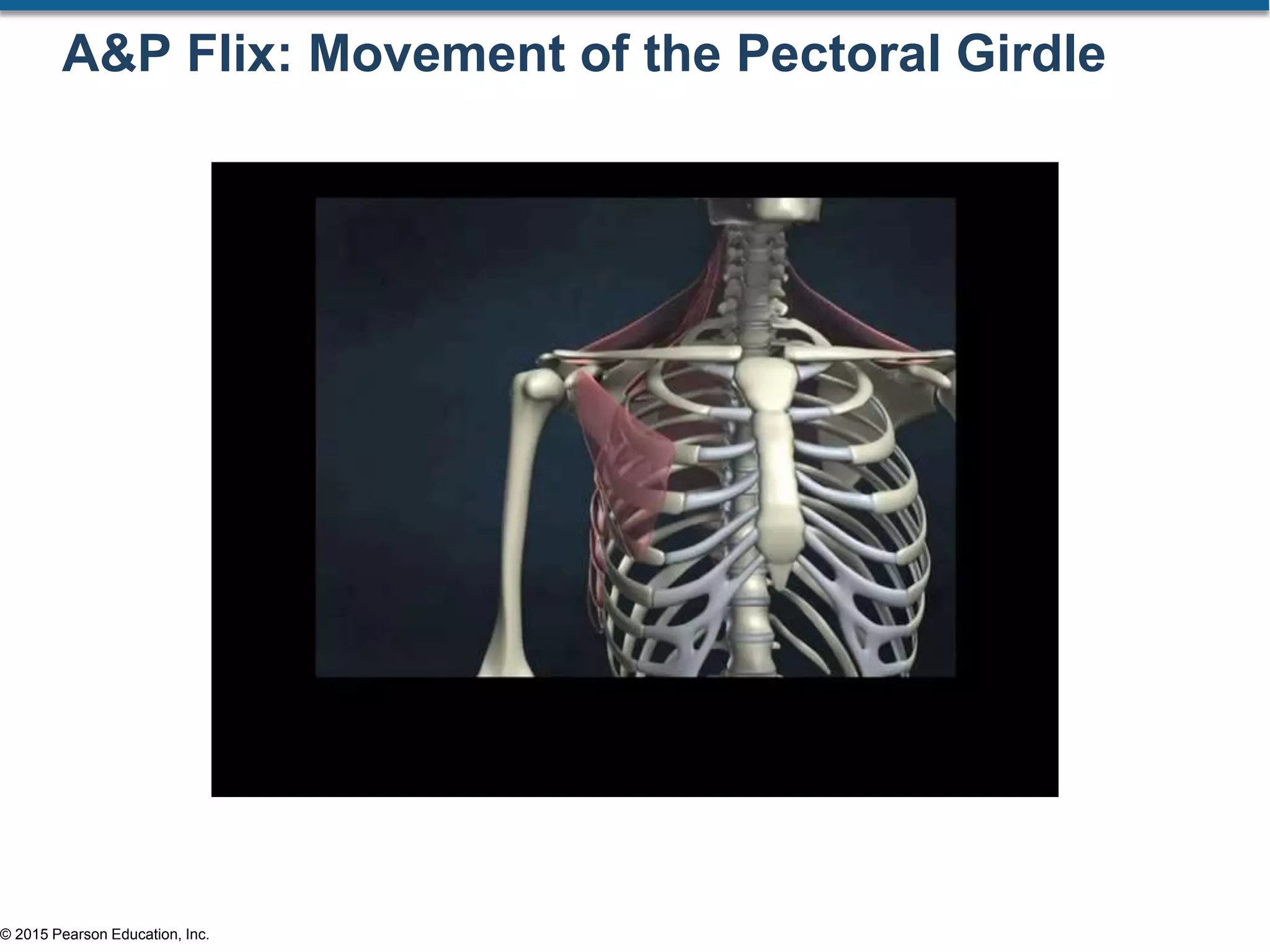
A&P Flix: Movement of the Pectoral Girdle
© 2015 Pearson Education, Inc.
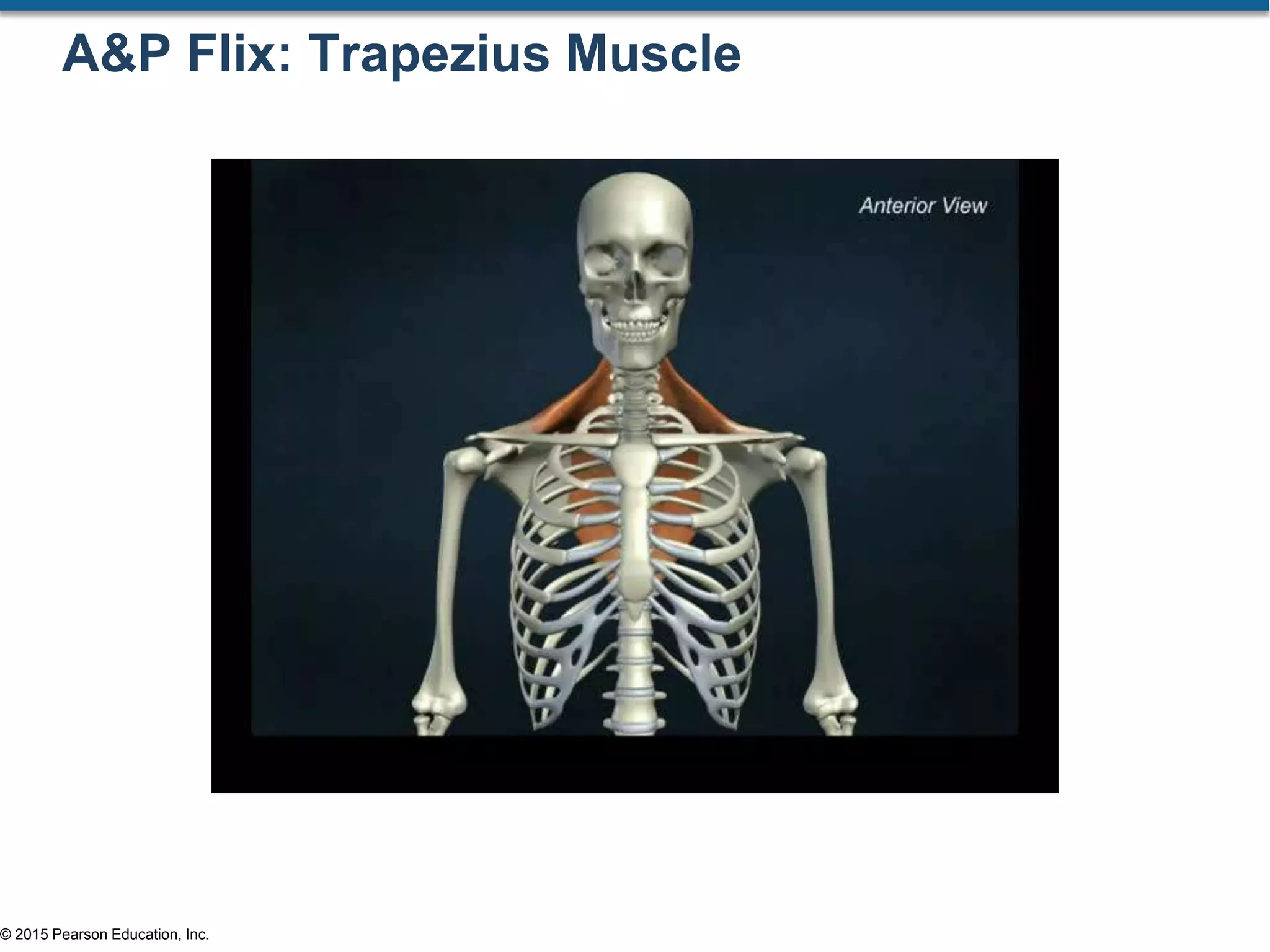
A&P Flix: Trapezius Muscle
© 2015 Pearson Education, Inc.
Muscles of the Pectoral Girdle and Upper
Limbs
• Muscles That Move the Arm
• Anterior view
• Deltoid
• Abducts the arm
• Pectoralis major
• Adducts and medially rotates the arm
© 2015 Pearson Education, Inc.
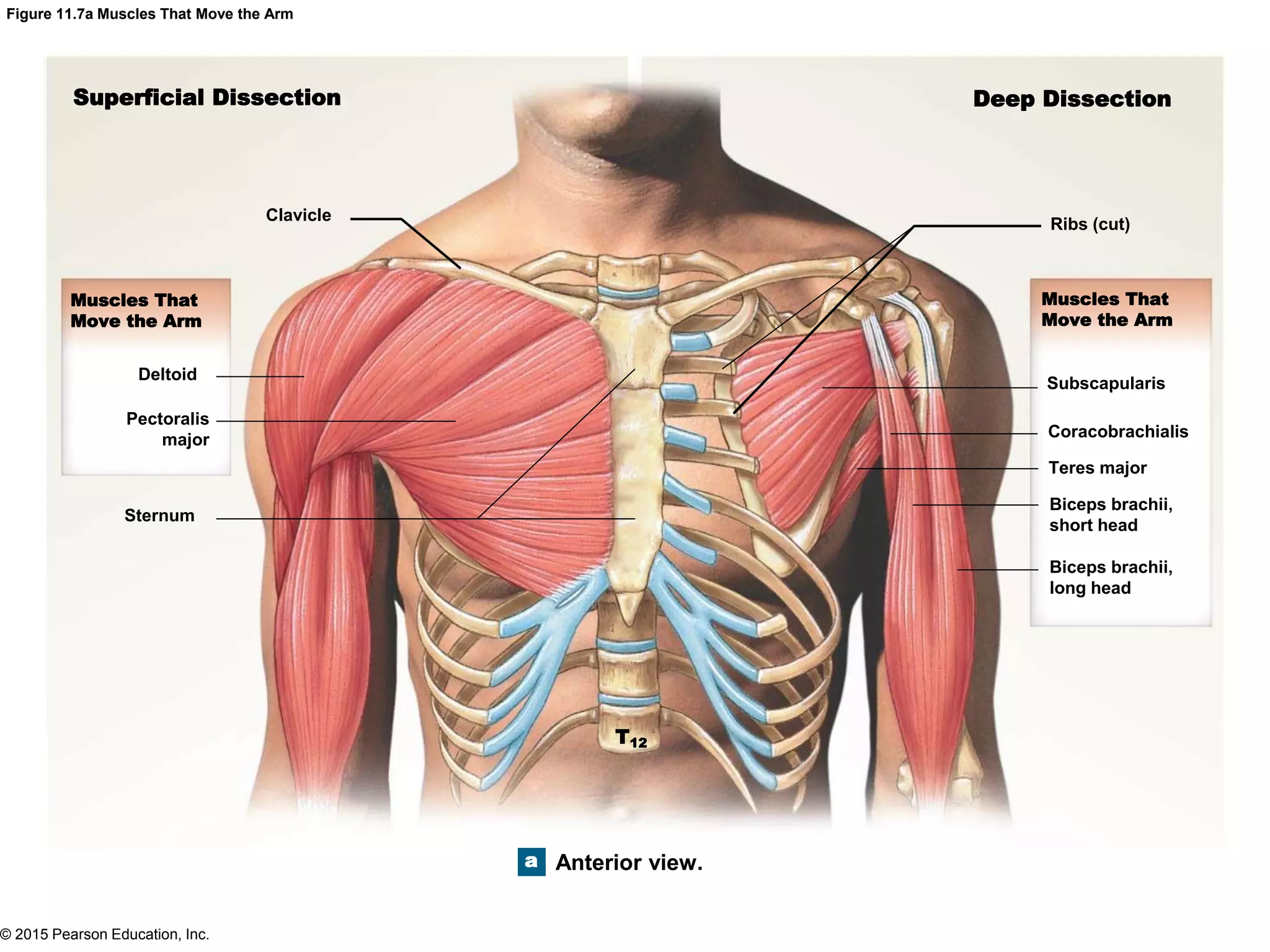
Figure 11.7a Muscles That Move the Arm
Superficial Dissection Deep Dissection
Muscles That
Move the Arm
Muscles That
Move the Arm
Ribs (cut)
Clavicle
Deltoid
Pectoralis
major
Sternum
Subscapularis
Coracobrachialis
Teres major
Biceps brachii,
short head
Biceps brachii,
long head
Anterior view.
T12
a
© 2015 Pearson Education, Inc.
Muscles of the Pectoral Girdle and Upper
Limbs
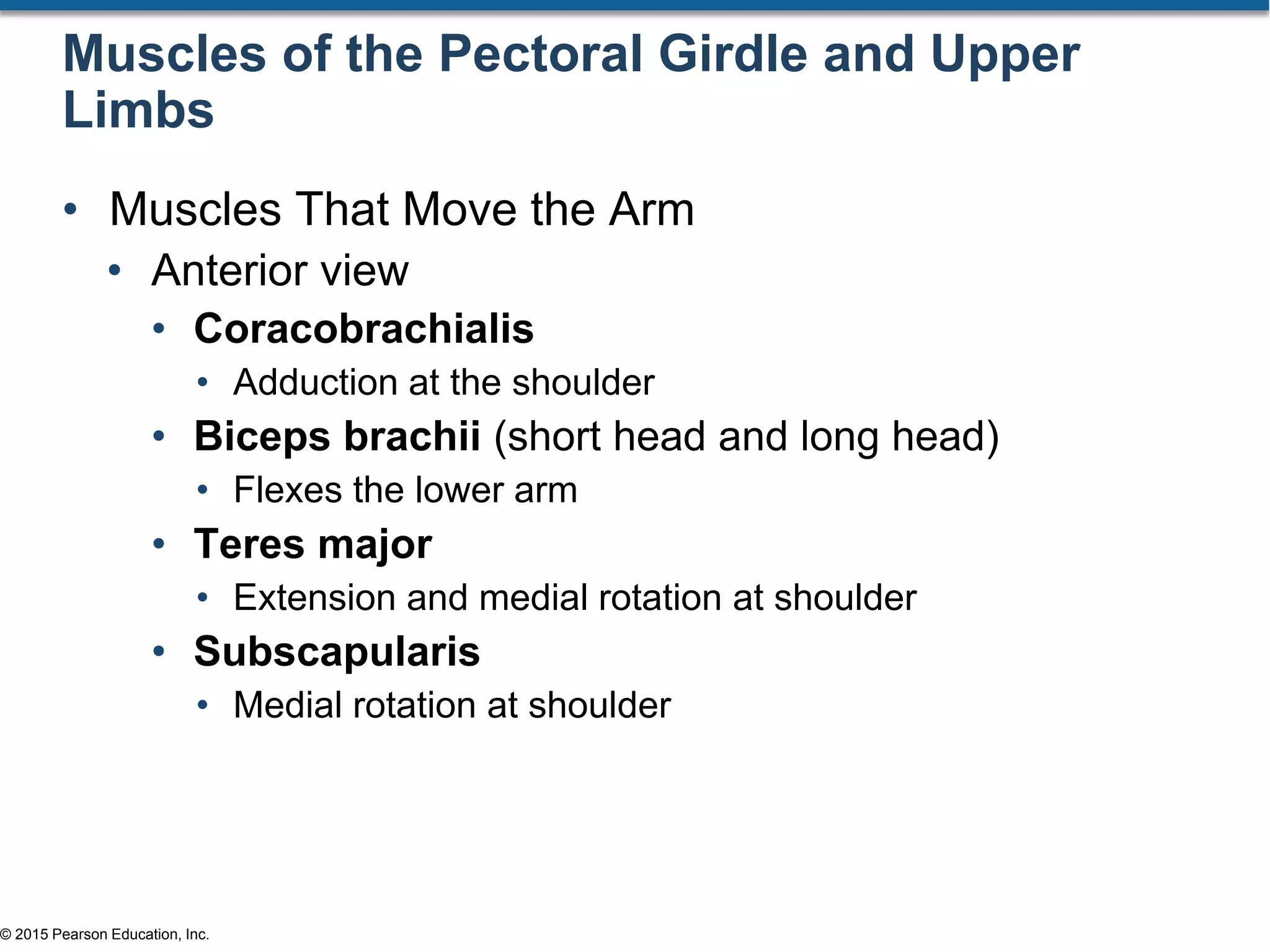
• Muscles That Move the Arm
• Anterior view
• Coracobrachialis
• Adduction at the shoulder
• Biceps brachii (short head and long head)
• Flexes the lower arm
• Teres major
• Extension and medial rotation at shoulder
• Subscapularis
• Medial rotation at shoulder
© 2015 Pearson Education, Inc.
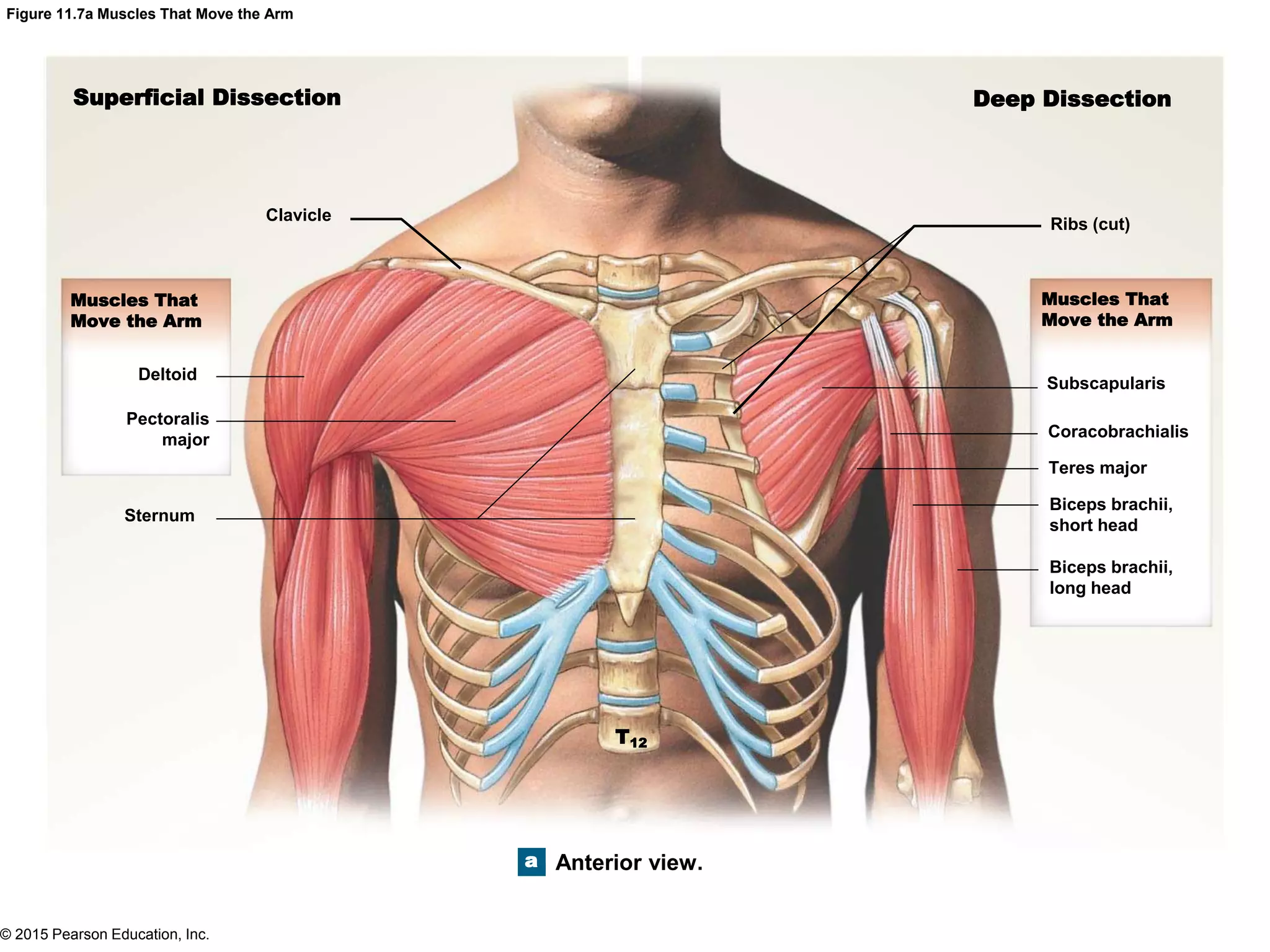
Figure 11.7a Muscles That Move the Arm
Superficial Dissection Deep Dissection
Muscles That
Move the Arm
Muscles That
Move the Arm
Ribs (cut)
Clavicle
Deltoid
Pectoralis
major
Sternum
Subscapularis
Coracobrachialis
Teres major
Biceps brachii,
short head
Biceps brachii,
long head
Anterior view.
T12
a
© 2015 Pearson Education, Inc.
Muscles of the Pectoral Girdle and Upper
Limbs
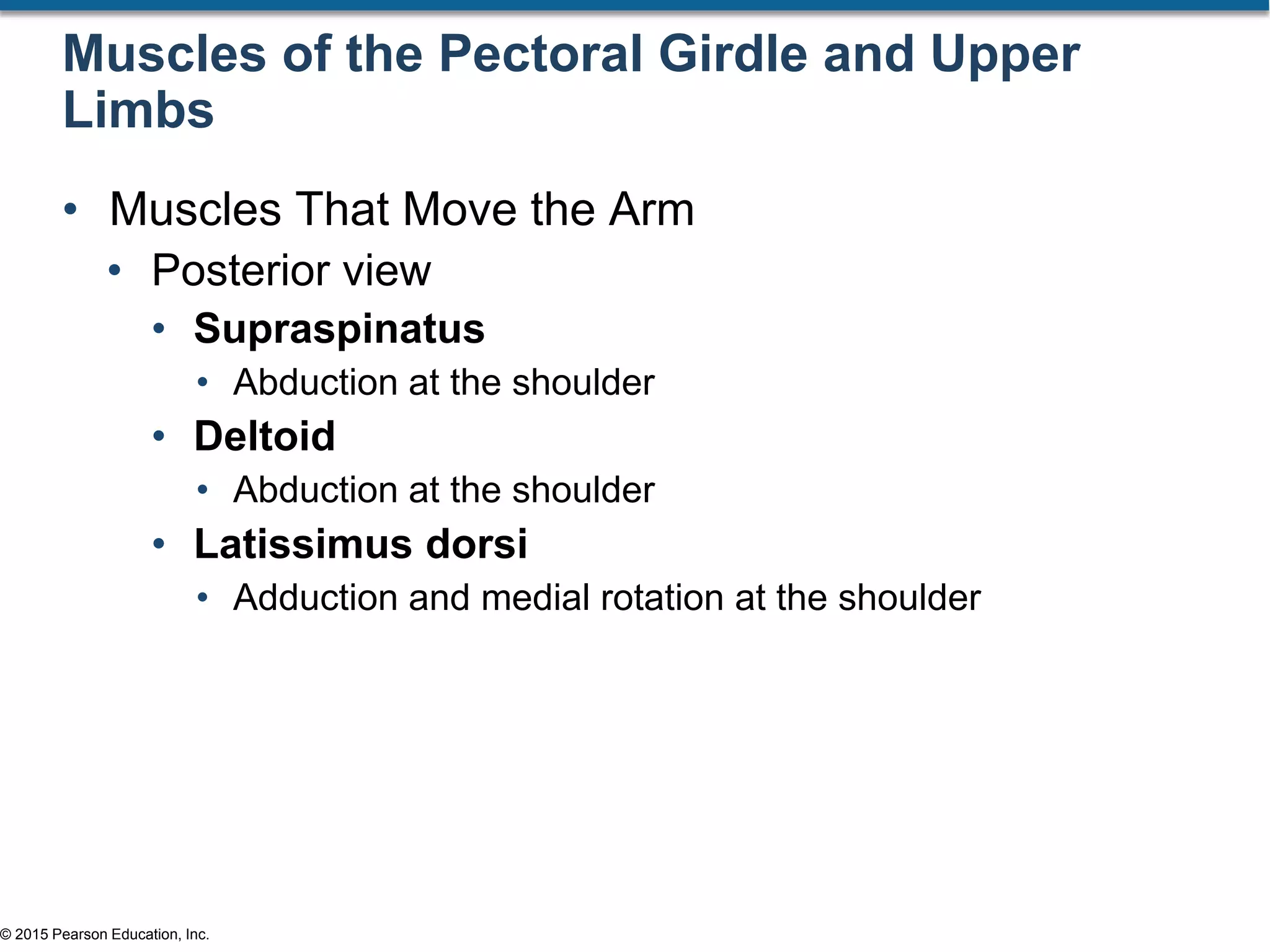
• Muscles That Move the Arm
• Posterior view
• Supraspinatus
• Abduction at the shoulder
• Deltoid
• Abduction at the shoulder
• Latissimus dorsi
• Adduction and medial rotation at the shoulder
© 2015 Pearson Education, Inc.
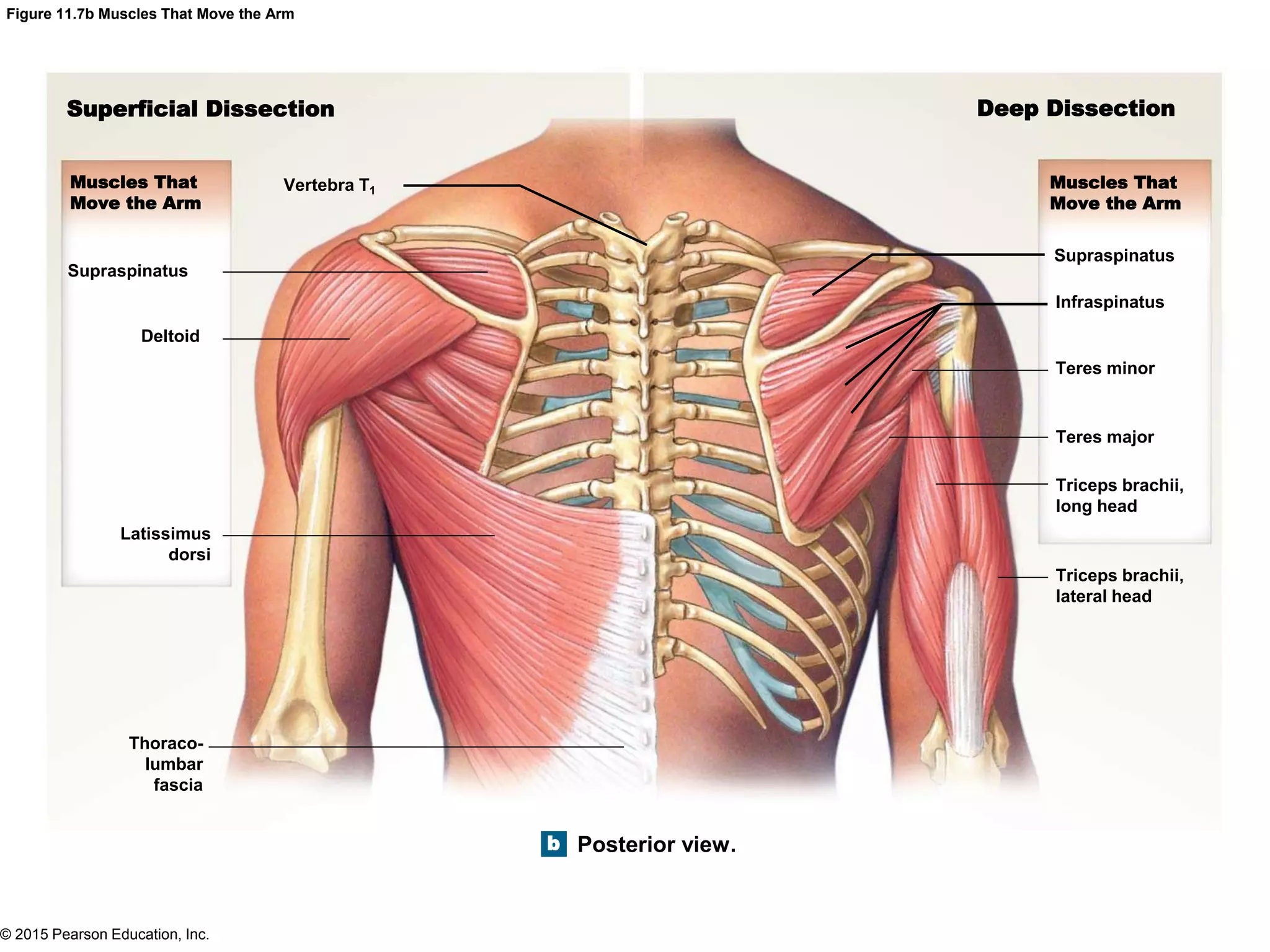
Figure 11.7b Muscles That Move the Arm
Superficial Dissection Deep Dissection
Muscles That
Move the Arm
Muscles That
Move the Arm
b Posterior view.
Triceps brachii,
lateral head
Triceps brachii,
long head
Teres major
Teres minor
Infraspinatus
Supraspinatus
Vertebra T1
Supraspinatus
Deltoid
Latissimus
dorsi
Thoraco-
lumbar
fascia
© 2015 Pearson Education, Inc.
Muscles of the Pectoral Girdle and Upper
Limbs
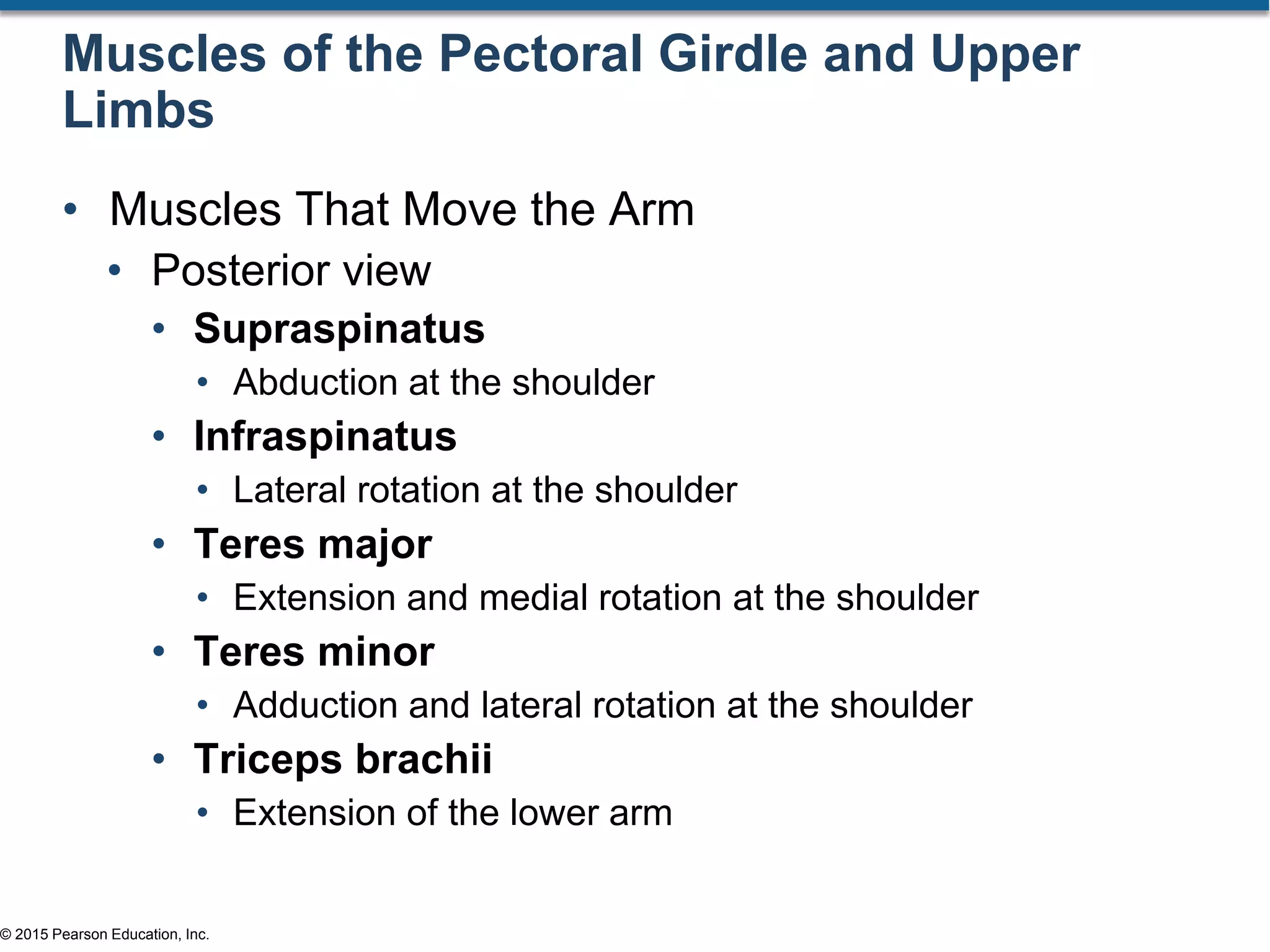
• Muscles That Move the Arm
• Posterior view
• Supraspinatus
• Abduction at the shoulder
• Infraspinatus
• Lateral rotation at the shoulder
• Teres major
• Extension and medial rotation at the shoulder
• Teres minor
• Adduction and lateral rotation at the shoulder
• Triceps brachii
• Extension of the lower arm
© 2015 Pearson Education, Inc.
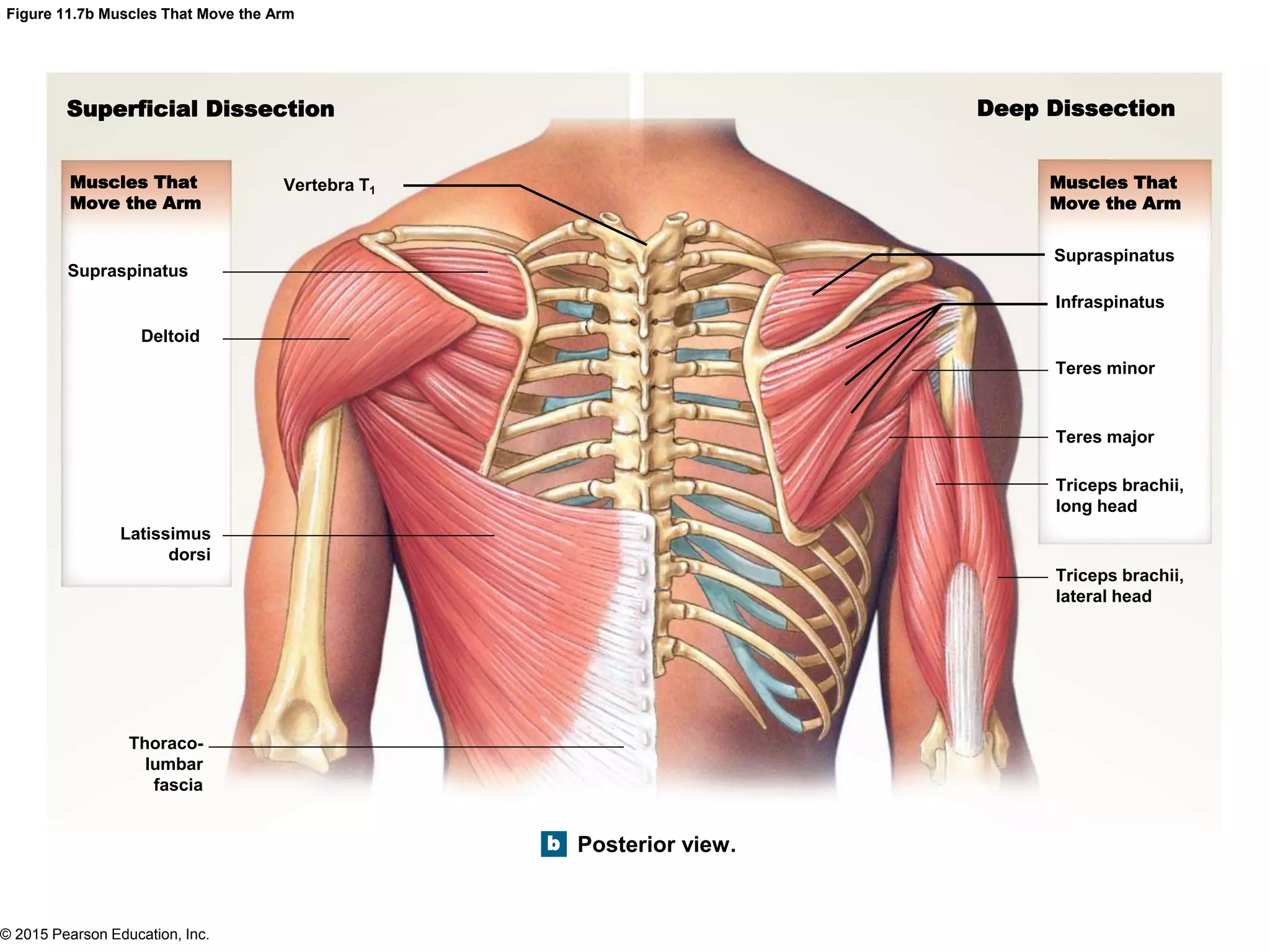
Figure 11.7b Muscles That Move the Arm
Superficial Dissection Deep Dissection
Muscles That
Move the Arm
Muscles That
Move the Arm
b Posterior view.
Triceps brachii,
lateral head
Triceps brachii,
long head
Teres major
Teres minor
Infraspinatus
Supraspinatus
Vertebra T1
Supraspinatus
Deltoid
Latissimus
dorsi
Thoraco-
lumbar
fascia
© 2015 Pearson Education, Inc.
Muscles of the Pectoral Girdle and Upper
Limbs
• Action Line of Muscles
• When a muscle contracts, it develops tension
• The direction the muscle moves upon developing
tension is known as the action line
© 2015 Pearson Education, Inc.
Muscles of the Pectoral Girdle and Upper
Limbs
• Action Line of Muscles (continued)
• Action lines that cross:
• The anterior aspect of a joint are flexors
• The posterior aspect of a joint are extensors
• The medial aspect of a joint are adductors or
sometimes called medial rotators
• The lateral aspect of a joint are abductors or
sometimes called lateral rotators
© 2015 Pearson Education, Inc.
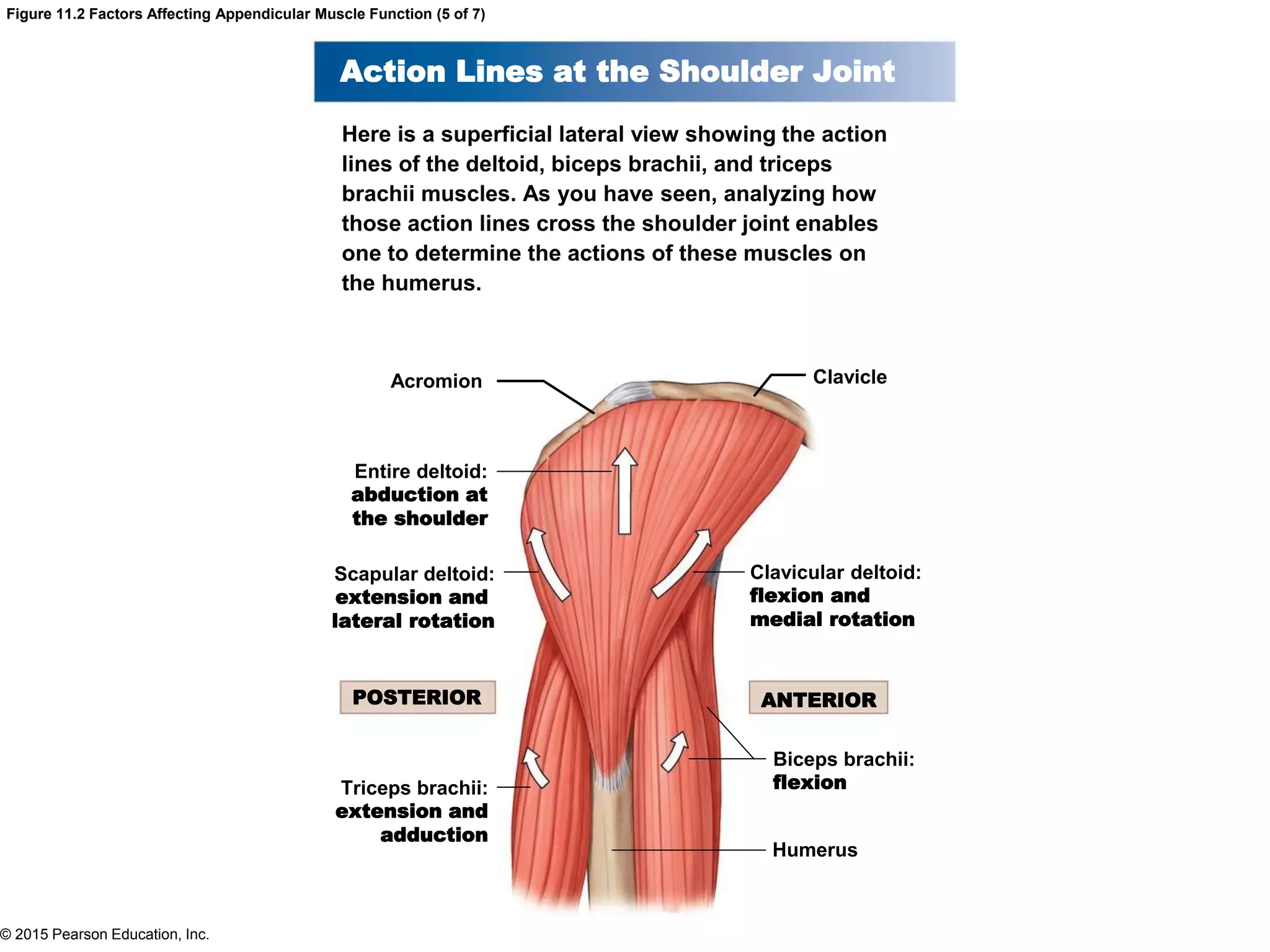
Figure 11.2 Factors Affecting Appendicular Muscle Function (5 of 7)
Action Lines at the Shoulder Joint
Here is a superficial lateral view showing the action
lines of the deltoid, biceps brachii, and triceps
brachii muscles. As you have seen, analyzing how
those action lines cross the shoulder joint enables
one to determine the actions of these muscles on
the humerus.
Acromion Clavicle
Clavicular deltoid:
flexion and
medial rotation
Entire deltoid:
abduction at
the shoulder
Scapular deltoid:
extension and
lateral rotation
Triceps brachii:
extension and
adduction
Biceps brachii:
flexion
Humerus
POSTERIOR ANTERIOR

Ch 10 and 11 part 1

  • 1.
  • 2.
    © 2015 PearsonEducation, Inc. Introduction • Appendicular Musculature • Appendicular muscles are responsible for: • Stabilizing the pectoral and pelvic girdles • Moving the upper and lower limbs • Absorbing shocks and jolts as you walk, run, or jump • Aiding in strengthening the joint area
  • 3.
    © 2015 PearsonEducation, Inc. Introduction • Two Major Groups of Appendicular Muscles • The muscles of the pectoral girdle and upper limbs • The muscles of the pelvic girdle and lower limbs
  • 4.
    © 2015 PearsonEducation, Inc. Factors Affecting Appendicular Muscle Function • Action Lines of the Muscle • Flexion and extension at the shoulder joint • Adduction and abduction at the shoulder joint • Medial and lateral rotation at the shoulder joint • Action lines at the hip joint • Spurt and Shunt Muscles
  • 5.
    © 2015 PearsonEducation, Inc. Figure 11.2 Factors Affecting Appendicular Muscle Function (7 of 7) Action Lines at the Hip Joint The hip joint, like the shoulder joint, is a multiaxial synovial joint that permits flexion/extension, adduction/abduction, and medial/lateral rotation. Determining the action of a muscle on the hip is identical to the process utilized for the shoulder, in that the action of a muscle on the hip is determined by the structure of the joint and the location of the insertion of the muscle on the femur (not shown) relative to the permitted axes of motion at the joint. Adductor magnus Iliopsoas: flexion Gluteus medius and minimus: abduction Obturator externus: lateral rotation Tensor fasciae latae: medial rotation Adductor longus: adduction Hamstring group: extension and lateral rotation Action lines of the adductor magnus Gluteal Group ExtensionExtension and abduction Flexion, abduction, and medial rotation Lateral Rotator GroupAdductor Group Extension and lateral rotationAdduction ANTERIOR POSTERIOR Gluteus maximus Gluteus medius Gluteus minimus Tensor fasciae latae Acetabulum Hamstring group Adductor longus Adductor magnus
  • 6.
    © 2015 PearsonEducation, Inc. Figure 11.2 Factors Affecting Appendicular Muscle Function (6 of 7) Spurt and Shunt Muscles Determining the location of the insertion of a muscle relative to the axis of the joint will provide additional details about the functions of the muscle at that joint. The primary action of a muscle whose insertion is close to the joint will be the production of movement at that joint. Such a muscle is termed a spurt muscle, and spurt muscles are prime movers. However, a muscle whose insertion is considerably farther from the joint will generally help to stabilize that joint in addition to producing motion at that joint. This type of muscle, a synergist, is termed a shunt muscle. Biceps brachii: movement and torque (spurt muscle) Triceps brachii: movement and torque (spurt muscle) Brachioradialis: stability and movement (shunt muscle) Extensors Flexors Elbow joint (monaxial)
  • 7.
    © 2015 PearsonEducation, Inc. Muscles of the Pectoral Girdle and Upper Limbs • Muscles associated with the pectoral girdle and upper limbs can be divided into four groups • Muscles that position the pectoral girdle • Muscles that move the arm • Muscles that move the forearm and hand • Muscles that move the hand and fingers
  • 8.
    © 2015 PearsonEducation, Inc. Muscles of the Pectoral Girdle and Upper Limbs • Muscles That Position the Pectoral Girdle • These muscles also coordinate with the muscles that move the arm • Levator scapulae • Elevates the scapula • Pectoralis minor • Protracts the shoulder
  • 9.
    © 2015 PearsonEducation, Inc. Figure 11.6 Muscles That Position the Pectoral Girdle, Part II Muscles That Position the Pectoral Girdle Levator scapulae Trapezius Subclavius Pectoralis minor Serratus anterior Internal intercostals External intercostals T12 Short head Long head Biceps brachii Serratus anterior Coracobrachialis Pectoralis minor (cut) Serratus anterior (insertion) Serratus anterior (origin) Pectoralis minor Trapezius Pectoralis major Subclavius Pectoralis major (cut and reflected) Origin Insertion
  • 10.
    © 2015 PearsonEducation, Inc. Muscles of the Pectoral Girdle and Upper Limbs • Muscles That Position the Pectoral Girdle • These muscles also coordinate with the muscles that move the arm • Rhomboid major • Adducts the scapula • Rhomboid minor • Adducts the scapula
  • 11.
    © 2015 PearsonEducation, Inc. Figure 11.5 Muscles That Position the Pectoral Girdle, Part I Superficial Dissection Deep Dissection Muscles That Position the Pectoral Girdle Muscles That Position the Pectoral Girdle Levator scapulae Rhomboid minor Rhomboid major Serratus anterior Triceps brachii Scapula C1 C7 Trapezius Deltoid Infraspinatus Teres minor Teres major Serratus anterior T12
  • 12.
    © 2015 PearsonEducation, Inc. Muscles of the Pectoral Girdle and Upper Limbs • Muscles That Position the Pectoral Girdle • These muscles also coordinate with the muscles that move the arm • Serratus anterior • Protracts the scapula • Subclavius • Protracts the scapula • Trapezius • Rotate scapula and extend the neck
  • 13.
    © 2015 PearsonEducation, Inc. Figure 11.6 Muscles That Position the Pectoral Girdle, Part II Muscles That Position the Pectoral Girdle Levator scapulae Trapezius Subclavius Pectoralis minor Serratus anterior Internal intercostals External intercostals T12 Short head Long head Biceps brachii Serratus anterior Coracobrachialis Pectoralis minor (cut) Serratus anterior (insertion) Serratus anterior (origin) Pectoralis minor Trapezius Pectoralis major Subclavius Pectoralis major (cut and reflected) Origin Insertion
  • 14.
    © 2015 PearsonEducation, Inc. Muscles of the Pectoral Girdle and Upper Limbs
  • 15.
    © 2015 PearsonEducation, Inc. A&P Flix: Muscles of the Pectoral Girdle (a)
  • 16.
    © 2015 PearsonEducation, Inc. A&P Flix: Muscles of the Pectoral Girdle (b)
  • 17.
    © 2015 PearsonEducation, Inc. A&P Flix: Muscles of the Pectoral Girdle (c)
  • 18.
    © 2015 PearsonEducation, Inc. A&P Flix: Movement of the Pectoral Girdle
  • 19.
    © 2015 PearsonEducation, Inc. A&P Flix: Trapezius Muscle
  • 20.
    © 2015 PearsonEducation, Inc. Muscles of the Pectoral Girdle and Upper Limbs • Muscles That Move the Arm • Anterior view • Deltoid • Abducts the arm • Pectoralis major • Adducts and medially rotates the arm
  • 21.
    © 2015 PearsonEducation, Inc. Figure 11.7a Muscles That Move the Arm Superficial Dissection Deep Dissection Muscles That Move the Arm Muscles That Move the Arm Ribs (cut) Clavicle Deltoid Pectoralis major Sternum Subscapularis Coracobrachialis Teres major Biceps brachii, short head Biceps brachii, long head Anterior view. T12 a
  • 22.
    © 2015 PearsonEducation, Inc. Muscles of the Pectoral Girdle and Upper Limbs • Muscles That Move the Arm • Anterior view • Coracobrachialis • Adduction at the shoulder • Biceps brachii (short head and long head) • Flexes the lower arm • Teres major • Extension and medial rotation at shoulder • Subscapularis • Medial rotation at shoulder
  • 23.
    © 2015 PearsonEducation, Inc. Figure 11.7a Muscles That Move the Arm Superficial Dissection Deep Dissection Muscles That Move the Arm Muscles That Move the Arm Ribs (cut) Clavicle Deltoid Pectoralis major Sternum Subscapularis Coracobrachialis Teres major Biceps brachii, short head Biceps brachii, long head Anterior view. T12 a
  • 24.
    © 2015 PearsonEducation, Inc. Muscles of the Pectoral Girdle and Upper Limbs • Muscles That Move the Arm • Posterior view • Supraspinatus • Abduction at the shoulder • Deltoid • Abduction at the shoulder • Latissimus dorsi • Adduction and medial rotation at the shoulder
  • 25.
    © 2015 PearsonEducation, Inc. Figure 11.7b Muscles That Move the Arm Superficial Dissection Deep Dissection Muscles That Move the Arm Muscles That Move the Arm b Posterior view. Triceps brachii, lateral head Triceps brachii, long head Teres major Teres minor Infraspinatus Supraspinatus Vertebra T1 Supraspinatus Deltoid Latissimus dorsi Thoraco- lumbar fascia
  • 26.
    © 2015 PearsonEducation, Inc. Muscles of the Pectoral Girdle and Upper Limbs • Muscles That Move the Arm • Posterior view • Supraspinatus • Abduction at the shoulder • Infraspinatus • Lateral rotation at the shoulder • Teres major • Extension and medial rotation at the shoulder • Teres minor • Adduction and lateral rotation at the shoulder • Triceps brachii • Extension of the lower arm
  • 27.
    © 2015 PearsonEducation, Inc. Figure 11.7b Muscles That Move the Arm Superficial Dissection Deep Dissection Muscles That Move the Arm Muscles That Move the Arm b Posterior view. Triceps brachii, lateral head Triceps brachii, long head Teres major Teres minor Infraspinatus Supraspinatus Vertebra T1 Supraspinatus Deltoid Latissimus dorsi Thoraco- lumbar fascia
  • 28.
    © 2015 PearsonEducation, Inc. Muscles of the Pectoral Girdle and Upper Limbs • Action Line of Muscles • When a muscle contracts, it develops tension • The direction the muscle moves upon developing tension is known as the action line
  • 29.
    © 2015 PearsonEducation, Inc. Muscles of the Pectoral Girdle and Upper Limbs • Action Line of Muscles (continued) • Action lines that cross: • The anterior aspect of a joint are flexors • The posterior aspect of a joint are extensors • The medial aspect of a joint are adductors or sometimes called medial rotators • The lateral aspect of a joint are abductors or sometimes called lateral rotators
  • 30.
    © 2015 PearsonEducation, Inc. Figure 11.2 Factors Affecting Appendicular Muscle Function (5 of 7) Action Lines at the Shoulder Joint Here is a superficial lateral view showing the action lines of the deltoid, biceps brachii, and triceps brachii muscles. As you have seen, analyzing how those action lines cross the shoulder joint enables one to determine the actions of these muscles on the humerus. Acromion Clavicle Clavicular deltoid: flexion and medial rotation Entire deltoid: abduction at the shoulder Scapular deltoid: extension and lateral rotation Triceps brachii: extension and adduction Biceps brachii: flexion Humerus POSTERIOR ANTERIOR