MUMPS Presented by: SAgun Paudel Rajiv Nepal Dipika Gaire
Introduction: Mumps is a contagious disease that is caused by the  mumps virus .  Anyone who is not immune from either previous mumps infection or from vaccination can get mumps. sometimes called  epidemic parotitis.
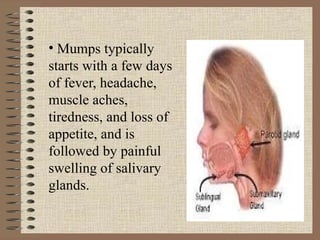
Mumps typically starts with a few days of fever, headache, muscle aches, tiredness, and loss of appetite, and is followed by painful swelling of salivary glands.
Some facts Acute viral viral disease of the human species. Parotitis and orchitis described by Hippocrates in 5th century B.C. Viral etiology described by Johnson and Goodpasture in 1934. Frequent cause of outbreaks among military personnel in prevaccine era.
Before the development of vaccination and the introduction of a vaccine, it was a common childhood disease worldwide. Mumps most commonly occurs in children ages 2 - 12 who have not been vaccinated against the disease.  However, the infection can occur at any age.
Mumps Epidemiology Reservoir : Human Transmission :  Respiratory drop nuclei , Subclinical infections may transmit Temporal pattern : Peak in late winter and spring Communicability : 3 days before to 4 days after onset of active disease
Incubation period The time between being exposed to the virus and getting sick (incubation period) is usually  12 - 24  days.
Transmission Mumps is a contagious disease that is spread from person to person through contact with respiratory secretions such as saliva from an infected person.  When an infected person coughs or sneezes, the droplets aerosolize and can enter the eyes, nose, or mouth of another person.  Mumps can also be spread by sharing food and drinks.
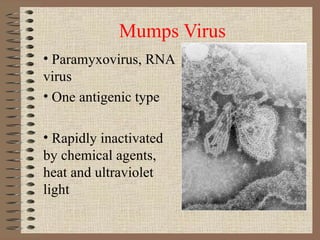
Mumps Virus Paramyxovirus, RNA virus One antigenic type Rapidly inactivated by chemical agents, heat and ultraviolet light
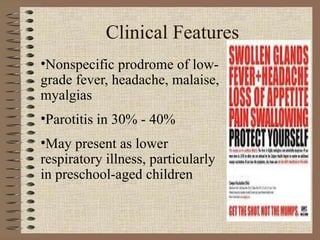
Clinical Features Nonspecific prodrome of low-grade fever, headache, malaise, myalgias Parotitis in 30% - 40% May present as lower respiratory illness, particularly in preschool-aged children
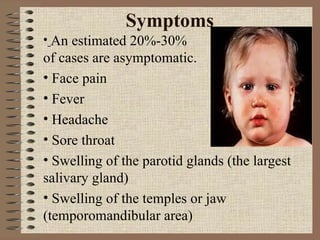
Symptoms An estimated 20%-30%  of cases are asymptomatic. Face pain Fever Headache Sore throat Swelling of the parotid glands (the largest salivary gland) Swelling of the temples or jaw (temporomandibular area)
Other symptoms  of this disease that can occur in males: Testicle lump Testicle pain Scrotal swelling Mumps may also infect the: Central nervous system Pancreas
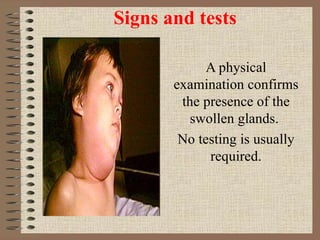
Signs and tests A physical examination confirms the presence of the swollen glands.  No testing is usually required.
Diagnosis A physical examination confirms the presence of the swollen glands.  Usually the disease is diagnosed on clinical grounds If there is uncertainty about the diagnosis, a test of saliva, or blood may be carried out.
A newer diagnostic confirmation, using real-time nested polymerase chain reaction (PCR) technology, has also been developed. As with any inflammation of the salivary glands, serum amylase is often elevated.
Treatment There is no specific treatment for mumps. Ice or heat packs applied to the neck area. An  acetaminophen   may help relieve pain. Do not give aspirin to children with a viral illness because of the risk of Reye syndrome.
We can also relieve symptoms with: Extra fluids Soft foods Warm salt water gargles
Expectations (prognosis) Death is very unusual, disease is self-limiting, and general outcome is good, even if other organs are involved. Patients usually do well, even if other organs are involved. After the illness, the patient has a life-long immunity to the mumps.
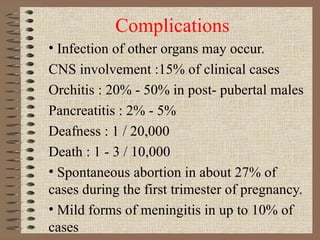
Complications Infection of other organs may occur. CNS involvement :15% of clinical cases Orchitis : 20% - 50% in post- pubertal males Pancreatitis : 2% - 5% Deafness : 1 / 20,000  Death : 1 - 3 / 10,000 Spontaneous abortion in about 27% of cases during the first trimester of pregnancy. Mild forms of meningitis in up to 10% of cases
Calling your health care provider if you or your child has mumps and: Eye redness Persistent drowsiness Persistent vomiting or abdominal pain Severe headache Testicle pain or a testicle lump convulsions occur.
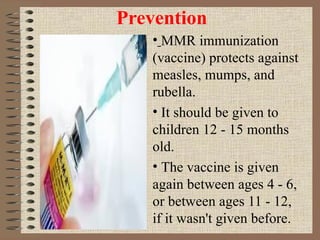
Prevention MMR immunization (vaccine) protects against measles, mumps, and rubella.  It should be given to children 12 - 15 months old.  The vaccine is given again between ages 4 - 6, or between ages 11 - 12, if it wasn't given before.
Mumps Vaccine Composition : Live virus (Jeryl Lynn strain) Efficacy : 95% (Range, 90% - 97%) Duration of Immunity : Lifelong Schedule : 2 Doses (as MMR)
References www.cdc.gov http://en.wikipedia.org Google
Thankyou!


Mumps presentation s agun

  • 1.
    MUMPS Presented by:SAgun Paudel Rajiv Nepal Dipika Gaire
  • 2.
    Introduction: Mumps isa contagious disease that is caused by the mumps virus . Anyone who is not immune from either previous mumps infection or from vaccination can get mumps. sometimes called epidemic parotitis.
  • 3.
    Mumps typically startswith a few days of fever, headache, muscle aches, tiredness, and loss of appetite, and is followed by painful swelling of salivary glands.
  • 4.
    Some facts Acuteviral viral disease of the human species. Parotitis and orchitis described by Hippocrates in 5th century B.C. Viral etiology described by Johnson and Goodpasture in 1934. Frequent cause of outbreaks among military personnel in prevaccine era.
  • 5.
    Before the developmentof vaccination and the introduction of a vaccine, it was a common childhood disease worldwide. Mumps most commonly occurs in children ages 2 - 12 who have not been vaccinated against the disease. However, the infection can occur at any age.
  • 6.
    Mumps Epidemiology Reservoir: Human Transmission : Respiratory drop nuclei , Subclinical infections may transmit Temporal pattern : Peak in late winter and spring Communicability : 3 days before to 4 days after onset of active disease
  • 7.
    Incubation period Thetime between being exposed to the virus and getting sick (incubation period) is usually 12 - 24 days.
  • 8.
    Transmission Mumps isa contagious disease that is spread from person to person through contact with respiratory secretions such as saliva from an infected person. When an infected person coughs or sneezes, the droplets aerosolize and can enter the eyes, nose, or mouth of another person. Mumps can also be spread by sharing food and drinks.
  • 9.
    Mumps Virus Paramyxovirus,RNA virus One antigenic type Rapidly inactivated by chemical agents, heat and ultraviolet light
  • 10.
    Clinical Features Nonspecificprodrome of low-grade fever, headache, malaise, myalgias Parotitis in 30% - 40% May present as lower respiratory illness, particularly in preschool-aged children
  • 11.
    Symptoms An estimated20%-30% of cases are asymptomatic. Face pain Fever Headache Sore throat Swelling of the parotid glands (the largest salivary gland) Swelling of the temples or jaw (temporomandibular area)
  • 12.
    Other symptoms of this disease that can occur in males: Testicle lump Testicle pain Scrotal swelling Mumps may also infect the: Central nervous system Pancreas
  • 13.
    Signs and testsA physical examination confirms the presence of the swollen glands. No testing is usually required.
  • 14.
    Diagnosis A physicalexamination confirms the presence of the swollen glands. Usually the disease is diagnosed on clinical grounds If there is uncertainty about the diagnosis, a test of saliva, or blood may be carried out.
  • 15.
    A newer diagnosticconfirmation, using real-time nested polymerase chain reaction (PCR) technology, has also been developed. As with any inflammation of the salivary glands, serum amylase is often elevated.
  • 16.
    Treatment There isno specific treatment for mumps. Ice or heat packs applied to the neck area. An acetaminophen may help relieve pain. Do not give aspirin to children with a viral illness because of the risk of Reye syndrome.
  • 17.
    We can alsorelieve symptoms with: Extra fluids Soft foods Warm salt water gargles
  • 18.
    Expectations (prognosis) Deathis very unusual, disease is self-limiting, and general outcome is good, even if other organs are involved. Patients usually do well, even if other organs are involved. After the illness, the patient has a life-long immunity to the mumps.
  • 19.
    Complications Infection ofother organs may occur. CNS involvement :15% of clinical cases Orchitis : 20% - 50% in post- pubertal males Pancreatitis : 2% - 5% Deafness : 1 / 20,000 Death : 1 - 3 / 10,000 Spontaneous abortion in about 27% of cases during the first trimester of pregnancy. Mild forms of meningitis in up to 10% of cases
  • 20.
    Calling your healthcare provider if you or your child has mumps and: Eye redness Persistent drowsiness Persistent vomiting or abdominal pain Severe headache Testicle pain or a testicle lump convulsions occur.
  • 21.
    Prevention MMR immunization(vaccine) protects against measles, mumps, and rubella. It should be given to children 12 - 15 months old. The vaccine is given again between ages 4 - 6, or between ages 11 - 12, if it wasn't given before.
  • 22.
    Mumps Vaccine Composition: Live virus (Jeryl Lynn strain) Efficacy : 95% (Range, 90% - 97%) Duration of Immunity : Lifelong Schedule : 2 Doses (as MMR)
  • 23.
  • 24.
  • 25.
  • 26.
  • 27.
  • 28.

Editor's Notes