MUMPS
DEFINITION
Mumps is an illness characterized by acute-onset
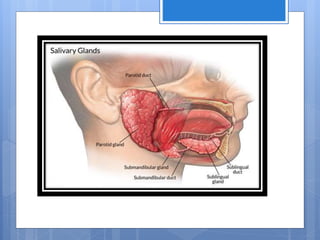
unilateral or bilateral tender, self-limited swelling of
the parotid or other salivary gland(s) that lasts at least
2 days and has no other apparent cause.
ETIOLOGIC AGENT
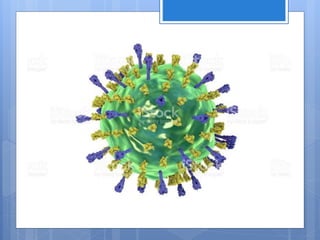
 Mumps is caused by a paramyxovirus with a negative-strand,
nonsegmented RNA genome.
 12 mumps virus genotypes have been identified.
 The viral genome is surrounded by a host cell–derived lipid
bilayer
EPIDEMIOLOGY
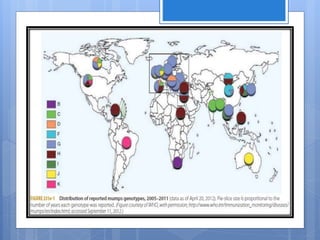
 Mumps is endemic worldwide, with epidemics every 3–5
years in unvaccinated populations.
 These epidemics typically occur in locations where children
and young adults congregate, such as schools, military
barracks, and other institutions.
 By 2001, fewer than 300 cases were reported, representing a
99.8% reduction from prevaccineera levels.
PATHOGENESIS
 Humans are the only natural hosts for mumps virus infection.
 The incubation period of mumps is ~19 days (range, 7–23
days).
 The virus is transmitted by the respiratory route via droplets,
saliva, and fomites.
 Mumps virus is typically shed from 1 week before to 1 week
after symptom onset, although this window appears to be
narrower in vaccinated individuals.
 Persons are most contagious 1–2 days before onset of clinical
symptoms.
 Inference from related respiratory diseases indicates that
primary replication likely occurs in the nasal mucosa or upper
respiratory mucosal epithelium.
 Mononuclear cells and cells within regional lymph nodes can
become infected;
 Further such infection facilitates the development of viremia
and poses a risk for a wide array of acute inflammatory
reactions.
 Classic sites of mumps virus replication include the salivary
glands, testes, pancreas, ovaries, mammary glands, and central
nervous system (CNS).
 The virus replicates well in glandular epithelium, but classic
parotitis is not a necessary component of mumps infection.
 Affected glands contain perivascular and interstitial
mononuclear cell infiltrates and exhibit hemorrhage with
prominent edema.
 Necrosis of acinar and epithelial duct cells is evident in the
salivary glands and in the germinal epithelium of the
seminiferous tubules of the testes.
 The virus probably enters cerebrospinal fluid (CSF) through
the choroid plexus or via transiting mononuclear cells during
plasma viremia.
 Evidence of placental and intrauterine spread in pregnancy has
been found in both early and late gestation.
 Disease is rarely fatal.
CLINICAL MANIFESTATIONS
 Up to half of mumps virus infections are asymptomatic or lead
to nonspecific respiratory symptoms.
 Inapparent infections are more common in adults than in
children.
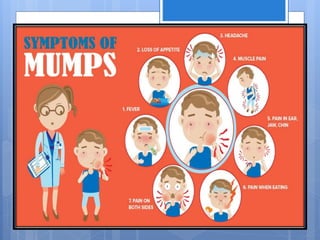
 The prodrome of mumps consists of low-grade fever, malaise,
myalgia, headache, and anorexia.
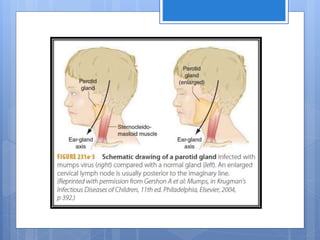
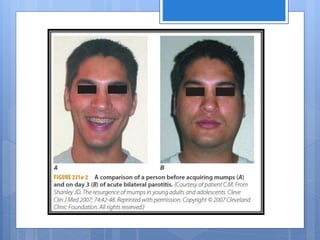
 Mumps parotitis—acute-onset unilateral or bilateral swelling
of the parotid or other salivary glands that lasts >2 days and
has no other apparent cause—develops in 70–90% of
symptomatic infections.
 Usually within 24 h of prodromal symptoms but sometimes as
long as 1 week thereafter.
 Parotitis is generally bilateral, although the two sides may not
be involved synchronously.
 Unilateral involvement is documented in about one-third of
cases.
 Swelling of the parotid is accompanied by tenderness and
obliteration of the space between the earlobe and the angle of
the mandible
 The patient frequently reports an earache and finds it difficult
to eat, swallow, or talk.
 The orifice of the parotid duct is commonly red and swollen.
 The submaxillary and sublingual glands are involved less often
than the parotid gland and are almost never involved alone.
 Glandular swelling increases for a few days and then gradually
subsides, disappearing within 1 week.
 In ~6% of mumps cases, obstruction of lymphatic drainage
secondary to bilateral salivary gland swelling may lead to
presternal pitting edema.
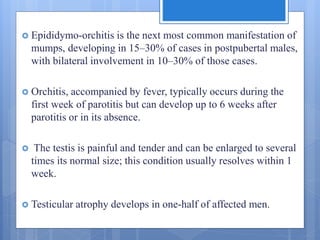
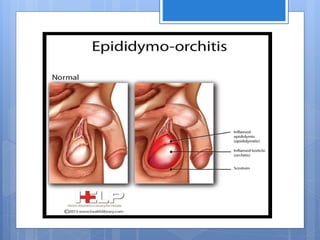
 Epididymo-orchitis is the next most common manifestation of
mumps, developing in 15–30% of cases in postpubertal males,
with bilateral involvement in 10–30% of those cases.
 Orchitis, accompanied by fever, typically occurs during the
first week of parotitis but can develop up to 6 weeks after
parotitis or in its absence.
 The testis is painful and tender and can be enlarged to several
times its normal size; this condition usually resolves within 1
week.
 Testicular atrophy develops in one-half of affected men.
 Sterility after mumps is rare, although subfertility is estimated
to occur in 13% of cases of unilateral orchitis and in 30–87%
of cases of bilateral orchitis.
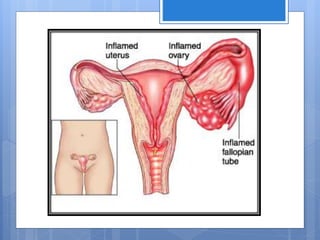
 Oophoritis occurs in ~5% of women with mumps and may be
associated with lower abdominal pain and vomiting .
 sterility or premature menopause rarely been associated .
 Mumps infection in postpubertal women may also present with
mastitis.
 Documented CSF pleocytosis indicates that mumps virus
invades the CNS in ~50% of cases;
 However, symptomatic CNS disease, typically in the form of
aseptic meningitis, occurs in <10% of cases, with a male
predominance.
 CNS symptoms of aseptic meningitis like stiff neck, headache,
and drowsiness.
 Appear ~5 days after parotitis and also occur often in the
absence of parotid involvement.
 Within the first 24 h polymorphonuclear leukocytes may
predominate in CSF (1000–2000 cells/μL).
 Second day nearly all the cells are lymphocytes.
 The glucose level in CSF may be low and the protein
concentration high, a pattern reminiscent of bacterial
meningitis.
 Mumps meningitis is a self-limited manifestation without
significant risk of death or long-term sequelae.
 Cranial nerve palsies have occasionally led to permanent
sequelae, particularly deafness.
 The reported incidence of mumps-associated hearing loss
varies between 1 in 1000 and 1 in 100,000.
 In ~0.1% of infections, mumps virus may cause encephalitis,
which presents as high fever with marked changes in the level
of consciousness, seizures, and focal neurologic symptoms.
 Electroencephalographic abnormalities may be seen.
 The mortality rate ~1.5%.
Other CNS problems occasionally associated with mumps
include;
 Cerebellar ataxia,
 Facial palsy,
 Transverse myelitis,
 Hydrocephalus,
 Guillain-barre syndrome,
 Flaccid paralysis, and
 Behavioral changes.
 Mumps pancreatitis, which may present as abdominal pain,
occurs in ~4% of infections.
 Myocarditis and endocardial fibroelastosis are rare and self-
limited but may represent severe complications of mumps
infection.
 However, mumps-associated electrocardiographic
abnormalities have been reported in up to 15% of cases.
 Other unusual complications include thyroiditis, nephritis,
arthritis, hepatic disease, keratouveitis, and thrombocytopenic
purpura.
 Abnormal renal function is common, but severe, life-
threatening nephritis is rare.
 It remains at issue whether an excessive number of
spontaneous abortions are associated with gestational mumps.
 Mumps in pregnancy does not appear to lead to premature
birth, low birth weight, or fetal malformations.
DIFFERENTIAL DIAGNOSIS
 Infectious causes of parotitis include
Viruses
 HIV
 Coxsackievirus
 Parainfluenza virus type 3
 Influenza A virus
 Epstein-barr virus
 Adenovirus
 Parvovirus B19
 Lymphocytic choriomeningitis virus
 Human herpesvirus 6
 Gram-positive bacteria
 Atypical mycobacteria
 Bartonella species
Parotitis can also develop in the setting of
 Sarcoidosis
 Sjogren’s syndrome
 Uremia
 Diabetes mellitus
 Malnutrition
 Cirrhosis
 Drug treatments.
Unilateral parotitis can be caused by ductal obstruction, cysts,
and tumors.
LABORATORY DIAGNOSIS
 Laboratory diagnosis is primarily based on detection of viral
RNA by reverse-transcriptase polymerase chain reaction
(RT-PCR) or on serology.
 For RT-PCR-based testing, viral RNA can be extracted either
directly from clinical samples or from cell cultures incubated
with clinical samples.
 Buccal swabs appear to be the best specimens for virus
detection, particularly when obtained within 2 days of clinical
onset.
 Mumps virus can also be detected readily in throat swabs and
saliva and, in cases of meningitis, in CSF.
 Mumps virus has rarely been detected in blood.
 The ability to detect viral RNA in clinical samples rapidly
diminishes beyond the first week after symptom onset,
 In several studies rates of virus detection were substantially
lower in recipients of two vaccine doses than in unvaccinated
persons or recipients of one dose.
 A serologic diagnosis of mumps is typically made by Enzyme-
linked immunosorbent assay (ELISA). The data must be
interpreted with caution.
 In vaccinated persons with mumps, IgM is typically absent;
thus, a negative IgM result in a vaccinated person does not rule
out mumps.
 In addition, regardless of vaccination status, IgM may not be
detectable;
 If serum is assayed too early (prior to day 3 of symptom onset)
or too late (beyond 6 weeks after symptom onset) in the course
of disease.
 Reliance on a rise in IgG titer in paired acute- and
convalescent-phase sera also is problematic: IgG titers in
convalescent-phase sera may be only nominally greater than
those in acute-phase sera.
 The main downside to replacement of these functional
serologic assays with the more RAPID ELISA method.
 Is the latter’s detection of all virus-specific antibodies,
including those that are nonneutralizing (i.e., nonprotective).
 Thus, an individual who is seropositive by ELISA may lack
protective levels of antibody.
 While there is a strong association between the presence of
mumps virus neutralizing antibody and protection from
disease.
TREATMENT
 Mumps is generally a benign, self-resolving illness.
 Therapy for parotitis and other clinical manifestations is
symptom based and supportive.
 The administration of analgesics and the application of warm
or cold compresses to the parotid area may be helpful.
 Testicular pain may be minimized by the local application of
cold compresses and gentle support for the scrotum.
Anesthetic blocks also may be used.
 Neither the administration of glucocorticoids nor incision of
the tunica albuginea is of proven value in severe orchitis.
 Anecdotal information on a small number of patients with
orchitis suggests that SC administration of interferon á2b may
help preserve the organ and fertility.
 Lumbar puncture is occasionally performed to relieve
headache associated with meningitis.
 Mumps immune globulin has not been consistently shown to
be effective in preventing mumps and is not recommended for
treatment or postexposure prophylaxis
PREVENTION
 Vaccination is the only practical control measure.
 Incidence and morbidity typically exceeding 90% after
vaccination.
 Large mumps outbreaks,young (often unvaccinated) children
in primary;
 Secondary in schools,young adults, particularly on college
and university campuses.
 Several mumps virus vaccines are used throughout the world;
the live attenuated JERYL LYNN STRAIN is used.
 Current recommendations are that mumps vaccine be
administered as part of the;
 Combined Trivalent measles-mumps-rubella vaccine (M-M-
R II)
or
 Quadrivalent measles-mumps-rubella-varicella vaccine
(ProQuad ).
According to IAP MMR vaccine
 1st doze should be given after 9mts of age/270 days of age
 2nd doze 15mts of age/4-8 week after 1st doze
 3rd doze after 4-6 yrs of age
 Mumps vaccine contains live attenuated virus.
It is not recommended for
 Pregnant women
 Allergic reaction to components of the vaccine
 Primary or secondary immunosuppression.
 Immunity to mumps is associated with the development of
neutralizing antibody.
 Seroconversion occurs in ~95% of recipients of the Jeryl Lynn
strain.
vaccine efficacy is
 one dose for ~80%
 two doses for 90%.
Mumps

Mumps

  • 1.
  • 2.
    DEFINITION Mumps is anillness characterized by acute-onset unilateral or bilateral tender, self-limited swelling of the parotid or other salivary gland(s) that lasts at least 2 days and has no other apparent cause.
  • 4.
    ETIOLOGIC AGENT  Mumpsis caused by a paramyxovirus with a negative-strand, nonsegmented RNA genome.  12 mumps virus genotypes have been identified.  The viral genome is surrounded by a host cell–derived lipid bilayer
  • 6.
    EPIDEMIOLOGY  Mumps isendemic worldwide, with epidemics every 3–5 years in unvaccinated populations.  These epidemics typically occur in locations where children and young adults congregate, such as schools, military barracks, and other institutions.  By 2001, fewer than 300 cases were reported, representing a 99.8% reduction from prevaccineera levels.
  • 8.
    PATHOGENESIS  Humans arethe only natural hosts for mumps virus infection.  The incubation period of mumps is ~19 days (range, 7–23 days).  The virus is transmitted by the respiratory route via droplets, saliva, and fomites.  Mumps virus is typically shed from 1 week before to 1 week after symptom onset, although this window appears to be narrower in vaccinated individuals.
  • 9.
     Persons aremost contagious 1–2 days before onset of clinical symptoms.  Inference from related respiratory diseases indicates that primary replication likely occurs in the nasal mucosa or upper respiratory mucosal epithelium.  Mononuclear cells and cells within regional lymph nodes can become infected;  Further such infection facilitates the development of viremia and poses a risk for a wide array of acute inflammatory reactions.
  • 10.
     Classic sitesof mumps virus replication include the salivary glands, testes, pancreas, ovaries, mammary glands, and central nervous system (CNS).  The virus replicates well in glandular epithelium, but classic parotitis is not a necessary component of mumps infection.  Affected glands contain perivascular and interstitial mononuclear cell infiltrates and exhibit hemorrhage with prominent edema.
  • 11.
     Necrosis ofacinar and epithelial duct cells is evident in the salivary glands and in the germinal epithelium of the seminiferous tubules of the testes.  The virus probably enters cerebrospinal fluid (CSF) through the choroid plexus or via transiting mononuclear cells during plasma viremia.  Evidence of placental and intrauterine spread in pregnancy has been found in both early and late gestation.  Disease is rarely fatal.
  • 12.
    CLINICAL MANIFESTATIONS  Upto half of mumps virus infections are asymptomatic or lead to nonspecific respiratory symptoms.  Inapparent infections are more common in adults than in children.  The prodrome of mumps consists of low-grade fever, malaise, myalgia, headache, and anorexia.  Mumps parotitis—acute-onset unilateral or bilateral swelling of the parotid or other salivary glands that lasts >2 days and has no other apparent cause—develops in 70–90% of symptomatic infections.
  • 13.
     Usually within24 h of prodromal symptoms but sometimes as long as 1 week thereafter.  Parotitis is generally bilateral, although the two sides may not be involved synchronously.  Unilateral involvement is documented in about one-third of cases.  Swelling of the parotid is accompanied by tenderness and obliteration of the space between the earlobe and the angle of the mandible  The patient frequently reports an earache and finds it difficult to eat, swallow, or talk.
  • 14.
     The orificeof the parotid duct is commonly red and swollen.  The submaxillary and sublingual glands are involved less often than the parotid gland and are almost never involved alone.  Glandular swelling increases for a few days and then gradually subsides, disappearing within 1 week.  In ~6% of mumps cases, obstruction of lymphatic drainage secondary to bilateral salivary gland swelling may lead to presternal pitting edema.
  • 17.
     Epididymo-orchitis isthe next most common manifestation of mumps, developing in 15–30% of cases in postpubertal males, with bilateral involvement in 10–30% of those cases.  Orchitis, accompanied by fever, typically occurs during the first week of parotitis but can develop up to 6 weeks after parotitis or in its absence.  The testis is painful and tender and can be enlarged to several times its normal size; this condition usually resolves within 1 week.  Testicular atrophy develops in one-half of affected men.
  • 19.
     Sterility aftermumps is rare, although subfertility is estimated to occur in 13% of cases of unilateral orchitis and in 30–87% of cases of bilateral orchitis.  Oophoritis occurs in ~5% of women with mumps and may be associated with lower abdominal pain and vomiting .  sterility or premature menopause rarely been associated .  Mumps infection in postpubertal women may also present with mastitis.
  • 21.
     Documented CSFpleocytosis indicates that mumps virus invades the CNS in ~50% of cases;  However, symptomatic CNS disease, typically in the form of aseptic meningitis, occurs in <10% of cases, with a male predominance.  CNS symptoms of aseptic meningitis like stiff neck, headache, and drowsiness.  Appear ~5 days after parotitis and also occur often in the absence of parotid involvement.
  • 22.
     Within thefirst 24 h polymorphonuclear leukocytes may predominate in CSF (1000–2000 cells/μL).  Second day nearly all the cells are lymphocytes.  The glucose level in CSF may be low and the protein concentration high, a pattern reminiscent of bacterial meningitis.  Mumps meningitis is a self-limited manifestation without significant risk of death or long-term sequelae.
  • 23.
     Cranial nervepalsies have occasionally led to permanent sequelae, particularly deafness.  The reported incidence of mumps-associated hearing loss varies between 1 in 1000 and 1 in 100,000.  In ~0.1% of infections, mumps virus may cause encephalitis, which presents as high fever with marked changes in the level of consciousness, seizures, and focal neurologic symptoms.  Electroencephalographic abnormalities may be seen.  The mortality rate ~1.5%.
  • 24.
    Other CNS problemsoccasionally associated with mumps include;  Cerebellar ataxia,  Facial palsy,  Transverse myelitis,  Hydrocephalus,  Guillain-barre syndrome,  Flaccid paralysis, and  Behavioral changes.
  • 25.
     Mumps pancreatitis,which may present as abdominal pain, occurs in ~4% of infections.  Myocarditis and endocardial fibroelastosis are rare and self- limited but may represent severe complications of mumps infection.  However, mumps-associated electrocardiographic abnormalities have been reported in up to 15% of cases.  Other unusual complications include thyroiditis, nephritis, arthritis, hepatic disease, keratouveitis, and thrombocytopenic purpura.
  • 26.
     Abnormal renalfunction is common, but severe, life- threatening nephritis is rare.  It remains at issue whether an excessive number of spontaneous abortions are associated with gestational mumps.  Mumps in pregnancy does not appear to lead to premature birth, low birth weight, or fetal malformations.
  • 28.
    DIFFERENTIAL DIAGNOSIS  Infectiouscauses of parotitis include Viruses  HIV  Coxsackievirus  Parainfluenza virus type 3  Influenza A virus  Epstein-barr virus  Adenovirus  Parvovirus B19  Lymphocytic choriomeningitis virus  Human herpesvirus 6
  • 29.
     Gram-positive bacteria Atypical mycobacteria  Bartonella species Parotitis can also develop in the setting of  Sarcoidosis  Sjogren’s syndrome  Uremia  Diabetes mellitus  Malnutrition  Cirrhosis  Drug treatments. Unilateral parotitis can be caused by ductal obstruction, cysts, and tumors.
  • 30.
    LABORATORY DIAGNOSIS  Laboratorydiagnosis is primarily based on detection of viral RNA by reverse-transcriptase polymerase chain reaction (RT-PCR) or on serology.  For RT-PCR-based testing, viral RNA can be extracted either directly from clinical samples or from cell cultures incubated with clinical samples.
  • 31.
     Buccal swabsappear to be the best specimens for virus detection, particularly when obtained within 2 days of clinical onset.  Mumps virus can also be detected readily in throat swabs and saliva and, in cases of meningitis, in CSF.  Mumps virus has rarely been detected in blood.  The ability to detect viral RNA in clinical samples rapidly diminishes beyond the first week after symptom onset,
  • 32.
     In severalstudies rates of virus detection were substantially lower in recipients of two vaccine doses than in unvaccinated persons or recipients of one dose.  A serologic diagnosis of mumps is typically made by Enzyme- linked immunosorbent assay (ELISA). The data must be interpreted with caution.  In vaccinated persons with mumps, IgM is typically absent; thus, a negative IgM result in a vaccinated person does not rule out mumps.
  • 33.
     In addition,regardless of vaccination status, IgM may not be detectable;  If serum is assayed too early (prior to day 3 of symptom onset) or too late (beyond 6 weeks after symptom onset) in the course of disease.  Reliance on a rise in IgG titer in paired acute- and convalescent-phase sera also is problematic: IgG titers in convalescent-phase sera may be only nominally greater than those in acute-phase sera.
  • 34.
     The maindownside to replacement of these functional serologic assays with the more RAPID ELISA method.  Is the latter’s detection of all virus-specific antibodies, including those that are nonneutralizing (i.e., nonprotective).  Thus, an individual who is seropositive by ELISA may lack protective levels of antibody.  While there is a strong association between the presence of mumps virus neutralizing antibody and protection from disease.
  • 35.
    TREATMENT  Mumps isgenerally a benign, self-resolving illness.  Therapy for parotitis and other clinical manifestations is symptom based and supportive.  The administration of analgesics and the application of warm or cold compresses to the parotid area may be helpful.
  • 36.
     Testicular painmay be minimized by the local application of cold compresses and gentle support for the scrotum. Anesthetic blocks also may be used.  Neither the administration of glucocorticoids nor incision of the tunica albuginea is of proven value in severe orchitis.  Anecdotal information on a small number of patients with orchitis suggests that SC administration of interferon á2b may help preserve the organ and fertility.
  • 37.
     Lumbar punctureis occasionally performed to relieve headache associated with meningitis.  Mumps immune globulin has not been consistently shown to be effective in preventing mumps and is not recommended for treatment or postexposure prophylaxis
  • 38.
    PREVENTION  Vaccination isthe only practical control measure.  Incidence and morbidity typically exceeding 90% after vaccination.  Large mumps outbreaks,young (often unvaccinated) children in primary;  Secondary in schools,young adults, particularly on college and university campuses.
  • 39.
     Several mumpsvirus vaccines are used throughout the world; the live attenuated JERYL LYNN STRAIN is used.  Current recommendations are that mumps vaccine be administered as part of the;  Combined Trivalent measles-mumps-rubella vaccine (M-M- R II) or  Quadrivalent measles-mumps-rubella-varicella vaccine (ProQuad ).
  • 40.
    According to IAPMMR vaccine  1st doze should be given after 9mts of age/270 days of age  2nd doze 15mts of age/4-8 week after 1st doze  3rd doze after 4-6 yrs of age  Mumps vaccine contains live attenuated virus. It is not recommended for  Pregnant women  Allergic reaction to components of the vaccine  Primary or secondary immunosuppression.
  • 41.
     Immunity tomumps is associated with the development of neutralizing antibody.  Seroconversion occurs in ~95% of recipients of the Jeryl Lynn strain. vaccine efficacy is  one dose for ~80%  two doses for 90%.