MUMPS
INTRODUCTION
Mumps is a viral illness caused by a paramyxovirus, a
member of the Rubella virus family. The average
incubation period for mumps is 16 to 18 days, with a
range of 12 to 25 days.
DEFINITION
Mumps is an acute viral infection of childhood that
typically involves swelling of one or both parotid
glands, although many different organs can be infected.
INCIDENCE
In India, sporadic cases and outbreak are reported
throughout the year from all regions of the country.
Ministry of health and family welfare, Government
of India, has reported 45 outbreaks of mumps
ETIOLOGY & RISK FACTORS
caused by a virus – paramyxovirus
Mumps in Vaccinated People
Immune Deficiency After Vaccination
Babies Born to Infected Mothers
Viral Infection From Immunization
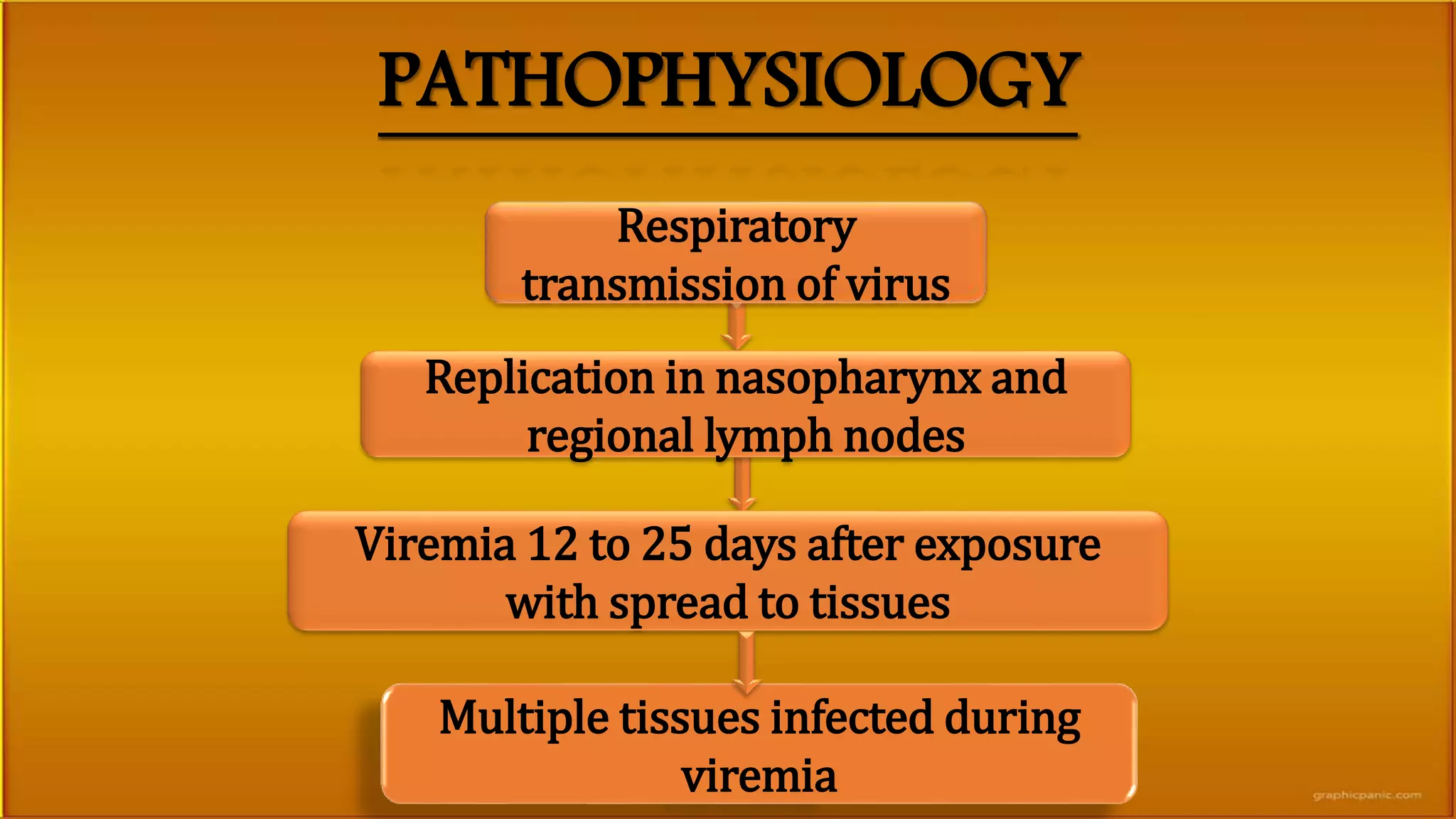
PATHOPHYSIOLOGY
Respiratory
transmission of virus
Replication in nasopharynx and
regional lymph nodes
Viremia 12 to 25 days after exposure
with spread to tissues
Multiple tissues infected during
viremia
INCUBATION PERIOD
The time between being exposed to the virus and
getting sick (incubation period) is usually 12 - 24
days
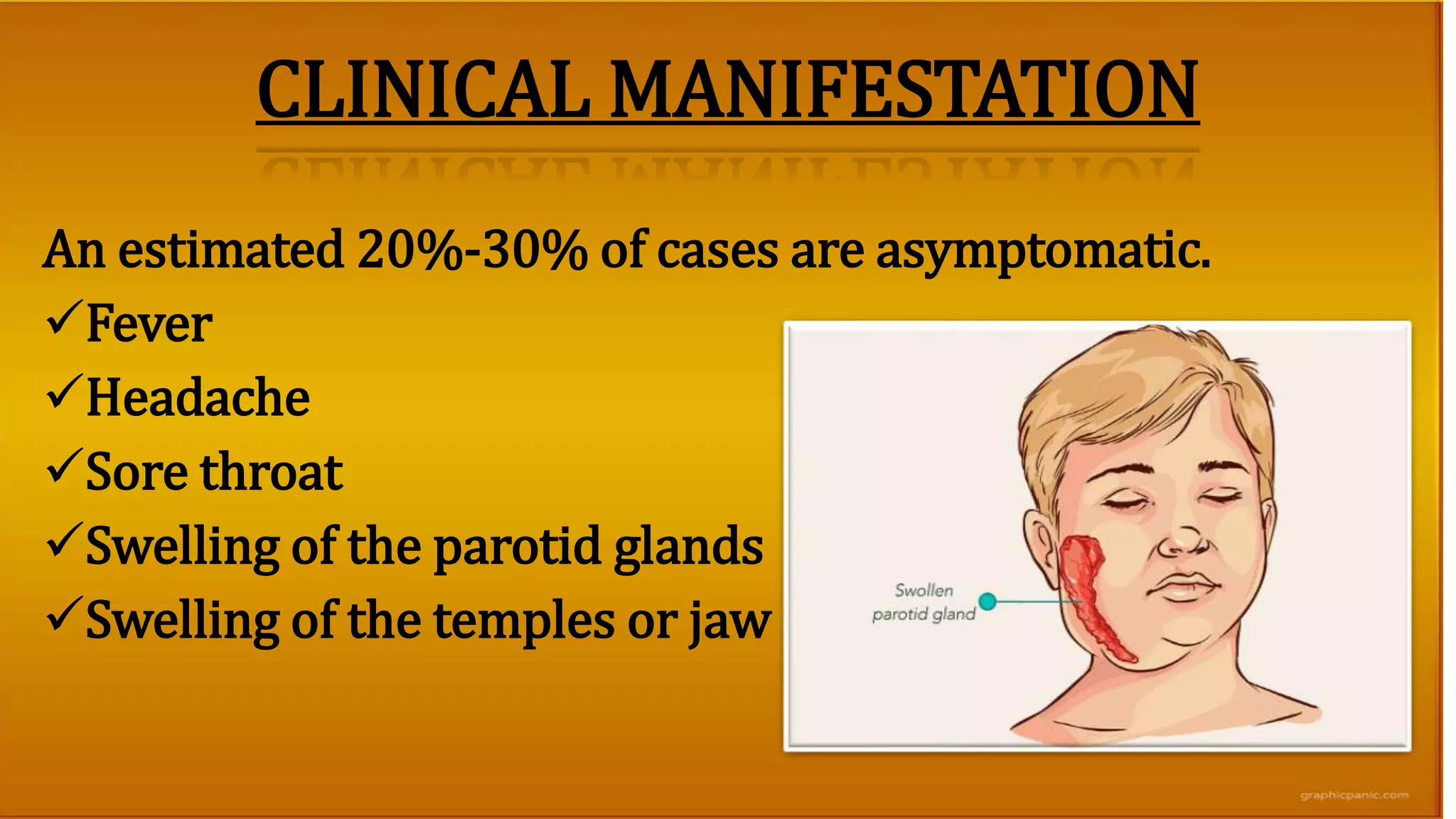
CLINICAL MANIFESTATION
An estimated 20%-30% of cases are asymptomatic.
Fever
Headache
Sore throat
Swelling of the parotid glands
Swelling of the temples or jaw
ASESSMENT & DIAGNOSTIC EVAUATION
1. History collection
2. Physical Examination -
confirms the presence of the swollen glands. No
testing is usually required.
LAB TEST
Pancreatic Enzyme Testing
Spinal Fluid Sample and Culture
Salivary Culture
Antibody Tests
Buccal Swab Reverse Transcription Polymerase
Chain Reaction (RT-PCR)
Imaging
Neck CT
Brain CT or MRI
Abdominal CT or Ultrasound
Testicular Ultrasound
MANAGEMENT
MEDICAL MANAGEMENT
PHARMACOLOGICAL MANAGEMENT
 paracetamol drug – whether liquid,
melt-in-the-mouth, or soluble. The drug
is available in different forms
(liquid/tablet)
 Non aspirin fever medications
 acetaminophen
 ibuprofen
NON PHARMACOLOGICAL MANAGEMENT
• Monitor temperature
• warm or cold packs (Topical application)
• Bed rest
DIETARY MANAGEMENT
oA light diet with plenty fluid intake is
encouraged
oAcidic foods (such as tomato, vinegar-containing
food additives) and liquids (such as orange juice)
should be avoided to lessen oral pain and
discomfort
NURSING
MANAGEMENT
Nursing diagnosis
1. Imbalanced nutrition less than body requirements related
to infectious condition as evidenced by swelling, pain and
difficulty in swallowing
2. Acute pain related to inflammatory process..
3. Risk for deficient fluid volume related to disease condition
such as swelling and difficulty in swallowing
4. Anxiety related to change in health status.
5. Hyperthermia related to inflammatory process as
evidenced by rise in body temperature.
Nursing intervention
Provide analgesics and apply warm or cool compresses to
the neck area to relieve pain
Give antibiotics and tapid sponge bath for fever
Increase fluid intake to prevent dehydration
Provide a high calorie, nutritionally rich soft or liquid food
frequently
 Avoid spicy, sour food that stimulate salivation or require
the act of chewing
Measure body weight daily
Closely observe for complications
VACCINATION
MMR (0.5 mL . / subcutaneous route)
2 doses:
1. at age 12–15 months
2. at age 4–6 years
MMRV (0.5 mL . / subcutaneous route)
HEALTH EDUCATION
When to Call the Doctor:
Call the doctor if you suspect that your child has mumps
If your child has been diagnosed with mumps, keep track of
his or her temperature and call the doctor if goes above 101°
(38.3° Celsius)
Mumps can also involve the brain and its membranes, call
the doctor immediately if your child has any of the following:
• s:ff neck, convulsions (seizures), extreme drowsiness, severe
headache, or changes of consciousness
COMPLICATIONS
o meningitis
o Encephalitis
o Orchitis
o Hearing loss
CONCLUSION
For a more thorough diagnosis when suspecting that
your child may have mumps, consult a paediatric
specialist. Ensure medicine dosage is followed
according to prescriptions. Contact the parents of
other children who may have come in contact with
your child during the days leading up to a diagnosed
case of the mumps, since the virus is contagious. Act
quickly when diagnosed to ensure effective treatment
Mumps

Mumps

  • 1.
  • 2.
    INTRODUCTION Mumps is aviral illness caused by a paramyxovirus, a member of the Rubella virus family. The average incubation period for mumps is 16 to 18 days, with a range of 12 to 25 days.
  • 3.
    DEFINITION Mumps is anacute viral infection of childhood that typically involves swelling of one or both parotid glands, although many different organs can be infected.
  • 4.
    INCIDENCE In India, sporadiccases and outbreak are reported throughout the year from all regions of the country. Ministry of health and family welfare, Government of India, has reported 45 outbreaks of mumps
  • 5.
    ETIOLOGY & RISKFACTORS caused by a virus – paramyxovirus Mumps in Vaccinated People Immune Deficiency After Vaccination Babies Born to Infected Mothers Viral Infection From Immunization
  • 6.
    PATHOPHYSIOLOGY Respiratory transmission of virus Replicationin nasopharynx and regional lymph nodes Viremia 12 to 25 days after exposure with spread to tissues Multiple tissues infected during viremia
  • 7.
    INCUBATION PERIOD The timebetween being exposed to the virus and getting sick (incubation period) is usually 12 - 24 days
  • 8.
    CLINICAL MANIFESTATION An estimated20%-30% of cases are asymptomatic. Fever Headache Sore throat Swelling of the parotid glands Swelling of the temples or jaw
  • 9.
    ASESSMENT & DIAGNOSTICEVAUATION 1. History collection 2. Physical Examination - confirms the presence of the swollen glands. No testing is usually required.
  • 10.
    LAB TEST Pancreatic EnzymeTesting Spinal Fluid Sample and Culture Salivary Culture Antibody Tests Buccal Swab Reverse Transcription Polymerase Chain Reaction (RT-PCR)
  • 11.
    Imaging Neck CT Brain CTor MRI Abdominal CT or Ultrasound Testicular Ultrasound
  • 12.
  • 13.
    MEDICAL MANAGEMENT PHARMACOLOGICAL MANAGEMENT paracetamol drug – whether liquid, melt-in-the-mouth, or soluble. The drug is available in different forms (liquid/tablet)  Non aspirin fever medications  acetaminophen  ibuprofen
  • 14.
    NON PHARMACOLOGICAL MANAGEMENT •Monitor temperature • warm or cold packs (Topical application) • Bed rest
  • 15.
    DIETARY MANAGEMENT oA lightdiet with plenty fluid intake is encouraged oAcidic foods (such as tomato, vinegar-containing food additives) and liquids (such as orange juice) should be avoided to lessen oral pain and discomfort
  • 16.
  • 17.
    Nursing diagnosis 1. Imbalancednutrition less than body requirements related to infectious condition as evidenced by swelling, pain and difficulty in swallowing 2. Acute pain related to inflammatory process.. 3. Risk for deficient fluid volume related to disease condition such as swelling and difficulty in swallowing 4. Anxiety related to change in health status. 5. Hyperthermia related to inflammatory process as evidenced by rise in body temperature.
  • 18.
    Nursing intervention Provide analgesicsand apply warm or cool compresses to the neck area to relieve pain Give antibiotics and tapid sponge bath for fever Increase fluid intake to prevent dehydration Provide a high calorie, nutritionally rich soft or liquid food frequently  Avoid spicy, sour food that stimulate salivation or require the act of chewing Measure body weight daily Closely observe for complications
  • 19.
    VACCINATION MMR (0.5 mL. / subcutaneous route) 2 doses: 1. at age 12–15 months 2. at age 4–6 years MMRV (0.5 mL . / subcutaneous route)
  • 20.
    HEALTH EDUCATION When toCall the Doctor: Call the doctor if you suspect that your child has mumps If your child has been diagnosed with mumps, keep track of his or her temperature and call the doctor if goes above 101° (38.3° Celsius) Mumps can also involve the brain and its membranes, call the doctor immediately if your child has any of the following: • s:ff neck, convulsions (seizures), extreme drowsiness, severe headache, or changes of consciousness
  • 21.
  • 22.
    CONCLUSION For a morethorough diagnosis when suspecting that your child may have mumps, consult a paediatric specialist. Ensure medicine dosage is followed according to prescriptions. Contact the parents of other children who may have come in contact with your child during the days leading up to a diagnosed case of the mumps, since the virus is contagious. Act quickly when diagnosed to ensure effective treatment