• Mumps is a contagious disease caused by a
virus that passes from one person to
another through saliva, nasal secretions,
and close personal contact.
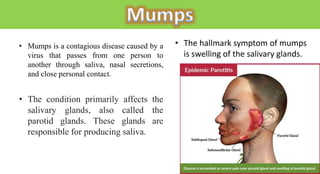
• The condition primarily affects the
salivary glands, also called the
parotid glands. These glands are
responsible for producing saliva.
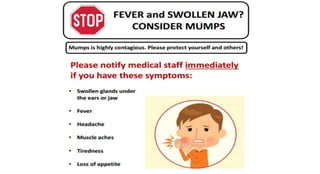
• The hallmark symptom of mumps
is swelling of the salivary glands.
• Symptoms of mumps usually appear
within two weeks of exposure to the
virus.
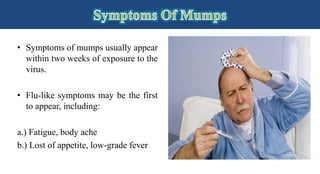
• Flu-like symptoms may be the first
to appear, including:
a.) Fatigue, body ache
b.) Lost of appetite, low-grade fever
• A high fever of 103°F (39°C) and
swelling of the salivary glands
follow over the next few days. The
glands may not all swell at once
• More commonly, they swell and
become painful periodically. You are
most likely to pass the mumps virus
to another person from the time you
come into contact with the virus to
when your parotid glands swell.
• Because mumps is a virus, it doesn’t
respond to antibiotics or other
medications.
• However, you can treat the
symptoms to make yourself more
comfortable while you’re sick.
These include:
• Rest when you feel weak/tired
a.) Drink plenty of fluid to avoid
dehydration due to the fever
a) Take over-the-counter pain
relievers: acetaminophen,
ibuprofen to bring down the
fever.
• Soothe swollen glands by
applying ice packs.
• Eat a soft diet of soup, yogurt and other
food that aren’t hard to chew ( chewing
maybe painful when your glands are
swollen
• Void acidic food or beverages that may
cause more pain in your salivary glands
• Most people who get mumps can’t
contract the disease a second time.
Having the virus once protects you
against becoming infected again.
Complications Associated With Mumps
• Complications from mumps are rare,
but can be serious if left untreated.
Mumps mostly affects the parotid
glands.
• However, it can also cause
inflammation in other areas of the
body, including the brain and
reproductive organs.
• Orchitis is inflammation of the
testicles that may be due to mumps.
• You can manage orchitis pain by
placing cold packs on the testicles
several times per day.
• In rare cases, orchitis can cause
sterility.
Orchitis
Complications Associated With Mumps
• Females infected with mumps may
experience swelling of the ovaries.
The inflammation can be painful but
doesn’t harm a woman’s eggs.
• However, if a woman contracts
mumps during pregnancy, she has a
higher-than-normal risk of
experiencing a miscarriage.
• Mumps may lead to meningitis
or encephalitis, two potentially
fatal conditions if left untreated.
• Meningitis is swelling of the
membranes around your spinal
cord and brain.
• Encephalitis is inflammation of
the brain
Complications Associated With Mumps
• Contact your doctor if you experience
seizures, loss of consciousness, or
severe headaches while you have
mumps.
• Mumps-induced pancreatitis is a
temporary condition.
• Pancreatitis is inflammation of the
pancreas, an organ in the abdominal
cavity.
Symptoms include: abdominal pain,
nausea, and vomiting.
• The mumps virus also leads to
permanent hearing loss in about
5 out of every 10,000 cases.
• The virus damages the cochlea,
one of the structures in your inner
ear that facilitates hearing.
How Can I Prevent Mumps
• Vaccination can prevent mumps.
• Most infants and children receive a
vaccine for measles, mumps, and
rubella (MMR) at the same time.
• The first MMR shot is generally
given between the ages of 12 and 15
months at a routine well-child visit
• A second vaccination is necessary
for school-aged children between 4
and 6 years old.
How Can I Prevent Mumps
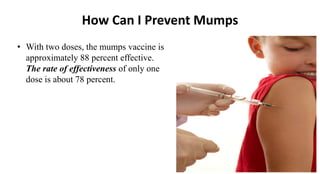
• With two doses, the mumps vaccine is
approximately 88 percent effective.
The rate of effectiveness of only one
dose is about 78 percent.
How Can I Prevent Mumps
• People who have compromised
immune systems, are allergic to gelatin
or neomycin, or are pregnant, shouldn’t
receive the MMR vaccine.
For more Information:
abrahamdaylee25@gmail.com
adayklee@yahoo.com
Contact: 0880760020/0776782278

Mumps

  • 2.
    • Mumps isa contagious disease caused by a virus that passes from one person to another through saliva, nasal secretions, and close personal contact. • The condition primarily affects the salivary glands, also called the parotid glands. These glands are responsible for producing saliva. • The hallmark symptom of mumps is swelling of the salivary glands.
  • 4.
    • Symptoms ofmumps usually appear within two weeks of exposure to the virus. • Flu-like symptoms may be the first to appear, including: a.) Fatigue, body ache b.) Lost of appetite, low-grade fever
  • 5.
    • A highfever of 103°F (39°C) and swelling of the salivary glands follow over the next few days. The glands may not all swell at once • More commonly, they swell and become painful periodically. You are most likely to pass the mumps virus to another person from the time you come into contact with the virus to when your parotid glands swell.
  • 8.
    • Because mumpsis a virus, it doesn’t respond to antibiotics or other medications. • However, you can treat the symptoms to make yourself more comfortable while you’re sick. These include: • Rest when you feel weak/tired a.) Drink plenty of fluid to avoid dehydration due to the fever a) Take over-the-counter pain relievers: acetaminophen, ibuprofen to bring down the fever.
  • 9.
    • Soothe swollenglands by applying ice packs.
  • 10.
    • Eat asoft diet of soup, yogurt and other food that aren’t hard to chew ( chewing maybe painful when your glands are swollen • Void acidic food or beverages that may cause more pain in your salivary glands • Most people who get mumps can’t contract the disease a second time. Having the virus once protects you against becoming infected again.
  • 13.
    Complications Associated WithMumps • Complications from mumps are rare, but can be serious if left untreated. Mumps mostly affects the parotid glands. • However, it can also cause inflammation in other areas of the body, including the brain and reproductive organs. • Orchitis is inflammation of the testicles that may be due to mumps. • You can manage orchitis pain by placing cold packs on the testicles several times per day. • In rare cases, orchitis can cause sterility.
  • 14.
  • 18.
    Complications Associated WithMumps • Females infected with mumps may experience swelling of the ovaries. The inflammation can be painful but doesn’t harm a woman’s eggs. • However, if a woman contracts mumps during pregnancy, she has a higher-than-normal risk of experiencing a miscarriage. • Mumps may lead to meningitis or encephalitis, two potentially fatal conditions if left untreated. • Meningitis is swelling of the membranes around your spinal cord and brain. • Encephalitis is inflammation of the brain
  • 19.
    Complications Associated WithMumps • Contact your doctor if you experience seizures, loss of consciousness, or severe headaches while you have mumps. • Mumps-induced pancreatitis is a temporary condition. • Pancreatitis is inflammation of the pancreas, an organ in the abdominal cavity. Symptoms include: abdominal pain, nausea, and vomiting. • The mumps virus also leads to permanent hearing loss in about 5 out of every 10,000 cases. • The virus damages the cochlea, one of the structures in your inner ear that facilitates hearing.
  • 20.
    How Can IPrevent Mumps • Vaccination can prevent mumps. • Most infants and children receive a vaccine for measles, mumps, and rubella (MMR) at the same time. • The first MMR shot is generally given between the ages of 12 and 15 months at a routine well-child visit • A second vaccination is necessary for school-aged children between 4 and 6 years old.
  • 21.
    How Can IPrevent Mumps • With two doses, the mumps vaccine is approximately 88 percent effective. The rate of effectiveness of only one dose is about 78 percent.
  • 22.
    How Can IPrevent Mumps • People who have compromised immune systems, are allergic to gelatin or neomycin, or are pregnant, shouldn’t receive the MMR vaccine.
  • 24.