MUMPS
Mumps
The name comes from the British word
"to mump", that is grimace or grin.
The appearance of the patient as a result
of parotid gland swelling seems to be in
grin
Definition
Mumps is an acute viral infection of
childhood that typically involves swelling of
one or both parotid glands, although many
different organs can be infected.
Etiology
Mumps virus, the cause of mumps, is an
RNA virus of the genus Rubulavirus in
the Paramyxoviridae family , which also
includes the parainfluenza viruses.
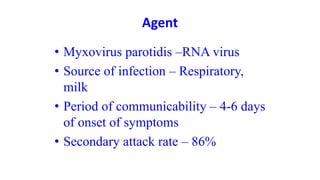
Agent
• Myxovirus parotidis –RNA virus
• Source of infection – Respiratory,
milk
• Period of communicability – 4-6 days
of onset of symptoms
• Secondary attack rate – 86%
Epidemiology
 Mumps is endemic in most unvaccinated
populations
 The virus is spread from human reservoir by ;
* Direct contact
* Airborne droplets
* Fomites contaminated by saliva
* possibly by urine
 It is distributed worldwide
 Affects both sexes equally
• Age & sex 5-15 yrs and girls common
• Immunity - life long
• Environmental factor – winter and spring
season favors
• Mode of transmission – droplet
• I.P - 2 to 3 weeks
Epidemiology (cont.)
 Virus has been isolated from saliva as long as
6 days before and up to 9 days after
appearance of salivary gland swelling.
 Transmission does not seem to occur more
than 24 hr before the appearance of the swelling
or later than 3 days after it has subsided.
 Virus has been isolated from urine from the
1st- 14th day after the onset of salivary gland
swelling.
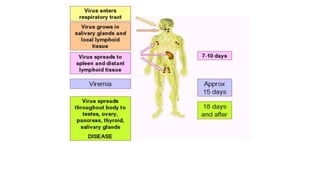
Pathogenesis
 After entry into the last and initial multiplication
in the cells of the respiratory tract,
the virus is bloodborne to many tissues,
among which the salivary and other glands are
the most susceptible.
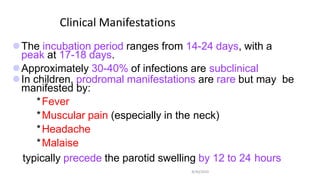
Clinical Manifestations
8/30/2010
The incubation period ranges from 14-24 days, with a
peak at 17-18 days.
Approximately 30-40% of infections are subclinical
In children, prodromal manifestations are rare but may be
manifested by:
*Fever
*Muscular pain (especially in the neck)
*Headache
*Malaise
typically precede the parotid swelling by 12 to 24 hours
Clinical Manifestations (cont.)
*Common complaints are:
• Earache on the side of parotid involvement
• Discomfort with eating or drinking acidic food
• Parotid pain is most pronounced during the first
few days of swelling
Clinical Manifestations (cont.)
The swollen parotid gland lifts the earlobe
upward and outward, and the angle of the
mandible is obscured
Opening of the Stensen duct on the
buccal mucosa is edematous and
erythematous.
 Trismus (spasm of the masticatory
muscles) can occur.
Toddler with mumps parotitis
Clinical Manifestations (cont.)
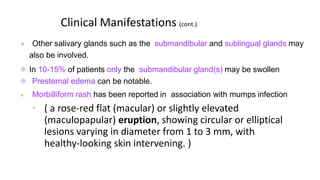
 Other salivary glands such as the submandibular and sublingual glands may
also be involved.
 In 10-15% of patients only the submandibular gland(s) may be swollen
 Presternal edema can be notable.
 Morbilliform rash has been reported in association with mumps infection
• ( a rose-red flat (macular) or slightly elevated
(maculopapular) eruption, showing circular or elliptical
lesions varying in diameter from 1 to 3 mm, with
healthy-looking skin intervening. )
Clinical Manifestations (cont.)
Systemic symptoms, including fever, usually resolve
within 3 to 5 days
 The parotid swelling subsides within 7 to 10 days
 Adolescents and adults have more severe disease than
young children.
Diagnosis
 The diagnosis of mumps parotitis is usually apparent from the clinical
symptoms and physical examination
 Routine laboratory tests are nonspecific; usually leukopenia (a
reduction in the number of white cells in the blood, )
 relative lymphocytosis.(higher-than-normal amount of lymphocytes, )
 An elevation in serum amylase levels is common; the rise tends to
parallel the parotid swelling and then to return to normal within 2 wk
Diagnosis (cont.)
The microbiologic diagnosis is by serology or
virus culture
Enzyme immunoassay for mumps
immunoglobulin (Ig).
IgG and IgM antibodies are most commonly used
for diagnosis.
 IgM antibodies are detectable in the first few
days of illness and are considered diagnostic
Diagnosis (cont.)
Mumps virus can be cultured from the
saliva, cerebrospinal fluid, blood, urine,
brain, and other infected tissues.
DIFFERENTIAL DIAGNOSIS
The differential diagnosis of parotitis is broad and includes:
 bacterial (suppurative) parotitis
 parotid duct stone
 drug reactions
 recurrent parotitis of childhood
 Other viruses, such as influenza, coxsackievirus A,
echovirus, and parainfluenza viruses 1 and 3, can cause
parotitis and are usually responsible for “recurrent
mumps”
 parotid tumor
Boy with parotitis not due to mumps
Treatment
There is no specific antiviral therapy; treatment is
entirely supportive.
 Antipyretics (acetaminophen or ibuprofen) are indicated
for fever.
Bed rest
Diet should be adjusted to the patient's ability to chew.
Treatment (cont.)
 Orchitis should be treated with local
support and bed rest.
Mumps arthritis may respond to a 2-wk
course of a nonsteroidal anti-inflammatory
agent or corticosteroids.
Complications
 MENINGOENCEPHALOMYELITIS
1.The most frequent complication in childhood
2.Clinical manifestations occur in more than
10% of patients
3. The mortality rate is about 2%
Complications
 MENINGOENCEPHALOMYELITIS (cont.)
5. may be either:
I. Primary infection of neurons:
parotitis frequently appears at the same
time or following the onset of encephalitis
II. Postinfectious encephalitis with
demyelination :
encephalitis follows parotitis by an
average of10 days.
Complications
 MENINGOENCEPHALOMYELITIS (cont.)
*Mumps meningoencephalitis is clinically
indistinguishable from meningoencephalitis of
other origins
Complications (cont.)
 ORCHITIS in prepubescent boys but are common (14-
35%) in adolescents and adults.
1. The testis is most often infected
2. Bilateral orchitis occurs in approximately 30% of
patients.
3. The orchitis usually follows parotitis within 8 days.
4. Infertility
1. Epididymitis
Complications (cont.)
OOPHORITIS
Pelvic pain and tenderness are noted in
about 7% of postpubertal female patients.
There is no evidence of impairment of
fertility.
Complications (cont.)
PANCREATITIS
* Mild or subclinical pancreatic involvement is common, but
severe pancreatitis is rare.
Complications (cont.)
 MYOCARDITIS
*Serious cardiac manifestations are extremely rare
Complications (cont.)
ARTHRITIS
*Migratory polyarthralgia and even arthritis are
occasionally seen in adults with mumps but are
rare in children.
*The knees, ankles, shoulders, and wrists are
most commonly affected.
Complications (cont.)
THYROIDITIS
* It is uncommon in children
* A diffuse, tender swelling of the thyroid
may occur about 1 wk after the onset of
parotitis
Complications (cont.)
DEAFNESS
* Unilateral, rarely bilateral, nerve deafness may occur
* the incidence is low (1/15,000 cases)
* mumps was historically a leading cause of unilateral nerve
deafness.
* The hearing loss may be transient or permanent.
Complications (cont.)
OCULAR COMPLICATIONS
* Dacryoadenitis may occur with painful
swelling, usually bilateral, of the lacrimal
glands.
* Optic neuritis (papillitis) may occur
*Symptoms vary from loss of vision to mild
blurring, with recovery in 10-20 days.
Prognosis
The prognosis of mumps in childhood is
excellent.
 Infection usually confers permanent
immunity
 Reinfections have been documented
Prevention
 Mumps Vaccine
 The vaccine induces antibody in 96% of seronegative
recipients and has 97% protective efficacy.
 The initial mumps immunization, usually as measles-
mumps-rubella (MMR) vaccine, is recommended at 12-
15 mo of age.
 A second immunization, also as MMR, is recommended
routinely at 4-6 yr of age but may be administered at any
time during childhood provided at least 4 wk have
elapsed since the first dose.
Prevention (cont.)
 Women should avoid becoming pregnant for 30 days after mumps
vaccination (3 mo if vaccination was performed with rubella vaccine).
 Other contraindications to vaccination include:
*allergy to a vaccine component (anaphylaxis to neomycin)
* moderate or severe acute illnesses with or without fever
*Immunodeficiency
* recent immune globulin administration
Prevention (cont.)
Children who have not previously received
the second dose should be immunized by
11-12 yr of age.
 Rarely, parotitis and low-grade fever can
develop 10-14 days after vaccination.
Vaccines do not shed virus.
 Maternal antibody is protective in the
infant in the first 6 mo of life.
Complications
• Orchitis
• Oophoiritis
• Spontaneous abortion
• Sensori neural hearing loss, (uni- or bilateral).
• Mild form of meningitis
• Encephalitis
mumps.pptx

mumps.pptx

  • 1.
  • 2.
    Mumps The name comesfrom the British word "to mump", that is grimace or grin. The appearance of the patient as a result of parotid gland swelling seems to be in grin
  • 3.
    Definition Mumps is anacute viral infection of childhood that typically involves swelling of one or both parotid glands, although many different organs can be infected.
  • 6.
    Etiology Mumps virus, thecause of mumps, is an RNA virus of the genus Rubulavirus in the Paramyxoviridae family , which also includes the parainfluenza viruses.
  • 7.
    Agent • Myxovirus parotidis–RNA virus • Source of infection – Respiratory, milk • Period of communicability – 4-6 days of onset of symptoms • Secondary attack rate – 86%
  • 8.
    Epidemiology  Mumps isendemic in most unvaccinated populations  The virus is spread from human reservoir by ; * Direct contact * Airborne droplets * Fomites contaminated by saliva * possibly by urine  It is distributed worldwide  Affects both sexes equally
  • 9.
    • Age &sex 5-15 yrs and girls common • Immunity - life long • Environmental factor – winter and spring season favors • Mode of transmission – droplet • I.P - 2 to 3 weeks
  • 10.
    Epidemiology (cont.)  Virushas been isolated from saliva as long as 6 days before and up to 9 days after appearance of salivary gland swelling.  Transmission does not seem to occur more than 24 hr before the appearance of the swelling or later than 3 days after it has subsided.  Virus has been isolated from urine from the 1st- 14th day after the onset of salivary gland swelling.
  • 11.
    Pathogenesis  After entryinto the last and initial multiplication in the cells of the respiratory tract, the virus is bloodborne to many tissues, among which the salivary and other glands are the most susceptible.
  • 13.
    Clinical Manifestations 8/30/2010 The incubationperiod ranges from 14-24 days, with a peak at 17-18 days. Approximately 30-40% of infections are subclinical In children, prodromal manifestations are rare but may be manifested by: *Fever *Muscular pain (especially in the neck) *Headache *Malaise typically precede the parotid swelling by 12 to 24 hours
  • 14.
    Clinical Manifestations (cont.) *Commoncomplaints are: • Earache on the side of parotid involvement • Discomfort with eating or drinking acidic food • Parotid pain is most pronounced during the first few days of swelling
  • 15.
    Clinical Manifestations (cont.) Theswollen parotid gland lifts the earlobe upward and outward, and the angle of the mandible is obscured Opening of the Stensen duct on the buccal mucosa is edematous and erythematous.  Trismus (spasm of the masticatory muscles) can occur.
  • 16.
  • 17.
    Clinical Manifestations (cont.) Other salivary glands such as the submandibular and sublingual glands may also be involved.  In 10-15% of patients only the submandibular gland(s) may be swollen  Presternal edema can be notable.  Morbilliform rash has been reported in association with mumps infection • ( a rose-red flat (macular) or slightly elevated (maculopapular) eruption, showing circular or elliptical lesions varying in diameter from 1 to 3 mm, with healthy-looking skin intervening. )
  • 18.
    Clinical Manifestations (cont.) Systemicsymptoms, including fever, usually resolve within 3 to 5 days  The parotid swelling subsides within 7 to 10 days  Adolescents and adults have more severe disease than young children.
  • 19.
    Diagnosis  The diagnosisof mumps parotitis is usually apparent from the clinical symptoms and physical examination  Routine laboratory tests are nonspecific; usually leukopenia (a reduction in the number of white cells in the blood, )  relative lymphocytosis.(higher-than-normal amount of lymphocytes, )  An elevation in serum amylase levels is common; the rise tends to parallel the parotid swelling and then to return to normal within 2 wk
  • 20.
    Diagnosis (cont.) The microbiologicdiagnosis is by serology or virus culture Enzyme immunoassay for mumps immunoglobulin (Ig). IgG and IgM antibodies are most commonly used for diagnosis.  IgM antibodies are detectable in the first few days of illness and are considered diagnostic
  • 21.
    Diagnosis (cont.) Mumps viruscan be cultured from the saliva, cerebrospinal fluid, blood, urine, brain, and other infected tissues.
  • 22.
    DIFFERENTIAL DIAGNOSIS The differentialdiagnosis of parotitis is broad and includes:  bacterial (suppurative) parotitis  parotid duct stone  drug reactions  recurrent parotitis of childhood  Other viruses, such as influenza, coxsackievirus A, echovirus, and parainfluenza viruses 1 and 3, can cause parotitis and are usually responsible for “recurrent mumps”  parotid tumor
  • 23.
    Boy with parotitisnot due to mumps
  • 24.
    Treatment There is nospecific antiviral therapy; treatment is entirely supportive.  Antipyretics (acetaminophen or ibuprofen) are indicated for fever. Bed rest Diet should be adjusted to the patient's ability to chew.
  • 25.
    Treatment (cont.)  Orchitisshould be treated with local support and bed rest. Mumps arthritis may respond to a 2-wk course of a nonsteroidal anti-inflammatory agent or corticosteroids.
  • 26.
    Complications  MENINGOENCEPHALOMYELITIS 1.The mostfrequent complication in childhood 2.Clinical manifestations occur in more than 10% of patients 3. The mortality rate is about 2%
  • 27.
    Complications  MENINGOENCEPHALOMYELITIS (cont.) 5.may be either: I. Primary infection of neurons: parotitis frequently appears at the same time or following the onset of encephalitis II. Postinfectious encephalitis with demyelination : encephalitis follows parotitis by an average of10 days.
  • 28.
    Complications  MENINGOENCEPHALOMYELITIS (cont.) *Mumpsmeningoencephalitis is clinically indistinguishable from meningoencephalitis of other origins
  • 29.
    Complications (cont.)  ORCHITISin prepubescent boys but are common (14- 35%) in adolescents and adults. 1. The testis is most often infected 2. Bilateral orchitis occurs in approximately 30% of patients. 3. The orchitis usually follows parotitis within 8 days. 4. Infertility 1. Epididymitis
  • 30.
    Complications (cont.) OOPHORITIS Pelvic painand tenderness are noted in about 7% of postpubertal female patients. There is no evidence of impairment of fertility.
  • 31.
    Complications (cont.) PANCREATITIS * Mildor subclinical pancreatic involvement is common, but severe pancreatitis is rare.
  • 32.
    Complications (cont.)  MYOCARDITIS *Seriouscardiac manifestations are extremely rare
  • 33.
    Complications (cont.) ARTHRITIS *Migratory polyarthralgiaand even arthritis are occasionally seen in adults with mumps but are rare in children. *The knees, ankles, shoulders, and wrists are most commonly affected.
  • 34.
    Complications (cont.) THYROIDITIS * Itis uncommon in children * A diffuse, tender swelling of the thyroid may occur about 1 wk after the onset of parotitis
  • 35.
    Complications (cont.) DEAFNESS * Unilateral,rarely bilateral, nerve deafness may occur * the incidence is low (1/15,000 cases) * mumps was historically a leading cause of unilateral nerve deafness. * The hearing loss may be transient or permanent.
  • 36.
    Complications (cont.) OCULAR COMPLICATIONS *Dacryoadenitis may occur with painful swelling, usually bilateral, of the lacrimal glands. * Optic neuritis (papillitis) may occur *Symptoms vary from loss of vision to mild blurring, with recovery in 10-20 days.
  • 37.
    Prognosis The prognosis ofmumps in childhood is excellent.  Infection usually confers permanent immunity  Reinfections have been documented
  • 38.
    Prevention  Mumps Vaccine The vaccine induces antibody in 96% of seronegative recipients and has 97% protective efficacy.  The initial mumps immunization, usually as measles- mumps-rubella (MMR) vaccine, is recommended at 12- 15 mo of age.  A second immunization, also as MMR, is recommended routinely at 4-6 yr of age but may be administered at any time during childhood provided at least 4 wk have elapsed since the first dose.
  • 39.
    Prevention (cont.)  Womenshould avoid becoming pregnant for 30 days after mumps vaccination (3 mo if vaccination was performed with rubella vaccine).  Other contraindications to vaccination include: *allergy to a vaccine component (anaphylaxis to neomycin) * moderate or severe acute illnesses with or without fever *Immunodeficiency * recent immune globulin administration
  • 40.
    Prevention (cont.) Children whohave not previously received the second dose should be immunized by 11-12 yr of age.  Rarely, parotitis and low-grade fever can develop 10-14 days after vaccination. Vaccines do not shed virus.  Maternal antibody is protective in the infant in the first 6 mo of life.
  • 41.
    Complications • Orchitis • Oophoiritis •Spontaneous abortion • Sensori neural hearing loss, (uni- or bilateral). • Mild form of meningitis • Encephalitis