Presented By
SAgun PAudel
Health Assistant
EIHS
Naulo Ghumti Nepal
ORIENTATION ON HIV,
AIDS AND STIS
Objectives of Presentation
2
General Objectives
To orient about HIV, AIDS and STIs for Development
of Knowledge, Attitude, and Practice for Prevention
of HIV and STIs.
Specific Objectives
• To know the basic concept HIV, AIDS & STIs
• To know the History of HIV Infection, situation of HIV in
Nepal
• To acquire knowledge about mode of Transmission of HIV,
How HIV does not Transmit, Window period.
• To know Pathogenesis, Diagnosis of HIV infection,
General clinical features of AIDS.
• To know Risk Population for HIV infection, Prevention of
HIV infection.
• To gain knowledge about Treatment/ curative health
services of HIV infection and AIDS.
• To know the knowledge about STIs, their clinical features,
treatment and Prevention.
3
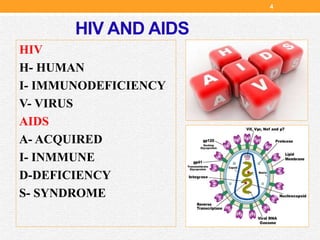
HIV AND AIDS
HIV
H- HUMAN
I- IMMUNODEFICIENCY
V- VIRUS
AIDS
A- ACQUIRED
I- INMMUNE
D-DEFICIENCY
S- SYNDROME
4
HISTORY OF HIV
• Originated in non-human primates in Sub-Saharan Africa
and was transferred to humans during the late 19th or
early 20th century.
• Two types of HIV exist: HIV-1 and HIV-2.
• The pandemic strain of HIV-1 is closely related to a virus
found in the chimpanzees of the subspecies Pan
troglodytes troglodytes, which lives in the forests of the
Central African nations of Cameroon, Equatoria
Guinea, Gabon, Republic of Congo and Central African
Republic.
5
• Most HIV researchers agree that HIV evolved at some
point from the closely related Simian immunodeficiency
virus (SIV), and that SIV or HIV (post mutation) was
transferred from non-human primates to humans in the
recent past.
• The first confirmed case of AIDS in the United States, a
16-year-old boy from Missouri who died in 1969.
Nepal's first cases of HIV/AIDS were reported in 1988, the
disease has primarily been transmitted by injecting drug
use and unprotected sex.
6
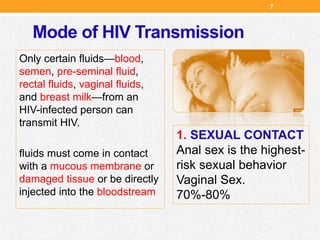
Mode of HIV Transmission
Only certain fluids—blood,
semen, pre-seminal fluid,
rectal fluids, vaginal fluids,
and breast milk—from an
HIV-infected person can
transmit HIV.
fluids must come in contact
with a mucous membrane or
damaged tissue or be directly
injected into the bloodstream
1. SEXUAL CONTACT
Anal sex is the highest-
risk sexual behavior
Vaginal Sex.
70%-80%
7
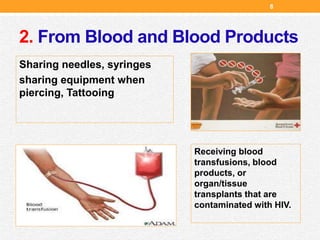
2. From Blood and Blood Products
Sharing needles, syringes
sharing equipment when
piercing, Tattooing
Receiving blood
transfusions, blood
products, or
organ/tissue
transplants that are
contaminated with HIV.
8
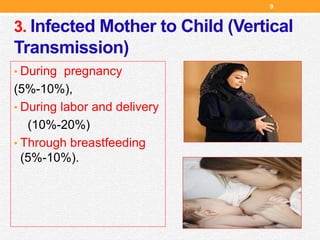
3. Infected Mother to Child (Vertical
Transmission)
• During pregnancy
(5%-10%),
• During labor and delivery
(10%-20%)
• Through breastfeeding
(5%-10%).
9
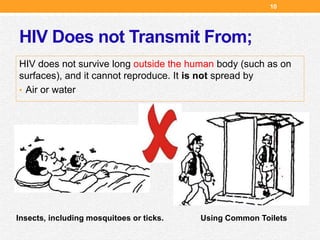
HIV Does not Transmit From;
HIV does not survive long outside the human body (such as on
surfaces), and it cannot reproduce. It is not spread by
• Air or water
Insects, including mosquitoes or ticks. Using Common Toilets
10
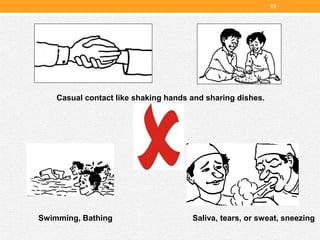
Saliva, tears, or sweat, sneezing
Casual contact like shaking hands and sharing dishes.
Swimming, Bathing
11
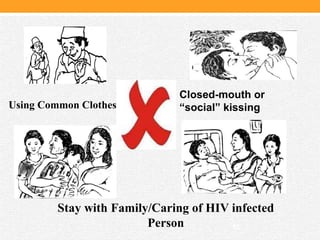
Using Common Clothes
Closed-mouth or
“social” kissing
Stay with Family/Caring of HIV infected
Person 12
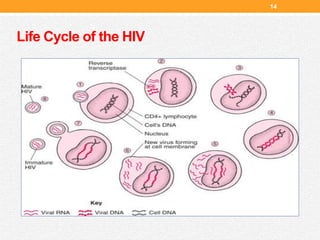
HOW HIV infects human?(Pathogenesis)
HIV destroys certain types of white blood cells, weakening
the body's defenses against infections and cancers.
HIV progressively destroys some types of white blood cells
called CD4+ lymphocytes.
Lymphocytes help defend the body against foreign cells,
infectious organisms, and cancer.
HIV destroys CD4+ lymphocytes, people become
susceptible to attack by many other infectious organisms.
13
Life Cycle of the HIV
14
SYMPTOM of HIV Infection
Initially no noticeable symptoms, but within a few weeks,
fever, rashes, swollen lymph nodes, fatigue, and a variety
of less common symptoms may develop.
Symptoms of initial (primary) HIV infection last from a few
days to 1 to 2 weeks.
The symptoms disappear, but lymph nodes often remain
enlarged, felt as small, painless lumps in the neck, under
the arms, or in the groin.
15
WINDOW PERIOD
• Time period between initial HIV infection and the
development of a measureable immunological (or
antibody) response to the infection
• During this period, a person infected with HIV
could still have a negative HIV test Result.
• Window period varies from person to person and
can range from as little as 2 weeks to as long as
3 months.
16
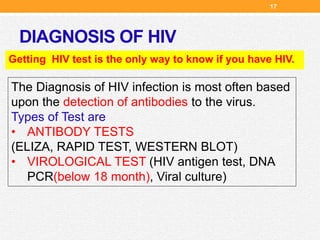
DIAGNOSIS OF HIV
Getting HIV test is the only way to know if you have HIV.
The Diagnosis of HIV infection is most often based
upon the detection of antibodies to the virus.
Types of Test are
• ANTIBODY TESTS
(ELIZA, RAPID TEST, WESTERN BLOT)
• VIROLOGICAL TEST (HIV antigen test, DNA
PCR(below 18 month), Viral culture)
17
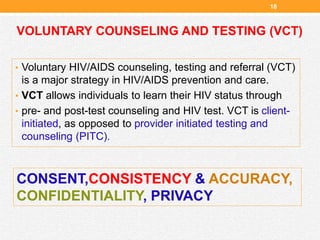
• Voluntary HIV/AIDS counseling, testing and referral (VCT)
is a major strategy in HIV/AIDS prevention and care.
• VCT allows individuals to learn their HIV status through
• pre- and post-test counseling and HIV test. VCT is client-
initiated, as opposed to provider initiated testing and
counseling (PITC).
VOLUNTARY COUNSELING AND TESTING (VCT)
CONSENT,CONSISTENCY & ACCURACY,
CONFIDENTIALITY, PRIVACY
18
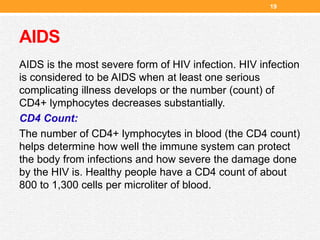
AIDS
AIDS is the most severe form of HIV infection. HIV infection
is considered to be AIDS when at least one serious
complicating illness develops or the number (count) of
CD4+ lymphocytes decreases substantially.
CD4 Count:
The number of CD4+ lymphocytes in blood (the CD4 count)
helps determine how well the immune system can protect
the body from infections and how severe the damage done
by the HIV is. Healthy people have a CD4 count of about
800 to 1,300 cells per microliter of blood.
19
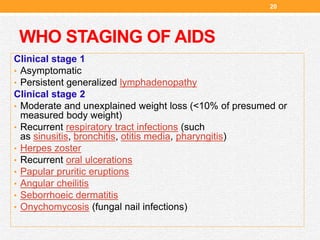
WHO STAGING OF AIDS
Clinical stage 1
• Asymptomatic
• Persistent generalized lymphadenopathy
Clinical stage 2
• Moderate and unexplained weight loss (<10% of presumed or
measured body weight)
• Recurrent respiratory tract infections (such
as sinusitis, bronchitis, otitis media, pharyngitis)
• Herpes zoster
• Recurrent oral ulcerations
• Papular pruritic eruptions
• Angular cheilitis
• Seborrhoeic dermatitis
• Onychomycosis (fungal nail infections)
20
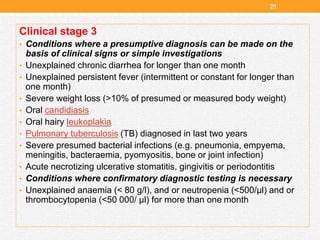
Clinical stage 3
• Conditions where a presumptive diagnosis can be made on the
basis of clinical signs or simple investigations
• Unexplained chronic diarrhea for longer than one month
• Unexplained persistent fever (intermittent or constant for longer than
one month)
• Severe weight loss (>10% of presumed or measured body weight)
• Oral candidiasis
• Oral hairy leukoplakia
• Pulmonary tuberculosis (TB) diagnosed in last two years
• Severe presumed bacterial infections (e.g. pneumonia, empyema,
meningitis, bacteraemia, pyomyositis, bone or joint infection)
• Acute necrotizing ulcerative stomatitis, gingivitis or periodontitis
• Conditions where confirmatory diagnostic testing is necessary
• Unexplained anaemia (< 80 g/l), and or neutropenia (<500/µl) and or
thrombocytopenia (<50 000/ µl) for more than one month
21
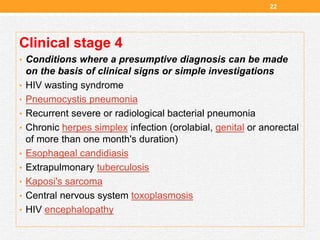
Clinical stage 4
• Conditions where a presumptive diagnosis can be made
on the basis of clinical signs or simple investigations
• HIV wasting syndrome
• Pneumocystis pneumonia
• Recurrent severe or radiological bacterial pneumonia
• Chronic herpes simplex infection (orolabial, genital or anorectal
of more than one month's duration)
• Esophageal candidiasis
• Extrapulmonary tuberculosis
• Kaposi's sarcoma
• Central nervous system toxoplasmosis
• HIV encephalopathy
22
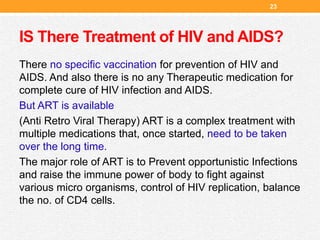
IS There Treatment of HIV and AIDS?
There no specific vaccination for prevention of HIV and
AIDS. And also there is no any Therapeutic medication for
complete cure of HIV infection and AIDS.
But ART is available
(Anti Retro Viral Therapy) ART is a complex treatment with
multiple medications that, once started, need to be taken
over the long time.
The major role of ART is to Prevent opportunistic Infections
and raise the immune power of body to fight against
various micro organisms, control of HIV replication, balance
the no. of CD4 cells.
23
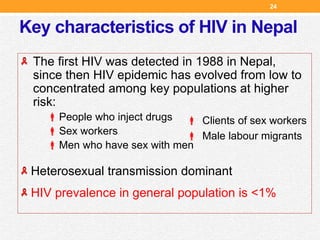
Key characteristics of HIV in Nepal
The first HIV was detected in 1988 in Nepal,
since then HIV epidemic has evolved from low to
concentrated among key populations at higher
risk:
People who inject drugs
Sex workers
Men who have sex with men
Heterosexual transmission dominant
HIV prevalence in general population is <1%
 Clients of sex workers
 Male labour migrants
24
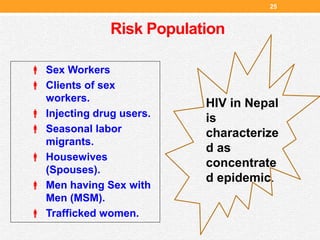
Risk Population
 Sex Workers
 Clients of sex
workers.
 Injecting drug users.
 Seasonal labor
migrants.
 Housewives
(Spouses).
 Men having Sex with
Men (MSM).
 Trafficked women.
HIV in Nepal
is
characterize
d as
concentrate
d epidemic.
25
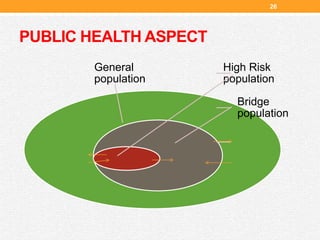
PUBLIC HEALTH ASPECT
26
High Risk
population
Bridge
population
General
population
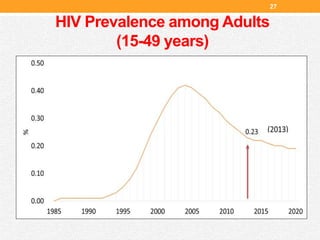
HIV Prevalence among Adults
(15-49 years)
27
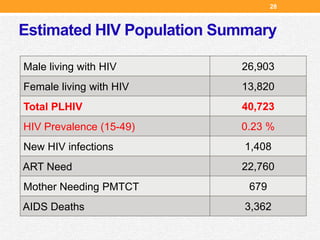
Estimated HIV Population Summary
Male living with HIV 26,903
Female living with HIV 13,820
Total PLHIV 40,723
HIV Prevalence (15-49) 0.23 %
New HIV infections 1,408
ART Need 22,760
Mother Needing PMTCT 679
AIDS Deaths 3,362
28
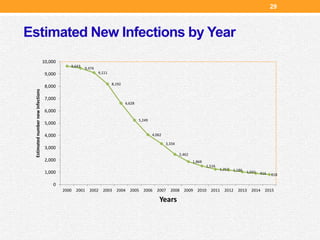
Estimated New Infections by Year
9,643
9,474
9,111
8,192
6,628
5,249
4,062
3,334
2,462
1,869
1,516
1,252 1,186 1,031 916 818
0
1,000
2,000
3,000
4,000
5,000
6,000
7,000
8,000
9,000
10,000
2000 2001 2002 2003 2004 2005 2006 2007 2008 2009 2010 2011 2012 2013 2014 2015
Estimatednumbernewinfections
Years
29
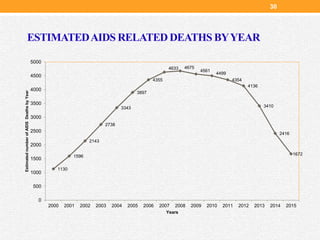
1130
1596
2143
2738
3343
3897
4355
4633 4675
4561
4499
4354
4136
3410
2416
1672
0
500
1000
1500
2000
2500
3000
3500
4000
4500
5000
2000 2001 2002 2003 2004 2005 2006 2007 2008 2009 2010 2011 2012 2013 2014 2015
EstimatednumberofAIDSDeathsbyYear
Years
ESTIMATEDAIDS RELATED DEATHS BYYEAR
30
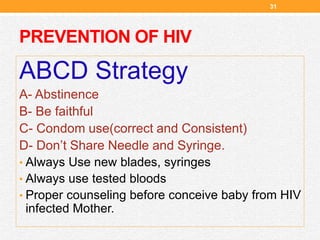
PREVENTION OF HIV
31
ABCD Strategy
A- Abstinence
B- Be faithful
C- Condom use(correct and Consistent)
D- Don’t Share Needle and Syringe.
• Always Use new blades, syringes
• Always use tested bloods
• Proper counseling before conceive baby from HIV
infected Mother.
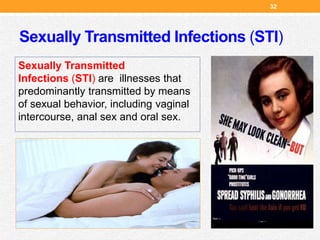
Sexually Transmitted Infections (STI)
32
Sexually Transmitted
Infections (STI) are illnesses that
predominantly transmitted by means
of sexual behavior, including vaginal
intercourse, anal sex and oral sex.
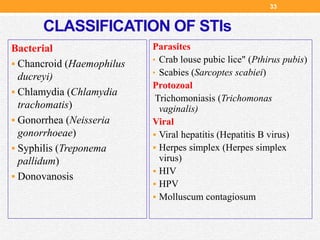
CLASSIFICATION OF STIs
33
Bacterial
 Chancroid (Haemophilus
ducreyi)
 Chlamydia (Chlamydia
trachomatis)
 Gonorrhea (Neisseria
gonorrhoeae)
 Syphilis (Treponema
pallidum)
 Donovanosis
Parasites
• Crab louse pubic lice" (Pthirus pubis)
• Scabies (Sarcoptes scabiei)
Protozoal
Trichomoniasis (Trichomonas
vaginalis)
Viral
 Viral hepatitis (Hepatitis B virus)
 Herpes simplex (Herpes simplex
virus)
 HIV
 HPV
 Molluscum contagiosum
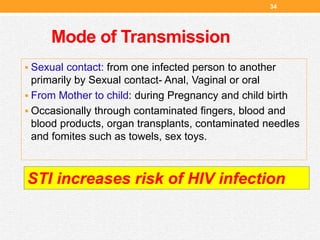
Mode of Transmission
34
 Sexual contact: from one infected person to another
primarily by Sexual contact- Anal, Vaginal or oral
 From Mother to child: during Pregnancy and child birth
 Occasionally through contaminated fingers, blood and
blood products, organ transplants, contaminated needles
and fomites such as towels, sex toys.
STI increases risk of HIV infection
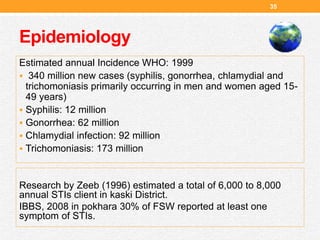
Epidemiology
35
Estimated annual Incidence WHO: 1999
 340 million new cases (syphilis, gonorrhea, chlamydial and
trichomoniasis primarily occurring in men and women aged 15-
49 years)
 Syphilis: 12 million
 Gonorrhea: 62 million
 Chlamydial infection: 92 million
 Trichomoniasis: 173 million
Research by Zeeb (1996) estimated a total of 6,000 to 8,000
annual STIs client in kaski District.
IBBS, 2008 in pokhara 30% of FSW reported at least one
symptom of STIs.
SIGN AND SYMPTOMS OF STIs
36
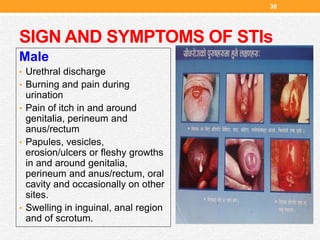
Male
• Urethral discharge
• Burning and pain during
urination
• Pain of itch in and around
genitalia, perineum and
anus/rectum
• Papules, vesicles,
erosion/ulcers or fleshy growths
in and around genitalia,
perineum and anus/rectum, oral
cavity and occasionally on other
sites.
• Swelling in inguinal, anal region
and of scrotum.
37
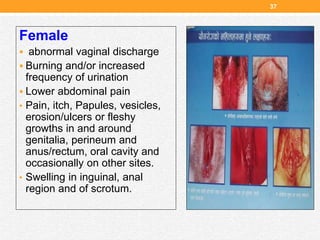
Female
 abnormal vaginal discharge
 Burning and/or increased
frequency of urination
 Lower abdominal pain
• Pain, itch, Papules, vesicles,
erosion/ulcers or fleshy
growths in and around
genitalia, perineum and
anus/rectum, oral cavity and
occasionally on other sites.
• Swelling in inguinal, anal
region and of scrotum.
RISK Factors for STIs
38
Sexual behaviors
 Sexual contact with multiple
partners
 Sexual contact without using
protective barriers
 Sexual contact with causal
partners
 Sexual contact with high
possibilities of trauma – anal
sex Other factors
 Age, socioeconomic
status, drug and
alcohol use etc.
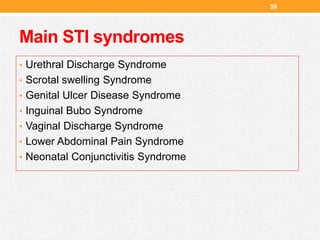
Main STI syndromes
39
• Urethral Discharge Syndrome
• Scrotal swelling Syndrome
• Genital Ulcer Disease Syndrome
• Inguinal Bubo Syndrome
• Vaginal Discharge Syndrome
• Lower Abdominal Pain Syndrome
• Neonatal Conjunctivitis Syndrome
Approaches of STIs Diagnosis and
Management
40
• Clinical Treatment
• Etiological Treatment
• Syndromic Treatment
• Enhanced Syndromic
Managenent
EDUCATIONAND COUNSELLING
THE 4cs
1. Compliance
- completing all the treatment as prescribed
2. CounselingEducation
- about the disease
- about HIV and AIDS
41
3. Contact tracing
- making sure all sexual partners are encouraged to get
treatment
4. Condoms
- promoting condom use and providing them
- how to avoid catching STI again
42
43
QUESTION /ANSWER
References
• National Voluntary Counseling and Testing Guideline
• http://aids.gov/
• http://www.cdc.gov/hiv
• www.google.com
• Publication of National Center for AIDS and STI control.
44
If you Need help ? If you have any
Problems or Query?
Contact (office)
Expanded Integrated Health
Service (EIHS)
NAULO GHUMTI NEPAL
Newroad, Pokhara
(Opposite side of Pokhara Sub-
metropolitan Office Near NCC Bank)
Phone No. : 061538547
45
Contact
Sagun Paudel
9856036932
mail4sagun@gmail.com
THANKYOU!!
You Can Download this
Presentation
www.slideshare.net/sagunpaudel

Orientation about HIV, AIDS and STIs

  • 1.
    Presented By SAgun PAudel HealthAssistant EIHS Naulo Ghumti Nepal ORIENTATION ON HIV, AIDS AND STIS
  • 2.
    Objectives of Presentation 2 GeneralObjectives To orient about HIV, AIDS and STIs for Development of Knowledge, Attitude, and Practice for Prevention of HIV and STIs.
  • 3.
    Specific Objectives • Toknow the basic concept HIV, AIDS & STIs • To know the History of HIV Infection, situation of HIV in Nepal • To acquire knowledge about mode of Transmission of HIV, How HIV does not Transmit, Window period. • To know Pathogenesis, Diagnosis of HIV infection, General clinical features of AIDS. • To know Risk Population for HIV infection, Prevention of HIV infection. • To gain knowledge about Treatment/ curative health services of HIV infection and AIDS. • To know the knowledge about STIs, their clinical features, treatment and Prevention. 3
  • 4.
    HIV AND AIDS HIV H-HUMAN I- IMMUNODEFICIENCY V- VIRUS AIDS A- ACQUIRED I- INMMUNE D-DEFICIENCY S- SYNDROME 4
  • 5.
    HISTORY OF HIV •Originated in non-human primates in Sub-Saharan Africa and was transferred to humans during the late 19th or early 20th century. • Two types of HIV exist: HIV-1 and HIV-2. • The pandemic strain of HIV-1 is closely related to a virus found in the chimpanzees of the subspecies Pan troglodytes troglodytes, which lives in the forests of the Central African nations of Cameroon, Equatoria Guinea, Gabon, Republic of Congo and Central African Republic. 5
  • 6.
    • Most HIVresearchers agree that HIV evolved at some point from the closely related Simian immunodeficiency virus (SIV), and that SIV or HIV (post mutation) was transferred from non-human primates to humans in the recent past. • The first confirmed case of AIDS in the United States, a 16-year-old boy from Missouri who died in 1969. Nepal's first cases of HIV/AIDS were reported in 1988, the disease has primarily been transmitted by injecting drug use and unprotected sex. 6
  • 7.
    Mode of HIVTransmission Only certain fluids—blood, semen, pre-seminal fluid, rectal fluids, vaginal fluids, and breast milk—from an HIV-infected person can transmit HIV. fluids must come in contact with a mucous membrane or damaged tissue or be directly injected into the bloodstream 1. SEXUAL CONTACT Anal sex is the highest- risk sexual behavior Vaginal Sex. 70%-80% 7
  • 8.
    2. From Bloodand Blood Products Sharing needles, syringes sharing equipment when piercing, Tattooing Receiving blood transfusions, blood products, or organ/tissue transplants that are contaminated with HIV. 8
  • 9.
    3. Infected Motherto Child (Vertical Transmission) • During pregnancy (5%-10%), • During labor and delivery (10%-20%) • Through breastfeeding (5%-10%). 9
  • 10.
    HIV Does notTransmit From; HIV does not survive long outside the human body (such as on surfaces), and it cannot reproduce. It is not spread by • Air or water Insects, including mosquitoes or ticks. Using Common Toilets 10
  • 11.
    Saliva, tears, orsweat, sneezing Casual contact like shaking hands and sharing dishes. Swimming, Bathing 11
  • 12.
    Using Common Clothes Closed-mouthor “social” kissing Stay with Family/Caring of HIV infected Person 12
  • 13.
    HOW HIV infectshuman?(Pathogenesis) HIV destroys certain types of white blood cells, weakening the body's defenses against infections and cancers. HIV progressively destroys some types of white blood cells called CD4+ lymphocytes. Lymphocytes help defend the body against foreign cells, infectious organisms, and cancer. HIV destroys CD4+ lymphocytes, people become susceptible to attack by many other infectious organisms. 13
  • 14.
    Life Cycle ofthe HIV 14
  • 15.
    SYMPTOM of HIVInfection Initially no noticeable symptoms, but within a few weeks, fever, rashes, swollen lymph nodes, fatigue, and a variety of less common symptoms may develop. Symptoms of initial (primary) HIV infection last from a few days to 1 to 2 weeks. The symptoms disappear, but lymph nodes often remain enlarged, felt as small, painless lumps in the neck, under the arms, or in the groin. 15
  • 16.
    WINDOW PERIOD • Timeperiod between initial HIV infection and the development of a measureable immunological (or antibody) response to the infection • During this period, a person infected with HIV could still have a negative HIV test Result. • Window period varies from person to person and can range from as little as 2 weeks to as long as 3 months. 16
  • 17.
    DIAGNOSIS OF HIV GettingHIV test is the only way to know if you have HIV. The Diagnosis of HIV infection is most often based upon the detection of antibodies to the virus. Types of Test are • ANTIBODY TESTS (ELIZA, RAPID TEST, WESTERN BLOT) • VIROLOGICAL TEST (HIV antigen test, DNA PCR(below 18 month), Viral culture) 17
  • 18.
    • Voluntary HIV/AIDScounseling, testing and referral (VCT) is a major strategy in HIV/AIDS prevention and care. • VCT allows individuals to learn their HIV status through • pre- and post-test counseling and HIV test. VCT is client- initiated, as opposed to provider initiated testing and counseling (PITC). VOLUNTARY COUNSELING AND TESTING (VCT) CONSENT,CONSISTENCY & ACCURACY, CONFIDENTIALITY, PRIVACY 18
  • 19.
    AIDS AIDS is themost severe form of HIV infection. HIV infection is considered to be AIDS when at least one serious complicating illness develops or the number (count) of CD4+ lymphocytes decreases substantially. CD4 Count: The number of CD4+ lymphocytes in blood (the CD4 count) helps determine how well the immune system can protect the body from infections and how severe the damage done by the HIV is. Healthy people have a CD4 count of about 800 to 1,300 cells per microliter of blood. 19
  • 20.
    WHO STAGING OFAIDS Clinical stage 1 • Asymptomatic • Persistent generalized lymphadenopathy Clinical stage 2 • Moderate and unexplained weight loss (<10% of presumed or measured body weight) • Recurrent respiratory tract infections (such as sinusitis, bronchitis, otitis media, pharyngitis) • Herpes zoster • Recurrent oral ulcerations • Papular pruritic eruptions • Angular cheilitis • Seborrhoeic dermatitis • Onychomycosis (fungal nail infections) 20
  • 21.
    Clinical stage 3 •Conditions where a presumptive diagnosis can be made on the basis of clinical signs or simple investigations • Unexplained chronic diarrhea for longer than one month • Unexplained persistent fever (intermittent or constant for longer than one month) • Severe weight loss (>10% of presumed or measured body weight) • Oral candidiasis • Oral hairy leukoplakia • Pulmonary tuberculosis (TB) diagnosed in last two years • Severe presumed bacterial infections (e.g. pneumonia, empyema, meningitis, bacteraemia, pyomyositis, bone or joint infection) • Acute necrotizing ulcerative stomatitis, gingivitis or periodontitis • Conditions where confirmatory diagnostic testing is necessary • Unexplained anaemia (< 80 g/l), and or neutropenia (<500/µl) and or thrombocytopenia (<50 000/ µl) for more than one month 21
  • 22.
    Clinical stage 4 •Conditions where a presumptive diagnosis can be made on the basis of clinical signs or simple investigations • HIV wasting syndrome • Pneumocystis pneumonia • Recurrent severe or radiological bacterial pneumonia • Chronic herpes simplex infection (orolabial, genital or anorectal of more than one month's duration) • Esophageal candidiasis • Extrapulmonary tuberculosis • Kaposi's sarcoma • Central nervous system toxoplasmosis • HIV encephalopathy 22
  • 23.
    IS There Treatmentof HIV and AIDS? There no specific vaccination for prevention of HIV and AIDS. And also there is no any Therapeutic medication for complete cure of HIV infection and AIDS. But ART is available (Anti Retro Viral Therapy) ART is a complex treatment with multiple medications that, once started, need to be taken over the long time. The major role of ART is to Prevent opportunistic Infections and raise the immune power of body to fight against various micro organisms, control of HIV replication, balance the no. of CD4 cells. 23
  • 24.
    Key characteristics ofHIV in Nepal The first HIV was detected in 1988 in Nepal, since then HIV epidemic has evolved from low to concentrated among key populations at higher risk: People who inject drugs Sex workers Men who have sex with men Heterosexual transmission dominant HIV prevalence in general population is <1%  Clients of sex workers  Male labour migrants 24
  • 25.
    Risk Population  SexWorkers  Clients of sex workers.  Injecting drug users.  Seasonal labor migrants.  Housewives (Spouses).  Men having Sex with Men (MSM).  Trafficked women. HIV in Nepal is characterize d as concentrate d epidemic. 25
  • 26.
    PUBLIC HEALTH ASPECT 26 HighRisk population Bridge population General population
  • 27.
    HIV Prevalence amongAdults (15-49 years) 27
  • 28.
    Estimated HIV PopulationSummary Male living with HIV 26,903 Female living with HIV 13,820 Total PLHIV 40,723 HIV Prevalence (15-49) 0.23 % New HIV infections 1,408 ART Need 22,760 Mother Needing PMTCT 679 AIDS Deaths 3,362 28
  • 29.
    Estimated New Infectionsby Year 9,643 9,474 9,111 8,192 6,628 5,249 4,062 3,334 2,462 1,869 1,516 1,252 1,186 1,031 916 818 0 1,000 2,000 3,000 4,000 5,000 6,000 7,000 8,000 9,000 10,000 2000 2001 2002 2003 2004 2005 2006 2007 2008 2009 2010 2011 2012 2013 2014 2015 Estimatednumbernewinfections Years 29
  • 30.
    1130 1596 2143 2738 3343 3897 4355 4633 4675 4561 4499 4354 4136 3410 2416 1672 0 500 1000 1500 2000 2500 3000 3500 4000 4500 5000 2000 20012002 2003 2004 2005 2006 2007 2008 2009 2010 2011 2012 2013 2014 2015 EstimatednumberofAIDSDeathsbyYear Years ESTIMATEDAIDS RELATED DEATHS BYYEAR 30
  • 31.
    PREVENTION OF HIV 31 ABCDStrategy A- Abstinence B- Be faithful C- Condom use(correct and Consistent) D- Don’t Share Needle and Syringe. • Always Use new blades, syringes • Always use tested bloods • Proper counseling before conceive baby from HIV infected Mother.
  • 32.
    Sexually Transmitted Infections(STI) 32 Sexually Transmitted Infections (STI) are illnesses that predominantly transmitted by means of sexual behavior, including vaginal intercourse, anal sex and oral sex.
  • 33.
    CLASSIFICATION OF STIs 33 Bacterial Chancroid (Haemophilus ducreyi)  Chlamydia (Chlamydia trachomatis)  Gonorrhea (Neisseria gonorrhoeae)  Syphilis (Treponema pallidum)  Donovanosis Parasites • Crab louse pubic lice" (Pthirus pubis) • Scabies (Sarcoptes scabiei) Protozoal Trichomoniasis (Trichomonas vaginalis) Viral  Viral hepatitis (Hepatitis B virus)  Herpes simplex (Herpes simplex virus)  HIV  HPV  Molluscum contagiosum
  • 34.
    Mode of Transmission 34 Sexual contact: from one infected person to another primarily by Sexual contact- Anal, Vaginal or oral  From Mother to child: during Pregnancy and child birth  Occasionally through contaminated fingers, blood and blood products, organ transplants, contaminated needles and fomites such as towels, sex toys. STI increases risk of HIV infection
  • 35.
    Epidemiology 35 Estimated annual IncidenceWHO: 1999  340 million new cases (syphilis, gonorrhea, chlamydial and trichomoniasis primarily occurring in men and women aged 15- 49 years)  Syphilis: 12 million  Gonorrhea: 62 million  Chlamydial infection: 92 million  Trichomoniasis: 173 million Research by Zeeb (1996) estimated a total of 6,000 to 8,000 annual STIs client in kaski District. IBBS, 2008 in pokhara 30% of FSW reported at least one symptom of STIs.
  • 36.
    SIGN AND SYMPTOMSOF STIs 36 Male • Urethral discharge • Burning and pain during urination • Pain of itch in and around genitalia, perineum and anus/rectum • Papules, vesicles, erosion/ulcers or fleshy growths in and around genitalia, perineum and anus/rectum, oral cavity and occasionally on other sites. • Swelling in inguinal, anal region and of scrotum.
  • 37.
    37 Female  abnormal vaginaldischarge  Burning and/or increased frequency of urination  Lower abdominal pain • Pain, itch, Papules, vesicles, erosion/ulcers or fleshy growths in and around genitalia, perineum and anus/rectum, oral cavity and occasionally on other sites. • Swelling in inguinal, anal region and of scrotum.
  • 38.
    RISK Factors forSTIs 38 Sexual behaviors  Sexual contact with multiple partners  Sexual contact without using protective barriers  Sexual contact with causal partners  Sexual contact with high possibilities of trauma – anal sex Other factors  Age, socioeconomic status, drug and alcohol use etc.
  • 39.
    Main STI syndromes 39 •Urethral Discharge Syndrome • Scrotal swelling Syndrome • Genital Ulcer Disease Syndrome • Inguinal Bubo Syndrome • Vaginal Discharge Syndrome • Lower Abdominal Pain Syndrome • Neonatal Conjunctivitis Syndrome
  • 40.
    Approaches of STIsDiagnosis and Management 40 • Clinical Treatment • Etiological Treatment • Syndromic Treatment • Enhanced Syndromic Managenent
  • 41.
    EDUCATIONAND COUNSELLING THE 4cs 1.Compliance - completing all the treatment as prescribed 2. CounselingEducation - about the disease - about HIV and AIDS 41
  • 42.
    3. Contact tracing -making sure all sexual partners are encouraged to get treatment 4. Condoms - promoting condom use and providing them - how to avoid catching STI again 42
  • 43.
  • 44.
    References • National VoluntaryCounseling and Testing Guideline • http://aids.gov/ • http://www.cdc.gov/hiv • www.google.com • Publication of National Center for AIDS and STI control. 44
  • 45.
    If you Needhelp ? If you have any Problems or Query? Contact (office) Expanded Integrated Health Service (EIHS) NAULO GHUMTI NEPAL Newroad, Pokhara (Opposite side of Pokhara Sub- metropolitan Office Near NCC Bank) Phone No. : 061538547 45 Contact Sagun Paudel 9856036932 mail4sagun@gmail.com THANKYOU!! You Can Download this Presentation www.slideshare.net/sagunpaudel

Editor's Notes