MUMPS
Dr.Muhammad Zaid Shaukat
MUMPS
Mumps is an important childhood disease that was historically
widespread but now occurs very infrequently. It is an acute viral
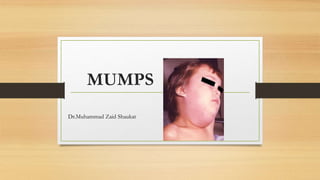
infection characterized by painful enlargement of the salivary
glands, chiefly the parotids, as the usual presenting sign.
Mumps is generally a self-limited disease: but it can be associated
with complications, especially in adults.
ETIOLOGY
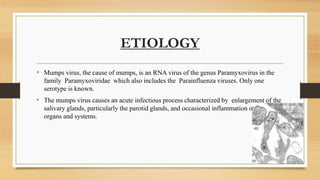
• Mumps virus, the cause of mumps, is an RNA virus of the genus Paramyxovirus in the
family Paramyxoviridae which also includes the Parainfluenza viruses. Only one
serotype is known.
• The mumps virus causes an acute infectious process characterized by enlargement of the
salivary glands, particularly the parotid glands, and occasional inflammation of other
organs and systems.
EPIDEMIOLOGY
The virus present in secretions prior to clinical onset of disease, is transtnitted
by way. Mumps is endemic in most unvaccinated populations; the virus spreads
from human reservoir by direct cont.Before introduction of the vaccine in
1967, the peak incidence of the disease occurred in children 5—9yr of age;
85% of infections occurred in children <15yr of age. Now most cases occur in
young adults, producing outbreaks in colleges or in the workplace. Primarily a
disease of children 10 to 15 years of age, it’s worldwide distribution with peak
incidence occurring in late winter and spring.
CLASSIFICATION
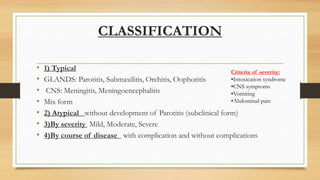
• 1) Typical
• GLANDS: Parotitis, Submaxilitis, Orchitis, Oophoritis
• CNS: Meningitis, Meningoencephalitis
• Mix form
• 2) Atypical without development of Parotitis (subclinical form)
• 3)By severity Mild, Moderate, Severe
• 4)By course of disease with complication and without complications
Criteria of severity:
•Intoxication syndrome
•CNS symptoms
•Vomiting
•Abdominal pain
CLINICAL MANIFESTATIONS
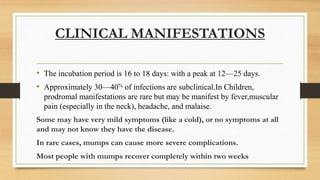
• The incubation period is 16 to 18 days: with a peak at 12—25 days.
• Approximately 30—40% of infections are subclinical.In Children,
prodromal manifestations are rare but may be manifest by fever,muscular
pain (especially in the neck), headache, and malaise.
Some may have very mild symptoms (like a cold), or no symptoms at all
and may not know they have the disease.
In rare cases, mumps can cause more severe complications.
Most people with mumps recover completely within two weeks
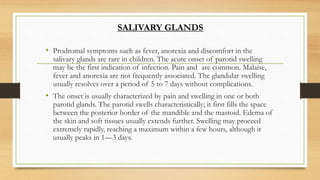
• Prodromal symptoms such as fever, anorexia and discomfort in the
salivary glands are rare in children. The acute onset of parotid swelling
may be the first indication of infection. Pain and are common. Malaise,
fever and anorexia are not frequently associated. The glandular swelling
usually resolves over a period of 5 to 7 days without complications.
• The onset is usually characterized by pain and swelling in one or both
parotid glands. The parotid swells characteristically; it first fills the space
between the posterior border of the mandible and the mastoid. Edema of
the skin and soft tissues usually extends further. Swelling may proceed
extremely rapidly, reaching a maximum within a few hours, although it
usually peaks in 1—3 days.
SALIVARY GLANDS
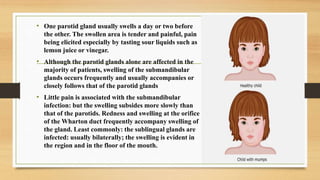
• One parotid gland usually swells a day or two before
the other. The swollen area is tender and painful, pain
being elicited especially by tasting sour liquids such as
lemon juice or vinegar.
• Although the parotid glands alone are affected in the
majority of patients, swelling of the submandibular
glands occurs frequently and usually accompanies or
closely follows that of the parotid glands
• Little pain is associated with the submandibular
infection: but the swelling subsides more slowly than
that of the parotids. Redness and swelling at the orifice
of the Wharton duct frequently accompany swelling of
the gland. Least commonly: the sublingual glands are
infected: usually bilaterally; the swelling is evident in
the region and in the floor of the mouth.
PANCREATITIS
• Mumps is the most common cause of acute pancreatitis of non suppurative
variety in childhood. Mild or subclinical pancreatic involvement is common,
but severe pancreatitis is rare. It may be unassociated with salivary gland
manifestations. Pain and tenderness: which are suggestive, may be
accompanied by fever, chills , vomiting, and prostration. Symptoms are
vomiting, fever (elevation of temperature for 3-5 days), epigastric pain with
deep tenderness in the left upper quadrant and sometimes diarrhea. There
is a marked increase in serum amylase. An elevated serum amylase value is
characteristically present in patients with mumps, with or without clinical
manifestations of pancreatitis.This is a selflimited disease requiring no
treatment.
ORCHITIS & EPIDIDYMITIS
• Orchitis typically occurs in the postpubertal patient. About one-third of
males with mumps develop Orchitis. Men from 15 to 29 years of age are
most likely to be affected. Orchitis begins near the end of the first week of
disease.
• Fever is noted first, followed by severe scrotal pain, swelling, erythema and
weakness. Orchitis is usually unilateral 60-80% of the time and bilateral
rarely. Orchitis may occur before or in absence of Parotitis.Complications
include atrophy and bilateral atrophy can lead to sterility. May be sterility (
infertility) present. Infertility is rare even with bilateral Orchitis.
• The testis is most often infected with or without epididymitis;
epididymitis may also occur alone. Bilateral Orchitis occurs in
approximately 30% of patients. Rarely, there is a hydrocele.The
Orchitis usually follows Parotitis within 8 days.
• Orchitis also occur without evidence of salivary gland infection.
The onset is usually abrupt with a rise in temperature, chills,
headache, nausea, and lower abdominal pain; when the right testis
is implicated appendicitis may be suggested as a diagnostic
possibility. The affected testis becomes tender and and the
adjacent skin is edematous and red. Approximately 30—40% of
affected testes undergo atrophy, leaving a cosmetic imbalance.
Infertility is rare even with bilateral Orchitis.
MENINGOENCEPHALITIS
• Aseptic meningitis and meningoencephalitis can occur .This is the most
frequent form in childhood. Clinical manifestations occur in >10% of cases.
The incidence of mumps is approximately 250/100000 cases 10% of these
cases occur in patients >20yr of age. The mortality rate is about 2%. Males
are affected three to five times as frequently as females.
• The pathogenesis of mumps meningoencephalitis may be either a
primary infection of neurons or encephalitis with demyelination.The
first type,Parotitis frequently appears at the same time or following
the onset of encephalitis. Parotitis may in some cases be absent.
• Mumps meningoencephalitis is clinically similar with
meningoencephalitis of other origins. There is a high fever,
vomiting, headache and positive meningeal symptoms. Moderate
stiffiess of the neck is seen, but the remaining findings on
neurologic exanlination are usually normal. The cerebrospinal fluid
may show a lymphocytic of <500 cells'mm:, although occasionally
the count may exceed 2,000 cells/mm3.
DIAGNOSIS
DIFFERENTIAL DIAGNOSIS
• Other viral causes of Parotitis include human immunodeficiency virus
(HIV)infection, influenza,parainfluenza viruses 1 and 3: cytomegalovirus and
Coxsackievirus.
• Acute suppurative parotitis is a bacterial infection caused by Staphylococcus
aureus in which pus can often be expressed from the duct. A salivary calculus
obstructing either a parotid or, more commonly, a submandibular duct causes
intermittent swelling.Preauricular or anterior cervical lymphadenitis can be
differentiated by the well-defined borders of the lymph node and a location that
is completely posterior to the angle of the mandible. Orchitis may also be
caused by Coxsackievirus.
TREATMENT
• Criteria for hospitalization:
• 1) Severity of disease 2) Pancreatitis
• 3) Orchitis 4) Meningitis
• There is no specific antiviral therapy; treatment is entirely supportive.
Antipyretics are indicated for fever. Bed rest should be guided by the patient's
needs, but no evidence indicates that it prevents complications. The diet should
be adjusted to the patient's ability to chew.Use a local dry warm on the salivary
glands. But it is not compressed because complications may occur in future.
• Use furacilin solution as an antiseptic solution for the oral cavity.
• Treatment of Orchitis includes analgesics,should be treated with local
support and bed rest. Usually we give antibacterial therapy (penicillin
im),hormonal therpay.
• Pancreatitis: Patient must exclude fatty food, fried food,alcohol,drinks with
gas. Bed rest is advised. Disintoxication must be parenteral. Use
Glucose,Ringer or Physiologic solution.
• Meningitis: bed-rest regime, antibacterial therapy (penicillin) and parenteral
disintoxication with dehydration.
• Symptomatic Treatment.
COMPLICATIONS
• Inflammation of the testicles (orchitis); this may lead to a decrease in testicular size
(testicular atrophy)
• Inflammation of the ovaries (oophoritis) and/or breast tissue (mastitis)
• Inflammation in the pancreas (pancreatitis)
• Inflammation of the brain (encephalitis)
• Inflammation of the tissue covering the brain and spinal cord (meningitis)
• Deafness
• Inflammation of the testicles could lead to temporary sterility or decrease fertility in
men, but no studies have assessed if it results in permanent infertility.
PREVENTION
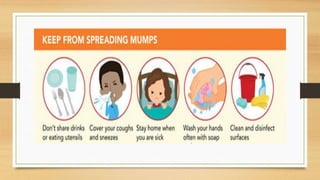
• The vaccine induces antibody in 96% of seronegative recipients and has 97%
protective efficacy.
• The initial mumps immunization, usually as measles-mumps-rubella (MMR)
vaccine, is recommended at 12—15 mo of age. A second immunization, also as
NIMR, is recommended routinely at 4—6 yr of age.
• Rarely: parotitis and low-grade fever can develop 10—14 days after vaccination.
• Vaccines do not shed virus.

MUMPS

  • 1.
  • 2.
    MUMPS Mumps is animportant childhood disease that was historically widespread but now occurs very infrequently. It is an acute viral infection characterized by painful enlargement of the salivary glands, chiefly the parotids, as the usual presenting sign. Mumps is generally a self-limited disease: but it can be associated with complications, especially in adults.
  • 3.
    ETIOLOGY • Mumps virus,the cause of mumps, is an RNA virus of the genus Paramyxovirus in the family Paramyxoviridae which also includes the Parainfluenza viruses. Only one serotype is known. • The mumps virus causes an acute infectious process characterized by enlargement of the salivary glands, particularly the parotid glands, and occasional inflammation of other organs and systems.
  • 4.
    EPIDEMIOLOGY The virus presentin secretions prior to clinical onset of disease, is transtnitted by way. Mumps is endemic in most unvaccinated populations; the virus spreads from human reservoir by direct cont.Before introduction of the vaccine in 1967, the peak incidence of the disease occurred in children 5—9yr of age; 85% of infections occurred in children <15yr of age. Now most cases occur in young adults, producing outbreaks in colleges or in the workplace. Primarily a disease of children 10 to 15 years of age, it’s worldwide distribution with peak incidence occurring in late winter and spring.
  • 6.
    CLASSIFICATION • 1) Typical •GLANDS: Parotitis, Submaxilitis, Orchitis, Oophoritis • CNS: Meningitis, Meningoencephalitis • Mix form • 2) Atypical without development of Parotitis (subclinical form) • 3)By severity Mild, Moderate, Severe • 4)By course of disease with complication and without complications Criteria of severity: •Intoxication syndrome •CNS symptoms •Vomiting •Abdominal pain
  • 7.
    CLINICAL MANIFESTATIONS • Theincubation period is 16 to 18 days: with a peak at 12—25 days. • Approximately 30—40% of infections are subclinical.In Children, prodromal manifestations are rare but may be manifest by fever,muscular pain (especially in the neck), headache, and malaise. Some may have very mild symptoms (like a cold), or no symptoms at all and may not know they have the disease. In rare cases, mumps can cause more severe complications. Most people with mumps recover completely within two weeks
  • 8.
    • Prodromal symptomssuch as fever, anorexia and discomfort in the salivary glands are rare in children. The acute onset of parotid swelling may be the first indication of infection. Pain and are common. Malaise, fever and anorexia are not frequently associated. The glandular swelling usually resolves over a period of 5 to 7 days without complications. • The onset is usually characterized by pain and swelling in one or both parotid glands. The parotid swells characteristically; it first fills the space between the posterior border of the mandible and the mastoid. Edema of the skin and soft tissues usually extends further. Swelling may proceed extremely rapidly, reaching a maximum within a few hours, although it usually peaks in 1—3 days. SALIVARY GLANDS
  • 9.
    • One parotidgland usually swells a day or two before the other. The swollen area is tender and painful, pain being elicited especially by tasting sour liquids such as lemon juice or vinegar. • Although the parotid glands alone are affected in the majority of patients, swelling of the submandibular glands occurs frequently and usually accompanies or closely follows that of the parotid glands • Little pain is associated with the submandibular infection: but the swelling subsides more slowly than that of the parotids. Redness and swelling at the orifice of the Wharton duct frequently accompany swelling of the gland. Least commonly: the sublingual glands are infected: usually bilaterally; the swelling is evident in the region and in the floor of the mouth.
  • 10.
    PANCREATITIS • Mumps isthe most common cause of acute pancreatitis of non suppurative variety in childhood. Mild or subclinical pancreatic involvement is common, but severe pancreatitis is rare. It may be unassociated with salivary gland manifestations. Pain and tenderness: which are suggestive, may be accompanied by fever, chills , vomiting, and prostration. Symptoms are vomiting, fever (elevation of temperature for 3-5 days), epigastric pain with deep tenderness in the left upper quadrant and sometimes diarrhea. There is a marked increase in serum amylase. An elevated serum amylase value is characteristically present in patients with mumps, with or without clinical manifestations of pancreatitis.This is a selflimited disease requiring no treatment.
  • 11.
    ORCHITIS & EPIDIDYMITIS •Orchitis typically occurs in the postpubertal patient. About one-third of males with mumps develop Orchitis. Men from 15 to 29 years of age are most likely to be affected. Orchitis begins near the end of the first week of disease. • Fever is noted first, followed by severe scrotal pain, swelling, erythema and weakness. Orchitis is usually unilateral 60-80% of the time and bilateral rarely. Orchitis may occur before or in absence of Parotitis.Complications include atrophy and bilateral atrophy can lead to sterility. May be sterility ( infertility) present. Infertility is rare even with bilateral Orchitis.
  • 12.
    • The testisis most often infected with or without epididymitis; epididymitis may also occur alone. Bilateral Orchitis occurs in approximately 30% of patients. Rarely, there is a hydrocele.The Orchitis usually follows Parotitis within 8 days. • Orchitis also occur without evidence of salivary gland infection. The onset is usually abrupt with a rise in temperature, chills, headache, nausea, and lower abdominal pain; when the right testis is implicated appendicitis may be suggested as a diagnostic possibility. The affected testis becomes tender and and the adjacent skin is edematous and red. Approximately 30—40% of affected testes undergo atrophy, leaving a cosmetic imbalance. Infertility is rare even with bilateral Orchitis.
  • 13.
    MENINGOENCEPHALITIS • Aseptic meningitisand meningoencephalitis can occur .This is the most frequent form in childhood. Clinical manifestations occur in >10% of cases. The incidence of mumps is approximately 250/100000 cases 10% of these cases occur in patients >20yr of age. The mortality rate is about 2%. Males are affected three to five times as frequently as females.
  • 14.
    • The pathogenesisof mumps meningoencephalitis may be either a primary infection of neurons or encephalitis with demyelination.The first type,Parotitis frequently appears at the same time or following the onset of encephalitis. Parotitis may in some cases be absent. • Mumps meningoencephalitis is clinically similar with meningoencephalitis of other origins. There is a high fever, vomiting, headache and positive meningeal symptoms. Moderate stiffiess of the neck is seen, but the remaining findings on neurologic exanlination are usually normal. The cerebrospinal fluid may show a lymphocytic of <500 cells'mm:, although occasionally the count may exceed 2,000 cells/mm3.
  • 15.
  • 16.
    DIFFERENTIAL DIAGNOSIS • Otherviral causes of Parotitis include human immunodeficiency virus (HIV)infection, influenza,parainfluenza viruses 1 and 3: cytomegalovirus and Coxsackievirus. • Acute suppurative parotitis is a bacterial infection caused by Staphylococcus aureus in which pus can often be expressed from the duct. A salivary calculus obstructing either a parotid or, more commonly, a submandibular duct causes intermittent swelling.Preauricular or anterior cervical lymphadenitis can be differentiated by the well-defined borders of the lymph node and a location that is completely posterior to the angle of the mandible. Orchitis may also be caused by Coxsackievirus.
  • 17.
    TREATMENT • Criteria forhospitalization: • 1) Severity of disease 2) Pancreatitis • 3) Orchitis 4) Meningitis • There is no specific antiviral therapy; treatment is entirely supportive. Antipyretics are indicated for fever. Bed rest should be guided by the patient's needs, but no evidence indicates that it prevents complications. The diet should be adjusted to the patient's ability to chew.Use a local dry warm on the salivary glands. But it is not compressed because complications may occur in future. • Use furacilin solution as an antiseptic solution for the oral cavity.
  • 18.
    • Treatment ofOrchitis includes analgesics,should be treated with local support and bed rest. Usually we give antibacterial therapy (penicillin im),hormonal therpay. • Pancreatitis: Patient must exclude fatty food, fried food,alcohol,drinks with gas. Bed rest is advised. Disintoxication must be parenteral. Use Glucose,Ringer or Physiologic solution. • Meningitis: bed-rest regime, antibacterial therapy (penicillin) and parenteral disintoxication with dehydration. • Symptomatic Treatment.
  • 19.
    COMPLICATIONS • Inflammation ofthe testicles (orchitis); this may lead to a decrease in testicular size (testicular atrophy) • Inflammation of the ovaries (oophoritis) and/or breast tissue (mastitis) • Inflammation in the pancreas (pancreatitis) • Inflammation of the brain (encephalitis) • Inflammation of the tissue covering the brain and spinal cord (meningitis) • Deafness • Inflammation of the testicles could lead to temporary sterility or decrease fertility in men, but no studies have assessed if it results in permanent infertility.
  • 20.
    PREVENTION • The vaccineinduces antibody in 96% of seronegative recipients and has 97% protective efficacy. • The initial mumps immunization, usually as measles-mumps-rubella (MMR) vaccine, is recommended at 12—15 mo of age. A second immunization, also as NIMR, is recommended routinely at 4—6 yr of age. • Rarely: parotitis and low-grade fever can develop 10—14 days after vaccination. • Vaccines do not shed virus.