Multiplexing and Switching
Multiplexing
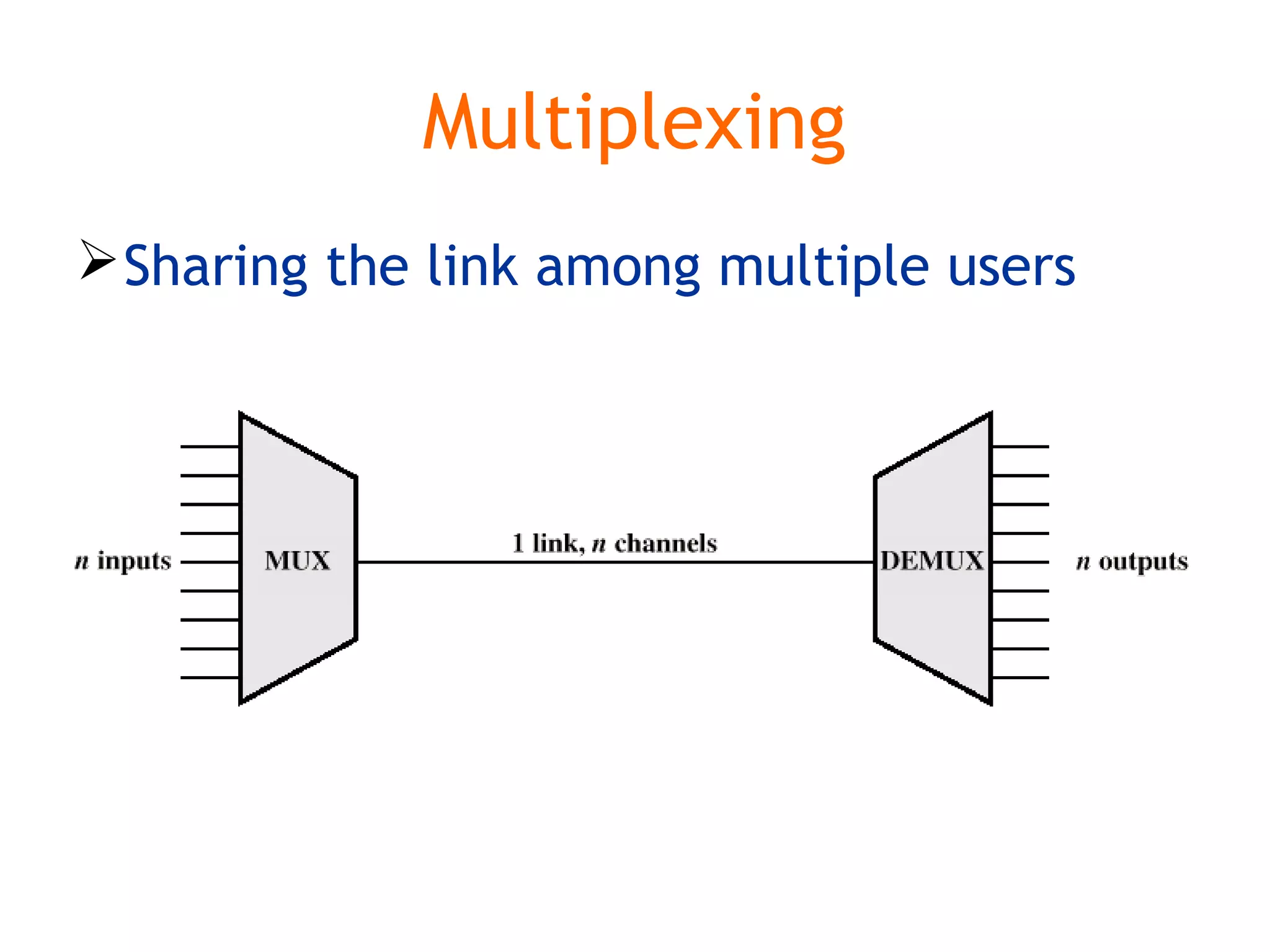
Sharing the link among multiple users
Multiplexing
Time Division Multiplexing (TDM)
 Synchronous TDM
 Statistical TDM
Frequency Division Multiplexing (FDM)
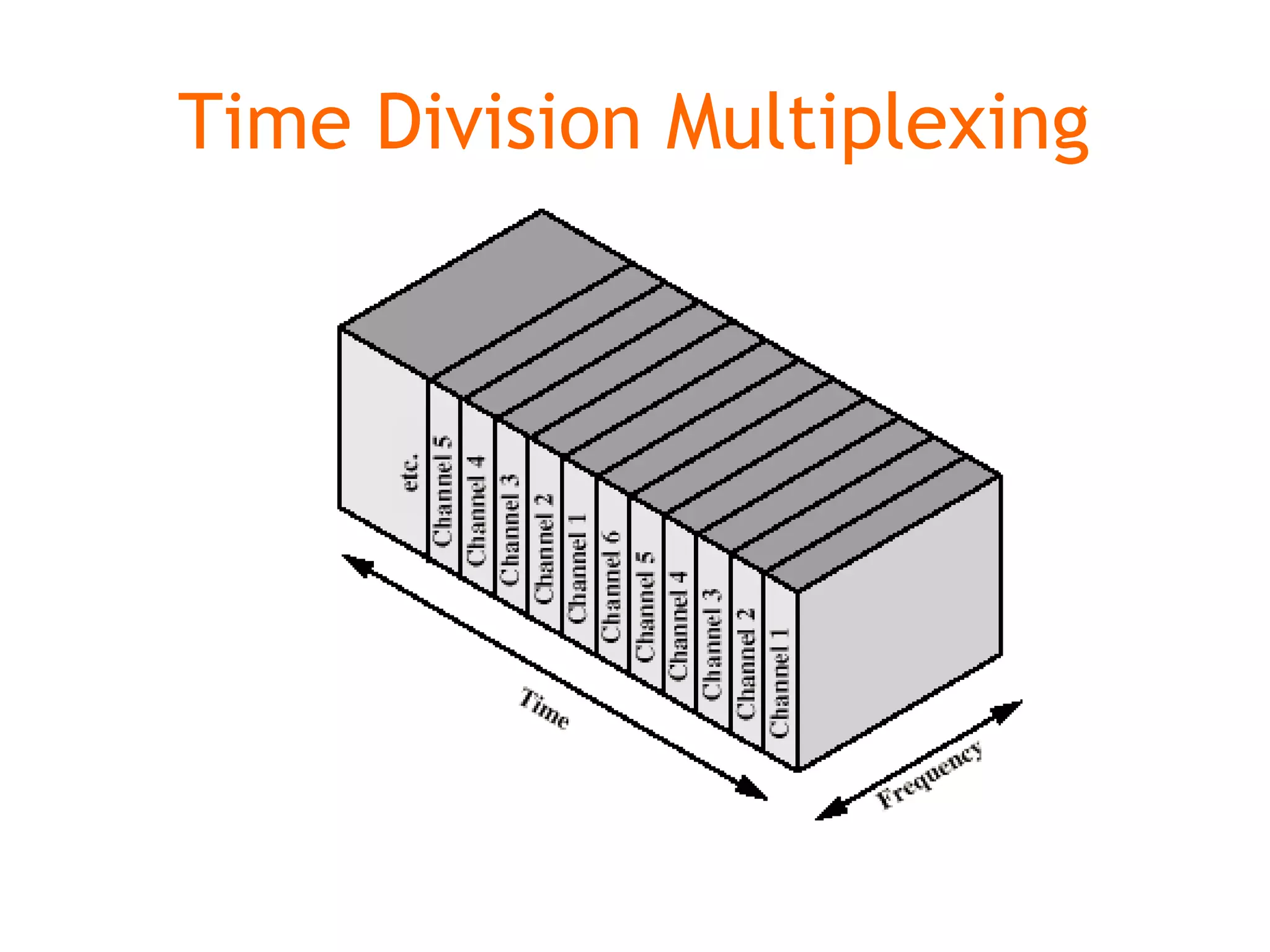
Time Division Multiplexing
The Basic Idea:
 As the name suggest, Divide time amongst the
users
 Give each user some time to transmit his data
 This process is periodic in a round robin fashion
 The time given to a each user is referred to as
Time Slot or Time Quantum
Time Division Multiplexing
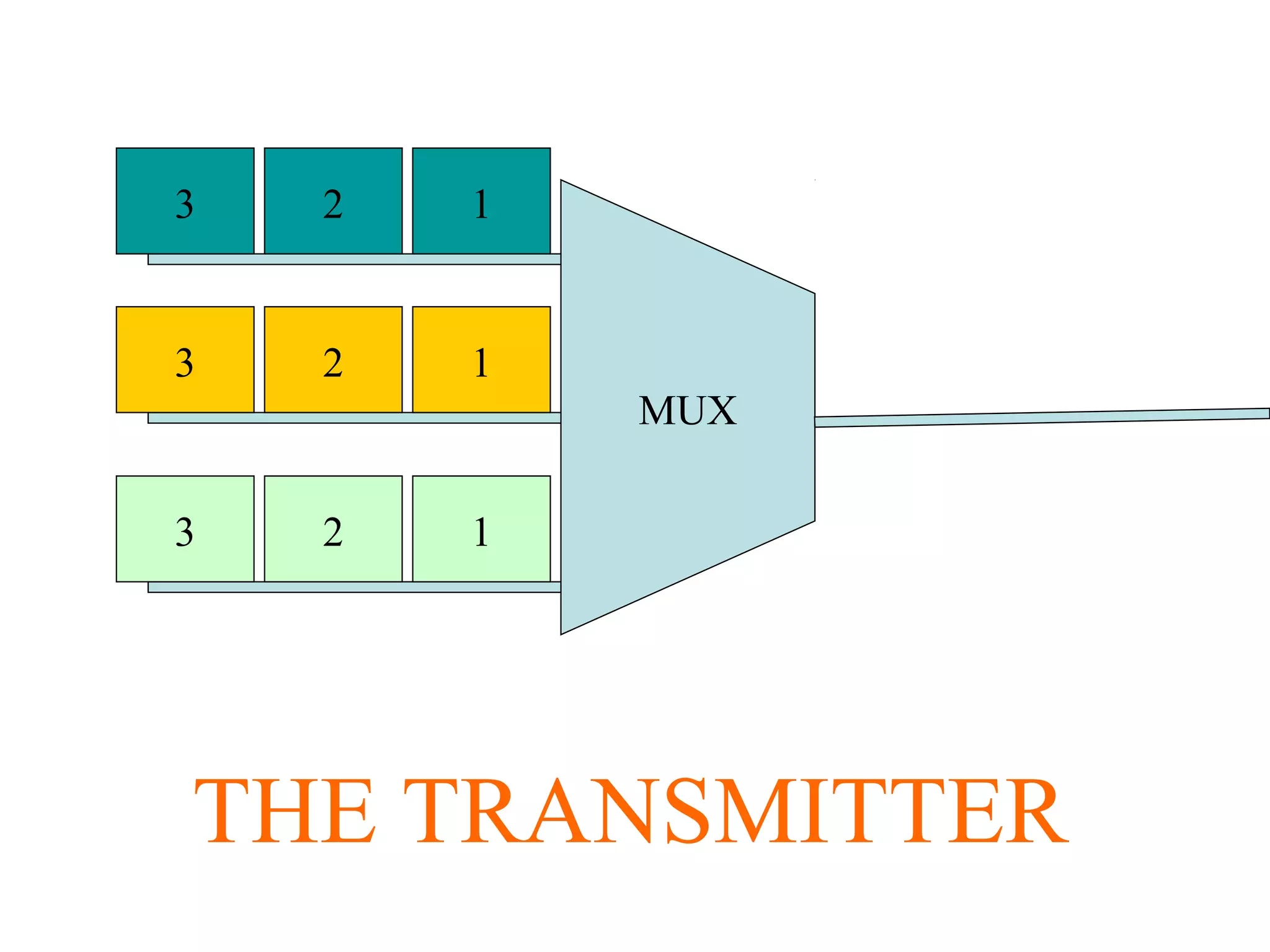
MUX
12
1
3
23
123
THE TRANSMITTER
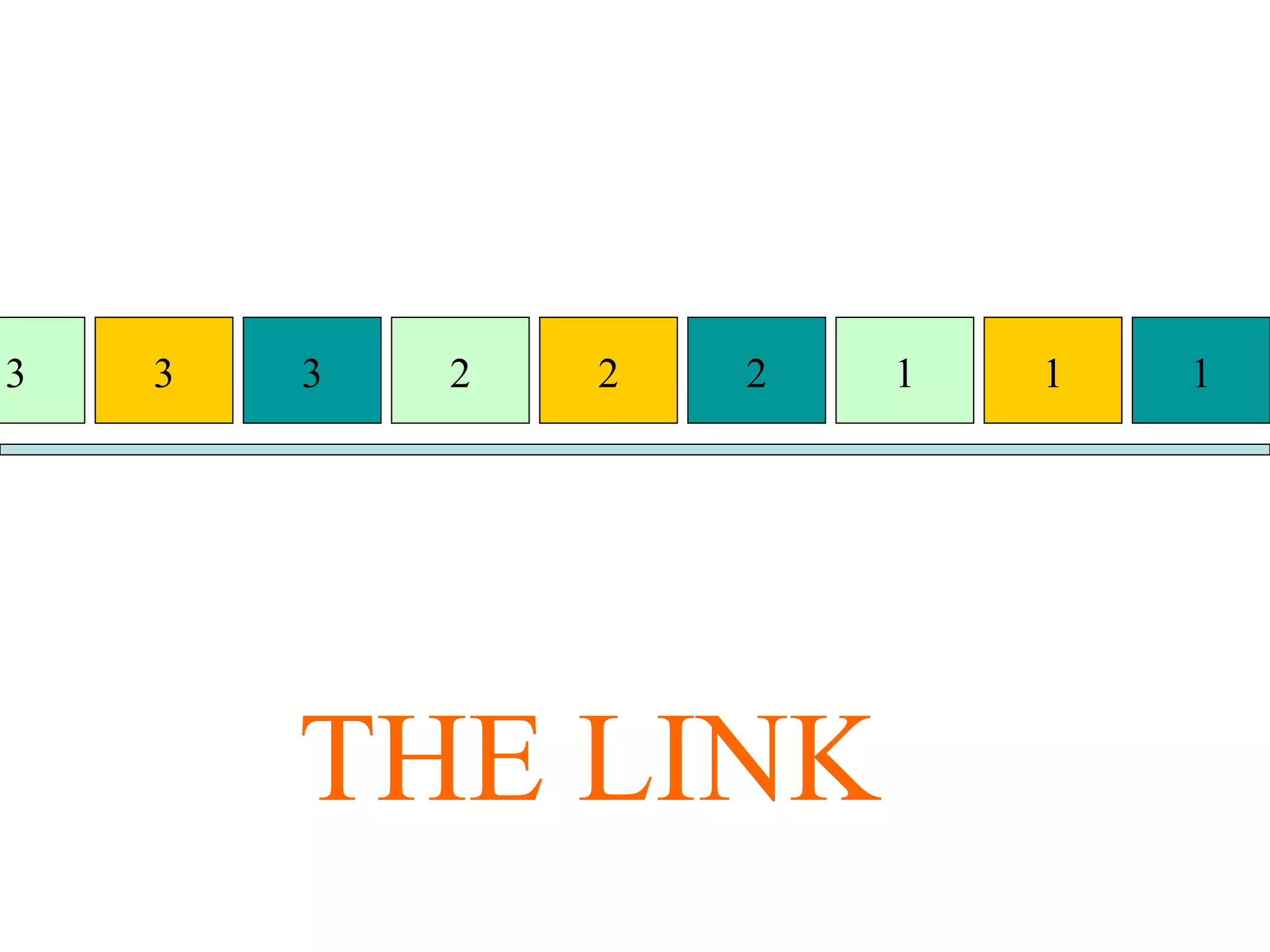
12 13 23 123
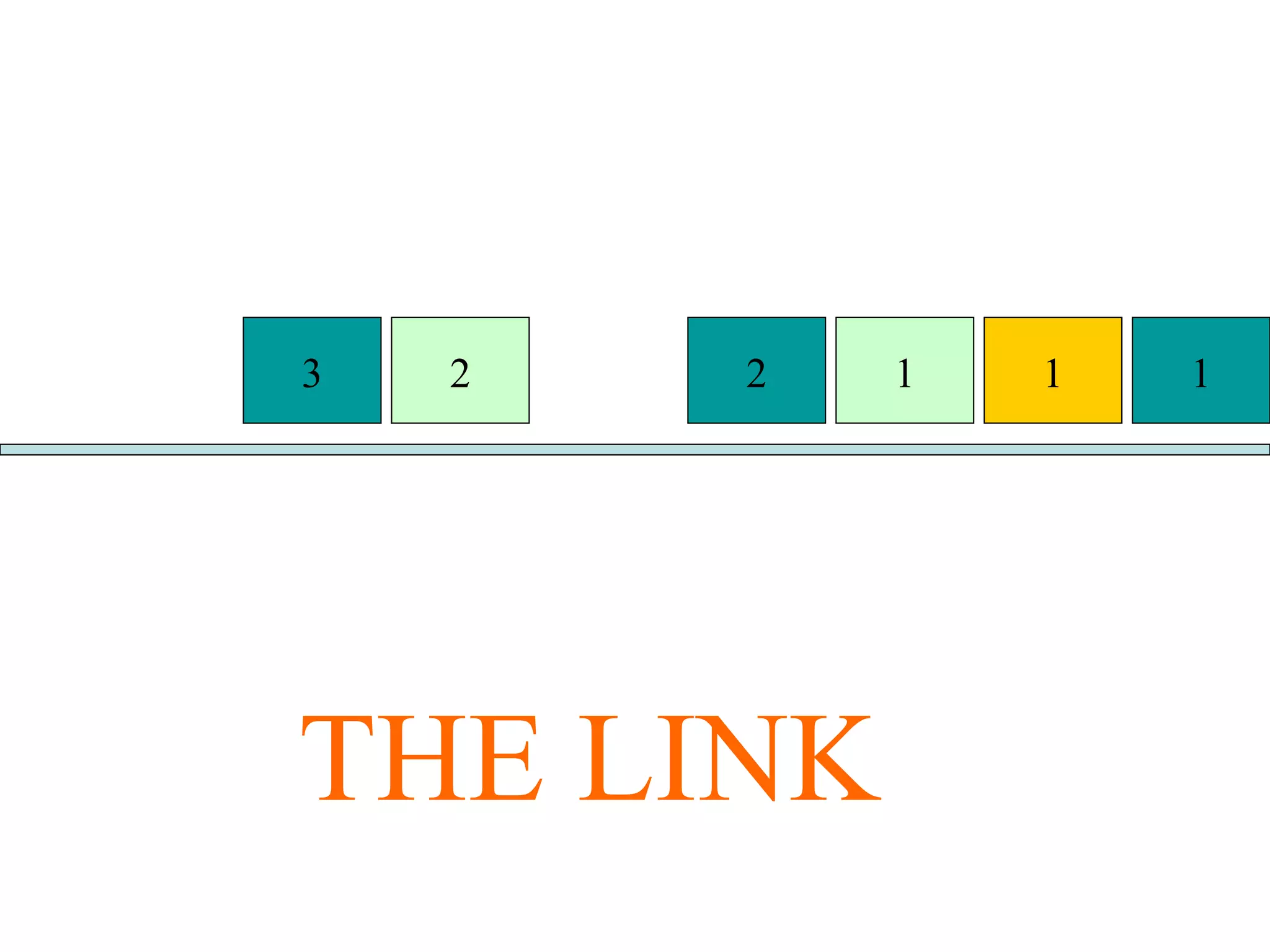
THE LINK
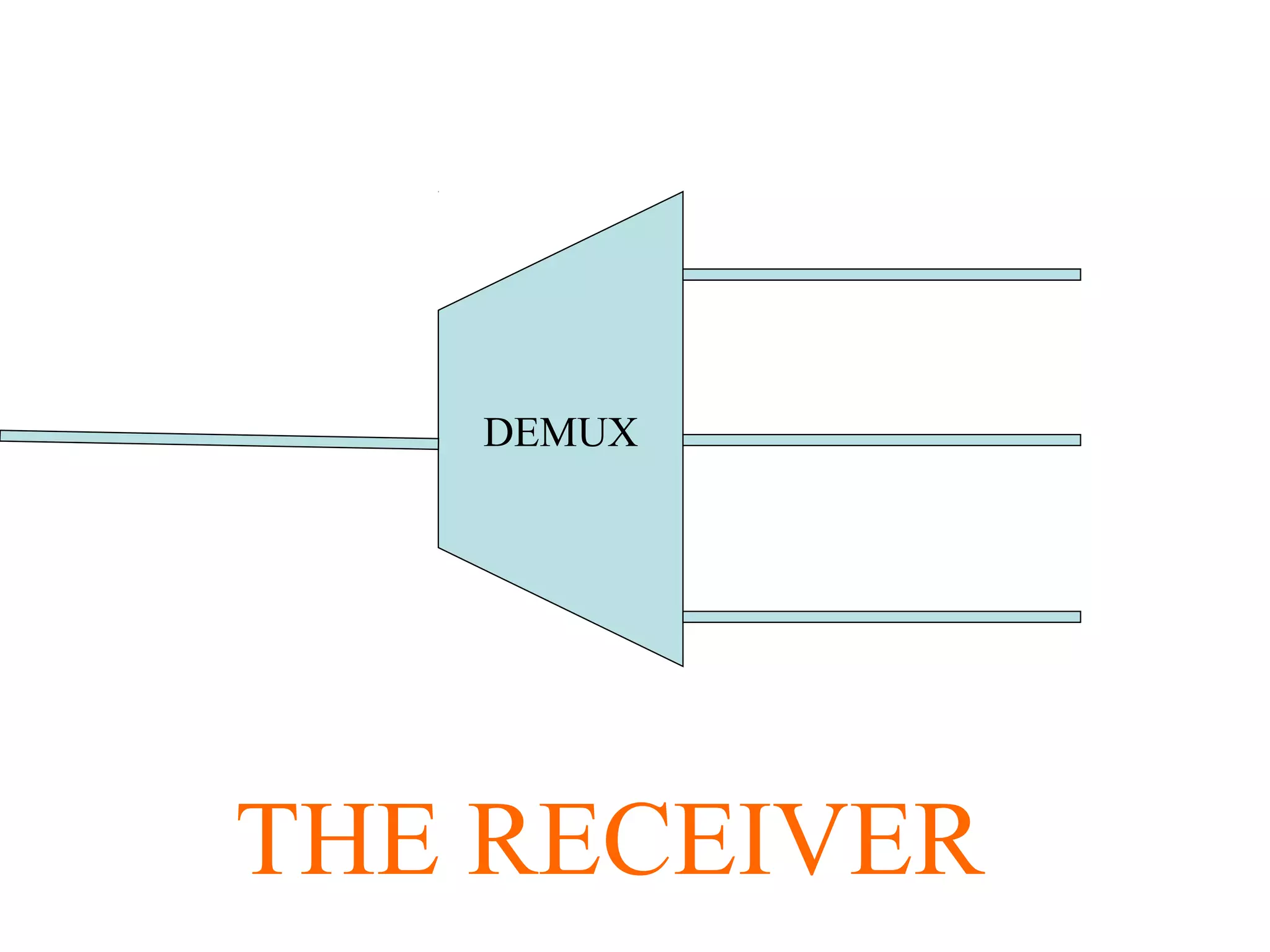
DEMUX
THE RECEIVER
There should be no Timing difference between
the
MUX and DEMUX
WARNING………!!!!!!!
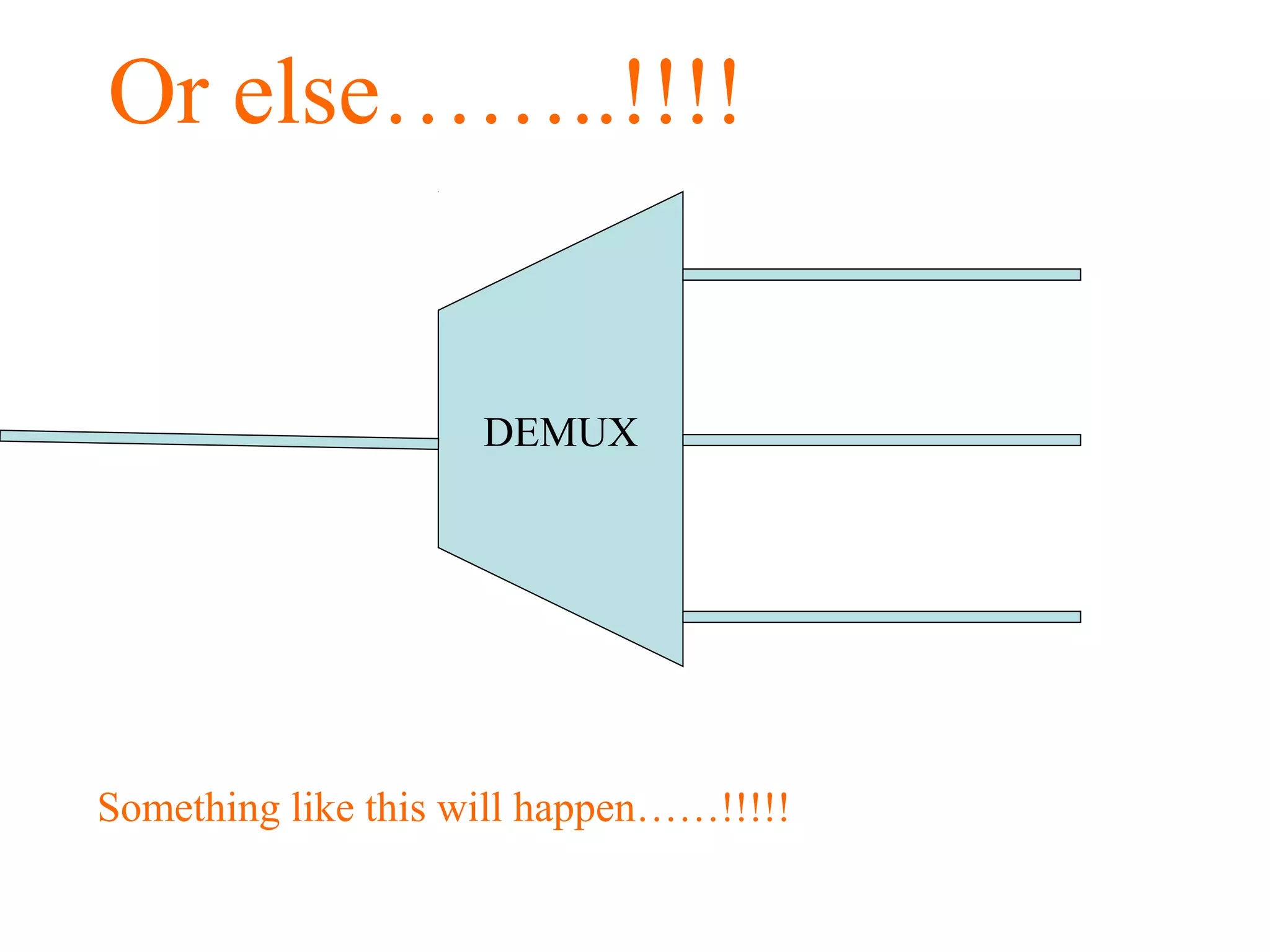
DEMUX
Or else……..!!!!
Something like this will happen……!!!!!
Therefore, the two devices
should be synchronized……
And so it is called Synchronous TDM
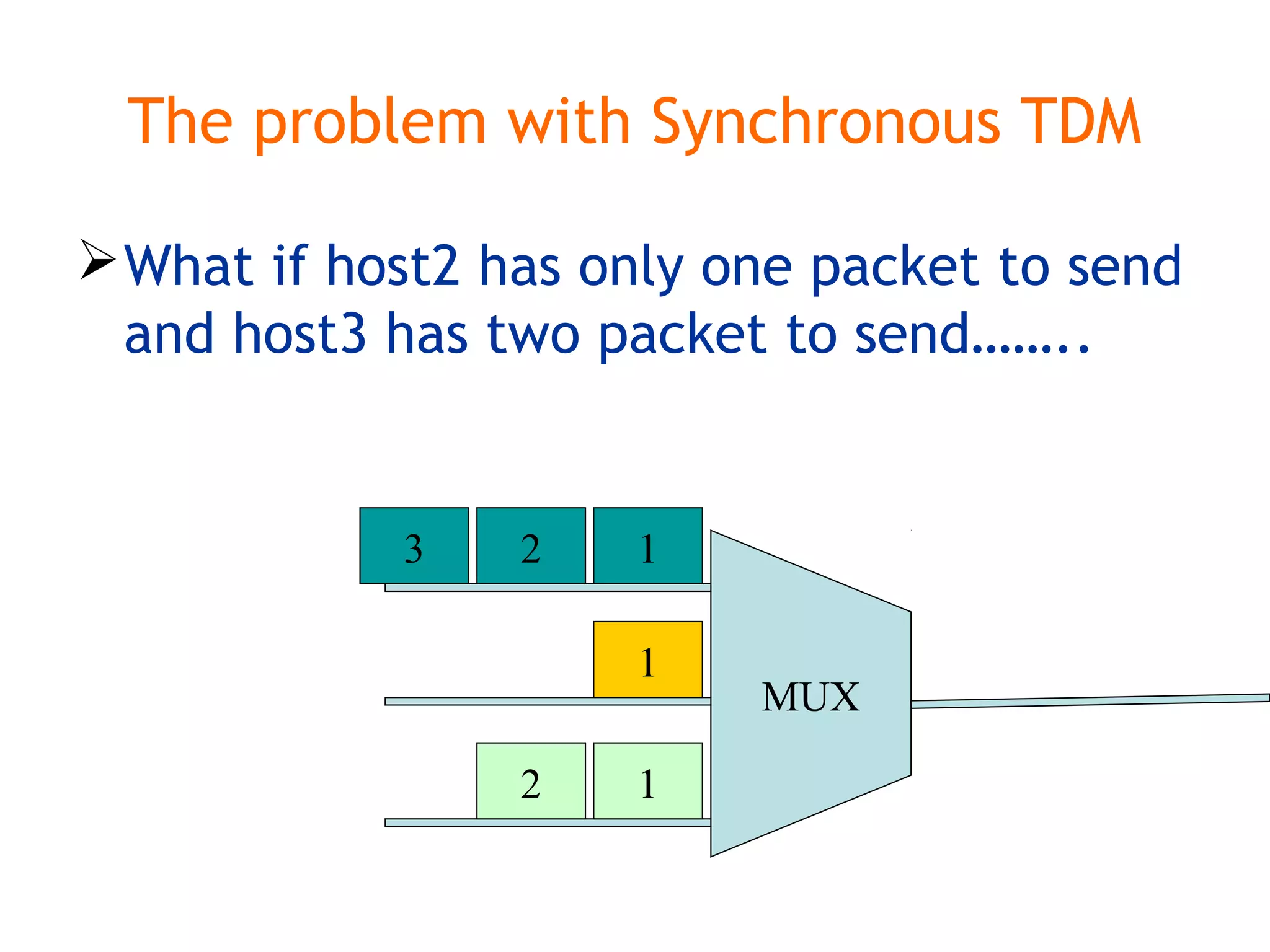
The problem with Synchronous TDM
What if host2 has only one packet to send
and host3 has two packet to send……..
MUX
12
1
3
12
12 13 12
THE LINK
Time slots are being
wasted….!!
The solution is
Statistical TDM
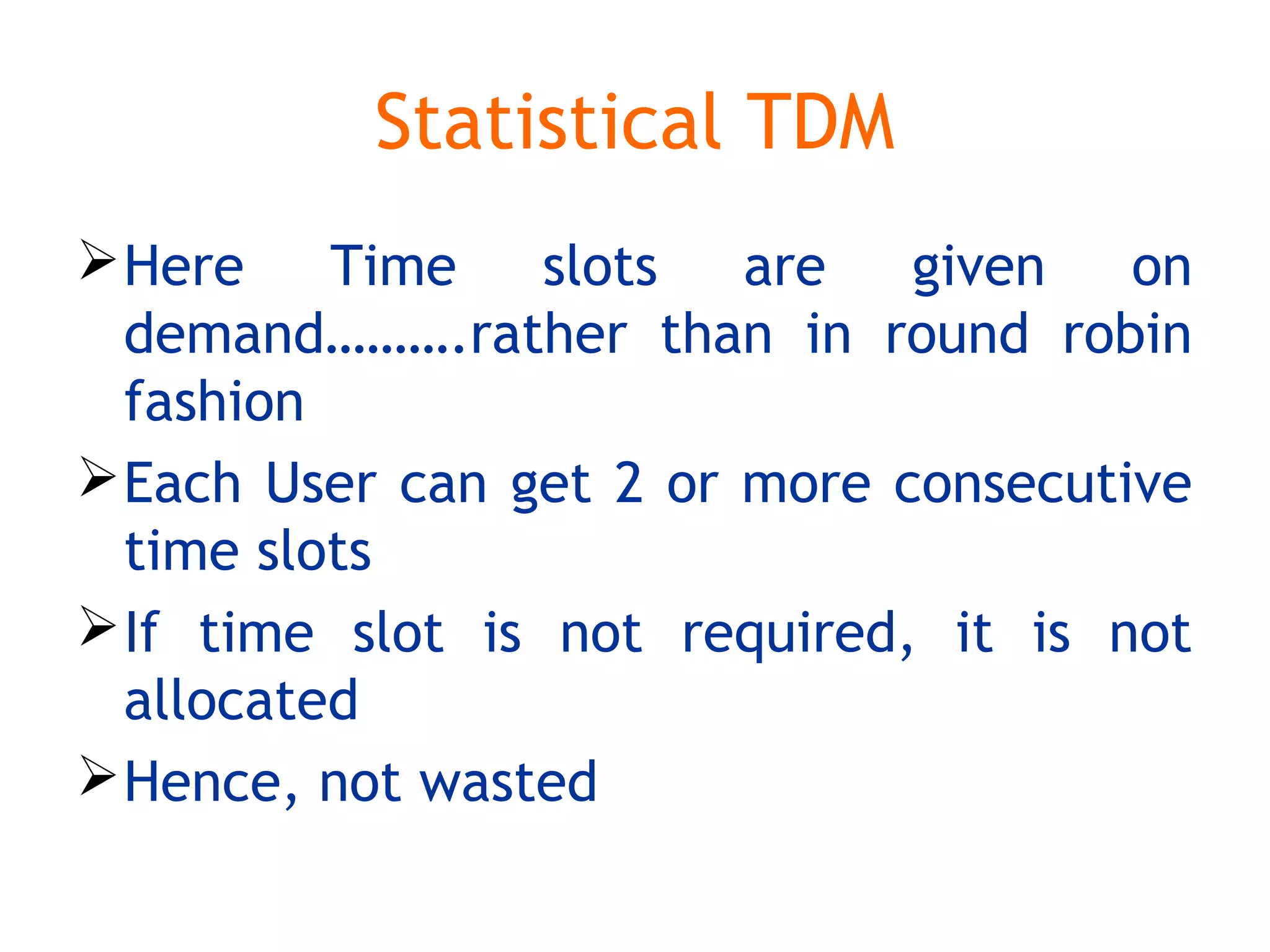
Statistical TDM
Here Time slots are given on
demand……….rather than in round robin
fashion
Each User can get 2 or more consecutive
time slots
If time slot is not required, it is not
allocated
Hence, not wasted
Frequency Division
Multiplexing
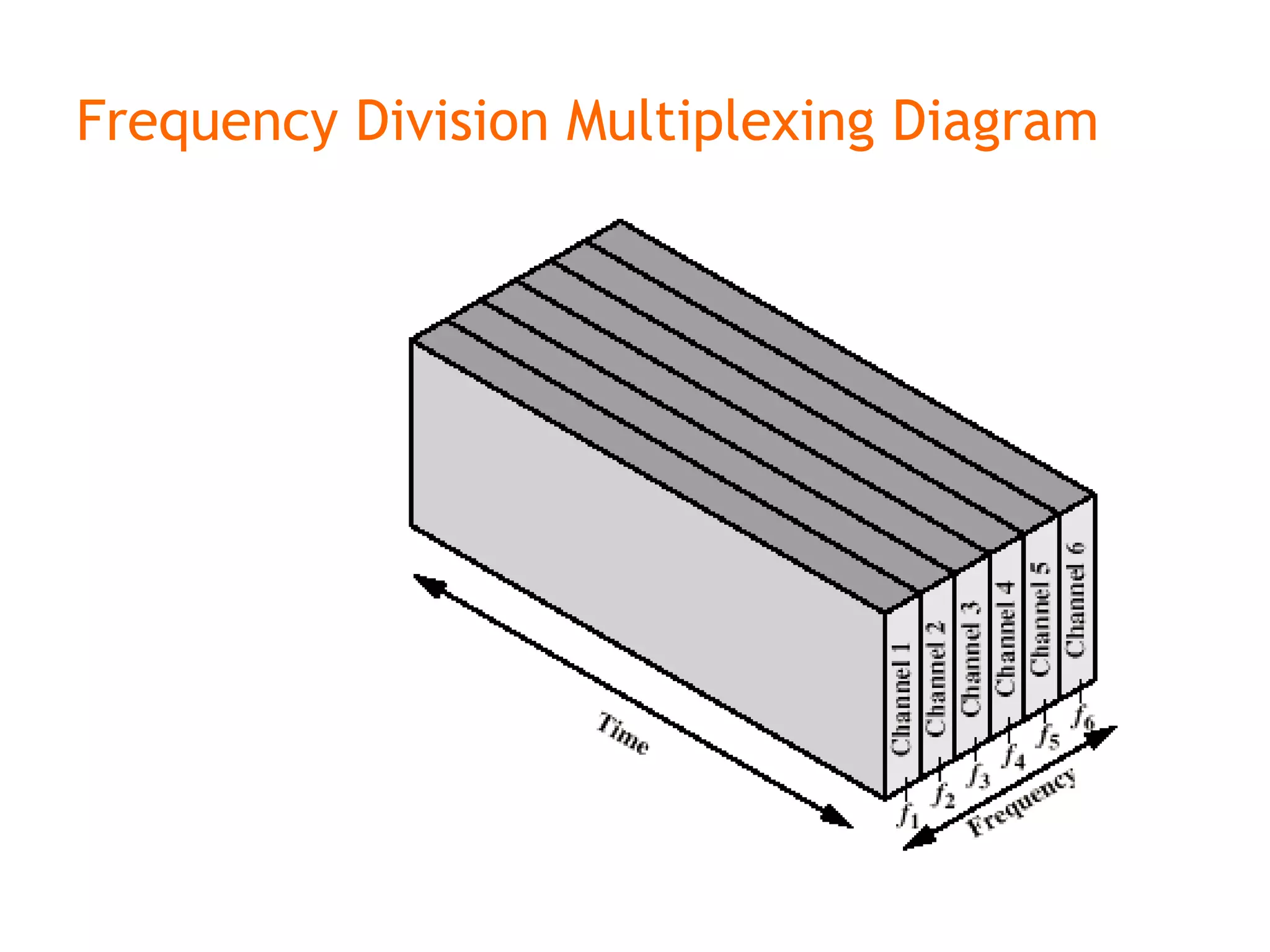
Frequency Division Multiplexing Diagram
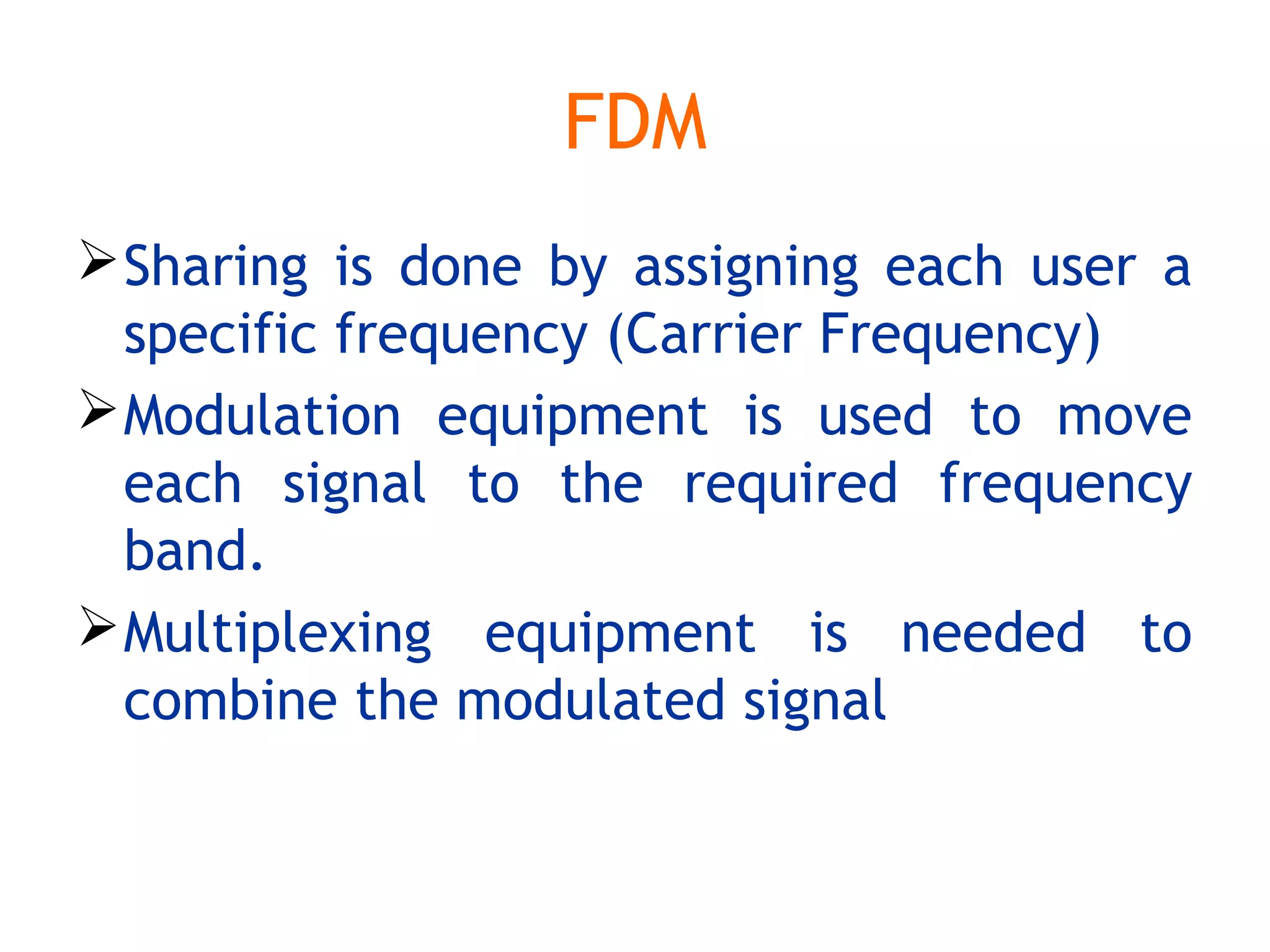
FDM
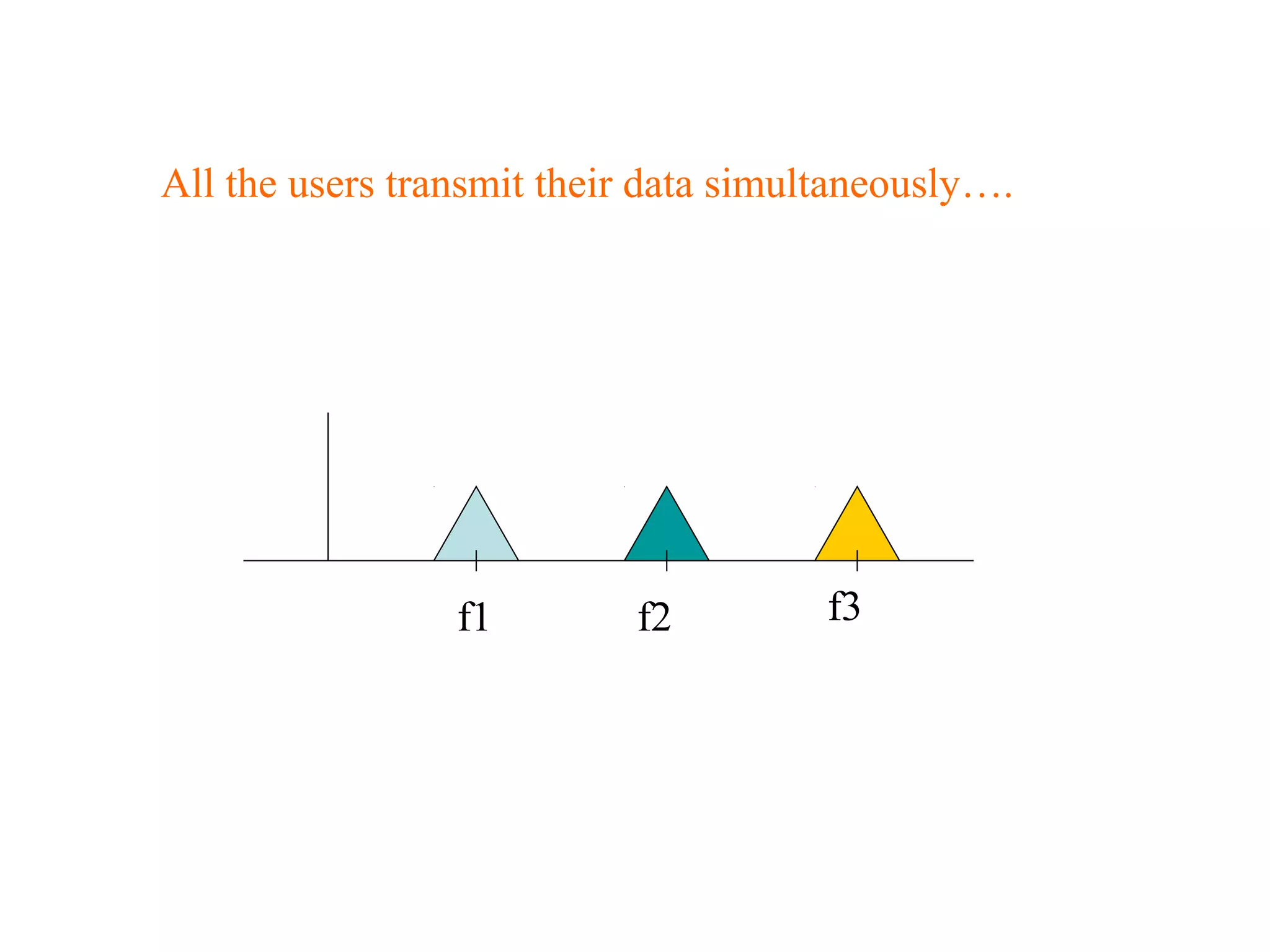
Sharing is done by assigning each user a
specific frequency (Carrier Frequency)
Modulation equipment is used to move
each signal to the required frequency
band.
Multiplexing equipment is needed to
combine the modulated signal
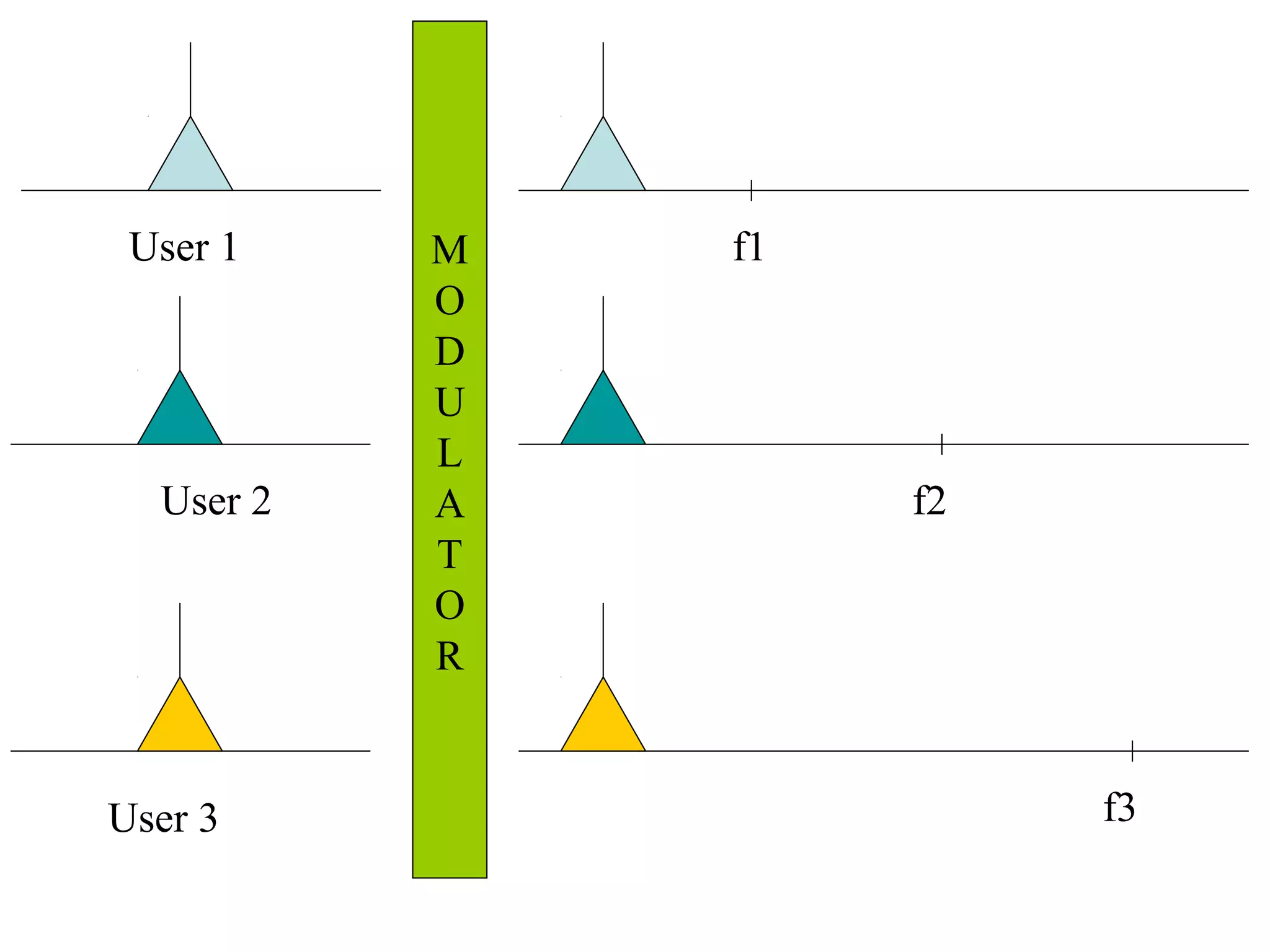
User 1
User 2
User 3
M
O
D
U
L
A
T
O
R
f1
f2
f3
All the users transmit their data simultaneously….
f1 f2 f3
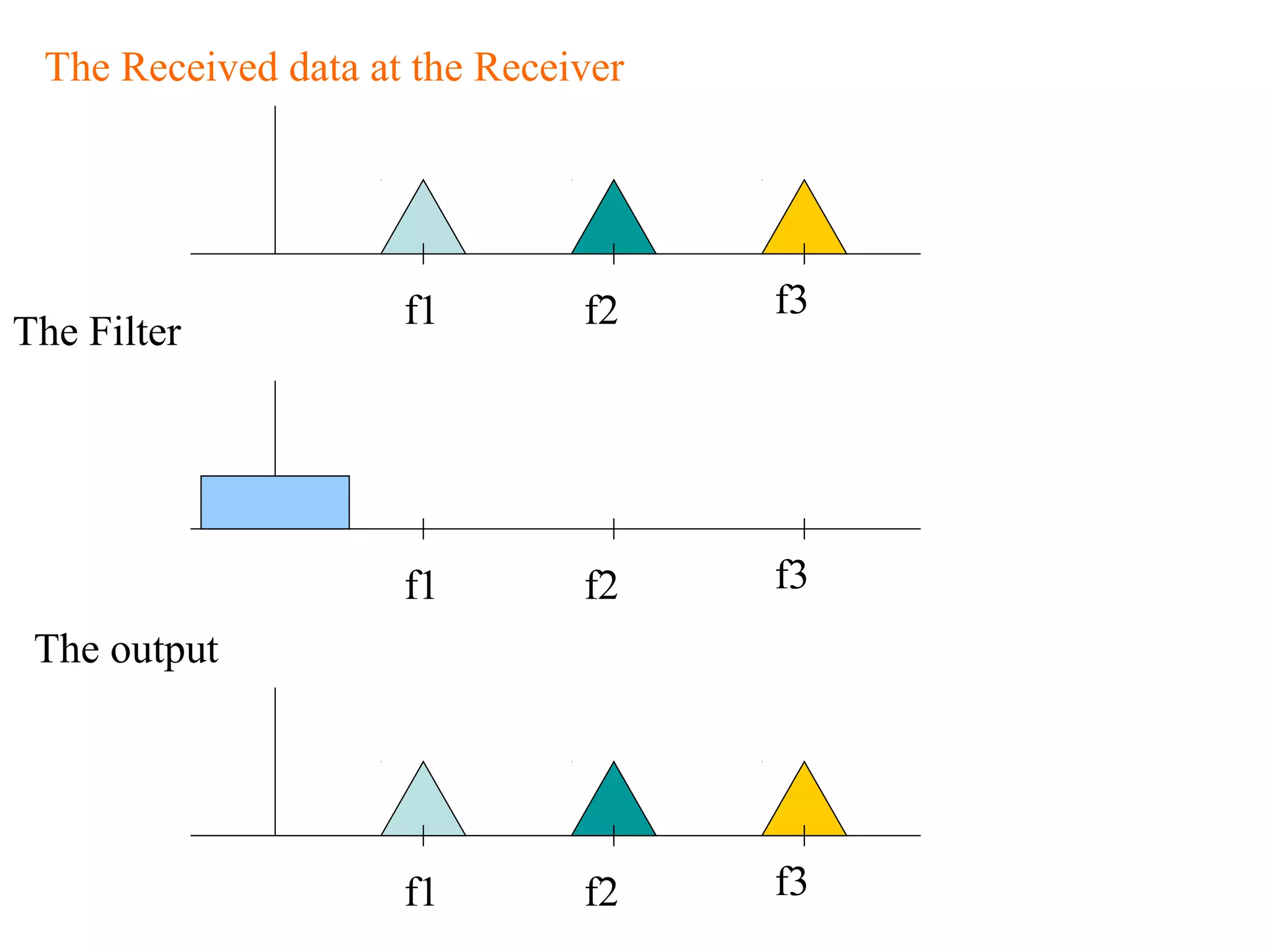
The Received data at the Receiver
f1 f2 f3
f1 f2 f3
The Filter
The output
f1 f2 f3
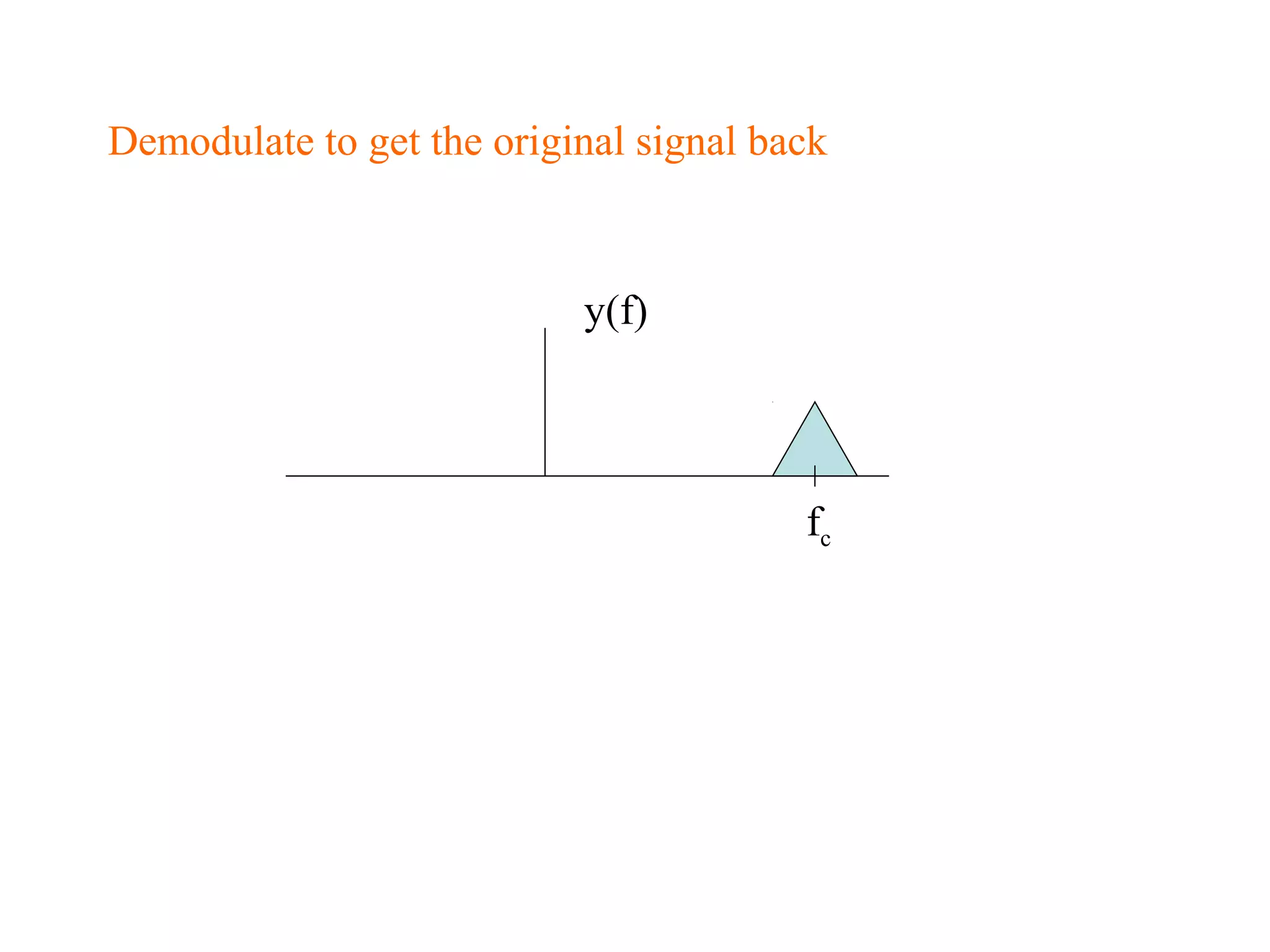
fc
y(f)
Demodulate to get the original signal back
Switching
Switching Networks
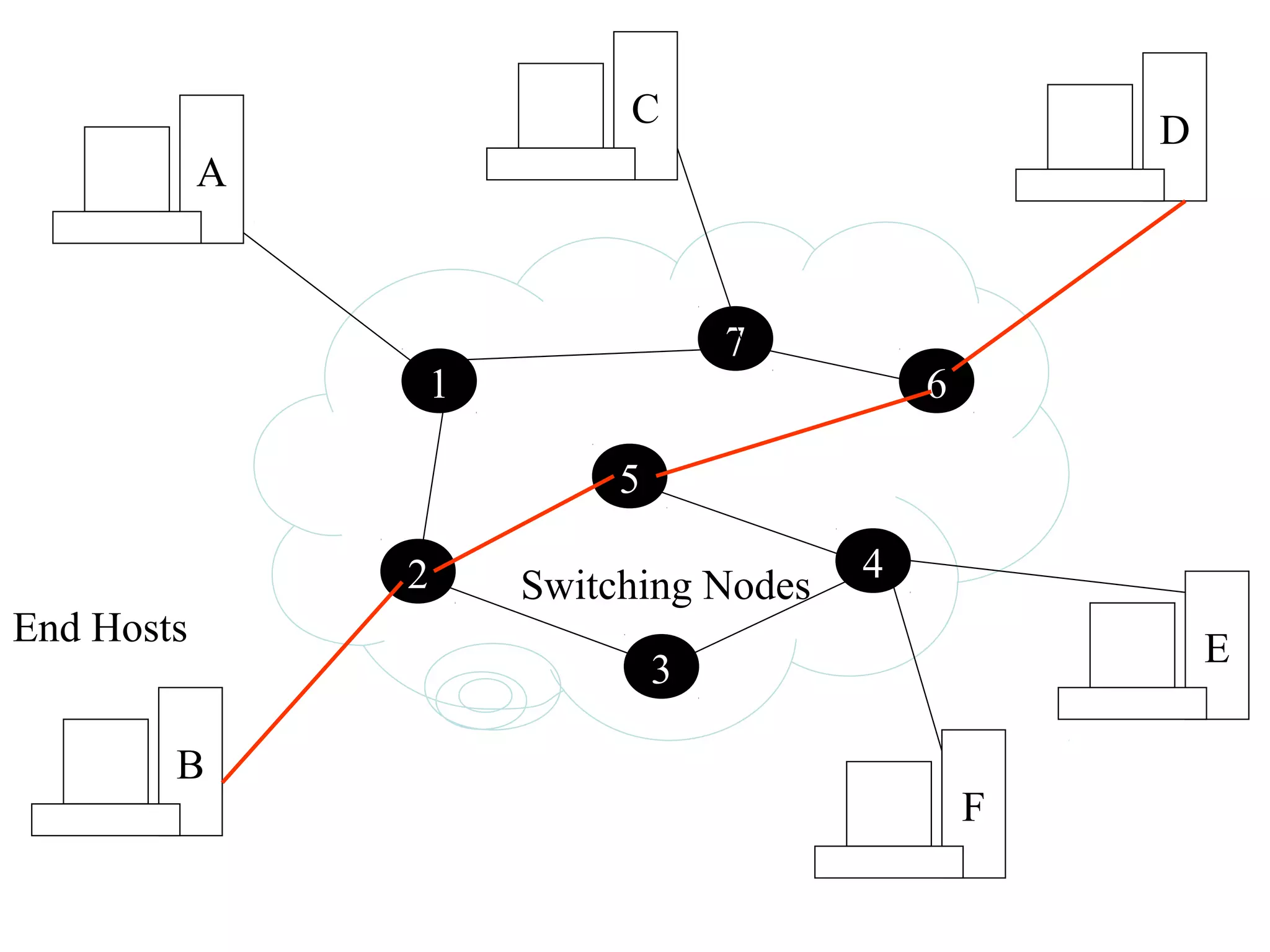
A network is made up of end hosts and
intermediate switching nodes
Data is usually passed through a
network of intermediate switching
nodes
The Switching nodes:
Not concerned with the contents of the data;
• Provide a switching facility that will move
data from node to node until they reach their
destination
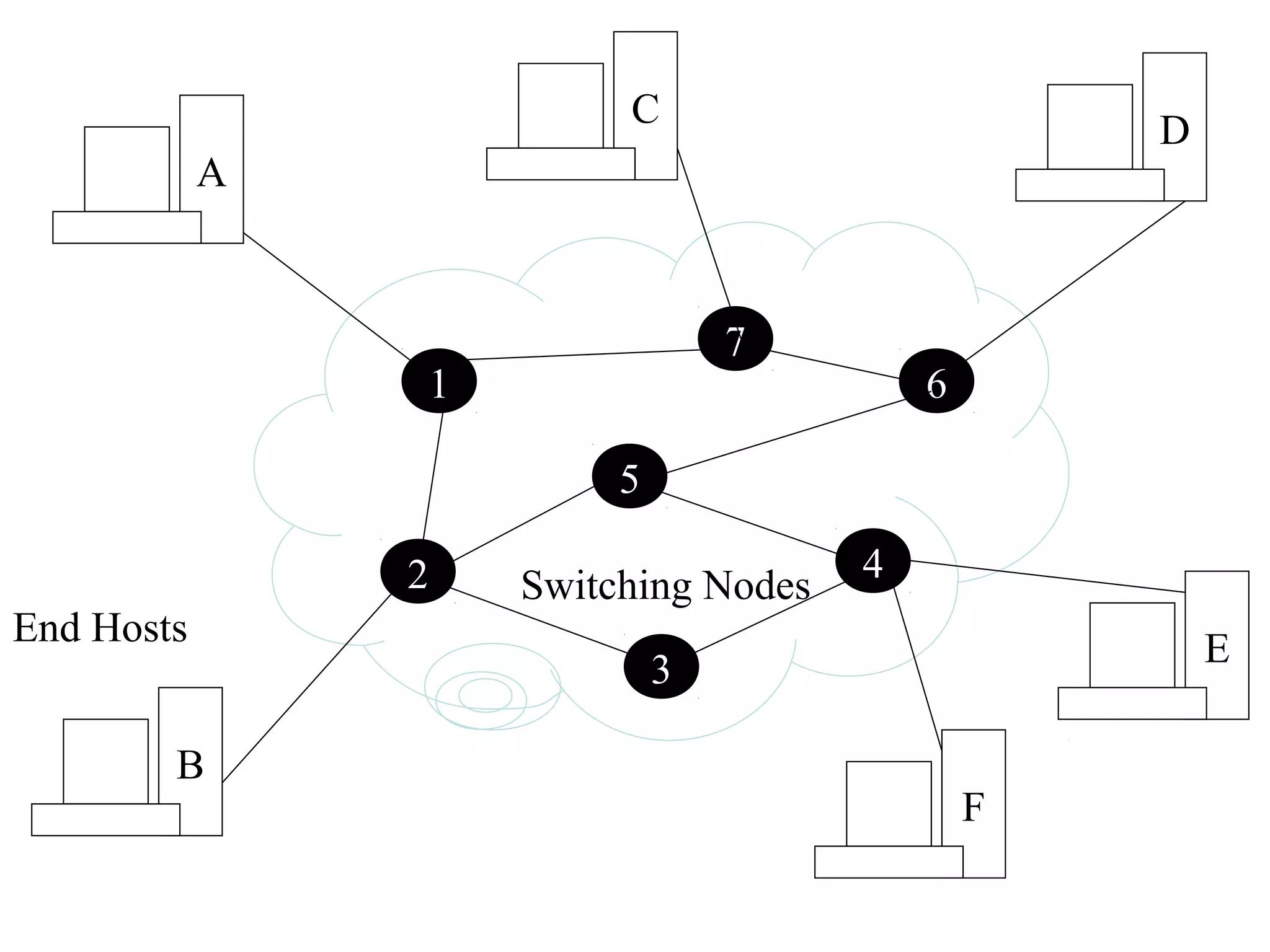
A
1
7
2
5
3
4
6
B
C
D
E
F
Switching Nodes
End Hosts
Some Notes…
 Some nodes only connect to other nodes
 Some nodes connect to end hosts also
 Usually the network is not fully connected; there
is not a direct link between each pair of nodes
 If there are more than one paths between any
pair of nodes; this increases the reliability of the
network
 Node-Node links are usually multiplexed
Two Technologies for Switching
Circuit Switching
Packet Switching
They differ in the way the nodes switch
information from one link to another on the
way from source to destination
Circuit Switching
A dedicated communication path between the
hosts
A
1
7
2
5
3
4
6
B
C
D
E
F
Switching Nodes
End Hosts
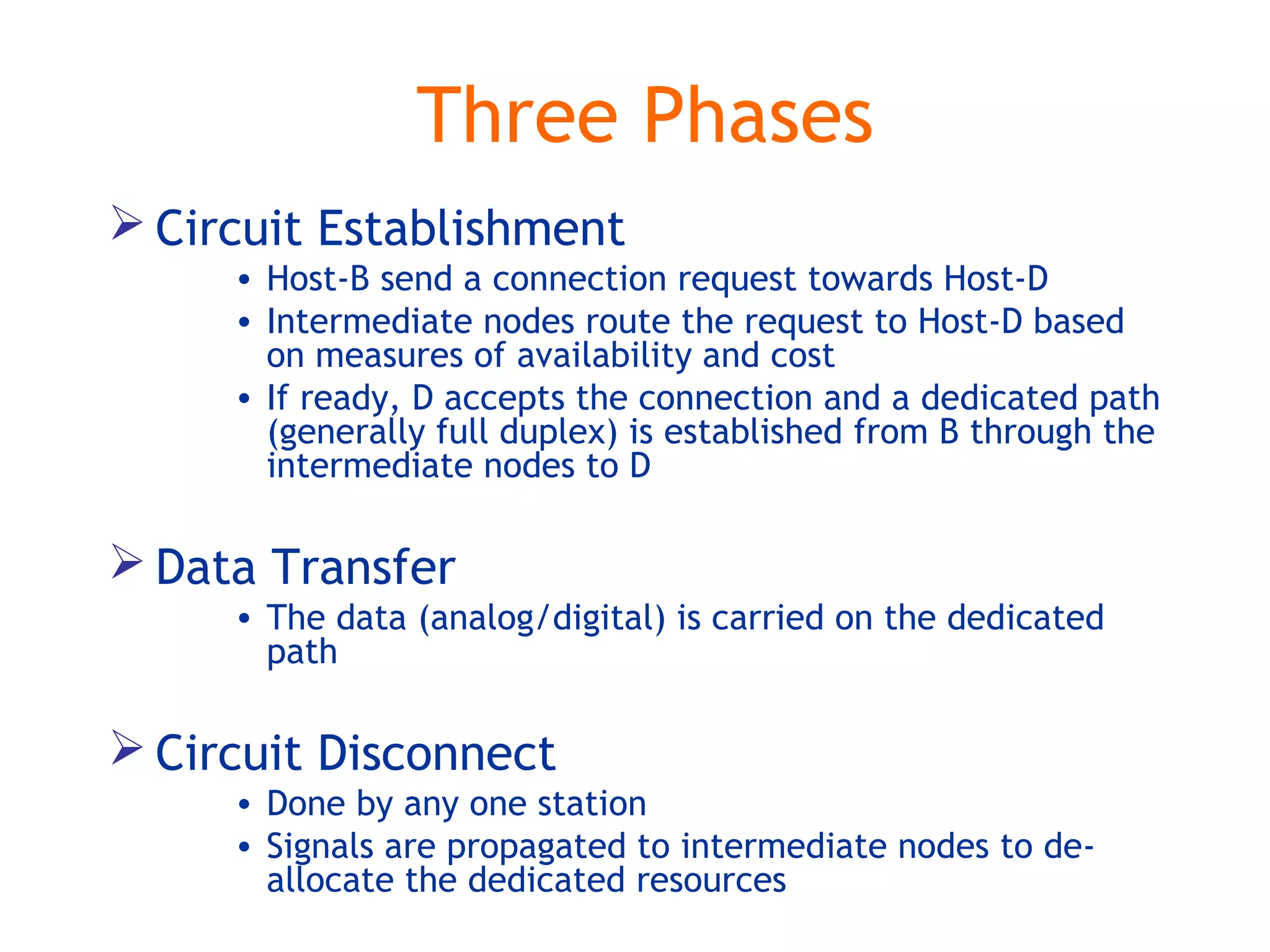
Three Phases
 Circuit Establishment
• Host-B send a connection request towards Host-D
• Intermediate nodes route the request to Host-D based
on measures of availability and cost
• If ready, D accepts the connection and a dedicated path
(generally full duplex) is established from B through the
intermediate nodes to D
 Data Transfer
• The data (analog/digital) is carried on the dedicated
path
 Circuit Disconnect
• Done by any one station
• Signals are propagated to intermediate nodes to de-
allocate the dedicated resources
Principles
• Circuit switching designed for voice
– Resources dedicated to a particular call
– Much of the time a data connection is idle
– Data rate is fixed
• Both ends must operate at the same rate
Packet Switching
Problems in Circuit Switching
 Circuit Switching approach is inefficient
 Since data rate is constant, therefore the
devices interconnected must transmit and
receive at the same data rate, This limits the
interconnection of variety of hosts
 Further calls are blocked when all the lines are
busy
Packet Switching…...A quick overview
 Data is transmitted in short packets
 If a source has larger message to send, the message is broken
up into a series of packets
 Each packet contains user’s data plus some control
information (header)
 The control information, at a minimum includes the
information that the network requires to be able to route the
packet through the network and deliver it to the intended
destination
 At each node the packet is received, stored briefly and passed
on to the next node
Advantages
 Line efficiency is greater
 A packet switching network can perform data rate
conversion
 In Circuit Switching, calls are blocked whereas in P.S.
packets are still accepted but delivery delay increases
 Priorities can be used, thus a higher priority packet
experiences less delay
Types of Packet Switching
Datagram Approach
Virtual Circuit Approach
Datagram Packet Switching
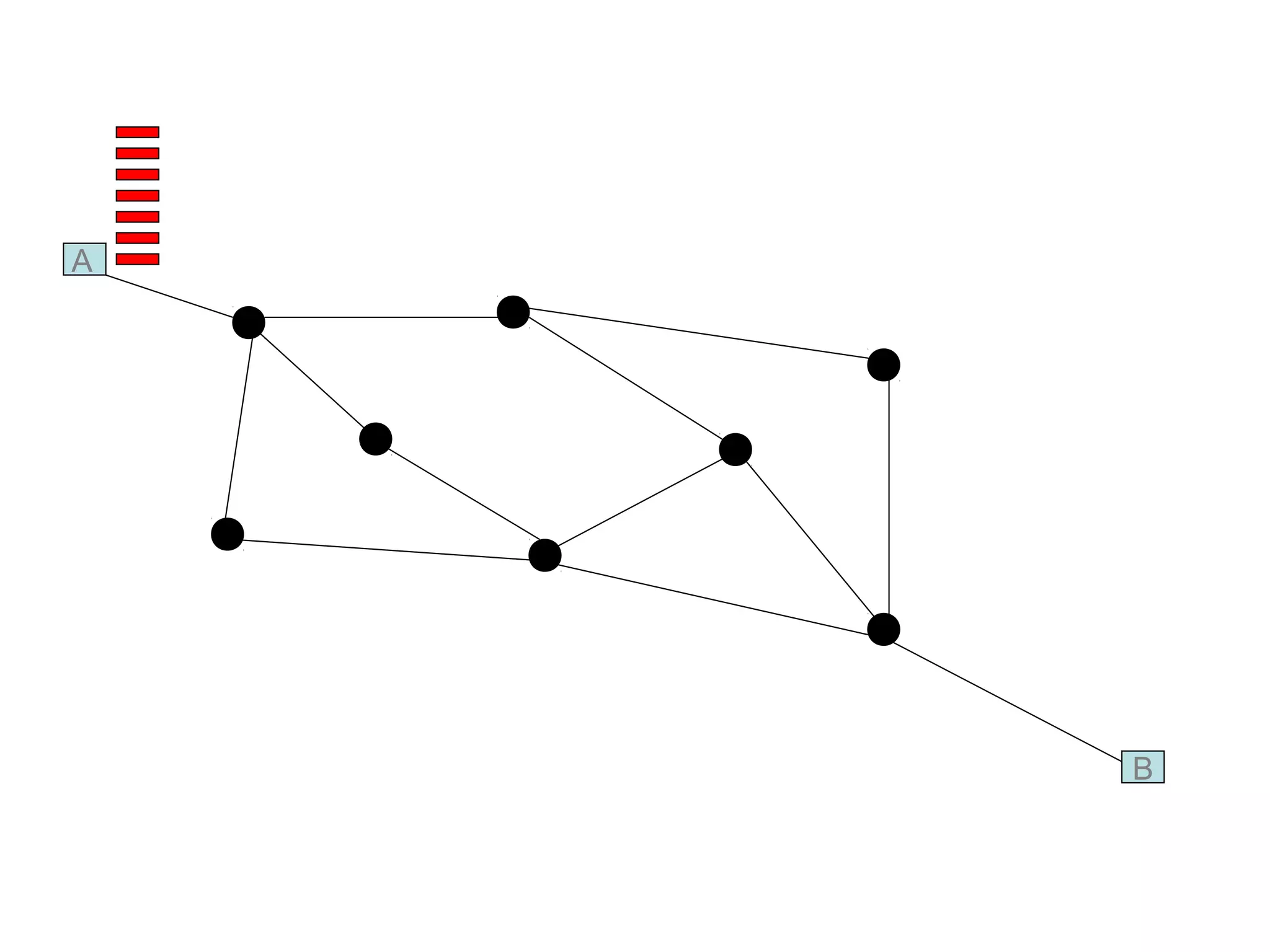
 Each packet is treated independently, with no reference to packets
that have gone before
 Each packet contains the address of its destination
 The packets with the same destination do not always follow the
same route
 Some packets can get late and some can get destroyed in the
network
 Therefore, packets can be received out of order at the destination
 There must be some mechanism of re-ordering at the receiver
 Each packet, treated independently, is referred to as datagram
A
B
Virtual Circuit Packet Switching
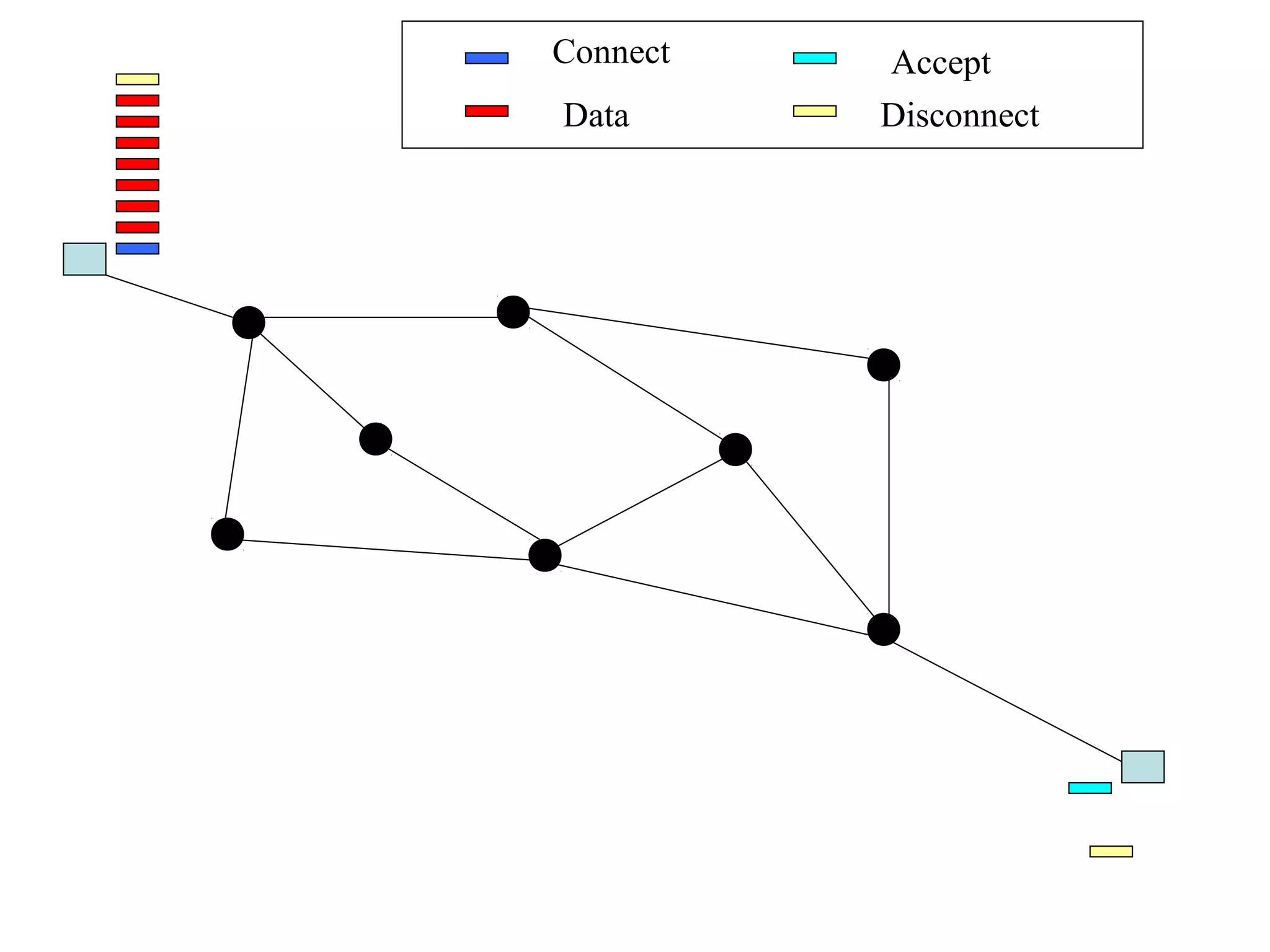
A preplanned route is established before
any packets are sent
All the packets follow that route
Just like circuit switching, the route
should be terminated after the
transmission of data
DisconnectData
Connect Accept
Packets will be received in order
However, packets can get lost on the way
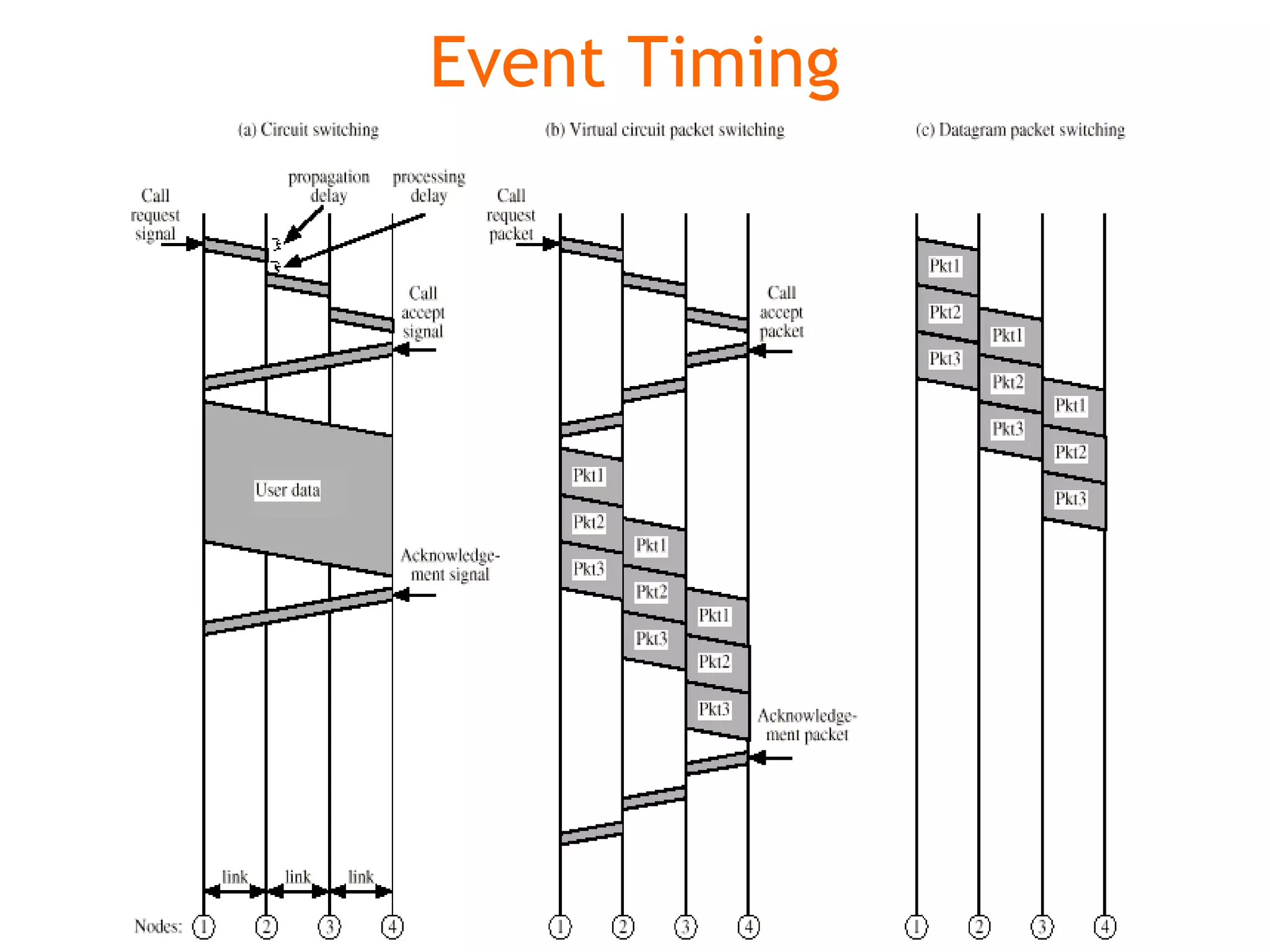
Event Timing

Multiplexing and switching(TDM ,FDM, Data gram, circuit switching)

  • 1.
  • 2.
  • 3.
    Multiplexing Time Division Multiplexing(TDM)  Synchronous TDM  Statistical TDM Frequency Division Multiplexing (FDM)
  • 4.
    Time Division Multiplexing TheBasic Idea:  As the name suggest, Divide time amongst the users  Give each user some time to transmit his data  This process is periodic in a round robin fashion  The time given to a each user is referred to as Time Slot or Time Quantum
  • 5.
  • 6.
  • 7.
    12 13 23123 THE LINK
  • 8.
  • 9.
    There should beno Timing difference between the MUX and DEMUX WARNING………!!!!!!!
  • 10.
    DEMUX Or else……..!!!! Something likethis will happen……!!!!!
  • 11.
    Therefore, the twodevices should be synchronized…… And so it is called Synchronous TDM
  • 12.
    The problem withSynchronous TDM What if host2 has only one packet to send and host3 has two packet to send…….. MUX 12 1 3 12
  • 13.
  • 14.
    Time slots arebeing wasted….!!
  • 15.
  • 16.
    Statistical TDM Here Timeslots are given on demand……….rather than in round robin fashion Each User can get 2 or more consecutive time slots If time slot is not required, it is not allocated Hence, not wasted
  • 17.
  • 18.
  • 19.
    FDM Sharing is doneby assigning each user a specific frequency (Carrier Frequency) Modulation equipment is used to move each signal to the required frequency band. Multiplexing equipment is needed to combine the modulated signal
  • 20.
    User 1 User 2 User3 M O D U L A T O R f1 f2 f3
  • 21.
    All the userstransmit their data simultaneously…. f1 f2 f3
  • 22.
    The Received dataat the Receiver f1 f2 f3 f1 f2 f3 The Filter The output f1 f2 f3
  • 23.
    fc y(f) Demodulate to getthe original signal back
  • 24.
  • 25.
    Switching Networks A networkis made up of end hosts and intermediate switching nodes Data is usually passed through a network of intermediate switching nodes The Switching nodes: Not concerned with the contents of the data; • Provide a switching facility that will move data from node to node until they reach their destination
  • 26.
  • 27.
    Some Notes…  Somenodes only connect to other nodes  Some nodes connect to end hosts also  Usually the network is not fully connected; there is not a direct link between each pair of nodes  If there are more than one paths between any pair of nodes; this increases the reliability of the network  Node-Node links are usually multiplexed
  • 28.
    Two Technologies forSwitching Circuit Switching Packet Switching They differ in the way the nodes switch information from one link to another on the way from source to destination
  • 29.
    Circuit Switching A dedicatedcommunication path between the hosts
  • 30.
  • 31.
    Three Phases  CircuitEstablishment • Host-B send a connection request towards Host-D • Intermediate nodes route the request to Host-D based on measures of availability and cost • If ready, D accepts the connection and a dedicated path (generally full duplex) is established from B through the intermediate nodes to D  Data Transfer • The data (analog/digital) is carried on the dedicated path  Circuit Disconnect • Done by any one station • Signals are propagated to intermediate nodes to de- allocate the dedicated resources
  • 32.
    Principles • Circuit switchingdesigned for voice – Resources dedicated to a particular call – Much of the time a data connection is idle – Data rate is fixed • Both ends must operate at the same rate
  • 33.
  • 34.
    Problems in CircuitSwitching  Circuit Switching approach is inefficient  Since data rate is constant, therefore the devices interconnected must transmit and receive at the same data rate, This limits the interconnection of variety of hosts  Further calls are blocked when all the lines are busy
  • 35.
    Packet Switching…...A quickoverview  Data is transmitted in short packets  If a source has larger message to send, the message is broken up into a series of packets  Each packet contains user’s data plus some control information (header)  The control information, at a minimum includes the information that the network requires to be able to route the packet through the network and deliver it to the intended destination  At each node the packet is received, stored briefly and passed on to the next node
  • 36.
    Advantages  Line efficiencyis greater  A packet switching network can perform data rate conversion  In Circuit Switching, calls are blocked whereas in P.S. packets are still accepted but delivery delay increases  Priorities can be used, thus a higher priority packet experiences less delay
  • 37.
    Types of PacketSwitching Datagram Approach Virtual Circuit Approach
  • 38.
    Datagram Packet Switching Each packet is treated independently, with no reference to packets that have gone before  Each packet contains the address of its destination  The packets with the same destination do not always follow the same route  Some packets can get late and some can get destroyed in the network  Therefore, packets can be received out of order at the destination  There must be some mechanism of re-ordering at the receiver  Each packet, treated independently, is referred to as datagram
  • 39.
  • 40.
    Virtual Circuit PacketSwitching A preplanned route is established before any packets are sent All the packets follow that route Just like circuit switching, the route should be terminated after the transmission of data
  • 41.
  • 42.
    Packets will bereceived in order However, packets can get lost on the way
  • 43.