
Frequency Division Multiplexing
Access (FDMA)
SOUMEN SANTRA
MCA, M.Tech, SCJP, MCP
Multiple Access : Introduction
 It is require in wireless communication systems.
 It allows the subscriber to send data simultaneously from
one mobile station to the base station while receiving
information from the base station to the mobile station.
 It supports a communication system to connect multiple
stations using a common link.
Multiplexing : Features
 One path many user.
 It is used to increase the bandwidth to enhance the
capacity.
 The process of combining multiple signal into a single
transmission channel.
 The channel can accommodate more data.
 It is used for maximum utilization of channel capacity.
 Nodes or stations are connected and use a common link , called a
multipoint or broadcast link .
 We need a multiple access protocol or co-ordinate access to the link .
 Multiple access schemes are used to allow many mobile users to share
simultaneously a finite amount of radio spectrum.
 There are many formal protocols are getting used to access to a
shared link .
Multiplexing : Features
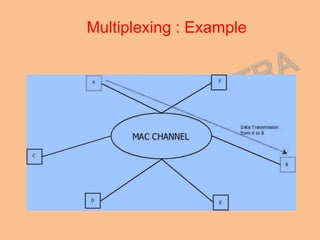
Multiplexing : Example
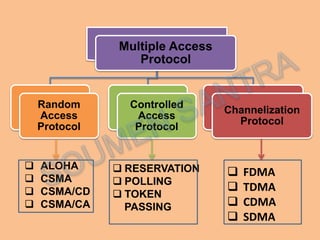
Multiple Access
Protocol
Random
Access
Protocol
Controlled
Access
Protocol
Channelization
Protocol
 ALOHA
 CSMA
 CSMA/CD
 CSMA/CA
 RESERVATION
 POLLING
 TOKEN
PASSING
 FDMA
 TDMA
 CDMA
 SDMA
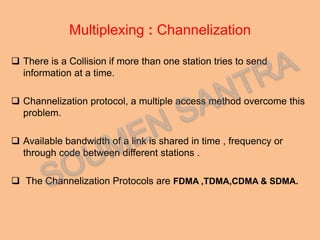
Multiplexing : Channelization
 There is a Collision if more than one station tries to send
information at a time.
 Channelization protocol, a multiple access method overcome this
problem.
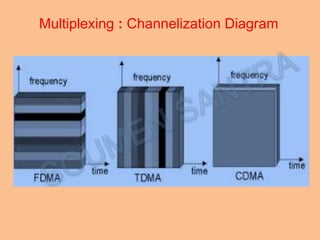
 Available bandwidth of a link is shared in time , frequency or
through code between different stations .
 The Channelization Protocols are FDMA ,TDMA,CDMA & SDMA.
Multiplexing : Channelization Diagram
Frequency division multiple access
FDMA
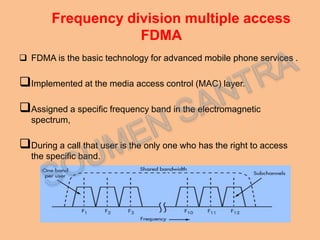
 FDMA is the basic technology for advanced mobile phone services .
Implemented at the media access control (MAC) layer.
Assigned a specific frequency band in the electromagnetic
spectrum,
During a call that user is the only one who has the right to access
the specific band.
FDMA : Features
 Continuous Transmission.
 Narrow bandwidth.
 It can be used both analog and digital signal.
 It is not vulnerable to the timing problem.
 It does not have near far problem, due to frequency filtering.
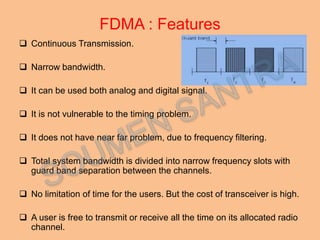
 Total system bandwidth is divided into narrow frequency slots with
guard band separation between the channels.
 No limitation of time for the users. But the cost of transceiver is high.
 A user is free to transmit or receive all the time on its allocated radio
channel.
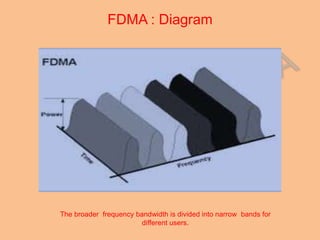
FDMA : Diagram
The broader frequency bandwidth is divided into narrow bands for
different users.
FDMA : Guard Bands
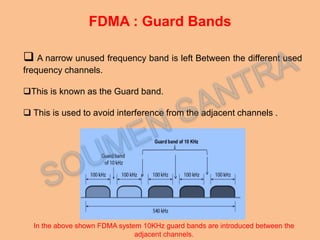
 A narrow unused frequency band is left Between the different used
frequency channels.
This is known as the Guard band.
 This is used to avoid interference from the adjacent channels .
In the above shown FDMA system 10KHz guard bands are introduced between the
adjacent channels.
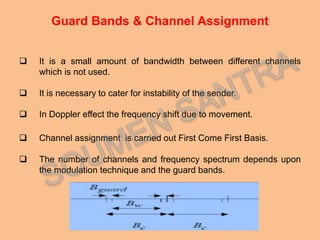
Guard Bands & Channel Assignment
 It is a small amount of bandwidth between different channels
which is not used.
 It is necessary to cater for instability of the sender.
 In Doppler effect the frequency shift due to movement.
 Channel assignment is carried out First Come First Basis.
 The number of channels and frequency spectrum depends upon
the modulation technique and the guard bands.
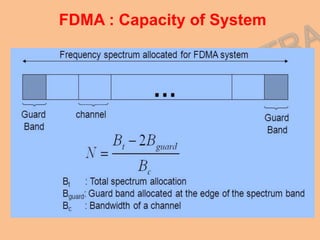
FDMA : Capacity of System
 It is implemented in narrowband system and less complex.
 The base station and the mobile station transmit and receive
simultaneously and continuously.
 Reduces the bit rate information and the use of efficient numerical
codes increases the capacity.
 Since the transmission is continuous , less number of bits are
required for synchronization and framing.
 No restriction regarding the type of baseband or type of modulation.
 Fairly efficient when the number of stations is small and the traffic is
uniformly constant.
 Capacity increase can be obtained by reducing the information bit
rate and using efficient digital code.
 No need for network timing & Channel bandwidth is relatively
narrow.
 It allots specific frequency band to every user.
FDMA : Advantages
 The maximum flow rate per channel is fixed and small.
 If channel is not in use it remains idle which results in wastage.
 Requires RF filtering to minimize adjacent channel interference.
 Does not differ significantly from analog system.
 Guard bands lead to a waste of capacity.
 Dedicated channels increases the call cost.
 Maximum bit rate per channel is fixed.
FDMA : Disadvantages
FDMA : Uses
 It is used in total access communication system.
 It is used in cellular communication and satellite communication.
 It is used for FM and AM radio broadcasting.
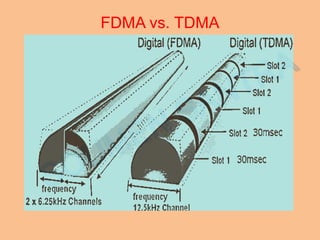
FDMA vs. TDMA
 In TDMA, the time domain is divided into different slots , whereas in
FDMA, allows more than one user to access the same frequency
band without interference.
 FDMA makes a good usage of transmitting and receiving power of
the signal since it has less inter modulation noise. But in TDMA, no
wastage of guard bands and also it has a flexible and faster bit rate.
Hence ,TDMA is more efficient and cost effective over FDMA.
FDMA vs. TDMA
GIVE FEEDBACK
THANK YOU

Frequency Division Multiplexing Access (FDMA)

  • 1.
    Frequency Division Multiplexing Access(FDMA) SOUMEN SANTRA MCA, M.Tech, SCJP, MCP
  • 2.
    Multiple Access :Introduction  It is require in wireless communication systems.  It allows the subscriber to send data simultaneously from one mobile station to the base station while receiving information from the base station to the mobile station.  It supports a communication system to connect multiple stations using a common link.
  • 3.
    Multiplexing : Features One path many user.  It is used to increase the bandwidth to enhance the capacity.  The process of combining multiple signal into a single transmission channel.  The channel can accommodate more data.  It is used for maximum utilization of channel capacity.
  • 4.
     Nodes orstations are connected and use a common link , called a multipoint or broadcast link .  We need a multiple access protocol or co-ordinate access to the link .  Multiple access schemes are used to allow many mobile users to share simultaneously a finite amount of radio spectrum.  There are many formal protocols are getting used to access to a shared link . Multiplexing : Features
  • 5.
  • 6.
    Multiple Access Protocol Random Access Protocol Controlled Access Protocol Channelization Protocol  ALOHA CSMA  CSMA/CD  CSMA/CA  RESERVATION  POLLING  TOKEN PASSING  FDMA  TDMA  CDMA  SDMA
  • 7.
    Multiplexing : Channelization There is a Collision if more than one station tries to send information at a time.  Channelization protocol, a multiple access method overcome this problem.  Available bandwidth of a link is shared in time , frequency or through code between different stations .  The Channelization Protocols are FDMA ,TDMA,CDMA & SDMA.
  • 8.
  • 9.
    Frequency division multipleaccess FDMA  FDMA is the basic technology for advanced mobile phone services . Implemented at the media access control (MAC) layer. Assigned a specific frequency band in the electromagnetic spectrum, During a call that user is the only one who has the right to access the specific band.
  • 10.
    FDMA : Features Continuous Transmission.  Narrow bandwidth.  It can be used both analog and digital signal.  It is not vulnerable to the timing problem.  It does not have near far problem, due to frequency filtering.  Total system bandwidth is divided into narrow frequency slots with guard band separation between the channels.  No limitation of time for the users. But the cost of transceiver is high.  A user is free to transmit or receive all the time on its allocated radio channel.
  • 11.
    FDMA : Diagram Thebroader frequency bandwidth is divided into narrow bands for different users.
  • 12.
    FDMA : GuardBands  A narrow unused frequency band is left Between the different used frequency channels. This is known as the Guard band.  This is used to avoid interference from the adjacent channels . In the above shown FDMA system 10KHz guard bands are introduced between the adjacent channels.
  • 13.
    Guard Bands &Channel Assignment  It is a small amount of bandwidth between different channels which is not used.  It is necessary to cater for instability of the sender.  In Doppler effect the frequency shift due to movement.  Channel assignment is carried out First Come First Basis.  The number of channels and frequency spectrum depends upon the modulation technique and the guard bands.
  • 14.
    FDMA : Capacityof System
  • 15.
     It isimplemented in narrowband system and less complex.  The base station and the mobile station transmit and receive simultaneously and continuously.  Reduces the bit rate information and the use of efficient numerical codes increases the capacity.  Since the transmission is continuous , less number of bits are required for synchronization and framing.  No restriction regarding the type of baseband or type of modulation.  Fairly efficient when the number of stations is small and the traffic is uniformly constant.  Capacity increase can be obtained by reducing the information bit rate and using efficient digital code.  No need for network timing & Channel bandwidth is relatively narrow.  It allots specific frequency band to every user. FDMA : Advantages
  • 16.
     The maximumflow rate per channel is fixed and small.  If channel is not in use it remains idle which results in wastage.  Requires RF filtering to minimize adjacent channel interference.  Does not differ significantly from analog system.  Guard bands lead to a waste of capacity.  Dedicated channels increases the call cost.  Maximum bit rate per channel is fixed. FDMA : Disadvantages
  • 17.
    FDMA : Uses It is used in total access communication system.  It is used in cellular communication and satellite communication.  It is used for FM and AM radio broadcasting.
  • 18.
  • 19.
     In TDMA,the time domain is divided into different slots , whereas in FDMA, allows more than one user to access the same frequency band without interference.  FDMA makes a good usage of transmitting and receiving power of the signal since it has less inter modulation noise. But in TDMA, no wastage of guard bands and also it has a flexible and faster bit rate. Hence ,TDMA is more efficient and cost effective over FDMA. FDMA vs. TDMA
  • 20.