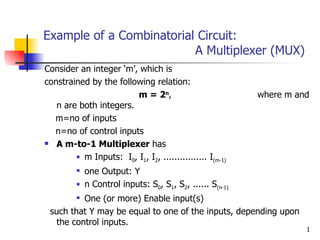
Example of a Combinatorial Circuit:   A Multiplexer (MUX) Consider an integer ‘m’, which is constrained by the following relation:  m = 2 n ,  where m and n are both integers. m=no of inputs n=no of control inputs A m-to-1 Multiplexer  has  m Inputs:  I 0 , I 1 , I 2 , ................ I (m-1)   one Output: Y n Control inputs: S 0 , S 1 , S 2 , ...... S (n-1) One (or more) Enable input(s) such that Y may be equal to one of the inputs, depending upon the control inputs.
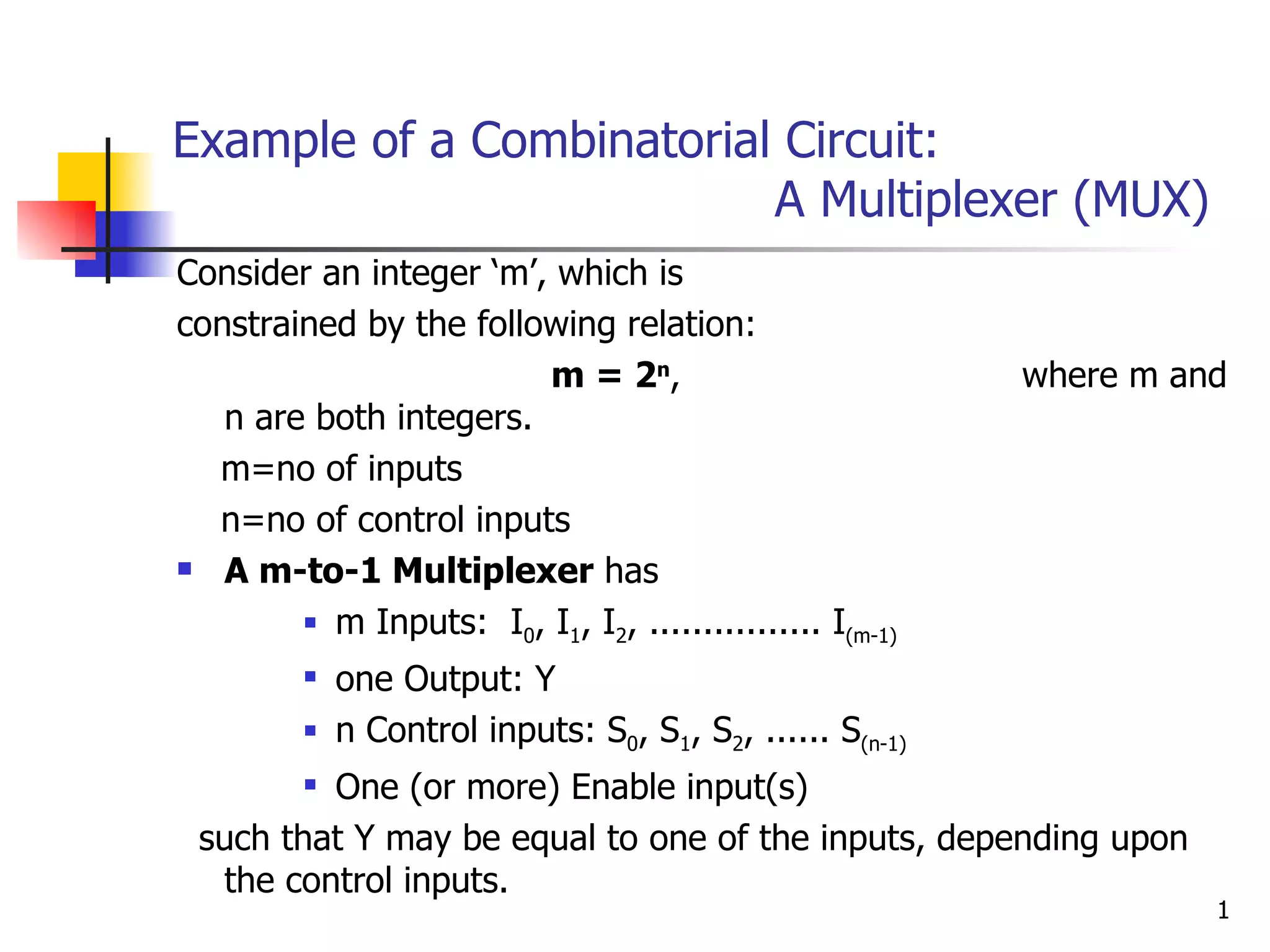
Example: A  4-to-1 Multiplexer  A 4-to-1 Multiplexer: I 0 I 1 I 2 I 3 S 0 S 1 Y 1 output n control inputs 2 n  inputs Enable (G)
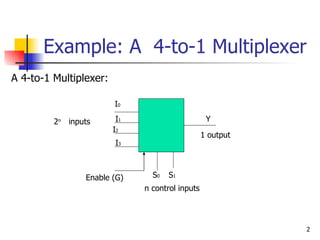
Characteristic Table of a Multiplexer If the MUX is enabled, s 0  s 1   0 0 Y=I 0   0 1 Y=I 1   1 0 Y=I 2   1 1 Y=I 3
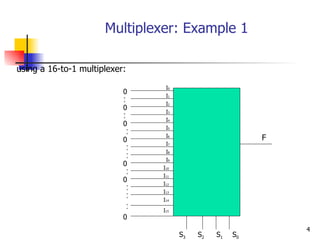
Multiplexer: Example 1 using a 16-to-1 multiplexer: F I 0 0 0 1 0 I 1 I 2 I 3 I 4 I 5 I 8 I 6 I 9 I 7 I 11 I 10 I 13 I 12 I 14 I 15 0 0 0 0 1 1 1 1 1 1 1 1 S 3 S 2 S 1 S 0
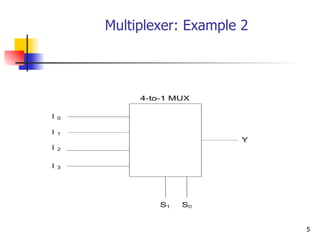
Multiplexer: Example 2
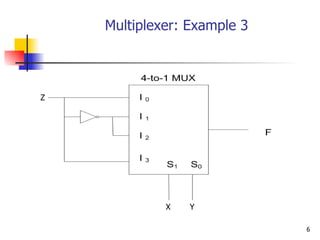
Multiplexer: Example 3 Z X Y
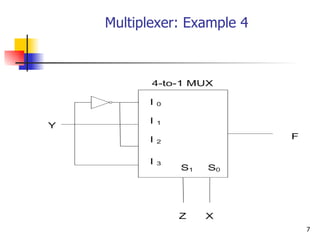
Multiplexer: Example 4
Demultiplexer (DMUX)/ Decoder When used as a demux their basic function is to take a single line input and send it to one of the several outputs depending upon the value of selection inputs.  When used as a decoder.Their basic function is to accept a binary word (code) as an input at the selection inputs and create a different binary word as an output .
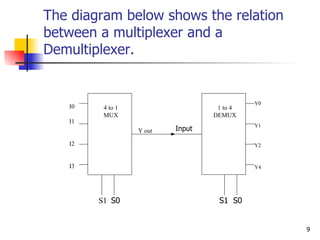
The diagram below shows the relation between a  multiplexer  and a  Demultiplexer . I0 I1 I2 I3 S1  S0 Y out Y0 Y1 Y2 Y4 S1  S0 Input 4 to 1 MUX 1 to 4 DEMUX
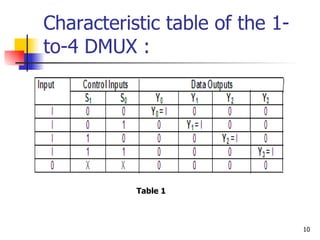
Characteristic table of the 1-to-4 DMUX :   Table 1
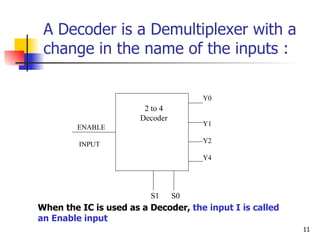
A Decoder is a Demultiplexer with a change in the name of the inputs : When the IC is used as a Decoder,  the input I is called an Enable input   Y0 Y1 Y2 Y4 S1  S0 ENABLE INPUT 2 to 4 Decoder
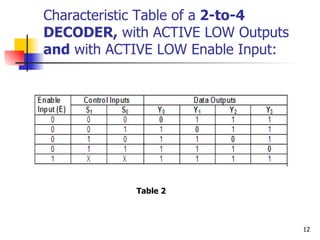
Characteristic Table of a  2-to-4 DECODER,  with ACTIVE LOW Outputs  and  with ACTIVE LOW Enable Input:  Table 2

Multiplexer demul

  • 1.
    Example of aCombinatorial Circuit: A Multiplexer (MUX) Consider an integer ‘m’, which is constrained by the following relation: m = 2 n , where m and n are both integers. m=no of inputs n=no of control inputs A m-to-1 Multiplexer has m Inputs: I 0 , I 1 , I 2 , ................ I (m-1) one Output: Y n Control inputs: S 0 , S 1 , S 2 , ...... S (n-1) One (or more) Enable input(s) such that Y may be equal to one of the inputs, depending upon the control inputs.
  • 2.
    Example: A 4-to-1 Multiplexer A 4-to-1 Multiplexer: I 0 I 1 I 2 I 3 S 0 S 1 Y 1 output n control inputs 2 n inputs Enable (G)
  • 3.
    Characteristic Table ofa Multiplexer If the MUX is enabled, s 0 s 1 0 0 Y=I 0 0 1 Y=I 1 1 0 Y=I 2 1 1 Y=I 3
  • 4.
    Multiplexer: Example 1using a 16-to-1 multiplexer: F I 0 0 0 1 0 I 1 I 2 I 3 I 4 I 5 I 8 I 6 I 9 I 7 I 11 I 10 I 13 I 12 I 14 I 15 0 0 0 0 1 1 1 1 1 1 1 1 S 3 S 2 S 1 S 0
  • 5.
  • 6.
  • 7.
  • 8.
    Demultiplexer (DMUX)/ DecoderWhen used as a demux their basic function is to take a single line input and send it to one of the several outputs depending upon the value of selection inputs. When used as a decoder.Their basic function is to accept a binary word (code) as an input at the selection inputs and create a different binary word as an output .
  • 9.
    The diagram belowshows the relation between a multiplexer and a Demultiplexer . I0 I1 I2 I3 S1 S0 Y out Y0 Y1 Y2 Y4 S1 S0 Input 4 to 1 MUX 1 to 4 DEMUX
  • 10.
    Characteristic table ofthe 1-to-4 DMUX : Table 1
  • 11.
    A Decoder isa Demultiplexer with a change in the name of the inputs : When the IC is used as a Decoder, the input I is called an Enable input Y0 Y1 Y2 Y4 S1 S0 ENABLE INPUT 2 to 4 Decoder
  • 12.
    Characteristic Table ofa 2-to-4 DECODER, with ACTIVE LOW Outputs and with ACTIVE LOW Enable Input: Table 2