Training   Training is the act of increasing the knowledge and skills of an employee for performing a particular job. It is an attempt to improve current or future employee performance by increasing an employee’s ability to perform through learning usually by changing the employee’s attitude or increasing his or her skills and knowledge.
The need for training and development is determined by employee’s performance deficiency,computed as follows:- Training and Development need  =  Std Performance - Actual Performance.
Purpose of training:- To increase the knowledge and skills for doing a particular job. To bridge the gap between job needs and employee skills, knowledge and behaviours. To perform the tasks given to employees in efficient manner i.e without any wastage.
Contd… To prepare existing employees for higher level jobs.(promotion) To keep updated with the new technologies/latest developments in job operations. To gain acceptance from peers. To make employee mobile and versatile.
Types of training:- Skills training Refresher training Cross- functional training Team training Creativity training Diversity training Literacy training.
Skills training:- Training in basic skills such as writing, computing, speaking, listening, problem solving, working as a part of team, leading others. Such training can be given through lectures, on the job, coaching etc.  Before employing these methods manager should
Before employing these methods manager should explain:- How training will help in their jobs. Relate the trianing to trainee’s goals Respect participant responses Encourage trainees to learn by doing Give feedback on progress.
Refresher training:- Thje reason for taking such training is the rapid changes in technology. Such training can be given by short term courses to make its employees up to date with latest developments through consultants who specailise in a particular area.
Cross-functional:- Such training is given to perform in operations in areas other than their assigned jobs.it includes:- Job rotation Exchange personnel for a certain period.
Team training:- Content tasks specifies the team goals Group processes reflect the way member function as a team
Creativity training:- Breaking away Generate new ideas Delaying judgement
Diversity training:- It considers all diverse dimensions in the workplace like race, gender, age, disabilities, education, ideas and backgrounds while designing a training programme.
Literacy training:- Such training focus on the basic skills required to perform a job adequately. To improve the literacy levels of employees with weak reading, writing and arithematic skills by providing them tutorials, home assignments, readind and writing exercises, simple mathematical tests.
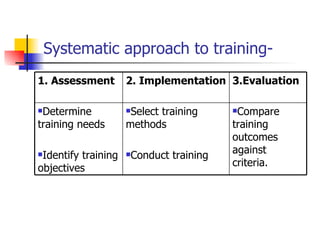
Systematic approach to training- Compare training outcomes against criteria. Select training methods Conduct training Determine  training needs Identify training objectives 3.Evaluation  2. Implementation  1. Assessment
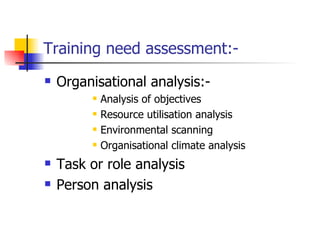
Training need assessment:- Organisational analysis:- Analysis of objectives Resource utilisation analysis Environmental scanning Organisational climate analysis Task or role analysis Person analysis
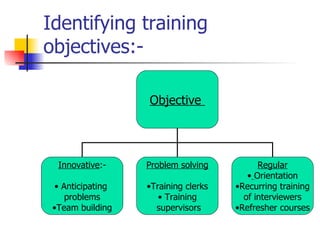
Identifying training objectives:- Objective  Innovative :- Anticipating  problems Team building Problem solving Training clerks Training supervisors Regular Orientation Recurring training of interviewers Refresher courses
Training methods:- (On-Job methods) Job Instruction Training Coaching Mentoring Job rotation Apprenticeship training Committee assignments
Off the Job methods:- Vestibule training-(for clerical and semi  skilled jobs) Role playing Lecture method Conference/discussion approach-(lecture as well as discussion) Programmed instruction-(series of planned sequential units arranged from simple to complex levels)
JIT: Four steps followed in JIT methods are: Trainee recieves an overview of the job, its purpose and its desired outcomes. Trainer demonstrates the job Employee is permitted to copy traines’s way. Employee does the job independently without supervision.
Coaching: The supervisor explains things and answer questions. He throws light on why things are done the way they are He offers a model for trainees to copy Conducts lots of decision making meetings with trainees Procedures are agreed upon and trainee is given enough authority to make divisions.
Mentoring: It is a relationship in which a senior person convey the technical, interpersonal and political skills. A mentor is a teacher, counsellor, supporter, facilitator in the realisation of the young person has about the kind of life he wants as an adult.
Mentoring… Its like guru-shishya relationship where the guru would do everything to develop the personality of the shishya offering emotional support and guidance.
Job rotation It means the movement of trainee from one job to another. It provides the trainee with greater understanding of different functional areas as well as better sense of their own career objectives and interests.also it help to build up rapport with wide range of individuals.
Apprenticeship training: Such training demand high level of participation from the trainee. Trainees spend a prescribed time amount of the time working with an experienced guide, coach or trainer.
Committee assignments: In such programme,  talented employees are assigned to important committees to work with them which will give these employees a broadening experience and can help them to understand the personalities and processes governing the organisations.  In such training the trainees are asked to solve an actual organisational problem and trainees have to work together and offer solutions to the problem.
Evaluation of training programme:- Reactions Learning Job behaviour Organisation Ultimate value
Methods of evaluation:- Questionnaires Tests Interviews Studies Human resource factors Cost benefit analysis Feedback
Executive development It is process of learning through which managers develop their conceptual and analytical abilities to manage. It is concerned with improving the performance of managers by giving them stimulating opportunities for growth and development.
Benefits:- It helps the manager to require KSAs required to successfully tackle with complex changes in environment and technologies. It make the executives to realise their own career goals and aspirations in a planned way. Executives can better perform their work.also they become more useful,versatile and productive.
Contd… It helps managers to broader their outlook. It help the managers to have a feel of how to discharge their duties without rubbing people.
Common practices in EDP:- The practices done to develop their  decision making skills  In-basket Business games Case studies
Interpersonal skills:- Role playing Sensitivity training Behaviour modelling
Job knowledge skills: On-the-job experiences Coaching Understudy
Organisational knowledge:- Job rotation Multiple management
General knowledge:- Special courses Special meetings Specific readings
Specific individual needs:- Special projects Committee assignments.

Training

  • 1.
    Training Training is the act of increasing the knowledge and skills of an employee for performing a particular job. It is an attempt to improve current or future employee performance by increasing an employee’s ability to perform through learning usually by changing the employee’s attitude or increasing his or her skills and knowledge.
  • 2.
    The need fortraining and development is determined by employee’s performance deficiency,computed as follows:- Training and Development need = Std Performance - Actual Performance.
  • 3.
    Purpose of training:-To increase the knowledge and skills for doing a particular job. To bridge the gap between job needs and employee skills, knowledge and behaviours. To perform the tasks given to employees in efficient manner i.e without any wastage.
  • 4.
    Contd… To prepareexisting employees for higher level jobs.(promotion) To keep updated with the new technologies/latest developments in job operations. To gain acceptance from peers. To make employee mobile and versatile.
  • 5.
    Types of training:-Skills training Refresher training Cross- functional training Team training Creativity training Diversity training Literacy training.
  • 6.
    Skills training:- Trainingin basic skills such as writing, computing, speaking, listening, problem solving, working as a part of team, leading others. Such training can be given through lectures, on the job, coaching etc. Before employing these methods manager should
  • 7.
    Before employing thesemethods manager should explain:- How training will help in their jobs. Relate the trianing to trainee’s goals Respect participant responses Encourage trainees to learn by doing Give feedback on progress.
  • 8.
    Refresher training:- Thjereason for taking such training is the rapid changes in technology. Such training can be given by short term courses to make its employees up to date with latest developments through consultants who specailise in a particular area.
  • 9.
    Cross-functional:- Such trainingis given to perform in operations in areas other than their assigned jobs.it includes:- Job rotation Exchange personnel for a certain period.
  • 10.
    Team training:- Contenttasks specifies the team goals Group processes reflect the way member function as a team
  • 11.
    Creativity training:- Breakingaway Generate new ideas Delaying judgement
  • 12.
    Diversity training:- Itconsiders all diverse dimensions in the workplace like race, gender, age, disabilities, education, ideas and backgrounds while designing a training programme.
  • 13.
    Literacy training:- Suchtraining focus on the basic skills required to perform a job adequately. To improve the literacy levels of employees with weak reading, writing and arithematic skills by providing them tutorials, home assignments, readind and writing exercises, simple mathematical tests.
  • 14.
    Systematic approach totraining- Compare training outcomes against criteria. Select training methods Conduct training Determine training needs Identify training objectives 3.Evaluation 2. Implementation 1. Assessment
  • 15.
    Training need assessment:-Organisational analysis:- Analysis of objectives Resource utilisation analysis Environmental scanning Organisational climate analysis Task or role analysis Person analysis
  • 16.
    Identifying training objectives:-Objective Innovative :- Anticipating problems Team building Problem solving Training clerks Training supervisors Regular Orientation Recurring training of interviewers Refresher courses
  • 17.
    Training methods:- (On-Jobmethods) Job Instruction Training Coaching Mentoring Job rotation Apprenticeship training Committee assignments
  • 18.
    Off the Jobmethods:- Vestibule training-(for clerical and semi skilled jobs) Role playing Lecture method Conference/discussion approach-(lecture as well as discussion) Programmed instruction-(series of planned sequential units arranged from simple to complex levels)
  • 19.
    JIT: Four stepsfollowed in JIT methods are: Trainee recieves an overview of the job, its purpose and its desired outcomes. Trainer demonstrates the job Employee is permitted to copy traines’s way. Employee does the job independently without supervision.
  • 20.
    Coaching: The supervisorexplains things and answer questions. He throws light on why things are done the way they are He offers a model for trainees to copy Conducts lots of decision making meetings with trainees Procedures are agreed upon and trainee is given enough authority to make divisions.
  • 21.
    Mentoring: It isa relationship in which a senior person convey the technical, interpersonal and political skills. A mentor is a teacher, counsellor, supporter, facilitator in the realisation of the young person has about the kind of life he wants as an adult.
  • 22.
    Mentoring… Its likeguru-shishya relationship where the guru would do everything to develop the personality of the shishya offering emotional support and guidance.
  • 23.
    Job rotation Itmeans the movement of trainee from one job to another. It provides the trainee with greater understanding of different functional areas as well as better sense of their own career objectives and interests.also it help to build up rapport with wide range of individuals.
  • 24.
    Apprenticeship training: Suchtraining demand high level of participation from the trainee. Trainees spend a prescribed time amount of the time working with an experienced guide, coach or trainer.
  • 25.
    Committee assignments: Insuch programme, talented employees are assigned to important committees to work with them which will give these employees a broadening experience and can help them to understand the personalities and processes governing the organisations. In such training the trainees are asked to solve an actual organisational problem and trainees have to work together and offer solutions to the problem.
  • 26.
    Evaluation of trainingprogramme:- Reactions Learning Job behaviour Organisation Ultimate value
  • 27.
    Methods of evaluation:-Questionnaires Tests Interviews Studies Human resource factors Cost benefit analysis Feedback
  • 28.
    Executive development Itis process of learning through which managers develop their conceptual and analytical abilities to manage. It is concerned with improving the performance of managers by giving them stimulating opportunities for growth and development.
  • 29.
    Benefits:- It helpsthe manager to require KSAs required to successfully tackle with complex changes in environment and technologies. It make the executives to realise their own career goals and aspirations in a planned way. Executives can better perform their work.also they become more useful,versatile and productive.
  • 30.
    Contd… It helpsmanagers to broader their outlook. It help the managers to have a feel of how to discharge their duties without rubbing people.
  • 31.
    Common practices inEDP:- The practices done to develop their decision making skills  In-basket Business games Case studies
  • 32.
    Interpersonal skills:- Roleplaying Sensitivity training Behaviour modelling
  • 33.
    Job knowledge skills:On-the-job experiences Coaching Understudy
  • 34.
    Organisational knowledge:- Jobrotation Multiple management
  • 35.
    General knowledge:- Specialcourses Special meetings Specific readings
  • 36.
    Specific individual needs:-Special projects Committee assignments.