Market Segmentation
Purpose of this section 1. Introduce the Concept of the MARKETING PLAN 2. To Define Market Segmentation 3. Present 4 types of market segmentation 4. Aspects of the Canadian market 5. Main types of segmentation in industrial markets
Baby Boomers & Chicken Purpose of this discussion is to explain the advantages of carefully watching how a market segment acts as it becomes older You have to watch consumption trends and match this -  (eg. This is the wrong time to open a steak house) “  Companies must plan constantly  and the plan must be based on an understanding of market trends and marketing segments”
Marketing Plan - many factors involved Consumer Analysis Environmental Analysis 1. Target Market - you have to decide on which segment 2. Look at competitors, what are they doing 3. Market research required 4. Develop a unique marketing plan
Fundamental Tasks in Developing a Marketing Plan 1. Target Market  ** 2. Implement a Marketing Program **  this recognizes that you are “consumer oriented  (to be able to do this, you have to recognize the difference among people and understand there are different segments)
What is a Market? PEOPLE
What is a Market? PEOPLE BUT - not just  ANY  people, they have to have Willingness to buy Purchasing power (money) Authority to buy
Types of Markets Consumer  Goods and Services Industrial  Goods and Services
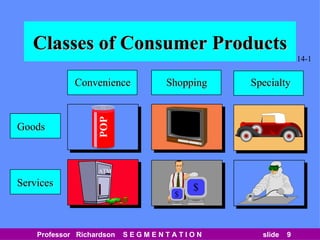
Classes of Consumer Products Convenience Shopping Specialty Goods Services 14-1 POP $ $ ATM
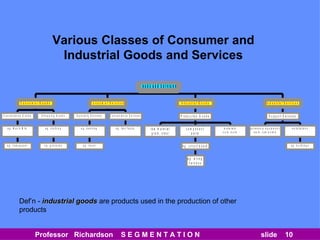
Various Classes of Consumer and Industrial Goods and Services Def’n -  industrial goods  are products used in the production of other products
Industrial Goods Industrial goods are things used in the production of other products Some products are both industrial and consumer goods - eg. electricity, water, desktop PCs 2 categories of industrial goods Production Goods Support Goods
Market Segmentation With a large country Many different types of people - it is too difficult to create a product that will satisfy everybody, that is why we focus on a segment of the total market
Market Segmentation   Defn “ Grouping people according to their similarity related to a particular product category”
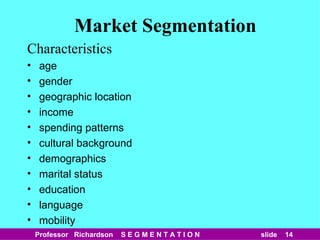
Market Segmentation Characteristics age gender geographic location income spending patterns cultural background demographics marital status education language mobility
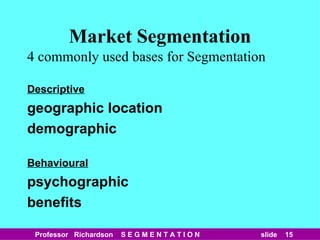
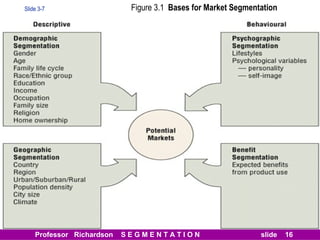
Market Segmentation 4 commonly used bases for Segmentation Descriptive geographic location  demographic Behavioural psychographic benefits
Figure 3.1  Bases for Market Segmentation Slide 3-7
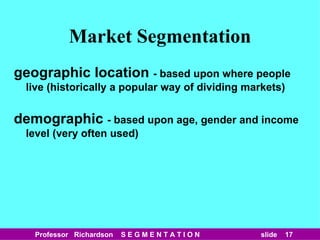
Market Segmentation geographic location  - based upon where people live (historically a popular way of dividing markets) demographic  - based upon age, gender and income level (very often used)
Market Segmentation Psychographic / lifestyles  - based on people’s opinions, interests, lifestyles eg, people who like hard rock music probably prefer beer to wine benefits  - based on the different expectation that customers have about what a product/service can do for them eg. People who want to but “lite” food cause ti will help them lose weight
Geographic location of Canadians most live in Toronto - Montreal axis + Vancouver most live along east-west line close to the American border
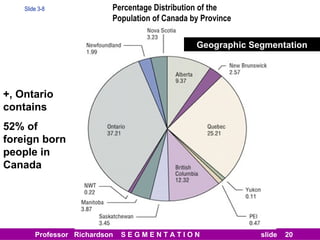
Percentage Distribution of the  Population of Canada by Province Slide 3-8 +, Ontario contains 52% of foreign born people in Canada Geographic Segmentation
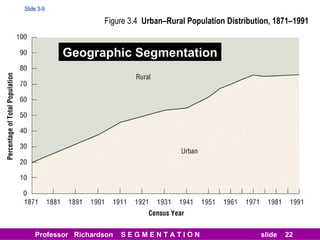
Impact of Immigration Ontario contains 51.8% of Canada’s living foreign-born people Most of these people live in Toronto Canada’s urban population is growing for 2 reasons 1. Immigrants come to Canada and make their homes in the cities 2. Canadians are moving out of the rural areas and in to the cities
Figure 3.4  Urban–Rural Population Distribution, 1871–1991 Slide 3-9 Geographic Segmentation
Geographic Segmentation The reason why we study geographic segmentation is because WHERE people live has a big effect on their consumption patterns. Additionally, WHERE people live in a city is also a reflection of their income level and we can make certain assumptions about their ABILITY TO SPEND based upon their address. This helps people plan store locations and the location of other services.
Geographic Segmentation Climate: winter equipment and recreation are effected by  geographic location you will sell more snow shovels in Northern Ontario than southern Ontario , BUT, population in Northern Ontario is very small clothing purchases are also effected by climate/geography
Demographic Segmentation Demographic Segmentation is   the most common approach   to Market Segmentation Variables are: age gender (male/female) income occupation education household (family - style) size
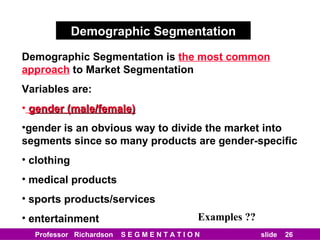
Demographic Segmentation Demographic Segmentation is   the most common approach   to Market Segmentation Variables are: gender (male/female) gender is an obvious way to divide the market into segments since so many products are gender-specific clothing medical products sports products/services entertainment Examples ??
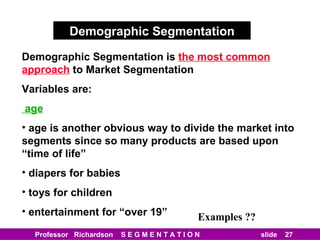
Demographic Segmentation Demographic Segmentation is   the most common approach   to Market Segmentation Variables are: age age is another obvious way to divide the market into segments since so many products are based upon “time of life” diapers for babies toys for children entertainment for “over 19” Examples ??
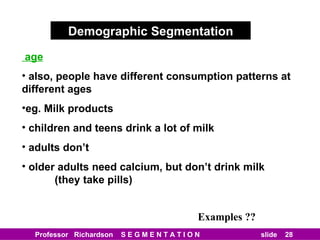
Demographic Segmentation age also, people have different consumption patterns at different ages eg. Milk products children and teens drink a lot of milk adults don’t older adults need calcium, but don’t drink milk   (they take pills) Examples ??
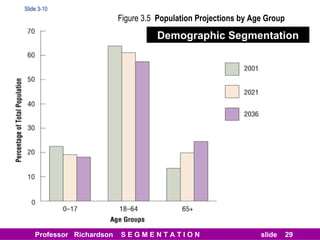
Figure 3.5  Population Projections by Age Group Slide 3-10 Demographic Segmentation
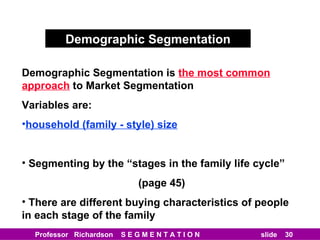
Demographic Segmentation Demographic Segmentation is   the most common approach   to Market Segmentation Variables are: household (family - style) size Segmenting by the “stages in the family life cycle” (page 45) There are different buying characteristics of people in each stage of the family
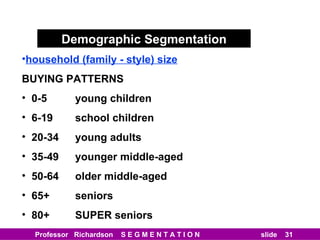
Demographic Segmentation household (family - style) size BUYING PATTERNS 0-5 young children 6-19 school children 20-34 young adults 35-49 younger middle-aged 50-64 older middle-aged 65+ seniors 80+  SUPER seniors
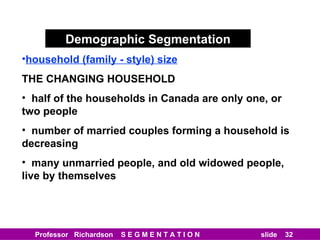
Demographic Segmentation household (family - style) size THE CHANGING HOUSEHOLD half of the households in Canada are only one, or two people number of married couples forming a household is decreasing many unmarried people, and old widowed people, live by themselves
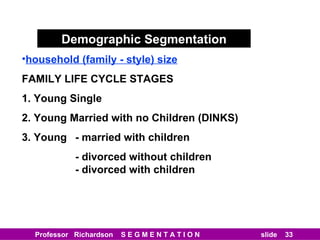
Demographic Segmentation household (family - style) size FAMILY LIFE CYCLE STAGES 1. Young Single 2. Young Married with no Children (DINKS) 3. Young  - married with children - divorced without children - divorced with children
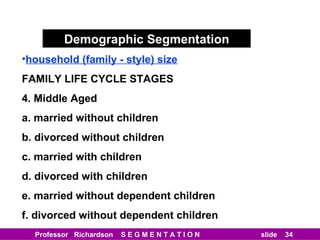
Demographic Segmentation household (family - style) size FAMILY LIFE CYCLE STAGES 4. Middle Aged a. married without children b. divorced without children c. married with children d. divorced with children e. married without dependent children f. divorced without dependent children
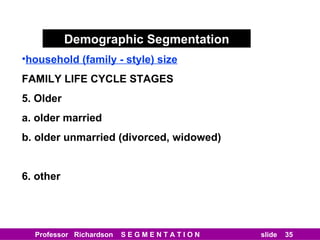
Demographic Segmentation household (family - style) size FAMILY LIFE CYCLE STAGES 5. Older a. older married b. older unmarried (divorced, widowed) 6. other
Demographic Segmentation household (family - style) size SSWD s single  separated  widowed  divorced in Canada,  1.6 million people live alone - they buy different sizes of products   eg. Single serving soup, etc.
Demographic Segmentation Demographic Segmentation is   the most common approach   to Market Segmentation Variables are: age gender (male/female) income occupation education household (family - style) size
Demographic Segmentation income Segmenting markets on the basis of income and expenditure patterns - The number of single mom families has increased by 12.8% between 1985 and 1994 - Male single parent families have more income, on average, than Female single parent families (chart 3.6)
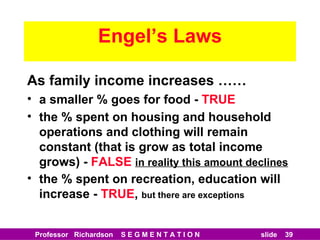
Engel’s Laws As family income increases …… a smaller % goes for food -  TRUE the % spent on housing and household operations and clothing will remain constant (that is grow as total income grows) -  FALSE  in reality this amount declines the % spent on recreation, education will increase -  TRUE ,  but there are exceptions
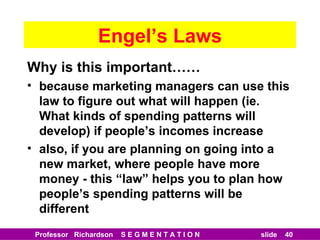
Engel’s Laws Why is this important…… because marketing managers can use this law to figure out what will happen (ie. What kinds of spending patterns will develop) if people’s incomes increase also, if you are planning on going into a new market, where people have more money - this “law” helps you to plan how people’s spending patterns will be different
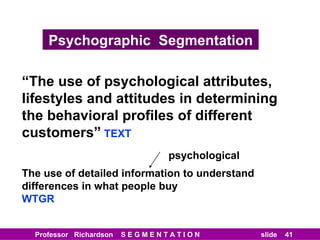
Psychographic  Segmentation “ The use of psychological attributes, lifestyles and attitudes in determining the behavioral profiles of different customers”   TEXT The use of detailed information to understand differences in what people buy WTGR psychological
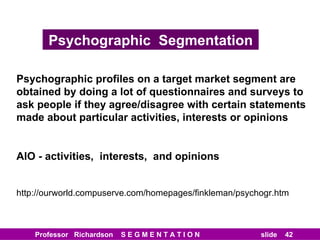
Psychographic  Segmentation Psychographic profiles on a target market segment are obtained by doing a lot of questionnaires and surveys to ask people if they agree/disagree with certain statements made about particular activities, interests or opinions AIO - activities,  interests,  and opinions http://ourworld.compuserve.com/homepages/finkleman/psychogr.htm
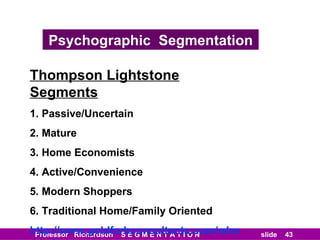
Psychographic  Segmentation Thompson Lightstone Segments 1. Passive/Uncertain 2. Mature 3. Home Economists 4. Active/Convenience 5. Modern Shoppers 6. Traditional Home/Family Oriented http://www.goldfarbconsultants.com/who.html
Psychographic  Segmentation LIFESTYLE PROFILES Table 3.8  - HOW DO YOU FIT?
Benefit  Segmentation “ It is based on the Attributes  (characteristics)  of products, as seen by the customers” example, people buy something because it causes a benefit ie. Diet coke - less sugar, lose weight ie. Extra white toothpaste, whiter teeth, better smile
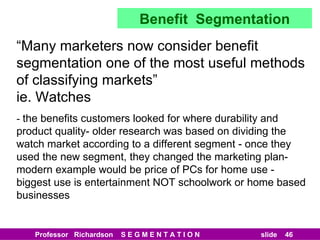
Benefit  Segmentation “ Many marketers now consider benefit segmentation one of the most useful methods of classifying markets” ie. Watches -  the benefits customers looked for where durability and product quality- older research was based on dividing the watch market according to a different segment - once they used the new segment, they changed the marketing plan- modern example would be price of PCs for home use - biggest use is entertainment NOT schoolwork or home based businesses
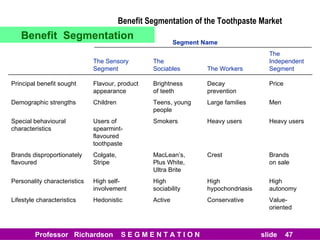
Benefit Segmentation of the Toothpaste Market   Segment Name The The Sensory The Independent Segment Sociables The Workers Segment Principal benefit sought Flavour, product Brightness Decay Price appearance of teeth prevention Demographic strengths Children Teens, young Large families Men people Special behavioural Users of Smokers Heavy users Heavy users characteristics spearmint- flavoured toothpaste Brands disproportionately Colgate, MacLean’s, Crest Brands flavoured Stripe Plus White, on sale Ultra Brite Personality characteristics High self- High High High involvement sociability hypochondriasis autonomy Lifestyle characteristics Hedonistic Active Conservative Value- oriented Benefit  Segmentation
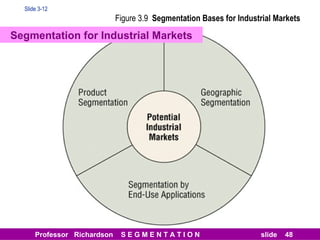
Figure 3.9  Segmentation Bases for Industrial Markets Slide 3-12 Segmentation for Industrial Markets
Geographic Segmentation useful for the automotive industry Product Segmentation ie. Special parts and components Segmentation by End-Use Application ie. Paint mfg. Paint for waterproof applications, paint for rust prevention, paint which sticks to glass Segmentation for Industrial Markets

Segmentation

  • 1.
  • 2.
    Purpose of thissection 1. Introduce the Concept of the MARKETING PLAN 2. To Define Market Segmentation 3. Present 4 types of market segmentation 4. Aspects of the Canadian market 5. Main types of segmentation in industrial markets
  • 3.
    Baby Boomers &Chicken Purpose of this discussion is to explain the advantages of carefully watching how a market segment acts as it becomes older You have to watch consumption trends and match this - (eg. This is the wrong time to open a steak house) “ Companies must plan constantly and the plan must be based on an understanding of market trends and marketing segments”
  • 4.
    Marketing Plan -many factors involved Consumer Analysis Environmental Analysis 1. Target Market - you have to decide on which segment 2. Look at competitors, what are they doing 3. Market research required 4. Develop a unique marketing plan
  • 5.
    Fundamental Tasks inDeveloping a Marketing Plan 1. Target Market ** 2. Implement a Marketing Program ** this recognizes that you are “consumer oriented (to be able to do this, you have to recognize the difference among people and understand there are different segments)
  • 6.
    What is aMarket? PEOPLE
  • 7.
    What is aMarket? PEOPLE BUT - not just ANY people, they have to have Willingness to buy Purchasing power (money) Authority to buy
  • 8.
    Types of MarketsConsumer Goods and Services Industrial Goods and Services
  • 9.
    Classes of ConsumerProducts Convenience Shopping Specialty Goods Services 14-1 POP $ $ ATM
  • 10.
    Various Classes ofConsumer and Industrial Goods and Services Def’n - industrial goods are products used in the production of other products
  • 11.
    Industrial Goods Industrialgoods are things used in the production of other products Some products are both industrial and consumer goods - eg. electricity, water, desktop PCs 2 categories of industrial goods Production Goods Support Goods
  • 12.
    Market Segmentation Witha large country Many different types of people - it is too difficult to create a product that will satisfy everybody, that is why we focus on a segment of the total market
  • 13.
    Market Segmentation Defn “ Grouping people according to their similarity related to a particular product category”
  • 14.
    Market Segmentation Characteristicsage gender geographic location income spending patterns cultural background demographics marital status education language mobility
  • 15.
    Market Segmentation 4commonly used bases for Segmentation Descriptive geographic location demographic Behavioural psychographic benefits
  • 16.
    Figure 3.1 Bases for Market Segmentation Slide 3-7
  • 17.
    Market Segmentation geographiclocation - based upon where people live (historically a popular way of dividing markets) demographic - based upon age, gender and income level (very often used)
  • 18.
    Market Segmentation Psychographic/ lifestyles - based on people’s opinions, interests, lifestyles eg, people who like hard rock music probably prefer beer to wine benefits - based on the different expectation that customers have about what a product/service can do for them eg. People who want to but “lite” food cause ti will help them lose weight
  • 19.
    Geographic location ofCanadians most live in Toronto - Montreal axis + Vancouver most live along east-west line close to the American border
  • 20.
    Percentage Distribution ofthe Population of Canada by Province Slide 3-8 +, Ontario contains 52% of foreign born people in Canada Geographic Segmentation
  • 21.
    Impact of ImmigrationOntario contains 51.8% of Canada’s living foreign-born people Most of these people live in Toronto Canada’s urban population is growing for 2 reasons 1. Immigrants come to Canada and make their homes in the cities 2. Canadians are moving out of the rural areas and in to the cities
  • 22.
    Figure 3.4 Urban–Rural Population Distribution, 1871–1991 Slide 3-9 Geographic Segmentation
  • 23.
    Geographic Segmentation Thereason why we study geographic segmentation is because WHERE people live has a big effect on their consumption patterns. Additionally, WHERE people live in a city is also a reflection of their income level and we can make certain assumptions about their ABILITY TO SPEND based upon their address. This helps people plan store locations and the location of other services.
  • 24.
    Geographic Segmentation Climate:winter equipment and recreation are effected by geographic location you will sell more snow shovels in Northern Ontario than southern Ontario , BUT, population in Northern Ontario is very small clothing purchases are also effected by climate/geography
  • 25.
    Demographic Segmentation DemographicSegmentation is the most common approach to Market Segmentation Variables are: age gender (male/female) income occupation education household (family - style) size
  • 26.
    Demographic Segmentation DemographicSegmentation is the most common approach to Market Segmentation Variables are: gender (male/female) gender is an obvious way to divide the market into segments since so many products are gender-specific clothing medical products sports products/services entertainment Examples ??
  • 27.
    Demographic Segmentation DemographicSegmentation is the most common approach to Market Segmentation Variables are: age age is another obvious way to divide the market into segments since so many products are based upon “time of life” diapers for babies toys for children entertainment for “over 19” Examples ??
  • 28.
    Demographic Segmentation agealso, people have different consumption patterns at different ages eg. Milk products children and teens drink a lot of milk adults don’t older adults need calcium, but don’t drink milk (they take pills) Examples ??
  • 29.
    Figure 3.5 Population Projections by Age Group Slide 3-10 Demographic Segmentation
  • 30.
    Demographic Segmentation DemographicSegmentation is the most common approach to Market Segmentation Variables are: household (family - style) size Segmenting by the “stages in the family life cycle” (page 45) There are different buying characteristics of people in each stage of the family
  • 31.
    Demographic Segmentation household(family - style) size BUYING PATTERNS 0-5 young children 6-19 school children 20-34 young adults 35-49 younger middle-aged 50-64 older middle-aged 65+ seniors 80+ SUPER seniors
  • 32.
    Demographic Segmentation household(family - style) size THE CHANGING HOUSEHOLD half of the households in Canada are only one, or two people number of married couples forming a household is decreasing many unmarried people, and old widowed people, live by themselves
  • 33.
    Demographic Segmentation household(family - style) size FAMILY LIFE CYCLE STAGES 1. Young Single 2. Young Married with no Children (DINKS) 3. Young - married with children - divorced without children - divorced with children
  • 34.
    Demographic Segmentation household(family - style) size FAMILY LIFE CYCLE STAGES 4. Middle Aged a. married without children b. divorced without children c. married with children d. divorced with children e. married without dependent children f. divorced without dependent children
  • 35.
    Demographic Segmentation household(family - style) size FAMILY LIFE CYCLE STAGES 5. Older a. older married b. older unmarried (divorced, widowed) 6. other
  • 36.
    Demographic Segmentation household(family - style) size SSWD s single separated widowed divorced in Canada, 1.6 million people live alone - they buy different sizes of products eg. Single serving soup, etc.
  • 37.
    Demographic Segmentation DemographicSegmentation is the most common approach to Market Segmentation Variables are: age gender (male/female) income occupation education household (family - style) size
  • 38.
    Demographic Segmentation incomeSegmenting markets on the basis of income and expenditure patterns - The number of single mom families has increased by 12.8% between 1985 and 1994 - Male single parent families have more income, on average, than Female single parent families (chart 3.6)
  • 39.
    Engel’s Laws Asfamily income increases …… a smaller % goes for food - TRUE the % spent on housing and household operations and clothing will remain constant (that is grow as total income grows) - FALSE in reality this amount declines the % spent on recreation, education will increase - TRUE , but there are exceptions
  • 40.
    Engel’s Laws Whyis this important…… because marketing managers can use this law to figure out what will happen (ie. What kinds of spending patterns will develop) if people’s incomes increase also, if you are planning on going into a new market, where people have more money - this “law” helps you to plan how people’s spending patterns will be different
  • 41.
    Psychographic Segmentation“ The use of psychological attributes, lifestyles and attitudes in determining the behavioral profiles of different customers” TEXT The use of detailed information to understand differences in what people buy WTGR psychological
  • 42.
    Psychographic SegmentationPsychographic profiles on a target market segment are obtained by doing a lot of questionnaires and surveys to ask people if they agree/disagree with certain statements made about particular activities, interests or opinions AIO - activities, interests, and opinions http://ourworld.compuserve.com/homepages/finkleman/psychogr.htm
  • 43.
    Psychographic SegmentationThompson Lightstone Segments 1. Passive/Uncertain 2. Mature 3. Home Economists 4. Active/Convenience 5. Modern Shoppers 6. Traditional Home/Family Oriented http://www.goldfarbconsultants.com/who.html
  • 44.
    Psychographic SegmentationLIFESTYLE PROFILES Table 3.8 - HOW DO YOU FIT?
  • 45.
    Benefit Segmentation“ It is based on the Attributes (characteristics) of products, as seen by the customers” example, people buy something because it causes a benefit ie. Diet coke - less sugar, lose weight ie. Extra white toothpaste, whiter teeth, better smile
  • 46.
    Benefit Segmentation“ Many marketers now consider benefit segmentation one of the most useful methods of classifying markets” ie. Watches - the benefits customers looked for where durability and product quality- older research was based on dividing the watch market according to a different segment - once they used the new segment, they changed the marketing plan- modern example would be price of PCs for home use - biggest use is entertainment NOT schoolwork or home based businesses
  • 47.
    Benefit Segmentation ofthe Toothpaste Market Segment Name The The Sensory The Independent Segment Sociables The Workers Segment Principal benefit sought Flavour, product Brightness Decay Price appearance of teeth prevention Demographic strengths Children Teens, young Large families Men people Special behavioural Users of Smokers Heavy users Heavy users characteristics spearmint- flavoured toothpaste Brands disproportionately Colgate, MacLean’s, Crest Brands flavoured Stripe Plus White, on sale Ultra Brite Personality characteristics High self- High High High involvement sociability hypochondriasis autonomy Lifestyle characteristics Hedonistic Active Conservative Value- oriented Benefit Segmentation
  • 48.
    Figure 3.9 Segmentation Bases for Industrial Markets Slide 3-12 Segmentation for Industrial Markets
  • 49.
    Geographic Segmentation usefulfor the automotive industry Product Segmentation ie. Special parts and components Segmentation by End-Use Application ie. Paint mfg. Paint for waterproof applications, paint for rust prevention, paint which sticks to glass Segmentation for Industrial Markets