TOPIC :- LASER
NAME :- SIDDHI SHRIVAS
DIVISON :- COMPUTER – C
ENROLLMENT NUMBER :- 130770107163
FACULTY NAME :-Mr. VIPUL PATEL
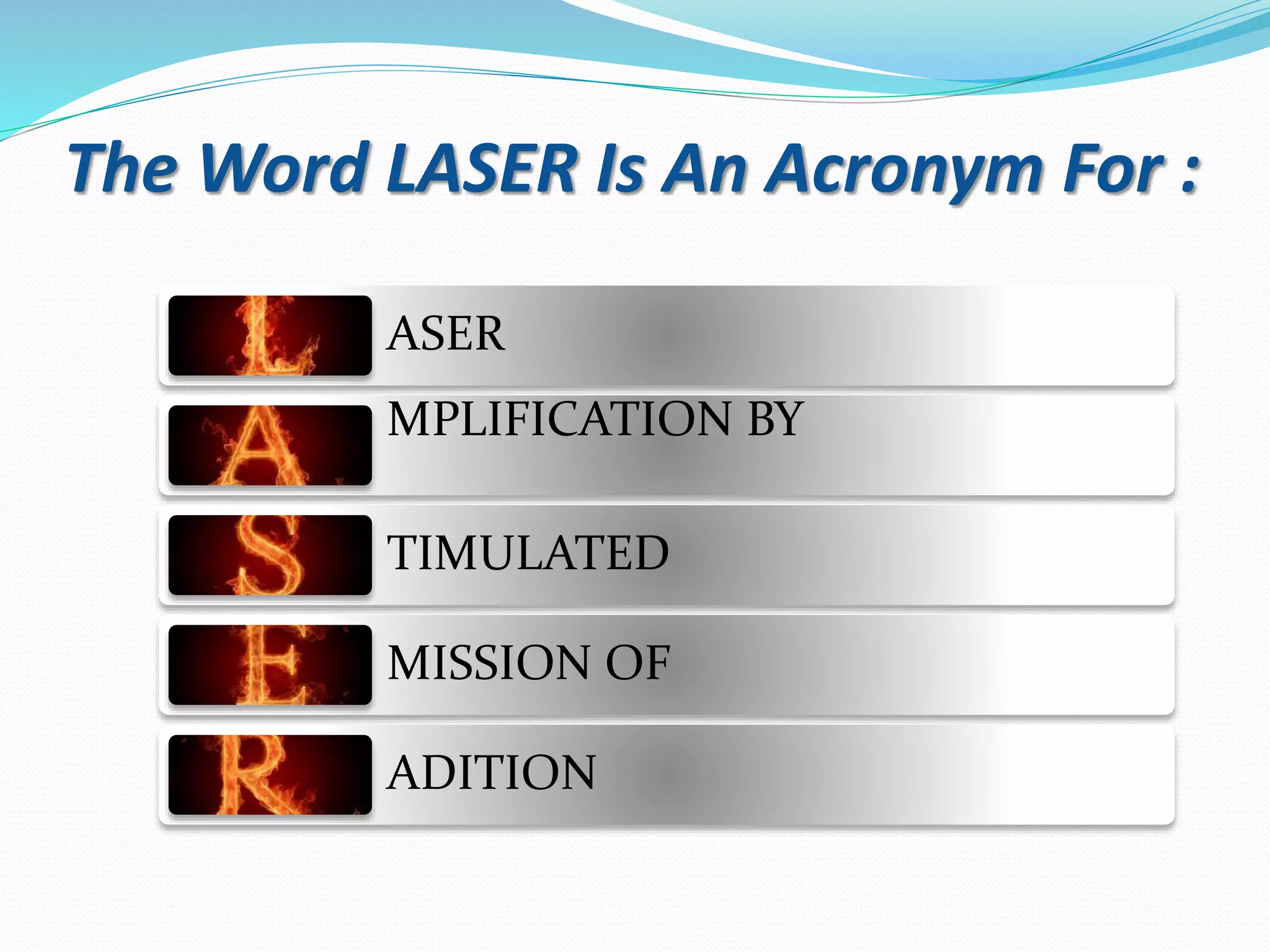
ASER
MPLIFICATION BY
TIMULATED
MISSION OF
ADITION
The Word LASER Is An Acronym For :
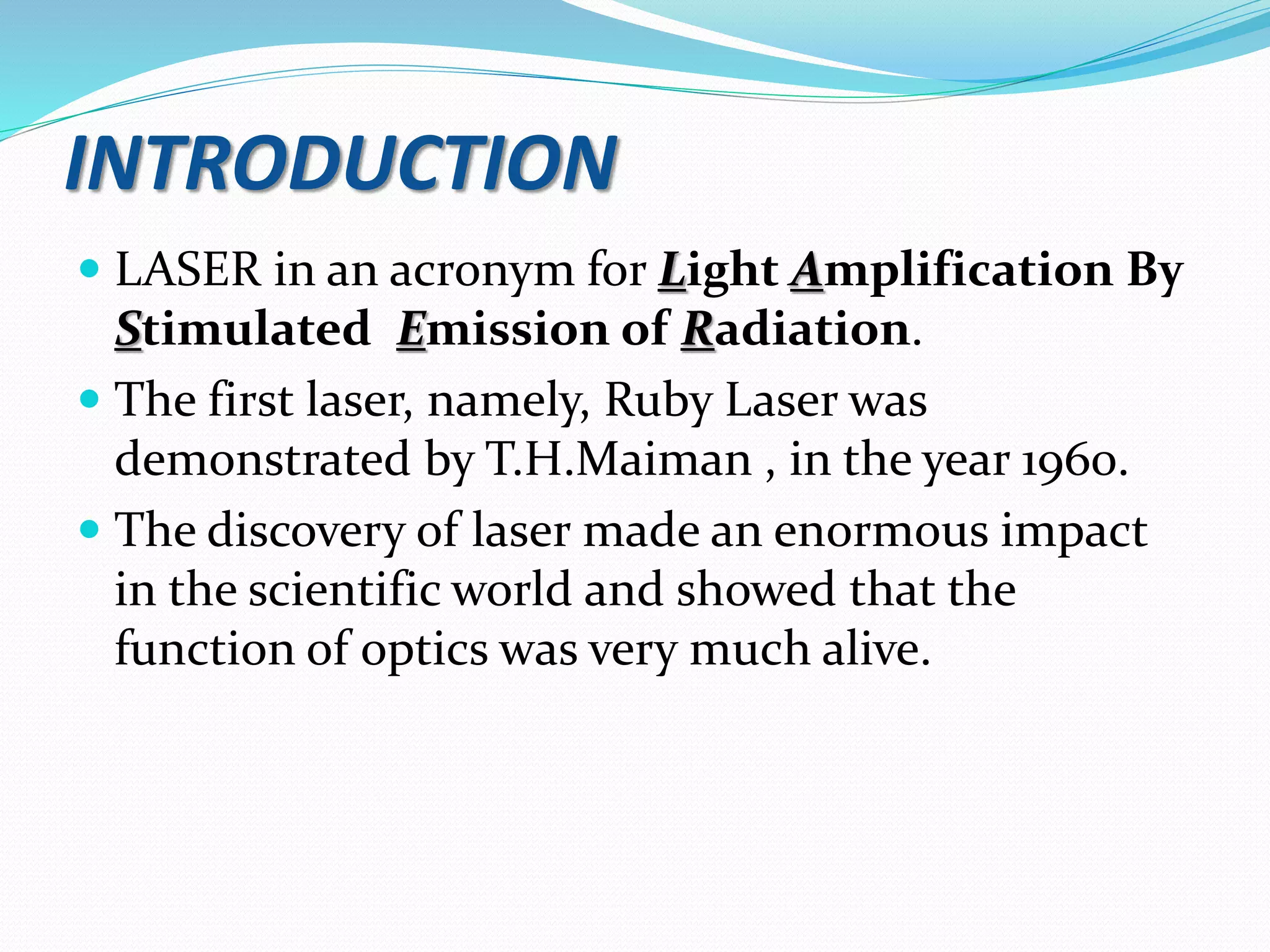
INTRODUCTION
 LASER in an acronym for Light Amplification By
Stimulated Emission of Radiation.
 The first laser, namely, Ruby Laser was
demonstrated by T.H.Maiman , in the year 1960.
 The discovery of laser made an enormous impact
in the scientific world and showed that the
function of optics was very much alive.
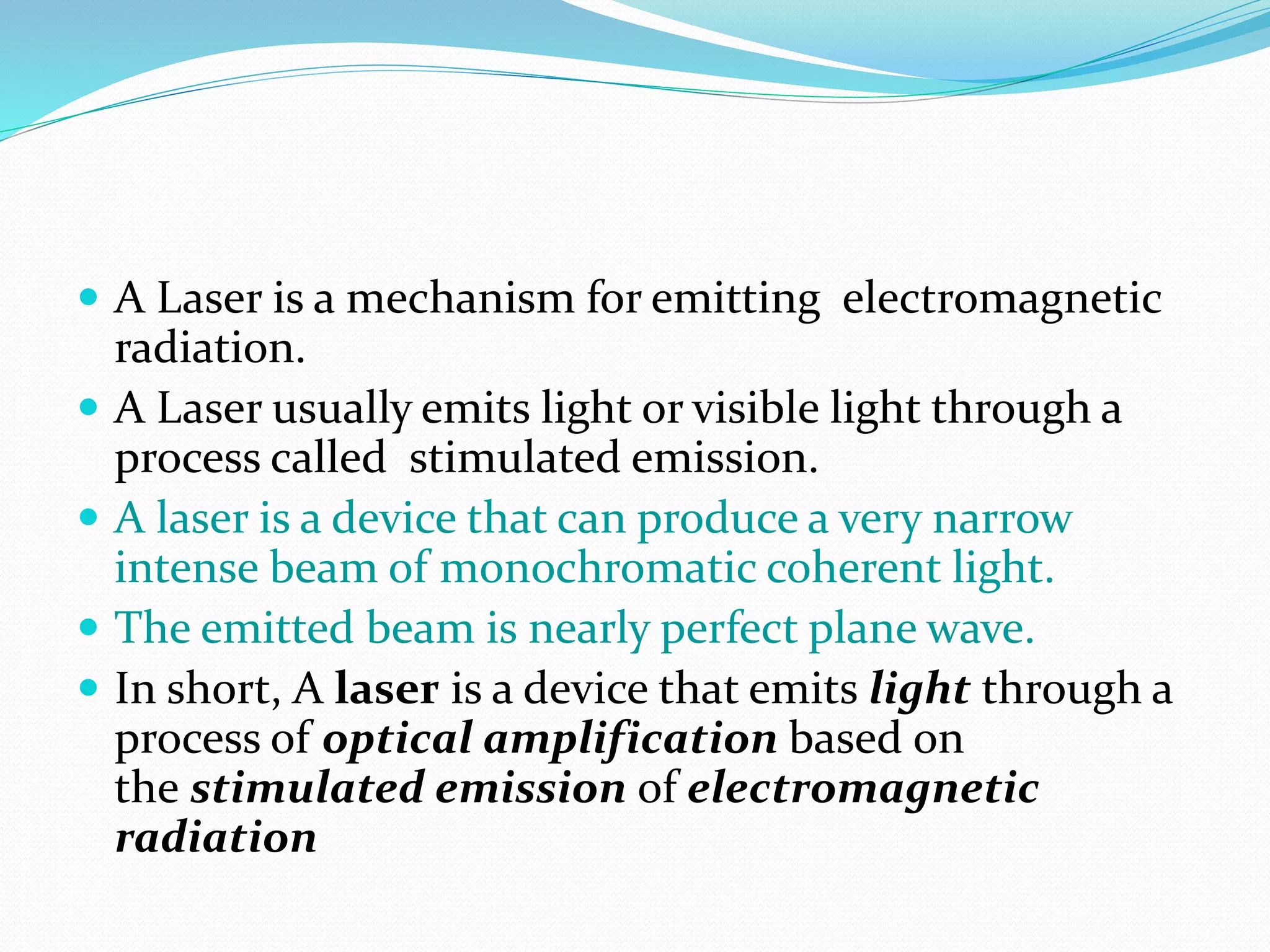
 A Laser is a mechanism for emitting electromagnetic
radiation.
 A Laser usually emits light or visible light through a
process called stimulated emission.
 A laser is a device that can produce a very narrow
intense beam of monochromatic coherent light.
 The emitted beam is nearly perfect plane wave.
 In short, A laser is a device that emits light through a
process of optical amplification based on
the stimulated emission of electromagnetic
radiation
CHARACTERISTICS OF LASER LIGHT
o Monochromatic
o Directional
o Coherent
o High intensity
 The light emitted from a laser is monochromatic , that
is, it is of one color/wavelength. In contrast, ordinary
white light is a combination of many colors (or
wavelengths) of light.
 Lasers emit light that is highly directional , that is, laser
light is emitted as a relatively narrow beam in a specific
direction. Ordinary light, such as from a light bulb, is
emitted in many directions away from the source.
 The light from a laser is said to be coherent, which
means that the wavelengths of the laser light are in
phase in space and time. Ordinary light can be a
mixture of many wavelengths.
 These three properties of laser light are what can
make it more hazardous than ordinary light. Laser
light can deposit a lot of energy within a small area.
EINSTEIN'S THEORY
 EINSTEIN EXPLAINED THE ACTION OF LASER BEAM
BASED ON QUANTUM THEORY OF LIGHT .
 Production of laser light is a particular
consequence of interaction of radiation
with matter.
THREE process that occur when light
Interacts with MATTER are:
o Induced Absorption.
o Spontaneous Emission.
o Stimulated emission.
1. INDUCED ABSORPTION
 If a photon of energy hv is incident on the atom in
the lower state, the incident photon and gets
excited to the higher energy state E2. this process
is called induced absorption.
 Normally, the higher energy state is an unstable
state so the atoms will make a transition back to
the lower energy state with the emission of a
photon.
photon
Before absorption After absorption
E2
E1
E2
E1
INDUCED ABSORPTION
 THE RATE OF ABSORPTION R12 IS PROPORTIONAL
TO THE POPULATION OF THE LOWER ENERGY
LEVEL N1 AND TO THE DENSITY OF INCIDENT
RADIATION ρ. HENCE,
R12 ∝ N1ρ
R12 =B12N1ρ
 WHERE B12 I STHE PROPOTINALITY CONSTANT
KNOWN AS THE PROBABILITY OF ABSORPTION OF
RADIATION PER UNIT TIME.
2. SPONTANEOUS EMISSION
 In spontaneous emission the atoms or molecules
in the higher energy state E2 eventually return to
the ground state by emitting their excess energy
spontaneously.
 The process is independent of external radiation .
 The rate of spontaneous emission is directly
proportional to the population of the energy level
E2.
After emission
Atom in ground stateAtom in excited state
Before emission
During
E2
E1
hv=E2-E1
SPONTANEOUS EMISSION
3. STIMULATED EMISSION
 When electron transits from higher level to lower
level in presence of external energy is known as
stimulated emission.
 In stimulated emission a photon having energy E
equal to the difference in energy between the two
levels E2 and E1 , stimulate an atom in the higher
state to make a transition to the lower state with
the creation of second photon.
Excited state
Before emission
E1
E2
After emissionie,
STIMULATED EMISSION
 According to Einstein's, under certain condition it
is possible to force an excited atom emit a photon
by another photon and the incident light wave
must be in same phase .hence we get an enhance
beam of coherent light
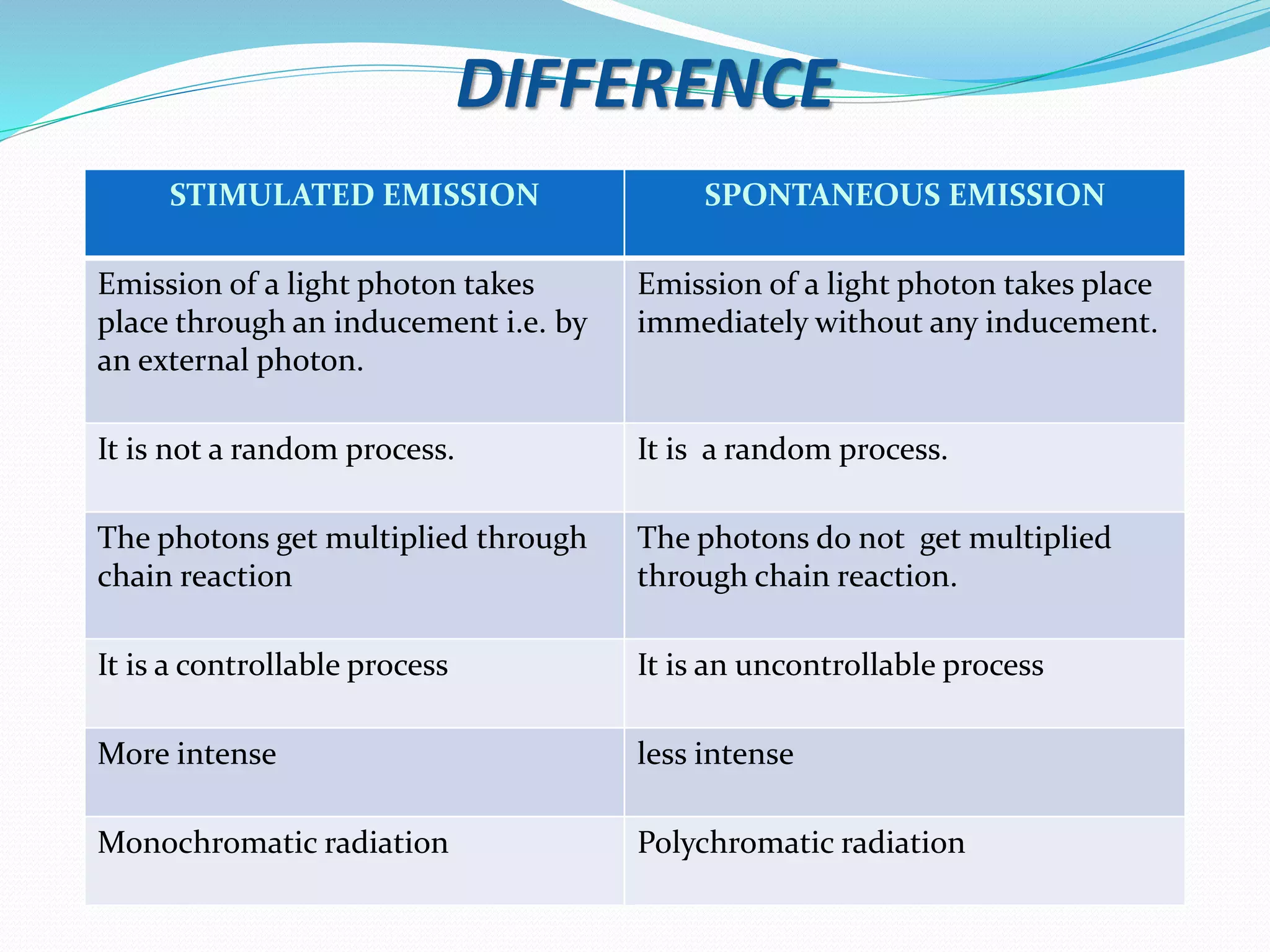
DIFFERENCE
STIMULATED EMISSION SPONTANEOUS EMISSION
Emission of a light photon takes
place through an inducement i.e. by
an external photon.
Emission of a light photon takes place
immediately without any inducement.
It is not a random process. It is a random process.
The photons get multiplied through
chain reaction
The photons do not get multiplied
through chain reaction.
It is a controllable process It is an uncontrollable process
More intense less intense
Monochromatic radiation Polychromatic radiation
BASIC CONCEPTS IN LASER :
 Population inversion : is a state of achieving more
number of atoms in the excited state compared to
ground state
Pumping Spontaneous emission
or/and collisions
Pumping
 Pumping : is the mechanism of exciting atoms from the
lower energy state to a higher energy state by supplying
energy from an external source
 Active medium: A medium in which population inversion
is achieved for laser action is called active medium. The
medium can be solid, liquid, gas and plasma.
 Optical resonators :A pair of concave mirrors placed on
either side of the discharge tube, one completely polished
and the other partially polished.
Therefore in a laser….
Three key elements in a laser
•Pumping process prepares amplifying medium in suitable state
•Optical power increases on each pass through amplifying medium
•If gain exceeds loss, device will oscillate, generating a coherentoutput
Nd: YAG Laser
(Neodymium Yttrium Aluminium Garnet Laser)
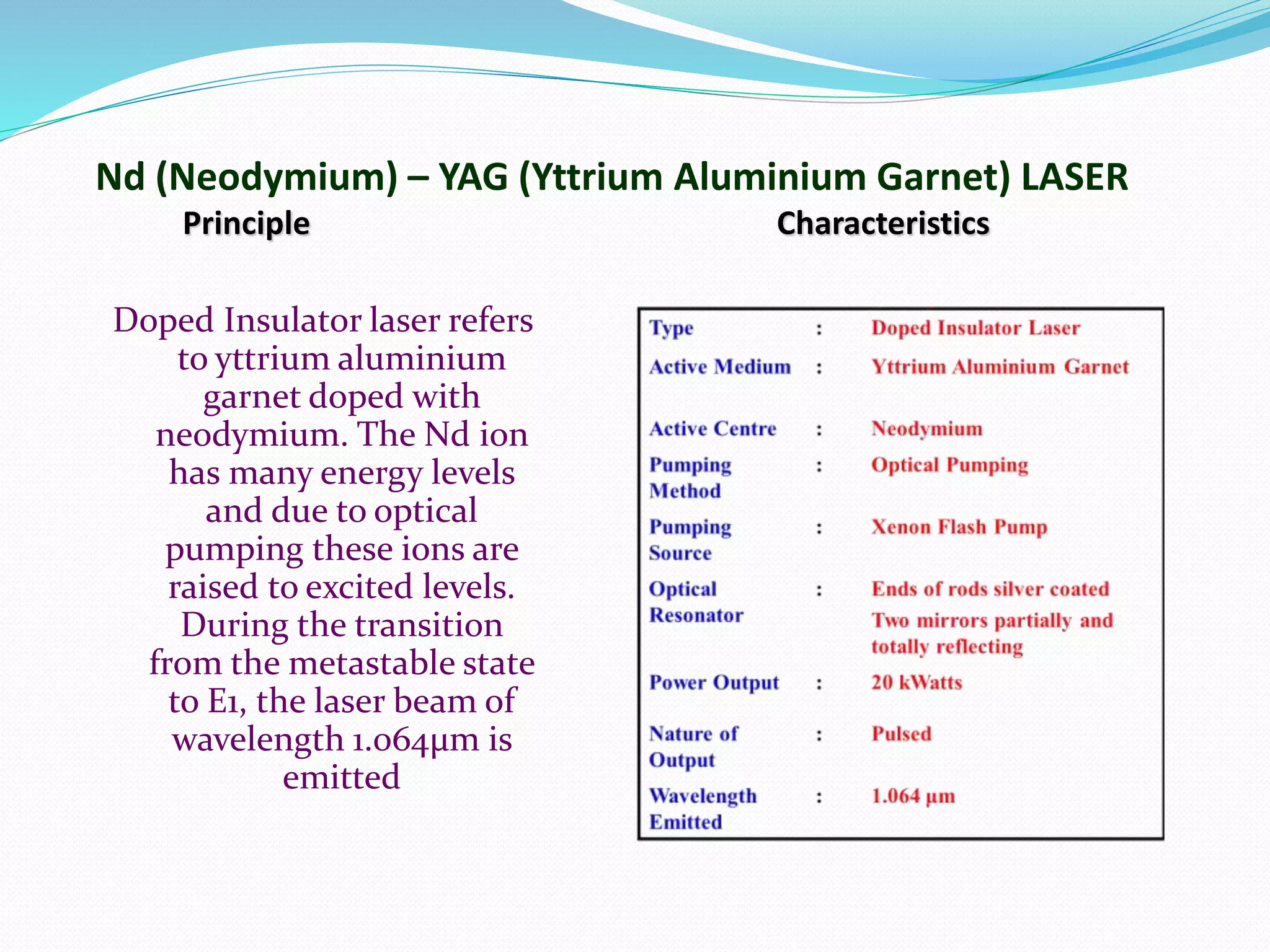
Nd (Neodymium) – YAG (Yttrium Aluminium Garnet) LASER
Principle Characteristics
Doped Insulator laser refers
to yttrium aluminium
garnet doped with
neodymium. The Nd ion
has many energy levels
and due to optical
pumping these ions are
raised to excited levels.
During the transition
from the metastable state
to E1, the laser beam of
wavelength 1.064μm is
emitted
DIAGRAM :
Power Supply
Capacitor
Resistor
Laser Rod
Flash Tube
M1– 100%
reflector mirror
M2 – partial
reflector mirror
CONSTRUCTION :
Essential parts of laser:-
Yttrium Aluminium Garnet in which 1.5% of neodymium ions are
doped as impurities. Nd3+ is the lasing ion.
Two end mirrors M1 (total reflector) & M2 (output coupler)
Excitation is achieved by krypton or xenon arc lamps
Nd : YAG laser rod has a length of about 5-10 cm with a diameter 6-
9mm. It is kept at one foci of an elliptical glass tube.
Krypton arc lamp , the optical source is placed at the other foci of
the glass tube. It is provided with necessary power supply
arrangement.
Mirrors M1 (total reflector) & M2(output coupler) act as a resonant
cavity to produce stimulated and amplification process.
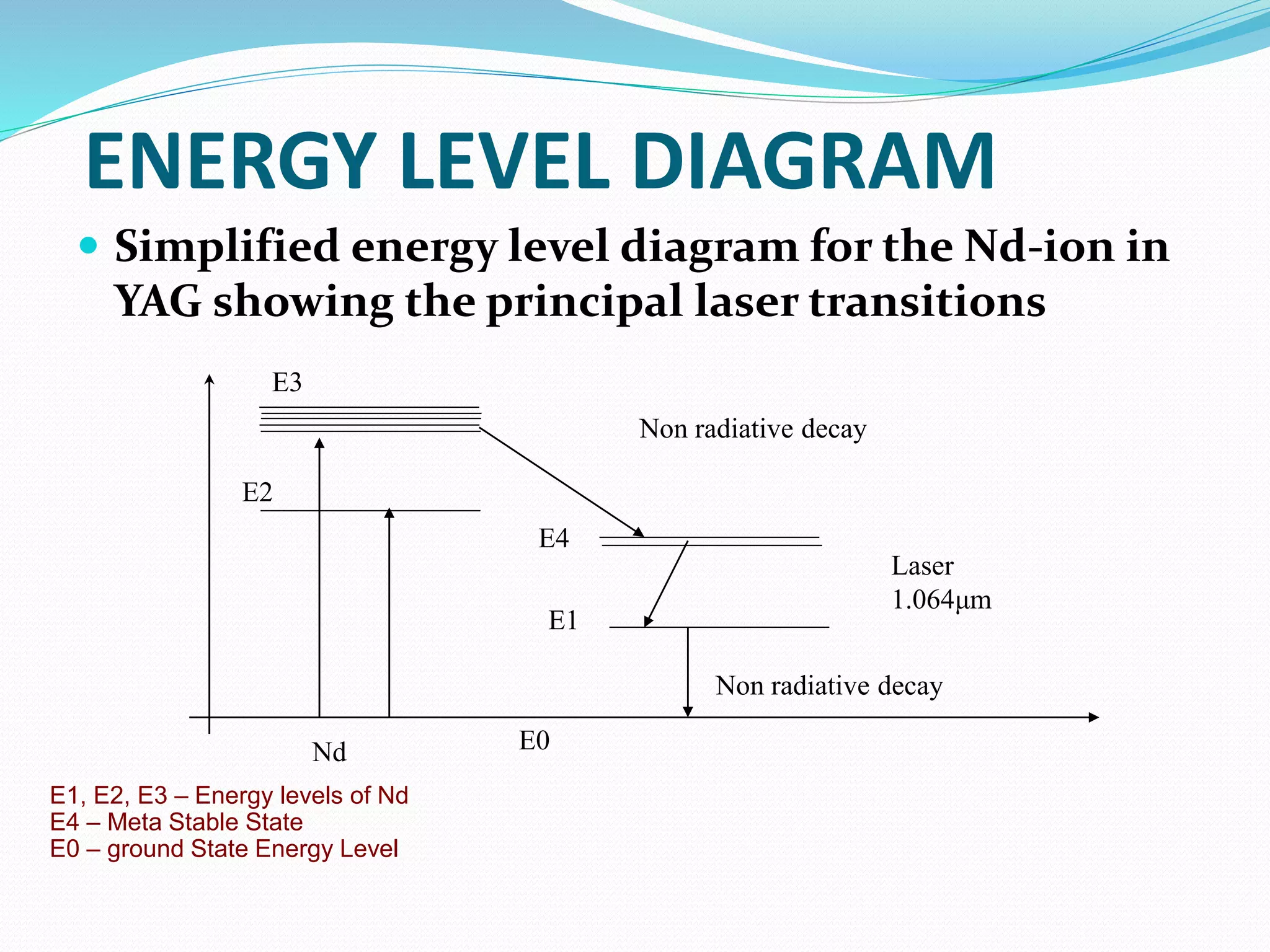
ENERGY LEVEL DIAGRAM
 Simplified energy level diagram for the Nd-ion in
YAG showing the principal laser transitions
Non radiative decay
Laser
1.064μm
Non radiative decay
E3
E2
E0
E1
E4
Nd
E1, E2, E3 – Energy levels of Nd
E4 – Meta Stable State
E0 – ground State Energy Level
APPLICATION OF LASER:
 Industry
 Weapons
 Drilling And Cutting
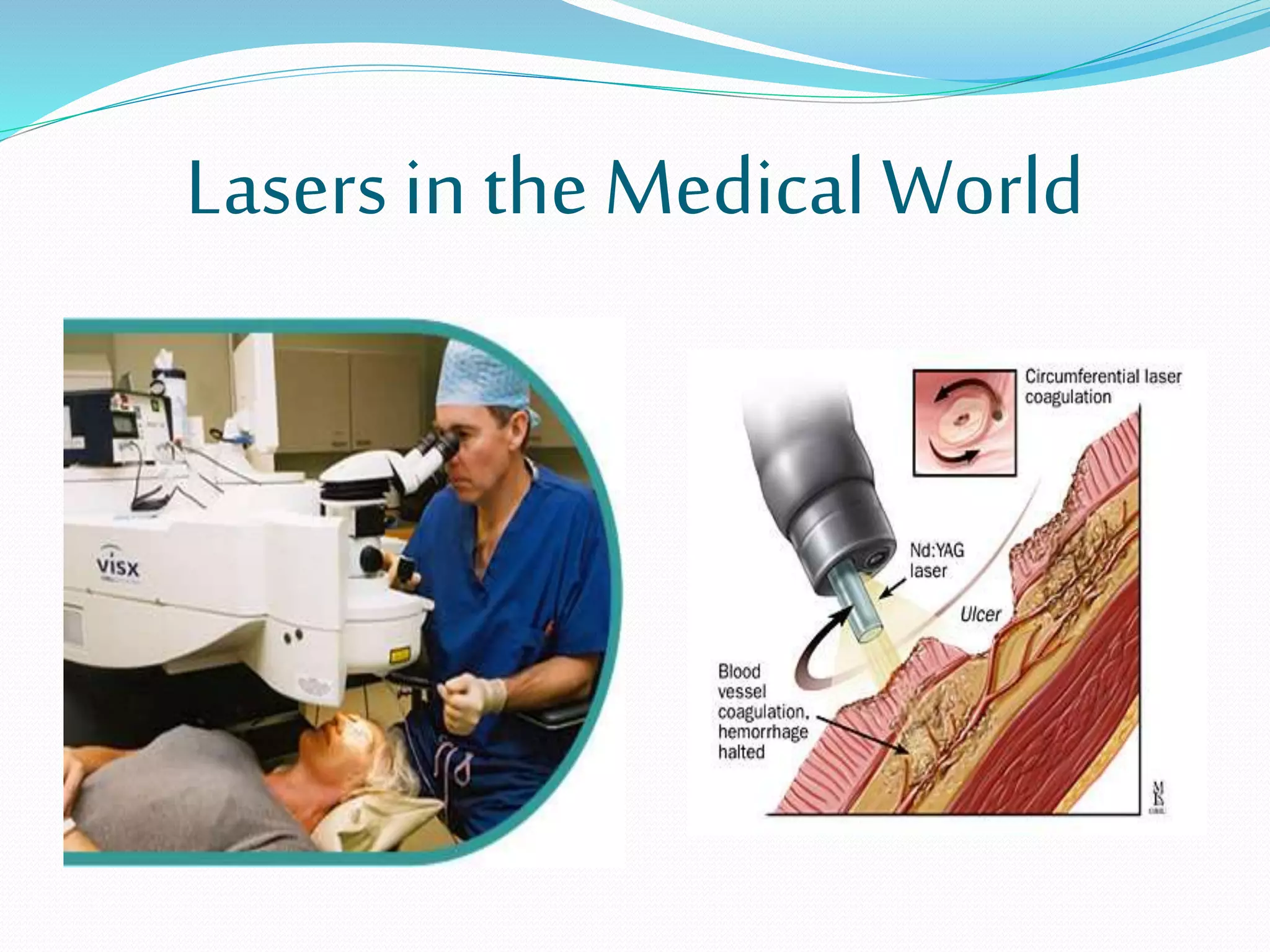
 In Medical World
 Communication
 Computer
 Chemistry
 Photography
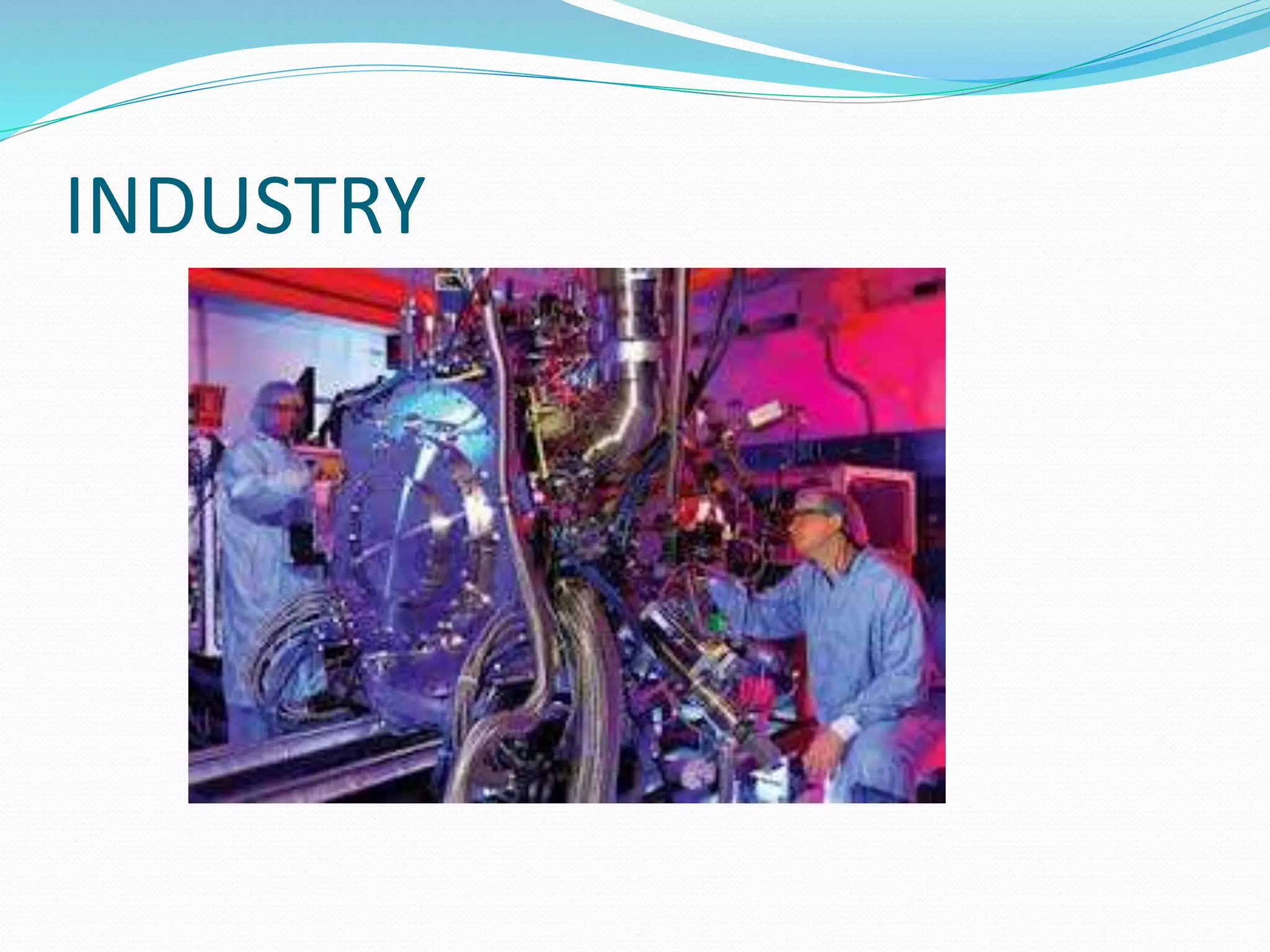
INDUSTRY
WEAPONS
Drilling And Cutting:
Lasers in the Medical World
COMMUNICATION
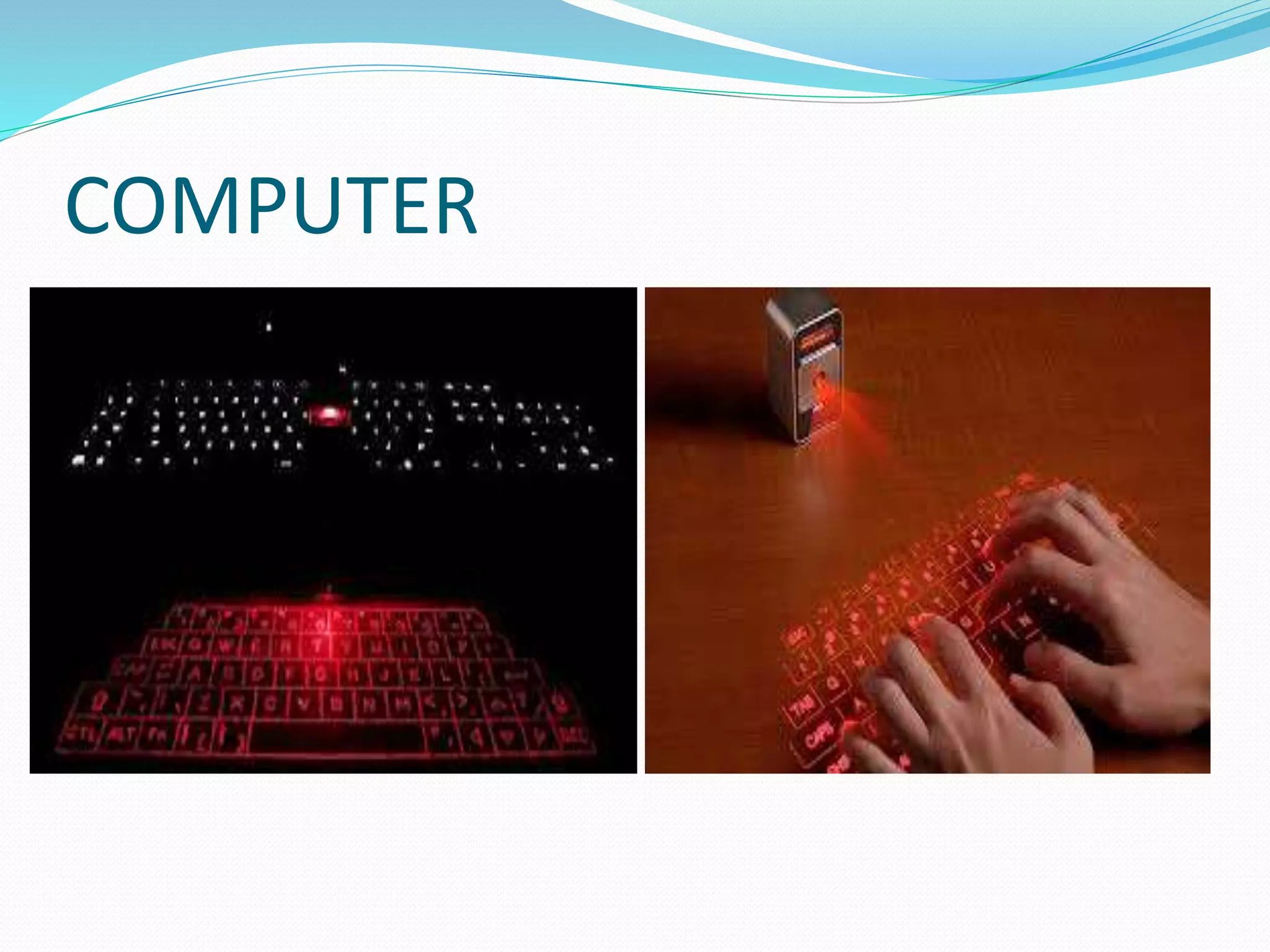
COMPUTER
CHEMISTRY
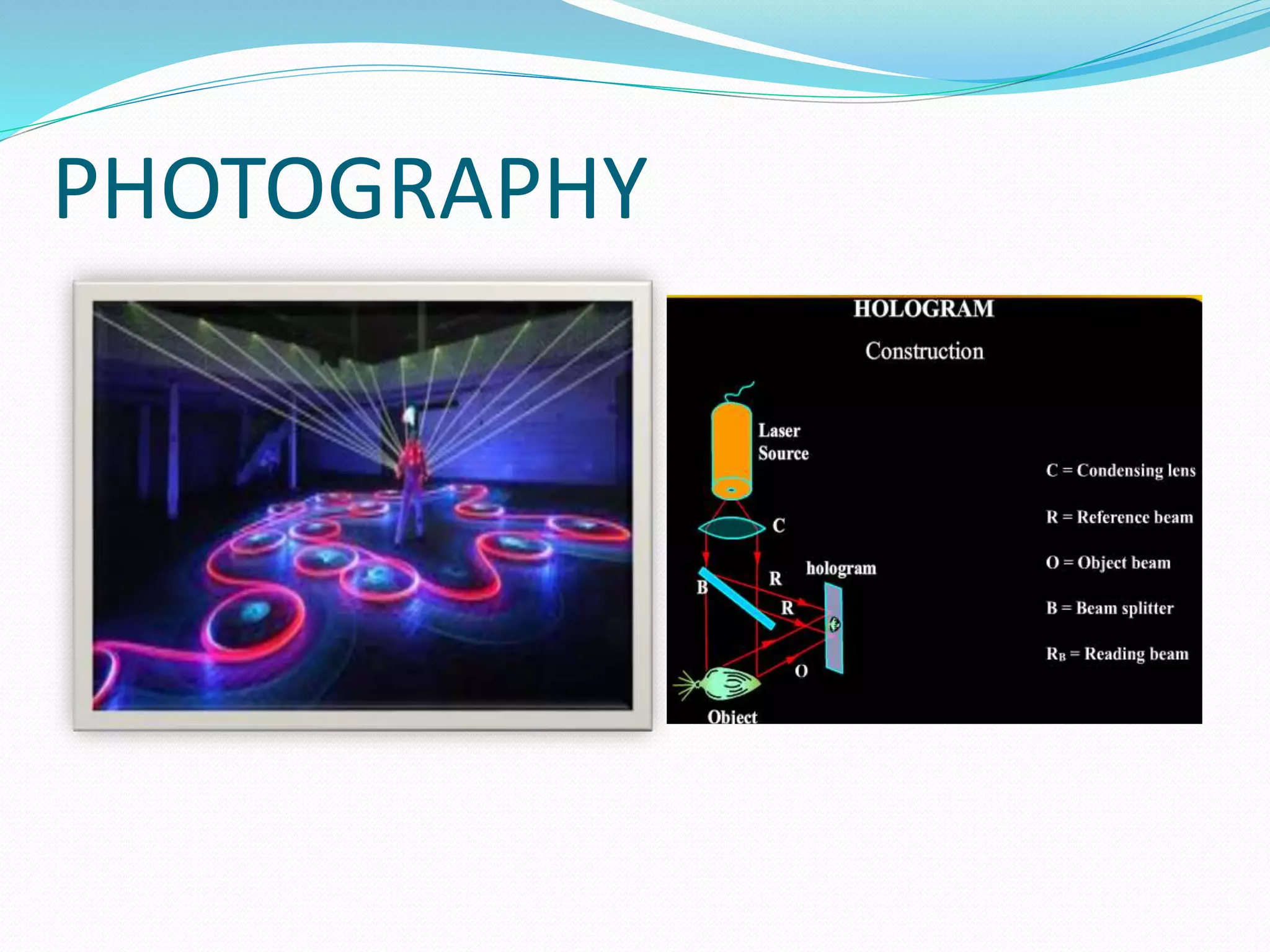
PHOTOGRAPHY
CONCLUSION
 Lasers are device which amplify light and produce
beams of light which are very intense, directional and
Pure in colour.
 Laser action is preceded by three processes namely
absorption, spontaneous emission and stimulated
emission.
 They can solid state ,gas, semiconductor or liquid.
 Laser can be used for many applications ,helped
people develop in many things in our daily life.
THANK YOU

Laser

  • 1.
    TOPIC :- LASER NAME:- SIDDHI SHRIVAS DIVISON :- COMPUTER – C ENROLLMENT NUMBER :- 130770107163 FACULTY NAME :-Mr. VIPUL PATEL
  • 2.
  • 4.
    INTRODUCTION  LASER inan acronym for Light Amplification By Stimulated Emission of Radiation.  The first laser, namely, Ruby Laser was demonstrated by T.H.Maiman , in the year 1960.  The discovery of laser made an enormous impact in the scientific world and showed that the function of optics was very much alive.
  • 5.
     A Laseris a mechanism for emitting electromagnetic radiation.  A Laser usually emits light or visible light through a process called stimulated emission.  A laser is a device that can produce a very narrow intense beam of monochromatic coherent light.  The emitted beam is nearly perfect plane wave.  In short, A laser is a device that emits light through a process of optical amplification based on the stimulated emission of electromagnetic radiation
  • 6.
    CHARACTERISTICS OF LASERLIGHT o Monochromatic o Directional o Coherent o High intensity
  • 7.
     The lightemitted from a laser is monochromatic , that is, it is of one color/wavelength. In contrast, ordinary white light is a combination of many colors (or wavelengths) of light.  Lasers emit light that is highly directional , that is, laser light is emitted as a relatively narrow beam in a specific direction. Ordinary light, such as from a light bulb, is emitted in many directions away from the source.  The light from a laser is said to be coherent, which means that the wavelengths of the laser light are in phase in space and time. Ordinary light can be a mixture of many wavelengths.  These three properties of laser light are what can make it more hazardous than ordinary light. Laser light can deposit a lot of energy within a small area.
  • 8.
    EINSTEIN'S THEORY  EINSTEINEXPLAINED THE ACTION OF LASER BEAM BASED ON QUANTUM THEORY OF LIGHT .  Production of laser light is a particular consequence of interaction of radiation with matter.
  • 9.
    THREE process thatoccur when light Interacts with MATTER are: o Induced Absorption. o Spontaneous Emission. o Stimulated emission.
  • 10.
    1. INDUCED ABSORPTION If a photon of energy hv is incident on the atom in the lower state, the incident photon and gets excited to the higher energy state E2. this process is called induced absorption.  Normally, the higher energy state is an unstable state so the atoms will make a transition back to the lower energy state with the emission of a photon.
  • 11.
    photon Before absorption Afterabsorption E2 E1 E2 E1 INDUCED ABSORPTION
  • 12.
     THE RATEOF ABSORPTION R12 IS PROPORTIONAL TO THE POPULATION OF THE LOWER ENERGY LEVEL N1 AND TO THE DENSITY OF INCIDENT RADIATION ρ. HENCE, R12 ∝ N1ρ R12 =B12N1ρ  WHERE B12 I STHE PROPOTINALITY CONSTANT KNOWN AS THE PROBABILITY OF ABSORPTION OF RADIATION PER UNIT TIME.
  • 13.
    2. SPONTANEOUS EMISSION In spontaneous emission the atoms or molecules in the higher energy state E2 eventually return to the ground state by emitting their excess energy spontaneously.  The process is independent of external radiation .  The rate of spontaneous emission is directly proportional to the population of the energy level E2.
  • 14.
    After emission Atom inground stateAtom in excited state Before emission During E2 E1 hv=E2-E1 SPONTANEOUS EMISSION
  • 15.
    3. STIMULATED EMISSION When electron transits from higher level to lower level in presence of external energy is known as stimulated emission.  In stimulated emission a photon having energy E equal to the difference in energy between the two levels E2 and E1 , stimulate an atom in the higher state to make a transition to the lower state with the creation of second photon.
  • 16.
    Excited state Before emission E1 E2 Afteremissionie, STIMULATED EMISSION
  • 17.
     According toEinstein's, under certain condition it is possible to force an excited atom emit a photon by another photon and the incident light wave must be in same phase .hence we get an enhance beam of coherent light
  • 18.
    DIFFERENCE STIMULATED EMISSION SPONTANEOUSEMISSION Emission of a light photon takes place through an inducement i.e. by an external photon. Emission of a light photon takes place immediately without any inducement. It is not a random process. It is a random process. The photons get multiplied through chain reaction The photons do not get multiplied through chain reaction. It is a controllable process It is an uncontrollable process More intense less intense Monochromatic radiation Polychromatic radiation
  • 19.
    BASIC CONCEPTS INLASER :  Population inversion : is a state of achieving more number of atoms in the excited state compared to ground state Pumping Spontaneous emission or/and collisions Pumping
  • 20.
     Pumping :is the mechanism of exciting atoms from the lower energy state to a higher energy state by supplying energy from an external source  Active medium: A medium in which population inversion is achieved for laser action is called active medium. The medium can be solid, liquid, gas and plasma.  Optical resonators :A pair of concave mirrors placed on either side of the discharge tube, one completely polished and the other partially polished.
  • 21.
    Therefore in alaser…. Three key elements in a laser •Pumping process prepares amplifying medium in suitable state •Optical power increases on each pass through amplifying medium •If gain exceeds loss, device will oscillate, generating a coherentoutput
  • 22.
    Nd: YAG Laser (NeodymiumYttrium Aluminium Garnet Laser)
  • 23.
    Nd (Neodymium) –YAG (Yttrium Aluminium Garnet) LASER Principle Characteristics Doped Insulator laser refers to yttrium aluminium garnet doped with neodymium. The Nd ion has many energy levels and due to optical pumping these ions are raised to excited levels. During the transition from the metastable state to E1, the laser beam of wavelength 1.064μm is emitted
  • 24.
    DIAGRAM : Power Supply Capacitor Resistor LaserRod Flash Tube M1– 100% reflector mirror M2 – partial reflector mirror
  • 25.
    CONSTRUCTION : Essential partsof laser:- Yttrium Aluminium Garnet in which 1.5% of neodymium ions are doped as impurities. Nd3+ is the lasing ion. Two end mirrors M1 (total reflector) & M2 (output coupler) Excitation is achieved by krypton or xenon arc lamps Nd : YAG laser rod has a length of about 5-10 cm with a diameter 6- 9mm. It is kept at one foci of an elliptical glass tube. Krypton arc lamp , the optical source is placed at the other foci of the glass tube. It is provided with necessary power supply arrangement. Mirrors M1 (total reflector) & M2(output coupler) act as a resonant cavity to produce stimulated and amplification process.
  • 26.
    ENERGY LEVEL DIAGRAM Simplified energy level diagram for the Nd-ion in YAG showing the principal laser transitions Non radiative decay Laser 1.064μm Non radiative decay E3 E2 E0 E1 E4 Nd E1, E2, E3 – Energy levels of Nd E4 – Meta Stable State E0 – ground State Energy Level
  • 27.
    APPLICATION OF LASER: Industry  Weapons  Drilling And Cutting  In Medical World  Communication  Computer  Chemistry  Photography
  • 28.
  • 29.
  • 30.
  • 31.
    Lasers in theMedical World
  • 32.
  • 33.
  • 34.
  • 35.
  • 36.
    CONCLUSION  Lasers aredevice which amplify light and produce beams of light which are very intense, directional and Pure in colour.  Laser action is preceded by three processes namely absorption, spontaneous emission and stimulated emission.  They can solid state ,gas, semiconductor or liquid.  Laser can be used for many applications ,helped people develop in many things in our daily life.
  • 37.