DISCUSSION TOPIC:
Team Work
(PUTS TEAM’S SUCCESSTEAM’S SUCCESS BEFORE PERSONAL SUCCESS)
WHO IS CONTRIBUTOR ?
The person who :-
 Concern for the human beings.
Take responsibility in any situation.
 Puts team’s success before personal success
 Take pride in doing their work well.
2
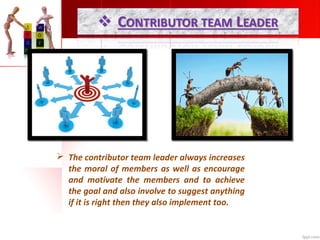
 The contributor team leader always increases
the moral of members as well as encourage
and motivate the members and to achieve
the goal and also involve to suggest anything
if it is right then they also implement too.
CONTENT:
 What is a team?What is a team?
 What do you mean by team work?What do you mean by team work?
 Why do we need team work?Why do we need team work?
 Why is teamwork important?Why is teamwork important?
 Exploration with exampleExploration with example
 7 essential skills for teamwork7 essential skills for teamwork
 Basics of good teamworkBasics of good teamwork
 Stages of team developmentStages of team development
 Characteristics of effective teamsCharacteristics of effective teams
 Team valueTeam value
 ConclusionConclusion
WHAT ISWHAT IS A TEAM?A TEAM?
A team is a collection of
individuals, each with
his/her own expertise,
brought together to
benefit a common goal.
What do you mean by team work?
• TEAMWORKTEAMWORK is a group of people with
various complementary skills, WORKINGWORKING
TOGETHERTOGETHER towards a common VISION.VISION.
• The most effective teamwork is produced
when all the individuals involved
harmonize their contributions and work
towards a common goal.
WHY DO WE NEED TEAM WORK?
•Teamwork helps to create synergysynergy as the
sum of a united force is usually greater than
the sum of an individual's output. It helps to
create a sense of belonging and hence a
feeling of loyalty is created. Team work helps
recreate thinking strategies and viewpoint of
people.
SYNERGY = TEAM > INDVIDUALSSYNERGY = TEAM > INDVIDUALS
Why Is Teamwork so Important?
Teamwork is important because it supports
a more empowered way of working,
promotes flexibility and responsiveness and
promotes the sense of achievement and
equity. It also enables tasks to be are
accomplished at a faster pace.
Exploration with Example:
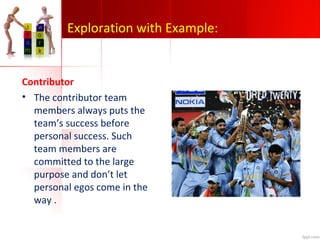
Contributor
• The contributor team
members always puts the
team’s success before
personal success. Such
team members are
committed to the large
purpose and don’t let
personal egos come in the
way .
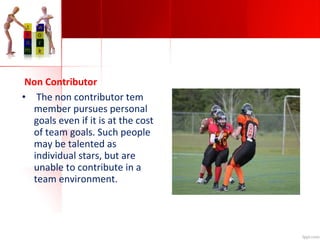
Non Contributor
• The non contributor tem
member pursues personal
goals even if it is at the cost
of team goals. Such people
may be talented as
individual stars, but are
unable to contribute in a
team environment.
12
CONTRIBUTOR FOCUS ON “WE” NOT ON “I”
We all have done
a great job. Well
done….!
HURREY
13
NON-CONTRIBUTOR FOCUS ON
PERSONAL SUCCESS
I have done a
great job…. will
get all credits for
myself…
What about us?? That we
did…. We also worked hard
for annual function
14
N R Narayana Murthy
Leading innovative
leadership in the
contribution
Of Infosys.. IT
giants.. Well
known author,
social worker
And an impressive
contributor
personality with
high thinking and
simple living . .
REAL LIFE EXAMPLE OFREAL LIFE EXAMPLE OF
CONTRIBUTORCONTRIBUTOR
CONTRIBUTOR LEADER
NARAYANA MURTHY
VIDEO:
7 Essential Skills for Teamwork
This list is used during the research cycle to
observe how well a team is working together
•1. Listening
•2. Questioning
•3. Persuading
•4. Respecting
•5. Helping
•6. Sharing
•7. Participating
• 1. Listening: Here the team members listen
to each other's ideas. You will observe the
students "piggy-backing" (or building) off
each other's ideas.
• 2. Questioning: The members here question
each other. You will observe the students
interacting, discussing, and posing questions
to all members of the team.
• 3. Persuading: The members in team use
persuasion. You will observe the students
exchanging, defending, and rethinking ideas.
• 4. Respecting: Here the members respect the
opinions of others. You will observe the students
encouraging and supporting the ideas and efforts of
others.
• 5. Helping: Here the members help each other. You
will observe the students offering assistance to each
other.
• 6. Sharing: The members here share. You will observe
the students offering ideas and reporting their
findings to each other.
• 7. Participating: The members in team participate.
You will observe each student contributing to the
project.
Basics of Good Teamwork:
• At all levels good team work rests on the 4 basic
elements of goals, roles, process and relationships.
High performance teams pay attention to all 4
elements.
 Goals:Goals: What we're trying to accomplish togetherWhat we're trying to accomplish together
 Roles:Roles: Who does what and how we handleWho does what and how we handle
overlaps and interdependenciesoverlaps and interdependencies
 Process:Process: How we run our business and how weHow we run our business and how we
work togetherwork together
 Relationships:Relationships: Communication and influence skillsCommunication and influence skills
for getting work donefor getting work done
STAGES OF TEAM DEVELOPMENT:
• True teamwork and cooperation,
members individually committed,
multiple leadersPerforming
Discussion Question?
What stage of group development is most
important?
A. Forming
B. Storming
C. Norming
D. Performing
There is no one best answer!!
CHARACTERISTICS OF EFFECTIVE TEAMS:
 The team must have a clear goal.
 The team must have a results-driven structure.
 The team must have competent team members.
 The team must have unified commitment.
 The team must have a collaborative climate.
 The team must have high standards that are
understood by all.
 The team must receive external support and
encouragement.
 The team must have principled leadership.
Example :
Example:
Example:
Results:
Members share authorityauthority and responsibilityresponsibility
for self management.
Members create synergy with strong sense
of mutual commitmentmutual commitment.
Generate performance greatergreater than the
sum of the performance of its individualindividual
members.
 Teamwork is the fuelfuel that allows common
people attains uncommon results.results.
• Members helphelp one another, help otherother
team members realizerealize their true potentialtrue potential.
• Members create an environment that
allow everyone to go beyondgo beyond their
limitationslimitations
Conclusion:
•When a team works well together as a unit they are able to
accomplish more than its individual members can do alone.
• When members apply different skills they are often able to
come up with a more effective solution than one person
working on the same problem.
• Mutual support can have the benefit of encouraging people
to achieve goals they may not have realized they could reach
on their own.
• It allows for an even distribution of work suited to
everyone's capabilities.
References:
• https://www.library.drexel.edu/blogs/groupwork/2012/07/18/what-is-teamwo
• http://www.nd-ted.org/TeachingResources/ClassroomTips/Teamwork.htm
• http://www.ndt-ed.org/TeachingResources/ClassroomTips/Teamwork.htm
• http://bellinghamschools.org/sites/default/files/studentgal/onlineresearch/old
• https://www.youtube.com/watch?v=o9mdHMtxOjY
Team work
Team work

Team work

  • 1.
    DISCUSSION TOPIC: Team Work (PUTSTEAM’S SUCCESSTEAM’S SUCCESS BEFORE PERSONAL SUCCESS)
  • 2.
    WHO IS CONTRIBUTOR? The person who :-  Concern for the human beings. Take responsibility in any situation.  Puts team’s success before personal success  Take pride in doing their work well. 2
  • 3.
     The contributorteam leader always increases the moral of members as well as encourage and motivate the members and to achieve the goal and also involve to suggest anything if it is right then they also implement too.
  • 5.
    CONTENT:  What isa team?What is a team?  What do you mean by team work?What do you mean by team work?  Why do we need team work?Why do we need team work?  Why is teamwork important?Why is teamwork important?  Exploration with exampleExploration with example  7 essential skills for teamwork7 essential skills for teamwork  Basics of good teamworkBasics of good teamwork  Stages of team developmentStages of team development  Characteristics of effective teamsCharacteristics of effective teams  Team valueTeam value  ConclusionConclusion
  • 6.
    WHAT ISWHAT ISA TEAM?A TEAM? A team is a collection of individuals, each with his/her own expertise, brought together to benefit a common goal.
  • 7.
    What do youmean by team work? • TEAMWORKTEAMWORK is a group of people with various complementary skills, WORKINGWORKING TOGETHERTOGETHER towards a common VISION.VISION. • The most effective teamwork is produced when all the individuals involved harmonize their contributions and work towards a common goal.
  • 8.
    WHY DO WENEED TEAM WORK? •Teamwork helps to create synergysynergy as the sum of a united force is usually greater than the sum of an individual's output. It helps to create a sense of belonging and hence a feeling of loyalty is created. Team work helps recreate thinking strategies and viewpoint of people. SYNERGY = TEAM > INDVIDUALSSYNERGY = TEAM > INDVIDUALS
  • 9.
    Why Is Teamworkso Important? Teamwork is important because it supports a more empowered way of working, promotes flexibility and responsiveness and promotes the sense of achievement and equity. It also enables tasks to be are accomplished at a faster pace.
  • 10.
    Exploration with Example: Contributor •The contributor team members always puts the team’s success before personal success. Such team members are committed to the large purpose and don’t let personal egos come in the way .
  • 11.
    Non Contributor • Thenon contributor tem member pursues personal goals even if it is at the cost of team goals. Such people may be talented as individual stars, but are unable to contribute in a team environment.
  • 12.
    12 CONTRIBUTOR FOCUS ON“WE” NOT ON “I” We all have done a great job. Well done….! HURREY
  • 13.
    13 NON-CONTRIBUTOR FOCUS ON PERSONALSUCCESS I have done a great job…. will get all credits for myself… What about us?? That we did…. We also worked hard for annual function
  • 14.
  • 15.
    N R NarayanaMurthy Leading innovative leadership in the contribution Of Infosys.. IT giants.. Well known author, social worker And an impressive contributor personality with high thinking and simple living . . REAL LIFE EXAMPLE OFREAL LIFE EXAMPLE OF CONTRIBUTORCONTRIBUTOR
  • 16.
  • 17.
  • 18.
    7 Essential Skillsfor Teamwork This list is used during the research cycle to observe how well a team is working together •1. Listening •2. Questioning •3. Persuading •4. Respecting •5. Helping •6. Sharing •7. Participating
  • 19.
    • 1. Listening:Here the team members listen to each other's ideas. You will observe the students "piggy-backing" (or building) off each other's ideas. • 2. Questioning: The members here question each other. You will observe the students interacting, discussing, and posing questions to all members of the team. • 3. Persuading: The members in team use persuasion. You will observe the students exchanging, defending, and rethinking ideas.
  • 20.
    • 4. Respecting:Here the members respect the opinions of others. You will observe the students encouraging and supporting the ideas and efforts of others. • 5. Helping: Here the members help each other. You will observe the students offering assistance to each other. • 6. Sharing: The members here share. You will observe the students offering ideas and reporting their findings to each other. • 7. Participating: The members in team participate. You will observe each student contributing to the project.
  • 21.
    Basics of GoodTeamwork: • At all levels good team work rests on the 4 basic elements of goals, roles, process and relationships. High performance teams pay attention to all 4 elements.  Goals:Goals: What we're trying to accomplish togetherWhat we're trying to accomplish together  Roles:Roles: Who does what and how we handleWho does what and how we handle overlaps and interdependenciesoverlaps and interdependencies  Process:Process: How we run our business and how weHow we run our business and how we work togetherwork together  Relationships:Relationships: Communication and influence skillsCommunication and influence skills for getting work donefor getting work done
  • 22.
    STAGES OF TEAMDEVELOPMENT: • True teamwork and cooperation, members individually committed, multiple leadersPerforming
  • 23.
    Discussion Question? What stageof group development is most important? A. Forming B. Storming C. Norming D. Performing There is no one best answer!!
  • 24.
    CHARACTERISTICS OF EFFECTIVETEAMS:  The team must have a clear goal.  The team must have a results-driven structure.  The team must have competent team members.  The team must have unified commitment.  The team must have a collaborative climate.  The team must have high standards that are understood by all.  The team must receive external support and encouragement.  The team must have principled leadership.
  • 26.
  • 27.
  • 28.
  • 29.
    Results: Members share authorityauthorityand responsibilityresponsibility for self management. Members create synergy with strong sense of mutual commitmentmutual commitment. Generate performance greatergreater than the sum of the performance of its individualindividual members.  Teamwork is the fuelfuel that allows common people attains uncommon results.results.
  • 30.
    • Members helphelpone another, help otherother team members realizerealize their true potentialtrue potential. • Members create an environment that allow everyone to go beyondgo beyond their limitationslimitations
  • 31.
    Conclusion: •When a teamworks well together as a unit they are able to accomplish more than its individual members can do alone. • When members apply different skills they are often able to come up with a more effective solution than one person working on the same problem. • Mutual support can have the benefit of encouraging people to achieve goals they may not have realized they could reach on their own. • It allows for an even distribution of work suited to everyone's capabilities.
  • 32.
    References: • https://www.library.drexel.edu/blogs/groupwork/2012/07/18/what-is-teamwo • http://www.nd-ted.org/TeachingResources/ClassroomTips/Teamwork.htm •http://www.ndt-ed.org/TeachingResources/ClassroomTips/Teamwork.htm • http://bellinghamschools.org/sites/default/files/studentgal/onlineresearch/old • https://www.youtube.com/watch?v=o9mdHMtxOjY