BIRLA INSTITUTE OF
TECHNOLOGY, MESRA
JAIPUR
Presented By
Anushka Pareek
MCA/25024/18
TOPIC :MULTIPLE SEQUENCE
ALIGNMENT
MULTIPLE SEQUENCE ALIGNMENT
 Multiple Sequence Alignment(MSA) is generally the
alignment of three or more biological sequence
(Protein or Nucleic acid) of similar length.
 In many cases, the input set of query sequences
are assumed to have an evolutionary relationship.
By which they share a lineage and are descended
from a common ancestor.
 From the output, homology can be inferred and the
evolutionary relationship between the sequence
studied.
PURPOSE OF MSA
 In order to characterize protein families ,identify
shared regions of homology in a multiple sequence
alignment.
 Determination of the consensus sequence of
several aligned sequences.
 Consensus sequence scan help to develop a
sequence “fingerprint” which allows the
identification of members of distantly related protein
family (motifs).
 MSA can help us to reveal biological facts about
proteins, like analysis of the secondary/tertiary
structure.
TYPES OF MSA
 Dynamic Programming approach
 Progressive method
 Iterative method
DYNAMIC PROGRAMMING APPROACH
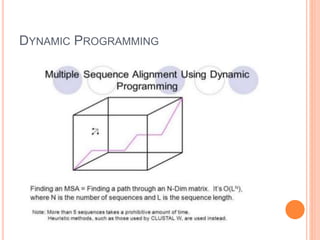
 In fact, dynamic programming is applicable to align
any number of sequences.
 Computes an optimal alignment for a given score
function.
 Because of its high running time, it is not typically
used in practice.
DYNAMIC PROGRAMMING
PROGRESSIVE METHOD
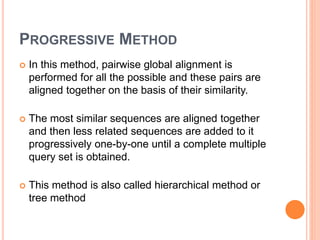
 In this method, pairwise global alignment is
performed for all the possible and these pairs are
aligned together on the basis of their similarity.
 The most similar sequences are aligned together
and then less related sequences are added to it
progressively one-by-one until a complete multiple
query set is obtained.
 This method is also called hierarchical method or
tree method
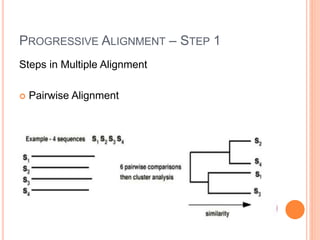
PROGRESSIVE ALIGNMENT – STEP 1
Steps in Multiple Alignment
 Pairwise Alignment
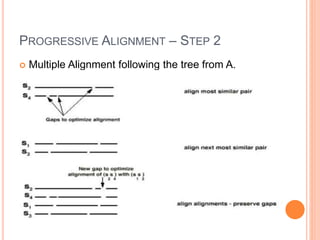
PROGRESSIVE ALIGNMENT – STEP 2
 Multiple Alignment following the tree from A.
PROS OF PROGRESSIVE ALIGNMENT
 Efficient enough to implement on a large scale for
many (100s to 1000s) sequences.
 Progressive alignment services are commonly
available on publicly accessible web servers, so
users need not locally install the applications of
interest.
 Most widely used method of multiple sequence
alignment because of speed and accuracy.
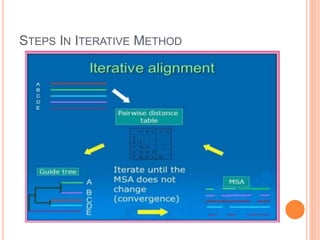
ITERATIVE METHOD
 A method of performing a series of steps to produce
sucessively better approximation to align many
sequences step-by-step is called iterative method.
 Here the pairwise sequence alignment is totally
avoided.
 Iterative methods attempt to improve on the weak
point of the progressive methods the heavy
dependence on the accuracy of the initial pairwise
alignment.
STEPS IN ITERATIVE METHOD
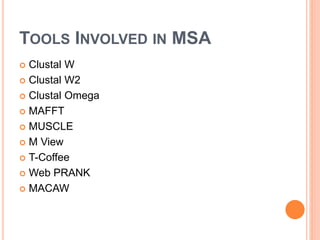
TOOLS INVOLVED IN MSA
 Clustal W
 Clustal W2
 Clustal Omega
 MAFFT
 MUSCLE
 M View
 T-Coffee
 Web PRANK
 MACAW
APPLICATIONS OF MSA
 Detecting similarities between sequences(closely or
distinctly related).
 Detecting conserved regions or motifs in
sequences.
 Detecting of structural homologies.
 Thus, assisting the improved prediction of
secondary and tertiary structures of proteins.
THANK YOU

Multiple Sequence Alignment

  • 1.
    BIRLA INSTITUTE OF TECHNOLOGY,MESRA JAIPUR Presented By Anushka Pareek MCA/25024/18 TOPIC :MULTIPLE SEQUENCE ALIGNMENT
  • 2.
    MULTIPLE SEQUENCE ALIGNMENT Multiple Sequence Alignment(MSA) is generally the alignment of three or more biological sequence (Protein or Nucleic acid) of similar length.  In many cases, the input set of query sequences are assumed to have an evolutionary relationship. By which they share a lineage and are descended from a common ancestor.  From the output, homology can be inferred and the evolutionary relationship between the sequence studied.
  • 3.
    PURPOSE OF MSA In order to characterize protein families ,identify shared regions of homology in a multiple sequence alignment.  Determination of the consensus sequence of several aligned sequences.  Consensus sequence scan help to develop a sequence “fingerprint” which allows the identification of members of distantly related protein family (motifs).  MSA can help us to reveal biological facts about proteins, like analysis of the secondary/tertiary structure.
  • 4.
    TYPES OF MSA Dynamic Programming approach  Progressive method  Iterative method
  • 5.
    DYNAMIC PROGRAMMING APPROACH In fact, dynamic programming is applicable to align any number of sequences.  Computes an optimal alignment for a given score function.  Because of its high running time, it is not typically used in practice.
  • 6.
  • 7.
    PROGRESSIVE METHOD  Inthis method, pairwise global alignment is performed for all the possible and these pairs are aligned together on the basis of their similarity.  The most similar sequences are aligned together and then less related sequences are added to it progressively one-by-one until a complete multiple query set is obtained.  This method is also called hierarchical method or tree method
  • 8.
    PROGRESSIVE ALIGNMENT –STEP 1 Steps in Multiple Alignment  Pairwise Alignment
  • 9.
    PROGRESSIVE ALIGNMENT –STEP 2  Multiple Alignment following the tree from A.
  • 10.
    PROS OF PROGRESSIVEALIGNMENT  Efficient enough to implement on a large scale for many (100s to 1000s) sequences.  Progressive alignment services are commonly available on publicly accessible web servers, so users need not locally install the applications of interest.  Most widely used method of multiple sequence alignment because of speed and accuracy.
  • 11.
    ITERATIVE METHOD  Amethod of performing a series of steps to produce sucessively better approximation to align many sequences step-by-step is called iterative method.  Here the pairwise sequence alignment is totally avoided.  Iterative methods attempt to improve on the weak point of the progressive methods the heavy dependence on the accuracy of the initial pairwise alignment.
  • 12.
  • 13.
    TOOLS INVOLVED INMSA  Clustal W  Clustal W2  Clustal Omega  MAFFT  MUSCLE  M View  T-Coffee  Web PRANK  MACAW
  • 14.
    APPLICATIONS OF MSA Detecting similarities between sequences(closely or distinctly related).  Detecting conserved regions or motifs in sequences.  Detecting of structural homologies.  Thus, assisting the improved prediction of secondary and tertiary structures of proteins.
  • 16.