BIRLA INSTITUTE OF TECHNOLOGY, MESRA
JAIPUR CAMPUS
TOPIC : MACRO ASSEMBLER
BY:
MEGHAJ KUMAR MALLICK
(MCA/25017/18)
2ND YEAR, 4TH SEMESTER
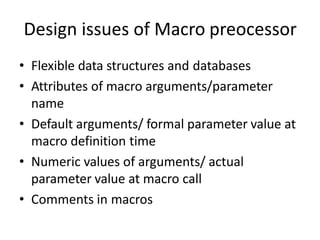
Design issues of Macro preocessor
• Flexible data structures and databases
• Attributes of macro arguments/parameter
name
• Default arguments/ formal parameter value at
macro definition time
• Numeric values of arguments/ actual
parameter value at macro call
• Comments in macros
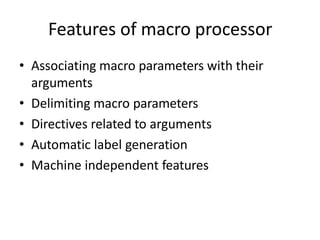
Features of macro processor
• Associating macro parameters with their
arguments
• Delimiting macro parameters
• Directives related to arguments
• Automatic label generation
• Machine independent features
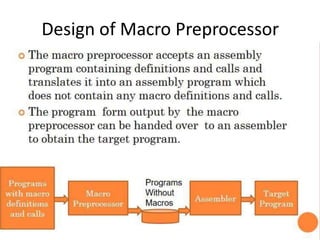
Design of Macro Preprocessor
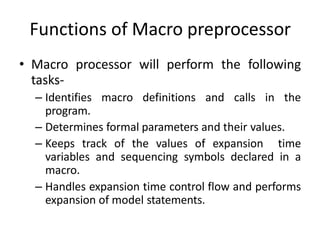
Functions of Macro preprocessor
• Macro processor will perform the following
tasks-
– Identifies macro definitions and calls in the
program.
– Determines formal parameters and their values.
– Keeps track of the values of expansion time
variables and sequencing symbols declared in a
macro.
– Handles expansion time control flow and performs
expansion of model statements.
Two pass Macro Processor
• General Design Steps
• Step 1: Specification of Problem:-
• Step 2 Specification of databases:-
• Step 3 Specification of database
formats
• Step 4 : Algorithm
Specify the problem
• In Pass-I the macro definitions are searched
and stored in the macro definition table and
the entry is made in macro name table
• In Pass-II the macro calls are identified and the
arguments are placed in the appropriate place
and the macro calls are replaced by macro
definitions.
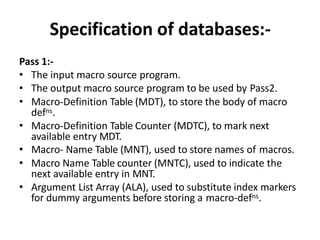
Specification of databases:-
Pass 1:-
• The input macro source program.
• The output macro source program to be used by Pass2.
• Macro-Definition Table (MDT), to store the body of macro
defns.
• Macro-Definition Table Counter (MDTC), to mark next
available entry MDT.
• Macro- Name Table (MNT), used to store names of macros.
• Macro Name Table counter (MNTC), used to indicate the
next available entry in MNT.
• Argument List Array (ALA), used to substitute index markers
for dummy arguments before storing a macro-defns.
Specification of databases:-
• Pass 2:-
• The copy of the input from Pass1.
• The output expanded source to be given to assembler.
• MDT, created by Pass1.
• MNT, created by Pass1.
• Macro-Definition Table Pointer (MDTP), used to
indicate the next line of text to be used during macro-
expansion.
• Argument List Array (ALA), used to substitute macro-
call arguments for the index markers in the stored
macro-defns
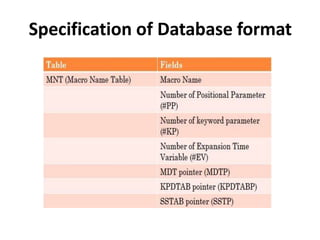
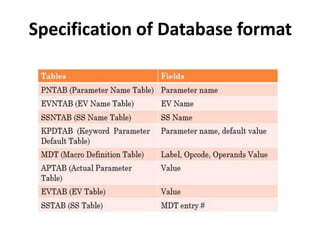
Specification of Database format
Argument List Array (ALA):
• ALA is used during both Pass1 & Pas2 but for some what
reverse functions.
• During Pass1, in order to simplify later argument
replacement during macro expansion, dummy arguments
are replaced with positional indicators when defn is stored.
Ex. # 1, # 2, # 3 etc.
• The ith dummy argument on the macro-name is
represented in the body by #i.
• These symbols are used in conjunction with ALA prepared
before expansion of a macro-call.
• Symbolic dummy argument are retained on macro-name to
enable the macro processor to handle argument
replacement byname rather by position.
Algorithm
• Pass1 of macro processor makes a line-by-line scan
over its input.
• Set MDTC = 1 as well as MNTC = 1.
• Read next line from input program.
• If it is a MACRO pseudo-op, the entire macro definition
except this (MACRO) line is stored in MDT.
• The name is entered into Macro Name Table along with
a pointer to the first location of MDT entry of the
definition.
• When the END pseudo-op is encountered all the
macro-defns have been processed, so control is
transferred to pass2
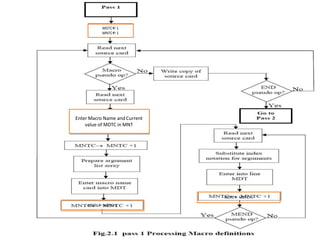
MDTC1
MNTC1
MDTC MDTC+1
MDTC MDTC+1
Enter Macro Name andCurrent
value of MDTC in MNT
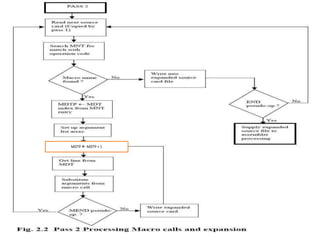
Algorithm for Pass – 2
•
• This algorithm reads one line of i/p prog. at a time.
• for each Line it checks if op-code of that line matches any of the MNT
• entry.
• When match is found (i.e. when call is pointer called MDTF to
corresponding macro defns stored inMDT.
• The initial value of MDTP is obtained from MDT index field of MNT
entry.
• The macro expander prepares the ALA consisting of a table of dummy
• argument indices & corresponding arguments to the call.
• Reading proceeds from the MDT, as each successive line is read, The
values form the argument list one substituted for dummy arguments
indices in the macro defn.
• Reading MEND line in MDT terminates expansion of macro & scanning
• continues from the input file.
• When END pseudo-op encountered , the expanded source program is
given to the assembler
MDTP  MDTP + 1
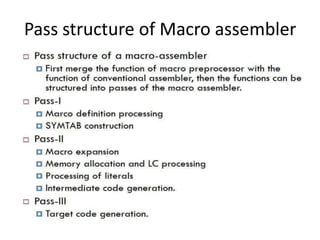
Pass structure of Macro assembler
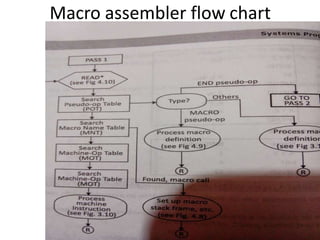
Macro assembler flow chart
THANK
YOU

Macro assembler

  • 1.
    BIRLA INSTITUTE OFTECHNOLOGY, MESRA JAIPUR CAMPUS TOPIC : MACRO ASSEMBLER BY: MEGHAJ KUMAR MALLICK (MCA/25017/18) 2ND YEAR, 4TH SEMESTER
  • 2.
    Design issues ofMacro preocessor • Flexible data structures and databases • Attributes of macro arguments/parameter name • Default arguments/ formal parameter value at macro definition time • Numeric values of arguments/ actual parameter value at macro call • Comments in macros
  • 3.
    Features of macroprocessor • Associating macro parameters with their arguments • Delimiting macro parameters • Directives related to arguments • Automatic label generation • Machine independent features
  • 4.
    Design of MacroPreprocessor
  • 5.
    Functions of Macropreprocessor • Macro processor will perform the following tasks- – Identifies macro definitions and calls in the program. – Determines formal parameters and their values. – Keeps track of the values of expansion time variables and sequencing symbols declared in a macro. – Handles expansion time control flow and performs expansion of model statements.
  • 6.
    Two pass MacroProcessor • General Design Steps • Step 1: Specification of Problem:- • Step 2 Specification of databases:- • Step 3 Specification of database formats • Step 4 : Algorithm
  • 7.
    Specify the problem •In Pass-I the macro definitions are searched and stored in the macro definition table and the entry is made in macro name table • In Pass-II the macro calls are identified and the arguments are placed in the appropriate place and the macro calls are replaced by macro definitions.
  • 8.
    Specification of databases:- Pass1:- • The input macro source program. • The output macro source program to be used by Pass2. • Macro-Definition Table (MDT), to store the body of macro defns. • Macro-Definition Table Counter (MDTC), to mark next available entry MDT. • Macro- Name Table (MNT), used to store names of macros. • Macro Name Table counter (MNTC), used to indicate the next available entry in MNT. • Argument List Array (ALA), used to substitute index markers for dummy arguments before storing a macro-defns.
  • 9.
    Specification of databases:- •Pass 2:- • The copy of the input from Pass1. • The output expanded source to be given to assembler. • MDT, created by Pass1. • MNT, created by Pass1. • Macro-Definition Table Pointer (MDTP), used to indicate the next line of text to be used during macro- expansion. • Argument List Array (ALA), used to substitute macro- call arguments for the index markers in the stored macro-defns
  • 10.
  • 11.
  • 12.
    Argument List Array(ALA): • ALA is used during both Pass1 & Pas2 but for some what reverse functions. • During Pass1, in order to simplify later argument replacement during macro expansion, dummy arguments are replaced with positional indicators when defn is stored. Ex. # 1, # 2, # 3 etc. • The ith dummy argument on the macro-name is represented in the body by #i. • These symbols are used in conjunction with ALA prepared before expansion of a macro-call. • Symbolic dummy argument are retained on macro-name to enable the macro processor to handle argument replacement byname rather by position.
  • 13.
    Algorithm • Pass1 ofmacro processor makes a line-by-line scan over its input. • Set MDTC = 1 as well as MNTC = 1. • Read next line from input program. • If it is a MACRO pseudo-op, the entire macro definition except this (MACRO) line is stored in MDT. • The name is entered into Macro Name Table along with a pointer to the first location of MDT entry of the definition. • When the END pseudo-op is encountered all the macro-defns have been processed, so control is transferred to pass2
  • 14.
    MDTC1 MNTC1 MDTC MDTC+1 MDTC MDTC+1 EnterMacro Name andCurrent value of MDTC in MNT
  • 15.
    Algorithm for Pass– 2 • • This algorithm reads one line of i/p prog. at a time. • for each Line it checks if op-code of that line matches any of the MNT • entry. • When match is found (i.e. when call is pointer called MDTF to corresponding macro defns stored inMDT. • The initial value of MDTP is obtained from MDT index field of MNT entry. • The macro expander prepares the ALA consisting of a table of dummy • argument indices & corresponding arguments to the call. • Reading proceeds from the MDT, as each successive line is read, The values form the argument list one substituted for dummy arguments indices in the macro defn. • Reading MEND line in MDT terminates expansion of macro & scanning • continues from the input file. • When END pseudo-op encountered , the expanded source program is given to the assembler
  • 16.
  • 17.
    Pass structure ofMacro assembler
  • 18.
  • 19.