BIRLA INSTITUTE OF TECHNOLOGY,MESRA
JAIPUR CAMPUS
TOPIC: ROUTING IN MANET
BY:
MEGHAJ KUMAR MALLICK
(MCA/25017/18)
2ND YEAR, 4TH SEMESTER
INTRODUCTION
• Routing is the process of selecting paths in a network along
which to send data packets. An ad hoc routing protocol is a
convention, or standard, that controls how nodes decide
which way to route packets between computing devices in a
mobile ad-hoc network.
• A mobile ad hoc network (MANET), sometimes called a
mobile mesh network, is a self- configuring network of mobile
devices connected by wireless links.
• Ad hoc networks can be built around any wireless technology,
including infrared, radio frequency (RF), global positioning
system (GPS), and so on
ROUTING
● Routing consists of two fundamental steps
■
■ Forwarding packets to the next hop (from an input interface
to an output interface in a traditional wired network)
Determining how to forward packets (building a routing table
or specifying a route)
● Forwarding packets is easy, but knowing where to
forward packets (especially efficiently) is hard
■
■
■
■
■
Reach the destination
Minimize the number of hops (path length)
Minimize delay
Minimize packet loss
Minimize cost
AD-HOC NETWORKS
• Two types of wireless network:
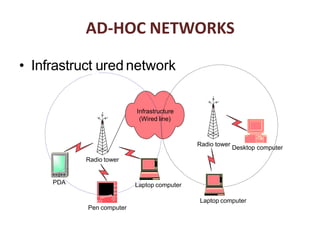
– Infrastructured
• the mobile node can move while communicating
• the base stations are fixed
• as the node goes out of the range of a base station, it gets
into the range of another base station
– Infrastructureless or ad-hoc
• the mobile node can move while communicating
• there are no fixed base stations
• all the nodes in the network need to act as routers
– In Latin “ad-hoc” literally means “for this purpose
only”. Then an ad-hoc network can be regarded as
“spontaneous network”
• Infrastruct ured network
PDA
Pen computer
Radio tower
Laptop computer
Infrastructure
(Wired line)
Radio tower
Desktop computer
Laptop computer
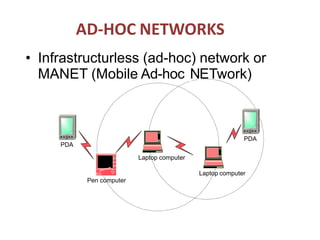
AD-HOC NETWORKS
• Infrastructurless (ad-hoc) network or
MANET (Mobile Ad-hoc NETwork)
AD-HOC NETWORKS
PDA
Laptop computer
Laptop computer
Pen computer
PDA
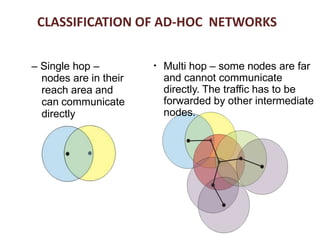
– Single hop –
nodes are in their
reach area and
can communicate
directly
●
Multi hop – some nodes are far
and cannot communicate
directly. The traffic has to be
forwarded by other intermediate
nodes.
CLASSIFICATION OF AD-HOC NETWORKS
• Characteristics of an ad-hoc network
– Collection of mobile nodes forming a
temporary network
– Network topology changes frequently and
unpredictably
– No centralized administration or standard
support services
– Each host is an independent router
– Hosts use wireless RF transceivers as
network interface
– Number of nodes 10 to 100 or at most
1000
CHARACTERISTICS
• Why we need ad-hoc networks?
●
Setting up of fixed access points and backbone
infrastructure is not always viable
●
Infrastructure may not be present in a disaster area
or war zone
Infrastructure may not be practical for short-range
radios; Bluetooth (range ~ 10m)
●
●
Do not need backbone infrastructure support
●
Are easy to deploy
Useful when infrastructure is absent, destroyed or
impractical
●
NEED OF AD-HOC NETWORK
EXAMPLE
Example of applications of ad hoc networks:
●
Emergency search-and-rescue operations.
Meetings or conventions in which persons wish to
quickly share information.
Data acquisition operations in inhospitable terrain.
Local area networks in the future.
●
●
ROUTING DECISION POINT
● Source routing
■
■ Sender determines a route and specifies it in the packet
header
Supported in IP, although not the typical routing scheme
● Hop-by-hop (datagram) routing
■
■ A routing decision is made at each forwarding point (at each
router)
Standard routing scheme for IP
● Virtual circuit routing
■
■
Determine and configure a path prior to sending first packet
Used in ATM (and analogous to voice telephone system)
ROUTING TABLE
● A routing table contains information to determine
how to forward packets
■
■
■ Source routing: Routing table is used to determine route to
the destination to be specified in the packet
Hop-by-hop routing: Routing table is used to determine the
next hop for a given destination
Virtual circuit routing: Routing table used to determine path
to configure through the network
● A distributed algorithm is required to build the
routing table
■
■
Distance vector algorithms
Link state algorithms
DISTANCE VECTOR ALGORITHMS
● “Distance” of each link in the network is a metric that
is to be minimized
■
■
Each link may have “distance” 1 to minimize hop count
Algorithm attempts to minimize distance
● The routing table at each node…
■
■
Specifies the next hop for each destination
Specifies the distance to that destination
● Neighbors can exchange routing table information to
find a route (or a better route) to a destination
LINK-STATE ALGORITHMS
●
●
Each node shares its link information so that all
nodes can build a map of the full network topology
Link information is updated when a link changes
state (goes up or down)
■ Link state determined by sending small “hello” packets to
neighbors
● Given full topology information, a node can
determine the next best hop or a route from the
source
MANET ROUTING
● Nodes must determine how to forward packets
■
■
Source routing: Routing decision is made at the sender
Hop-by-hop routing: Routing decision is made at each
intermediate node
● Difficult to achieve good performance
■
■
■
■
Routes change over time due to node mobility
Best to avoid long delays when first sending packets
Best to reduce overhead of route discovery and
maintenance
Want to involve as many nodes as possible – to find better
paths and reduce likelihood of partitions
MANET ROUTING APPROACHES
● Decision time
■
■
Proactive or table-driven – maintain routing tables
Reactive or on-demand – determine routing on an as-needed
basis
● Network structure
■
■ Hierarchical – impose a hierarchy on a collection of nodes
and reflect this hierarchy in the routing algorithm
○ May use a proactive protocol for routing within a cluster
or zone
○ May use a reactive protocol for routing between
distinguished “cluster heads”
Non-hierarchical – make decisions among all nodes
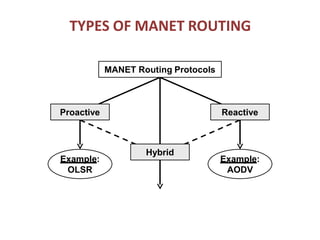
TYPES OF MANET ROUTING
MANET Routing Protocols
Hybrid
Proactive Reactive
Example:
OLSR
Example:
AODV
COMMON FEATURES
● MANET routing protocols must…
■
■
Discover a path from source to destination
Maintain that path (e.g., if an intermediate node moves and
breaks the path)
■ Define mechanisms to exchange routing information
● Reactive protocols
■
■ Discover a path when a packet needs to be transmitted and
no known path exists
Attempt to alter the path when a routing failure occurs
● Proactive protocols
■
■
Find paths, in advance, for all source-pair destinations
Periodically exchange routing information to maintain paths
• Is it possible to use standard routing
protocols?
● Distance-vector protocols
●
● Slow convergence due to “Count to Infinity”
Problem
Creates loops during node failure, network
partition or congestion
●
Link state protocols
●
● Use flooding technique and create excessive
traffic and control overhead
Require a lot of processor power and therefore
high power consumption
PROBLEMS WITH ROUTING
• Limitations of the Wireless Network
● packet loss due to transmission errors
variable capacity links
frequent disconnections/partitions
limited communication bandwidth
Broadcast nature of the communications
●
●
●
●
• Limitations Imposed by Mobility
●
dynamically changing topologies/routes
lack of mobility awareness by
system/applications
●
• Limitations of the Mobile Computer
●
short battery lifetime
Routing in MANET

Routing in MANET

  • 1.
    BIRLA INSTITUTE OFTECHNOLOGY,MESRA JAIPUR CAMPUS TOPIC: ROUTING IN MANET BY: MEGHAJ KUMAR MALLICK (MCA/25017/18) 2ND YEAR, 4TH SEMESTER
  • 2.
    INTRODUCTION • Routing isthe process of selecting paths in a network along which to send data packets. An ad hoc routing protocol is a convention, or standard, that controls how nodes decide which way to route packets between computing devices in a mobile ad-hoc network. • A mobile ad hoc network (MANET), sometimes called a mobile mesh network, is a self- configuring network of mobile devices connected by wireless links. • Ad hoc networks can be built around any wireless technology, including infrared, radio frequency (RF), global positioning system (GPS), and so on
  • 3.
    ROUTING ● Routing consistsof two fundamental steps ■ ■ Forwarding packets to the next hop (from an input interface to an output interface in a traditional wired network) Determining how to forward packets (building a routing table or specifying a route) ● Forwarding packets is easy, but knowing where to forward packets (especially efficiently) is hard ■ ■ ■ ■ ■ Reach the destination Minimize the number of hops (path length) Minimize delay Minimize packet loss Minimize cost
  • 4.
    AD-HOC NETWORKS • Twotypes of wireless network: – Infrastructured • the mobile node can move while communicating • the base stations are fixed • as the node goes out of the range of a base station, it gets into the range of another base station – Infrastructureless or ad-hoc • the mobile node can move while communicating • there are no fixed base stations • all the nodes in the network need to act as routers – In Latin “ad-hoc” literally means “for this purpose only”. Then an ad-hoc network can be regarded as “spontaneous network”
  • 5.
    • Infrastruct urednetwork PDA Pen computer Radio tower Laptop computer Infrastructure (Wired line) Radio tower Desktop computer Laptop computer AD-HOC NETWORKS
  • 6.
    • Infrastructurless (ad-hoc)network or MANET (Mobile Ad-hoc NETwork) AD-HOC NETWORKS PDA Laptop computer Laptop computer Pen computer PDA
  • 7.
    – Single hop– nodes are in their reach area and can communicate directly ● Multi hop – some nodes are far and cannot communicate directly. The traffic has to be forwarded by other intermediate nodes. CLASSIFICATION OF AD-HOC NETWORKS
  • 8.
    • Characteristics ofan ad-hoc network – Collection of mobile nodes forming a temporary network – Network topology changes frequently and unpredictably – No centralized administration or standard support services – Each host is an independent router – Hosts use wireless RF transceivers as network interface – Number of nodes 10 to 100 or at most 1000 CHARACTERISTICS
  • 9.
    • Why weneed ad-hoc networks? ● Setting up of fixed access points and backbone infrastructure is not always viable ● Infrastructure may not be present in a disaster area or war zone Infrastructure may not be practical for short-range radios; Bluetooth (range ~ 10m) ● ● Do not need backbone infrastructure support ● Are easy to deploy Useful when infrastructure is absent, destroyed or impractical ● NEED OF AD-HOC NETWORK
  • 10.
    EXAMPLE Example of applicationsof ad hoc networks: ● Emergency search-and-rescue operations. Meetings or conventions in which persons wish to quickly share information. Data acquisition operations in inhospitable terrain. Local area networks in the future. ● ●
  • 11.
    ROUTING DECISION POINT ●Source routing ■ ■ Sender determines a route and specifies it in the packet header Supported in IP, although not the typical routing scheme ● Hop-by-hop (datagram) routing ■ ■ A routing decision is made at each forwarding point (at each router) Standard routing scheme for IP ● Virtual circuit routing ■ ■ Determine and configure a path prior to sending first packet Used in ATM (and analogous to voice telephone system)
  • 12.
    ROUTING TABLE ● Arouting table contains information to determine how to forward packets ■ ■ ■ Source routing: Routing table is used to determine route to the destination to be specified in the packet Hop-by-hop routing: Routing table is used to determine the next hop for a given destination Virtual circuit routing: Routing table used to determine path to configure through the network ● A distributed algorithm is required to build the routing table ■ ■ Distance vector algorithms Link state algorithms
  • 13.
    DISTANCE VECTOR ALGORITHMS ●“Distance” of each link in the network is a metric that is to be minimized ■ ■ Each link may have “distance” 1 to minimize hop count Algorithm attempts to minimize distance ● The routing table at each node… ■ ■ Specifies the next hop for each destination Specifies the distance to that destination ● Neighbors can exchange routing table information to find a route (or a better route) to a destination
  • 14.
    LINK-STATE ALGORITHMS ● ● Each nodeshares its link information so that all nodes can build a map of the full network topology Link information is updated when a link changes state (goes up or down) ■ Link state determined by sending small “hello” packets to neighbors ● Given full topology information, a node can determine the next best hop or a route from the source
  • 15.
    MANET ROUTING ● Nodesmust determine how to forward packets ■ ■ Source routing: Routing decision is made at the sender Hop-by-hop routing: Routing decision is made at each intermediate node ● Difficult to achieve good performance ■ ■ ■ ■ Routes change over time due to node mobility Best to avoid long delays when first sending packets Best to reduce overhead of route discovery and maintenance Want to involve as many nodes as possible – to find better paths and reduce likelihood of partitions
  • 16.
    MANET ROUTING APPROACHES ●Decision time ■ ■ Proactive or table-driven – maintain routing tables Reactive or on-demand – determine routing on an as-needed basis ● Network structure ■ ■ Hierarchical – impose a hierarchy on a collection of nodes and reflect this hierarchy in the routing algorithm ○ May use a proactive protocol for routing within a cluster or zone ○ May use a reactive protocol for routing between distinguished “cluster heads” Non-hierarchical – make decisions among all nodes
  • 17.
    TYPES OF MANETROUTING MANET Routing Protocols Hybrid Proactive Reactive Example: OLSR Example: AODV
  • 18.
    COMMON FEATURES ● MANETrouting protocols must… ■ ■ Discover a path from source to destination Maintain that path (e.g., if an intermediate node moves and breaks the path) ■ Define mechanisms to exchange routing information ● Reactive protocols ■ ■ Discover a path when a packet needs to be transmitted and no known path exists Attempt to alter the path when a routing failure occurs ● Proactive protocols ■ ■ Find paths, in advance, for all source-pair destinations Periodically exchange routing information to maintain paths
  • 19.
    • Is itpossible to use standard routing protocols? ● Distance-vector protocols ● ● Slow convergence due to “Count to Infinity” Problem Creates loops during node failure, network partition or congestion ● Link state protocols ● ● Use flooding technique and create excessive traffic and control overhead Require a lot of processor power and therefore high power consumption PROBLEMS WITH ROUTING
  • 20.
    PROBLEMS WITH ROUTING •Limitations of the Wireless Network ● packet loss due to transmission errors variable capacity links frequent disconnections/partitions limited communication bandwidth Broadcast nature of the communications ● ● ● ● • Limitations Imposed by Mobility ● dynamically changing topologies/routes lack of mobility awareness by system/applications ● • Limitations of the Mobile Computer ● short battery lifetime