BIRLA INSTITUTE OF TECHNOLOGY
MESRA, JAIPUR CAMPUS
TOPIC : PEEPHOLE OPTIMIZATION
BY:
MEGHAJ KUMAR MALLICK
(MCA/25017/18)
2ND YEAR 3RD SEMESTER
CONTENTS
2
What is an Optimization
Introduction to Peephole Optimization
Working Flow of Peephole Optimization
Replacement Rules
Functioning of Peephole Optimization & Example
Conclusion
References
What is Optimization ??
 Process of transforming a piece of code to make it more efficient (eitherin
terms of time or space) without changing its output or side-effects.
 Tries to minimize or maximize some attributes of an executable computer
program.
Introduction to Peephole
Optimization ??
 Optimization performed over a very small set of
instructions in a segment of generated code.
 Works by recognizing sets of instructions that can be
replaced by shorter or faster sets of instructions.
 Goals:
 improve performance
 reduce code size
 reduce memory footprint
Why it’s needed ??
After compilation, the code still has some flaws
 Scheduling & allocation really are NP-Complete
 Optimizer may not implement every needed transformation
Curing the problem
 More work on scheduling and allocation
 Implement more optimizations
— or —
 Optimize after compilation
 Peephole optimization
 Link-time optimization
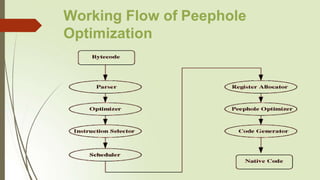
Working Flow of Peephole
Optimization
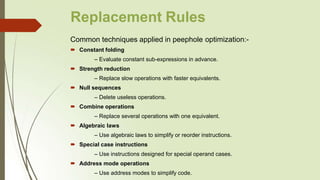
Replacement Rules
Common techniques applied in peephole optimization:-
 Constant folding
– Evaluate constant sub-expressions in advance.
 Strength reduction
– Replace slow operations with faster equivalents.
 Null sequences
– Delete useless operations.
 Combine operations
– Replace several operations with one equivalent.
 Algebraic laws
– Use algebraic laws to simplify or reorder instructions.
 Special case instructions
– Use instructions designed for special operand cases.
 Address mode operations
– Use address modes to simplify code.
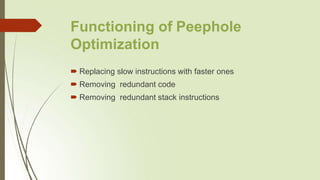
Functioning of Peephole
Optimization
 Replacing slow instructions with faster ones
 Removing redundant code
 Removing redundant stack instructions
Functioning (Contd…)
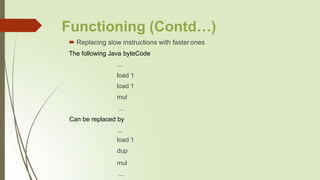
 Replacing slow instructions with faster ones
The following Java byteCode
...
load 1
load 1
mul
...
Can be replaced by
...
load 1
dup
mul
...
Functioning (Contd…)
 Removing redundant code
 Another example is to eliminate redundant load stores.
a = b + c;
d = a + e;
is straightforwardly implemented as
MOV b,
ADD c,
MOV R0, a
MOV a,
ADD e,
MOV R0, d
R0 # Copy b to the register
R0 # Add c to the register, the register is now b+c
# Copy the register to a
R0 # Copy a to the register
R0 # Add e to the register, the register is now a+e [(b+c)+e]
# Copy the register to d
Functioning (Contd…)
 Removing redundant code
but can be optimized to
MOV b,
ADD c,
MOV R0, a
ADD e, R0
MOV R0, d
R0 # Copy b to the register
R0 # Add c to the register, which is now b+c (a)
# Copy the register to a
# Add e to the register, which is now b+c+e [(a)+e]
# Copy the register to d
Functioning (Contd…)
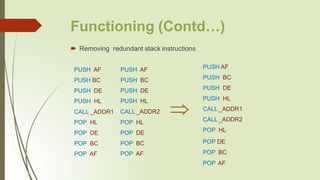
 Removing redundant stack instructions
PUSH AF PUSH AF
PUSH BC PUSH BC
PUSH DE PUSH DE
PUSH HL PUSH HL
POP HL POP HL
POP DE POP DE
POP BC POP BC
POP AF POP AF
CALL _ADDR1 CALL _ADDR2 
PUSH AF
PUSH BC
PUSH DE
PUSH HL
CALL _ADDR1
CALL_ADDR2
POP HL
POP DE
POP BC
POP AF
Functioning (Contd…)
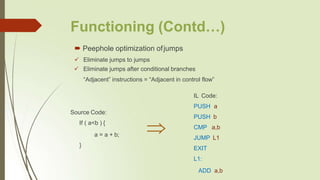
Source Code:
If ( a<b ) {
a = a + b;
}
 Peephole optimization ofjumps
 Eliminate jumps to jumps
 Eliminate jumps after conditional branches
“Adjacent” instructions = “Adjacent in control flow”
IL Code:
PUSH a
PUSH b
CMP a,b
JUMP L1
EXIT
L1:
ADD a,b

Other Considerations
Control-flow operations
 Can clear simplifier’s window at branch or label
 More aggressive approach: combine across branches
 Same considerations arise with predication
Physical versus logical windows
 Can run optimizer over a logical window
 Logical windows (within block) improve effectiveness
Conclusion
So…
 Peephole optimization remains viable
 Post allocation improvements
 Cleans up rough edges
 Peephole technology works for selection
 Description driven matchers
 Used in several important systems
All of this will work equally well in binary-to-binary translation
References
 https://en.wikipedia.org/wiki/Peephole_optimization
 http://www.iosrjournals.org/iosr-jce/papers/Vol9-Issue4/N0948086.pdf?id=255
 https://class.coursera.org/compilers/lecture/76
 https://www.slideshare.net/AnulChaudhary/peephole-optimization-techniques-in-
compiler-design
Peephole Optimization

Peephole Optimization

  • 1.
    BIRLA INSTITUTE OFTECHNOLOGY MESRA, JAIPUR CAMPUS TOPIC : PEEPHOLE OPTIMIZATION BY: MEGHAJ KUMAR MALLICK (MCA/25017/18) 2ND YEAR 3RD SEMESTER
  • 2.
    CONTENTS 2 What is anOptimization Introduction to Peephole Optimization Working Flow of Peephole Optimization Replacement Rules Functioning of Peephole Optimization & Example Conclusion References
  • 3.
    What is Optimization??  Process of transforming a piece of code to make it more efficient (eitherin terms of time or space) without changing its output or side-effects.  Tries to minimize or maximize some attributes of an executable computer program.
  • 4.
    Introduction to Peephole Optimization??  Optimization performed over a very small set of instructions in a segment of generated code.  Works by recognizing sets of instructions that can be replaced by shorter or faster sets of instructions.  Goals:  improve performance  reduce code size  reduce memory footprint
  • 5.
    Why it’s needed?? After compilation, the code still has some flaws  Scheduling & allocation really are NP-Complete  Optimizer may not implement every needed transformation Curing the problem  More work on scheduling and allocation  Implement more optimizations — or —  Optimize after compilation  Peephole optimization  Link-time optimization
  • 6.
    Working Flow ofPeephole Optimization
  • 7.
    Replacement Rules Common techniquesapplied in peephole optimization:-  Constant folding – Evaluate constant sub-expressions in advance.  Strength reduction – Replace slow operations with faster equivalents.  Null sequences – Delete useless operations.  Combine operations – Replace several operations with one equivalent.  Algebraic laws – Use algebraic laws to simplify or reorder instructions.  Special case instructions – Use instructions designed for special operand cases.  Address mode operations – Use address modes to simplify code.
  • 8.
    Functioning of Peephole Optimization Replacing slow instructions with faster ones  Removing redundant code  Removing redundant stack instructions
  • 9.
    Functioning (Contd…)  Replacingslow instructions with faster ones The following Java byteCode ... load 1 load 1 mul ... Can be replaced by ... load 1 dup mul ...
  • 10.
    Functioning (Contd…)  Removingredundant code  Another example is to eliminate redundant load stores. a = b + c; d = a + e; is straightforwardly implemented as MOV b, ADD c, MOV R0, a MOV a, ADD e, MOV R0, d R0 # Copy b to the register R0 # Add c to the register, the register is now b+c # Copy the register to a R0 # Copy a to the register R0 # Add e to the register, the register is now a+e [(b+c)+e] # Copy the register to d
  • 11.
    Functioning (Contd…)  Removingredundant code but can be optimized to MOV b, ADD c, MOV R0, a ADD e, R0 MOV R0, d R0 # Copy b to the register R0 # Add c to the register, which is now b+c (a) # Copy the register to a # Add e to the register, which is now b+c+e [(a)+e] # Copy the register to d
  • 12.
    Functioning (Contd…)  Removingredundant stack instructions PUSH AF PUSH AF PUSH BC PUSH BC PUSH DE PUSH DE PUSH HL PUSH HL POP HL POP HL POP DE POP DE POP BC POP BC POP AF POP AF CALL _ADDR1 CALL _ADDR2  PUSH AF PUSH BC PUSH DE PUSH HL CALL _ADDR1 CALL_ADDR2 POP HL POP DE POP BC POP AF
  • 13.
    Functioning (Contd…) Source Code: If( a<b ) { a = a + b; }  Peephole optimization ofjumps  Eliminate jumps to jumps  Eliminate jumps after conditional branches “Adjacent” instructions = “Adjacent in control flow” IL Code: PUSH a PUSH b CMP a,b JUMP L1 EXIT L1: ADD a,b 
  • 14.
    Other Considerations Control-flow operations Can clear simplifier’s window at branch or label  More aggressive approach: combine across branches  Same considerations arise with predication Physical versus logical windows  Can run optimizer over a logical window  Logical windows (within block) improve effectiveness
  • 15.
    Conclusion So…  Peephole optimizationremains viable  Post allocation improvements  Cleans up rough edges  Peephole technology works for selection  Description driven matchers  Used in several important systems All of this will work equally well in binary-to-binary translation
  • 16.
    References  https://en.wikipedia.org/wiki/Peephole_optimization  http://www.iosrjournals.org/iosr-jce/papers/Vol9-Issue4/N0948086.pdf?id=255 https://class.coursera.org/compilers/lecture/76  https://www.slideshare.net/AnulChaudhary/peephole-optimization-techniques-in- compiler-design