B Y
M E G H A J K U M A R M A L L I C K
M C A
1 S T Y E A R
1 S T S E M E S T E R
M C A / 2 5 0 1 7 / 1 8
1
PARTIAL ORDER RELATION
INTRODUCTION
2
 An equivalence relation is a relation that is reflexive,
symmetric, and transitive
 A partial ordering (or partial order) is a relation that is
reflexive, anti -symmetric, and transitive
 Recall that anti-symmetric means that if (a,b)  R, then (b,a) R
unless b = a
 Thus, (a,a) is allowed to be in R
 But since it’s reflexive, all possible (a,a) must be in R
 A set S with a partial ordering R is called a partially
ordered set, or poset
 Denoted by (S,R)
PARTIAL ORDERING EXAMPLES
3
 Show that ≥ is a partial order on the set of integers
 It is reflexive: a ≥ a for all a  Z
 It is antisymmetric: if a ≥ b then the only way that
b ≥ a is when b = a
 It is transitive: if a ≥ b and b ≥ c, then a ≥ c
 Note that ≥ is the partial ordering on the set of
integers
 (Z, ≥) is the partially ordered set, or poset
SYMBOL USAGE
4
 The symbol  is used to represent any relation
when discussing partial orders
 Not just the less than or equals to relation
 Can represent ≤, ≥,, etc
 Thus, a  b denotes that (a,b)  R
 The poset is (S,)
 The symbol  is used to denote a  b but a ≠ b
 If  represents ≥, then  represents >
 Fonts for this lecture set (specifically for the  and  symbols) are
available on the course website
COMPARABILITY
5
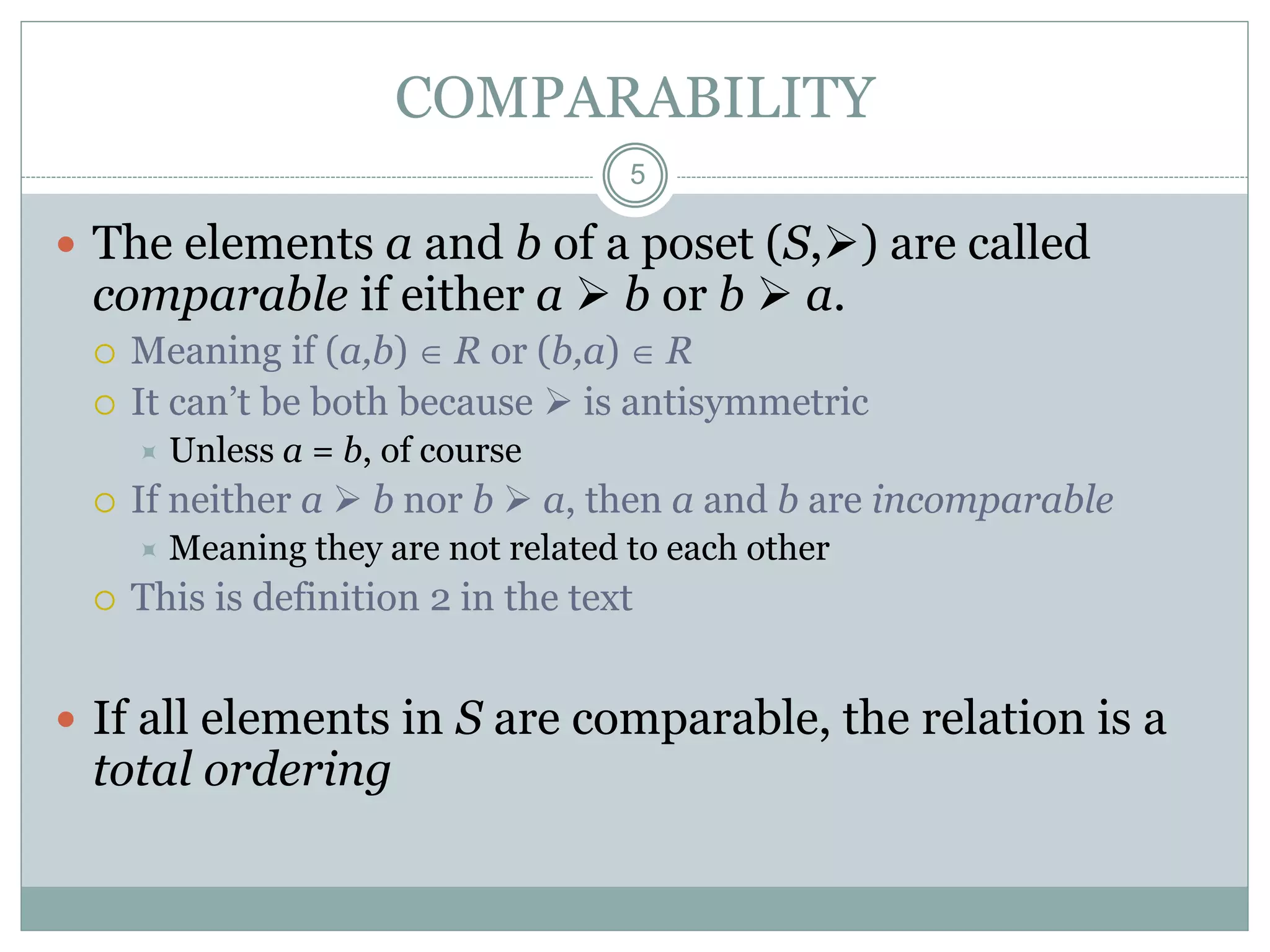
 The elements a and b of a poset (S,) are called
comparable if either a  b or b  a.
 Meaning if (a,b)  R or (b,a)  R
 It can’t be both because  is antisymmetric
 Unless a = b, of course
 If neither a  b nor b  a, then a and b are incomparable
 Meaning they are not related to each other
 This is definition 2 in the text
 If all elements in S are comparable, the relation is a
total ordering
COMPARABILITY EXAMPLES
6
 Let  be the “divides” operator |
 In the poset (Z+,|), are the integers 3 and 9
comparable?
 Yes, as 3 | 9
 Are 7 and 5 comparable?
 No, as 7 | 5 and 5 | 7
 Thus, as there are pairs of elements in Z+ that are not
comparable, the poset (Z+,|) is a partial order
COMPARABILITY EXAMPLES
7
 Let  be the less than or equals operator ≤
 In the poset (Z+,≤), are the integers 3 and 9
comparable?
 Yes, as 3 ≤ 9
 Are 7 and 5 comparable?
 Yes, as 5 ≤ 7
 As all pairs of elements in Z+ are comparable, the
poset (Z+,≤) is a total order
 a.k.a. totally ordered poset, linear order, chain, etc.
WELL-ORDERED SETS
8
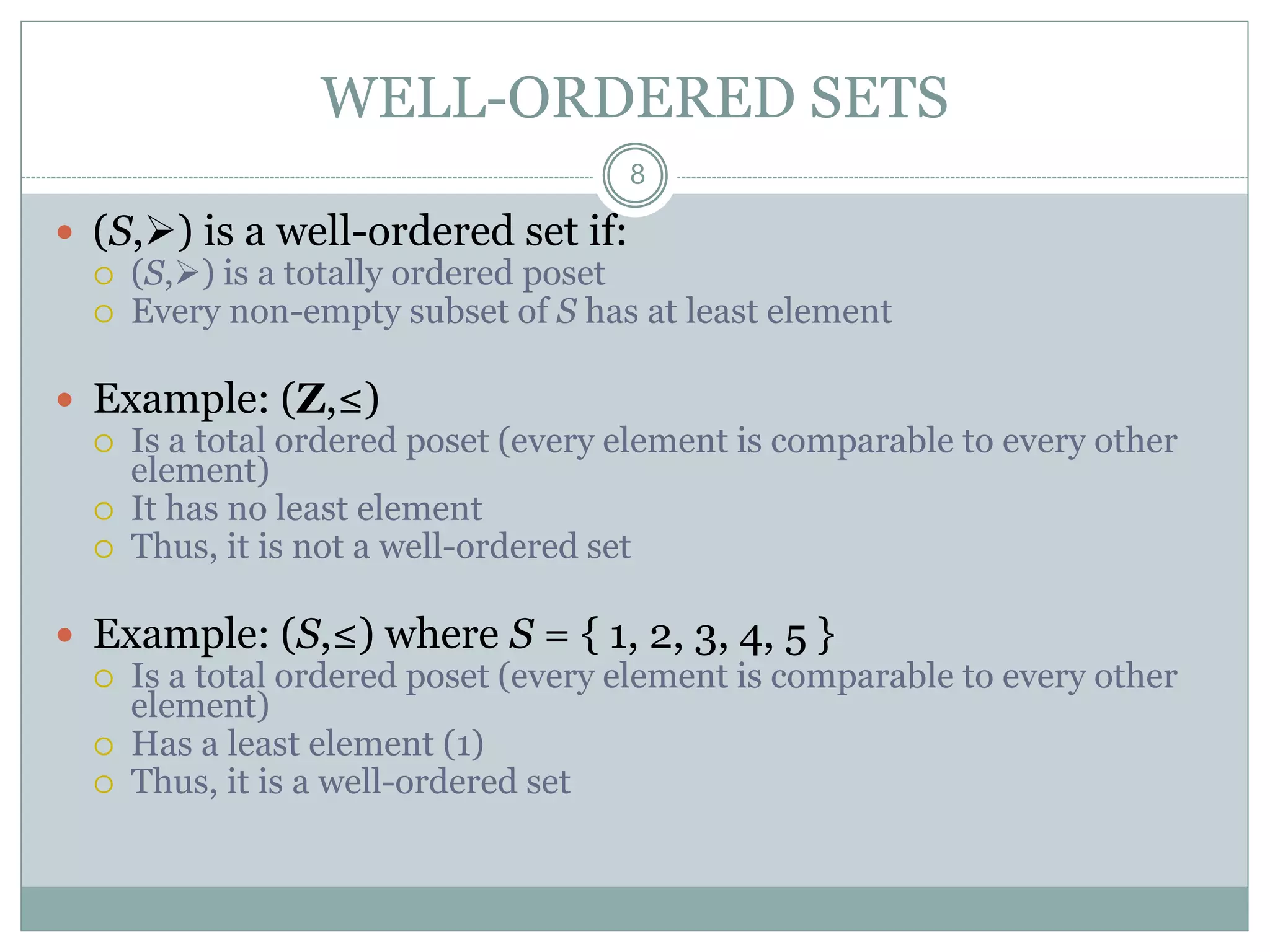
 (S,) is a well-ordered set if:
 (S,) is a totally ordered poset
 Every non-empty subset of S has at least element
 Example: (Z,≤)
 Is a total ordered poset (every element is comparable to every other
element)
 It has no least element
 Thus, it is not a well-ordered set
 Example: (S,≤) where S = { 1, 2, 3, 4, 5 }
 Is a total ordered poset (every element is comparable to every other
element)
 Has a least element (1)
 Thus, it is a well-ordered set
HASSE DIAGRAMS
9
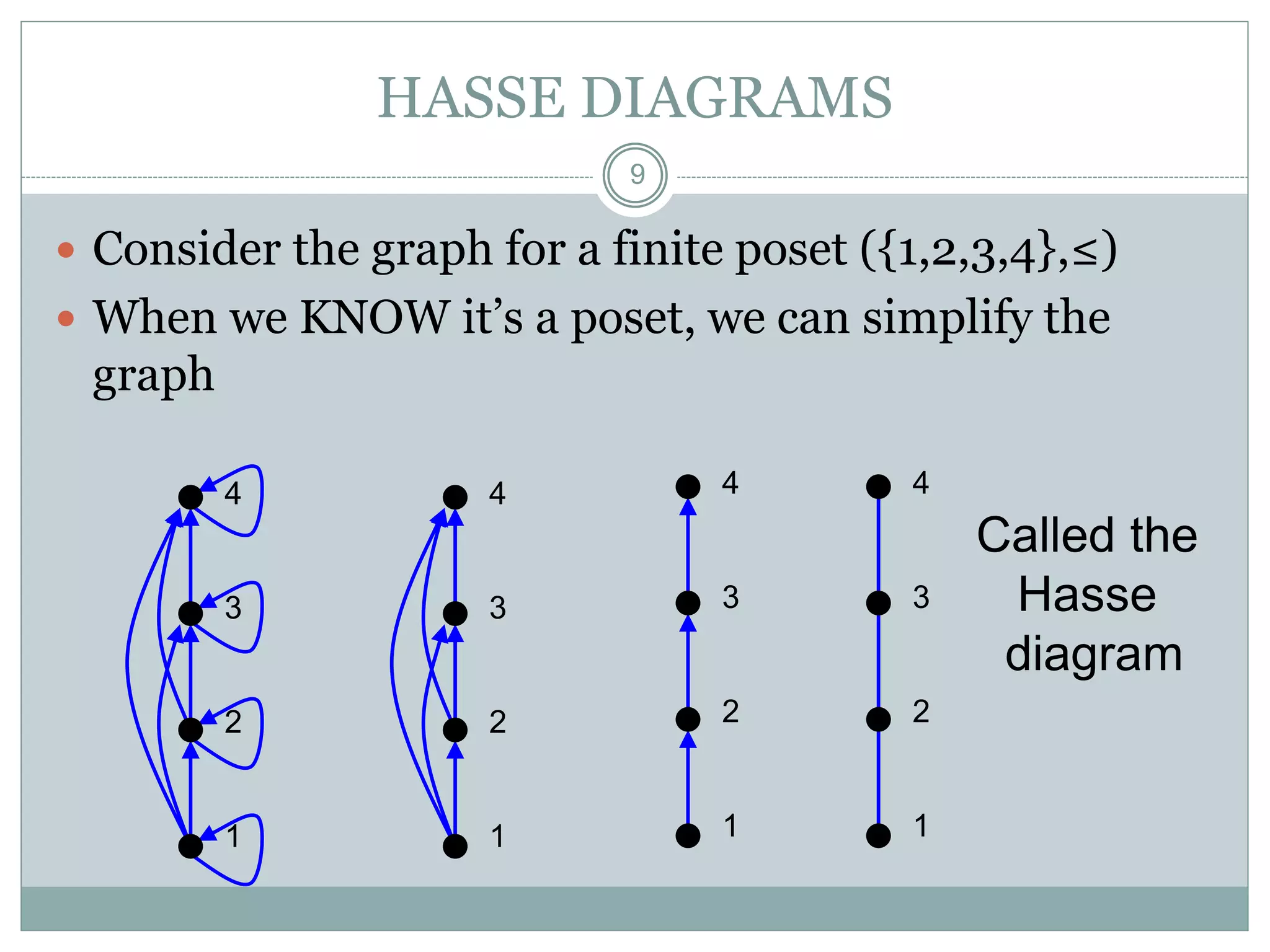
 Consider the graph for a finite poset ({1,2,3,4},≤)
 When we KNOW it’s a poset, we can simplify the
graph
4
3
2
1
4
3
2
1
4
3
2
1
4
3
2
1
Called the
Hasse
diagram
HASSE DIAGRAM
10
 For the poset ({1,2,3,4,6,8,12}, |)
 I T I S U S E D T O C A L C U L A T E T H E R A N K I N G O F
C O L L E G E S A C R O S S T H E W O R L D .
I T I S A L S O U S E D T O F I N D S C H E D U L E F O R V A R I O U S
S P O R T S .
11
REAL LIFE EXAMPLE
12

24 partial-orderings

  • 1.
    B Y M EG H A J K U M A R M A L L I C K M C A 1 S T Y E A R 1 S T S E M E S T E R M C A / 2 5 0 1 7 / 1 8 1 PARTIAL ORDER RELATION
  • 2.
    INTRODUCTION 2  An equivalencerelation is a relation that is reflexive, symmetric, and transitive  A partial ordering (or partial order) is a relation that is reflexive, anti -symmetric, and transitive  Recall that anti-symmetric means that if (a,b)  R, then (b,a) R unless b = a  Thus, (a,a) is allowed to be in R  But since it’s reflexive, all possible (a,a) must be in R  A set S with a partial ordering R is called a partially ordered set, or poset  Denoted by (S,R)
  • 3.
    PARTIAL ORDERING EXAMPLES 3 Show that ≥ is a partial order on the set of integers  It is reflexive: a ≥ a for all a  Z  It is antisymmetric: if a ≥ b then the only way that b ≥ a is when b = a  It is transitive: if a ≥ b and b ≥ c, then a ≥ c  Note that ≥ is the partial ordering on the set of integers  (Z, ≥) is the partially ordered set, or poset
  • 4.
    SYMBOL USAGE 4  Thesymbol  is used to represent any relation when discussing partial orders  Not just the less than or equals to relation  Can represent ≤, ≥,, etc  Thus, a  b denotes that (a,b)  R  The poset is (S,)  The symbol  is used to denote a  b but a ≠ b  If  represents ≥, then  represents >  Fonts for this lecture set (specifically for the  and  symbols) are available on the course website
  • 5.
    COMPARABILITY 5  The elementsa and b of a poset (S,) are called comparable if either a  b or b  a.  Meaning if (a,b)  R or (b,a)  R  It can’t be both because  is antisymmetric  Unless a = b, of course  If neither a  b nor b  a, then a and b are incomparable  Meaning they are not related to each other  This is definition 2 in the text  If all elements in S are comparable, the relation is a total ordering
  • 6.
    COMPARABILITY EXAMPLES 6  Let be the “divides” operator |  In the poset (Z+,|), are the integers 3 and 9 comparable?  Yes, as 3 | 9  Are 7 and 5 comparable?  No, as 7 | 5 and 5 | 7  Thus, as there are pairs of elements in Z+ that are not comparable, the poset (Z+,|) is a partial order
  • 7.
    COMPARABILITY EXAMPLES 7  Let be the less than or equals operator ≤  In the poset (Z+,≤), are the integers 3 and 9 comparable?  Yes, as 3 ≤ 9  Are 7 and 5 comparable?  Yes, as 5 ≤ 7  As all pairs of elements in Z+ are comparable, the poset (Z+,≤) is a total order  a.k.a. totally ordered poset, linear order, chain, etc.
  • 8.
    WELL-ORDERED SETS 8  (S,)is a well-ordered set if:  (S,) is a totally ordered poset  Every non-empty subset of S has at least element  Example: (Z,≤)  Is a total ordered poset (every element is comparable to every other element)  It has no least element  Thus, it is not a well-ordered set  Example: (S,≤) where S = { 1, 2, 3, 4, 5 }  Is a total ordered poset (every element is comparable to every other element)  Has a least element (1)  Thus, it is a well-ordered set
  • 9.
    HASSE DIAGRAMS 9  Considerthe graph for a finite poset ({1,2,3,4},≤)  When we KNOW it’s a poset, we can simplify the graph 4 3 2 1 4 3 2 1 4 3 2 1 4 3 2 1 Called the Hasse diagram
  • 10.
    HASSE DIAGRAM 10  Forthe poset ({1,2,3,4,6,8,12}, |)
  • 11.
     I TI S U S E D T O C A L C U L A T E T H E R A N K I N G O F C O L L E G E S A C R O S S T H E W O R L D . I T I S A L S O U S E D T O F I N D S C H E D U L E F O R V A R I O U S S P O R T S . 11 REAL LIFE EXAMPLE
  • 12.