Multiple sclerosis Ramesh Debur
Definition It is a inflammatory, demyelinating disorder involving the  white matter of the central nervous system
Etiology
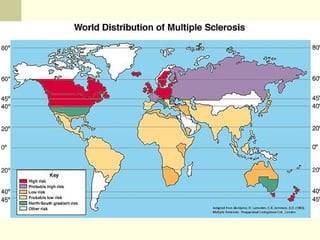
Eitology and Demographics More in the northern hemisphere than in the southern hemisphere More in Europe, Canada, North America than the rest Risk Stratification White > Asian > African
 
Etiology / Demographics Anywhere between 10 to 60 years Peak onset between 20 to 40 years Female  > Male Genetic factors 20 times increase if the first degree relative is affected Monozygotic twins 30% greater chance Migrants to europe at increased risk Environment
Onset Insidious onset Optic Neuritis - Complaint of mono occular weakness and pain most common Parasthesias,  Weakness Pain Impaired coordination
Clinical Features
Initial Signs and clinical features Action tremor ascending numbness starting in the feet;  bilateral hand numbness;  hemiparesthesia;  dysesthesia in one of the above distributions;  generalized heat intolerance Motor weakness with UMN symptoms
Later clinical features Motor System  Weakness (mono, quadri, etc), Spasticity,  + ve Babinski’s,  Cerebellar Dysdiodochokinesia, ataxia, scanning speech, incordination, loss of balance. Sensory Lhermitte's sign, dysesthetic pain, paresthesia, numbness  Posterior column loss heat intolerance
Urinary Incontinence, increased frequency, incomplete emptying, UTI Optic disc pallor, atrophy, blurred vision, diplopia, nystagmus, oscillopsia, intranuclear ophthalmoplegia, central scotomas or other visual field defects
Symptoms Depression Lhermitte’s sign Weakness Fatigue Dizziness or vertigo Heat sensitivity Sexual dysfunction
Diagnosis Standard Criteria History of at least two attacks; Clinical evidence of at least one lesion and clinical or para clinical evidence of another lesion
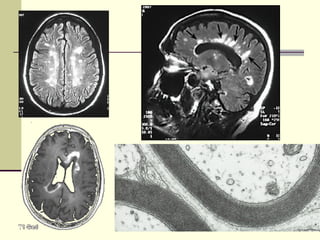
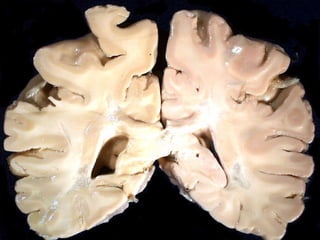
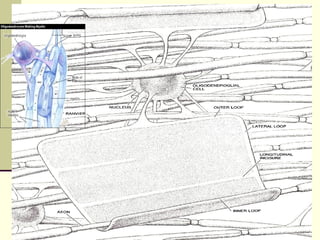
Hallmarks Disseminated white matter lesions of the CNS were first described by a French neurologist Charcot in late 19 th  Century perivascular inflammation and demyelination   Periventricular distribution of plaques  is often seen.
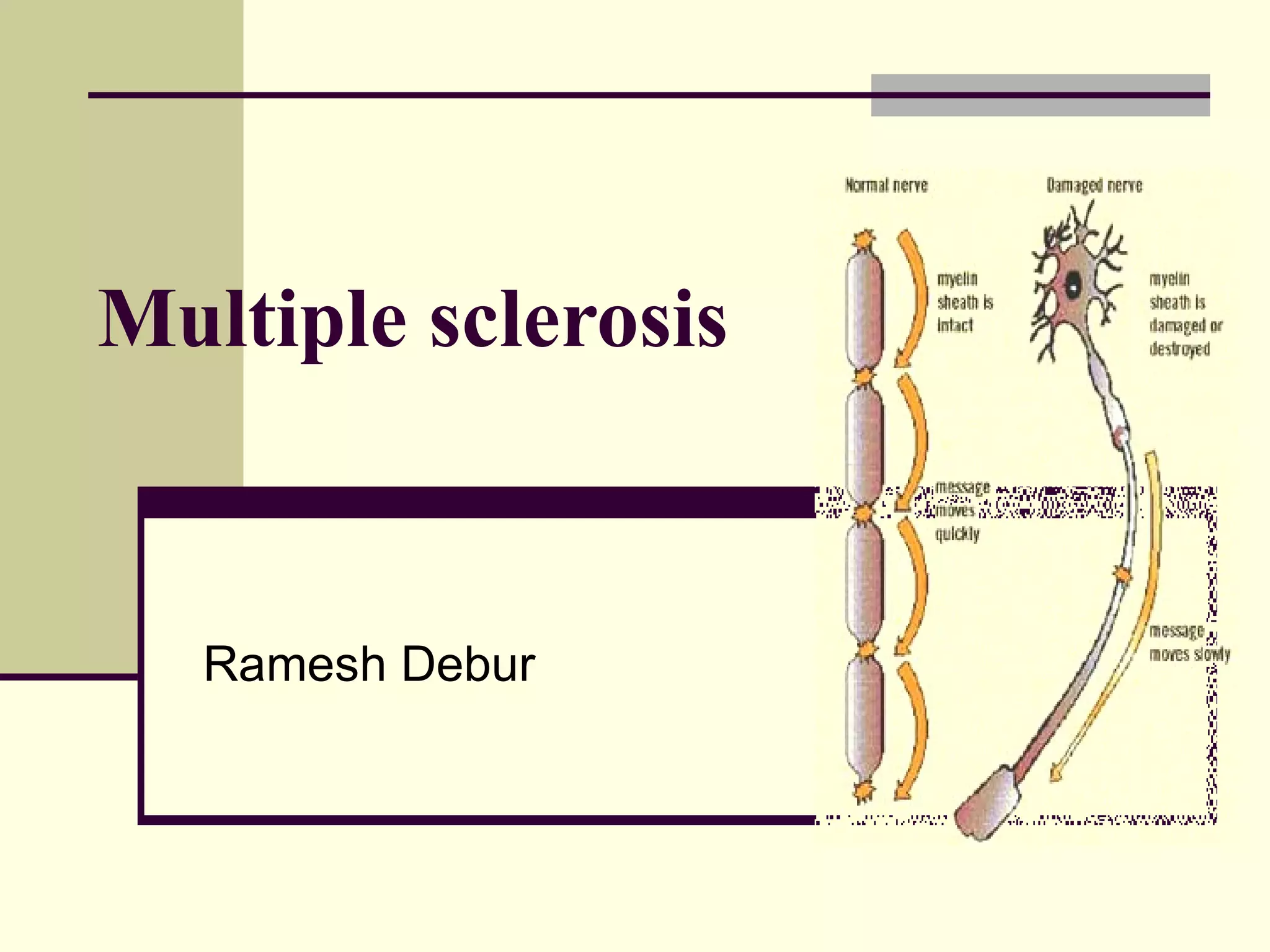
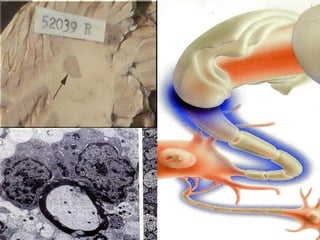
Mechanisms of Plaque Evolution blood-brain barrier is disrupted at the onset of symptoms ,  acute inflammatory response of lymphocytes, plasma cells and macrophages can produce demyelination by direct or indirect mechanisms .  The macrophages in those lesions contain myelin fragments or myelin breakdown products. Lymphocytes contribute to pathologic processes by means of antibody- and cell-mediated immunity (direct mechanism) or by secretion of lymphocytes and cytokines (indirect mechanism


Results of Demyelination conduction block at the site of lesion slower conduction time along the affected nerve  increased subjective feeling of fatigue secondary to compensation for neurologic deficits
Clinical Diagnosis Interneculear opthalmoplegia Optic neuritis Positive rhomberg sign Lhermitte’s sign Atleast 2 episodes of weakness with spontaneous resolution of symptoms
Differential diagnosis CNS infection (e.g., Lyme disease, syphilis, human immunodeficiency virus infection, human T-lymphotrophic virus type I) CNS inflammatory condition (e.g., sarcoidosis, systemic lupus erythematosus, Sjögren's syndrome) CNS microvascular disease (e.g., disease caused by hypertension, diabetes mellitus, vasculitis, ) Genetic disorder (e.g., leukodystrophy, hereditary myelopathy, mitochondrial disease) Structural or compressive condition of the brain and spinal cord (e.g., cervical spondylosis, tumor, herniated disc, Chiari's malformation)  Vitamin B12 deficiency
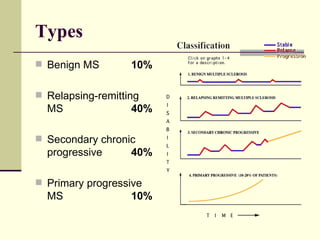
Types Benign MS  10% Relapsing-remitting MS  40% Secondary chronic progressive  40% Primary progressive MS  10%
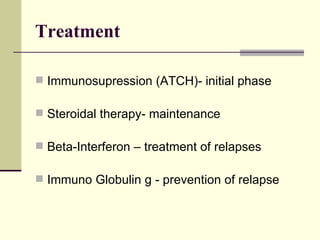
Treatment Immunosupression (ATCH)- initial phase Steroidal therapy- maintenance Beta-Interferon – treatment of relapses Immuno Globulin g - prevention of relapse
Physiotherapy Management
Alternative Therapies
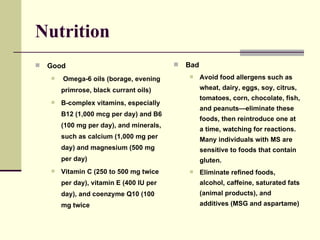
Nutrition Good Omega-6 oils (borage, evening primrose, black currant oils)  B-complex vitamins, especially B12 (1,000 mcg per day) and B6 (100 mg per day), and minerals, such as calcium (1,000 mg per day) and magnesium (500 mg per day)  Vitamin C (250 to 500 mg twice per day), vitamin E (400 IU per day), and coenzyme Q10 (100 mg twice  Bad Avoid food allergens such as wheat, dairy, eggs, soy, citrus, tomatoes, corn, chocolate, fish, and peanuts—eliminate these foods, then reintroduce one at a time, watching for reactions. Many individuals with MS are sensitive to foods that contain gluten.  Eliminate refined foods, alcohol, caffeine, saturated fats (animal products), and additives (MSG and aspartame)
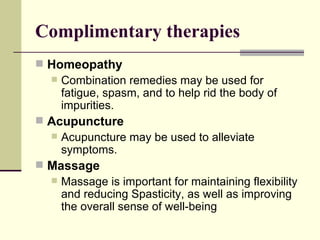
Complimentary therapies Homeopathy Combination remedies may be used for fatigue, spasm, and to help rid the body of impurities.  Acupuncture Acupuncture may be used to alleviate symptoms. Massage Massage is important for maintaining flexibility and reducing Spasticity, as well as improving the overall sense of well-being
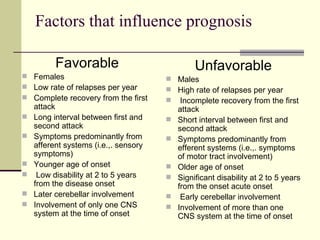
Factors that influence prognosis Favorable   Females  Low rate of relapses per year  Complete recovery from the first attack Long interval between first and second attack  Symptoms predominantly from afferent systems (i.e.,. sensory symptoms)  Younger age of onset   Low disability at 2 to 5 years from the disease onset  Later cerebellar involvement Involvement of only one CNS system at the time of onset  Unfavorable Males High rate of relapses per year   Incomplete recovery from the first attack Short interval between first and second attack Symptoms predominantly from efferent systems (i.e.,. symptoms of motor tract involvement) Older age of onset Significant disability at 2 to 5 years from the onset acute onset   Early cerebellar involvement Involvement of more than one CNS system at the time of onset
Physiotherapy Management Philosophy of Neuro Rehabilitation: Education and Self Management
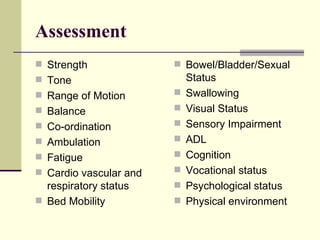
Assessment Strength Tone Range of Motion Balance Co-ordination Ambulation Fatigue Cardio vascular and respiratory status Bed Mobility Bowel/Bladder/Sexual Status Swallowing Visual Status Sensory Impairment ADL Cognition Vocational status Psychological status Physical environment
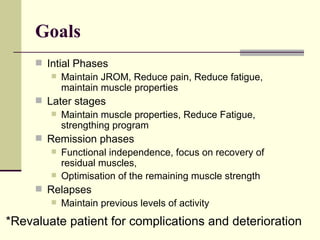
Goals Intial Phases Maintain JROM, Reduce pain, Reduce fatigue, maintain muscle properties Later stages Maintain muscle properties, Reduce Fatigue, strengthing program Remission phases Functional independence, focus on recovery of residual muscles, Optimisation of the remaining muscle strength Relapses Maintain previous levels of activity *Revaluate patient for complications and deterioration
Management  Three levels of treatment based on : Symptomatic treatment Standardized profiles Patient Driven goals
Symptomatic  Fatigue Factors contributing : sleep deprivation, neuromuscular fatigue, depression, etc Management: Energy conservation, exercise planning, rest activities, enviromental adaptaion Aerobic exercise, general endurance exercises, general conditioning exercises,
Weakness: could be due to Spasticity, disuse, fatigue, Deconditioning, etc, Treatment: slow progressive exercises, PNF, compensatory strengthing techniques, bracing, mobility aids, orthotics. Spasticity: due to the UMN syndrome Treatment: Stretching, RIP, Surgical & medical management
Balance & coordination: due to cerebellar problems Treatment: Strengthing proximal musculature, using visual cues, biofeedback, weighted cuffs,  Sensory problems: Dorsal column problems Treatment: compensatory strategies, retraining methods, counter irritant therapy,
Cognitive dysfunction: Due to central demyelination Treatment: Compensatory strategies such as memory book, etc, Clear reasoning strategies, short term recall (e.g.. For ADL),  General Deconditioning  Treatment: Aerobic exercises, swimming etc,
Standardised profiles General Measures Functional Independence Measures (FIM) Barthel Index Disease Specific Krutzke Scale for multiple sclerosis Modified fatigue impact inventory Mental health inventory QOL  SF – 36 Modified Social Support survey

Multiple Sclerosis

  • 1.
  • 2.
    Definition It isa inflammatory, demyelinating disorder involving the white matter of the central nervous system
  • 3.
  • 4.
    Eitology and DemographicsMore in the northern hemisphere than in the southern hemisphere More in Europe, Canada, North America than the rest Risk Stratification White > Asian > African
  • 5.
  • 6.
    Etiology / DemographicsAnywhere between 10 to 60 years Peak onset between 20 to 40 years Female > Male Genetic factors 20 times increase if the first degree relative is affected Monozygotic twins 30% greater chance Migrants to europe at increased risk Environment
  • 7.
    Onset Insidious onsetOptic Neuritis - Complaint of mono occular weakness and pain most common Parasthesias, Weakness Pain Impaired coordination
  • 8.
  • 9.
    Initial Signs andclinical features Action tremor ascending numbness starting in the feet; bilateral hand numbness; hemiparesthesia; dysesthesia in one of the above distributions; generalized heat intolerance Motor weakness with UMN symptoms
  • 10.
    Later clinical featuresMotor System Weakness (mono, quadri, etc), Spasticity, + ve Babinski’s, Cerebellar Dysdiodochokinesia, ataxia, scanning speech, incordination, loss of balance. Sensory Lhermitte's sign, dysesthetic pain, paresthesia, numbness Posterior column loss heat intolerance
  • 11.
    Urinary Incontinence, increasedfrequency, incomplete emptying, UTI Optic disc pallor, atrophy, blurred vision, diplopia, nystagmus, oscillopsia, intranuclear ophthalmoplegia, central scotomas or other visual field defects
  • 12.
    Symptoms Depression Lhermitte’ssign Weakness Fatigue Dizziness or vertigo Heat sensitivity Sexual dysfunction
  • 13.
    Diagnosis Standard CriteriaHistory of at least two attacks; Clinical evidence of at least one lesion and clinical or para clinical evidence of another lesion
  • 14.
    Hallmarks Disseminated whitematter lesions of the CNS were first described by a French neurologist Charcot in late 19 th Century perivascular inflammation and demyelination Periventricular distribution of plaques is often seen.
  • 15.
    Mechanisms of PlaqueEvolution blood-brain barrier is disrupted at the onset of symptoms , acute inflammatory response of lymphocytes, plasma cells and macrophages can produce demyelination by direct or indirect mechanisms . The macrophages in those lesions contain myelin fragments or myelin breakdown products. Lymphocytes contribute to pathologic processes by means of antibody- and cell-mediated immunity (direct mechanism) or by secretion of lymphocytes and cytokines (indirect mechanism
  • 16.
  • 17.
  • 18.
  • 19.
  • 20.
    Results of Demyelinationconduction block at the site of lesion slower conduction time along the affected nerve increased subjective feeling of fatigue secondary to compensation for neurologic deficits
  • 21.
    Clinical Diagnosis Interneculearopthalmoplegia Optic neuritis Positive rhomberg sign Lhermitte’s sign Atleast 2 episodes of weakness with spontaneous resolution of symptoms
  • 22.
    Differential diagnosis CNSinfection (e.g., Lyme disease, syphilis, human immunodeficiency virus infection, human T-lymphotrophic virus type I) CNS inflammatory condition (e.g., sarcoidosis, systemic lupus erythematosus, Sjögren's syndrome) CNS microvascular disease (e.g., disease caused by hypertension, diabetes mellitus, vasculitis, ) Genetic disorder (e.g., leukodystrophy, hereditary myelopathy, mitochondrial disease) Structural or compressive condition of the brain and spinal cord (e.g., cervical spondylosis, tumor, herniated disc, Chiari's malformation) Vitamin B12 deficiency
  • 23.
    Types Benign MS 10% Relapsing-remitting MS 40% Secondary chronic progressive 40% Primary progressive MS 10%
  • 24.
    Treatment Immunosupression (ATCH)-initial phase Steroidal therapy- maintenance Beta-Interferon – treatment of relapses Immuno Globulin g - prevention of relapse
  • 25.
  • 26.
  • 27.
    Nutrition Good Omega-6oils (borage, evening primrose, black currant oils) B-complex vitamins, especially B12 (1,000 mcg per day) and B6 (100 mg per day), and minerals, such as calcium (1,000 mg per day) and magnesium (500 mg per day) Vitamin C (250 to 500 mg twice per day), vitamin E (400 IU per day), and coenzyme Q10 (100 mg twice Bad Avoid food allergens such as wheat, dairy, eggs, soy, citrus, tomatoes, corn, chocolate, fish, and peanuts—eliminate these foods, then reintroduce one at a time, watching for reactions. Many individuals with MS are sensitive to foods that contain gluten. Eliminate refined foods, alcohol, caffeine, saturated fats (animal products), and additives (MSG and aspartame)
  • 28.
    Complimentary therapies HomeopathyCombination remedies may be used for fatigue, spasm, and to help rid the body of impurities. Acupuncture Acupuncture may be used to alleviate symptoms. Massage Massage is important for maintaining flexibility and reducing Spasticity, as well as improving the overall sense of well-being
  • 29.
    Factors that influenceprognosis Favorable   Females  Low rate of relapses per year  Complete recovery from the first attack Long interval between first and second attack  Symptoms predominantly from afferent systems (i.e.,. sensory symptoms)  Younger age of onset   Low disability at 2 to 5 years from the disease onset  Later cerebellar involvement Involvement of only one CNS system at the time of onset  Unfavorable Males High rate of relapses per year   Incomplete recovery from the first attack Short interval between first and second attack Symptoms predominantly from efferent systems (i.e.,. symptoms of motor tract involvement) Older age of onset Significant disability at 2 to 5 years from the onset acute onset   Early cerebellar involvement Involvement of more than one CNS system at the time of onset
  • 30.
    Physiotherapy Management Philosophyof Neuro Rehabilitation: Education and Self Management
  • 31.
    Assessment Strength ToneRange of Motion Balance Co-ordination Ambulation Fatigue Cardio vascular and respiratory status Bed Mobility Bowel/Bladder/Sexual Status Swallowing Visual Status Sensory Impairment ADL Cognition Vocational status Psychological status Physical environment
  • 32.
    Goals Intial PhasesMaintain JROM, Reduce pain, Reduce fatigue, maintain muscle properties Later stages Maintain muscle properties, Reduce Fatigue, strengthing program Remission phases Functional independence, focus on recovery of residual muscles, Optimisation of the remaining muscle strength Relapses Maintain previous levels of activity *Revaluate patient for complications and deterioration
  • 33.
    Management Threelevels of treatment based on : Symptomatic treatment Standardized profiles Patient Driven goals
  • 34.
    Symptomatic FatigueFactors contributing : sleep deprivation, neuromuscular fatigue, depression, etc Management: Energy conservation, exercise planning, rest activities, enviromental adaptaion Aerobic exercise, general endurance exercises, general conditioning exercises,
  • 35.
    Weakness: could bedue to Spasticity, disuse, fatigue, Deconditioning, etc, Treatment: slow progressive exercises, PNF, compensatory strengthing techniques, bracing, mobility aids, orthotics. Spasticity: due to the UMN syndrome Treatment: Stretching, RIP, Surgical & medical management
  • 36.
    Balance & coordination:due to cerebellar problems Treatment: Strengthing proximal musculature, using visual cues, biofeedback, weighted cuffs, Sensory problems: Dorsal column problems Treatment: compensatory strategies, retraining methods, counter irritant therapy,
  • 37.
    Cognitive dysfunction: Dueto central demyelination Treatment: Compensatory strategies such as memory book, etc, Clear reasoning strategies, short term recall (e.g.. For ADL), General Deconditioning Treatment: Aerobic exercises, swimming etc,
  • 38.
    Standardised profiles GeneralMeasures Functional Independence Measures (FIM) Barthel Index Disease Specific Krutzke Scale for multiple sclerosis Modified fatigue impact inventory Mental health inventory QOL SF – 36 Modified Social Support survey