Physiotherapy treatment options for people with ataxia Anita Watson Lecturer in Physiotherapy [email_address]
Contents Neurological Physiotherapy Ataxia UK Physiotherapy Guidelines Salford Activity Limitation Score for Ataxia (SALSA) Outcome Measure
Neurological Physiotherapy What do we do: Work to maximise quality of life by restoring, maintaining and improving function and movement.  Where do we work: In-patient, out patient and community Independently and as part of multi-disciplinary teams. The CSP Code of Professional Values, 2011
Neurological Physiotherapy How to find us: Referral by a GP, Consultant, Allied Healthcare Professional or self referral. Private - look up neurological physiotherapy (yellow pages or Google)or access  Physio2u on the CSP website. http://www.csp.org.uk/physio2u/search/table
What do we do? Assess your problems  Identify a treatment plan Monitor progress using outcome measures Edwards, 2002
Ataxia UK Guidelines-Physiotherapy Produced by Betty Cassidy, Cherry Kilbride and Ann Hollands (2009). Review of rehabilitation approaches and physiotherapy interventions in children and adults with ataxia (1980-2009). http://www.ataxia.org.uk/data/files/physiotherapy_supplement_to_ataxia_guidelines_final__word_.pdf
Treadmill Training Balance and Mobility Aids Weighting Visual Feedback Lycra Garments Cold Therapy Exercise Ataxia UK Guidelines-Physiotherapy
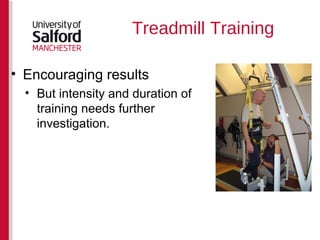
Treadmill Training Encouraging results But intensity and duration of training needs further investigation.
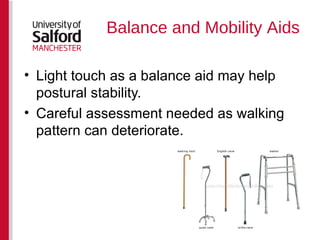
Balance and Mobility Aids Light touch as a balance aid may help postural stability. Careful assessment needed as walking pattern can deteriorate.
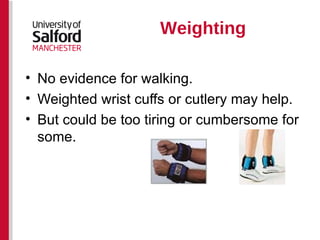
Weighting No evidence for walking. Weighted wrist cuffs or cutlery may help. But could be too tiring or cumbersome for some.
Visual Feedback Visual rehearsal of stepping and reaching might improve performance and safety but is short lived in nature.
Lycra Garments Insufficient data to support the use of lycra garments  Recently project by Ataxia UK showed inconclusive results.
Cold Therapy Cooling of the arm can temporarily reduce tremor, aiding functional activities. Further studies are warranted.
Exercise Aerobic/endurance training could be a means of promoting activity and reducing deconditioning. But very little evidence to date.
Take home messages Exercise that increases movement practice shows positive outcomes-treadmill training, auditory cuing, targeted balance training, robot training and constraint induced movement therapy.  But further work needed about intensity and duration.
Take home messages Visual rehearsal of a movement can be used as a short term strategy to improve performance. Walking aids and weighting to be assessed on a case by case basis. More studies looking at lycra garments and cooling.
Limitations of ataxia research in physiotherapy Further research is needed to establish: Which interventions are most effective. How much and how often. The underlying mechanisms of ataxia.  Robust and sensitive outcome measures.
SALSA-questionnaire development Item generation. Items grouped, themed and reworded. Questionnaire scale added-Likert. Reviewed by people with ataxia (6) to ensure face and content validity does it look like it will measure what it says??
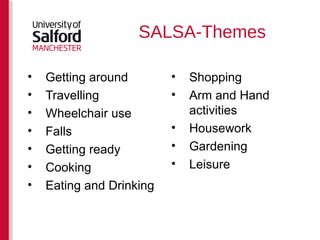
SALSA-Themes Getting around Travelling Wheelchair use Falls Getting ready Cooking Eating and Drinking Shopping Arm and Hand activities Housework Gardening Leisure
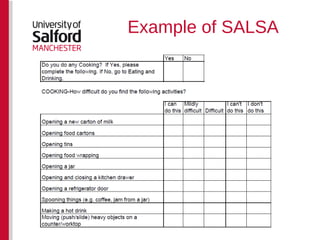
Example of SALSA
What next?? Questionnaire is now being completed by a larger sample to collect further data for validity, sensitivity and stability testing. Finding will be analysed to quantify patient’s problems. Even larger numbers are needed-any volunteers?
Acknowledgements Ataxia UK - helping with recruiting participants. Dr Ealing, Dr Tyrell and their teams. Salford Royal and Greater Manchester Physiotherapists. All people with ataxia who have taken part so far. Professor Sarah Tyson and Dr Richard Jones, University of Salford

Ataxia Physiotherapy Presentation - COAP study day

  • 1.
    Physiotherapy treatment optionsfor people with ataxia Anita Watson Lecturer in Physiotherapy [email_address]
  • 2.
    Contents Neurological PhysiotherapyAtaxia UK Physiotherapy Guidelines Salford Activity Limitation Score for Ataxia (SALSA) Outcome Measure
  • 3.
    Neurological Physiotherapy Whatdo we do: Work to maximise quality of life by restoring, maintaining and improving function and movement. Where do we work: In-patient, out patient and community Independently and as part of multi-disciplinary teams. The CSP Code of Professional Values, 2011
  • 4.
    Neurological Physiotherapy Howto find us: Referral by a GP, Consultant, Allied Healthcare Professional or self referral. Private - look up neurological physiotherapy (yellow pages or Google)or access Physio2u on the CSP website. http://www.csp.org.uk/physio2u/search/table
  • 5.
    What do wedo? Assess your problems Identify a treatment plan Monitor progress using outcome measures Edwards, 2002
  • 6.
    Ataxia UK Guidelines-PhysiotherapyProduced by Betty Cassidy, Cherry Kilbride and Ann Hollands (2009). Review of rehabilitation approaches and physiotherapy interventions in children and adults with ataxia (1980-2009). http://www.ataxia.org.uk/data/files/physiotherapy_supplement_to_ataxia_guidelines_final__word_.pdf
  • 7.
    Treadmill Training Balanceand Mobility Aids Weighting Visual Feedback Lycra Garments Cold Therapy Exercise Ataxia UK Guidelines-Physiotherapy
  • 8.
    Treadmill Training Encouragingresults But intensity and duration of training needs further investigation.
  • 9.
    Balance and MobilityAids Light touch as a balance aid may help postural stability. Careful assessment needed as walking pattern can deteriorate.
  • 10.
    Weighting No evidencefor walking. Weighted wrist cuffs or cutlery may help. But could be too tiring or cumbersome for some.
  • 11.
    Visual Feedback Visualrehearsal of stepping and reaching might improve performance and safety but is short lived in nature.
  • 12.
    Lycra Garments Insufficientdata to support the use of lycra garments Recently project by Ataxia UK showed inconclusive results.
  • 13.
    Cold Therapy Coolingof the arm can temporarily reduce tremor, aiding functional activities. Further studies are warranted.
  • 14.
    Exercise Aerobic/endurance trainingcould be a means of promoting activity and reducing deconditioning. But very little evidence to date.
  • 15.
    Take home messagesExercise that increases movement practice shows positive outcomes-treadmill training, auditory cuing, targeted balance training, robot training and constraint induced movement therapy. But further work needed about intensity and duration.
  • 16.
    Take home messagesVisual rehearsal of a movement can be used as a short term strategy to improve performance. Walking aids and weighting to be assessed on a case by case basis. More studies looking at lycra garments and cooling.
  • 17.
    Limitations of ataxiaresearch in physiotherapy Further research is needed to establish: Which interventions are most effective. How much and how often. The underlying mechanisms of ataxia. Robust and sensitive outcome measures.
  • 18.
    SALSA-questionnaire development Itemgeneration. Items grouped, themed and reworded. Questionnaire scale added-Likert. Reviewed by people with ataxia (6) to ensure face and content validity does it look like it will measure what it says??
  • 19.
    SALSA-Themes Getting aroundTravelling Wheelchair use Falls Getting ready Cooking Eating and Drinking Shopping Arm and Hand activities Housework Gardening Leisure
  • 20.
  • 21.
    What next?? Questionnaireis now being completed by a larger sample to collect further data for validity, sensitivity and stability testing. Finding will be analysed to quantify patient’s problems. Even larger numbers are needed-any volunteers?
  • 22.
    Acknowledgements Ataxia UK- helping with recruiting participants. Dr Ealing, Dr Tyrell and their teams. Salford Royal and Greater Manchester Physiotherapists. All people with ataxia who have taken part so far. Professor Sarah Tyson and Dr Richard Jones, University of Salford