Multiple sclerosis
K. NITHYA(13GD1ROO29)
GUIDE : SUDHEER KUMAR SIR
IV – B PHARMACY
INTRODUCTION
• Multiple sclerosis (MS) is a demyelinating disease in which the insulating
covers of nerve cells in the brain and spinal cord are damaged. This damage
disrupts the ability of parts of the nervous system to communicate, resulting in a
range of signs and symptoms, including physical, mental, and sometimes
psychiatric problems. Specific symptoms can include double vision, blindness in
one eye, muscle weakness, trouble with sensation, or trouble with coordination. MS
takes several forms, with new symptoms either occurring in isolated attacks
(relapsing forms) or building up over time (progressive forms). Between attacks,
symptoms may disappear completely; however, permanent neurological problems
often remain, especially as the disease advances
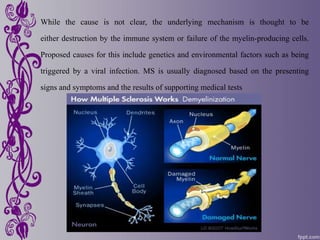
While the cause is not clear, the underlying mechanism is thought to be
either destruction by the immune system or failure of the myelin-producing cells.
Proposed causes for this include genetics and environmental factors such as being
triggered by a viral infection. MS is usually diagnosed based on the presenting
signs and symptoms and the results of supporting medical tests
HISTORY
• The earliest description of multiple sclerosis was recorded in
Holland on august 4,1421 but the of the disease really begins
in the 19th century with the first clear illustrations and clinical
description of the disease beginning to appear in 1838’’
• The first actual case was diagnosed in 1849. It was Dr. Jean-
Martin Charcot who is credited with giving us the first signs
and symptoms of multiple sclerosis.
ETIOLOGY
• Unknown cause
• Related to infectious, immunologic, and genetic
factors
• Possible precipitating factors include
Infection
Physical injury
Emotional stress
Excessive fatigue
Pregnancy
Poor state of health
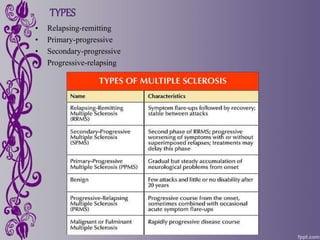
TYPES
• Relapsing-remitting
• Primary-progressive
• Secondary-progressive
• Progressive-relapsing
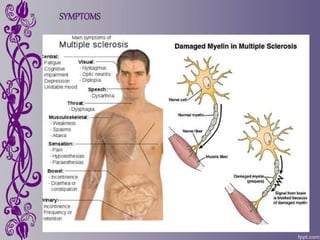
SYMPTOMS
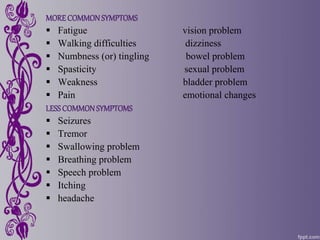
MORE COMMONSYMPTOMS
 Fatigue vision problem
 Walking difficulties dizziness
 Numbness (or) tingling bowel problem
 Spasticity sexual problem
 Weakness bladder problem
 Pain emotional changes
LESSCOMMONSYMPTOMS
 Seizures
 Tremor
 Swallowing problem
 Breathing problem
 Speech problem
 Itching
 headache
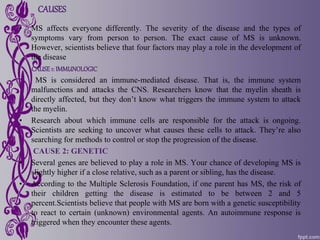
CAUSES
• MS affects everyone differently. The severity of the disease and the types of
symptoms vary from person to person. The exact cause of MS is unknown.
However, scientists believe that four factors may play a role in the development of
the disease
CAUSE1: IMMUNOLOGIC
MS is considered an immune-mediated disease. That is, the immune system
malfunctions and attacks the CNS. Researchers know that the myelin sheath is
directly affected, but they don’t know what triggers the immune system to attack
the myelin.
• Research about which immune cells are responsible for the attack is ongoing.
Scientists are seeking to uncover what causes these cells to attack. They’re also
searching for methods to control or stop the progression of the disease.
CAUSE 2: GENETIC
• Several genes are believed to play a role in MS. Your chance of developing MS is
slightly higher if a close relative, such as a parent or sibling, has the disease.
• According to the Multiple Sclerosis Foundation, if one parent has MS, the risk of
their children getting the disease is estimated to be between 2 and 5
percent.Scientists believe that people with MS are born with a genetic susceptibility
to react to certain (unknown) environmental agents. An autoimmune response is
triggered when they encounter these agents.
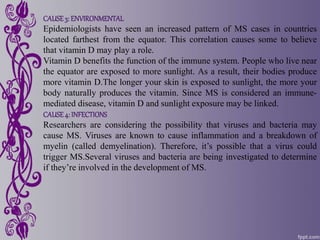
CAUSE3: ENVIRONMENTAL
Epidemiologists have seen an increased pattern of MS cases in countries
located farthest from the equator. This correlation causes some to believe
that vitamin D may play a role.
Vitamin D benefits the function of the immune system. People who live near
the equator are exposed to more sunlight. As a result, their bodies produce
more vitamin D.The longer your skin is exposed to sunlight, the more your
body naturally produces the vitamin. Since MS is considered an immune-
mediated disease, vitamin D and sunlight exposure may be linked.
CAUSE4: INFECTIONS
Researchers are considering the possibility that viruses and bacteria may
cause MS. Viruses are known to cause inflammation and a breakdown of
myelin (called demyelination). Therefore, it’s possible that a virus could
trigger MS.Several viruses and bacteria are being investigated to determine
if they’re involved in the development of MS.
PATHOPHYSIOLOGY
Mylelinsheath
– Segmented lamination that wraps axons of many nerve cells
– Increases velocity of nerve impulse conduction in the axons
– Composed of myelin, a substance with high lipid content
• Characterized by chronic inflammation, demyelination, and
gliosis (scarring) in the CNS
• Initially triggered by a virus in genetically susceptible
individuals
• Subsequent antigen-antibody reaction leads to demyelination
of axons
• Disease process consists of loss of myelin, disappearance of
oligodendrocytes, and proliferation of astrocytes
• Changes result in plaque formation with plaques scattered
throughout the CNS
• Initially the myelin sheaths of the neurons in the brain and
spinal cord are attacked, but the nerve fiber is not affected
• Patient may complain of noticeable impairment of
function
• Myelin can regenerate, and symptoms disappear, resulting
in a remission
• Myelin can be replaced by glial scar tissue
• Without myelin, nerve impulses slow down
• With destruction of axons, impulses are totally blocked
• Results in permanent loss of nerve function
DIAGNOSIS
• Diagnosing multiple sclerosis (MS) is complex and challenging, mostly because
MS symptoms are unique to each individual, and they can mimic those of a number
of other diseases
• Mcdonald criteria for diagnosing ms
• Magnetic resonance imaging (mri) scan in diagnosing ms
• Lumbar puncture in diagnosing ms
• Visual evoked potential testing to diagnose ms
• Blood tests to diagnose ms
TREATMENT
• No known cure
• Treatments involve relieving the symptoms or slowing the progression of
the disease
• These are mostly drug treatments
• Also CAMs-complementary Alternative Medicines
CAMs
• Used with or instead of conventional drug treatments
• Some include
• Acupuncture
• Herbal medicine
• Yoga
• Relaxation techniques
• Hypnosis
CONVENTIONALDRUGTREATMENTS
• Disease-modifying drugs
• ABC Treatments
• Chemotherapeutic Agents
• Corticosteroids & ACTH
CAMS
ACUPUNCTURE
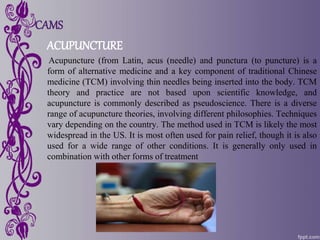
Acupuncture (from Latin, acus (needle) and punctura (to puncture) is a
form of alternative medicine and a key component of traditional Chinese
medicine (TCM) involving thin needles being inserted into the body. TCM
theory and practice are not based upon scientific knowledge, and
acupuncture is commonly described as pseudoscience. There is a diverse
range of acupuncture theories, involving different philosophies. Techniques
vary depending on the country. The method used in TCM is likely the most
widespread in the US. It is most often used for pain relief, though it is also
used for a wide range of other conditions. It is generally only used in
combination with other forms of treatment
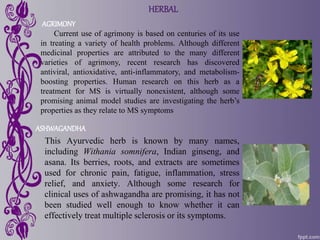
ASHWAGANDHA
This Ayurvedic herb is known by many names,
including Withania somnifera, Indian ginseng, and
asana. Its berries, roots, and extracts are sometimes
used for chronic pain, fatigue, inflammation, stress
relief, and anxiety. Although some research for
clinical uses of ashwagandha are promising, it has not
been studied well enough to know whether it can
effectively treat multiple sclerosis or its symptoms.
HERBAL
AGRIMONY
Current use of agrimony is based on centuries of its use
in treating a variety of health problems. Although different
medicinal properties are attributed to the many different
varieties of agrimony, recent research has discovered
antiviral, antioxidative, anti-inflammatory, and metabolism-
boosting properties. Human research on this herb as a
treatment for MS is virtually nonexistent, although some
promising animal model studies are investigating the herb’s
properties as they relate to MS symptoms
CATNIP
Apparently catnip is not just for kitties some individuals use this herb for
MS pain management. Catnip has sedative effects, which may actually
make fatigue worse or multiply the effect of other sedative medicati.
Research in humans is sorely lacking, but early animal trials on extracts of
various species of this plant indicate that catnip may have anti-
inflammatory and pain relief abilities.
BARBERRY
Barberry, or Berberis vulgaris ,has long been used in Indian and
Middle Eastern medicine for easing inflammation, fighting
infection, treating diarrhea, and calming heartburn. It can be
used in many forms and may be used to boost the immune
system, but human research is lacking
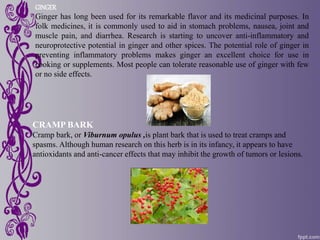
GINGER
Ginger has long been used for its remarkable flavor and its medicinal purposes. In
folk medicines, it is commonly used to aid in stomach problems, nausea, joint and
muscle pain, and diarrhea. Research is starting to uncover anti-inflammatory and
neuroprotective potential in ginger and other spices. The potential role of ginger in
preventing inflammatory problems makes ginger an excellent choice for use in
cooking or supplements. Most people can tolerate reasonable use of ginger with few
or no side effects.
CRAMP BARK
Cramp bark, or Viburnum opulus ,is plant bark that is used to treat cramps and
spasms. Although human research on this herb is in its infancy, it appears to have
antioxidants and anti-cancer effects that may inhibit the growth of tumors or lesions.
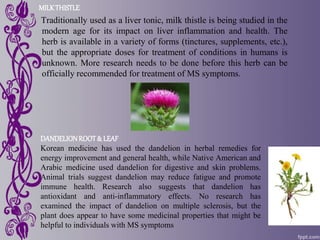
MILKTHISTLE
Traditionally used as a liver tonic, milk thistle is being studied in the
modern age for its impact on liver inflammation and health. The
herb is available in a variety of forms (tinctures, supplements, etc.),
but the appropriate doses for treatment of conditions in humans is
unknown. More research needs to be done before this herb can be
officially recommended for treatment of MS symptoms.
DANDELIONROOT& LEAF
Korean medicine has used the dandelion in herbal remedies for
energy improvement and general health, while Native American and
Arabic medicine used dandelion for digestive and skin problems.
Animal trials suggest dandelion may reduce fatigue and promote
immune health. Research also suggests that dandelion has
antioxidant and anti-inflammatory effects. No research has
examined the impact of dandelion on multiple sclerosis, but the
plant does appear to have some medicinal properties that might be
helpful to individuals with MS symptoms
YOGA
HYPNOTHERAPY
• Hypnotherapy aims to work on the mental processes rather than the
physical processes at work in ill health. In a typical hypnotherapy
session, the hypnotist will induce a deep state of relaxation which
encourages a heightened susceptibility to suggestion. The therapist
will then make suggestions that are of therapeutic value to the
individual with the expectation that the individual's thought and
behavioural patterns will be sufficiently modified on waking to effect
some positive changes.
• Some people with multiple sclerosis look to hypnotherapy for a range
of symptoms including pain, spasm, anxiety and depression. Though
no large-scale studies have evaluated the effectiveness of hypnosis as
a form of treatment for people with MS specifically, limited research
suggests that hypnosis-induced relaxation can help reduce anxiety and
pain.
CONCLUSION
In just the past few years, research has further clarified the cellular and molecular
events that accompany an MS immune attack on myelin and has raised speculation
that there could be several diseases comprising what we now call MS.
Epidemiological studies have also clarified the prognosis and reaffirmed that many
patients do well. The distinction between relapsing-remitting MS and secondary
progressive MS has assumed increasing importance, in part because of different
responses to treatment. New criteria for the diagnosis of MS have also been
developed to take advantage of the extraordinary sensitivity of MR imaging. Most
importantly, in less than 10 years, five new drugs have been developed with proven
ability to alter the natural history of MS and mitigate the disease. These advances
have completely altered the clinician's approach to the patient with MS and
foreshadow new hope for the ultimate conquest of this disease.
REFERENCE
Glossary of MS terms (national multiple sclerosis society)
Article: Innovative therapies redefine treatment goals in
multiple sclerposis.
Schumacher fa, beeve gw, kibler rf, et al. Problems of
experimental trials of therapy in multiple sclerosis. Ann N Y
acad sci 1965; 122: 552–568.
Ellison gw, myers lw, mickey mr, et al. Clinicial experience
with azathioprine: the pros. Neurology. 1988; 38 (supl 2): 20-
23.
 Fda news release: fda approves zinbryta to treat multiple
sclerosis may 27, 2016
 "NINDS multiple sclerosis information page". National
institute of neurological disorders and stroke. November 19,
2015. Retrieved 6 march 2016.
MULTIPLE SCLEROSIS

MULTIPLE SCLEROSIS

  • 1.
    Multiple sclerosis K. NITHYA(13GD1ROO29) GUIDE: SUDHEER KUMAR SIR IV – B PHARMACY
  • 2.
    INTRODUCTION • Multiple sclerosis(MS) is a demyelinating disease in which the insulating covers of nerve cells in the brain and spinal cord are damaged. This damage disrupts the ability of parts of the nervous system to communicate, resulting in a range of signs and symptoms, including physical, mental, and sometimes psychiatric problems. Specific symptoms can include double vision, blindness in one eye, muscle weakness, trouble with sensation, or trouble with coordination. MS takes several forms, with new symptoms either occurring in isolated attacks (relapsing forms) or building up over time (progressive forms). Between attacks, symptoms may disappear completely; however, permanent neurological problems often remain, especially as the disease advances
  • 3.
    While the causeis not clear, the underlying mechanism is thought to be either destruction by the immune system or failure of the myelin-producing cells. Proposed causes for this include genetics and environmental factors such as being triggered by a viral infection. MS is usually diagnosed based on the presenting signs and symptoms and the results of supporting medical tests
  • 4.
    HISTORY • The earliestdescription of multiple sclerosis was recorded in Holland on august 4,1421 but the of the disease really begins in the 19th century with the first clear illustrations and clinical description of the disease beginning to appear in 1838’’ • The first actual case was diagnosed in 1849. It was Dr. Jean- Martin Charcot who is credited with giving us the first signs and symptoms of multiple sclerosis.
  • 5.
    ETIOLOGY • Unknown cause •Related to infectious, immunologic, and genetic factors • Possible precipitating factors include Infection Physical injury Emotional stress Excessive fatigue Pregnancy Poor state of health
  • 6.
    TYPES • Relapsing-remitting • Primary-progressive •Secondary-progressive • Progressive-relapsing
  • 7.
  • 8.
    MORE COMMONSYMPTOMS  Fatiguevision problem  Walking difficulties dizziness  Numbness (or) tingling bowel problem  Spasticity sexual problem  Weakness bladder problem  Pain emotional changes LESSCOMMONSYMPTOMS  Seizures  Tremor  Swallowing problem  Breathing problem  Speech problem  Itching  headache
  • 9.
    CAUSES • MS affectseveryone differently. The severity of the disease and the types of symptoms vary from person to person. The exact cause of MS is unknown. However, scientists believe that four factors may play a role in the development of the disease CAUSE1: IMMUNOLOGIC MS is considered an immune-mediated disease. That is, the immune system malfunctions and attacks the CNS. Researchers know that the myelin sheath is directly affected, but they don’t know what triggers the immune system to attack the myelin. • Research about which immune cells are responsible for the attack is ongoing. Scientists are seeking to uncover what causes these cells to attack. They’re also searching for methods to control or stop the progression of the disease. CAUSE 2: GENETIC • Several genes are believed to play a role in MS. Your chance of developing MS is slightly higher if a close relative, such as a parent or sibling, has the disease. • According to the Multiple Sclerosis Foundation, if one parent has MS, the risk of their children getting the disease is estimated to be between 2 and 5 percent.Scientists believe that people with MS are born with a genetic susceptibility to react to certain (unknown) environmental agents. An autoimmune response is triggered when they encounter these agents.
  • 10.
    CAUSE3: ENVIRONMENTAL Epidemiologists haveseen an increased pattern of MS cases in countries located farthest from the equator. This correlation causes some to believe that vitamin D may play a role. Vitamin D benefits the function of the immune system. People who live near the equator are exposed to more sunlight. As a result, their bodies produce more vitamin D.The longer your skin is exposed to sunlight, the more your body naturally produces the vitamin. Since MS is considered an immune- mediated disease, vitamin D and sunlight exposure may be linked. CAUSE4: INFECTIONS Researchers are considering the possibility that viruses and bacteria may cause MS. Viruses are known to cause inflammation and a breakdown of myelin (called demyelination). Therefore, it’s possible that a virus could trigger MS.Several viruses and bacteria are being investigated to determine if they’re involved in the development of MS.
  • 11.
    PATHOPHYSIOLOGY Mylelinsheath – Segmented laminationthat wraps axons of many nerve cells – Increases velocity of nerve impulse conduction in the axons – Composed of myelin, a substance with high lipid content • Characterized by chronic inflammation, demyelination, and gliosis (scarring) in the CNS • Initially triggered by a virus in genetically susceptible individuals • Subsequent antigen-antibody reaction leads to demyelination of axons • Disease process consists of loss of myelin, disappearance of oligodendrocytes, and proliferation of astrocytes • Changes result in plaque formation with plaques scattered throughout the CNS
  • 12.
    • Initially themyelin sheaths of the neurons in the brain and spinal cord are attacked, but the nerve fiber is not affected • Patient may complain of noticeable impairment of function • Myelin can regenerate, and symptoms disappear, resulting in a remission • Myelin can be replaced by glial scar tissue • Without myelin, nerve impulses slow down • With destruction of axons, impulses are totally blocked • Results in permanent loss of nerve function
  • 13.
    DIAGNOSIS • Diagnosing multiplesclerosis (MS) is complex and challenging, mostly because MS symptoms are unique to each individual, and they can mimic those of a number of other diseases • Mcdonald criteria for diagnosing ms • Magnetic resonance imaging (mri) scan in diagnosing ms • Lumbar puncture in diagnosing ms • Visual evoked potential testing to diagnose ms • Blood tests to diagnose ms
  • 14.
    TREATMENT • No knowncure • Treatments involve relieving the symptoms or slowing the progression of the disease • These are mostly drug treatments • Also CAMs-complementary Alternative Medicines CAMs • Used with or instead of conventional drug treatments • Some include • Acupuncture • Herbal medicine • Yoga • Relaxation techniques • Hypnosis CONVENTIONALDRUGTREATMENTS • Disease-modifying drugs • ABC Treatments • Chemotherapeutic Agents • Corticosteroids & ACTH
  • 15.
    CAMS ACUPUNCTURE Acupuncture (from Latin,acus (needle) and punctura (to puncture) is a form of alternative medicine and a key component of traditional Chinese medicine (TCM) involving thin needles being inserted into the body. TCM theory and practice are not based upon scientific knowledge, and acupuncture is commonly described as pseudoscience. There is a diverse range of acupuncture theories, involving different philosophies. Techniques vary depending on the country. The method used in TCM is likely the most widespread in the US. It is most often used for pain relief, though it is also used for a wide range of other conditions. It is generally only used in combination with other forms of treatment
  • 16.
    ASHWAGANDHA This Ayurvedic herbis known by many names, including Withania somnifera, Indian ginseng, and asana. Its berries, roots, and extracts are sometimes used for chronic pain, fatigue, inflammation, stress relief, and anxiety. Although some research for clinical uses of ashwagandha are promising, it has not been studied well enough to know whether it can effectively treat multiple sclerosis or its symptoms. HERBAL AGRIMONY Current use of agrimony is based on centuries of its use in treating a variety of health problems. Although different medicinal properties are attributed to the many different varieties of agrimony, recent research has discovered antiviral, antioxidative, anti-inflammatory, and metabolism- boosting properties. Human research on this herb as a treatment for MS is virtually nonexistent, although some promising animal model studies are investigating the herb’s properties as they relate to MS symptoms
  • 17.
    CATNIP Apparently catnip isnot just for kitties some individuals use this herb for MS pain management. Catnip has sedative effects, which may actually make fatigue worse or multiply the effect of other sedative medicati. Research in humans is sorely lacking, but early animal trials on extracts of various species of this plant indicate that catnip may have anti- inflammatory and pain relief abilities. BARBERRY Barberry, or Berberis vulgaris ,has long been used in Indian and Middle Eastern medicine for easing inflammation, fighting infection, treating diarrhea, and calming heartburn. It can be used in many forms and may be used to boost the immune system, but human research is lacking
  • 18.
    GINGER Ginger has longbeen used for its remarkable flavor and its medicinal purposes. In folk medicines, it is commonly used to aid in stomach problems, nausea, joint and muscle pain, and diarrhea. Research is starting to uncover anti-inflammatory and neuroprotective potential in ginger and other spices. The potential role of ginger in preventing inflammatory problems makes ginger an excellent choice for use in cooking or supplements. Most people can tolerate reasonable use of ginger with few or no side effects. CRAMP BARK Cramp bark, or Viburnum opulus ,is plant bark that is used to treat cramps and spasms. Although human research on this herb is in its infancy, it appears to have antioxidants and anti-cancer effects that may inhibit the growth of tumors or lesions.
  • 19.
    MILKTHISTLE Traditionally used asa liver tonic, milk thistle is being studied in the modern age for its impact on liver inflammation and health. The herb is available in a variety of forms (tinctures, supplements, etc.), but the appropriate doses for treatment of conditions in humans is unknown. More research needs to be done before this herb can be officially recommended for treatment of MS symptoms. DANDELIONROOT& LEAF Korean medicine has used the dandelion in herbal remedies for energy improvement and general health, while Native American and Arabic medicine used dandelion for digestive and skin problems. Animal trials suggest dandelion may reduce fatigue and promote immune health. Research also suggests that dandelion has antioxidant and anti-inflammatory effects. No research has examined the impact of dandelion on multiple sclerosis, but the plant does appear to have some medicinal properties that might be helpful to individuals with MS symptoms
  • 20.
  • 21.
    HYPNOTHERAPY • Hypnotherapy aimsto work on the mental processes rather than the physical processes at work in ill health. In a typical hypnotherapy session, the hypnotist will induce a deep state of relaxation which encourages a heightened susceptibility to suggestion. The therapist will then make suggestions that are of therapeutic value to the individual with the expectation that the individual's thought and behavioural patterns will be sufficiently modified on waking to effect some positive changes. • Some people with multiple sclerosis look to hypnotherapy for a range of symptoms including pain, spasm, anxiety and depression. Though no large-scale studies have evaluated the effectiveness of hypnosis as a form of treatment for people with MS specifically, limited research suggests that hypnosis-induced relaxation can help reduce anxiety and pain.
  • 22.
    CONCLUSION In just thepast few years, research has further clarified the cellular and molecular events that accompany an MS immune attack on myelin and has raised speculation that there could be several diseases comprising what we now call MS. Epidemiological studies have also clarified the prognosis and reaffirmed that many patients do well. The distinction between relapsing-remitting MS and secondary progressive MS has assumed increasing importance, in part because of different responses to treatment. New criteria for the diagnosis of MS have also been developed to take advantage of the extraordinary sensitivity of MR imaging. Most importantly, in less than 10 years, five new drugs have been developed with proven ability to alter the natural history of MS and mitigate the disease. These advances have completely altered the clinician's approach to the patient with MS and foreshadow new hope for the ultimate conquest of this disease.
  • 23.
    REFERENCE Glossary of MSterms (national multiple sclerosis society) Article: Innovative therapies redefine treatment goals in multiple sclerposis. Schumacher fa, beeve gw, kibler rf, et al. Problems of experimental trials of therapy in multiple sclerosis. Ann N Y acad sci 1965; 122: 552–568. Ellison gw, myers lw, mickey mr, et al. Clinicial experience with azathioprine: the pros. Neurology. 1988; 38 (supl 2): 20- 23.  Fda news release: fda approves zinbryta to treat multiple sclerosis may 27, 2016  "NINDS multiple sclerosis information page". National institute of neurological disorders and stroke. November 19, 2015. Retrieved 6 march 2016.