
Paige Abrams, Summer Clay, Shauna Fassino,
Megan Hofer, Marika Schipper, Carly Smith
Multiple Sclerosis
What is MS?
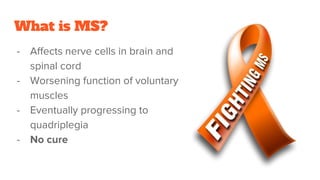
- Affects nerve cells in brain and
spinal cord
- Worsening function of voluntary
muscles
- Eventually progressing to
quadriplegia
- No cure
What Is Like To Have MS?
Pathophysiology
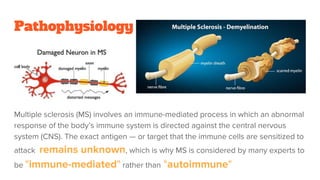
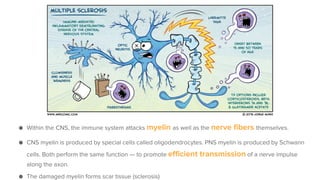
Multiple sclerosis (MS) involves an immune-mediated process in which an abnormal
response of the body’s immune system is directed against the central nervous
system (CNS). The exact antigen — or target that the immune cells are sensitized to
attack remains unknown, which is why MS is considered by many experts to
be "immune-mediated" rather than "autoimmune"
● Within the CNS, the immune system attacks myelin as well as the nerve fibers themselves.
● CNS myelin is produced by special cells called oligodendrocytes. PNS myelin is produced by Schwann
cells. Both perform the same function — to promote efficient transmission of a nerve impulse
along the axon.
● The damaged myelin forms scar tissue (sclerosis)
Pathophysiology
Continued
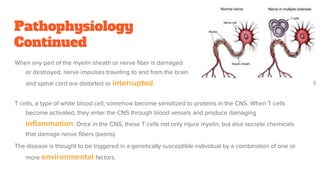
When any part of the myelin sheath or nerve fiber is damaged
or destroyed, nerve impulses traveling to and from the brain
and spinal cord are distorted or interrupted.
T cells, a type of white blood cell, somehow become sensitized to proteins in the CNS. When T cells
become activated, they enter the CNS through blood vessels and produce damaging
inflammation. Once in the CNS, these T cells not only injure myelin, but also secrete chemicals
that damage nerve fibers (axons).
The disease is thought to be triggered in a genetically susceptible individual by a combination of one or
more environmental factors.
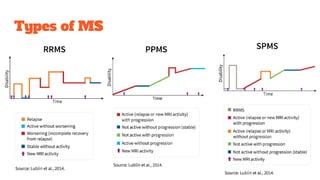
Types of MS
Clinical Manifestations
“Everyday is a struggle due to the fatigue… Sometimes I just have to stay in bed
because I can’t function.” -Tracy
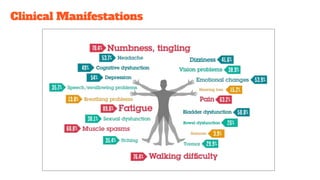
Subjective & objective data: fatigue, pain or paresthesias, changes in vision,
tinnitus or vertigo, Uhthoff’s sign, dysphagia, slurred speech (dysarthria),
muscle spasticity and uncontrollable movements, muscle weakness,
bowel and bladder dysfunction, nystagmus, and cognitive changes.
(ATI)
Findings may be vague, so diagnosis may not be made for several years. (ATI)
Relapses and remissions (ATI)
Diagnosis
Requires one of the following:
1. Two or more exacerbations 1 month apart that last at least 24 hours
OR
1. History of repeated exacerbations and remissions (with or without complete
recovery) followed by more severe and progressive manifestations lasting
6 months or more
OR
1. Slowly increasing manifestations for at least 6 months
(LeMone, 2013)
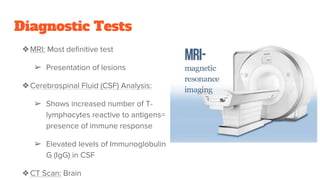
Diagnostic Tests
❖MRI: Most definitive test
➢ Presentation of lesions
❖Cerebrospinal Fluid (CSF) Analysis:
➢ Shows increased number of T-
lymphocytes reactive to antigens=
presence of immune response
➢ Elevated levels of Immunoglobulin
G (IgG) in CSF
❖CT Scan: Brain
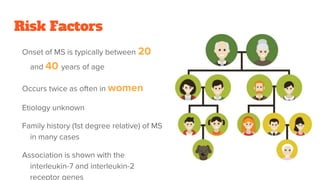
Risk Factors
Onset of MS is typically between 20
and 40 years of age
Occurs twice as often in women
Etiology unknown
Family history (1st degree relative) of MS
in many cases
Association is shown with the
interleukin-7 and interleukin-2
receptor genes
Medications
Three main types
Immunosuppressive agents
Corticosteroids
Antispasmodics
Medications (cont.)
Immunosuppressive agents: used to reduce
frequency of relapse
Azathioprine (Imuran) and Cyclosporine
(Sandimmune)
Monitor for long term effects, be alert for manifestations of
infection, assess for HTN, assess kidney function
Corticosteroids: used to reduce inflammation in acute exacerbations
Prednisone
Monitor for increased risk for infection, hypervolemia, hypernatremia, hypokalemia, hyperglycemia,
GI bleeding and personality changes
Medications (cont.)
Antispasmodics: used to treat muscle spasticity
Dantrolene (Dantrium), Tizanidine (Zanaflex), Baclofen (Lioresal) and Diazepam
(Valium)
Observe for increased weakness, monitor for liver damage (tizanidine and dantrolene)
Report jaundice and increased weakness to provider and avoid stopping baclofen suddenly
Other medications
Interferon beta (betaseron): immunomodulator, used to prevent or treat relapse
Carbamazepine (Tegretol): anticonvulsant, used for paresthesia
Docusate Sodium (Colace): stool softener, used for constipation
Propantheline: anticholinergic, used for bladder dysfunction
Primidone (Mysoline) and Clonazepam (Klonopin): beta-blockers, used for
tremors
Patient Teaching
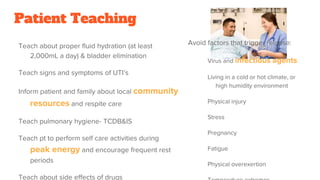
Teach about proper fluid hydration (at least
2,000mL a day) & bladder elimination
Teach signs and symptoms of UTI’s
Inform patient and family about local community
resources and respite care
Teach pulmonary hygiene- TCDB&IS
Teach pt to perform self care activities during
peak energy and encourage frequent rest
periods
Teach about side effects of drugs
Avoid factors that trigger relapse:
Virus and infectious agents
Living in a cold or hot climate, or
high humidity environment
Physical injury
Stress
Pregnancy
Fatigue
Physical overexertion
Community Resources
Family Caregiver Alliance:
785 Market Street, Suite 750, SF
(415) 434-3388
www.caregiver.org
Redwood Caregiver Resource Center:
1140 Sonoma Ave., Suite 1B, Santa Rosa
(707) 542-0282
www.redwoodcrc.org
Caregiver Support Self Help Group:
October 10th, 12:00pm
Round Table Pizza, 2065 Occidental Rd., Santa Rosa
National MS Society Research Video
Current Research: Myelin Repair
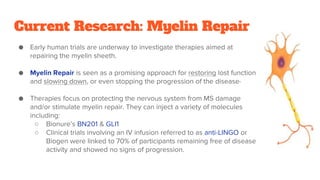
● Early human trials are underway to investigate therapies aimed at
repairing the myelin sheeth.
● Myelin Repair is seen as a promising approach for restoring lost function
and slowing down, or even stopping the progression of the disease·
● Therapies focus on protecting the nervous system from MS damage
and/or stimulate myelin repair. They can inject a variety of molecules
including:
○ Bionure’s BN201 & GLI1
○ Clinical trials involving an IV infusion referred to as anti-LINGO or
Biogen were linked to 70% of participants remaining free of disease
activity and showed no signs of progression.
Current Research: Stem Cell Therapy
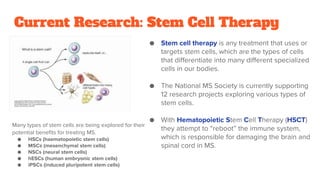
● Stem cell therapy is any treatment that uses or
targets stem cells, which are the types of cells
that differentiate into many different specialized
cells in our bodies.
● The National MS Society is currently supporting
12 research projects exploring various types of
stem cells.
● With Hematopoietic Stem Cell Therapy (HSCT)
they attempt to “reboot” the immune system,
which is responsible for damaging the brain and
spinal cord in MS.
Many types of stem cells are being explored for their
potential benefits for treating MS.
● HSCs (haematopoietic stem cells)
● MSCs (mesenchymal stem cells)
● NSCs (neural stem cells)
● hESCs (human embryonic stem cells)
● iPSCs (induced pluripotent stem cells)
Current Research: Exercise & Diet
Exercise
Research has shown exercise is helpful in
managing many MS symptoms. Studies show
that patients who participated in an aerobic
exercise program benefited from:
better cardiovascular fitness
improved strength
better bladder and bowel function
less fatigue and depression
a more positive attitude/mood improvement
increased participation in social activities
Yoga
Diet
● Recently there have been links to
MS management with patients
everyday diet. A diet high in Vitamin
D and Biotin is recommended.
● Researchers have also found links
between our gut microbiome and
MS. We know that these bacteria can
affect the immune system and that
the gut microbiome can affect the
type of MS patients have. As of this
year research has now initiated a
trial of probiotics in MS patients.
Nursing Considerations:
● Monitoring of: visual acuity, speech patterns (fatigue with talking), swallowing, activity tolerance, and
skin integrity.
● Aid to decrease the risk of developing a urinary tract infection by encouraging fluid intake. Assist the
client with bladder elimination.
● Monitor cognitive changes and plan interventions. (Reorient the client. Place objects used daily in
routine places.)
● Use a communication board to help with dysarthria.
● Discuss coping mechanisms and sources of support.
● Apply eye patches to treat diplopia and alternate between eyes every few hours.
● Instruct client to visually scan environment.
● Exercise and stretch involved muscles.
● Cluster care to aid in energy conservation and plan rest periods.
● Promote and maintain safe home and hospital environment to reduce the risk of injury.
References
ATI RN Adult Medical Surgical Nursing Review Module (9th ed). (2013). Assessment Technologies Institute.
ATI RN Pharmacology for Nursing Review Module (6th ed). (2013). Assessment Technologies Institute.
Diet & Nutrition. National Multiple Sclerosis Society. Retrieved from
http://www.nationalmssociety.org/Living-Well-With-MS/Health-Wellness/Diet-Nutrition
LeMone, P., Burke, K., & Bauldoff, G. (2011). Medical-Surgical Nursing: Critical Thinking in Patient Care (5th ed). Upper Saddle
River, NJ Pearson.
Multiple Sclerosis and Acupuncture. (2016). Acupuncture Technology News. Retrieved from
http://www.miridiatech.com/news/2011/03/multiple-sclerosis-and-acupuncture/
Now MS Research. YouTube. Retrieved from https://www.youtube.com/embed/UXfxhlFik4o
Restoring What's Been Lost. (2016). National Multiple Sclerosis Society. Retrieved from
http://www.nationalmssociety.org/Research/Research-We-
Fund/Restoring-What-s-Been-Lost
Stem Cells in MS. National Multiple Sclerosis Society. Retrieved from
http://www.nationalmssociety.org/Research/Research-News-Progress/Stem-Cells-
in-MS
Weiner, Howard L. MD. Multiple Sclerosis Research. The McCourt Foundation.
(http://mccourtfoundation.org/research/ms-research
What Is MS? National Multiple Sclerosis Society. Retrieved from http://www.nationalmssociety.org/What-is-MS
What is it like to have MS? (2016). YouTube. Retrieved from https://www.youtube.com/watch?v=HwWI25XtV7Y

Multiple Sclerosis

  • 1.
    Paige Abrams, SummerClay, Shauna Fassino, Megan Hofer, Marika Schipper, Carly Smith Multiple Sclerosis
  • 2.
    What is MS? -Affects nerve cells in brain and spinal cord - Worsening function of voluntary muscles - Eventually progressing to quadriplegia - No cure
  • 3.
    What Is LikeTo Have MS?
  • 4.
    Pathophysiology Multiple sclerosis (MS)involves an immune-mediated process in which an abnormal response of the body’s immune system is directed against the central nervous system (CNS). The exact antigen — or target that the immune cells are sensitized to attack remains unknown, which is why MS is considered by many experts to be "immune-mediated" rather than "autoimmune"
  • 5.
    ● Within theCNS, the immune system attacks myelin as well as the nerve fibers themselves. ● CNS myelin is produced by special cells called oligodendrocytes. PNS myelin is produced by Schwann cells. Both perform the same function — to promote efficient transmission of a nerve impulse along the axon. ● The damaged myelin forms scar tissue (sclerosis)
  • 6.
    Pathophysiology Continued When any partof the myelin sheath or nerve fiber is damaged or destroyed, nerve impulses traveling to and from the brain and spinal cord are distorted or interrupted. T cells, a type of white blood cell, somehow become sensitized to proteins in the CNS. When T cells become activated, they enter the CNS through blood vessels and produce damaging inflammation. Once in the CNS, these T cells not only injure myelin, but also secrete chemicals that damage nerve fibers (axons). The disease is thought to be triggered in a genetically susceptible individual by a combination of one or more environmental factors.
  • 7.
  • 8.
  • 9.
    Clinical Manifestations “Everyday isa struggle due to the fatigue… Sometimes I just have to stay in bed because I can’t function.” -Tracy Subjective & objective data: fatigue, pain or paresthesias, changes in vision, tinnitus or vertigo, Uhthoff’s sign, dysphagia, slurred speech (dysarthria), muscle spasticity and uncontrollable movements, muscle weakness, bowel and bladder dysfunction, nystagmus, and cognitive changes. (ATI) Findings may be vague, so diagnosis may not be made for several years. (ATI) Relapses and remissions (ATI)
  • 10.
    Diagnosis Requires one ofthe following: 1. Two or more exacerbations 1 month apart that last at least 24 hours OR 1. History of repeated exacerbations and remissions (with or without complete recovery) followed by more severe and progressive manifestations lasting 6 months or more OR 1. Slowly increasing manifestations for at least 6 months (LeMone, 2013)
  • 11.
    Diagnostic Tests ❖MRI: Mostdefinitive test ➢ Presentation of lesions ❖Cerebrospinal Fluid (CSF) Analysis: ➢ Shows increased number of T- lymphocytes reactive to antigens= presence of immune response ➢ Elevated levels of Immunoglobulin G (IgG) in CSF ❖CT Scan: Brain
  • 12.
    Risk Factors Onset ofMS is typically between 20 and 40 years of age Occurs twice as often in women Etiology unknown Family history (1st degree relative) of MS in many cases Association is shown with the interleukin-7 and interleukin-2 receptor genes
  • 13.
    Medications Three main types Immunosuppressiveagents Corticosteroids Antispasmodics
  • 14.
    Medications (cont.) Immunosuppressive agents:used to reduce frequency of relapse Azathioprine (Imuran) and Cyclosporine (Sandimmune) Monitor for long term effects, be alert for manifestations of infection, assess for HTN, assess kidney function Corticosteroids: used to reduce inflammation in acute exacerbations Prednisone Monitor for increased risk for infection, hypervolemia, hypernatremia, hypokalemia, hyperglycemia, GI bleeding and personality changes
  • 15.
    Medications (cont.) Antispasmodics: usedto treat muscle spasticity Dantrolene (Dantrium), Tizanidine (Zanaflex), Baclofen (Lioresal) and Diazepam (Valium) Observe for increased weakness, monitor for liver damage (tizanidine and dantrolene) Report jaundice and increased weakness to provider and avoid stopping baclofen suddenly
  • 16.
    Other medications Interferon beta(betaseron): immunomodulator, used to prevent or treat relapse Carbamazepine (Tegretol): anticonvulsant, used for paresthesia Docusate Sodium (Colace): stool softener, used for constipation Propantheline: anticholinergic, used for bladder dysfunction Primidone (Mysoline) and Clonazepam (Klonopin): beta-blockers, used for tremors
  • 17.
    Patient Teaching Teach aboutproper fluid hydration (at least 2,000mL a day) & bladder elimination Teach signs and symptoms of UTI’s Inform patient and family about local community resources and respite care Teach pulmonary hygiene- TCDB&IS Teach pt to perform self care activities during peak energy and encourage frequent rest periods Teach about side effects of drugs Avoid factors that trigger relapse: Virus and infectious agents Living in a cold or hot climate, or high humidity environment Physical injury Stress Pregnancy Fatigue Physical overexertion
  • 18.
    Community Resources Family CaregiverAlliance: 785 Market Street, Suite 750, SF (415) 434-3388 www.caregiver.org Redwood Caregiver Resource Center: 1140 Sonoma Ave., Suite 1B, Santa Rosa (707) 542-0282 www.redwoodcrc.org Caregiver Support Self Help Group: October 10th, 12:00pm Round Table Pizza, 2065 Occidental Rd., Santa Rosa
  • 19.
    National MS SocietyResearch Video
  • 20.
    Current Research: MyelinRepair ● Early human trials are underway to investigate therapies aimed at repairing the myelin sheeth. ● Myelin Repair is seen as a promising approach for restoring lost function and slowing down, or even stopping the progression of the disease· ● Therapies focus on protecting the nervous system from MS damage and/or stimulate myelin repair. They can inject a variety of molecules including: ○ Bionure’s BN201 & GLI1 ○ Clinical trials involving an IV infusion referred to as anti-LINGO or Biogen were linked to 70% of participants remaining free of disease activity and showed no signs of progression.
  • 21.
    Current Research: StemCell Therapy ● Stem cell therapy is any treatment that uses or targets stem cells, which are the types of cells that differentiate into many different specialized cells in our bodies. ● The National MS Society is currently supporting 12 research projects exploring various types of stem cells. ● With Hematopoietic Stem Cell Therapy (HSCT) they attempt to “reboot” the immune system, which is responsible for damaging the brain and spinal cord in MS. Many types of stem cells are being explored for their potential benefits for treating MS. ● HSCs (haematopoietic stem cells) ● MSCs (mesenchymal stem cells) ● NSCs (neural stem cells) ● hESCs (human embryonic stem cells) ● iPSCs (induced pluripotent stem cells)
  • 22.
    Current Research: Exercise& Diet Exercise Research has shown exercise is helpful in managing many MS symptoms. Studies show that patients who participated in an aerobic exercise program benefited from: better cardiovascular fitness improved strength better bladder and bowel function less fatigue and depression a more positive attitude/mood improvement increased participation in social activities Yoga Diet ● Recently there have been links to MS management with patients everyday diet. A diet high in Vitamin D and Biotin is recommended. ● Researchers have also found links between our gut microbiome and MS. We know that these bacteria can affect the immune system and that the gut microbiome can affect the type of MS patients have. As of this year research has now initiated a trial of probiotics in MS patients.
  • 23.
    Nursing Considerations: ● Monitoringof: visual acuity, speech patterns (fatigue with talking), swallowing, activity tolerance, and skin integrity. ● Aid to decrease the risk of developing a urinary tract infection by encouraging fluid intake. Assist the client with bladder elimination. ● Monitor cognitive changes and plan interventions. (Reorient the client. Place objects used daily in routine places.) ● Use a communication board to help with dysarthria. ● Discuss coping mechanisms and sources of support. ● Apply eye patches to treat diplopia and alternate between eyes every few hours. ● Instruct client to visually scan environment. ● Exercise and stretch involved muscles. ● Cluster care to aid in energy conservation and plan rest periods. ● Promote and maintain safe home and hospital environment to reduce the risk of injury.
  • 24.
    References ATI RN AdultMedical Surgical Nursing Review Module (9th ed). (2013). Assessment Technologies Institute. ATI RN Pharmacology for Nursing Review Module (6th ed). (2013). Assessment Technologies Institute. Diet & Nutrition. National Multiple Sclerosis Society. Retrieved from http://www.nationalmssociety.org/Living-Well-With-MS/Health-Wellness/Diet-Nutrition LeMone, P., Burke, K., & Bauldoff, G. (2011). Medical-Surgical Nursing: Critical Thinking in Patient Care (5th ed). Upper Saddle River, NJ Pearson. Multiple Sclerosis and Acupuncture. (2016). Acupuncture Technology News. Retrieved from http://www.miridiatech.com/news/2011/03/multiple-sclerosis-and-acupuncture/ Now MS Research. YouTube. Retrieved from https://www.youtube.com/embed/UXfxhlFik4o Restoring What's Been Lost. (2016). National Multiple Sclerosis Society. Retrieved from http://www.nationalmssociety.org/Research/Research-We- Fund/Restoring-What-s-Been-Lost Stem Cells in MS. National Multiple Sclerosis Society. Retrieved from http://www.nationalmssociety.org/Research/Research-News-Progress/Stem-Cells- in-MS Weiner, Howard L. MD. Multiple Sclerosis Research. The McCourt Foundation. (http://mccourtfoundation.org/research/ms-research What Is MS? National Multiple Sclerosis Society. Retrieved from http://www.nationalmssociety.org/What-is-MS What is it like to have MS? (2016). YouTube. Retrieved from https://www.youtube.com/watch?v=HwWI25XtV7Y

Editor's Notes

  • #10 The disease is marked by relapses and remissions that may or may not return the client to their previous baseline level of function (ATI) Questionnaire for Tracy: At what age were you when you were diagnosed? 43 How did the doctors conclude that you had MS? Through MRI and spinal tap along w/ ongoing multiple symptoms What are the symptoms that you experience most on a daily basis? fatigue, weakness, dizziness, sleeping issues, memory issues, depression, and anxiety Are there any daily activities that are especially difficult for you? & do you have any strategies to help you cope with these difficulties? “Everyday is a struggle due the fatigue... the heat is a huge issue. I just have to push myself through. I avoid the heat as much as possible, and I avoid stress which is hard, and sometimes I just have to stay in bed because I can't function.” What medications do you take to manage your symptoms? & do you feel like your medications help? “I currently do a monthly infusion of Tysabri, I also take Zoloft, Xanax, Restoril, Gabapentin, Amantadine I think that's all the MS related drugs.” “I feel the meds help for the most part but sometimes the side effects are worrisome. It's a lot of hit and miss. Some days they work well, some days it feels they don't help at all. I will say that the Tysabri is the best of all the actual MS drugs I have tried. I just had to have a port placed in my chest because of vein issues.” Info about Tracy’s meds: Tysabri: formally called Antegren, generic name is natalizumab. Given by IV infusion “Tysabri (natalizumab) is a monoclonal antibody that affects the actions of the body's immune system. Monoclonal antibodies are made to target and destroy only certain cells in the body. This may help to protect healthy cells from damage.” <https://www.drugs.com/tysabri.html> “I will say that the Tysabri is the best of all the actual MS drugs I have tried. I just had to have a port placed in my chest because of vein issues.” -Tracy “Common side effects of Tysabri include headache, tired feeling, joint or muscle pain, redness/irritation at the injection site, swelling hands/feet/ankles, changes in menstrual cycle, stomach pain, diarrhea, skin rash, depression, painful menstrual cramps, or cold symptoms such as stuffy nose, sneezing, or sore throat.” <http://www.rxlist.com/tysabri-side-effects-drug-center.htm> Zoloft (sertraline) for depression Xanax (alprazolam) for anxiety Restoril (temazepam) for insomnia Gabapentin (neurontin) for nerve pain Amantadine “has been demonstrated that this amantadine, through some unknown mechanism, is sometimes effective in relieving fatigue in multiple sclerosis” (National MS Society) (but typically used for treatment of Parkinson’s disease)
  • #13 Interleukin- a class of glycoproteins produced by leukocytes for regulating immune response Smoking can increase person's risk of developing MS and exacerbates symptoms
  • #15 Immunosuppressives can cause nephrotoxicity by causing reduction of renal blood flow and GFR
  • #16 Intrathecal (spinal cord) administration available for Baclofen in severe cases of MS
  • #18 At least 2,000mL per day fluids to prevent tenacious sputum and UTI’s Some people need to self cath Pulmonary hygiene: TCDB, IS Avoids: may cause a relapse in manifestations