NON 5q SMA
Dr Ravi goyal
SR neurology
GMC kota
 The UMN is a motor neuron, the cell body lies
within the motor cortex of the cerebrum, and the
axon forms the corticobulbar and corticospinal
tracts.
 The LMN lying in the brainstem motor nuclei and
the anterior horns of the spinal cord, directly
innervate skeletal muscles.
 The UMNs are rostral to the LMNs and exert direct
or indirect supranuclear control over the LMNs .
 The SMA are a group of disorders caused by
degeneration of anterior horn cells and in some
subtypes, of bulbar motor neuron.
 Majority (96%) related with mutation in 5q
chromosome – 5q SMA
 Another (4%) –Non 5q SMA
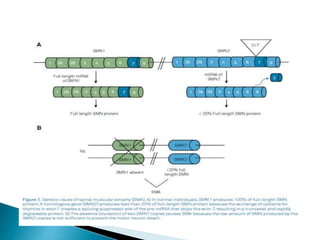
 Almost all cases are genetically determined, with
most being autosomal recessive due to
homozygous deletions of the survival motor
neuron (SMN) gene on chromosome 5q13.
 begins within the first few months of life.
 never able to sit without support.
 Symptoms include severe hypotonia, a weak cry and
respiratory distress.
 posture - characteristic “frog-leg” position.
 Death from respiratory failure, pneumonia, and
malnutrition usually occurs before age 2 years.
 usually begin between the ages of 6 and18 months.
 Delayed motor milestones are often the first clue.
 A fine hand tremor due to minipolymyoclonus suggests
diagnosis.
 It is quantitatively much milder, and progression is slower.
 Contractures of the hips and knees, clubfoot deformities,
severe scoliosis, and dislocation of the hips.
 survive into the third or fourth decade of adulthood.
 The onset is typically after 18 months of age (usually
between 5 and 15 yr years) and presents with difficulty in
walking .
 The disorder has an appearance not unlike a limb-girdle
muscular dystrophy With waddling gait.
 The clinical course of SMA 3 is slow progressive limb-
girdle weakness, with long periods of stability that last
for years.
 The characteristic clinical presentation is a slowly progressive
limb-girdle weakness leading to difficulty in walking, climbing
stairs, and rising from a chair or the floor.
 Fasciculations are an important finding and occur in 75% of
patients.
 Quadriceps muscle weakness is often a prominent feature.
 Bulbar signs, bony deformities such as scoliosis and respiratory
weakness are rare.
 Many cases have a distribution of weakness reminiscent of the
limb-girdle muscular dystrophies, leading to the older term,
pseudomyopathic SMA .
 very rare entity.
 clinically and genetically heterogeneous.
 Classified on the basis of -
 1. distribution of muscle weakness
(proximal, distal or bulbar)
 2. inheritance pattern (autosomal dominant,
autosomal recessive or X-linked)
Axon : Transport – DCTN1 ,BICD2
Chaperons –heat shock protein –HSPB1 ,HSPB3 , HSPB8
DNA/RNA – Processing - IGHMBP2
tRNA synthetase –GARS
Endoplasmic Reticulum - BSCL2
Membrane and synapse function –
neurotransmitter processing and synthesis –SLC5A7
ION flux –TRPV4
Signal transduction – NFKB1 –PLEKHG5
 The clinical hallmark is symmetrical muscle
weakness more for proximal than distal limb
muscles.
 Affecting the legs more than the arm.
 The clinical course ranges from static to rapidly
progressive, leading to respiratory distress
requiring mechanical Ventilation.
 Deep tendon reflexes can vary from absent to
brisk, depending on form, age at onset and
duration of he disease.
 In most cases intellect is preserved.
 It may be Early onset
Late onset
 Congenital to childhood onset
 May be AD , AR or XR
 Additional features, such as arthrogryposis,
myoclonic epilepsy, sensorineural deafness, or
pontocerebellar hypoplasia may be there .
 It is a rare disorder, with a variable onset age (from infancy
to early in the third decade).
 Encompassing sensorineural deafness, bulbar palsy and
respiratory compromise, often causing death.
 Type 1 is an AR condition caused by mutations in solute
carrier family 52, riboflavin transporter, member 3
(SLC52A3) implicated in dietary uptake of riboflavin.
 Type 2 is also AR condition related to mutations in
another riboflavin transporter gene, SLC52A2 function
 in riboflavin uptake from blood to target cells.
 Fazio-Londe syndrome is considered the same
disease entity as Brown-Vialetto-Van Laere
syndrome but it does not involve hearing loss.
 Type 1 have decreased plasma levels of riboflavin
and its coenzyme forms so oral supplementation
of riboflavin provides a life-saving treatment .
 Although patients with type 2 do not show reduced
plasma riboflavin, but they are also responsive to
high-dose oral riboflavin treatment.
 AR (SMARD1 /HMN6 /DSMA1)
 Gene mutation - IGHMBP2 (transcription factor)
 Age- congenital to 2 year (3 to 6 month of life).
 Presented with hypotonia distal>proximal weakness
 diaphagramatic paralysis (ventilator dependent)
cardiomyopathy and lactic acidosis .
 AR (DSMA4)
 Gene – PLEKHG (Pleckstrin homology domain
protein family G member 5
 Nuclear factor Kb activator
 Age 2-11 year
 Only LMN features
 GARS mutation (glyceyl tRNA synthetase)
 Age 17 yrs with rare UMN sign
 Distal SMA with UL predominance,type 5B
 BSCL2 (Seipin ) mutation
 Age 15 years
 UMN sign with Hyperhydrosis (40%)
Both have slow progression
 Allelic phenotype of BSCL2 gene mutation (11q12.3)
 AD
 Spastic paraparesis
 Amyotrophy of hands and feet
 Asmpytomatic 4% cases
 Brown –Viaietto-Van Laare syndrome
Type 1
Type 2
 Fazio Londe syndrome
 sporadic AD or AR progressive facial and bulbar
palsy of late childhood.
 Eventual develop respiratory failure in the second
decade of life.
 Llittle or no evidence of involvement of other motor
neurons and with normal extraocular motility.
 differential diagnosis includes a structural brainstem
lesion, myasthenia gravis, and the Miller-Fisher
variant of GBS.
 Molecular genetic tests :-
 Next Generation sequencing technology –
 Allow us to sequence DNA and RNA much more quickly
and cheaply than older ones with high speed.
 Include prepration of DNA , amplification by PCR and
array sequenceing .
 Electromyography to record the electrical activity From
the brain and spinal cord to a peripheral nerve root in
Arms and legs .
• Nerve conduction velocity studies -
• Measure electrical energy by Assessing the nerve’s
ability to send a signal.
• Muscle biopsy used to diagnose Neuromuscular
disorders and may also reveal if a person is a carrier
of a defective gene that could be passed to children.
• Serum CPK level
 No drug is available for curing non 5q SMA till now,
 Except Brown –Viaietto-Van Laare syndrome
(ribflavin is effective)
 Treatment consists of managing the symptoms
 and preventing complications .
 Muscle relaxants such as baclofen, tizanidine, and
the benzodiazepines may reduce spasticity.
 Antisense oligonucleotide increases exon 7
inclusion in SMN 2 mRNA
 FDA approved in 2016
 Intra thecal adminstration
 Dose - 12mg (5ml)
 4 loading doses 2 wk apart and 4th 30 days after
3rd dose, maintenance dose every 4 month
 Mc s/e respiratory infection and constipation.
 only for 5q SMA
 Very costly US$125,000 per injection
 It is an adeno-associated virus vector-based gene therapy .
 Indicated for the treatment of SMA less than 2 years of age with bi-
allelic mutations in the survival motor neuron 1 (SMN1) gene
 It address the genetic root cause of SMA by replacing defective SMN1
gene.
 Administration - a single, one-time intravenous (IV) infusion per year.
 Data from the Phase 3 STR1VE trial show prolonged event-free survival,
increases in motor function and significant milestone achievement in
patients with SMA Type 1, consistent with the Phase 1 START trial .
 FDA approved at 24 may 2019
 The most commonly adverse reactions (incidence >=5%)
elevated aminotransferases and vomiting.
 Administer systemic corticosteroid to all patients before
and after Zolgensma infusion. Continue to monitor liver
function for at least 3 months after on .
 Total cost $2.1 million or $425,000 a year spread out
over five years.
 the world’s most expensive drug.
 Occupational and physiotherapy improves
 Posture
 Prevent joint immobility
 Slow muscle weakness and atrophy.
Stretching and strengthening exercise reduces
 Spasticity
 Increase range of motion and
 Keeps circulation flowing.
 Some individual requires additional therapy for
 Speech, Chewing and swallowing difficulties.
 Assistive devices such as
 Supports or braces,
 Orthotics,
 Speech synthesizers and
 Wheelchairs may improve the quality of life with SMA.
 Non-5q SMA has long represented a challenge for
clinicians and scientists due to its enormous
variability, both clinically and genetically.
 The advances in next generation sequencing have
elucidated the causal genes for many SMA types,
 yet this only further complicates matters by revealing
overlaps with several other neuromuscular disorders.
 The major challenge for the future will be
determining the pathogenicity of the causal
mutation among a multitude of genetic
alterations.
 To this end, platforms for sharing of next
generation sequencing data should be developed
to increase the chances of finding a second hit,
 Accurate and predictive models of SMA should
be created by screening of potential mutations
and for the identification of drug hits.
 Pestronk A. Hereditary motor syndromes. Available at:
 http://neuromuscular.wustl.edu/synmot.html. Accessed
February 11, 2011.
 Harms MB, Allred P, Gardner R Jr, et al. Dominant spinal
muscular atrophy with lower extremity predominance:
linkage to 14q32. Neurology 2010;75:539 –546.
 Jokela M, Penttilä S, Huovinen S, et al. Late-onset lower
 motor neuronopathy: a new autosomal dominant
disorder.
 Neurology 2011;77:334 –340 Basil T. Darras
 Non-5q spinal muscular atrophies: The alphanumeric
soup thickens
THANK YOU

Sma ppt

  • 1.
    NON 5q SMA DrRavi goyal SR neurology GMC kota
  • 2.
     The UMNis a motor neuron, the cell body lies within the motor cortex of the cerebrum, and the axon forms the corticobulbar and corticospinal tracts.  The LMN lying in the brainstem motor nuclei and the anterior horns of the spinal cord, directly innervate skeletal muscles.  The UMNs are rostral to the LMNs and exert direct or indirect supranuclear control over the LMNs .
  • 3.
     The SMAare a group of disorders caused by degeneration of anterior horn cells and in some subtypes, of bulbar motor neuron.  Majority (96%) related with mutation in 5q chromosome – 5q SMA  Another (4%) –Non 5q SMA
  • 4.
     Almost allcases are genetically determined, with most being autosomal recessive due to homozygous deletions of the survival motor neuron (SMN) gene on chromosome 5q13.
  • 7.
     begins withinthe first few months of life.  never able to sit without support.  Symptoms include severe hypotonia, a weak cry and respiratory distress.  posture - characteristic “frog-leg” position.  Death from respiratory failure, pneumonia, and malnutrition usually occurs before age 2 years.
  • 8.
     usually beginbetween the ages of 6 and18 months.  Delayed motor milestones are often the first clue.  A fine hand tremor due to minipolymyoclonus suggests diagnosis.  It is quantitatively much milder, and progression is slower.  Contractures of the hips and knees, clubfoot deformities, severe scoliosis, and dislocation of the hips.  survive into the third or fourth decade of adulthood.
  • 9.
     The onsetis typically after 18 months of age (usually between 5 and 15 yr years) and presents with difficulty in walking .  The disorder has an appearance not unlike a limb-girdle muscular dystrophy With waddling gait.  The clinical course of SMA 3 is slow progressive limb- girdle weakness, with long periods of stability that last for years.
  • 10.
     The characteristicclinical presentation is a slowly progressive limb-girdle weakness leading to difficulty in walking, climbing stairs, and rising from a chair or the floor.  Fasciculations are an important finding and occur in 75% of patients.  Quadriceps muscle weakness is often a prominent feature.  Bulbar signs, bony deformities such as scoliosis and respiratory weakness are rare.  Many cases have a distribution of weakness reminiscent of the limb-girdle muscular dystrophies, leading to the older term, pseudomyopathic SMA .
  • 11.
     very rareentity.  clinically and genetically heterogeneous.  Classified on the basis of -  1. distribution of muscle weakness (proximal, distal or bulbar)  2. inheritance pattern (autosomal dominant, autosomal recessive or X-linked)
  • 12.
    Axon : Transport– DCTN1 ,BICD2 Chaperons –heat shock protein –HSPB1 ,HSPB3 , HSPB8 DNA/RNA – Processing - IGHMBP2 tRNA synthetase –GARS Endoplasmic Reticulum - BSCL2 Membrane and synapse function – neurotransmitter processing and synthesis –SLC5A7 ION flux –TRPV4 Signal transduction – NFKB1 –PLEKHG5
  • 13.
     The clinicalhallmark is symmetrical muscle weakness more for proximal than distal limb muscles.  Affecting the legs more than the arm.  The clinical course ranges from static to rapidly progressive, leading to respiratory distress requiring mechanical Ventilation.
  • 14.
     Deep tendonreflexes can vary from absent to brisk, depending on form, age at onset and duration of he disease.  In most cases intellect is preserved.  It may be Early onset Late onset
  • 15.
     Congenital tochildhood onset  May be AD , AR or XR  Additional features, such as arthrogryposis, myoclonic epilepsy, sensorineural deafness, or pontocerebellar hypoplasia may be there .
  • 17.
     It isa rare disorder, with a variable onset age (from infancy to early in the third decade).  Encompassing sensorineural deafness, bulbar palsy and respiratory compromise, often causing death.  Type 1 is an AR condition caused by mutations in solute carrier family 52, riboflavin transporter, member 3 (SLC52A3) implicated in dietary uptake of riboflavin.  Type 2 is also AR condition related to mutations in another riboflavin transporter gene, SLC52A2 function  in riboflavin uptake from blood to target cells.
  • 18.
     Fazio-Londe syndromeis considered the same disease entity as Brown-Vialetto-Van Laere syndrome but it does not involve hearing loss.  Type 1 have decreased plasma levels of riboflavin and its coenzyme forms so oral supplementation of riboflavin provides a life-saving treatment .  Although patients with type 2 do not show reduced plasma riboflavin, but they are also responsive to high-dose oral riboflavin treatment.
  • 24.
     AR (SMARD1/HMN6 /DSMA1)  Gene mutation - IGHMBP2 (transcription factor)  Age- congenital to 2 year (3 to 6 month of life).  Presented with hypotonia distal>proximal weakness  diaphagramatic paralysis (ventilator dependent) cardiomyopathy and lactic acidosis .
  • 25.
     AR (DSMA4) Gene – PLEKHG (Pleckstrin homology domain protein family G member 5  Nuclear factor Kb activator  Age 2-11 year  Only LMN features
  • 26.
     GARS mutation(glyceyl tRNA synthetase)  Age 17 yrs with rare UMN sign  Distal SMA with UL predominance,type 5B  BSCL2 (Seipin ) mutation  Age 15 years  UMN sign with Hyperhydrosis (40%) Both have slow progression
  • 27.
     Allelic phenotypeof BSCL2 gene mutation (11q12.3)  AD  Spastic paraparesis  Amyotrophy of hands and feet  Asmpytomatic 4% cases
  • 28.
     Brown –Viaietto-VanLaare syndrome Type 1 Type 2  Fazio Londe syndrome
  • 29.
     sporadic ADor AR progressive facial and bulbar palsy of late childhood.  Eventual develop respiratory failure in the second decade of life.  Llittle or no evidence of involvement of other motor neurons and with normal extraocular motility.  differential diagnosis includes a structural brainstem lesion, myasthenia gravis, and the Miller-Fisher variant of GBS.
  • 30.
     Molecular genetictests :-  Next Generation sequencing technology –  Allow us to sequence DNA and RNA much more quickly and cheaply than older ones with high speed.  Include prepration of DNA , amplification by PCR and array sequenceing .  Electromyography to record the electrical activity From the brain and spinal cord to a peripheral nerve root in Arms and legs .
  • 31.
    • Nerve conductionvelocity studies - • Measure electrical energy by Assessing the nerve’s ability to send a signal. • Muscle biopsy used to diagnose Neuromuscular disorders and may also reveal if a person is a carrier of a defective gene that could be passed to children. • Serum CPK level
  • 32.
     No drugis available for curing non 5q SMA till now,  Except Brown –Viaietto-Van Laare syndrome (ribflavin is effective)  Treatment consists of managing the symptoms  and preventing complications .  Muscle relaxants such as baclofen, tizanidine, and the benzodiazepines may reduce spasticity.
  • 33.
     Antisense oligonucleotideincreases exon 7 inclusion in SMN 2 mRNA  FDA approved in 2016  Intra thecal adminstration  Dose - 12mg (5ml)
  • 34.
     4 loadingdoses 2 wk apart and 4th 30 days after 3rd dose, maintenance dose every 4 month  Mc s/e respiratory infection and constipation.  only for 5q SMA  Very costly US$125,000 per injection
  • 35.
     It isan adeno-associated virus vector-based gene therapy .  Indicated for the treatment of SMA less than 2 years of age with bi- allelic mutations in the survival motor neuron 1 (SMN1) gene  It address the genetic root cause of SMA by replacing defective SMN1 gene.  Administration - a single, one-time intravenous (IV) infusion per year.  Data from the Phase 3 STR1VE trial show prolonged event-free survival, increases in motor function and significant milestone achievement in patients with SMA Type 1, consistent with the Phase 1 START trial .
  • 36.
     FDA approvedat 24 may 2019  The most commonly adverse reactions (incidence >=5%) elevated aminotransferases and vomiting.  Administer systemic corticosteroid to all patients before and after Zolgensma infusion. Continue to monitor liver function for at least 3 months after on .  Total cost $2.1 million or $425,000 a year spread out over five years.  the world’s most expensive drug.
  • 37.
     Occupational andphysiotherapy improves  Posture  Prevent joint immobility  Slow muscle weakness and atrophy. Stretching and strengthening exercise reduces  Spasticity  Increase range of motion and  Keeps circulation flowing.
  • 38.
     Some individualrequires additional therapy for  Speech, Chewing and swallowing difficulties.  Assistive devices such as  Supports or braces,  Orthotics,  Speech synthesizers and  Wheelchairs may improve the quality of life with SMA.
  • 39.
     Non-5q SMAhas long represented a challenge for clinicians and scientists due to its enormous variability, both clinically and genetically.  The advances in next generation sequencing have elucidated the causal genes for many SMA types,  yet this only further complicates matters by revealing overlaps with several other neuromuscular disorders.
  • 40.
     The majorchallenge for the future will be determining the pathogenicity of the causal mutation among a multitude of genetic alterations.  To this end, platforms for sharing of next generation sequencing data should be developed to increase the chances of finding a second hit,  Accurate and predictive models of SMA should be created by screening of potential mutations and for the identification of drug hits.
  • 41.
     Pestronk A.Hereditary motor syndromes. Available at:  http://neuromuscular.wustl.edu/synmot.html. Accessed February 11, 2011.  Harms MB, Allred P, Gardner R Jr, et al. Dominant spinal muscular atrophy with lower extremity predominance: linkage to 14q32. Neurology 2010;75:539 –546.  Jokela M, Penttilä S, Huovinen S, et al. Late-onset lower  motor neuronopathy: a new autosomal dominant disorder.  Neurology 2011;77:334 –340 Basil T. Darras  Non-5q spinal muscular atrophies: The alphanumeric soup thickens
  • 42.