Multiple SclerosisKrista Lamkin3/06/10
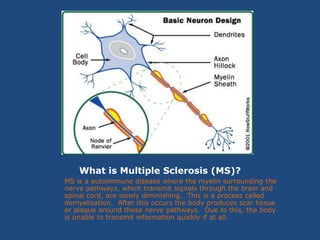
What is Multiple Sclerosis (MS)?MS is a autoimmune disease where the myelin surrounding the nerve pathways, which transmit signals through the brain and spinal cord, are slowly diminishing.  This is a process called demyelization.  After this occurs the body produces scar tissue or plaque around these nerve pathways.  Due to this, the body is unable to transmit information quickly if at all.
MS Stages of DevelopmentRelapsing/Remitting: In this stage the pt experience acute attacks.  Between these attacks the disorder is not progressing.  During this time, pt may be admitted to hospital for three to five days to get intravenous corticosteroids.  Some side effects may include: osteoporosis and impaired memory.  The impaired memory can be reversed.
Secondary Progressive: In this stage the disorder is progressing at a variable rate.  This stage normally takes many years to form; approximately 10-25 years.
Primary Progressive: Progression of disease WITHOUT REMISSION.  (Relates to 10% of those diagnosed with MS)
Progressive Relapsing: Progressive from the onset with clear acute relapses.  (Relates to 5% of those diagnosed with MS)     ***In the chronic stages, patient will be treated with medical management.  This may include, catheterization, tube feeding, or surgical release of tendons for contractures.***
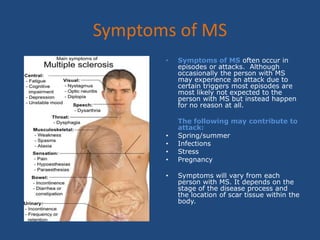
Symptoms of MSSymptoms of MS often occur in episodes or attacks.  Although occasionally the person with MS may experience an attack due to certain triggers most episodes are most likely not expected to the person with MS but instead happen for no reason at all.The following may contribute to attack:Spring/summerInfectionsStressPregnancySymptoms will vary from each person with MS. It depends on the stage of the disease process and the location of scar tissue within the body.
How can Occupational Therapy help for a person with MS?Fatigue Management- Often people with MS will feel fatigue.  This has been categorized into primary and secondary fatigue.  Primary fatigue is due to the disease process itself:  ex: when the nerve pathways are demylenated the body will use more energy to activate the muscle.  Secondary fatigue may be due to deconditioning, respiratory muscle weakness, and pain.  Some techniques used are: pacing, successful work/rest ratio, use of electronic aids as needed, control of spasticity, heat control, aerobic activity, and improved trunk control.
Control of tremors: Interventions Occupational Therapy may use are: splinting (support of the limbs), use of weights, activities focused on trunk support, controlling fatigue through energy conservation techniques, and decrease fine motor coordination demands.
Cognitive Compensations- Patient may have cognitive changes that change throughout the day.  It is best for Occupational Therapy to present new information simply to patient and repeatedly.  There must be consistency with the program from day to day with the days patient is seen, the time, and modalities used.  Occupational Therapy will also allow extra time to complete activities, help the patient keep organized and work space uncluttered, and the occupational therapist may use memory aids such as timers.Occupational Therapy Cont.Improving Sensory Deficits- The therapist aims to make patient and family aware of his or her sensory dysfunction and teaches the patient compensatory techniques.  If a patient is suffering from loss of tactile sensation, the Occupational Therapist will help the patient compensate visually.  If patient can not feel pain or temperature, the Occupational Therapist may ask for them to stay out of situations where they may get burned.  If patient is experiencing visual deficits, the Occupational Therapist may suggest covering one eye, or to use devices recommended for low vision such as a magnifying glass.
Strength and Endurance Training- Graded resistive activities increase the strength of key muscle groups and should be targeted to specific muscle groups that are task specific.  To increase endurance, focus should be on increasing repetitions instead of weight.  Occupational Therapy Cont.Contracture Prevention and Treatment- Contractures develop with patients with limited Active Range of Motion.  They have difficulty moving their joints into full range.  Contractures can be prevented by regular movement of muscles and joints.  A program of Active Range of Motion  (patient does all movement alone) and Passive Range of Motion (where therapist moves patient) and stretching at least twice a day will be recommended.
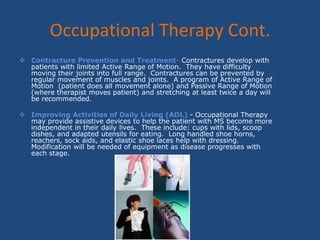
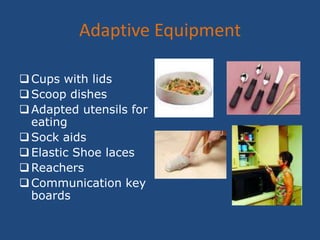
Improving Activities of Daily Living (ADL)- Occupational Therapy may provide assistive devices to help the patient with MS become more independent in their daily lives.  These include: cups with lids, scoop dishes, and adapted utensils for eating.  Long handled shoe horns, reachers, sock aids, and elastic shoe laces help with dressing.  Modification will be needed of equipment as disease progresses with each stage.  Occupational Therapy ContCommunication- the Occupational Therapist will work closely with the speech therapist in this area but may recommend devices such as communication keyboards.

Multiple Sclerosis Powerpoint

  • 1.
  • 2.
    What is MultipleSclerosis (MS)?MS is a autoimmune disease where the myelin surrounding the nerve pathways, which transmit signals through the brain and spinal cord, are slowly diminishing. This is a process called demyelization. After this occurs the body produces scar tissue or plaque around these nerve pathways. Due to this, the body is unable to transmit information quickly if at all.
  • 3.
    MS Stages ofDevelopmentRelapsing/Remitting: In this stage the pt experience acute attacks. Between these attacks the disorder is not progressing. During this time, pt may be admitted to hospital for three to five days to get intravenous corticosteroids. Some side effects may include: osteoporosis and impaired memory. The impaired memory can be reversed.
  • 4.
    Secondary Progressive: Inthis stage the disorder is progressing at a variable rate. This stage normally takes many years to form; approximately 10-25 years.
  • 5.
    Primary Progressive: Progressionof disease WITHOUT REMISSION. (Relates to 10% of those diagnosed with MS)
  • 6.
    Progressive Relapsing: Progressivefrom the onset with clear acute relapses. (Relates to 5% of those diagnosed with MS) ***In the chronic stages, patient will be treated with medical management. This may include, catheterization, tube feeding, or surgical release of tendons for contractures.***
  • 7.
    Symptoms of MSSymptomsof MS often occur in episodes or attacks. Although occasionally the person with MS may experience an attack due to certain triggers most episodes are most likely not expected to the person with MS but instead happen for no reason at all.The following may contribute to attack:Spring/summerInfectionsStressPregnancySymptoms will vary from each person with MS. It depends on the stage of the disease process and the location of scar tissue within the body.
  • 8.
    How can OccupationalTherapy help for a person with MS?Fatigue Management- Often people with MS will feel fatigue. This has been categorized into primary and secondary fatigue. Primary fatigue is due to the disease process itself: ex: when the nerve pathways are demylenated the body will use more energy to activate the muscle. Secondary fatigue may be due to deconditioning, respiratory muscle weakness, and pain. Some techniques used are: pacing, successful work/rest ratio, use of electronic aids as needed, control of spasticity, heat control, aerobic activity, and improved trunk control.
  • 9.
    Control of tremors:Interventions Occupational Therapy may use are: splinting (support of the limbs), use of weights, activities focused on trunk support, controlling fatigue through energy conservation techniques, and decrease fine motor coordination demands.
  • 10.
    Cognitive Compensations- Patientmay have cognitive changes that change throughout the day. It is best for Occupational Therapy to present new information simply to patient and repeatedly. There must be consistency with the program from day to day with the days patient is seen, the time, and modalities used. Occupational Therapy will also allow extra time to complete activities, help the patient keep organized and work space uncluttered, and the occupational therapist may use memory aids such as timers.Occupational Therapy Cont.Improving Sensory Deficits- The therapist aims to make patient and family aware of his or her sensory dysfunction and teaches the patient compensatory techniques. If a patient is suffering from loss of tactile sensation, the Occupational Therapist will help the patient compensate visually. If patient can not feel pain or temperature, the Occupational Therapist may ask for them to stay out of situations where they may get burned. If patient is experiencing visual deficits, the Occupational Therapist may suggest covering one eye, or to use devices recommended for low vision such as a magnifying glass.
  • 11.
    Strength and EnduranceTraining- Graded resistive activities increase the strength of key muscle groups and should be targeted to specific muscle groups that are task specific. To increase endurance, focus should be on increasing repetitions instead of weight. Occupational Therapy Cont.Contracture Prevention and Treatment- Contractures develop with patients with limited Active Range of Motion. They have difficulty moving their joints into full range. Contractures can be prevented by regular movement of muscles and joints. A program of Active Range of Motion (patient does all movement alone) and Passive Range of Motion (where therapist moves patient) and stretching at least twice a day will be recommended.
  • 12.
    Improving Activities ofDaily Living (ADL)- Occupational Therapy may provide assistive devices to help the patient with MS become more independent in their daily lives. These include: cups with lids, scoop dishes, and adapted utensils for eating. Long handled shoe horns, reachers, sock aids, and elastic shoe laces help with dressing. Modification will be needed of equipment as disease progresses with each stage. Occupational Therapy ContCommunication- the Occupational Therapist will work closely with the speech therapist in this area but may recommend devices such as communication keyboards.