Multiple sclerosis
INTRODUCTION
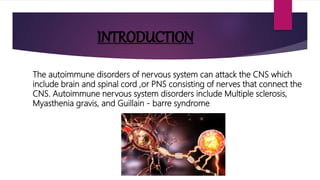
The autoimmune disorders of nervous system can attack the CNS which
include brain and spinal cord ,or PNS consisting of nerves that connect the
CNS. Autoimmune nervous system disorders include Multiple sclerosis,
Myasthenia gravis, and Guillain - barre syndrome.
DEFINITION
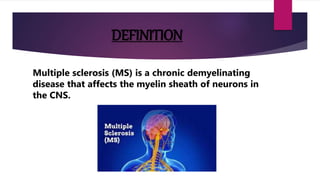
Multiple sclerosis (MS) is a chronic demyelinating
disease that affects the myelin sheath of neurons in
the CNS.
INCIDENCE
 Onset occurs between 20-40 years of age.
 Women are more affected than men. (AANN,2011).
 Whites are more affected than Hispanics , blacks , or Asians
.
 Most prevalent in colder climates of North America &
Europe.
 Migration.
ETIOLOGY & RISK FACTORS
 Exact cause is not known yet.
 Most theories suggest that MS is an immune genetic viral
disease (with Epstein Barr virus).
Risk factors are: –
 Age ( most of the time between 20-40 yrs.').
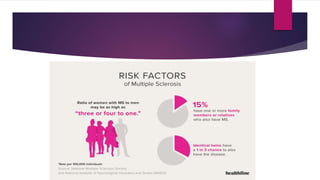
 Sex (women have more chance).
 Family history (genetic susceptibility).
 Certain infections ( like Epsteinbarr virus)
CONTI…
 Climate (more in cold climate areas).
 Certain auto-immune diseases (higher risks with thyroid
disease, type-1 DM or IBD).
 Smoking.
 Stress, fatigue.
 Physical injury.
 Pregnancy (may relating to stress to labour, or puerperium)
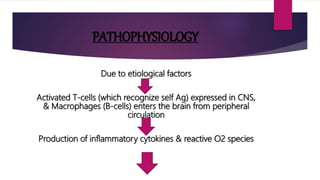
PATHOPHYSIOLOGY
Due to etiological factors
Activated T-cells (which recognize self Ag) expressed in CNS,
& Macrophages (B-cells) enters the brain from peripheral
circulation
Production of inflammatory cytokines & reactive O2 species
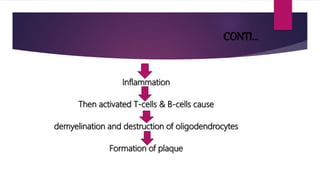
CONTI…
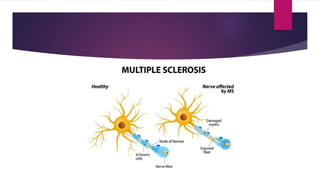
Inflammation
Then activated T-cells & B-cells cause
demyelination and destruction of oligodendrocytes
Formation of plaque
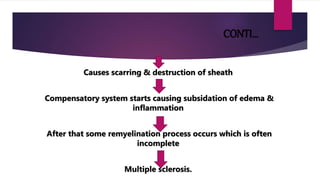
CONTI…
Causes scarring & destruction of sheath
Compensatory system starts causing subsidation of edema &
inflammation
After that some remyelination process occurs which is often
incomplete
Multiple sclerosis.
Clinical manifestation
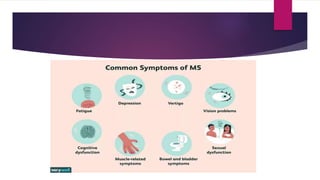
The most common early symptoms of MS are:
 Fatigue
 Vision problems
 Tingling and numbness
 Vertigo and dizziness
 Muscle weakness and spasms
 Problems with balance and coordination
CONTI…
Other, less common, symptoms include:
 Speech and swallowing problems
 Cognitive dysfunction
 Difficulty with walking
 Bladder and bowel dysfunction
 Sexual dysfunction
 Mood swings, depression
TYPES
The course of illness varies from person to person.
The 4 clinical patterns (types) have been
CONTI…
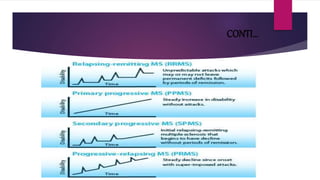
1. Relapsing
remitting MS (most common initial pattern):
Episodes of acute worsening with recovery and a
stable course between relapse.
CONTI…
2. Primary progressive MS:
Gradual, nearly continuous neurologic
deterioration from onset of manifestations
CONTI…
3) Secondary progressive MS:
Gradual neurologic deterioration with or without
superimposed acute relapses in a client who
previously had relapsing remiting MS.
CONTI…
CONTI…
4. Progressive relapsing MS:
Gradual neurologic deterioration from the onset of
manifestations but with sub-sequent superimposed
relapses
DIAGNOSTIC EVALUATION
 There is no definitive test for MS
 Detailed history of episodes of neurologic
dysfunction
 Physical examination
MEDICAL MANAGEMENT
 No exact cure.
 Aim is to prevent or postpone the long term
disability (often evolves slowly over many years).
 The treatment falls into 3 categories:-
1. Treatment of acute relapses.
2. Treatment aimed at disease management.
3. Symptomatic treatment.
CONTI…
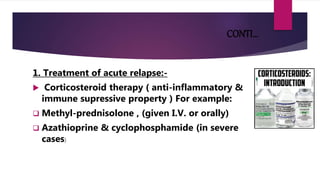
1. Treatment of acute relapse:-
 Corticosteroid therapy ( anti-inflammatory &
immune supressive property ) For example:
 Methyl-prednisolone , (given I.V. or orally)
 Azathioprine & cyclophosphamide (in severe
cases)
CONTI…
2) Treat exacerbations:- (treatment aimed at disease
management)
 Interferon-Beta 1b - Betaseron, given subcutaneously.
(antiviral & immuno-regulatory) (for ambulatory clients
with relapsing –remitting)
 Interferon Beta 1a - Avonex, (for treating replasing form
of MS).
 Glatiramer acetate - Copaxane , (for relapsing re-emitting
MS).
CONTI…
3. Symptomatic treatment:-
 For bladder dysfunction: - oxybutynin, propantheline.
 For constipation: - psyllium hydrophilic mucilloid,
suppositories.
 For fatigue: - amantadine, modafinil .
 For spasticity: - baclofen, diazefen, dantrolone
CONTI…
 For Tremor : - propanolol, phenobarbital,
clonazepam.
 For dysesthesias & trigeminal neurolgia: -
carbamazepine, phenytoin, amitriptyline.
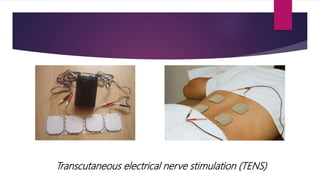
 For dysesthesias: - Transcutaneous electrical
nerve stimulation (TENS) is also helpful.
Transcutaneous electrical nerve stimulation (TENS)
CONTI…
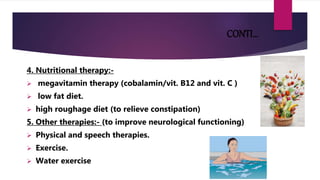
4. Nutritional therapy:-
 megavitamin therapy (cobalamin/vit. B12 and vit. C )
 low fat diet.
 high roughage diet (to relieve constipation)
5. Other therapies:- (to improve neurological functioning)
 Physical and speech therapies.
 Exercise.
 Water exercise
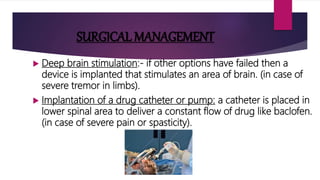
SURGICAL MANAGEMENT
 Deep brain stimulation:- if other options have failed then a
device is implanted that stimulates an area of brain. (in case of
severe tremor in limbs).

 Implantation of a drug catheter or pump: a catheter is placed in
lower spinal area to deliver a constant flow of drug like baclofen.
(in case of severe pain or spasticity).
NURSING MANAGEMENT
1. Nursing diagnosis: Fatigue related to increased energy needs as evidenced by facial
expression of client.
Intervention:
 Keep the environment cool.
 Provide mental support.
 Plan for rest periods during the day.
 Facilitate sleep by reducing night time interruption, noise, and light.
CONTI…
2. Nursing diagnosis: Impaired physical mobility related to weakness, contractures,
spasticity and ataxia as evidenced by pain in muscles and verbal experience.
Intervention:
 Assess the degree of muscle spasticity.
 Stretch muscles & perform ROM exercise.
 Administer anti-spasmotics as ordered.
 Position in neutral alignment.
 Consult with doctor for splints.
CONTI…
3. Nursing diagnosis: Impaired elimination pattern related to immobility &
demyelination as evidenced by disturbed bowel movement.
Intervention:
 Assess for normal bowel movement .
 Administer suppository as adviced by physician.
 Teach client to consume high fibre diet and 2000 ml of fluid.
Conti…
 4. Nursing diagnosis: Impaired urinary elimination pattern related to bladder
dysfunction as evidenced by low output and acute pain.
Intervention:
 Assess the skin for incontinance associated dermatitis with each voiding.
 Maintain fluid intake of 2000ml /day.
 Toilet every 2 hour .
 Scan bladder for post void residual volume.
 If PVR is more than 100ml , then catheterize.
CONTI…
5. Nursing diagnosis: Situational self esteeem, related to loss of
independence and fear of disability as evidenced by irritativeness and
facial expressions.
Intervention:
 Assess for depression and any related treatment.
 Assess for client’s problem solving strategies.
 Evaluate client’s support system.
 Provide experience that increase the client’ autonomy.
HEALTH EDUCATION
 Multiple Sclerosis can effect a person's life. Lessthan
5% of people die from MS.
 "Good nutrition; adequate rest; avoidance ofstress,
heat, and extreme physical exertion; and good
bladder hygiene may improve quality of life and
reduce symptoms." (The Gale Encyclopedia of
Medicine)
COMPLICATION
 Muscle stiffness or spams
 Paralysis , typically in the leg
 Problems with bladder or sexual function
 Mental changes , such as forget fulness or mood swings
 Epilepsy
CONCLUSION
Multiple sclerosis is an Inflammatory disease that
attacks the brain and the spinal cord at different
time . The protective myelin is damaged , which
interferes with the conclusion of nerve impulses.
Ms

Ms

  • 1.
  • 2.
    INTRODUCTION The autoimmune disordersof nervous system can attack the CNS which include brain and spinal cord ,or PNS consisting of nerves that connect the CNS. Autoimmune nervous system disorders include Multiple sclerosis, Myasthenia gravis, and Guillain - barre syndrome.
  • 3.
    DEFINITION Multiple sclerosis (MS)is a chronic demyelinating disease that affects the myelin sheath of neurons in the CNS.
  • 5.
    INCIDENCE  Onset occursbetween 20-40 years of age.  Women are more affected than men. (AANN,2011).  Whites are more affected than Hispanics , blacks , or Asians .  Most prevalent in colder climates of North America & Europe.  Migration.
  • 6.
    ETIOLOGY & RISKFACTORS  Exact cause is not known yet.  Most theories suggest that MS is an immune genetic viral disease (with Epstein Barr virus). Risk factors are: –  Age ( most of the time between 20-40 yrs.').  Sex (women have more chance).  Family history (genetic susceptibility).  Certain infections ( like Epsteinbarr virus)
  • 8.
    CONTI…  Climate (morein cold climate areas).  Certain auto-immune diseases (higher risks with thyroid disease, type-1 DM or IBD).  Smoking.  Stress, fatigue.  Physical injury.  Pregnancy (may relating to stress to labour, or puerperium)
  • 9.
    PATHOPHYSIOLOGY Due to etiologicalfactors Activated T-cells (which recognize self Ag) expressed in CNS, & Macrophages (B-cells) enters the brain from peripheral circulation Production of inflammatory cytokines & reactive O2 species
  • 10.
    CONTI… Inflammation Then activated T-cells& B-cells cause demyelination and destruction of oligodendrocytes Formation of plaque
  • 11.
    CONTI… Causes scarring &destruction of sheath Compensatory system starts causing subsidation of edema & inflammation After that some remyelination process occurs which is often incomplete Multiple sclerosis.
  • 12.
    Clinical manifestation The mostcommon early symptoms of MS are:  Fatigue  Vision problems  Tingling and numbness  Vertigo and dizziness  Muscle weakness and spasms  Problems with balance and coordination
  • 14.
    CONTI… Other, less common,symptoms include:  Speech and swallowing problems  Cognitive dysfunction  Difficulty with walking  Bladder and bowel dysfunction  Sexual dysfunction  Mood swings, depression
  • 15.
    TYPES The course ofillness varies from person to person. The 4 clinical patterns (types) have been
  • 16.
    CONTI… 1. Relapsing remitting MS(most common initial pattern): Episodes of acute worsening with recovery and a stable course between relapse.
  • 17.
    CONTI… 2. Primary progressiveMS: Gradual, nearly continuous neurologic deterioration from onset of manifestations
  • 18.
    CONTI… 3) Secondary progressiveMS: Gradual neurologic deterioration with or without superimposed acute relapses in a client who previously had relapsing remiting MS.
  • 19.
  • 20.
    CONTI… 4. Progressive relapsingMS: Gradual neurologic deterioration from the onset of manifestations but with sub-sequent superimposed relapses
  • 21.
    DIAGNOSTIC EVALUATION  Thereis no definitive test for MS  Detailed history of episodes of neurologic dysfunction  Physical examination
  • 22.
    MEDICAL MANAGEMENT  Noexact cure.  Aim is to prevent or postpone the long term disability (often evolves slowly over many years).  The treatment falls into 3 categories:- 1. Treatment of acute relapses. 2. Treatment aimed at disease management. 3. Symptomatic treatment.
  • 23.
    CONTI… 1. Treatment ofacute relapse:-  Corticosteroid therapy ( anti-inflammatory & immune supressive property ) For example:  Methyl-prednisolone , (given I.V. or orally)  Azathioprine & cyclophosphamide (in severe cases)
  • 24.
    CONTI… 2) Treat exacerbations:-(treatment aimed at disease management)  Interferon-Beta 1b - Betaseron, given subcutaneously. (antiviral & immuno-regulatory) (for ambulatory clients with relapsing –remitting)  Interferon Beta 1a - Avonex, (for treating replasing form of MS).  Glatiramer acetate - Copaxane , (for relapsing re-emitting MS).
  • 25.
    CONTI… 3. Symptomatic treatment:- For bladder dysfunction: - oxybutynin, propantheline.  For constipation: - psyllium hydrophilic mucilloid, suppositories.  For fatigue: - amantadine, modafinil .  For spasticity: - baclofen, diazefen, dantrolone
  • 26.
    CONTI…  For Tremor: - propanolol, phenobarbital, clonazepam.  For dysesthesias & trigeminal neurolgia: - carbamazepine, phenytoin, amitriptyline.  For dysesthesias: - Transcutaneous electrical nerve stimulation (TENS) is also helpful.
  • 27.
  • 28.
    CONTI… 4. Nutritional therapy:- megavitamin therapy (cobalamin/vit. B12 and vit. C )  low fat diet.  high roughage diet (to relieve constipation) 5. Other therapies:- (to improve neurological functioning)  Physical and speech therapies.  Exercise.  Water exercise
  • 29.
    SURGICAL MANAGEMENT  Deepbrain stimulation:- if other options have failed then a device is implanted that stimulates an area of brain. (in case of severe tremor in limbs).  Implantation of a drug catheter or pump: a catheter is placed in lower spinal area to deliver a constant flow of drug like baclofen. (in case of severe pain or spasticity).
  • 30.
    NURSING MANAGEMENT 1. Nursingdiagnosis: Fatigue related to increased energy needs as evidenced by facial expression of client. Intervention:  Keep the environment cool.  Provide mental support.  Plan for rest periods during the day.  Facilitate sleep by reducing night time interruption, noise, and light.
  • 31.
    CONTI… 2. Nursing diagnosis:Impaired physical mobility related to weakness, contractures, spasticity and ataxia as evidenced by pain in muscles and verbal experience. Intervention:  Assess the degree of muscle spasticity.  Stretch muscles & perform ROM exercise.  Administer anti-spasmotics as ordered.  Position in neutral alignment.  Consult with doctor for splints.
  • 32.
    CONTI… 3. Nursing diagnosis:Impaired elimination pattern related to immobility & demyelination as evidenced by disturbed bowel movement. Intervention:  Assess for normal bowel movement .  Administer suppository as adviced by physician.  Teach client to consume high fibre diet and 2000 ml of fluid.
  • 33.
    Conti…  4. Nursingdiagnosis: Impaired urinary elimination pattern related to bladder dysfunction as evidenced by low output and acute pain. Intervention:  Assess the skin for incontinance associated dermatitis with each voiding.  Maintain fluid intake of 2000ml /day.  Toilet every 2 hour .  Scan bladder for post void residual volume.  If PVR is more than 100ml , then catheterize.
  • 34.
    CONTI… 5. Nursing diagnosis:Situational self esteeem, related to loss of independence and fear of disability as evidenced by irritativeness and facial expressions. Intervention:  Assess for depression and any related treatment.  Assess for client’s problem solving strategies.  Evaluate client’s support system.  Provide experience that increase the client’ autonomy.
  • 35.
    HEALTH EDUCATION  MultipleSclerosis can effect a person's life. Lessthan 5% of people die from MS.  "Good nutrition; adequate rest; avoidance ofstress, heat, and extreme physical exertion; and good bladder hygiene may improve quality of life and reduce symptoms." (The Gale Encyclopedia of Medicine)
  • 36.
    COMPLICATION  Muscle stiffnessor spams  Paralysis , typically in the leg  Problems with bladder or sexual function  Mental changes , such as forget fulness or mood swings  Epilepsy
  • 37.
    CONCLUSION Multiple sclerosis isan Inflammatory disease that attacks the brain and the spinal cord at different time . The protective myelin is damaged , which interferes with the conclusion of nerve impulses.