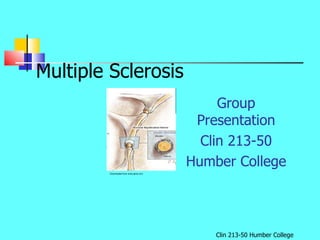
Multiple Sclerosis Group Presentation Clin 213-50 Humber College Clin 213-50 Humber College Downloaded from www.jama.com
Introduction Brief Overview of disease condition History of MS Epidemiology and world wide distribution Types of MS Signs and Symptoms Factors causing Disease Diagnosis Treatments Research Themes  Conclusion  References Clin 213-50 Humber College
Overview  MS is predominantly a white a matter disease and a  neurodegenreative disorder of the central nervous system that includes the brain, spinal cord and nerves.  Clin 213-50 Humber College
Multiple Sclerosis - Introduction It is an inflammatory and demyelinating disease.  Inflammation: body’s own immune cells attack the nervous system.  Demyelination: myelin (protective covering of the nerves) is destroyed leaving multiple areas of scar tissue or sclerosis. It is progressive disease   Most common age of occurrence – between 20 and 40
History of Multiple Sclerosis The earliest description of MS was recorded in Holland on August 4, 1421 but the history of the disease really begins in the 19th century with the first clear illustrations and clinical description of the disease beginning to appear in 1838”  Ref  :  ( Barnes, David.  Multiple Sclerosis Questions and Answers,  Merit Publishing International, Florida, 2000) .   The first actual case was diagnosed in 1849.  It was Dr.Jean-Martin Charcot who is credited with giving us the first signs and symptoms of Multiple Sclerosis .   Clin 213-50 Humber College
Multiple Sclerosis - Epidemiology Worldwide occurrence:1.1  –  2.5 million cases   MS in women  is 2-3 times more prevalent than in men. It is not contagious  In Canada an estimated that 55,000-75,000 people have multiple sclerosis
World Distribution of MS Clin 213-50 Humber College
Multiple Sclerosis - Types There are 4 types of MS Relapsing-remitting MS (RR-MS) Primary-progressive MS (PP-MS) Progressive-relapsing MS (PR-MS) Secondary-progressive MS (SP-MS)
Multiple Sclerosis - Types Relapsing-remitting MS (RR-MS) More than 80% of the cases Defined clinical exacerbation of neurological symptoms Followed by complete or incomplete remission   during which the person fully or partially recovers from the deficits acquired during relapse
Multiple Sclerosis - Types  Primary-progressive MS (PP-MS) 10 to 20% of individuals with MS are diagnosed with PP-MS Gradual progression of the disease from its onset No overlapping relapses and remissions
Multiple Sclerosis - Types  Progressive-relapsing MS (PR-MS) Rare  Initially presenting as PP-MS   however, during the course of the disease the individuals develop true neurologic exacerbations Steady progression of clinical neurological damage with superimposed relapses and remissions.
Multiple Sclerosis - Types Secondary Progressive MS (SP-MS) SP-MS is characterized by a steady progression of neurological damage with or without superimposed relapses and minor remissions Individuals with SP-MS will have experienced a period of RR-MS, which may have lasted from 2 to 40 years Any super-imposed relapses and remissions fade over time
Multiple Sclerosis Signs and Symptoms Vision impairment   Tingling and numbness of the skin and limbs   Difficulty with walking   Weakness and exhaustion   Memory loss  Depression  Urinary and bowel problems   Clin 213-50 Humber College
Multiple Sclerosis Signs and Symptoms The symptoms of MS may occur in isolation or in combination A clinical attack is considered if the symptoms are present for a minimum of 24 hours.
Factors Contributing for MS Genetic Factors Gender:  Women are 2 to 3 times more likely to get the disease. Family history of MS:  A family history increases the risk of developing MS  Race:  MS appears more commonly in Caucasians than in groups  Environmental factors:  MS occurs most commonly in those living in northern climates  Infections:  Researchers believe that many autoimmune diseases are provoked by some kind of infection that strikes people who have a certain genetic makeup  Socioeconomic status:  Least common in rural and lower class Migration : The age at which you may move may also be an important factor.  “If you move before the age of 15, your risk is that of the people in the country you move to.  If you move after the age of 15, your risk stays fixed at that of the country you grew up in”   (Ref:O’Connor)
Multiple Sclerosis - Causes The exact cause of multiple sclerosis is not clear In MS patients, a higher number of immune cells is seen which suggest there might be an immune response; this is suspected to be due to a virus or genetic defect Other causes are environmental and hereditary
Multiple Sclerosis - Diagnosis MS is a clinical diagnosis. It is diagnosed by neurological examination and brain MRI scans. Family history and lumber puncture are also used for diagnosis. If MS is present, very high percentage of protein IgG (oligoclonal antibody) bands can be seen in spinal fluid which is an additional confirmatory test. IgG banding is seen in other diseases as well such as, Syphilis.
Possible v/s Definite MS General Physical Examination History of all complaints of patients general health.  MRI (Magnetic Resonance Imaging) CSF (Cerebrospinal fluid) Fluid examined for cells, proteins, and electrolytes Proteins examined for presence of oligoclonal bands. NOT COMMON IN EARLY CASES  Clin 213-50 Humber College
MRI as Surrogate marker of disease process in MS Brain lesions Character Large  >  3 mm Ovoid Oriented perpendicular to ventricles Enhancing Open-ring enhancement Multifocal homogeneous Location Multiple white matter Brainstem, infratentorial Juxtacortical Corpus callosum Pointing away Moth eaten Callosal atrophy (REF: Christopher Bourque, Diagnostic Issues) Clin 213-50 Humber College
Multiple Sclerosis - Diagnosis Challenges Early diagnosis of MS is a challenge as immediate access to imaging and scans is not available in many parts of the country. Sometimes, family physicians may not diagnose the problem and hence won ’ t be able to send the patient to the right place. Due to similar symptoms in other diseases, MS can often be misdiagnosed.
How Does it work? Clin 213-50 Humber College
Demyelination of Nerve Fibers in MS Clin 213-50 Humber College The destruction of the myelin sheath leads to impaired communication between nerve cells and neurological symptoms such as abnormal sensations, vision problems , and weakness
Mode of Action The immune system attacks axons , causing  destruction of the myelin sheath resulting in a  Conduction Block  which leads to permanent loss of function. Clin 213-50 Humber College
How Autoimmune response cause MS Clin 213-50 Humber College
Pathophysiology  Autoimmune response results in damage and lost fibers. Nerves can regain myelin, but process is not fast enough to avoid the deterioration that occurs  Astrocytes form scars where myelin formerly existed Inflammation, loss of myelin, and nerve fibers, and the scarring that follows result in reduced transmission of nerve signals within the CNS.  Types of symptoms and severity vary widely due to the location of the scar tissue and extent of demyelination Clin 213-50 Humber College
Clinical Tools for MS Diagnosis    Schumacher Clinical Criteria -1965 Age (onset 10-50 years) CNS white matter disease Lesions disseminated in time and space Objective abnormalities on exam Consistent time course Attacks lasting > 24 hrs., spaced at least 1 month apart Slow or stepwise progression for > 6 months No better explanation Diagnosis by experienced clinician. Clin 213-50 Humber College
Clinical Tools for MS Diagnosis  Poser Criteria for the 1983 Widely used for last 20 years Definite or probable Laboratory supported MS Replaced by McDonald criteria 2001 Technical advances enable quicker diagnosis Controversial Clin 213-50 Humber College
Clinical Tools for MS Diagnosis McDonald Criteria Clin 213-50 Humber College
Clinical Tools for MS Diagnosis Expanded Disability Status Scale  Kurtzke ’ s Expanded Disability Status Scale (EDSS)  - Primary clinical outcome measure It is based on the measurement of mobility related abnormalities
Clinical Tools for MS Diagnosis  EDSS - Issues Disadvantages of EDSS Not a linear scale Heavily favors issues related with mobility Does not assess cognitive function Does not capture subtle changes
Clinical Tools for MS Diagnosis  EDSS - Issues EDSS is normally used against placebo-controlled arm. Now as more effective treatments are there it is unethical to use placebo as a control To judge the efficacy of investigational drug against the active arm, bigger sample size is required and more responsive outcome measures needed.
Clinical Tools for MS Diagnosis   Multiple Sclerosis Functional Composite  To overcome these issues, a new multidimensional outcome measure, the Multiple Sclerosis Functional Composite (MSFC) was proposed.  MSFC includes clinical dimensions of arm, leg and cognitive function.
Clinical Tools for MS Diagnosis   Multiple Sclerosis Functional Composite  MSFC is more sensitive to change than EDSS Change in MSFC over the first year of observation predicted subsequent change in the EDSS.
Treatment of Multiple Sclerosis  Although no cure exists for MS, treatment aims to reduce the number of relapses or attacks and to lessen their severity when they do occur.  Medications Chemotherapy MRI devoted to neurological imaging : using three-dimensional imaging that determines whether a patient's condition is worsening. Clin 213-50 Humber College
Treatments available in Canada Treatment involves managing the symptoms of multiple sclerosis as well as treating the disease before permanent damage occurs. Since 1995 Four medications have been approved by Health Canada for the treatment of relapsing-remitting MS (RRMS).  One is approved for secondary-progressive MS (SPMS).  One is approved for people at high risk of developing MS . Clin 213-50 Humber College
Alternative Treatments Acupuncture  Aromatherapy  Cannabis (Marijuana) Chiropractic  Cold Immersion  Dietary Supplements  Herbal Medication  Homepathy Injection of Venom such as snake and bee  Massage  Meditation  Reflexology  Tai Chi  Yoga  REF :Multiple Sclerosis: Hope Through Research, 06 April  2003 http:// intelihealth .com/IH/ ihtIH /WSIHW000/8320/21151/195415.html?d= dmtcontent Clin 213-50 Humber College
Medications used for MS   Spasticity  (involuntary muscle spasms)  - Baclofen, Tizanidine, Diazepam, Dantrolene Optic Neuritis - Methlyprednisolone, Oral steroids Fatigue - Antidepressant, Amantadine Pain - Codeine, Aspirin Sexual Dysfunction - Viagra, Pravatine  Tremor - Isoniazid, Primidone, Propranolol  Disease-Modifying Drugs - Interferon beta 1a and 1b, and Glatiramer acetate Clin 213-50 Humber College
Current Treatments  Clin 213-50 Humber College Interferon use in MS Discovered in 1957 A protein substance naturally produced in the body and believed to function to modulate the immune system where one infection with one virus interferes with a subsequent infection with another virus Interferon's interact with receptors on non-infected cells to promote the synthesis of antiviral proteins that prevent further infection. They belong to Cytokines, which are hormones of the immune system Significant antiviral agents
Current Treatments Clin 213-50 Humber College Avonex altered long-term course of MS in patients who began treatment immediately after initial attack  35% decrease in the rate of developing second attack  42% reduction in new or enlarging T2 hyper intense lesions
C urrent treatments cont’d: Disease Modifying Drugs Interferon Beta 1a (Avonex and Rebif):  Protein that is a replica of human interferon. It suppresses the immune system and helps to maintain the blood-brain barrier.  Avonex injected into the muscle once a week and Rebif is injected under the skin three times a week.  This drug is useful to people who have definite progressive MS.  One side effect of the drug is a flu like symptom  Interferon Beta 1b (Betaseron):   Different from our own interferon.  This medication does the same thing as beta 1a, but is injected just under the skin every two days. This is also given to people who have definite progressive MS.  Side effects include irritation, bruising, and redness at the site of injection and the flu like symptoms.  Clin 213-50 Humber College
Current Treatments cont’d: INTRAMUSCULAR INTERFERON BETA-1aTHERAPY ( LAWRENCE,D. JACOBS et al,  SEPTEMBER28, 2000) Objective: Initiating treatment at the time of a first clinical demyelinating event is of value. Method : A randomized, double-blind trial of 383 patients who had a first acute clinical demyelinating event. 193 patients were randomly assigned to receive weekly intra-muscular injections of 30 μg of interferon beta-1a and 190 were assigned to receive weekly injections of placebo. Study end points: were the development of clinically definite multiple sclerosis and changes in findings on MRI of the brain. Results :During three years of follow-up, the cumulative probability of the development of clinically definite multiple sclerosis was significantly lower in the interferon beta-1a group than in the placebo group (rate ratio, 0.56; 95 percent confidence interval, 0.38 to 0.81;  =0.002). Conclusions :   Initiating treatment with interferon beta-1a at the time of a first demyelinating event is beneficial for patients with brain lesions on MRI.
Current Treatments cont’d: Alemtuzumab Reduces the number of attacks experienced by people with relapsing-remitting multiple sclerosis. Alemtuzumab appears to be reasonably well tolerated despite the fact that it kills T cells.  One serious side effect was that one third of the trial subjects developed autoimmune thyroid disease (Graves ’ s disease) Relatively easily managed with thyroxin supplementation and most people with MS would exchange multiple sclerosis for Graves ’ s disease.  Clin 213-50 Humber College
Antidepressants Efficacy Trial Michael A. Posternak, M.D. et al,  (Am J Psychiatry 2002; 159:191 – 200) Method: After reviewing 31 antidepressant efficacy trials published between 1994 and 1998,  A computerized MEDLINE search and a manual search were used to identify studies evaluating the efficacy of antidepressants Antidepressant efficacy trials routinely exclude ,subjects believed to have high placebo response rates. Exclusion of these subjects significantly increases recruitment costs. The generalizability of antidepressant efficacy trials to a narrow population of “pure” depressed patients. eligibility is ascertained through a sequence of screening stages, and many ineligible subjects may not even be referred to such trials. No standard inclusion and exclusion criteria set exists.
Safety and Efficacy Issues Interferon beta-1a and hepatic injury. In March 2005, the prescribing information and medication guide were updated to include important new safety information including precautions for patients and pregnancy. Reference : Communication from Biogen dated 1 March 2005, posted on  http://www. fda . gov / medwatch .
A Randomized, Placebo-Controlled Trial of Natalizumab for Relapsing Multiple Sclerosis A total of 942 patients, 627 were randomly assigned to receive natalizumab (at a dose of 300 mg) and 315 to receive placebo by  intravenous infusion every four weeks for more than two years. (α4 integrin antagonist in a new class of selective adhesion molecule inhibitors).  Natalizumab reduced the risk of sustained progression of disability by 42 percent Over two years (hazard ratio, 0.58; 95 percent confidence interval, 0.43 to 0.77;P<0.001). The cumulative probability of progression (on the basis of Kaplan – Meier analysis) was 17 percent in the natalizumab group.  Ref : (ClinicalTrials.gov number, NCT00027300.)
Nataluzimab: marketing  withdrawal pending evaluation Suspended marketing of nataluzimab (Tysabri ® ) while two serious adverse events are evaluated. One confirmed fatal case  One possible case of progressive multifocal leukoencephalopathy ,a rare, serious  progressive neurologic disease usually occurring in immunosuppressed patients. FDA News, P05-07. 28 February 2005.  http://www. fda . gov / cder /drug/advisory/ natalizumab . htm .
Multiple Sclerosis and Epstein-Barr Virus   Ref:  Lynn I. Levin, PhD, MPH et al,  JAMA . 2003;289(12):1533-1536 (doi:10.1001/jama.289.12.1533) Objective  To determine whether antibodies to EBV are elevated before the onset of MS. Design, Setting, and Population  Nested case-control study conducted among more than 3 million US military personnel with blood samples collected between 1988 and 2000. Result :  Average time between blood collection and MS onset was 4 years. The date of onset of MS is difficult to establish accurately, Increased antibody response to EBV occurs early in relation to pathological process that leads to demyelination and clinical disease. No association was found between cytomegalovirus antibodies and MS. Strongest predictors of MS were serum levels of IgG antibodies to VCA( viral capsid antigen  ) or EBNA( nuclear antigen) complex.
Research Themes for Multiple Sclerosis MS research has generally taken two forms : Studies that focus on the mechanisms associated with nerve damage and nerve repair. Focusing on symptoms  Clinical Trials is distinctly divided into five phases i.e.,conceptualization, planning,implementation, analyzing and reporting. Clin 213-50 Humber College
Focus on current trends Hookworms Stem cells Vitamin D
Hookworms In MS Aims to determine whether infection with a small and harmless number of the worms can lead to an improvement on the severity of MS over a 12 month period. The trial is a multi-Centre study being carried out in UK Intended recruitment is 72 patients - 36 on hookworms and 36 on placebo. Method : 25 worms are introduced painlessly through a patch in the arm. They are then flushed out after nine months  If the trial is successful, the worms have the potential to provide a simple, cheap, natural and controllable treatment for MS.  Final result of the trial will be available in 2011/2012 Ref   :  Source: Professor Cris Constantinescu , University of Nottingham(UK) Clin 213-50 Humber College
Stem Cells in Multiple Sclerosis History 1945  –  Nuclear explosions over Hiroshima and Nagasaki 1950s  –  First studies involving HSC 1960s  –  Till and McCulloch establish the existence of pluripotent HSC Clin 213-50 Humber College
Stem Cells in Multiple Sclerosis How are Stem Cells different from the other types of cells? They have two important properties: - they are unspecialized cells capable of self renewal  - under certain conditions they can be induced to differentiate into other types of cells Clin 213-50 Humber College
Stem Cells in Multiple Sclerosis Sources of Stem Cells Embryonic stem cells Fetal stem cells Umbilical cord stem cells Adult stem cells Bone marrow Hematopoietic stem cells Mesenchymal stem cells Peripheral blood Clin 213-50 Humber College
Stem Cells in Multiple Sclerosis Hemopoietic stem cells  Give rise to all blood cells Collected from: Bone marrow Peripheral blood Clin 213-50 Humber College
Stem Cells in Multiple Sclerosis Method used to harvest HSC Bone marrow is stimulated using a cytokine As a result the blood is enriched with HSC Fluorescence Activated Cell Sorting is used to separate the different blood cells Cell Surface Marker Combinations (usually CD34) are used to achieve further purification Clin 213-50 Humber College
Stem Cells in Multiple Sclerosis Number of HSC transplantations performed annually worldwide: Aoutologous transplantations >30,000 Allogeneic transplantations >15,000 Used to treat such conditions as non-Hodgkin Lymphoma, multiple myeloma, Sickle cell anemia, lymphoid and hematologic cancers Clin 213-50 Humber College
Stem Cells in Multiple Sclerosis HSC transplantation for MS timeline 1997 – A. Fassas at al -  Peripheral blood stem cell transplantation in the treatment of progressive multiple sclerosis: first results of a pilot study 2003 - R. K. Burt  at al -  Hematopoietic stem cell transplantation for progressive multiple sclerosis: failure of a total body irradiation-based conditioning regimen to prevent disease progression in patients with high disability scores January 2009 - R. K. Burt  at al -  Autologous non-myeloablative haemopoietic stem cell transplantation in relapsing-remitting multiple sclerosis: a phase I/II study Clin 213-50 Humber College
Stem Cells in Multiple Sclerosis Autologous non-myeloablative haemopoietic stem cell transplantation in relapsing-remitting multiple sclerosis: a phase I/II study Study hypothesis:  An autologous HSC transplantation will reset the immune system of patients with MS, by replacing the autoreactive lymphocytes with ones that are self-tolerant Clin 213-50 Humber College
Stem Cells in Multiple Sclerosis Study method: This is accomplished by a process in which the patient ’ s autoreactive lymphocytes are destroyed by an initial course of chemotherapy, followed by HSC transplantation Clin 213-50 Humber College
Stem Cells in Multiple Sclerosis Inclusion criteria: Age between 18-55 Had relapsing-remitting MS  Met the McDonald criteria for MS Met the Poser criteria for MS Were treated with interferon beta for 6 months without response  EDSS scores measured at least 3 months after the last attack -  2.0-5.5 points  Normal levels for renal, hepatic, cardiac and pulmonary function  Clin 213-50 Humber College
Stem Cells in Multiple Sclerosis Study method description: Peripheral blood cells mobilized with cyclophosphamide, followed from day 5 by filgrastim  Once the neutrophils recovered the activated HSC were collected using apheresis and cryopreserved Conditioning regimen - cyclophosphamide given in four equal fractions between days -5 and -2, followed by alemtuzumab and methyl-prednisolone on day -2 Clin 213-50 Humber College
Stem Cells in Multiple Sclerosis Study method description cont ’ d: HSC re-infused on day 0 Filgrastim from day 5 till neutrophil recovery Clin 213-50 Humber College
Stem Cells in Multiple Sclerosis Post-chemotherapy prophylaxis: Atibacterial - cefepime, piperacillin – tazobactam  Antifungal- fluconazole  Antiviral - valaciclovir , aciclovir  Pneumocystis jirovecii  prevention - trimethoprim-sulfamethoxazole, nebulised pentamidine Clin 213-50 Humber College
Stem Cells in Multiple Sclerosis Study results Mobilization and transplantation procedures were considered well tolerated as there were no non-hematological toxicities of grade III or higher Relapse in 5 patients (23%) - these patients were treated with immunosuppressants and achieved remission and further neurological improvement Clin 213-50 Humber College
Stem Cells in Multiple Sclerosis Study results cont ’ d: 81% of patients improved by 1 or more points on EDSS score None had a score lower than the baseline All patients improved their EDSS score after the HSC transplantation Clin 213-50 Humber College
Stem Cells in Multiple Sclerosis Study results cont ’ d: Using Scripps neurological rating scale (NRS), it was determined  that 19 patients improved by 10 or more points and none of the patients had scores lower than their baseline scores Scores on the timed 25-foot walk, right-hand peg test and left-hand peg test all improved in comparison to baseline Patients felt that their health and quality of life has improved after the transplantation. Clin 213-50 Humber College
Stem Cells in Multiple Sclerosis Study results cont ’ d: at the time of publication the progression-free survival was 100% Reversal of neurological symptoms with improved EDSS score from baseline was observed in 81% of the patients Clin 213-50 Humber College
Stem Cells in Multiple Sclerosis Study results cont ’ d: Neurological function continued to improve for up to 2 years after the transplantation It was observed that some improvement occurred after a delay of 1 or more years Clin 213-50 Humber College
Stem Cells in Multiple Sclerosis Study results cont ’ d: The authors conclude that the autologous non-myeloablative haemopoietic stem cell transplantation is a procedure that can benefit patients with relapsing-remitting MS because it appears to stop progression of neurological symptoms as well as reverse neurological deficiency Clin 213-50 Humber College
Stem Cells in Multiple Sclerosis The results of this study are very encouraging because in contrast to the currently used therapies which aim to slow down the progression of MS without offering a cure for the disease, the autologous non-myeloablative haemopoietic stem cell transplantation promises to deliver a treatment that could not only delay the progression of the disease but also reverse the existing neurological damage. Clin 213-50 Humber College
Stem Cells in Multiple Sclerosis A new phase III study is on the way that will asses the efficacy of the tested method against any of the FDA-approved medication  A Canadian center will take part in the trial Clin 213-50 Humber College
Stem Cells in Multiple Sclerosis There is hope that a cure for the early stages of MS could be developed in the very near future Clin 213-50 Humber College
Vitamin D – the basics Vitamin D is a lipid soluble vitamin It is needed for the absorption of calcium which aids in the formation and maintenance of strong bones  It also aids in proper regulation of calcium and phosphorous levels in the blood Many disorders can arise because of vitaminD deficiency such as  rickets and osteomalacia
Sources of Vitamin D The dermal layer of the skin can manufacture vitamin D from UV rays of the sun, from there  the liver and kidney help  convert vitamin D to its  active hormone form It can also be obtained  form dietary sources such as cod liver oil, fortified  butter and margarine.
Vitamin D and Multiple sclerosis Some of the latest findings in research done in patients with multiple sclerosis (MS) is that, there is a correlation between vitamin  D deficiency and MS. Vitamin D deficiency afflicts most MS patients, as demonstrated by their low bone mass and high fracture rates (Nieves et. Al) We will be discussing 2 research papers on this topic and their findings.
1. High prevalence of vitamin D deficiency and  reduced bone mass in multiple sclerosis J. Nieves, F. Cosman, J. Herbert, V. Shen and R. Lindsay This study compared the bone mineral density of female MS patients with a healthy reference population. The subject population consisted of 80 females hospitalized with serious functional and medical problems suggesting a severe form of MS.  Male and black subjects were excluded from this study as they have been studied to have variant vitamin D levels (ref).
Neives et. Al cont’d The bone mass density (BMD) from the femoral neck and the lumbar spine and the total body mineral samples were obtained from subjects in both groups through dual x-ray absorptiometry.
Neives et. Al cont’d (Results) Discovered that the mean BMD for the patient group was 0.905 g/cm2 in the lumbar spine and 0.676 g/cm2 in the femoral neck, which causes them to be twice at risk for bone fractures specifically in the female population. The level was 1 to 2 significant digits lower in women with MS than their healthy counterparts. They also found that the chronic progressive MS had the lowest BMD and relapsing-remitting MS had the highest.
 
Neives et al. cont’d A lower bone mass density triggers fractures as well as osteoporosis specifically in females. Their findings suggested that a continued supplementation of vitamin D to the MS patients would reduce bone fractures and osteoporosis, which is common for them.
Cytokine Profile in Patients with Multiple Sclerosis Following Vitamin D Supplementation. B.D. Mahon, S. A. Gordon, J. Cruz, F. Cosman, and M.T. Cantorna In the next trial discussed, patients diagnosed with MS who also had a baseline 25 hydroxyvitamin D levels <25 ng/ml, were placed in a randomized, double blind design study in two groups (this study incorporated males and female subjects from a variety of age groups) :
Cytokine Profile in Patients with Multiple Sclerosis Following Vitamin D Supplementation. B.D. Mahon, S. A. Gordon, J. Cruz, F. Cosman, and M.T. Cantorna 1. Vitamin D supplemented group (800 mg supplemental calcium plus 1000 IU Vitamin D) 2. Placebo group (this group was assigned 800 mg supplemental calcium plus placebo)
Cytokine Profile in Patients with Multiple Sclerosis Following Vitamin D Supplementation. B.D. Mahon, S. A. Gordon, J. Cruz, F. Cosman, and M.T. Cantorna The subjects were given their supplements for 6 months  After that blood samples were obtained and the levels of 25 hydroxyvitamin D were measured  Radioligand-binding assay was used to measure the level of 25 hydroxyvitamin D
Cytokine Profile in Patients with Multiple Sclerosis Following Vitamin D Supplementation. B.D. Mahon, S. A. Gordon, J. Cruz, F. Cosman, and M.T. Cantorna As expected, the vitamin D supplemented group displayed an increase in the 25-hydroxyvitamin D level, and the placebo treatment did not affect 25-hydroxyvitamin D levels.
Cytokine Profile in Patients with Multiple Sclerosis Following Vitamin D Supplementation. B.D. Mahon, S. A. Gordon, J. Cruz, F. Cosman, and M.T. Cantorna
Conclusion (vitamin D) Based on the findings from both studies, vitamin D deficiency is significantly common in patients with MS.  MS is also more prevalent in environments where vitamin D level are lowered either by lack of sunlight or dietary intake.  This deficiency among MS patients can be reduced by providing them with vitamin D supplements
Issues with Trial Design: Some clinical trials are observational studies in which investigators do not manipulate the patient or disease but simply gather data in order to learn about the course of the disease. Most clinical trials, though, are interventional trials, in which investigators attempt to intervene in a disease process to alter the disease course. Drug treatment trials are among the most common of interventional clinical trials.  Clinical studies of multiple sclerosis have used many different types of study designs and statistical analyses with subtle differences that may influence the results of their interpretation. The most common design for multiple sclerosis clinical studies is a randomized double-blind study.
Issues with Trial Design Cont’d: In order to discern the effect of a drug, patients are assigned to different treatment groups, or arms. At least one arm will receive investigational treatments, and at least one arm will function as a control group. Clinical trials may compare treatment with an experimental drug to no treatment (placebo control), or to an approved, standard of care (SOC) treatment (active control). MS clinical drug trials for relapsing-remitting MS (RRMS) increasingly utilize active-control or superiority/non-inferiority trial designs, as it could be considered unethical to treat patients with placebo for an extended duration when approved therapies for RRMS exist.
Issues with Trial Design Cont’d: Smaller, short-duration phase I or II trials and older phase III trials in RRMS, some of which are ongoing, may still employ a placebo-controlled design. Clinical trials for progressive forms of MS may still be placebo-controlled since there are no established therapies for primary progressive MS (PPMS) or for secondary progressive MS (SPMS). Placebo controlled trials are common; even though there are major ethical issues surrounding using placebos as the comparator : - It is evident that a placebo comparator provides the most solid evidence of efficacy, but it is also very clear that it is unacceptable when an effective therapy already exists - As there is a growing amount of approved effective therapies, especially for relapsing multiple sclerosis patients and an increasing need for early treatment, placebo-controlled clinical trials raises more of a predicament
Ethical Considerations: Placebo-controlled MS trials The Challenge:   As there is a growing amount of approved effective therapies, especially for relapsing multiple sclerosis patients and an increasing need for early treatment, placebo-controlled clinical trials raises more of a predicament  The Goal:  Future RRMS clinical trials will most likely be designed as active-control or superiority/non-inferiority trials. There would be more effective therapies allowing the same for progressive MS and the placebo-controlled trials will no longer be the standard. The Solution:  Society’s International Advisory Committee on Clinical Trials in MS - bandage solution
Guidelines 2001: It was determined that if placebo-controlled trials would be conducted, it should only be offered with a rigorous informed consent and only if the patients have refused to use the existing treatments or if existing treatments are unavailable to them for certain reasons, or that the patients have not positively responded to them It was this panel that provided guidelines in 2001, for conducting placebo-controlled MS trials ethically. It states six terms in which placebo-controlled trials are permitted Polman et al.  Neurology. 2008; 70: 1134-1140
Six terms for Placebo-Controlled Trials 1. When there is no established effective therapy available  2. Those who refuse the established effective therapy  3. If the patient has not responded to the reputable effective therapy
Six terms for Placebo-Controlled Trials Cont’d 4. When the effective therapy is not available and resources are restricted  5. No evidence that short-term withdrawal (6 months or less) of MS therapies can cause long-term differences in clinical outcomes  6. Does not cause serious or permanent harm as in clinical trials of symptomatic treatments.
Informed Consent Informed Consent seems to be the best resolution for now Improving informed consent procedures allows for greater constraints for placebo-controlled trials in “resource-restricted” environments where existing therapies may not be available.
Conclusion World wide 2.5 million people live with MS. MRI as an out come of MS trials  - widely used in trials of relapsing-remitting and progressive multiple sclerosis add little if anything independently to the clinically relevant relapse and disability outcomes  Disability as outcome of MS Trials Reducing possibility of False positive   Online tool for individual for easy assessment for non commercial purpose  -Prognosis of the individual course of disease  Research Methodologies - possibilities of publishing false positive results Microarray-based classification and clinical predictors  - in MS research e.g. to identify genes that are differentially expressed depending on the disease course or to refine the prediction of patient outcome  Launch of website - for treatment guidelines and available treatments
Reference All About MS  @     http://www. mult -sclerosis.org/   Multiple Sclerosis Society  @     http://www. mssociety .org. uk /   The National Multiple Sclerosis Society  @  http://www. nationalmssociety .org/  All About MS  @     http://www. mult -sclerosis.org/ Multiple Sclerosis Society  @     http://www. mssociety .org. uk / The National Multiple Sclerosis Society  @  http://www. nationalmssociety .org Resource Link for the MS Foundation (MS Facts)  @  http://www. msfacts .org/  Barnes, David.  Multiple Sclerosis Questions and Answers,  Merit Publishing International, Florida, 2000 O ’ Connor, Dr. Paul.  Multiple Sclerosis The Facts You Need,  Firefly Books Inc., New York, 1999.    Christopher Bourque, Diagnostic Issues Ref : “ DEMYELINATING DISEASE MULTIPLE SCLEROSIS ” ELLEN MARDER MD PHD, 8/4/2005  Multiple Sclerosis: Hope Through Research, 06 April  2003 http:// intelihealth .com/IH/ ihtIH /WSIHW000/8320/21151/195415.html?d= dmtcontent >,  www.jama.com  on February 14, 2009 Clin 213-50 Humber College

Multiple Sclerosis

  • 1.
    Multiple Sclerosis GroupPresentation Clin 213-50 Humber College Clin 213-50 Humber College Downloaded from www.jama.com
  • 2.
    Introduction Brief Overviewof disease condition History of MS Epidemiology and world wide distribution Types of MS Signs and Symptoms Factors causing Disease Diagnosis Treatments Research Themes Conclusion References Clin 213-50 Humber College
  • 3.
    Overview MSis predominantly a white a matter disease and a neurodegenreative disorder of the central nervous system that includes the brain, spinal cord and nerves. Clin 213-50 Humber College
  • 4.
    Multiple Sclerosis -Introduction It is an inflammatory and demyelinating disease. Inflammation: body’s own immune cells attack the nervous system. Demyelination: myelin (protective covering of the nerves) is destroyed leaving multiple areas of scar tissue or sclerosis. It is progressive disease Most common age of occurrence – between 20 and 40
  • 5.
    History of MultipleSclerosis The earliest description of MS was recorded in Holland on August 4, 1421 but the history of the disease really begins in the 19th century with the first clear illustrations and clinical description of the disease beginning to appear in 1838” Ref : ( Barnes, David. Multiple Sclerosis Questions and Answers, Merit Publishing International, Florida, 2000) . The first actual case was diagnosed in 1849. It was Dr.Jean-Martin Charcot who is credited with giving us the first signs and symptoms of Multiple Sclerosis . Clin 213-50 Humber College
  • 6.
    Multiple Sclerosis -Epidemiology Worldwide occurrence:1.1 – 2.5 million cases MS in women is 2-3 times more prevalent than in men. It is not contagious In Canada an estimated that 55,000-75,000 people have multiple sclerosis
  • 7.
    World Distribution ofMS Clin 213-50 Humber College
  • 8.
    Multiple Sclerosis -Types There are 4 types of MS Relapsing-remitting MS (RR-MS) Primary-progressive MS (PP-MS) Progressive-relapsing MS (PR-MS) Secondary-progressive MS (SP-MS)
  • 9.
    Multiple Sclerosis -Types Relapsing-remitting MS (RR-MS) More than 80% of the cases Defined clinical exacerbation of neurological symptoms Followed by complete or incomplete remission during which the person fully or partially recovers from the deficits acquired during relapse
  • 10.
    Multiple Sclerosis -Types Primary-progressive MS (PP-MS) 10 to 20% of individuals with MS are diagnosed with PP-MS Gradual progression of the disease from its onset No overlapping relapses and remissions
  • 11.
    Multiple Sclerosis -Types Progressive-relapsing MS (PR-MS) Rare Initially presenting as PP-MS however, during the course of the disease the individuals develop true neurologic exacerbations Steady progression of clinical neurological damage with superimposed relapses and remissions.
  • 12.
    Multiple Sclerosis -Types Secondary Progressive MS (SP-MS) SP-MS is characterized by a steady progression of neurological damage with or without superimposed relapses and minor remissions Individuals with SP-MS will have experienced a period of RR-MS, which may have lasted from 2 to 40 years Any super-imposed relapses and remissions fade over time
  • 13.
    Multiple Sclerosis Signsand Symptoms Vision impairment Tingling and numbness of the skin and limbs Difficulty with walking Weakness and exhaustion Memory loss Depression Urinary and bowel problems Clin 213-50 Humber College
  • 14.
    Multiple Sclerosis Signsand Symptoms The symptoms of MS may occur in isolation or in combination A clinical attack is considered if the symptoms are present for a minimum of 24 hours.
  • 15.
    Factors Contributing forMS Genetic Factors Gender: Women are 2 to 3 times more likely to get the disease. Family history of MS: A family history increases the risk of developing MS Race: MS appears more commonly in Caucasians than in groups Environmental factors: MS occurs most commonly in those living in northern climates Infections: Researchers believe that many autoimmune diseases are provoked by some kind of infection that strikes people who have a certain genetic makeup Socioeconomic status: Least common in rural and lower class Migration : The age at which you may move may also be an important factor. “If you move before the age of 15, your risk is that of the people in the country you move to. If you move after the age of 15, your risk stays fixed at that of the country you grew up in” (Ref:O’Connor)
  • 16.
    Multiple Sclerosis -Causes The exact cause of multiple sclerosis is not clear In MS patients, a higher number of immune cells is seen which suggest there might be an immune response; this is suspected to be due to a virus or genetic defect Other causes are environmental and hereditary
  • 17.
    Multiple Sclerosis -Diagnosis MS is a clinical diagnosis. It is diagnosed by neurological examination and brain MRI scans. Family history and lumber puncture are also used for diagnosis. If MS is present, very high percentage of protein IgG (oligoclonal antibody) bands can be seen in spinal fluid which is an additional confirmatory test. IgG banding is seen in other diseases as well such as, Syphilis.
  • 18.
    Possible v/s DefiniteMS General Physical Examination History of all complaints of patients general health. MRI (Magnetic Resonance Imaging) CSF (Cerebrospinal fluid) Fluid examined for cells, proteins, and electrolytes Proteins examined for presence of oligoclonal bands. NOT COMMON IN EARLY CASES Clin 213-50 Humber College
  • 19.
    MRI as Surrogatemarker of disease process in MS Brain lesions Character Large > 3 mm Ovoid Oriented perpendicular to ventricles Enhancing Open-ring enhancement Multifocal homogeneous Location Multiple white matter Brainstem, infratentorial Juxtacortical Corpus callosum Pointing away Moth eaten Callosal atrophy (REF: Christopher Bourque, Diagnostic Issues) Clin 213-50 Humber College
  • 20.
    Multiple Sclerosis -Diagnosis Challenges Early diagnosis of MS is a challenge as immediate access to imaging and scans is not available in many parts of the country. Sometimes, family physicians may not diagnose the problem and hence won ’ t be able to send the patient to the right place. Due to similar symptoms in other diseases, MS can often be misdiagnosed.
  • 21.
    How Does itwork? Clin 213-50 Humber College
  • 22.
    Demyelination of NerveFibers in MS Clin 213-50 Humber College The destruction of the myelin sheath leads to impaired communication between nerve cells and neurological symptoms such as abnormal sensations, vision problems , and weakness
  • 23.
    Mode of ActionThe immune system attacks axons , causing destruction of the myelin sheath resulting in a Conduction Block which leads to permanent loss of function. Clin 213-50 Humber College
  • 24.
    How Autoimmune responsecause MS Clin 213-50 Humber College
  • 25.
    Pathophysiology Autoimmuneresponse results in damage and lost fibers. Nerves can regain myelin, but process is not fast enough to avoid the deterioration that occurs Astrocytes form scars where myelin formerly existed Inflammation, loss of myelin, and nerve fibers, and the scarring that follows result in reduced transmission of nerve signals within the CNS. Types of symptoms and severity vary widely due to the location of the scar tissue and extent of demyelination Clin 213-50 Humber College
  • 26.
    Clinical Tools forMS Diagnosis Schumacher Clinical Criteria -1965 Age (onset 10-50 years) CNS white matter disease Lesions disseminated in time and space Objective abnormalities on exam Consistent time course Attacks lasting > 24 hrs., spaced at least 1 month apart Slow or stepwise progression for > 6 months No better explanation Diagnosis by experienced clinician. Clin 213-50 Humber College
  • 27.
    Clinical Tools forMS Diagnosis Poser Criteria for the 1983 Widely used for last 20 years Definite or probable Laboratory supported MS Replaced by McDonald criteria 2001 Technical advances enable quicker diagnosis Controversial Clin 213-50 Humber College
  • 28.
    Clinical Tools forMS Diagnosis McDonald Criteria Clin 213-50 Humber College
  • 29.
    Clinical Tools forMS Diagnosis Expanded Disability Status Scale Kurtzke ’ s Expanded Disability Status Scale (EDSS) - Primary clinical outcome measure It is based on the measurement of mobility related abnormalities
  • 30.
    Clinical Tools forMS Diagnosis EDSS - Issues Disadvantages of EDSS Not a linear scale Heavily favors issues related with mobility Does not assess cognitive function Does not capture subtle changes
  • 31.
    Clinical Tools forMS Diagnosis EDSS - Issues EDSS is normally used against placebo-controlled arm. Now as more effective treatments are there it is unethical to use placebo as a control To judge the efficacy of investigational drug against the active arm, bigger sample size is required and more responsive outcome measures needed.
  • 32.
    Clinical Tools forMS Diagnosis Multiple Sclerosis Functional Composite To overcome these issues, a new multidimensional outcome measure, the Multiple Sclerosis Functional Composite (MSFC) was proposed. MSFC includes clinical dimensions of arm, leg and cognitive function.
  • 33.
    Clinical Tools forMS Diagnosis Multiple Sclerosis Functional Composite MSFC is more sensitive to change than EDSS Change in MSFC over the first year of observation predicted subsequent change in the EDSS.
  • 34.
    Treatment of MultipleSclerosis Although no cure exists for MS, treatment aims to reduce the number of relapses or attacks and to lessen their severity when they do occur. Medications Chemotherapy MRI devoted to neurological imaging : using three-dimensional imaging that determines whether a patient's condition is worsening. Clin 213-50 Humber College
  • 35.
    Treatments available inCanada Treatment involves managing the symptoms of multiple sclerosis as well as treating the disease before permanent damage occurs. Since 1995 Four medications have been approved by Health Canada for the treatment of relapsing-remitting MS (RRMS). One is approved for secondary-progressive MS (SPMS). One is approved for people at high risk of developing MS . Clin 213-50 Humber College
  • 36.
    Alternative Treatments Acupuncture Aromatherapy Cannabis (Marijuana) Chiropractic Cold Immersion Dietary Supplements Herbal Medication Homepathy Injection of Venom such as snake and bee Massage Meditation Reflexology Tai Chi Yoga REF :Multiple Sclerosis: Hope Through Research, 06 April 2003 http:// intelihealth .com/IH/ ihtIH /WSIHW000/8320/21151/195415.html?d= dmtcontent Clin 213-50 Humber College
  • 37.
    Medications used forMS Spasticity (involuntary muscle spasms) - Baclofen, Tizanidine, Diazepam, Dantrolene Optic Neuritis - Methlyprednisolone, Oral steroids Fatigue - Antidepressant, Amantadine Pain - Codeine, Aspirin Sexual Dysfunction - Viagra, Pravatine Tremor - Isoniazid, Primidone, Propranolol Disease-Modifying Drugs - Interferon beta 1a and 1b, and Glatiramer acetate Clin 213-50 Humber College
  • 38.
    Current Treatments Clin 213-50 Humber College Interferon use in MS Discovered in 1957 A protein substance naturally produced in the body and believed to function to modulate the immune system where one infection with one virus interferes with a subsequent infection with another virus Interferon's interact with receptors on non-infected cells to promote the synthesis of antiviral proteins that prevent further infection. They belong to Cytokines, which are hormones of the immune system Significant antiviral agents
  • 39.
    Current Treatments Clin213-50 Humber College Avonex altered long-term course of MS in patients who began treatment immediately after initial attack 35% decrease in the rate of developing second attack 42% reduction in new or enlarging T2 hyper intense lesions
  • 40.
    C urrent treatmentscont’d: Disease Modifying Drugs Interferon Beta 1a (Avonex and Rebif): Protein that is a replica of human interferon. It suppresses the immune system and helps to maintain the blood-brain barrier. Avonex injected into the muscle once a week and Rebif is injected under the skin three times a week. This drug is useful to people who have definite progressive MS. One side effect of the drug is a flu like symptom Interferon Beta 1b (Betaseron): Different from our own interferon. This medication does the same thing as beta 1a, but is injected just under the skin every two days. This is also given to people who have definite progressive MS. Side effects include irritation, bruising, and redness at the site of injection and the flu like symptoms. Clin 213-50 Humber College
  • 41.
    Current Treatments cont’d:INTRAMUSCULAR INTERFERON BETA-1aTHERAPY ( LAWRENCE,D. JACOBS et al, SEPTEMBER28, 2000) Objective: Initiating treatment at the time of a first clinical demyelinating event is of value. Method : A randomized, double-blind trial of 383 patients who had a first acute clinical demyelinating event. 193 patients were randomly assigned to receive weekly intra-muscular injections of 30 μg of interferon beta-1a and 190 were assigned to receive weekly injections of placebo. Study end points: were the development of clinically definite multiple sclerosis and changes in findings on MRI of the brain. Results :During three years of follow-up, the cumulative probability of the development of clinically definite multiple sclerosis was significantly lower in the interferon beta-1a group than in the placebo group (rate ratio, 0.56; 95 percent confidence interval, 0.38 to 0.81; =0.002). Conclusions : Initiating treatment with interferon beta-1a at the time of a first demyelinating event is beneficial for patients with brain lesions on MRI.
  • 42.
    Current Treatments cont’d:Alemtuzumab Reduces the number of attacks experienced by people with relapsing-remitting multiple sclerosis. Alemtuzumab appears to be reasonably well tolerated despite the fact that it kills T cells. One serious side effect was that one third of the trial subjects developed autoimmune thyroid disease (Graves ’ s disease) Relatively easily managed with thyroxin supplementation and most people with MS would exchange multiple sclerosis for Graves ’ s disease. Clin 213-50 Humber College
  • 43.
    Antidepressants Efficacy TrialMichael A. Posternak, M.D. et al, (Am J Psychiatry 2002; 159:191 – 200) Method: After reviewing 31 antidepressant efficacy trials published between 1994 and 1998, A computerized MEDLINE search and a manual search were used to identify studies evaluating the efficacy of antidepressants Antidepressant efficacy trials routinely exclude ,subjects believed to have high placebo response rates. Exclusion of these subjects significantly increases recruitment costs. The generalizability of antidepressant efficacy trials to a narrow population of “pure” depressed patients. eligibility is ascertained through a sequence of screening stages, and many ineligible subjects may not even be referred to such trials. No standard inclusion and exclusion criteria set exists.
  • 44.
    Safety and EfficacyIssues Interferon beta-1a and hepatic injury. In March 2005, the prescribing information and medication guide were updated to include important new safety information including precautions for patients and pregnancy. Reference : Communication from Biogen dated 1 March 2005, posted on http://www. fda . gov / medwatch .
  • 45.
    A Randomized, Placebo-ControlledTrial of Natalizumab for Relapsing Multiple Sclerosis A total of 942 patients, 627 were randomly assigned to receive natalizumab (at a dose of 300 mg) and 315 to receive placebo by intravenous infusion every four weeks for more than two years. (α4 integrin antagonist in a new class of selective adhesion molecule inhibitors). Natalizumab reduced the risk of sustained progression of disability by 42 percent Over two years (hazard ratio, 0.58; 95 percent confidence interval, 0.43 to 0.77;P<0.001). The cumulative probability of progression (on the basis of Kaplan – Meier analysis) was 17 percent in the natalizumab group. Ref : (ClinicalTrials.gov number, NCT00027300.)
  • 46.
    Nataluzimab: marketing withdrawal pending evaluation Suspended marketing of nataluzimab (Tysabri ® ) while two serious adverse events are evaluated. One confirmed fatal case One possible case of progressive multifocal leukoencephalopathy ,a rare, serious progressive neurologic disease usually occurring in immunosuppressed patients. FDA News, P05-07. 28 February 2005. http://www. fda . gov / cder /drug/advisory/ natalizumab . htm .
  • 47.
    Multiple Sclerosis andEpstein-Barr Virus Ref: Lynn I. Levin, PhD, MPH et al, JAMA . 2003;289(12):1533-1536 (doi:10.1001/jama.289.12.1533) Objective To determine whether antibodies to EBV are elevated before the onset of MS. Design, Setting, and Population Nested case-control study conducted among more than 3 million US military personnel with blood samples collected between 1988 and 2000. Result : Average time between blood collection and MS onset was 4 years. The date of onset of MS is difficult to establish accurately, Increased antibody response to EBV occurs early in relation to pathological process that leads to demyelination and clinical disease. No association was found between cytomegalovirus antibodies and MS. Strongest predictors of MS were serum levels of IgG antibodies to VCA( viral capsid antigen ) or EBNA( nuclear antigen) complex.
  • 48.
    Research Themes forMultiple Sclerosis MS research has generally taken two forms : Studies that focus on the mechanisms associated with nerve damage and nerve repair. Focusing on symptoms Clinical Trials is distinctly divided into five phases i.e.,conceptualization, planning,implementation, analyzing and reporting. Clin 213-50 Humber College
  • 49.
    Focus on currenttrends Hookworms Stem cells Vitamin D
  • 50.
    Hookworms In MSAims to determine whether infection with a small and harmless number of the worms can lead to an improvement on the severity of MS over a 12 month period. The trial is a multi-Centre study being carried out in UK Intended recruitment is 72 patients - 36 on hookworms and 36 on placebo. Method : 25 worms are introduced painlessly through a patch in the arm. They are then flushed out after nine months If the trial is successful, the worms have the potential to provide a simple, cheap, natural and controllable treatment for MS. Final result of the trial will be available in 2011/2012 Ref : Source: Professor Cris Constantinescu , University of Nottingham(UK) Clin 213-50 Humber College
  • 51.
    Stem Cells inMultiple Sclerosis History 1945 – Nuclear explosions over Hiroshima and Nagasaki 1950s – First studies involving HSC 1960s – Till and McCulloch establish the existence of pluripotent HSC Clin 213-50 Humber College
  • 52.
    Stem Cells inMultiple Sclerosis How are Stem Cells different from the other types of cells? They have two important properties: - they are unspecialized cells capable of self renewal - under certain conditions they can be induced to differentiate into other types of cells Clin 213-50 Humber College
  • 53.
    Stem Cells inMultiple Sclerosis Sources of Stem Cells Embryonic stem cells Fetal stem cells Umbilical cord stem cells Adult stem cells Bone marrow Hematopoietic stem cells Mesenchymal stem cells Peripheral blood Clin 213-50 Humber College
  • 54.
    Stem Cells inMultiple Sclerosis Hemopoietic stem cells Give rise to all blood cells Collected from: Bone marrow Peripheral blood Clin 213-50 Humber College
  • 55.
    Stem Cells inMultiple Sclerosis Method used to harvest HSC Bone marrow is stimulated using a cytokine As a result the blood is enriched with HSC Fluorescence Activated Cell Sorting is used to separate the different blood cells Cell Surface Marker Combinations (usually CD34) are used to achieve further purification Clin 213-50 Humber College
  • 56.
    Stem Cells inMultiple Sclerosis Number of HSC transplantations performed annually worldwide: Aoutologous transplantations >30,000 Allogeneic transplantations >15,000 Used to treat such conditions as non-Hodgkin Lymphoma, multiple myeloma, Sickle cell anemia, lymphoid and hematologic cancers Clin 213-50 Humber College
  • 57.
    Stem Cells inMultiple Sclerosis HSC transplantation for MS timeline 1997 – A. Fassas at al - Peripheral blood stem cell transplantation in the treatment of progressive multiple sclerosis: first results of a pilot study 2003 - R. K. Burt at al - Hematopoietic stem cell transplantation for progressive multiple sclerosis: failure of a total body irradiation-based conditioning regimen to prevent disease progression in patients with high disability scores January 2009 - R. K. Burt at al - Autologous non-myeloablative haemopoietic stem cell transplantation in relapsing-remitting multiple sclerosis: a phase I/II study Clin 213-50 Humber College
  • 58.
    Stem Cells inMultiple Sclerosis Autologous non-myeloablative haemopoietic stem cell transplantation in relapsing-remitting multiple sclerosis: a phase I/II study Study hypothesis: An autologous HSC transplantation will reset the immune system of patients with MS, by replacing the autoreactive lymphocytes with ones that are self-tolerant Clin 213-50 Humber College
  • 59.
    Stem Cells inMultiple Sclerosis Study method: This is accomplished by a process in which the patient ’ s autoreactive lymphocytes are destroyed by an initial course of chemotherapy, followed by HSC transplantation Clin 213-50 Humber College
  • 60.
    Stem Cells inMultiple Sclerosis Inclusion criteria: Age between 18-55 Had relapsing-remitting MS Met the McDonald criteria for MS Met the Poser criteria for MS Were treated with interferon beta for 6 months without response EDSS scores measured at least 3 months after the last attack - 2.0-5.5 points Normal levels for renal, hepatic, cardiac and pulmonary function Clin 213-50 Humber College
  • 61.
    Stem Cells inMultiple Sclerosis Study method description: Peripheral blood cells mobilized with cyclophosphamide, followed from day 5 by filgrastim Once the neutrophils recovered the activated HSC were collected using apheresis and cryopreserved Conditioning regimen - cyclophosphamide given in four equal fractions between days -5 and -2, followed by alemtuzumab and methyl-prednisolone on day -2 Clin 213-50 Humber College
  • 62.
    Stem Cells inMultiple Sclerosis Study method description cont ’ d: HSC re-infused on day 0 Filgrastim from day 5 till neutrophil recovery Clin 213-50 Humber College
  • 63.
    Stem Cells inMultiple Sclerosis Post-chemotherapy prophylaxis: Atibacterial - cefepime, piperacillin – tazobactam Antifungal- fluconazole Antiviral - valaciclovir , aciclovir Pneumocystis jirovecii prevention - trimethoprim-sulfamethoxazole, nebulised pentamidine Clin 213-50 Humber College
  • 64.
    Stem Cells inMultiple Sclerosis Study results Mobilization and transplantation procedures were considered well tolerated as there were no non-hematological toxicities of grade III or higher Relapse in 5 patients (23%) - these patients were treated with immunosuppressants and achieved remission and further neurological improvement Clin 213-50 Humber College
  • 65.
    Stem Cells inMultiple Sclerosis Study results cont ’ d: 81% of patients improved by 1 or more points on EDSS score None had a score lower than the baseline All patients improved their EDSS score after the HSC transplantation Clin 213-50 Humber College
  • 66.
    Stem Cells inMultiple Sclerosis Study results cont ’ d: Using Scripps neurological rating scale (NRS), it was determined that 19 patients improved by 10 or more points and none of the patients had scores lower than their baseline scores Scores on the timed 25-foot walk, right-hand peg test and left-hand peg test all improved in comparison to baseline Patients felt that their health and quality of life has improved after the transplantation. Clin 213-50 Humber College
  • 67.
    Stem Cells inMultiple Sclerosis Study results cont ’ d: at the time of publication the progression-free survival was 100% Reversal of neurological symptoms with improved EDSS score from baseline was observed in 81% of the patients Clin 213-50 Humber College
  • 68.
    Stem Cells inMultiple Sclerosis Study results cont ’ d: Neurological function continued to improve for up to 2 years after the transplantation It was observed that some improvement occurred after a delay of 1 or more years Clin 213-50 Humber College
  • 69.
    Stem Cells inMultiple Sclerosis Study results cont ’ d: The authors conclude that the autologous non-myeloablative haemopoietic stem cell transplantation is a procedure that can benefit patients with relapsing-remitting MS because it appears to stop progression of neurological symptoms as well as reverse neurological deficiency Clin 213-50 Humber College
  • 70.
    Stem Cells inMultiple Sclerosis The results of this study are very encouraging because in contrast to the currently used therapies which aim to slow down the progression of MS without offering a cure for the disease, the autologous non-myeloablative haemopoietic stem cell transplantation promises to deliver a treatment that could not only delay the progression of the disease but also reverse the existing neurological damage. Clin 213-50 Humber College
  • 71.
    Stem Cells inMultiple Sclerosis A new phase III study is on the way that will asses the efficacy of the tested method against any of the FDA-approved medication A Canadian center will take part in the trial Clin 213-50 Humber College
  • 72.
    Stem Cells inMultiple Sclerosis There is hope that a cure for the early stages of MS could be developed in the very near future Clin 213-50 Humber College
  • 73.
    Vitamin D –the basics Vitamin D is a lipid soluble vitamin It is needed for the absorption of calcium which aids in the formation and maintenance of strong bones It also aids in proper regulation of calcium and phosphorous levels in the blood Many disorders can arise because of vitaminD deficiency such as rickets and osteomalacia
  • 74.
    Sources of VitaminD The dermal layer of the skin can manufacture vitamin D from UV rays of the sun, from there the liver and kidney help convert vitamin D to its active hormone form It can also be obtained form dietary sources such as cod liver oil, fortified butter and margarine.
  • 75.
    Vitamin D andMultiple sclerosis Some of the latest findings in research done in patients with multiple sclerosis (MS) is that, there is a correlation between vitamin D deficiency and MS. Vitamin D deficiency afflicts most MS patients, as demonstrated by their low bone mass and high fracture rates (Nieves et. Al) We will be discussing 2 research papers on this topic and their findings.
  • 76.
    1. High prevalenceof vitamin D deficiency and reduced bone mass in multiple sclerosis J. Nieves, F. Cosman, J. Herbert, V. Shen and R. Lindsay This study compared the bone mineral density of female MS patients with a healthy reference population. The subject population consisted of 80 females hospitalized with serious functional and medical problems suggesting a severe form of MS. Male and black subjects were excluded from this study as they have been studied to have variant vitamin D levels (ref).
  • 77.
    Neives et. Alcont’d The bone mass density (BMD) from the femoral neck and the lumbar spine and the total body mineral samples were obtained from subjects in both groups through dual x-ray absorptiometry.
  • 78.
    Neives et. Alcont’d (Results) Discovered that the mean BMD for the patient group was 0.905 g/cm2 in the lumbar spine and 0.676 g/cm2 in the femoral neck, which causes them to be twice at risk for bone fractures specifically in the female population. The level was 1 to 2 significant digits lower in women with MS than their healthy counterparts. They also found that the chronic progressive MS had the lowest BMD and relapsing-remitting MS had the highest.
  • 79.
  • 80.
    Neives et al.cont’d A lower bone mass density triggers fractures as well as osteoporosis specifically in females. Their findings suggested that a continued supplementation of vitamin D to the MS patients would reduce bone fractures and osteoporosis, which is common for them.
  • 81.
    Cytokine Profile inPatients with Multiple Sclerosis Following Vitamin D Supplementation. B.D. Mahon, S. A. Gordon, J. Cruz, F. Cosman, and M.T. Cantorna In the next trial discussed, patients diagnosed with MS who also had a baseline 25 hydroxyvitamin D levels <25 ng/ml, were placed in a randomized, double blind design study in two groups (this study incorporated males and female subjects from a variety of age groups) :
  • 82.
    Cytokine Profile inPatients with Multiple Sclerosis Following Vitamin D Supplementation. B.D. Mahon, S. A. Gordon, J. Cruz, F. Cosman, and M.T. Cantorna 1. Vitamin D supplemented group (800 mg supplemental calcium plus 1000 IU Vitamin D) 2. Placebo group (this group was assigned 800 mg supplemental calcium plus placebo)
  • 83.
    Cytokine Profile inPatients with Multiple Sclerosis Following Vitamin D Supplementation. B.D. Mahon, S. A. Gordon, J. Cruz, F. Cosman, and M.T. Cantorna The subjects were given their supplements for 6 months After that blood samples were obtained and the levels of 25 hydroxyvitamin D were measured Radioligand-binding assay was used to measure the level of 25 hydroxyvitamin D
  • 84.
    Cytokine Profile inPatients with Multiple Sclerosis Following Vitamin D Supplementation. B.D. Mahon, S. A. Gordon, J. Cruz, F. Cosman, and M.T. Cantorna As expected, the vitamin D supplemented group displayed an increase in the 25-hydroxyvitamin D level, and the placebo treatment did not affect 25-hydroxyvitamin D levels.
  • 85.
    Cytokine Profile inPatients with Multiple Sclerosis Following Vitamin D Supplementation. B.D. Mahon, S. A. Gordon, J. Cruz, F. Cosman, and M.T. Cantorna
  • 86.
    Conclusion (vitamin D)Based on the findings from both studies, vitamin D deficiency is significantly common in patients with MS. MS is also more prevalent in environments where vitamin D level are lowered either by lack of sunlight or dietary intake. This deficiency among MS patients can be reduced by providing them with vitamin D supplements
  • 87.
    Issues with TrialDesign: Some clinical trials are observational studies in which investigators do not manipulate the patient or disease but simply gather data in order to learn about the course of the disease. Most clinical trials, though, are interventional trials, in which investigators attempt to intervene in a disease process to alter the disease course. Drug treatment trials are among the most common of interventional clinical trials. Clinical studies of multiple sclerosis have used many different types of study designs and statistical analyses with subtle differences that may influence the results of their interpretation. The most common design for multiple sclerosis clinical studies is a randomized double-blind study.
  • 88.
    Issues with TrialDesign Cont’d: In order to discern the effect of a drug, patients are assigned to different treatment groups, or arms. At least one arm will receive investigational treatments, and at least one arm will function as a control group. Clinical trials may compare treatment with an experimental drug to no treatment (placebo control), or to an approved, standard of care (SOC) treatment (active control). MS clinical drug trials for relapsing-remitting MS (RRMS) increasingly utilize active-control or superiority/non-inferiority trial designs, as it could be considered unethical to treat patients with placebo for an extended duration when approved therapies for RRMS exist.
  • 89.
    Issues with TrialDesign Cont’d: Smaller, short-duration phase I or II trials and older phase III trials in RRMS, some of which are ongoing, may still employ a placebo-controlled design. Clinical trials for progressive forms of MS may still be placebo-controlled since there are no established therapies for primary progressive MS (PPMS) or for secondary progressive MS (SPMS). Placebo controlled trials are common; even though there are major ethical issues surrounding using placebos as the comparator : - It is evident that a placebo comparator provides the most solid evidence of efficacy, but it is also very clear that it is unacceptable when an effective therapy already exists - As there is a growing amount of approved effective therapies, especially for relapsing multiple sclerosis patients and an increasing need for early treatment, placebo-controlled clinical trials raises more of a predicament
  • 90.
    Ethical Considerations: Placebo-controlledMS trials The Challenge: As there is a growing amount of approved effective therapies, especially for relapsing multiple sclerosis patients and an increasing need for early treatment, placebo-controlled clinical trials raises more of a predicament The Goal: Future RRMS clinical trials will most likely be designed as active-control or superiority/non-inferiority trials. There would be more effective therapies allowing the same for progressive MS and the placebo-controlled trials will no longer be the standard. The Solution: Society’s International Advisory Committee on Clinical Trials in MS - bandage solution
  • 91.
    Guidelines 2001: Itwas determined that if placebo-controlled trials would be conducted, it should only be offered with a rigorous informed consent and only if the patients have refused to use the existing treatments or if existing treatments are unavailable to them for certain reasons, or that the patients have not positively responded to them It was this panel that provided guidelines in 2001, for conducting placebo-controlled MS trials ethically. It states six terms in which placebo-controlled trials are permitted Polman et al. Neurology. 2008; 70: 1134-1140
  • 92.
    Six terms forPlacebo-Controlled Trials 1. When there is no established effective therapy available 2. Those who refuse the established effective therapy 3. If the patient has not responded to the reputable effective therapy
  • 93.
    Six terms forPlacebo-Controlled Trials Cont’d 4. When the effective therapy is not available and resources are restricted 5. No evidence that short-term withdrawal (6 months or less) of MS therapies can cause long-term differences in clinical outcomes 6. Does not cause serious or permanent harm as in clinical trials of symptomatic treatments.
  • 94.
    Informed Consent InformedConsent seems to be the best resolution for now Improving informed consent procedures allows for greater constraints for placebo-controlled trials in “resource-restricted” environments where existing therapies may not be available.
  • 95.
    Conclusion World wide2.5 million people live with MS. MRI as an out come of MS trials - widely used in trials of relapsing-remitting and progressive multiple sclerosis add little if anything independently to the clinically relevant relapse and disability outcomes Disability as outcome of MS Trials Reducing possibility of False positive Online tool for individual for easy assessment for non commercial purpose -Prognosis of the individual course of disease Research Methodologies - possibilities of publishing false positive results Microarray-based classification and clinical predictors - in MS research e.g. to identify genes that are differentially expressed depending on the disease course or to refine the prediction of patient outcome Launch of website - for treatment guidelines and available treatments
  • 96.
    Reference All AboutMS @   http://www. mult -sclerosis.org/ Multiple Sclerosis Society @   http://www. mssociety .org. uk / The National Multiple Sclerosis Society @ http://www. nationalmssociety .org/ All About MS @   http://www. mult -sclerosis.org/ Multiple Sclerosis Society @   http://www. mssociety .org. uk / The National Multiple Sclerosis Society @ http://www. nationalmssociety .org Resource Link for the MS Foundation (MS Facts) @ http://www. msfacts .org/ Barnes, David. Multiple Sclerosis Questions and Answers, Merit Publishing International, Florida, 2000 O ’ Connor, Dr. Paul. Multiple Sclerosis The Facts You Need, Firefly Books Inc., New York, 1999.   Christopher Bourque, Diagnostic Issues Ref : “ DEMYELINATING DISEASE MULTIPLE SCLEROSIS ” ELLEN MARDER MD PHD, 8/4/2005 Multiple Sclerosis: Hope Through Research, 06 April 2003 http:// intelihealth .com/IH/ ihtIH /WSIHW000/8320/21151/195415.html?d= dmtcontent >, www.jama.com on February 14, 2009 Clin 213-50 Humber College