
Understanding Multiple Intelligences - at home and school
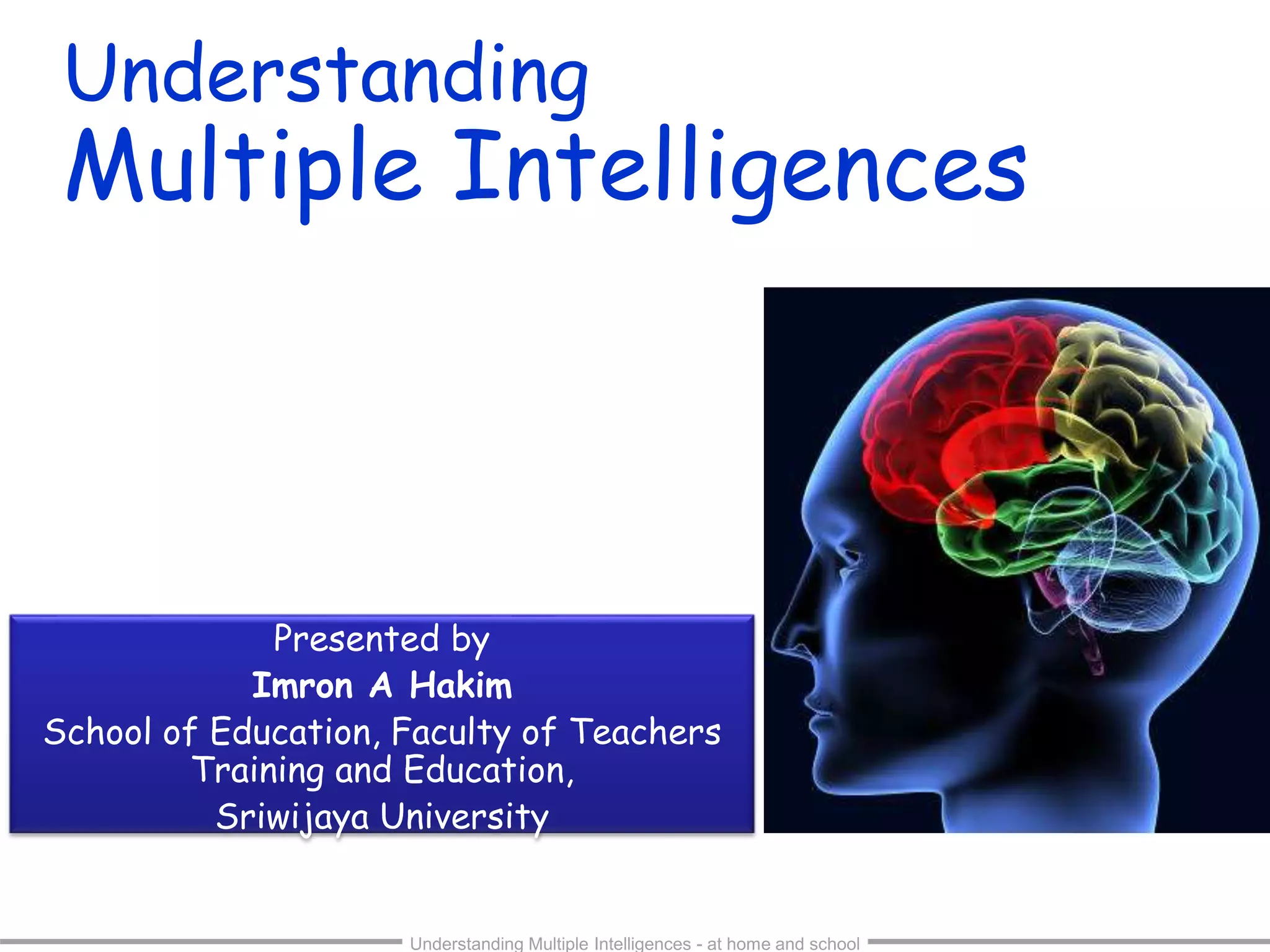
Understanding
Multiple Intelligences
Presented by
Imron A Hakim
School of Education, Faculty of Teachers
Training and Education,
Sriwijaya University
Overview
• Definition
• Multiple Intelligence (MI)
• Conclusion
Understanding Multiple Intelligences - at home and school
Definition
Understanding Multiple Intelligences - at home and school
• What is Intelligence?
Intelligence:
“An ability to solve problems
and/or create products.”
“Intelligences are not skills; they
are biological potentials which are
realized to a greater or lesser
extent dependent upon each
individual’s opportunities and
motivation.”
Understanding Multiple Intelligences - at home and school
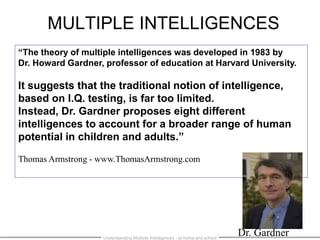
MULTIPLE INTELLIGENCES
“The theory of multiple intelligences was developed in 1983 by
Dr. Howard Gardner, professor of education at Harvard University.
It suggests that the traditional notion of intelligence,
based on I.Q. testing, is far too limited.
Instead, Dr. Gardner proposes eight different
intelligences to account for a broader range of human
potential in children and adults.”
Thomas Armstrong - www.ThomasArmstrong.com
Dr. GardnerUnderstanding Multiple Intelligences - at home and school
Understanding Multiple Intelligences - at home and school
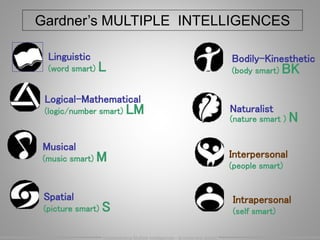
Linguistic
(word smart) L
Logical-Mathematical
(logic/number smart) LM
Musical
(music smart) M
Spatial
(picture smart) S
Bodily-Kinesthetic
(body smart) BK
Naturalist
(nature smart ) N
Interpersonal
(people smart)
Intrapersonal
(self smart)
Gardner’s MULTIPLE INTELLIGENCES
Understanding Multiple Intelligences - at home and school
1. LINGUISTIC (Verbal)
INTELLIGENCE
This person likes to learn new vocabulary,
play with words, create puns, read, and
write.
CHARACTERISTICS of the WORD SMART Learner
• Learns best by hearing, reading, and writing
• Likes to read
• Enjoys talking
• Listens well to others
• Gets absorbed in reading
• Learns languages easily
• Masters oral/written presentations with ease
• Does well in traditional school setting
Understanding Multiple Intelligences - at home and school
2. LOGICAL-MATHEMATICAL
INTELLIGENCE
This person likes to be precise and accurate,
figure out relationships, set special goals,
problem-solve, and play with numbers.
CHARACTERISITICS of the NUMBER SMART Learner
• Logical thinker
• Precision and accuracy is important
• Goal setter
• Money manager
• Concrete thinker
• Efficient worker
• Practical ideas
Understanding Multiple Intelligences - at home and school
3. MUSICAL INTELLIGENCE
This person hears music in his/her head most
of the time, thinks in musical terms,
sings/hums to self, taps fingers, legs or feet
to rhythms, and makes a connection between
emotions and music.
CHARACTERISTICS of the MUSIC SMART LEARNER
• Distracted by sound(s)
• Active listener
• Uses songs to understand concepts/skills
• Recites poems, rhymes, chants and raps
• Learns/Remembers song lyrics with ease
• Responds to others’ vocal cues
• Is a strong auditory learner
• Learns best when material is in rhyme, has a tune,
contains rhyme patterns or is rhythmic
Understanding Multiple Intelligences - at home and school
4. SPATIAL INTELLIGENCE
• This person likes to draw, doodle, do
puzzles, imagine, use color, sketch, create
cartoons, and do cartography.
CHARACTERISTICS of the PICTURE SMART
Learner
• Uses mind to create images
• Tends to dream in color
• Enjoys using graphic organizers
• Relies on models
• Finds maps helpful rather than verbal
directions
• Moves things in head, space and time (e.g.,
Legos)
Understanding Multiple Intelligences - at home and school
5. BODILY- KINESTHETIC
INTELLIGENCE
This person likes to build, experience, touch,
feel, make things, and move.
CHARACTERISTICS of the BODY SMART Learner
• Does many things
• Expresses learning through movement
• Is dramatic
• Is athletic
• Is active
• Is energetic
• Is physically involved with learning
• Needs concrete experience
• Likes variety
• Thinks best when body is moving
Understanding Multiple Intelligences - at home and school
6. NATURALIST INTELLIGENCE
This person likes to put things in to categories,
sort items by attributes, develop collections,
plant and grow natural items, and relates to
animals.
CHARACTERISICS of the NATURE SMART Learner
• Environmentalist
• Enjoys collecting natural objects (E.g.,
seashells, rocks)
• Has expansive knowledge of substances found
in nature
• Likes to dabble in indoor/outdoor
gardening/farming
• Sensitive to the feelings of animals
Understanding Multiple Intelligences - at home and school
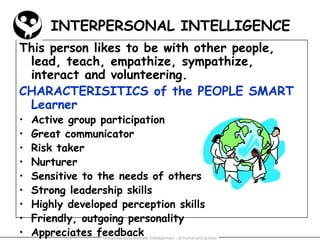
7. INTERPERSONAL INTELLIGENCE
This person likes to be with other people,
lead, teach, empathize, sympathize,
interact and volunteering.
CHARACTERISITICS of the PEOPLE SMART
Learner
• Active group participation
• Great communicator
• Risk taker
• Nurturer
• Sensitive to the needs of others
• Strong leadership skills
• Highly developed perception skills
• Friendly, outgoing personality
• Appreciates feedback
Understanding Multiple Intelligences - at home and school
8. INTRAPERSONAL INTELLIGENCE
• This person likes to spend time time alone,
reflect, have time to review ideas and may
require extended deadlines.
CHARACTERISTICS of the SELF-SMART Learner
• Enjoys working by him/herself
• Has a few close friends
• Analyzes material
• Meditates
• Requires time for reflection
• Is independent
• Prefers quiet working area
• Likes to be last-needs time to think/reflect
• Finds research interesting
• Needs freedom for creativity
Understanding Multiple Intelligences - at home and school
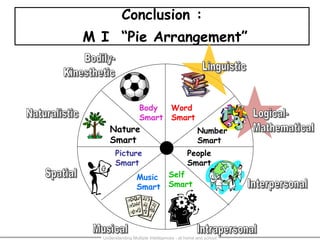
Conclusion :
M I “Pie Arrangement”
Word
Smart
Number
Smart
Picture
Smart
Body
Smart
Music
Smart
Self
Smart
People
Smart
Nature
Smart
Understanding Multiple Intelligences - at home and school
KEY POINTS in MI THEORY
• Each person may possess all eight
intelligences
• Most people can develop each intelligence to
an adequate level of competency
• Intelligences usually work together in complex
and cooperative ways
• There are many ways to express intelligence
within each category
Understanding Multiple Intelligences - at home and school

Multiple intelligence presentation 5 juni 2015

  • 1.
    Understanding Multiple Intelligences- at home and school Understanding Multiple Intelligences Presented by Imron A Hakim School of Education, Faculty of Teachers Training and Education, Sriwijaya University
  • 2.
    Overview • Definition • MultipleIntelligence (MI) • Conclusion Understanding Multiple Intelligences - at home and school
  • 3.
    Definition Understanding Multiple Intelligences- at home and school • What is Intelligence? Intelligence: “An ability to solve problems and/or create products.”
  • 4.
    “Intelligences are notskills; they are biological potentials which are realized to a greater or lesser extent dependent upon each individual’s opportunities and motivation.” Understanding Multiple Intelligences - at home and school
  • 5.
    MULTIPLE INTELLIGENCES “The theoryof multiple intelligences was developed in 1983 by Dr. Howard Gardner, professor of education at Harvard University. It suggests that the traditional notion of intelligence, based on I.Q. testing, is far too limited. Instead, Dr. Gardner proposes eight different intelligences to account for a broader range of human potential in children and adults.” Thomas Armstrong - www.ThomasArmstrong.com Dr. GardnerUnderstanding Multiple Intelligences - at home and school
  • 6.
    Understanding Multiple Intelligences- at home and school Linguistic (word smart) L Logical-Mathematical (logic/number smart) LM Musical (music smart) M Spatial (picture smart) S Bodily-Kinesthetic (body smart) BK Naturalist (nature smart ) N Interpersonal (people smart) Intrapersonal (self smart) Gardner’s MULTIPLE INTELLIGENCES
  • 7.
    Understanding Multiple Intelligences- at home and school 1. LINGUISTIC (Verbal) INTELLIGENCE This person likes to learn new vocabulary, play with words, create puns, read, and write. CHARACTERISTICS of the WORD SMART Learner • Learns best by hearing, reading, and writing • Likes to read • Enjoys talking • Listens well to others • Gets absorbed in reading • Learns languages easily • Masters oral/written presentations with ease • Does well in traditional school setting
  • 8.
    Understanding Multiple Intelligences- at home and school 2. LOGICAL-MATHEMATICAL INTELLIGENCE This person likes to be precise and accurate, figure out relationships, set special goals, problem-solve, and play with numbers. CHARACTERISITICS of the NUMBER SMART Learner • Logical thinker • Precision and accuracy is important • Goal setter • Money manager • Concrete thinker • Efficient worker • Practical ideas
  • 9.
    Understanding Multiple Intelligences- at home and school 3. MUSICAL INTELLIGENCE This person hears music in his/her head most of the time, thinks in musical terms, sings/hums to self, taps fingers, legs or feet to rhythms, and makes a connection between emotions and music. CHARACTERISTICS of the MUSIC SMART LEARNER • Distracted by sound(s) • Active listener • Uses songs to understand concepts/skills • Recites poems, rhymes, chants and raps • Learns/Remembers song lyrics with ease • Responds to others’ vocal cues • Is a strong auditory learner • Learns best when material is in rhyme, has a tune, contains rhyme patterns or is rhythmic
  • 10.
    Understanding Multiple Intelligences- at home and school 4. SPATIAL INTELLIGENCE • This person likes to draw, doodle, do puzzles, imagine, use color, sketch, create cartoons, and do cartography. CHARACTERISTICS of the PICTURE SMART Learner • Uses mind to create images • Tends to dream in color • Enjoys using graphic organizers • Relies on models • Finds maps helpful rather than verbal directions • Moves things in head, space and time (e.g., Legos)
  • 11.
    Understanding Multiple Intelligences- at home and school 5. BODILY- KINESTHETIC INTELLIGENCE This person likes to build, experience, touch, feel, make things, and move. CHARACTERISTICS of the BODY SMART Learner • Does many things • Expresses learning through movement • Is dramatic • Is athletic • Is active • Is energetic • Is physically involved with learning • Needs concrete experience • Likes variety • Thinks best when body is moving
  • 12.
    Understanding Multiple Intelligences- at home and school 6. NATURALIST INTELLIGENCE This person likes to put things in to categories, sort items by attributes, develop collections, plant and grow natural items, and relates to animals. CHARACTERISICS of the NATURE SMART Learner • Environmentalist • Enjoys collecting natural objects (E.g., seashells, rocks) • Has expansive knowledge of substances found in nature • Likes to dabble in indoor/outdoor gardening/farming • Sensitive to the feelings of animals
  • 13.
    Understanding Multiple Intelligences- at home and school 7. INTERPERSONAL INTELLIGENCE This person likes to be with other people, lead, teach, empathize, sympathize, interact and volunteering. CHARACTERISITICS of the PEOPLE SMART Learner • Active group participation • Great communicator • Risk taker • Nurturer • Sensitive to the needs of others • Strong leadership skills • Highly developed perception skills • Friendly, outgoing personality • Appreciates feedback
  • 14.
    Understanding Multiple Intelligences- at home and school 8. INTRAPERSONAL INTELLIGENCE • This person likes to spend time time alone, reflect, have time to review ideas and may require extended deadlines. CHARACTERISTICS of the SELF-SMART Learner • Enjoys working by him/herself • Has a few close friends • Analyzes material • Meditates • Requires time for reflection • Is independent • Prefers quiet working area • Likes to be last-needs time to think/reflect • Finds research interesting • Needs freedom for creativity
  • 15.
    Understanding Multiple Intelligences- at home and school Conclusion : M I “Pie Arrangement” Word Smart Number Smart Picture Smart Body Smart Music Smart Self Smart People Smart Nature Smart
  • 16.
    Understanding Multiple Intelligences- at home and school KEY POINTS in MI THEORY • Each person may possess all eight intelligences • Most people can develop each intelligence to an adequate level of competency • Intelligences usually work together in complex and cooperative ways • There are many ways to express intelligence within each category
  • 17.