Howard Gardner developed the theory of multiple intelligences in 1983. He argued that intelligence consists of multiple abilities rather than a single general ability. Gardner identified 8 types of intelligence: linguistic, logical-mathematical, visual-spatial, bodily-kinesthetic, musical, interpersonal, intrapersonal, and naturalistic. Each type involves a different skill set that helps individuals solve problems, create products, and discover new knowledge in different ways.
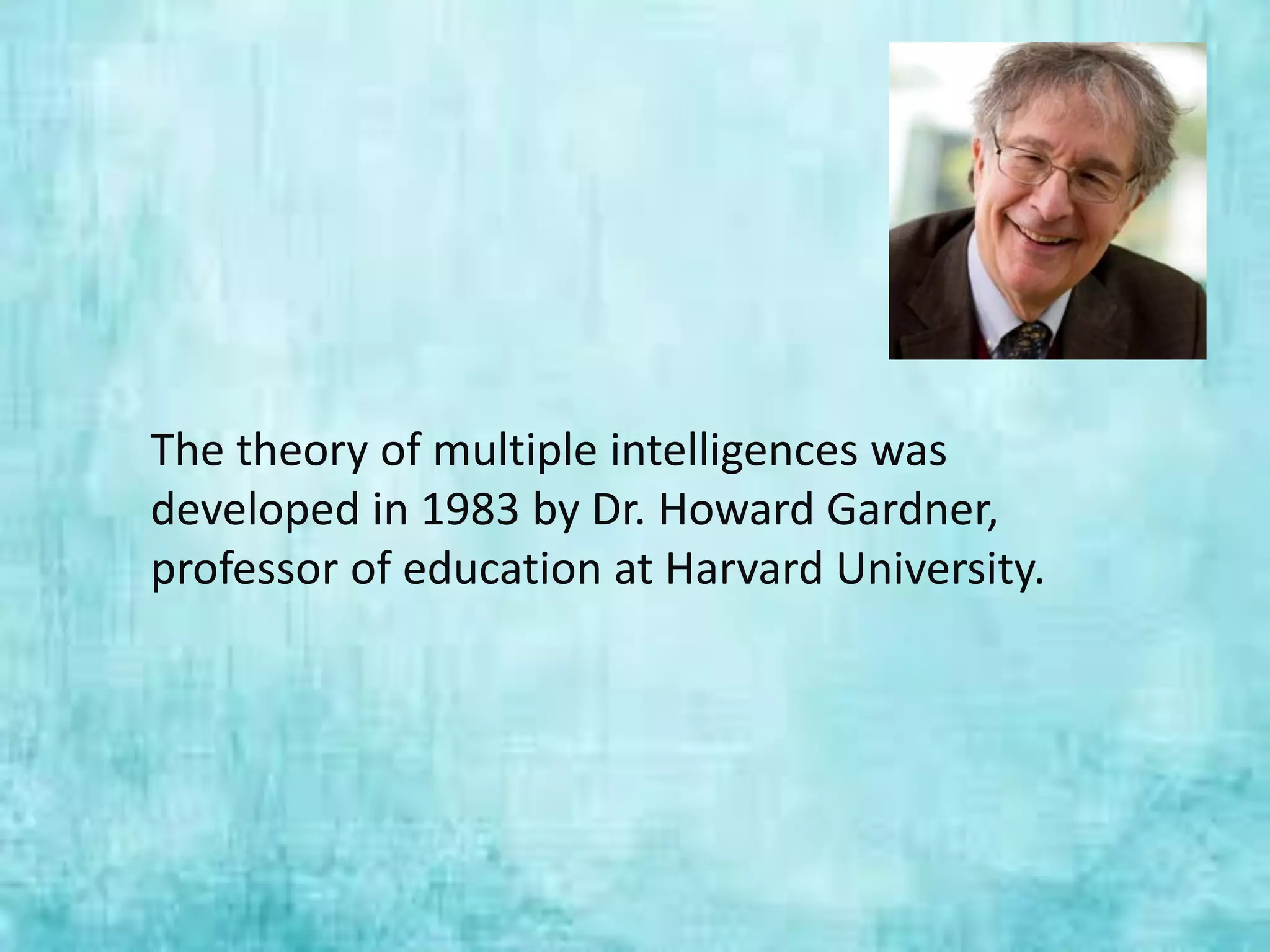
The theory ofmultiple intelligences was
developed in 1983 by Dr. Howard Gardner,
professor of education at Harvard University.
3.
According toGardner, intelligence consist of a
multiple number of abilities which helps an
individual to solve problems, create products
and discover new knowledge.
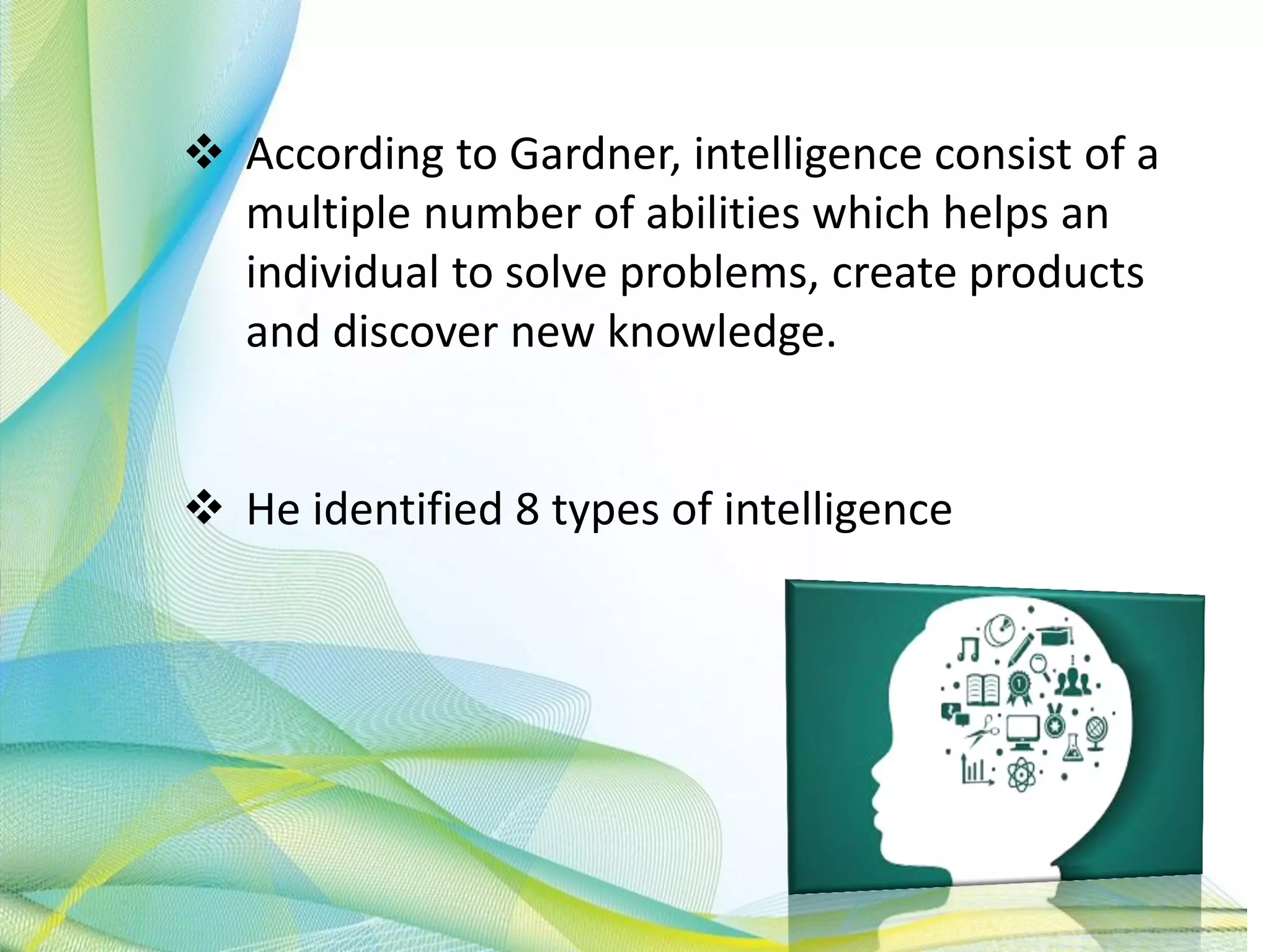
He identified 8 types of intelligence
4.
1. Linguistic-Verbal Intelligence
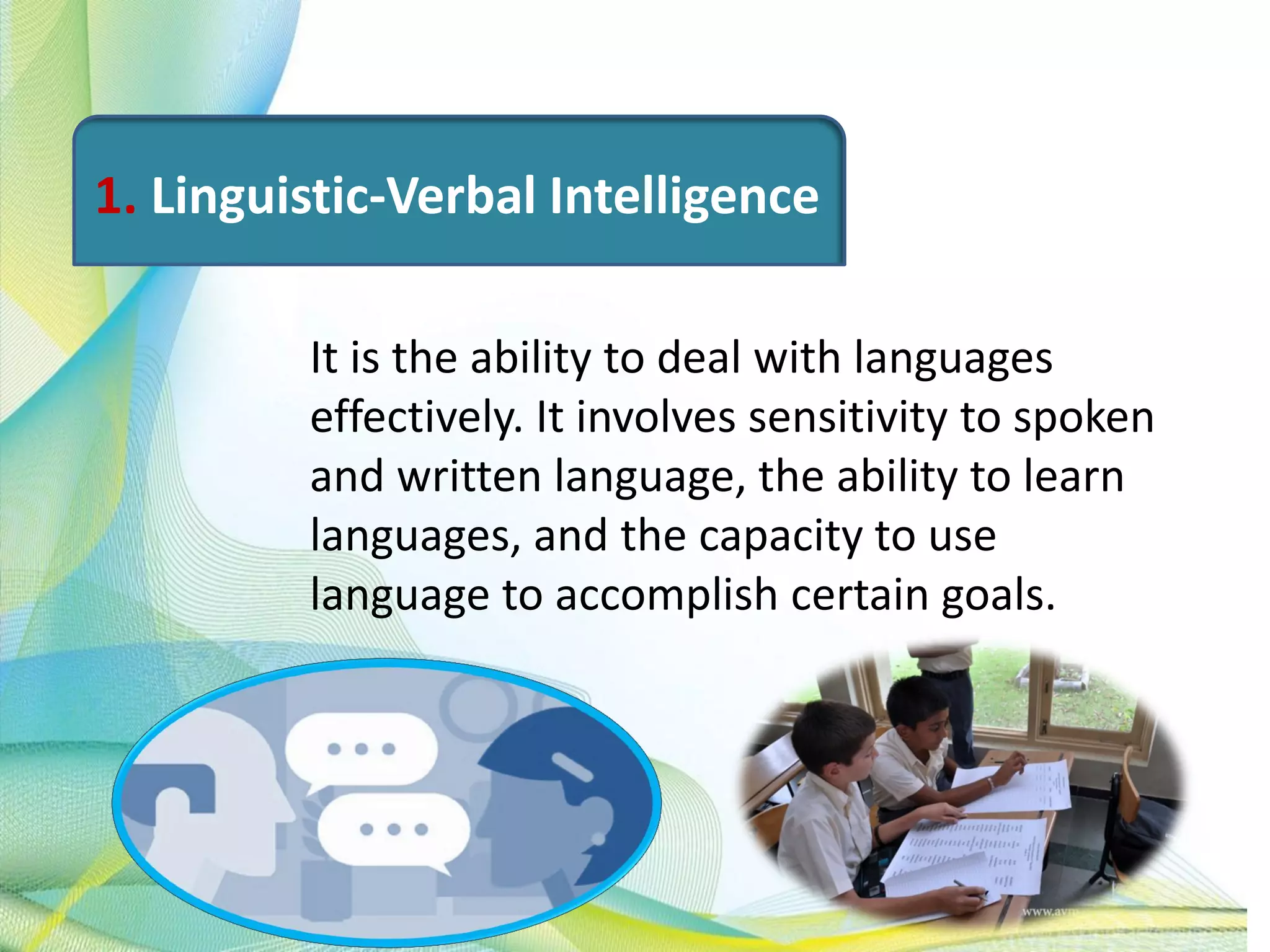
Itis the ability to deal with languages
effectively. It involves sensitivity to spoken
and written language, the ability to learn
languages, and the capacity to use
language to accomplish certain goals.
5.
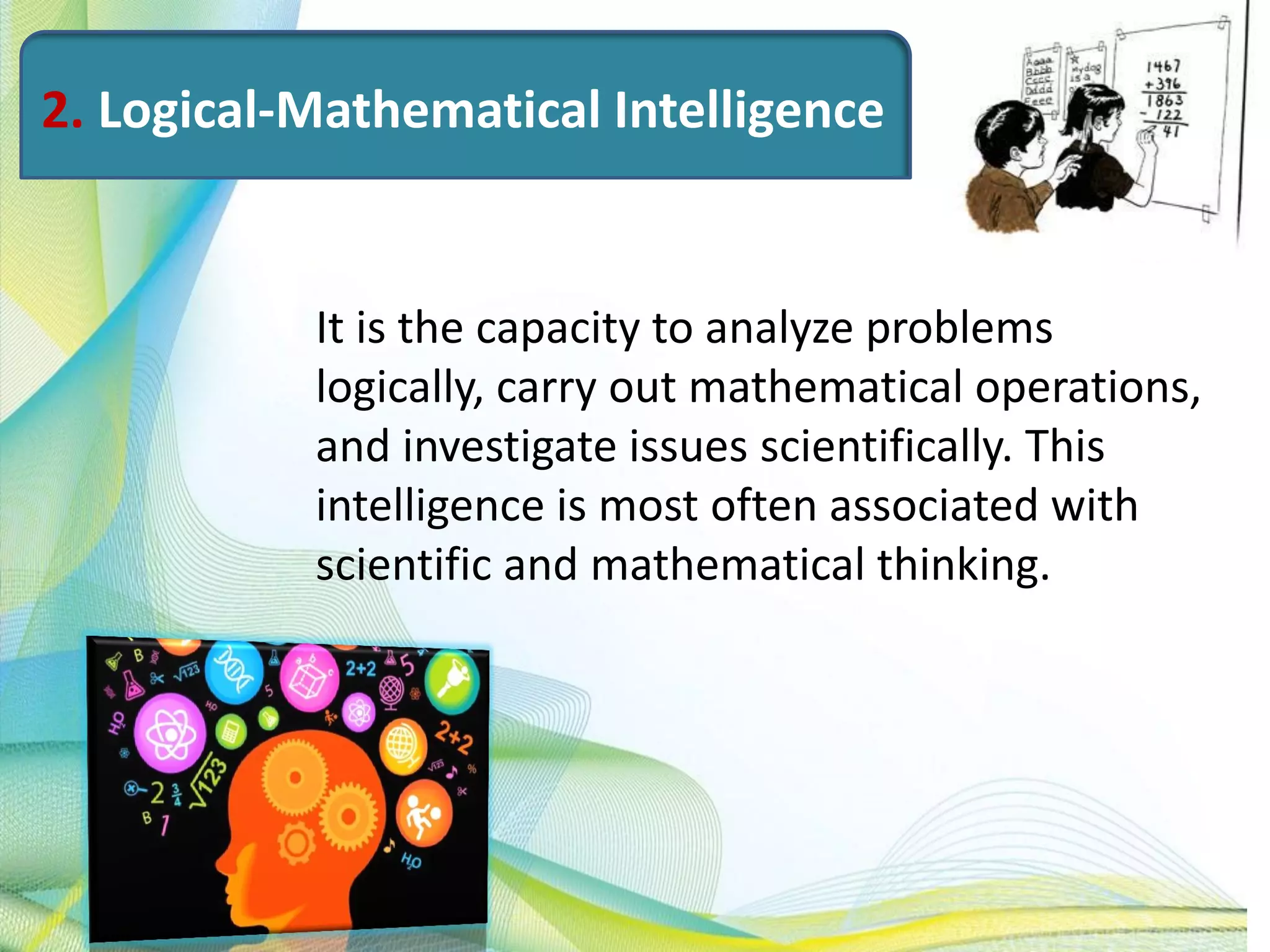
2. Logical-Mathematical Intelligence
Itis the capacity to analyze problems
logically, carry out mathematical operations,
and investigate issues scientifically. This
intelligence is most often associated with
scientific and mathematical thinking.
6.
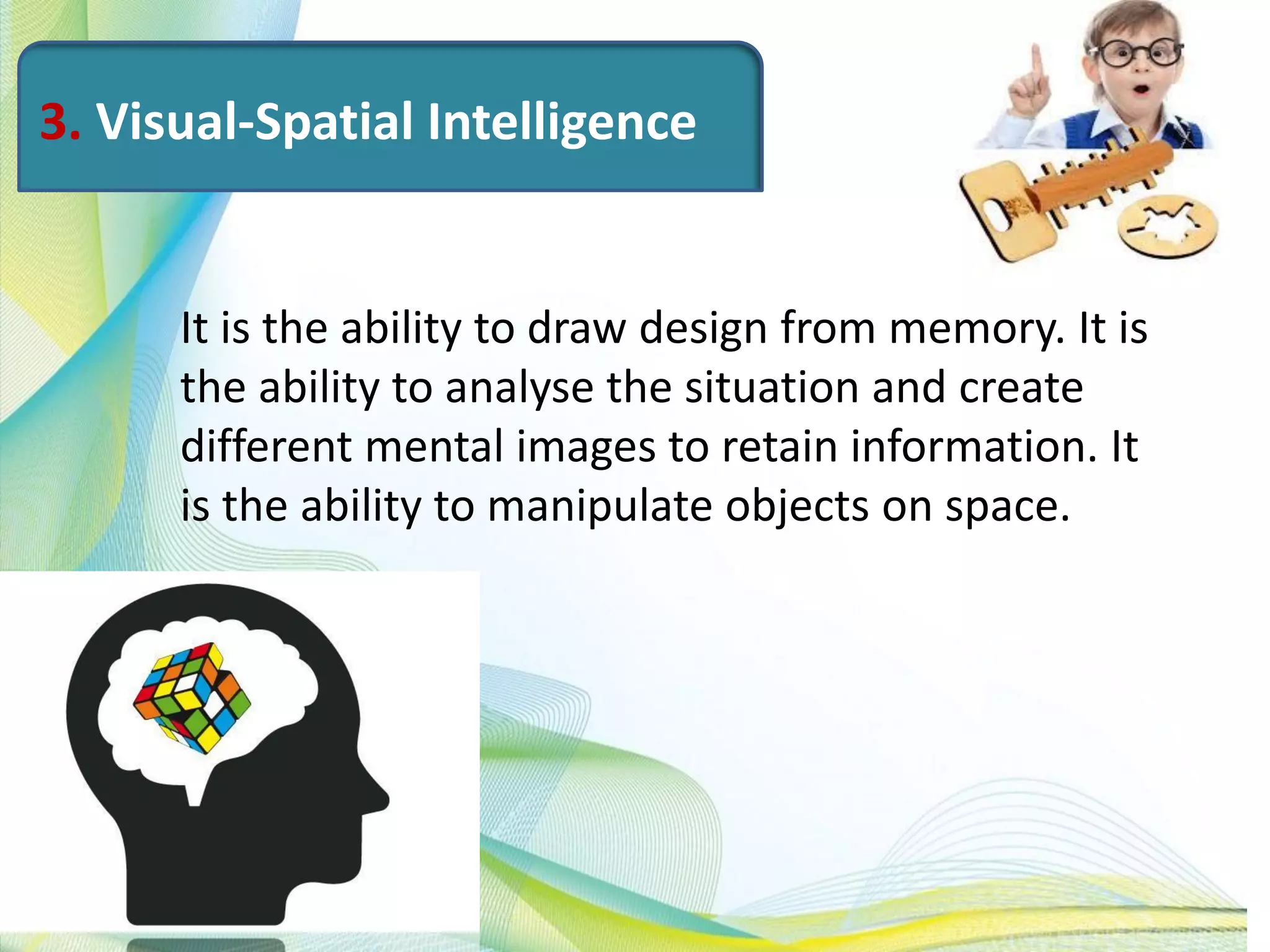
3. Visual-Spatial Intelligence
Itis the ability to draw design from memory. It is
the ability to analyse the situation and create
different mental images to retain information. It
is the ability to manipulate objects on space.
7.
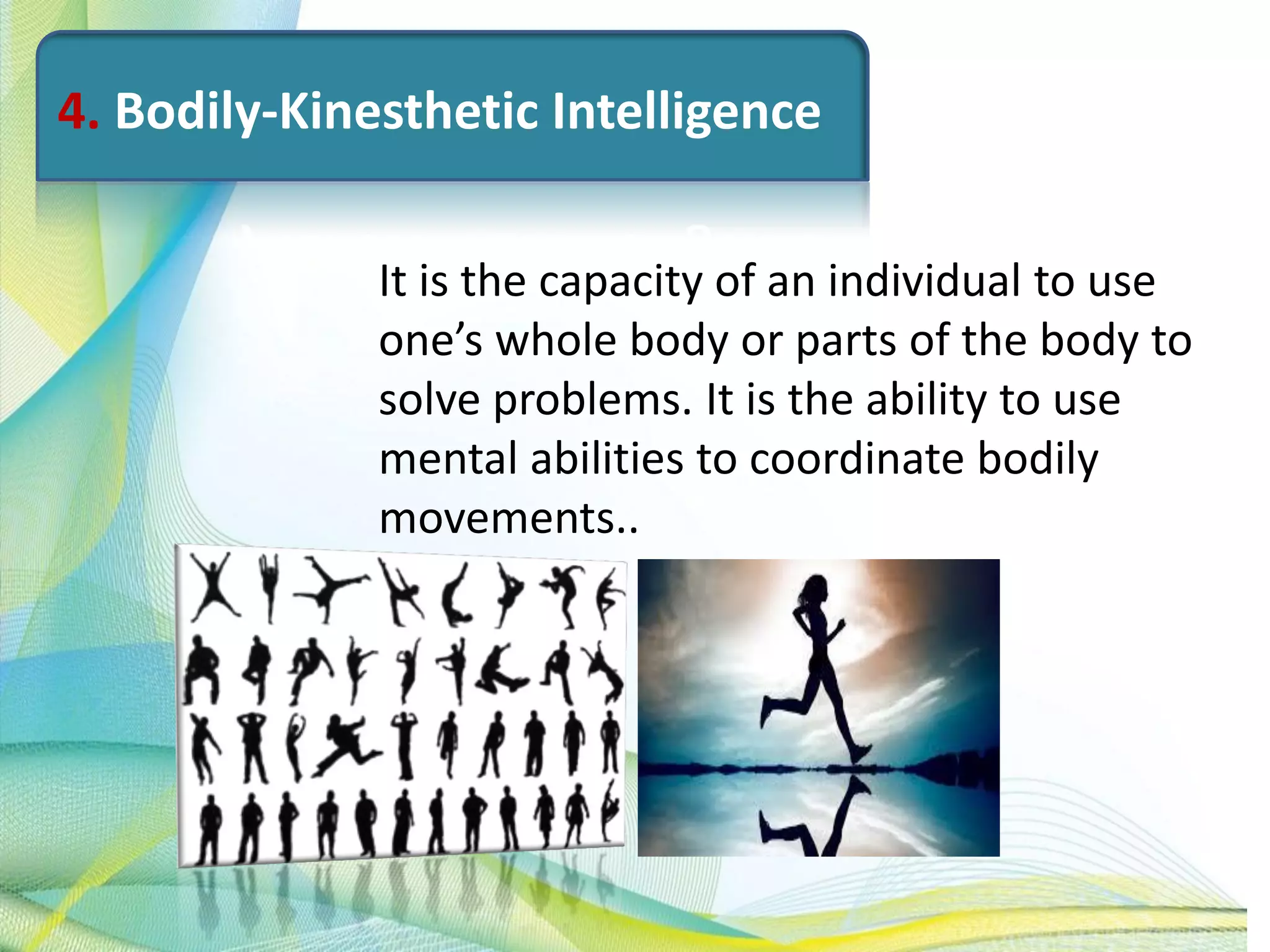
4. Bodily-Kinesthetic Intelligence
Itis the capacity of an individual to use
one’s whole body or parts of the body to
solve problems. It is the ability to use
mental abilities to coordinate bodily
movements..
8.
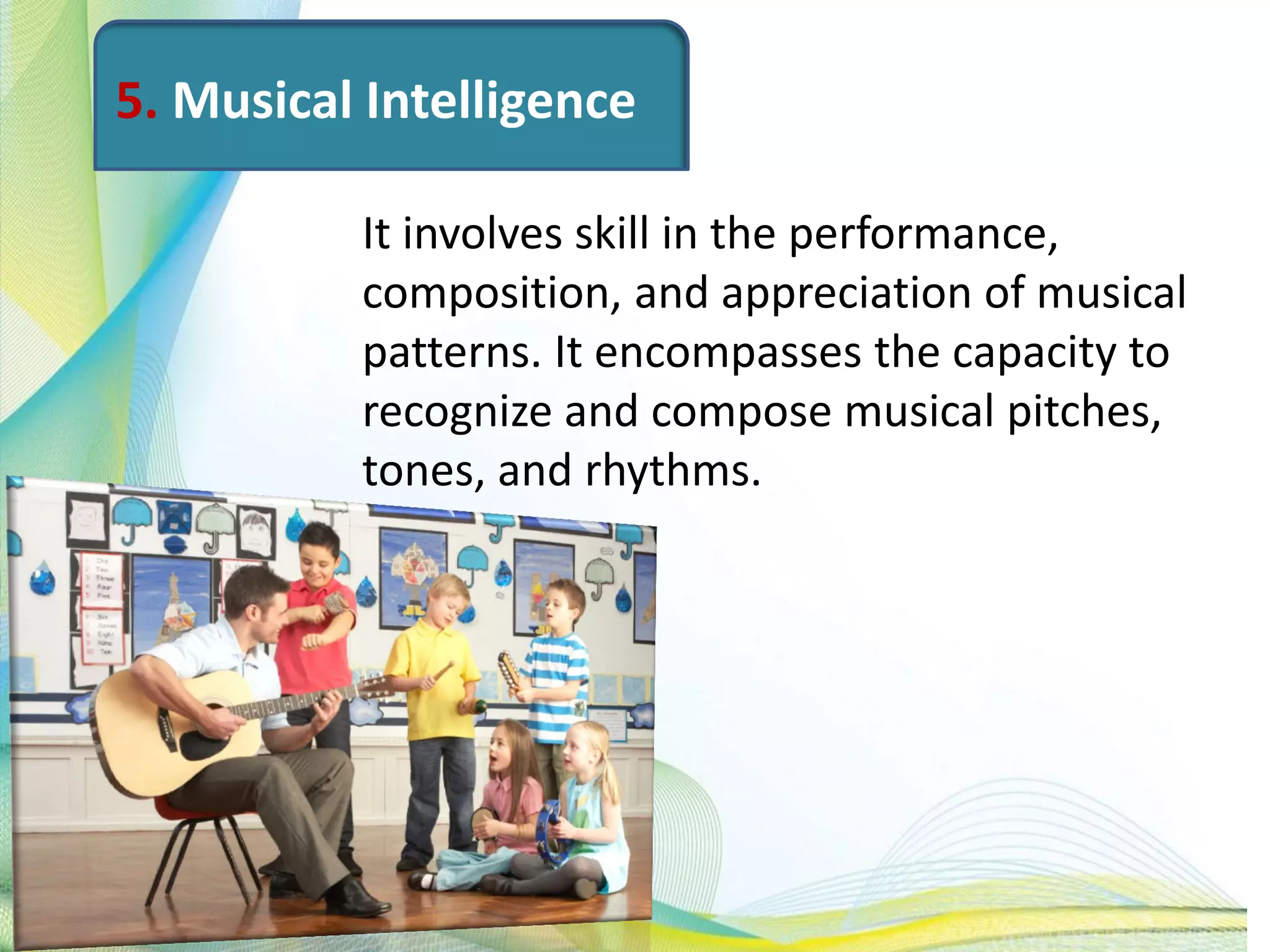
5. Musical Intelligence
Itinvolves skill in the performance,
composition, and appreciation of musical
patterns. It encompasses the capacity to
recognize and compose musical pitches,
tones, and rhythms.
9.
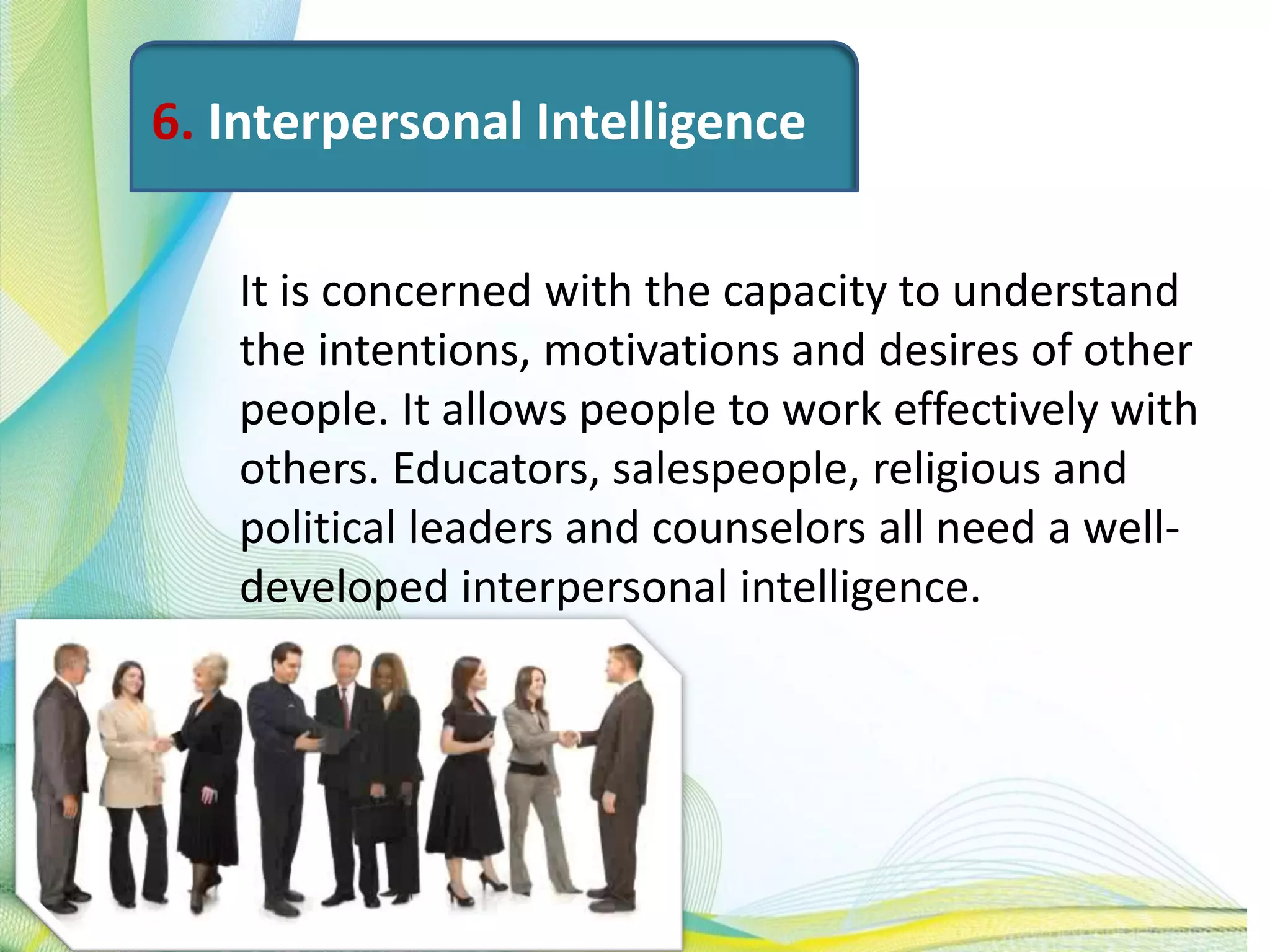
6. Interpersonal Intelligence
Itis concerned with the capacity to understand
the intentions, motivations and desires of other
people. It allows people to work effectively with
others. Educators, salespeople, religious and
political leaders and counselors all need a well-
developed interpersonal intelligence.
10.
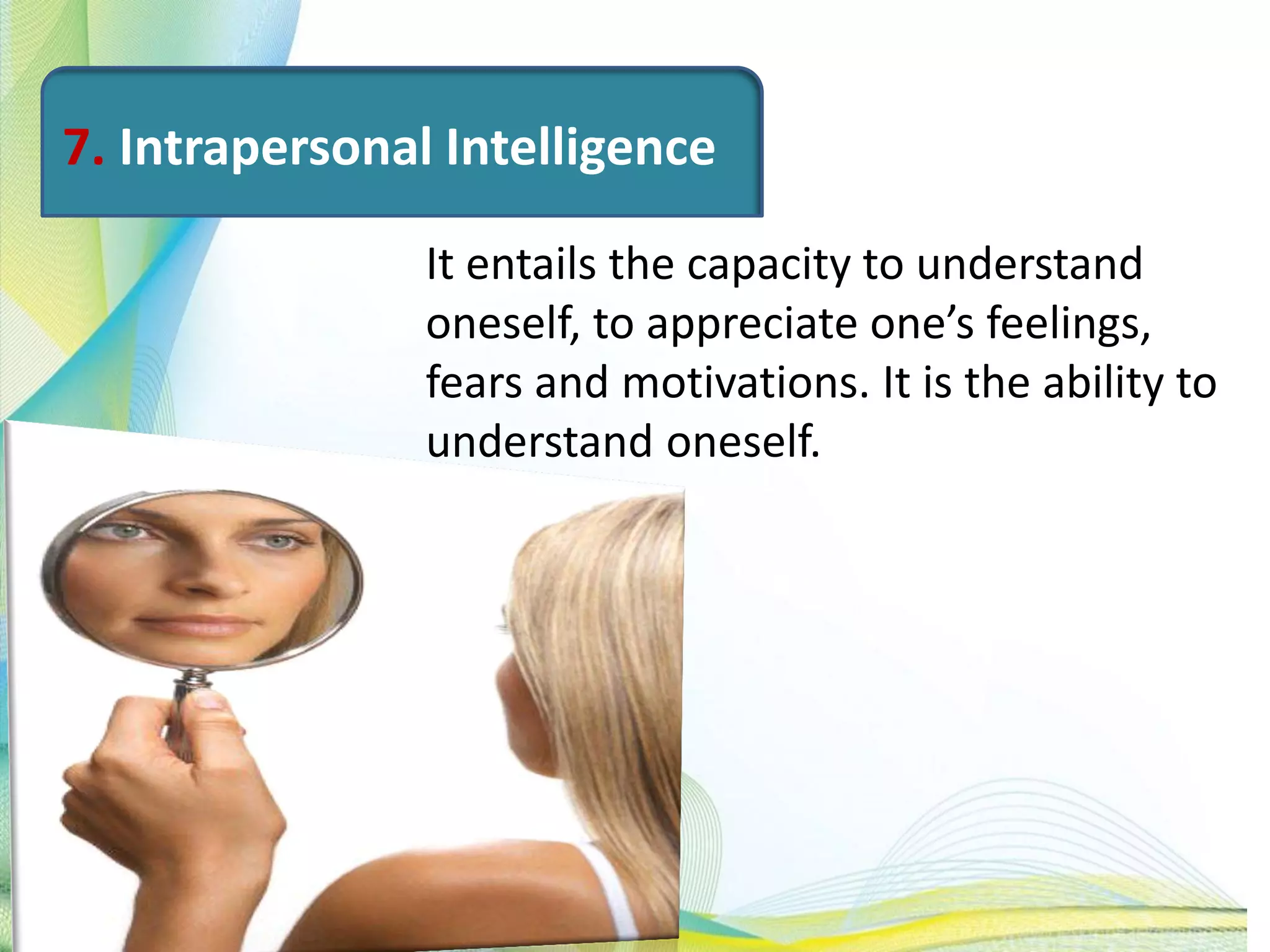
7. Intrapersonal Intelligence
Itentails the capacity to understand
oneself, to appreciate one’s feelings,
fears and motivations. It is the ability to
understand oneself.
11.
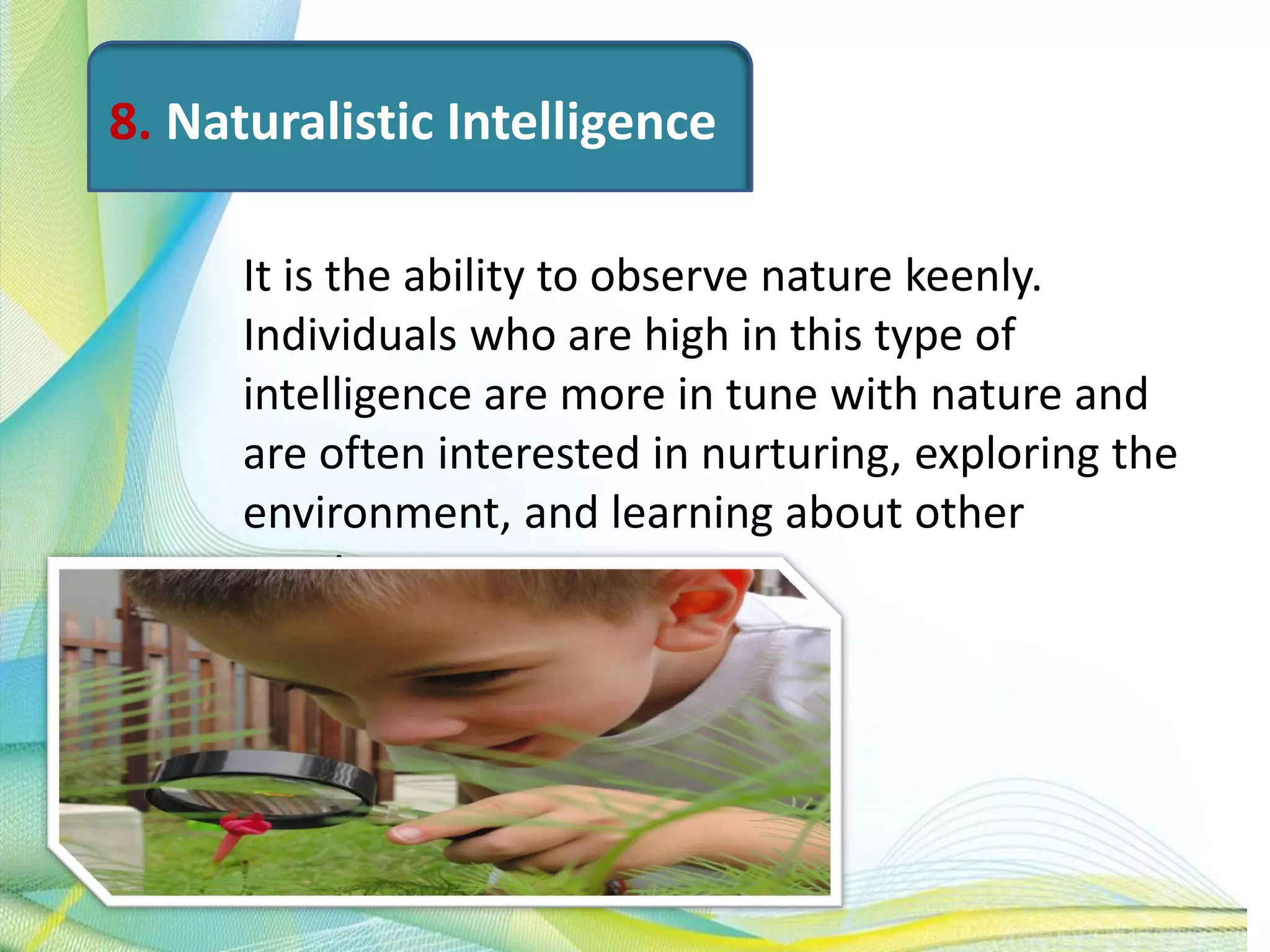
8. Naturalistic Intelligence
Itis the ability to observe nature keenly.
Individuals who are high in this type of
intelligence are more in tune with nature and
are often interested in nurturing, exploring the
environment, and learning about other
species.