MULTIPLE INTELLIGENCES 
“The theory of multiple intelligences was developed in 1983 by 
Dr. Howard Gardner, professor of education at Harvard University. 
It suggests that the traditional notion of intelligence, based on I.Q. 
testing, is far too limited. Instead, Dr. Gardner proposes eight 
different intelligences to account for a broader range of human 
potential in children and adults.” 
Thomas Armstrong - www.ThomasArmstrong.com 
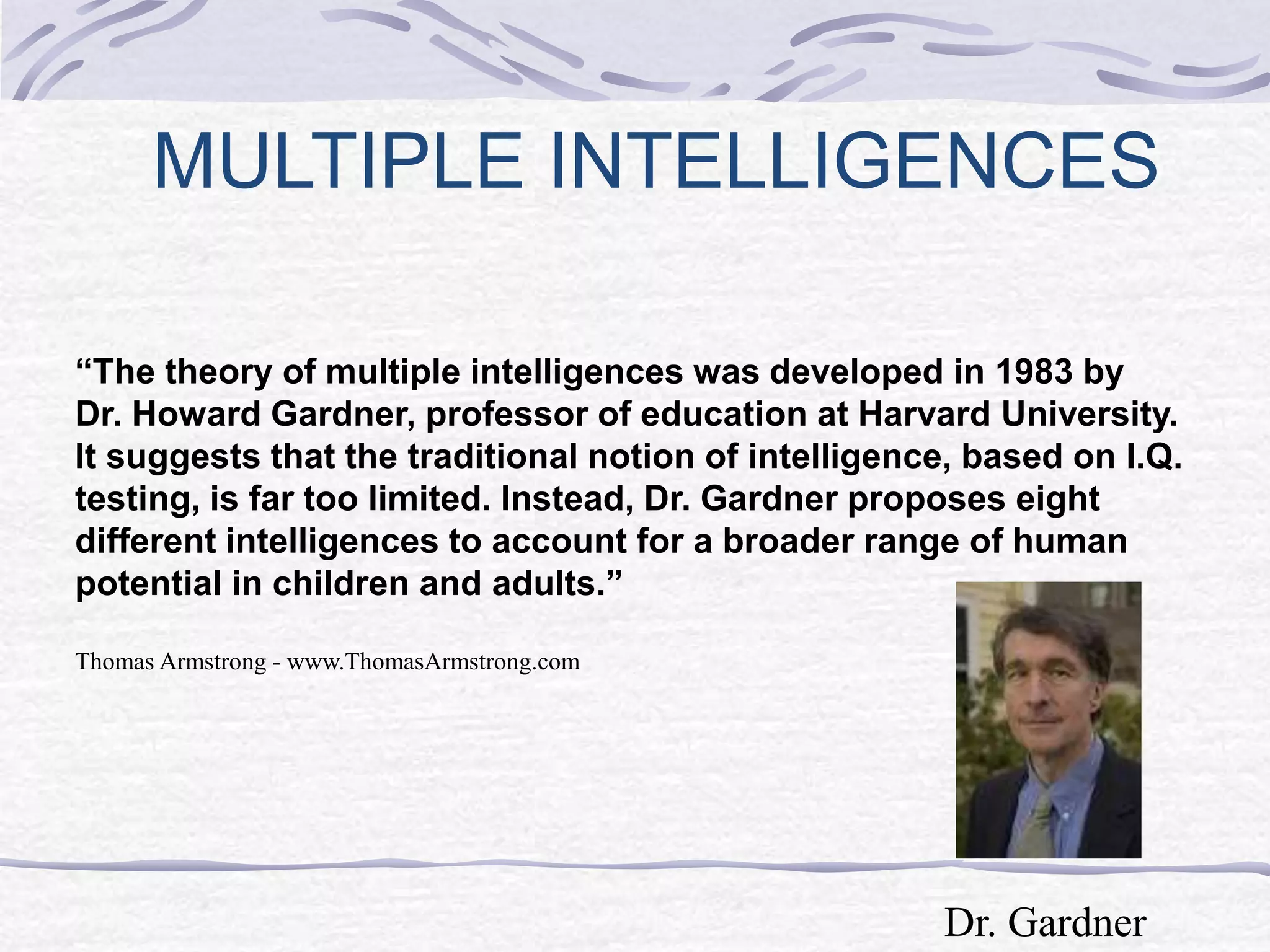
Dr. Gardner
The Multiple Intelligences are: 
•Verbal/Linguistic Intelligence - “word smart” 
•Logical-mathematical Intelligence - “number/reasoning smart” 
•Visual/Spatial Intelligence - “picture smart” 
•Bodily/Kinesthetic Intelligence - “body smart” 
•Musical/Rhythmic Intelligence - “music smart” 
•Interpersonal Intelligence - “people smart” 
•Intrapersonal Intelligence - “self smart” 
•Naturalist Intelligence - “nature smart”
Multiple Intelligences examples: 
•Verbal/Linguistic Intelligence - 
•Mark Twain, Robert Frost, poets, writers, newscasters 
•Logical-mathematical Intelligence - 
•Einstein, accounting, banking, medicine, scientific research 
•Visual/Spatial Intelligence - 
•Martin Luther King (dreamer). artists, architecture, advertising 
•Bodily/Kinesthetic Intelligence - 
•Adrian Peterson , dancers, dramatic acting, mime, physical education 
•Musical/Rhythmic Intelligence - 
•Taylor Swift, music composers, music teachers, musical theatre 
•Interpersonal Intelligence - 
•Billy Graham, counseling, politics, sociologists, therapists 
•Intrapersonal Intelligence - 
•Psychiatry, spiritual counseling, philosopher 
•Naturalist Intelligence - 
•Farmers, gardeners, florists, geologist, archaeologists
Multiple Intelligences 
“Dr. Gardner says that our schools and culture focus most of their 
attention on linguistic and logical-mathematical intelligence. We 
esteem the highly articulate or logical people of our culture. 
However, Dr. Gardner says that we should also place equal attention 
on individuals who show gifts in the other intelligences. 
Unfortunately, many children who have these gifts don’t receive 
much reinforcement for them in school. Many of these kids, in fact, 
end up being labeled ‘learning disabled,’ ‘ADD’ (attention deficit 
disorder), or simply underachievers, when their unique ways of 
thinking and learning aren’t addressed by a heavily linguistic or 
logical mathematical classroom.” 
Thomas Armstrong - www.ThomasArmstrong.com 
Gifted and Talented Students handout
Multiple Intelligences Theory 
The theory of multiple intelligences proposes a major transformation 
in the way our schools are run. It suggests that teachers be trained 
to present their lessons in a wide variety of ways using music, 
cooperative learning, art activities, role play, multimedia, field trips, 
inner reflection, and much more.
How to Teach or Learn in 
8 Different Ways 
“One of the most remarkable features of the theory of multiple 
intelligences is how it provides eight different potential pathways to 
learning. If a teacher is having difficulty reaching a student in the 
more traditional linguistic or logical ways of instruction, the theory of 
multiple intelligences suggests several other ways in which the 
material might be presented to facilitate effective learning. 
Thomas Armstrong - www.ThomasArmstrong.com
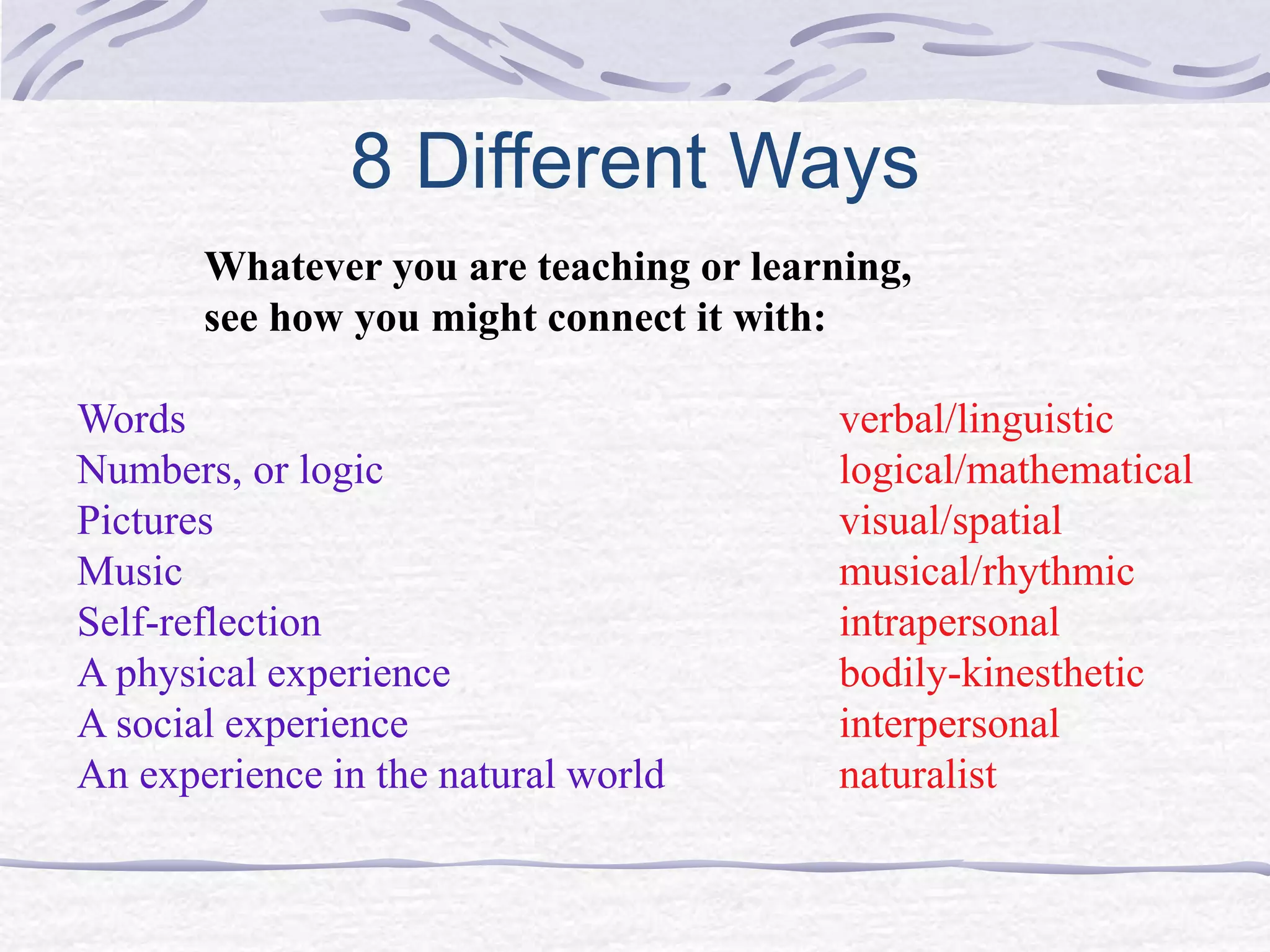
8 Different Ways 
Whatever you are teaching or learning, 
see how you might connect it with: 
Words verbal/linguistic 
Numbers, or logic logical/mathematical 
Pictures visual/spatial 
Music musical/rhythmic 
Self-reflection intrapersonal 
A physical experience bodily-kinesthetic 
A social experience interpersonal 
An experience in the natural world naturalist
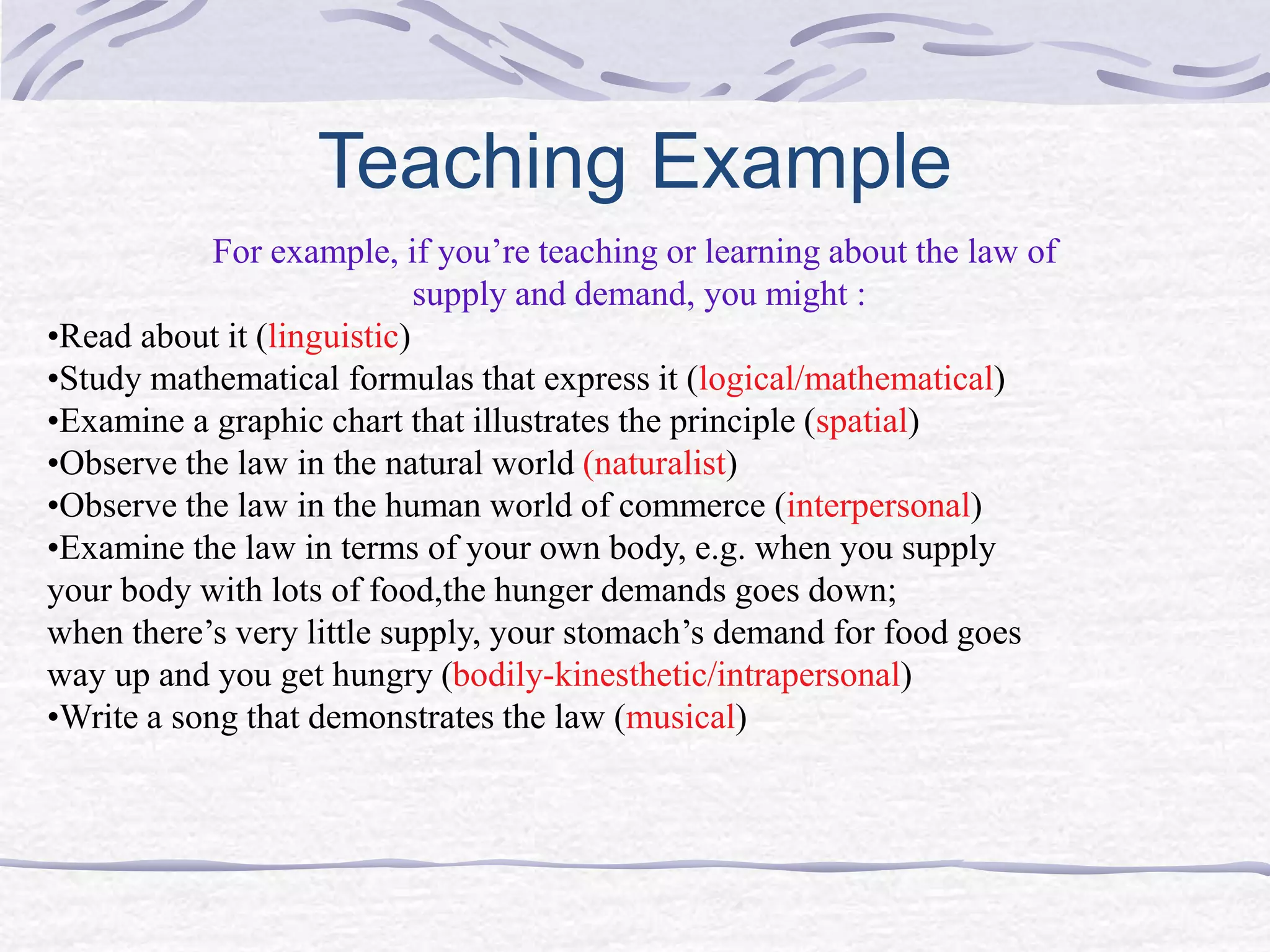
Teaching Example 
For example, if you’re teaching or learning about the law of 
supply and demand, you might : 
•Read about it (linguistic) 
•Study mathematical formulas that express it (logical/mathematical) 
•Examine a graphic chart that illustrates the principle (spatial) 
•Observe the law in the natural world (naturalist) 
•Observe the law in the human world of commerce (interpersonal) 
•Examine the law in terms of your own body, e.g. when you supply 
your body with lots of food,the hunger demands goes down; 
when there’s very little supply, your stomach’s demand for food goes 
way up and you get hungry (bodily-kinesthetic/intrapersonal) 
•Write a song that demonstrates the law (musical)
Multiple Intelligences 
Concept to Classroom 
http://www.thirteen.org/edonline/concept2class/mi/index.html 
MI WHEEL ACTIVITY 
Multiple Intelligences and Technology 
http://www.casacanada.com/multech.html
Multiple Intelligences 
Report Card 
1, Write the name of a book you have read lately. 
2. Rate your math ability from 1-10 with 10 being highest. 
3. Write down the name of the kind of music you like. 
4. Write down how you revitalize yourself. 
5. Write down what you can do that is a physical activity. 
6. Draw a picture that shows how you are feeling today.
Self-Analysis Worksheets 
Multiple Intelligence Assessment 
Complete and bring results to next class
Multiple Intelligences Rap 
by Shawna Munson 
The eight intelligences are really cool. 
We all have them so no one is a fool 
Linguistic deals with writing and with words. 
We have language - we're not like animals or birds. 
Logical-mathematical doesn't need to be a shock. 
If you study real hard, you'll be smarter than Spock! 
Spatial involves seeing, drawing, and art, 
Creating different things and taking them apart. 
In case you didn't know, kinesthetic is P.E. 
Get fit and coordinated athletically! 
Naturalists are collectors of animals and plants. 
They like to press flowers and count little ants. 
All of these so far are really neat, 
But I like musical 'cause it has a beat. 
Sometimes, I feel lonely, without any friends, 
But interpersonal skills put that to an end. 
Intrapersonal skills are when you want to reflect. 
For yourself, you should always have respect. 
Now, I've come to the end of my rap. 
Learn in many ways and you'll never be a sap.
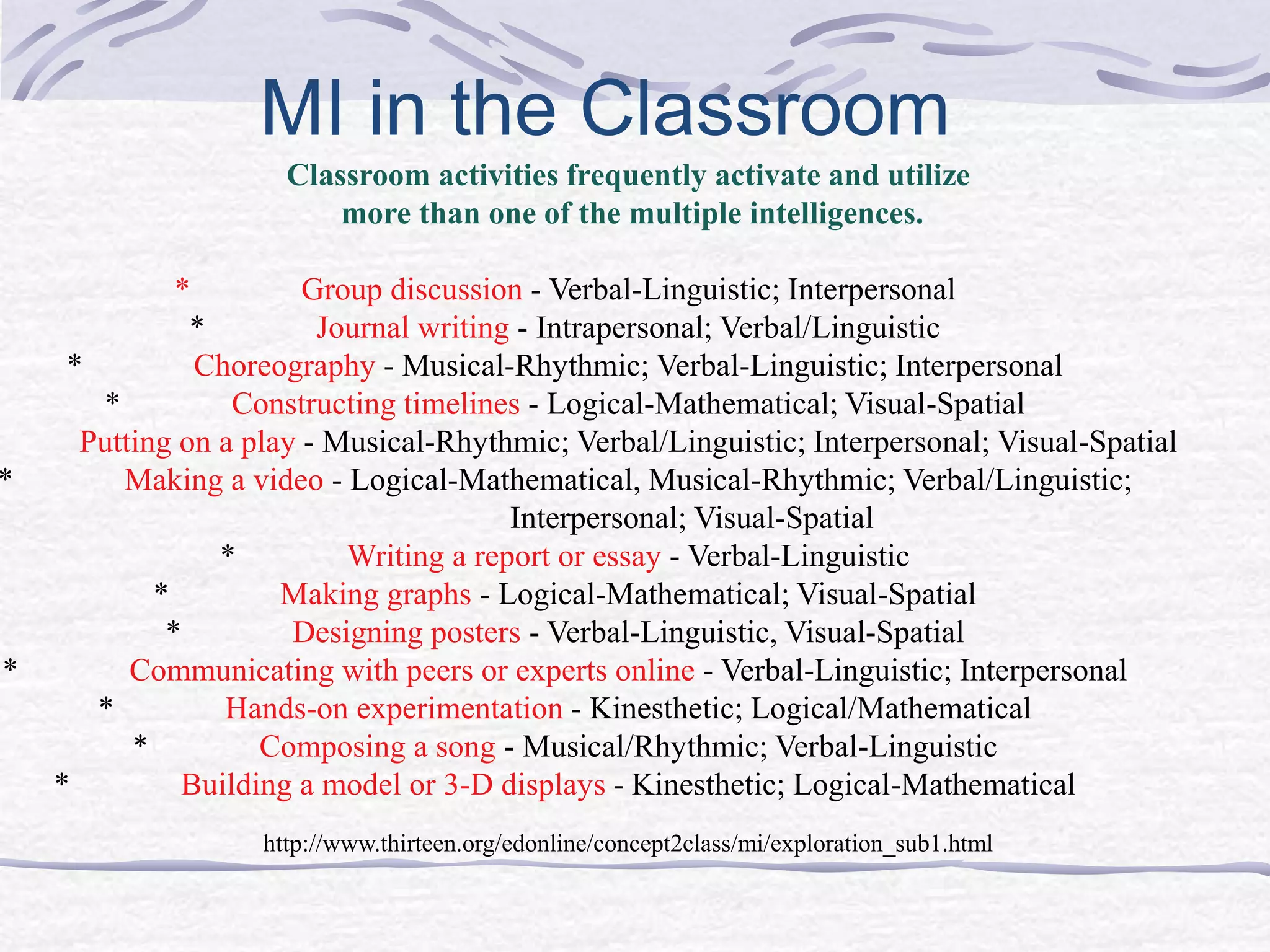
MI in the Classroom 
Classroom activities frequently activate and utilize 
more than one of the multiple intelligences. 
* Group discussion - Verbal-Linguistic; Interpersonal 
* Journal writing - Intrapersonal; Verbal/Linguistic 
* Choreography - Musical-Rhythmic; Verbal-Linguistic; Interpersonal 
* Constructing timelines - Logical-Mathematical; Visual-Spatial 
Putting on a play - Musical-Rhythmic; Verbal/Linguistic; Interpersonal; Visual-Spatial 
* Making a video - Logical-Mathematical, Musical-Rhythmic; Verbal/Linguistic; 
Interpersonal; Visual-Spatial 
* Writing a report or essay - Verbal-Linguistic 
* Making graphs - Logical-Mathematical; Visual-Spatial 
* Designing posters - Verbal-Linguistic, Visual-Spatial 
* Communicating with peers or experts online - Verbal-Linguistic; Interpersonal 
* Hands-on experimentation - Kinesthetic; Logical/Mathematical 
* Composing a song - Musical/Rhythmic; Verbal-Linguistic 
* Building a model or 3-D displays - Kinesthetic; Logical-Mathematical 
http://www.thirteen.org/edonline/concept2class/mi/exploration_sub1.html
Children’s Literature book – 
Multiple Intelligences Activities
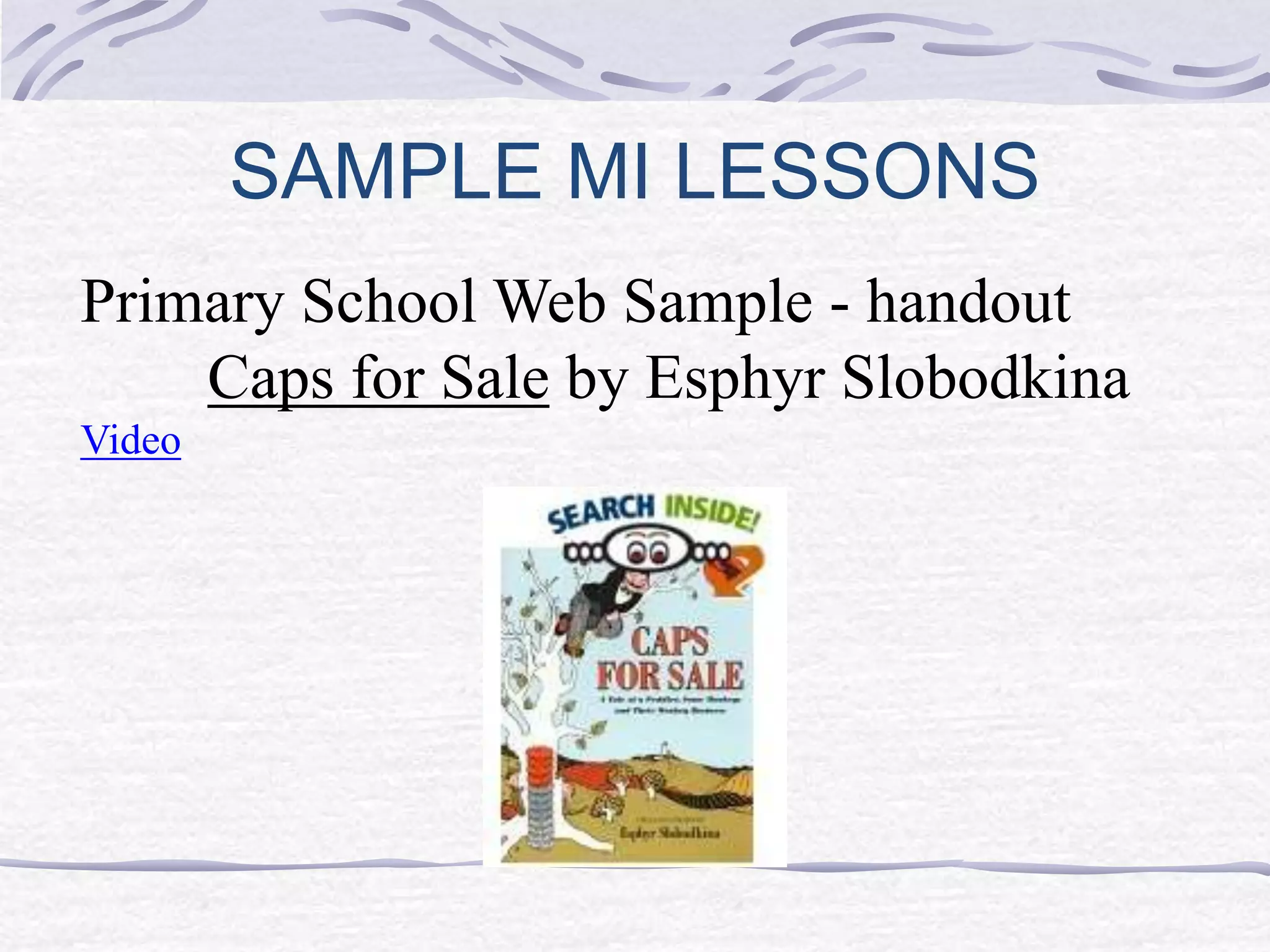
SAMPLE MI LESSONS 
Primary School Web Sample - handout 
Caps for Sale by Esphyr Slobodkina 
Video
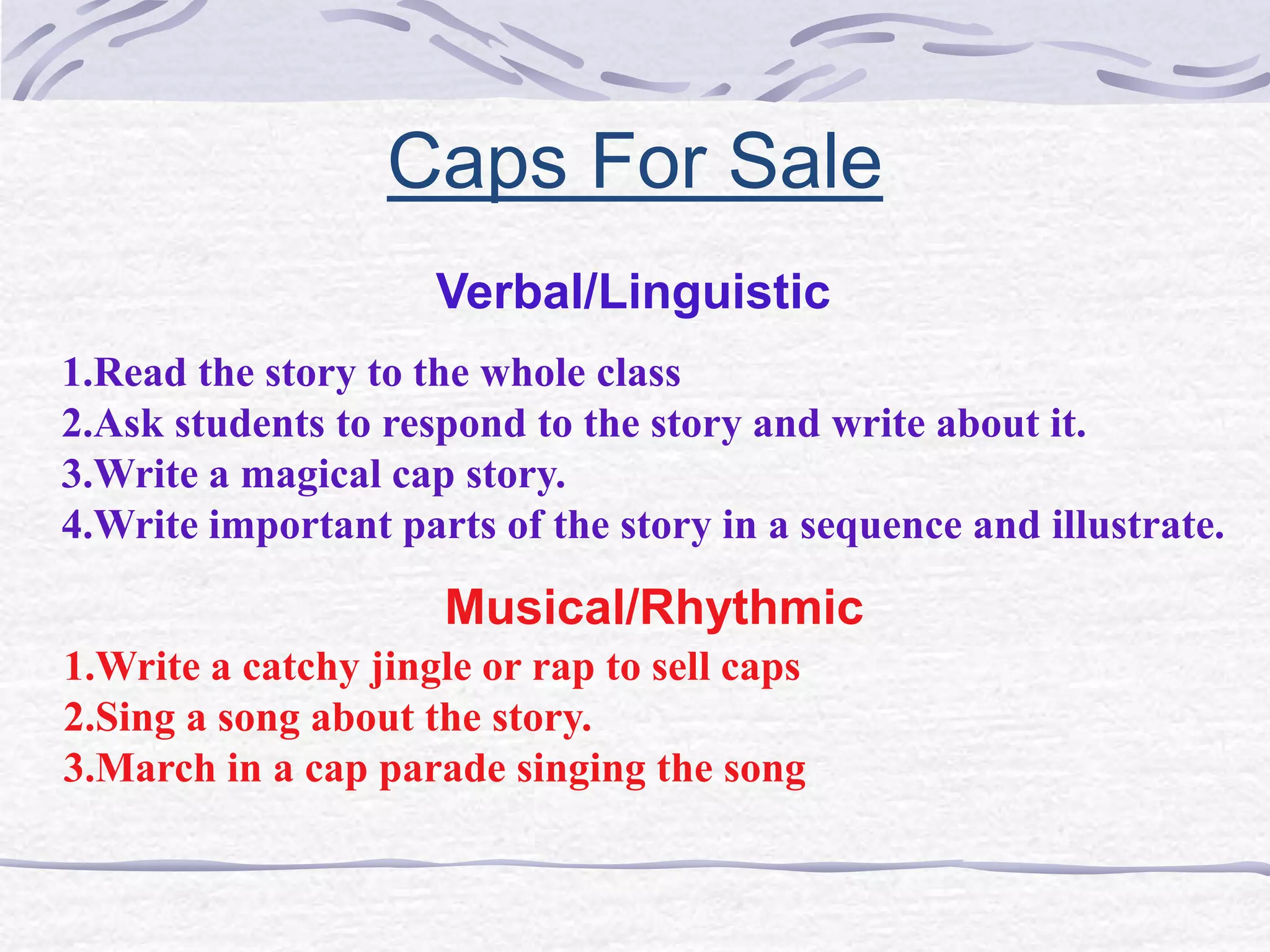
Caps For Sale 
Verbal/Linguistic 
1.Read the story to the whole class 
2.Ask students to respond to the story and write about it. 
3.Write a magical cap story. 
4.Write important parts of the story in a sequence and illustrate. 
Musical/Rhythmic 
1.Write a catchy jingle or rap to sell caps 
2.Sing a song about the story. 
3.March in a cap parade singing the song
Caps for Sale 
Logical/Mathematical 
1.Have a collection of caps and brainstorm many ways to sort them. 
2.Graph distances from students’ homes. 
3.Make up word problems involving cap-purchasing stories 
at fifty cents per cap. 
Visual/Spatial 
1.Have students close their eyes and think of the story, Caps for Sale,. 
Ask them to capture their favorite part by drawing and writing 
about it. 
2. Ask students to design a new style cap and logo.
Caps for Sale 
Bodily/Kinesthetic 
1.Bake money-shaped cookies. 
2.Role play the story. 
3.Have a cap parade. 
4.Have a cap relay 
Intrapersonal 
1.Have the students write down all they know about monkeys. 
Interpersonal 
1.In literacy study groups discuss the plot, setting, character, 
problem, and solution for the Caps for Sale story.
Shapes - Circles 
•Make a group circle by joining hands. 
Interpersonal, Bodily-Kinesthetic 
•Look for circles around the classroom. 
Spatial 
•Make circles in art projects. 
Spatial, Bodily-Kinesthetic 
•Sing “The Circle Game” and other circle songs. 
Musical 
•Make up stories about circles. 
Linguistic 
•Compare sizes of circles (from small to large). 
Spatial, Logical-Mathematical
Multiplication - 7’s table 
•Count to 70, standing up and clapping on every seventh number. 
Bodily-Kinesthetic 
•Sing the Multiplication Rock song for the 7’s. 
Musical 
•Chant the numbers 1 to 70, placing special emphasis on every 
seventh number. 
Musical 
•Complete a “hundreds chart,” coloring in every seventh number. 
Spatial
Multiple Intelligences Spelling 
•Create categories for your spelling words. 
logical-mathematical 
•Write your words using different colors for the letters of parts of 
the word. 
visual/spatial 
•Make up a story using all spelling words. Tell the story to another person. 
verbal/linguistic 
•Sing-spell your words to the melody of your favorite song. 
musical 
•Create your own goals on how you will study and learn your 
spelling words. 
intrapersonal
Multiple Intelligences Poster 
•Verbal/Linguistic Intelligence 
•Logical-mathematical Intelligence 
•Visual/Spatial Intelligence 
•Bodily/Kinesthetic Intelligence 
•Musical/Rhythmic Intelligence 
•Interpersonal Intelligence 
•Intrapersonal Intelligence 
•Naturalist Intelligence -
Multiple Intelligences 
Video
Multiple Intelligences 
Instructional Techniques and Ideas 
http://www.educ.state.ak.us/tls/frameworks/sstudies/part3a2.htm 
8 Kinds of Smart 
handout
Multiple Intelligences 
Assessment 
Lesson Assessment 
http://www.gigglepotz.com/miassess.htm
Multiple Intelligences 
Assessment 
“How can you use the theory of multiple intelligences to assess student achievement in 
your classroom? The MI approach to testing is closely related to authentic assessment. 
This approach enables students to demonstrate the depth of their understanding, 
connect their classwork to real-life experiences, and apply their knowledge to new 
situations.” 
Using Multiple Intelligences in Assessment 
http://www.teachervision.fen.com/lesson-plans/lesson-4933.html?detoured=1 
“There is no "right" way to use multiple intelligences in testing and assessment. 
You don't have to overhaul your whole curriculum. 
But you can make an effort to address each student's strengths and weaknesses 
by using creative alternatives to traditional testing in your classroom.”

Multiple intelligences2011 12

  • 1.
    MULTIPLE INTELLIGENCES “Thetheory of multiple intelligences was developed in 1983 by Dr. Howard Gardner, professor of education at Harvard University. It suggests that the traditional notion of intelligence, based on I.Q. testing, is far too limited. Instead, Dr. Gardner proposes eight different intelligences to account for a broader range of human potential in children and adults.” Thomas Armstrong - www.ThomasArmstrong.com Dr. Gardner
  • 2.
    The Multiple Intelligencesare: •Verbal/Linguistic Intelligence - “word smart” •Logical-mathematical Intelligence - “number/reasoning smart” •Visual/Spatial Intelligence - “picture smart” •Bodily/Kinesthetic Intelligence - “body smart” •Musical/Rhythmic Intelligence - “music smart” •Interpersonal Intelligence - “people smart” •Intrapersonal Intelligence - “self smart” •Naturalist Intelligence - “nature smart”
  • 3.
    Multiple Intelligences examples: •Verbal/Linguistic Intelligence - •Mark Twain, Robert Frost, poets, writers, newscasters •Logical-mathematical Intelligence - •Einstein, accounting, banking, medicine, scientific research •Visual/Spatial Intelligence - •Martin Luther King (dreamer). artists, architecture, advertising •Bodily/Kinesthetic Intelligence - •Adrian Peterson , dancers, dramatic acting, mime, physical education •Musical/Rhythmic Intelligence - •Taylor Swift, music composers, music teachers, musical theatre •Interpersonal Intelligence - •Billy Graham, counseling, politics, sociologists, therapists •Intrapersonal Intelligence - •Psychiatry, spiritual counseling, philosopher •Naturalist Intelligence - •Farmers, gardeners, florists, geologist, archaeologists
  • 4.
    Multiple Intelligences “Dr.Gardner says that our schools and culture focus most of their attention on linguistic and logical-mathematical intelligence. We esteem the highly articulate or logical people of our culture. However, Dr. Gardner says that we should also place equal attention on individuals who show gifts in the other intelligences. Unfortunately, many children who have these gifts don’t receive much reinforcement for them in school. Many of these kids, in fact, end up being labeled ‘learning disabled,’ ‘ADD’ (attention deficit disorder), or simply underachievers, when their unique ways of thinking and learning aren’t addressed by a heavily linguistic or logical mathematical classroom.” Thomas Armstrong - www.ThomasArmstrong.com Gifted and Talented Students handout
  • 5.
    Multiple Intelligences Theory The theory of multiple intelligences proposes a major transformation in the way our schools are run. It suggests that teachers be trained to present their lessons in a wide variety of ways using music, cooperative learning, art activities, role play, multimedia, field trips, inner reflection, and much more.
  • 6.
    How to Teachor Learn in 8 Different Ways “One of the most remarkable features of the theory of multiple intelligences is how it provides eight different potential pathways to learning. If a teacher is having difficulty reaching a student in the more traditional linguistic or logical ways of instruction, the theory of multiple intelligences suggests several other ways in which the material might be presented to facilitate effective learning. Thomas Armstrong - www.ThomasArmstrong.com
  • 7.
    8 Different Ways Whatever you are teaching or learning, see how you might connect it with: Words verbal/linguistic Numbers, or logic logical/mathematical Pictures visual/spatial Music musical/rhythmic Self-reflection intrapersonal A physical experience bodily-kinesthetic A social experience interpersonal An experience in the natural world naturalist
  • 8.
    Teaching Example Forexample, if you’re teaching or learning about the law of supply and demand, you might : •Read about it (linguistic) •Study mathematical formulas that express it (logical/mathematical) •Examine a graphic chart that illustrates the principle (spatial) •Observe the law in the natural world (naturalist) •Observe the law in the human world of commerce (interpersonal) •Examine the law in terms of your own body, e.g. when you supply your body with lots of food,the hunger demands goes down; when there’s very little supply, your stomach’s demand for food goes way up and you get hungry (bodily-kinesthetic/intrapersonal) •Write a song that demonstrates the law (musical)
  • 9.
    Multiple Intelligences Conceptto Classroom http://www.thirteen.org/edonline/concept2class/mi/index.html MI WHEEL ACTIVITY Multiple Intelligences and Technology http://www.casacanada.com/multech.html
  • 10.
    Multiple Intelligences ReportCard 1, Write the name of a book you have read lately. 2. Rate your math ability from 1-10 with 10 being highest. 3. Write down the name of the kind of music you like. 4. Write down how you revitalize yourself. 5. Write down what you can do that is a physical activity. 6. Draw a picture that shows how you are feeling today.
  • 11.
    Self-Analysis Worksheets MultipleIntelligence Assessment Complete and bring results to next class
  • 12.
    Multiple Intelligences Rap by Shawna Munson The eight intelligences are really cool. We all have them so no one is a fool Linguistic deals with writing and with words. We have language - we're not like animals or birds. Logical-mathematical doesn't need to be a shock. If you study real hard, you'll be smarter than Spock! Spatial involves seeing, drawing, and art, Creating different things and taking them apart. In case you didn't know, kinesthetic is P.E. Get fit and coordinated athletically! Naturalists are collectors of animals and plants. They like to press flowers and count little ants. All of these so far are really neat, But I like musical 'cause it has a beat. Sometimes, I feel lonely, without any friends, But interpersonal skills put that to an end. Intrapersonal skills are when you want to reflect. For yourself, you should always have respect. Now, I've come to the end of my rap. Learn in many ways and you'll never be a sap.
  • 13.
    MI in theClassroom Classroom activities frequently activate and utilize more than one of the multiple intelligences. * Group discussion - Verbal-Linguistic; Interpersonal * Journal writing - Intrapersonal; Verbal/Linguistic * Choreography - Musical-Rhythmic; Verbal-Linguistic; Interpersonal * Constructing timelines - Logical-Mathematical; Visual-Spatial Putting on a play - Musical-Rhythmic; Verbal/Linguistic; Interpersonal; Visual-Spatial * Making a video - Logical-Mathematical, Musical-Rhythmic; Verbal/Linguistic; Interpersonal; Visual-Spatial * Writing a report or essay - Verbal-Linguistic * Making graphs - Logical-Mathematical; Visual-Spatial * Designing posters - Verbal-Linguistic, Visual-Spatial * Communicating with peers or experts online - Verbal-Linguistic; Interpersonal * Hands-on experimentation - Kinesthetic; Logical/Mathematical * Composing a song - Musical/Rhythmic; Verbal-Linguistic * Building a model or 3-D displays - Kinesthetic; Logical-Mathematical http://www.thirteen.org/edonline/concept2class/mi/exploration_sub1.html
  • 14.
    Children’s Literature book– Multiple Intelligences Activities
  • 15.
    SAMPLE MI LESSONS Primary School Web Sample - handout Caps for Sale by Esphyr Slobodkina Video
  • 16.
    Caps For Sale Verbal/Linguistic 1.Read the story to the whole class 2.Ask students to respond to the story and write about it. 3.Write a magical cap story. 4.Write important parts of the story in a sequence and illustrate. Musical/Rhythmic 1.Write a catchy jingle or rap to sell caps 2.Sing a song about the story. 3.March in a cap parade singing the song
  • 17.
    Caps for Sale Logical/Mathematical 1.Have a collection of caps and brainstorm many ways to sort them. 2.Graph distances from students’ homes. 3.Make up word problems involving cap-purchasing stories at fifty cents per cap. Visual/Spatial 1.Have students close their eyes and think of the story, Caps for Sale,. Ask them to capture their favorite part by drawing and writing about it. 2. Ask students to design a new style cap and logo.
  • 18.
    Caps for Sale Bodily/Kinesthetic 1.Bake money-shaped cookies. 2.Role play the story. 3.Have a cap parade. 4.Have a cap relay Intrapersonal 1.Have the students write down all they know about monkeys. Interpersonal 1.In literacy study groups discuss the plot, setting, character, problem, and solution for the Caps for Sale story.
  • 19.
    Shapes - Circles •Make a group circle by joining hands. Interpersonal, Bodily-Kinesthetic •Look for circles around the classroom. Spatial •Make circles in art projects. Spatial, Bodily-Kinesthetic •Sing “The Circle Game” and other circle songs. Musical •Make up stories about circles. Linguistic •Compare sizes of circles (from small to large). Spatial, Logical-Mathematical
  • 20.
    Multiplication - 7’stable •Count to 70, standing up and clapping on every seventh number. Bodily-Kinesthetic •Sing the Multiplication Rock song for the 7’s. Musical •Chant the numbers 1 to 70, placing special emphasis on every seventh number. Musical •Complete a “hundreds chart,” coloring in every seventh number. Spatial
  • 21.
    Multiple Intelligences Spelling •Create categories for your spelling words. logical-mathematical •Write your words using different colors for the letters of parts of the word. visual/spatial •Make up a story using all spelling words. Tell the story to another person. verbal/linguistic •Sing-spell your words to the melody of your favorite song. musical •Create your own goals on how you will study and learn your spelling words. intrapersonal
  • 22.
    Multiple Intelligences Poster •Verbal/Linguistic Intelligence •Logical-mathematical Intelligence •Visual/Spatial Intelligence •Bodily/Kinesthetic Intelligence •Musical/Rhythmic Intelligence •Interpersonal Intelligence •Intrapersonal Intelligence •Naturalist Intelligence -
  • 24.
  • 25.
    Multiple Intelligences InstructionalTechniques and Ideas http://www.educ.state.ak.us/tls/frameworks/sstudies/part3a2.htm 8 Kinds of Smart handout
  • 26.
    Multiple Intelligences Assessment Lesson Assessment http://www.gigglepotz.com/miassess.htm
  • 27.
    Multiple Intelligences Assessment “How can you use the theory of multiple intelligences to assess student achievement in your classroom? The MI approach to testing is closely related to authentic assessment. This approach enables students to demonstrate the depth of their understanding, connect their classwork to real-life experiences, and apply their knowledge to new situations.” Using Multiple Intelligences in Assessment http://www.teachervision.fen.com/lesson-plans/lesson-4933.html?detoured=1 “There is no "right" way to use multiple intelligences in testing and assessment. You don't have to overhaul your whole curriculum. But you can make an effort to address each student's strengths and weaknesses by using creative alternatives to traditional testing in your classroom.”