Learning Style and
Intelligence
Chapter 3
What is learning style?
Your learning style is your
learning preference.
How do
you like to
learn?
Knowing about Your Learning
Style Helps You to:
 Be more productive
 Increase achievement
 Be more creative
 Improve problem solving
 Make better decisions
 Learn more effectively
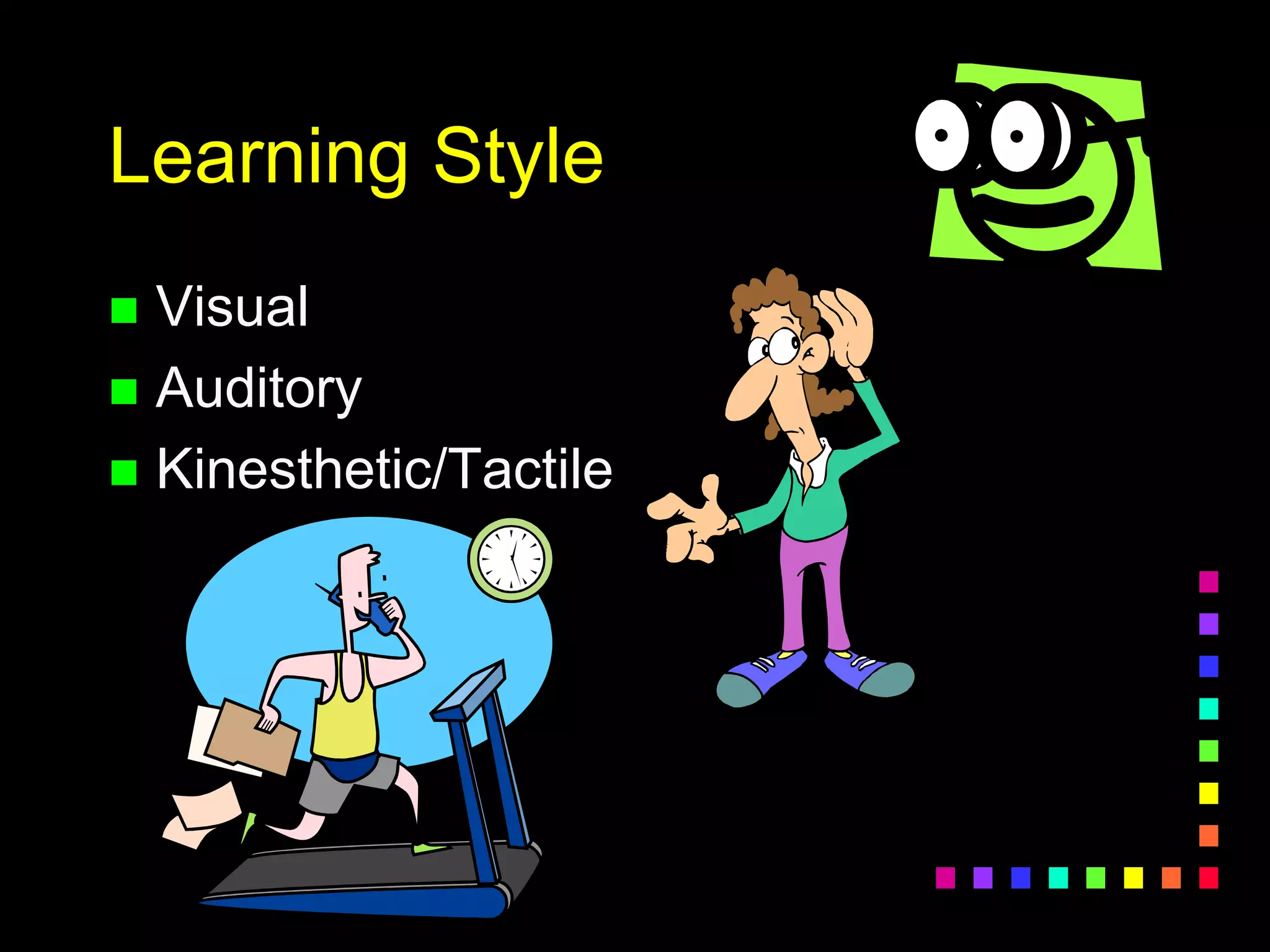
Learning Style
 Visual
 Auditory
 Kinesthetic/Tactile
Learning Style Memory Exercise
 15 items will be passed around. Can
you remember them?
How did you remember the
items?
 Did you remember what you could see,
feel, hear or touch?
 What is your strongest preference?
What worked best for you?
 Auditory
 Visual
 Or kinesthetic?
Visual Learners
 Learn through seeing and reading
 Prefer written directions
 Often good readers
Visual Learners Learn Best
With:
 pictures
 illustrations
 photos
 graphs
 diagrams
 maps
Visual Learning Techniques
 Mental photograph or video
 Flash cards
 Highlighting
 Draw pictures to remember
 Use pictures or symbols in the margin to
remember
 Draw a map or outline
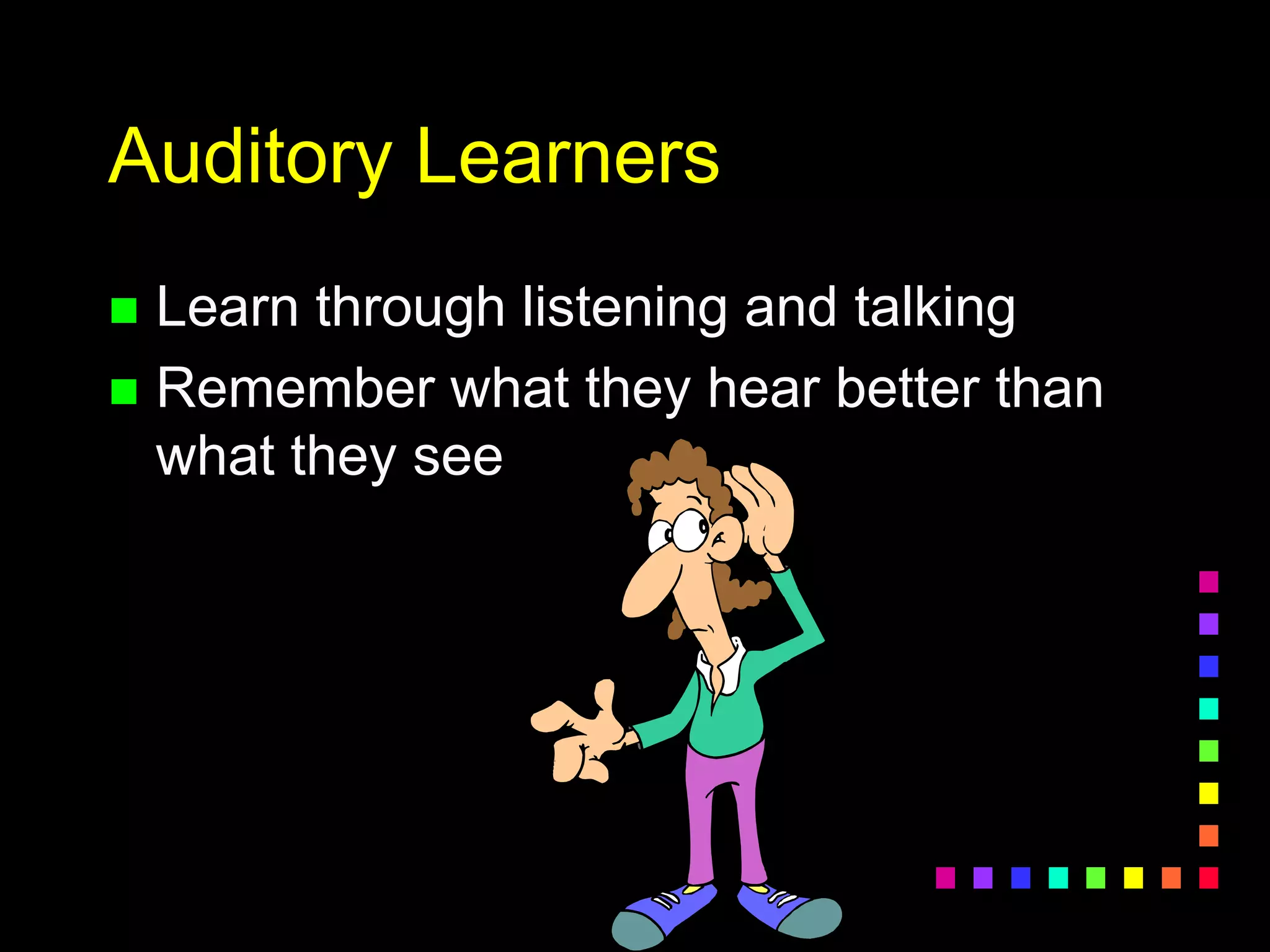
Auditory Learners
 Learn through listening and talking
 Remember what they hear better than
what they see
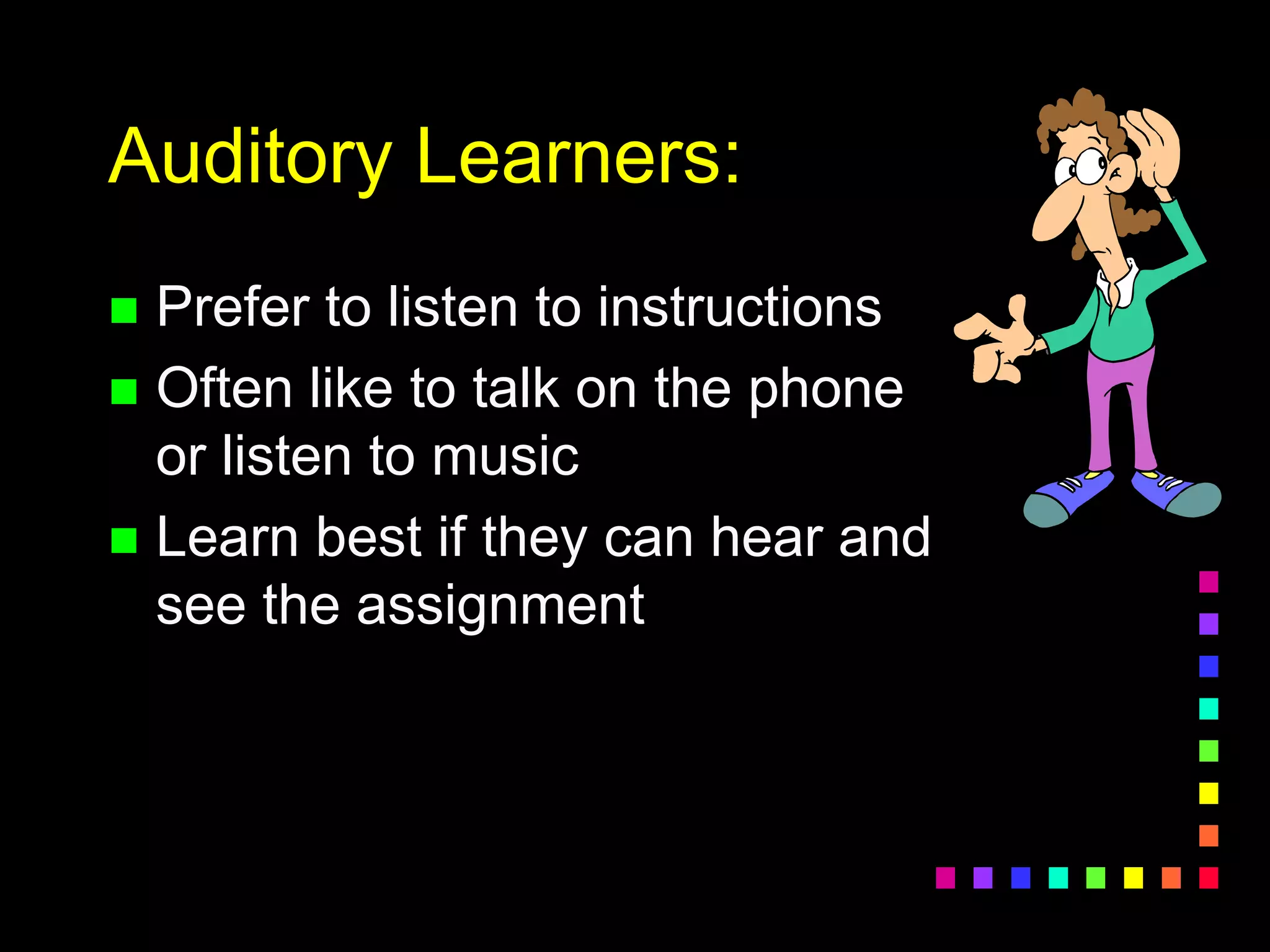
Auditory Learners:
 Prefer to listen to instructions
 Often like to talk on the phone
or listen to music
 Learn best if they can hear and
see the assignment
Auditory Learning Techniques
 Discuss what you have learned
with others
 Participate in study groups
 Recite aloud
 Teach others what you have learned
 Use flash cards and say the items
 Use music in the background if it does
not distract you or use it as a break from
studying
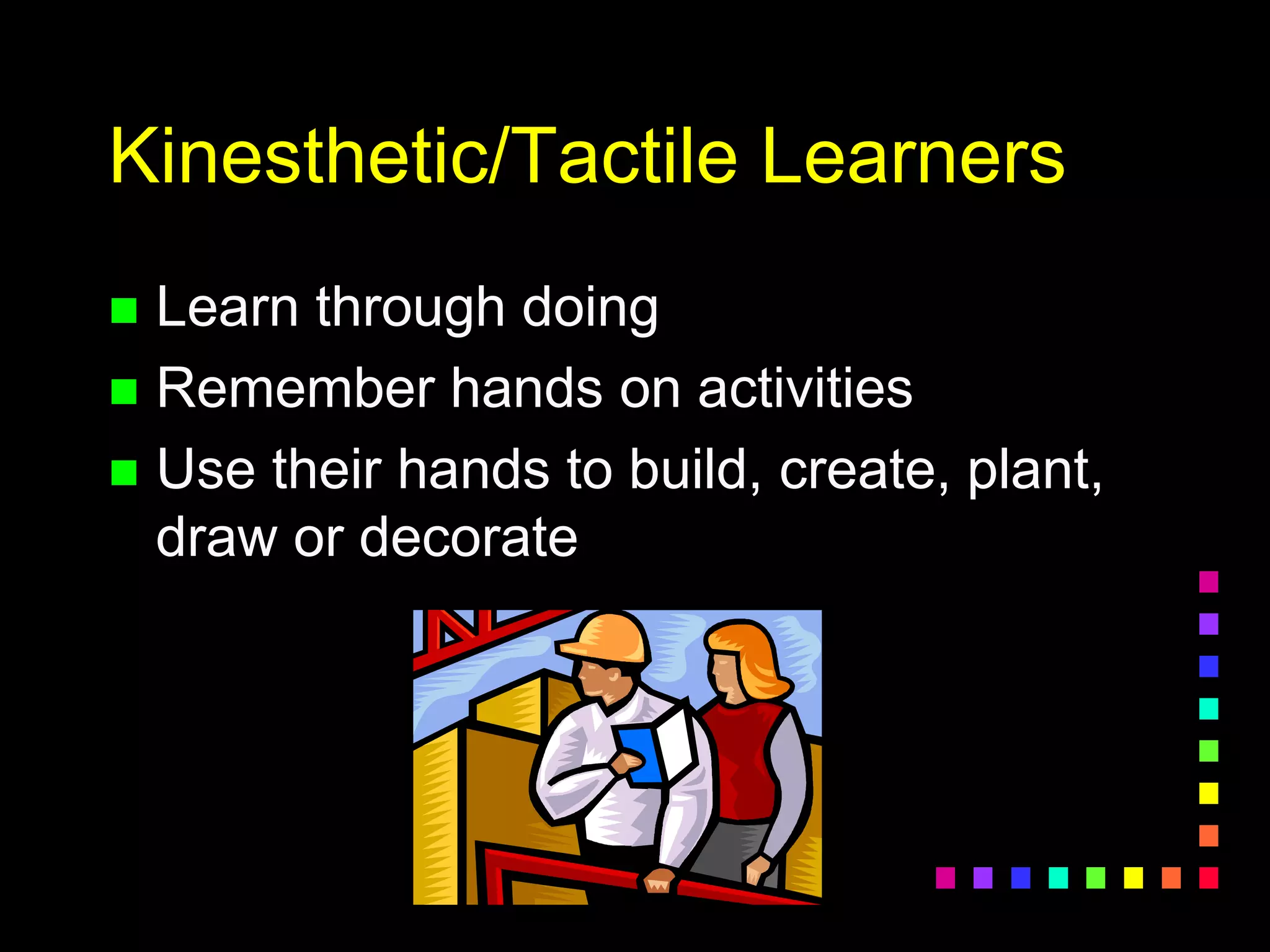
Kinesthetic/Tactile Learners
 Learn through doing
 Remember hands on activities
 Use their hands to build, create, plant,
draw or decorate
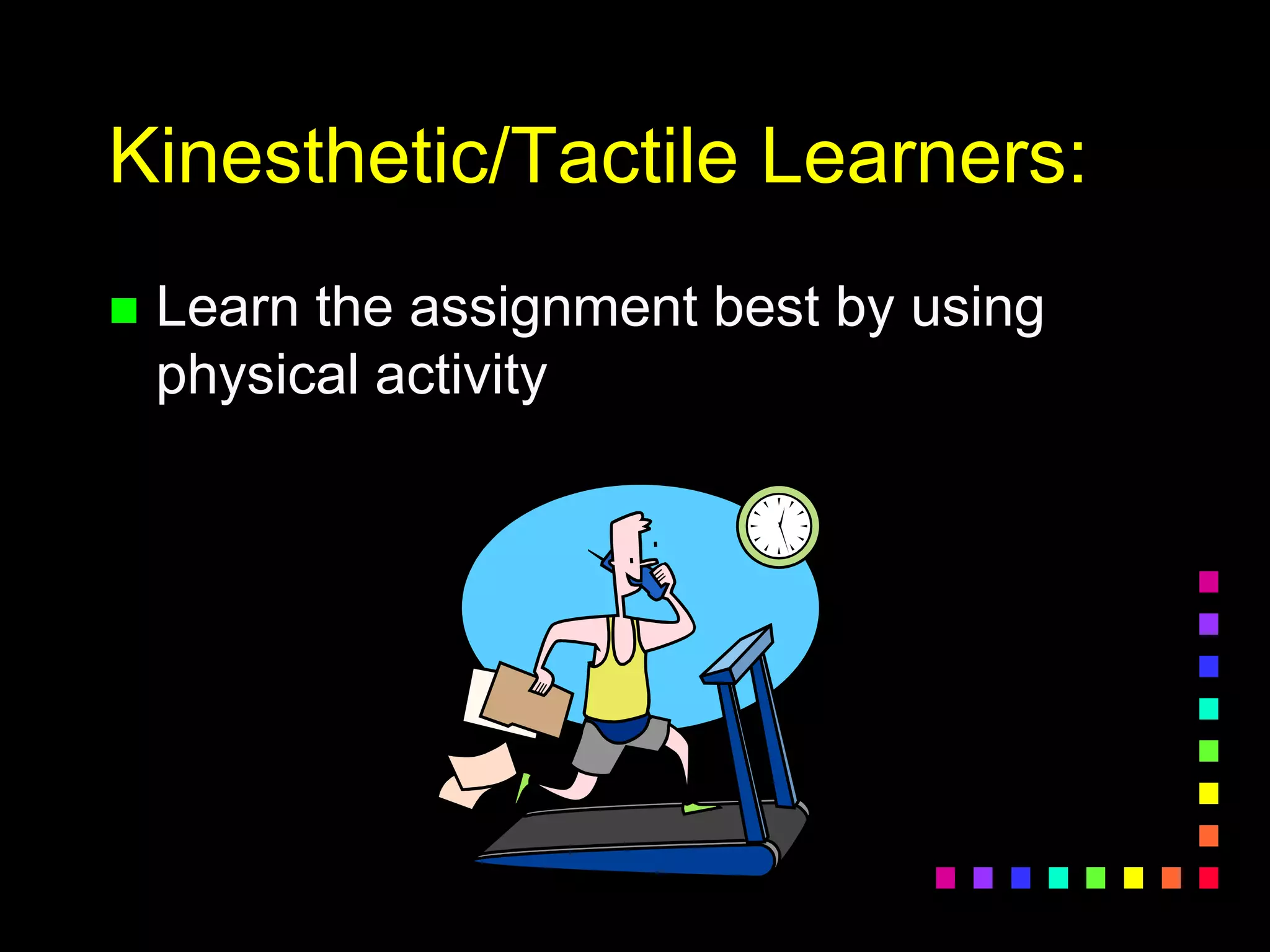
Kinesthetic/Tactile Learners:
 Learn the assignment best by using
physical activity
Kinesthetic/Tactile Learning
Techniques
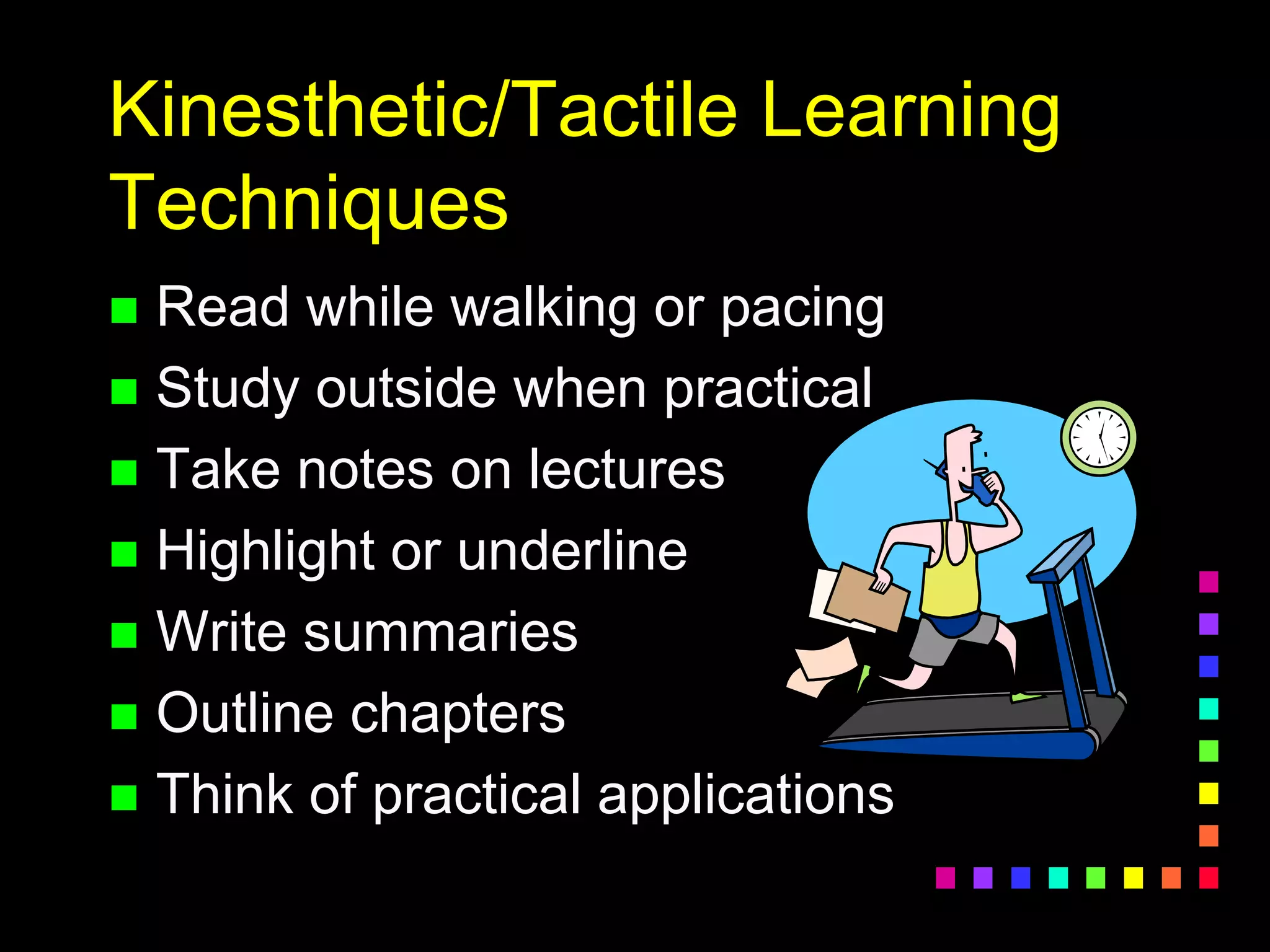
 Read while walking or pacing
 Study outside when practical
 Take notes on lectures
 Highlight or underline
 Write summaries
 Outline chapters
 Think of practical applications
Activity: Complete the
Learning Style Quiz in the
Textbook
Environmental
 Sound
 Light
 Temperature
 Design (formal or informal)
Emotional
 Motivation
 Persistence
 Responsibility
 Structure
Sociological
 Alone/peer
 Authority figures present
 Several ways
Physical
 Auditory
 Visual
 Tactile
 Kinesthetic
 Intake
 Evening/morning
 Late morning
 Afternoon
 Mobility
Written Exercise
 Understanding your Peps Learning
Style Inventory
 What is your ideal environment for
learning?
Your Personality and Your
Learning Style
For review, what is your
personality type?
 Extravert or Introvert?
 Sensing or Intuitive?
 Thinking or Feeling?
 Judging or Perceptive?
Extraverts
 Learn best when in action
 Value physical activity
 Like to study with others
Extravert
 Learn by talking.
 Discuss what you have learned with
others.
 Like variety and action. Take frequent
breaks and do something active.
Caution!
 Extraverts can get so distracted by
activity and socialization that the
studying does not get done.
Introverts
 Learn best by pausing to think
 Value reading
 Prefer to study individually
 Need quiet for concentration
Introvert
 Find a quiet place to study by yourself.
 Plan to study for longer periods of time
so you can concentrate.
 Find places with minimal distractions
such as the library.
 Turn off the phone.
Caution!
 This type may miss out on sharing ideas
with others and the fun and social life of
college.
Sensing
 Seeks specific information
 Memorizes facts
 Values what is practical
 Follows instructions
 Likes hands-on experience
 Wants clear assignments
Sensing
 Good at mastering facts and details.
 Think about practical applications to
motivate yourself.
 Ask, “How can I use this.”
INtuitive
 Seeks quick insights
 Uses imagination to go beyond the facts
 Values what is original
 Likes theories
 Reads between the lines
 Independent thinkers
INtuitive
 Good at learning concepts and theories
 Ask yourself, “What is the main point?”
Caution!
 Since this type focuses on general
concepts and theories, they are likely to
miss the details and facts. To learn the
details, organize them into broad
categories that have meaning for you.
Thinking
 Wants objective material to study
 Logic guides learning
 Likes to critique new ideas
 Finds flaws in an argument
 Learns by challenge and debate
 Wants logical presentations
Thinking
 Thinking types are good at logic.
 Ask yourself, “What do I think of these
ideas?”
 Debate or discuss your ideas with
others.
 Allow time to think and reflect on your
studies.
Feeling
 Wants to be able to relate to the
material personally
 Personal values are important
 Likes to please instructors
 Learns by being supported and
appreciated
 Wants faculty who establish personal
rapport with students
Feeling
 Search for personal meaning to
motivate yourself.
 Help others to learn.
 Whenever possible, choose classes that
relate to your personal interests.
 Find a comfortable environment for
learning.
Judging
 Find ways to organize the material to
learn it easier.
 If possible, select instructors who
present material in an organized way.
 Set goals and use a schedule to
motivate yourself.
 Use a daily planner or to-do list.
Caution!
 This type tends to be structured and
controlled which can limit creativity.
 They may be in conflict with others who
are less organized.
 They may be overachievers who get
stressed easily.
Perceptive
 Good at looking at the possibilities and
keeping the options open.
 Allow time to be thorough and complete
your work.
 Have fun while learning.
 Study in groups with a mixture of
perceptive and judging types.
What if your personality does
not match the teacher’s
personality?
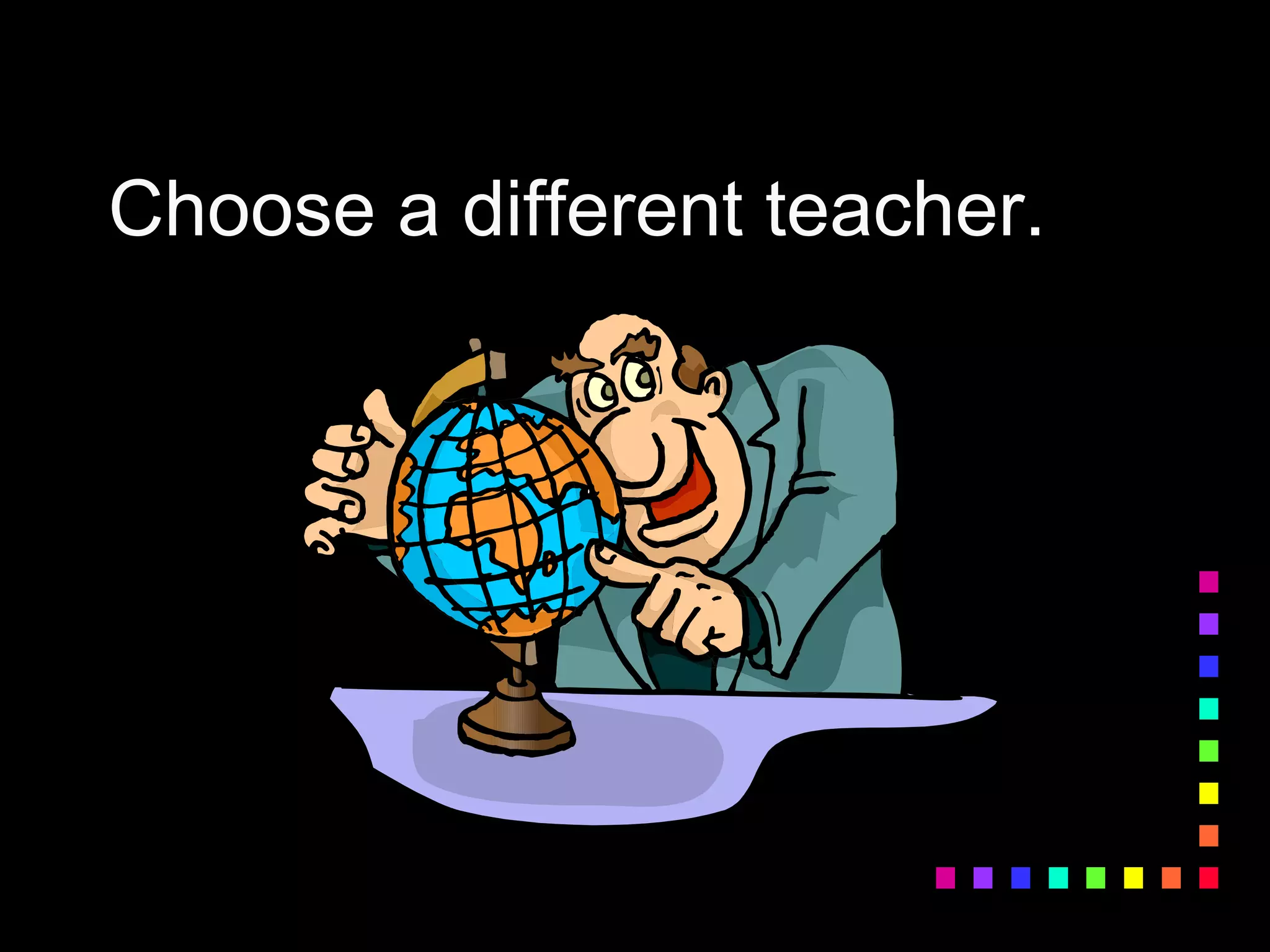
Choose a different teacher.
What else?
Adapt
Tolerate
Appreciate
Understand
Communicate
Multiple
Intelligences
Multiple Intelligences
 Developed by Howard Gardner
 Defined as the human ability to solve
problems or design or compose things
valued in at least one culture
 Broadens the scope of human potential
Learning Style
 Intelligences put to work
 Measured by your performance
 You can develop these areas and
become competent in each one
MULTIPLE INTELLIGENCES
•Verbal/Linguistic
•Logical-Mathematical
•Musical/Rhythmic
•Visual/Spatial
•Bodily/Kinesthetic
•Intrapersonal
•Interpersonal
•Naturalist
Your textbook provides an
opportunity to explore your
multiple intelligences.
These intelligences work
together in complex ways to
make us unique individuals.
Keys to Success:
Create Your Success
Create Your Success
 We make decisions and choices that
create the future.
 Our behavior leads
to our success or failure.
Sometimes we blame others
 My parents did it to me.
 My teacher gave me a poor grade.
 My boss gave me a poor evaluation.
When we take responsibility
for our actions, we create our
success.
Ask these questions:
 How did I create this situation?
 How can I make the best of it?
 What can I do about it now?
 If I didn’t create it, how do I choose to
react to it?
Caution!
 Sometimes you do not create it all.
 You can still choose your attitude and
reaction to what has happened.
Chapter 3