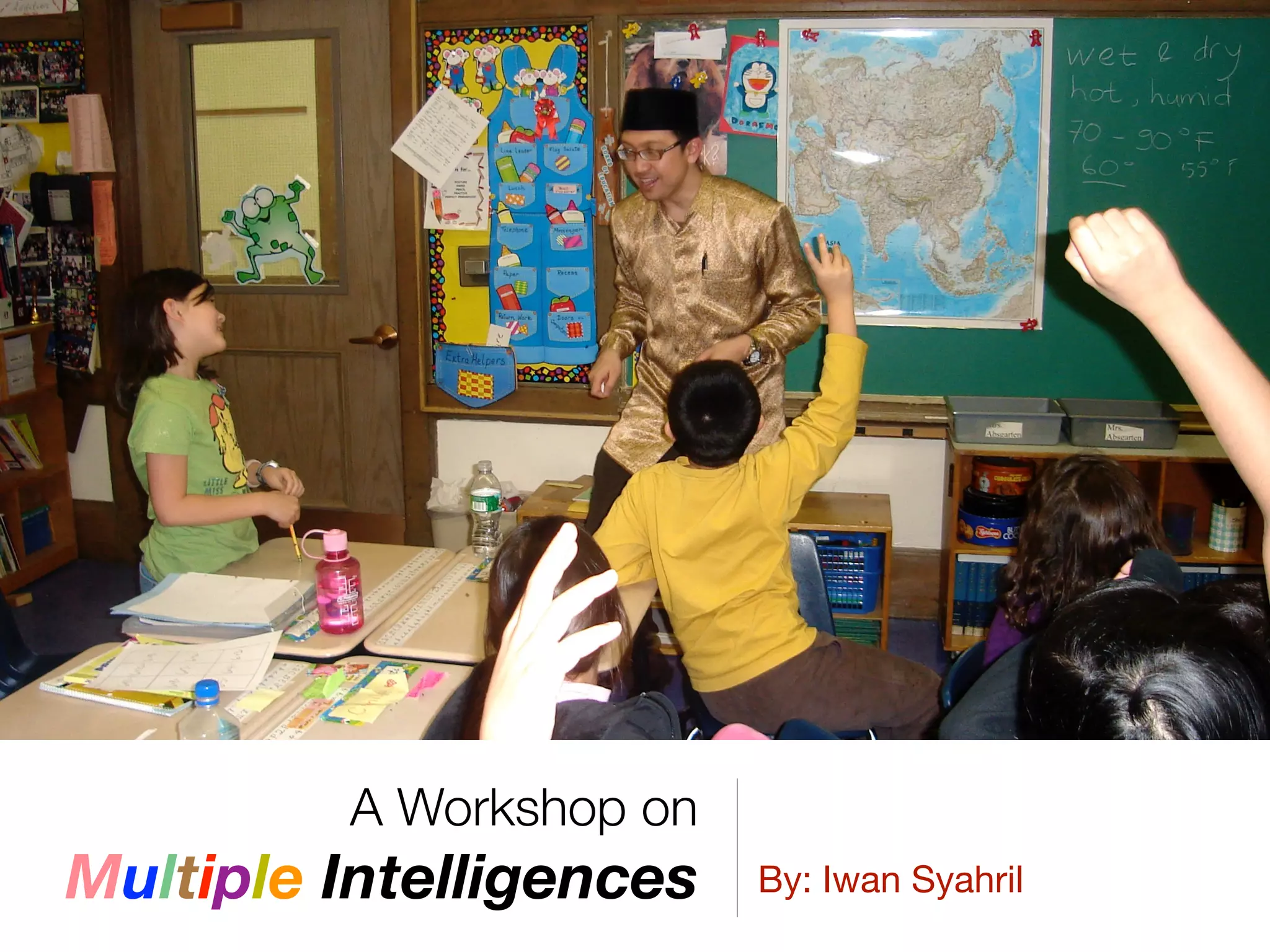
A Workshop on
Multiple Intelligences By: Iwan Syahril
Objectives
• To review the theory of
Multiple Intelligences (MI).

• To explore ways to
integrate MI theory into
curriculum/lessons.
Agenda
• Housekeeping

• Inner-Outer Circles

• Group formation - successful people

• MI Stations

• MI in Teaching and Learning
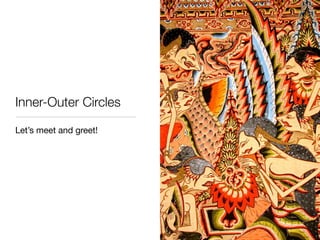
Inner-Outer Circles
Let’s meet and greet!
Jot down names of successful people.
Write as many as you can in 1 minute.
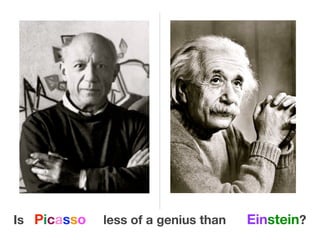
Is Picasso less of a genius than Einstein?
Multiple
Intelligences
• MI STATIONS.

• Cooperative Learning Structure:

1.Encourager.

2.Recorder.

3. Logistics & Time-keeper.

4. Reader.

5. Manager.
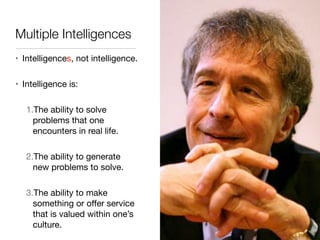
Multiple Intelligences
• Intelligences, not intelligence.

• Intelligence is:

1.The ability to solve
problems that one
encounters in real life.

2.The ability to generate
new problems to solve.

3.The ability to make
something or offer service
that is valued within one’s
culture.
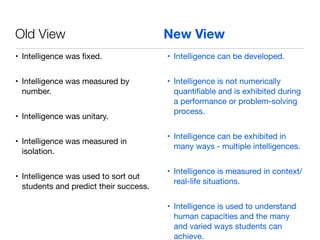
Old View	 	 	 New View
• Intelligence was fixed.

• Intelligence was measured by
number.

• Intelligence was unitary.

• Intelligence was measured in
isolation.

• Intelligence was used to sort out
students and predict their success.

• Intelligence can be developed.

• Intelligence is not numerically
quantifiable and is exhibited during
a performance or problem-solving
process.

• Intelligence can be exhibited in
many ways - multiple intelligences.

• Intelligence is measured in context/
real-life situations.

• Intelligence is used to understand
human capacities and the many
and varied ways students can
achieve.
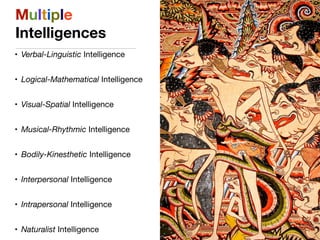
Multiple
Intelligences
• Verbal-Linguistic Intelligence

• Logical-Mathematical Intelligence

• Visual-Spatial Intelligence

• Musical-Rhythmic Intelligence 

• Bodily-Kinesthetic Intelligence

• Interpersonal Intelligence

• Intrapersonal Intelligence

• Naturalist Intelligence
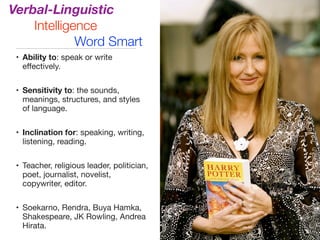
Verbal-Linguistic
Intelligence
Word Smart
• Ability to: speak or write
effectively.

• Sensitivity to: the sounds,
meanings, structures, and styles
of language.

• Inclination for: speaking, writing,
listening, reading.

• Teacher, religious leader, politician,
poet, journalist, novelist,
copywriter, editor.

• Soekarno, Rendra, Buya Hamka,
Shakespeare, JK Rowling, Andrea
Hirata.
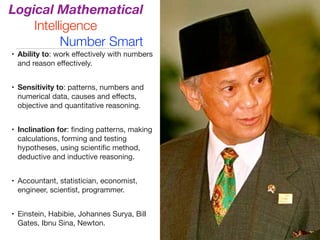
Logical Mathematical
Intelligence
Number Smart
• Ability to: work effectively with numbers
and reason effectively.

• Sensitivity to: patterns, numbers and
numerical data, causes and effects,
objective and quantitative reasoning.

• Inclination for: finding patterns, making
calculations, forming and testing
hypotheses, using scientific method,
deductive and inductive reasoning.

• Accountant, statistician, economist,
engineer, scientist, programmer.

• Einstein, Habibie, Johannes Surya, Bill
Gates, Ibnu Sina, Newton.
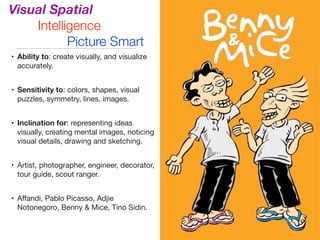
Visual Spatial
Intelligence
Picture Smart
• Ability to: create visually, and visualize
accurately.

• Sensitivity to: colors, shapes, visual
puzzles, symmetry, lines, images.

• Inclination for: representing ideas
visually, creating mental images, noticing
visual details, drawing and sketching.

• Artist, photographer, engineer, decorator,
tour guide, scout ranger.

• Affandi, Pablo Picasso, Adjie
Notonegoro, Benny & Mice, Tino Sidin.
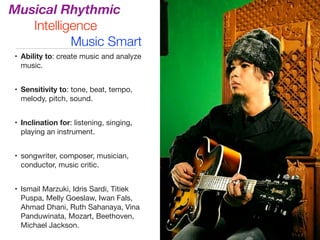
Musical Rhythmic
Intelligence
Music Smart
• Ability to: create music and analyze
music.

• Sensitivity to: tone, beat, tempo,
melody, pitch, sound.

• Inclination for: listening, singing,
playing an instrument.

• songwriter, composer, musician,
conductor, music critic.

• Ismail Marzuki, Idris Sardi, Titiek
Puspa, Melly Goeslaw, Iwan Fals,
Ahmad Dhani, Ruth Sahanaya, Vina
Panduwinata, Mozart, Beethoven,
Michael Jackson.
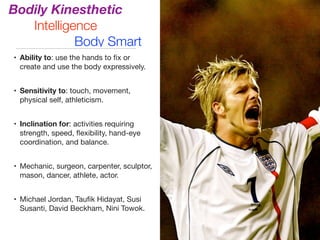
Bodily Kinesthetic
Intelligence
Body Smart
• Ability to: use the hands to fix or
create and use the body expressively.

• Sensitivity to: touch, movement,
physical self, athleticism.

• Inclination for: activities requiring
strength, speed, flexibility, hand-eye
coordination, and balance.

• Mechanic, surgeon, carpenter, sculptor,
mason, dancer, athlete, actor.

• Michael Jordan, Taufik Hidayat, Susi
Susanti, David Beckham, Nini Towok.
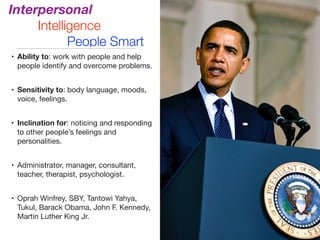
Interpersonal
Intelligence
People Smart
• Ability to: work with people and help
people identify and overcome problems.

• Sensitivity to: body language, moods,
voice, feelings.

• Inclination for: noticing and responding
to other people’s feelings and
personalities.

• Administrator, manager, consultant,
teacher, therapist, psychologist.

• Oprah Winfrey, SBY, Tantowi Yahya,
Tukul, Barack Obama, John F. Kennedy,
Martin Luther King Jr.
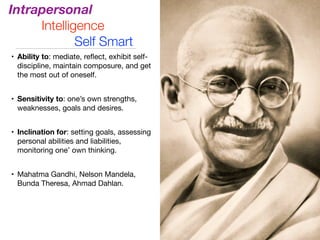
Intrapersonal
Intelligence
Self Smart
• Ability to: mediate, reflect, exhibit self-
discipline, maintain composure, and get
the most out of oneself.

• Sensitivity to: one’s own strengths,
weaknesses, goals and desires.

• Inclination for: setting goals, assessing
personal abilities and liabilities,
monitoring one’ own thinking.

• Mahatma Gandhi, Nelson Mandela,
Bunda Theresa, Ahmad Dahlan.
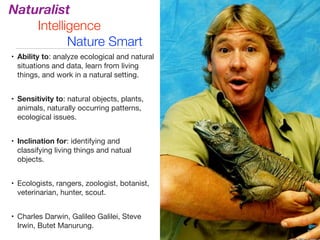
Naturalist
Intelligence
Nature Smart
• Ability to: analyze ecological and natural
situations and data, learn from living
things, and work in a natural setting.

• Sensitivity to: natural objects, plants,
animals, naturally occurring patterns,
ecological issues.

• Inclination for: identifying and
classifying living things and natual
objects.

• Ecologists, rangers, zoologist, botanist,
veterinarian, hunter, scout.

• Charles Darwin, Galileo Galilei, Steve
Irwin, Butet Manurung.
So, what does MI mean to teaching and learning?
VARY
WHAT YOU DO &
HOW YOU DO IT!
“It’s not about how smart you are,
but how you are smart.”
-Howard Gardner
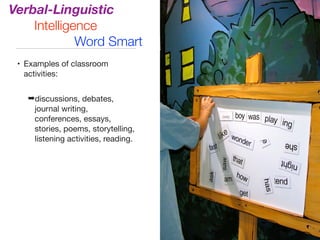
• Examples of classroom
activities:

➡discussions, debates,
journal writing,
conferences, essays,
stories, poems, storytelling,
listening activities, reading.
Verbal-Linguistic
Intelligence
Word Smart
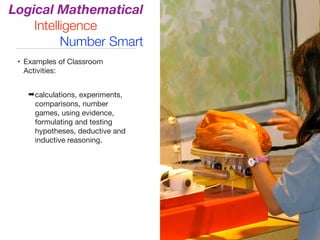
• Examples of Classroom
Activities:

➡calculations, experiments,
comparisons, number
games, using evidence,
formulating and testing
hypotheses, deductive and
inductive reasoning.
Logical Mathematical
Intelligence
Number Smart
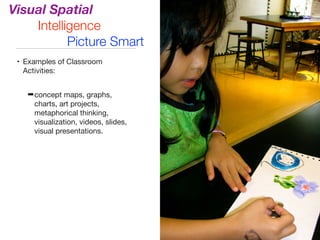
• Examples of Classroom
Activities:

➡concept maps, graphs,
charts, art projects,
metaphorical thinking,
visualization, videos, slides,
visual presentations.
Visual Spatial
Intelligence
Picture Smart
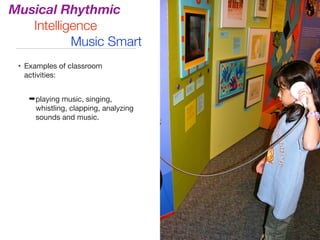
• Examples of classroom
activities:

➡playing music, singing,
whistling, clapping, analyzing
sounds and music.
Musical Rhythmic
Intelligence
Music Smart
• Examples of Classroom
Activities:

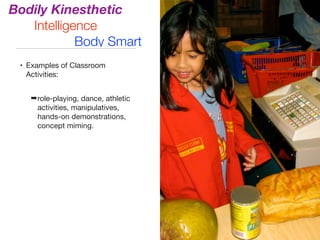
➡role-playing, dance, athletic
activities, manipulatives,
hands-on demonstrations,
concept miming.
Bodily Kinesthetic
Intelligence
Body Smart
• Examples of Classroom
Activities: 

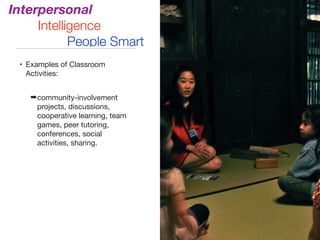
➡community-involvement
projects, discussions,
cooperative learning, team
games, peer tutoring,
conferences, social
activities, sharing.
Interpersonal
Intelligence
People Smart
• Examples of Classroom
Activities:

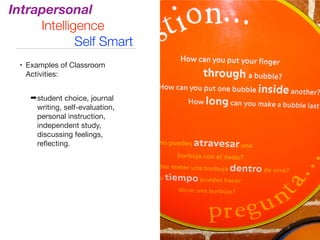
➡student choice, journal
writing, self-evaluation,
personal instruction,
independent study,
discussing feelings,
reflecting.
Intrapersonal
Intelligence
Self Smart
• Examples of Classroom
Activities:

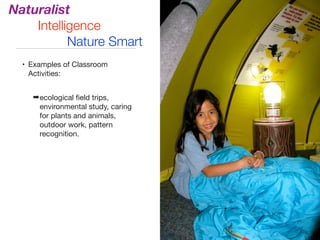
➡ecological field trips,
environmental study, caring
for plants and animals,
outdoor work, pattern
recognition.
Naturalist
Intelligence
Nature Smart
A Video on Multiple Intelligences (1)
A Video on Multiple Intelligences (2)
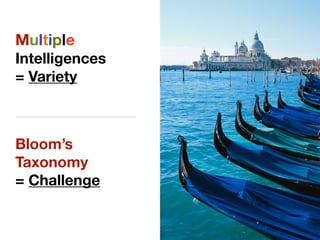
Multiple
Intelligences
= Variety
Bloom’s
Taxonomy
= Challenge
“Education that treats everybody in the same
way is the most unfair education.”
--Howard Gardner

A workshop on multiple intelligences

  • 1.
    A Workshop on MultipleIntelligences By: Iwan Syahril
  • 2.
    Objectives • To reviewthe theory of Multiple Intelligences (MI). • To explore ways to integrate MI theory into curriculum/lessons.
  • 3.
    Agenda • Housekeeping • Inner-OuterCircles • Group formation - successful people • MI Stations • MI in Teaching and Learning
  • 4.
  • 5.
    Jot down namesof successful people. Write as many as you can in 1 minute.
  • 6.
    Is Picasso lessof a genius than Einstein?
  • 7.
    Multiple Intelligences • MI STATIONS. •Cooperative Learning Structure: 1.Encourager. 2.Recorder. 3. Logistics & Time-keeper. 4. Reader. 5. Manager.
  • 8.
    Multiple Intelligences • Intelligences,not intelligence. • Intelligence is: 1.The ability to solve problems that one encounters in real life. 2.The ability to generate new problems to solve. 3.The ability to make something or offer service that is valued within one’s culture.
  • 9.
    Old View New View • Intelligence was fixed. • Intelligence was measured by number. • Intelligence was unitary. • Intelligence was measured in isolation. • Intelligence was used to sort out students and predict their success. • Intelligence can be developed. • Intelligence is not numerically quantifiable and is exhibited during a performance or problem-solving process. • Intelligence can be exhibited in many ways - multiple intelligences. • Intelligence is measured in context/ real-life situations. • Intelligence is used to understand human capacities and the many and varied ways students can achieve.
  • 10.
    Multiple Intelligences • Verbal-Linguistic Intelligence •Logical-Mathematical Intelligence • Visual-Spatial Intelligence • Musical-Rhythmic Intelligence • Bodily-Kinesthetic Intelligence • Interpersonal Intelligence • Intrapersonal Intelligence • Naturalist Intelligence
  • 11.
    Verbal-Linguistic Intelligence Word Smart • Abilityto: speak or write effectively. • Sensitivity to: the sounds, meanings, structures, and styles of language. • Inclination for: speaking, writing, listening, reading. • Teacher, religious leader, politician, poet, journalist, novelist, copywriter, editor. • Soekarno, Rendra, Buya Hamka, Shakespeare, JK Rowling, Andrea Hirata.
  • 12.
    Logical Mathematical Intelligence Number Smart •Ability to: work effectively with numbers and reason effectively. • Sensitivity to: patterns, numbers and numerical data, causes and effects, objective and quantitative reasoning. • Inclination for: finding patterns, making calculations, forming and testing hypotheses, using scientific method, deductive and inductive reasoning. • Accountant, statistician, economist, engineer, scientist, programmer. • Einstein, Habibie, Johannes Surya, Bill Gates, Ibnu Sina, Newton.
  • 13.
    Visual Spatial Intelligence Picture Smart •Ability to: create visually, and visualize accurately. • Sensitivity to: colors, shapes, visual puzzles, symmetry, lines, images. • Inclination for: representing ideas visually, creating mental images, noticing visual details, drawing and sketching. • Artist, photographer, engineer, decorator, tour guide, scout ranger. • Affandi, Pablo Picasso, Adjie Notonegoro, Benny & Mice, Tino Sidin.
  • 14.
    Musical Rhythmic Intelligence Music Smart •Ability to: create music and analyze music. • Sensitivity to: tone, beat, tempo, melody, pitch, sound. • Inclination for: listening, singing, playing an instrument. • songwriter, composer, musician, conductor, music critic. • Ismail Marzuki, Idris Sardi, Titiek Puspa, Melly Goeslaw, Iwan Fals, Ahmad Dhani, Ruth Sahanaya, Vina Panduwinata, Mozart, Beethoven, Michael Jackson.
  • 15.
    Bodily Kinesthetic Intelligence Body Smart •Ability to: use the hands to fix or create and use the body expressively. • Sensitivity to: touch, movement, physical self, athleticism. • Inclination for: activities requiring strength, speed, flexibility, hand-eye coordination, and balance. • Mechanic, surgeon, carpenter, sculptor, mason, dancer, athlete, actor. • Michael Jordan, Taufik Hidayat, Susi Susanti, David Beckham, Nini Towok.
  • 16.
    Interpersonal Intelligence People Smart • Abilityto: work with people and help people identify and overcome problems. • Sensitivity to: body language, moods, voice, feelings. • Inclination for: noticing and responding to other people’s feelings and personalities. • Administrator, manager, consultant, teacher, therapist, psychologist. • Oprah Winfrey, SBY, Tantowi Yahya, Tukul, Barack Obama, John F. Kennedy, Martin Luther King Jr.
  • 17.
    Intrapersonal Intelligence Self Smart • Abilityto: mediate, reflect, exhibit self- discipline, maintain composure, and get the most out of oneself. • Sensitivity to: one’s own strengths, weaknesses, goals and desires. • Inclination for: setting goals, assessing personal abilities and liabilities, monitoring one’ own thinking. • Mahatma Gandhi, Nelson Mandela, Bunda Theresa, Ahmad Dahlan.
  • 18.
    Naturalist Intelligence Nature Smart • Abilityto: analyze ecological and natural situations and data, learn from living things, and work in a natural setting. • Sensitivity to: natural objects, plants, animals, naturally occurring patterns, ecological issues. • Inclination for: identifying and classifying living things and natual objects. • Ecologists, rangers, zoologist, botanist, veterinarian, hunter, scout. • Charles Darwin, Galileo Galilei, Steve Irwin, Butet Manurung.
  • 19.
    So, what doesMI mean to teaching and learning? VARY WHAT YOU DO & HOW YOU DO IT! “It’s not about how smart you are, but how you are smart.” -Howard Gardner
  • 20.
    • Examples ofclassroom activities: ➡discussions, debates, journal writing, conferences, essays, stories, poems, storytelling, listening activities, reading. Verbal-Linguistic Intelligence Word Smart
  • 21.
    • Examples ofClassroom Activities: ➡calculations, experiments, comparisons, number games, using evidence, formulating and testing hypotheses, deductive and inductive reasoning. Logical Mathematical Intelligence Number Smart
  • 22.
    • Examples ofClassroom Activities: ➡concept maps, graphs, charts, art projects, metaphorical thinking, visualization, videos, slides, visual presentations. Visual Spatial Intelligence Picture Smart
  • 23.
    • Examples ofclassroom activities: ➡playing music, singing, whistling, clapping, analyzing sounds and music. Musical Rhythmic Intelligence Music Smart
  • 24.
    • Examples ofClassroom Activities: ➡role-playing, dance, athletic activities, manipulatives, hands-on demonstrations, concept miming. Bodily Kinesthetic Intelligence Body Smart
  • 25.
    • Examples ofClassroom Activities: ➡community-involvement projects, discussions, cooperative learning, team games, peer tutoring, conferences, social activities, sharing. Interpersonal Intelligence People Smart
  • 26.
    • Examples ofClassroom Activities: ➡student choice, journal writing, self-evaluation, personal instruction, independent study, discussing feelings, reflecting. Intrapersonal Intelligence Self Smart
  • 27.
    • Examples ofClassroom Activities: ➡ecological field trips, environmental study, caring for plants and animals, outdoor work, pattern recognition. Naturalist Intelligence Nature Smart
  • 28.
    A Video onMultiple Intelligences (1)
  • 30.
    A Video onMultiple Intelligences (2)
  • 32.
  • 33.
    “Education that treatseverybody in the same way is the most unfair education.” --Howard Gardner