TYPES
OF
LEARNERS Presenter: Glizell Ocampo
FAST /GIFTED LEARNERS
 
 Gifted is a frequent designation and a 
certain specific I.Q. range has been 
allotted to those who are known as gifted 
people. The gifted and talented learners 
are those whose intellectual abilities are
exceptionally and constantly outstanding.
 Scores on intelligence testing ranging 
from 130 to 140 have been used to 
identify them.
FAST /GIFTED LEARNERS
 
 They  rank  high  in  academic  
achievement  and  cover  a  wide ground 
within a limited period of time.
  They are fast thinking, highly creative and 
imaginative with very high constructive 
abilities.
FAST /GIFTED LEARNERS
 
  They have very good cordial 
relationships.  They make friends easily.
 They have outstanding leadership 
qualities and can work well under 
pressure.
 They  are  mostly  invariably  good  in  all  
subjects.
FAST /GIFTED LEARNERS
 
• Enrichment of instructional programmed: 
an abundant supply of books, laboratory 
equipment, and illustrative material for he 
may select the one needed according to 
his personal aims.
•  School work to give a liberal background 
for later professional preparation.
FAST /GIFTED LEARNERS
 
 More of verbal descriptions and 
generalization, less of repetition, study 
beyond that required for average or slow 
learner. 
 Emphasis on development of personality 
and character traits.
FAST /GIFTED LEARNERS
 
•  Skipping of grades commensurate with 
social and emotional development.
•  Emphasis on well-rounded development 
and expansion of interests.
•  More permissiveness, freedom and 
challenge than more prescription of work.
SUPERIOR/BRIGHT LEARNERS
 
 Bright children are the ones who succeed 
better in a typical school setting.
 A bright child knows the answer.
 A bright child works hard to achieve.
 A bright child enjoys school.
SUPERIOR/BRIGHT LEARNERS
 
• Have an extra challenge ready that allows 
the student to go deeper into the subject, 
learn a little more, or apply a skill he has just 
learned in a new way.
SUPERIOR/BRIGHT LEARNERS
 
 Help the child to create an ongoing individual 
project. Perhaps a report on something she is 
interested in, a PowerPoint presentation, or a 
creative writing project - anything that is 
motivating, educationally sound and can be 
worked on here and there.
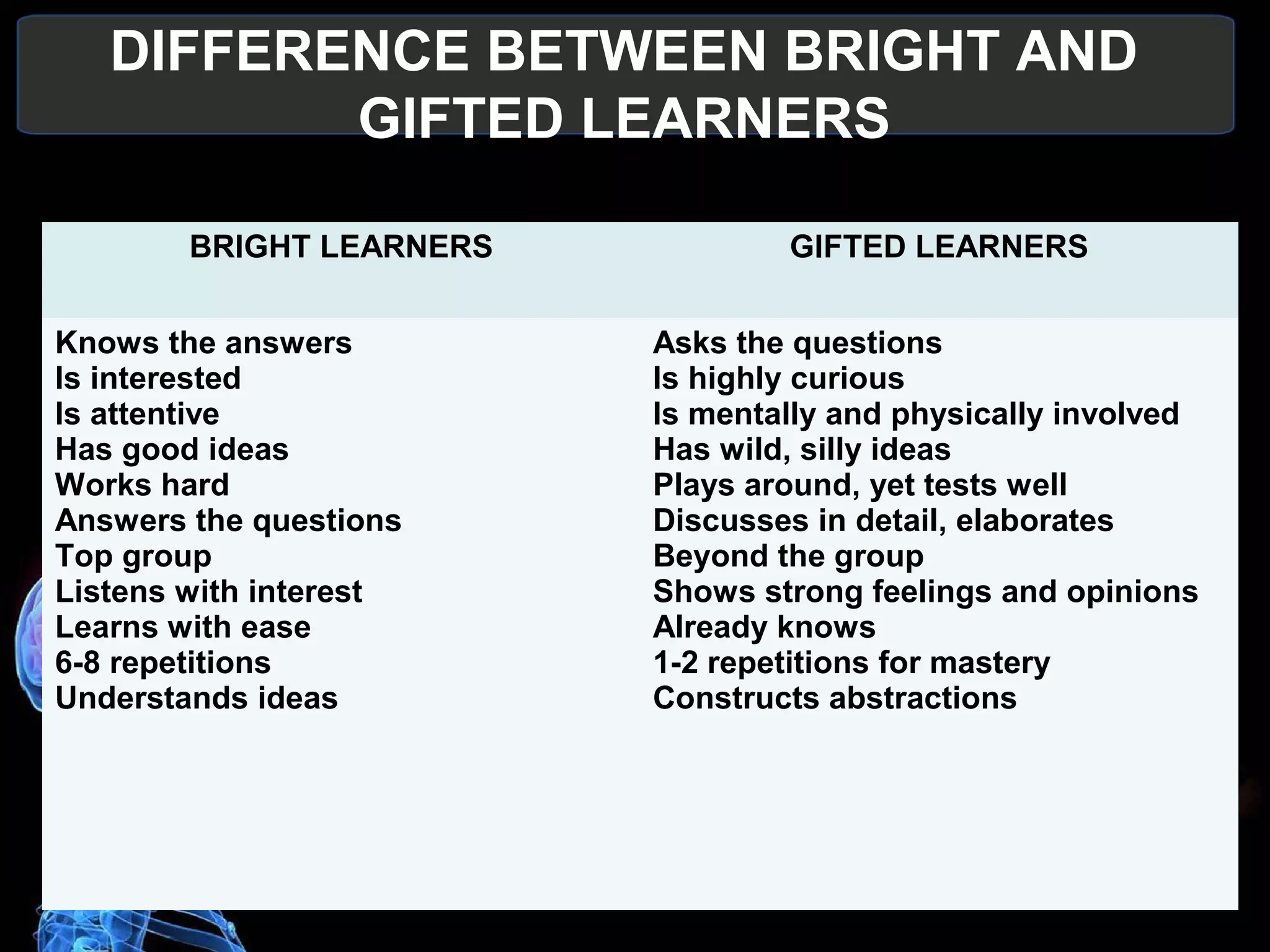
DIFFERENCE BETWEEN BRIGHT AND
FAST LEARNERS
 BRIGHT LEARNERS FAST LEARNERS
Knows the answers
Is interested
Is attentive
Has good ideas
Works hard
Answers the questions
Top group
Listens with interest
Learns with ease
6-8 repetitions
Understands ideas
Asks the questions
Is highly curious
Is mentally and physically involved
Has wild, silly ideas
Plays around, yet tests well
Discusses in detail, elaborates
Beyond the group
Shows strong feelings and opinions
Already knows
1-2 repetitions for mastery
Constructs abstractions
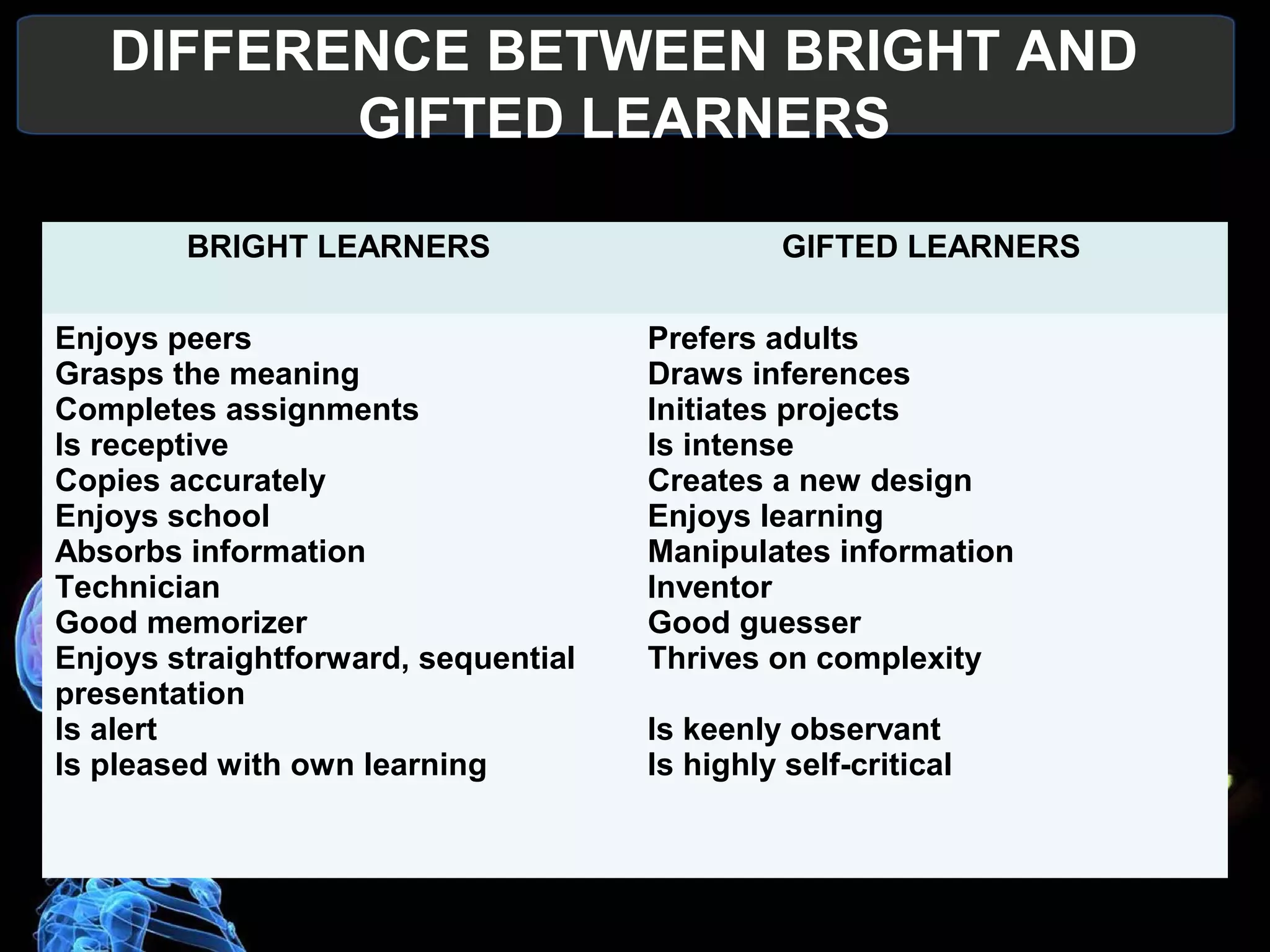
DIFFERENCE BETWEEN BRIGHT AND
FAST LEARNERS
 BRIGHT LEARNERS FAST LEARNERS
Enjoys peers
Grasps the meaning
Completes assignments
Is receptive
Copies accurately
Enjoys school
Absorbs information
Technician
Good memorizer
Enjoys straightforward, sequential
presentation
Is alert
Is pleased with own learning
Prefers adults
Draws inferences
Initiates projects
Is intense
Creates a new design
Enjoys learning
Manipulates information
Inventor
Good guesser
Thrives on complexity
Is keenly observant
Is highly self-critical
AVERAGE LEARNERS
  Majority of learners can be classified as 
normal learners.  That is to say that majority 
of learners are of average abilities. 
 They manifest average ability.
 They have their own learning problems like 
lateness to school,truancy, wrong peer 
group.
 They manifest giftedness when faced with 
AVERAGE LEARNERS
 
  They need a teacher who finds out what 
their interests are and builds on them.
 They need a teacher who discovers the 
learning style of each student.
 They need a teacher who will ask complex 
questions and expect that the students will be 
able to answer them.
SLOW LEARNERS
 
 A child who qualifies for special education 
services .
 They  exhibit numerous  learning  difficulties  
that  seem  to  defy  all  learning 
methodologies and procedures.
 The I.Q., of slow learners is in most cases 
below 90.
SLOW LEARNERS
 
 The slow learners have a short attention 
span, that is, they cannot concentrate for 
long.
 They have short memory and they don’t 
remember easily what they have been 
taught.
 The slow learners are always bored and 
generally have no interest in learning.
 They have poor communication skills. They 
SLOW LEARNERS
 
 They have poor eye-hand coordination.  They 
cannot see properly nor even copy correctly.
 Their  numeric  ability  is  very  low  and  they  
are  very  poor  in calculation.
  They  have  poor  social  interaction  and  
cannot  get  along  with others easily.
 They score low in all types of tests and 
assessment.
SLOW LEARNERS
 
Health Problems
A child’s mother might have had measles, 
venereal diseases that might have caused 
mental retardation in the child.  Also the 
mother might be malnourished during 
pregnancy.  The child’s health might also
be affected after birth.
SLOW LEARNERS
 
Psychological Problems
Mothers who experience intense and 
excessive anxiety, worry, stress and the like 
may give birth to disturbed children, since the 
mother’s state of health affects the child. 
SLOW LEARNERS
 
Genetic Problem
If slowness or dullness run in the lineage, 
inherited characteristics from parents may 
influence the general intellectual 
development of the child.
SLOW LEARNERS
 
Home Based Problems
Broken homes and extreme poverty on the 
part of the parents may affect the child.
SLOW LEARNERS
 
School Based Problems 
- Poor methods of teaching
- Poor  teacher-pupil  relationships  for  
example  when  a  child constantly 
experiences hostility from the teacher.
- Poor learning environment is not conducive to 
learning.
SLOW LEARNERS
 
•  More repetition of facts in different contexts 
and drill on fundamentals.
•  To make learning concrete, more 
illustrations, demonstra-tions, examples, 
experiences to be given.
•  Effective motivation in the form of immediate 
rewards, short-term goals, praise, 
encouragement.
SLOW LEARNERS
 
•  School work to be related with the 
occupations the learners will take up as 
adults.
• Very little criticism or sarcastic remarks to be 
given.
•  Illustrations to be simple and specific, 
examples to be given from daily life.
•  More schooling, more hours of school work 
and more years.
Types of Learners

Types of Learners