Howard
Gardner's
Multiple
Intelligences
Theory
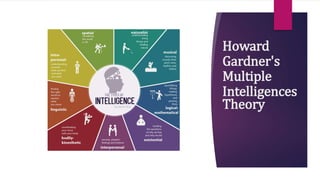
Gardner identified eight components of intelligence (Chapman,
1996 & Lazier, 2000). He asserts that we are all born with the
potential to develop a multiplicity of intelligences. He argues
that these intelligences are distinct from each other, and that
each person has some level of each of these intelligences. He
asserts that these intelligences are most often overlooked and
not tested by researchers and psychologists, like those skills and
abilities valued in different cultures.
 This theory challenge the assumption in many
learning theories that learning is a universal human
process that all individuals experience according to
the same principles. Howard Gardner's of multiple
intelligence challenges the understanding that
intelligence is dominated by a single general ability.
He argues that intelligence actually consists of many
distinct intelligences.
The MI theory “requires” the teacher to come up with
a variety of instructional materials and strategies, to
make sure that the needs of students with specific
intelligences or abilities are addressed.
Gardner defines intelligence as a “biopsychological
potential to process information that can be activated
in a cultural setting to solve problems or create
products that are of value in a culture”
Linguistic Intelligence (“word
smart”)
 Linguistic Intelligence is a part of Howard Gardner's
multiple intelligence theory that deals with sensitivity to
the spoken and written language, ability to learn
languages, and capacity to use language to accomplish
certain goals.
 People with linguistic intelligence, such as William
Shakespeare and Oprah Winfrey, have an ability to
analyze information and create products involving oral
and written language such as speeches, books, and memos.
Logical-Mathematical
Intelligence
(“number/reasoning smart”)
 Logical-mathematical intelligence refers to the
capacity to analyze problems logically, carry out
mathematical operations, and investigate issues
scientifically.
 People with logical-mathematical intelligence, such as
Albert Einstein and Bill Gates, have an ability to
develop equations and proofs, make calculations, and
solve abstract problems.
Spatial Intelligence (“picture
smart”)
 Spatial intelligence features the potential to recognize
and manipulate the patterns of wide space (those
used, for instance, by navigators and pilots) as well as
the patterns of more confined areas, such as those of
importance to sculptors, surgeons, chess players,
graphic artists, or architects.
 People with spatial intelligence, such as Frank Lloyd
Wright and Amelia Earhart, have an ability to recognize
and manipulate large-scale and fine-grained spatial
images.
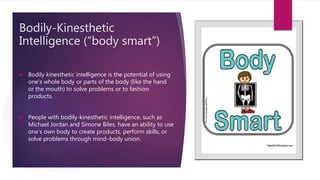
Bodily-Kinesthetic
Intelligence (“body smart”)
 Bodily kinesthetic intelligence is the potential of using
one’s whole body or parts of the body (like the hand
or the mouth) to solve problems or to fashion
products.
 People with bodily-kinesthetic intelligence, such as
Michael Jordan and Simone Biles, have an ability to use
one’s own body to create products, perform skills, or
solve problems through mind–body union.
Musical Intelligence (“music
smart”)
 Musical intelligence refers to the skill in the
performance, composition, and appreciation of musical
patterns.
 People with musical intelligence, such as Beethoven
and Ed Sheeran, have an ability to recognize and
create musical pitch, rhythm, timbre, and tone.
Interpersonal Intelligence
(“people smart”)
 Interpersonal intelligence is the capacity to understand
the intentions, motivations, and desires of other
people and consequently to work effectively with
others.
 People with interpersonal intelligence, such as
Mahatma Gandhi and Mother Teresa, have an ability to
recognize and understand other people’s moods,
desires, motivations, and intentions.
Intrapersonal Intelligence
(“self smart”)
 Intrapersonal intelligence is the capacity to understand oneself, to
have an effective working model of oneself-including own’s
desires, fears, and capacities—and to use such information
effectively in regulating one’s own life.
 People with intrapersonal intelligence, such as Aristotle and Maya
Angelou, have an ability to recognize and understand his or her
own moods, desires, motivations, and intentions.
 This type of intelligence can help a person to understand which
life goals are important and how to achieve them.
Naturalist intelligence
(“nature smart”)
 Naturalistic intelligence involves expertise in the
recognition and classification of the numerous
species—the flora and fauna—of his or her
environment.
 People with naturalistic intelligence, such as Charles
Darwin and Jane Goddall, have an ability to identify
and distinguish among different types of plants,
animals, and weather formations that are found in the
natural world.
Existential
Intelligence
 Sensitivity and capacity
to tackle deep questions
about human existence,
such as the meaning of
life, why do we die, and
how did we get here

Multiple intelligence

  • 1.
  • 2.
    Gardner identified eightcomponents of intelligence (Chapman, 1996 & Lazier, 2000). He asserts that we are all born with the potential to develop a multiplicity of intelligences. He argues that these intelligences are distinct from each other, and that each person has some level of each of these intelligences. He asserts that these intelligences are most often overlooked and not tested by researchers and psychologists, like those skills and abilities valued in different cultures.
  • 3.
     This theorychallenge the assumption in many learning theories that learning is a universal human process that all individuals experience according to the same principles. Howard Gardner's of multiple intelligence challenges the understanding that intelligence is dominated by a single general ability. He argues that intelligence actually consists of many distinct intelligences.
  • 4.
    The MI theory“requires” the teacher to come up with a variety of instructional materials and strategies, to make sure that the needs of students with specific intelligences or abilities are addressed. Gardner defines intelligence as a “biopsychological potential to process information that can be activated in a cultural setting to solve problems or create products that are of value in a culture”
  • 6.
    Linguistic Intelligence (“word smart”) Linguistic Intelligence is a part of Howard Gardner's multiple intelligence theory that deals with sensitivity to the spoken and written language, ability to learn languages, and capacity to use language to accomplish certain goals.  People with linguistic intelligence, such as William Shakespeare and Oprah Winfrey, have an ability to analyze information and create products involving oral and written language such as speeches, books, and memos.
  • 7.
    Logical-Mathematical Intelligence (“number/reasoning smart”)  Logical-mathematicalintelligence refers to the capacity to analyze problems logically, carry out mathematical operations, and investigate issues scientifically.  People with logical-mathematical intelligence, such as Albert Einstein and Bill Gates, have an ability to develop equations and proofs, make calculations, and solve abstract problems.
  • 8.
    Spatial Intelligence (“picture smart”) Spatial intelligence features the potential to recognize and manipulate the patterns of wide space (those used, for instance, by navigators and pilots) as well as the patterns of more confined areas, such as those of importance to sculptors, surgeons, chess players, graphic artists, or architects.  People with spatial intelligence, such as Frank Lloyd Wright and Amelia Earhart, have an ability to recognize and manipulate large-scale and fine-grained spatial images.
  • 9.
    Bodily-Kinesthetic Intelligence (“body smart”) Bodily kinesthetic intelligence is the potential of using one’s whole body or parts of the body (like the hand or the mouth) to solve problems or to fashion products.  People with bodily-kinesthetic intelligence, such as Michael Jordan and Simone Biles, have an ability to use one’s own body to create products, perform skills, or solve problems through mind–body union.
  • 10.
    Musical Intelligence (“music smart”) Musical intelligence refers to the skill in the performance, composition, and appreciation of musical patterns.  People with musical intelligence, such as Beethoven and Ed Sheeran, have an ability to recognize and create musical pitch, rhythm, timbre, and tone.
  • 11.
    Interpersonal Intelligence (“people smart”) Interpersonal intelligence is the capacity to understand the intentions, motivations, and desires of other people and consequently to work effectively with others.  People with interpersonal intelligence, such as Mahatma Gandhi and Mother Teresa, have an ability to recognize and understand other people’s moods, desires, motivations, and intentions.
  • 12.
    Intrapersonal Intelligence (“self smart”) Intrapersonal intelligence is the capacity to understand oneself, to have an effective working model of oneself-including own’s desires, fears, and capacities—and to use such information effectively in regulating one’s own life.  People with intrapersonal intelligence, such as Aristotle and Maya Angelou, have an ability to recognize and understand his or her own moods, desires, motivations, and intentions.  This type of intelligence can help a person to understand which life goals are important and how to achieve them.
  • 13.
    Naturalist intelligence (“nature smart”) Naturalistic intelligence involves expertise in the recognition and classification of the numerous species—the flora and fauna—of his or her environment.  People with naturalistic intelligence, such as Charles Darwin and Jane Goddall, have an ability to identify and distinguish among different types of plants, animals, and weather formations that are found in the natural world.
  • 14.
    Existential Intelligence  Sensitivity andcapacity to tackle deep questions about human existence, such as the meaning of life, why do we die, and how did we get here