ED 450 Assessment & Evaluation
              Soledad Camacho
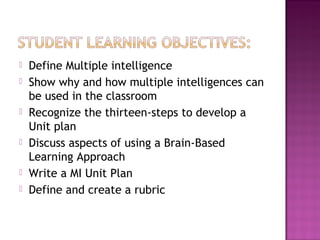
   Define Multiple intelligence
   Show why and how multiple intelligences can
    be used in the classroom
   Recognize the thirteen-steps to develop a
    Unit plan
   Discuss aspects of using a Brain-Based
    Learning Approach
   Write a MI Unit Plan
   Define and create a rubric
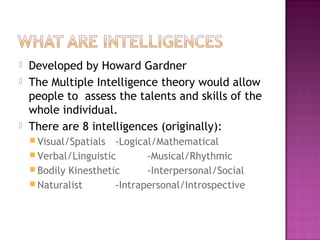
   Developed by Howard Gardner
   The Multiple Intelligence theory would allow
    people to assess the talents and skills of the
    whole individual.
   There are 8 intelligences (originally):
     Visual/Spatials  -Logical/Mathematical
     Verbal/Linguistic       -Musical/Rhythmic
     Bodily Kinesthetic      -Interpersonal/Social
     Naturalist       -Intrapersonal/Introspective
   It allows teachers to honor the diversity of
    students and understand that not all student
    can achieve the standards at the same time and
    by only one mode.
   By creating a unit plan incorporating learning
    experiences and assessments using the MI
    provides a creative way to teach the standards,
    differentiate instruction, and motivate students
    to learn in a variety of fun and challenging
    ways.
An enriched environment will:
  Stimulate   all the senses (but not all at once)
  Has an atmosphere free of undue pressure
  Presents a series of novel challenges that is at
   the student’s developmental level
  Allows social interaction
  Promotes the development of broad range of
   skills and interests
 *** It enables teachers to make the most of
   students’ individual differences and diversity
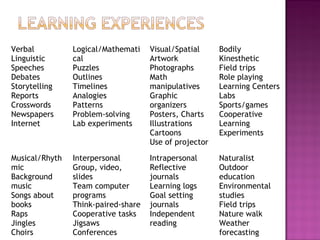
Verbal          Logical/Mathemati    Visual/Spatial     Bodily
Linguistic      cal                  Artwork            Kinesthetic
Speeches        Puzzles              Photographs        Field trips
Debates         Outlines             Math               Role playing
Storytelling    Timelines            manipulatives      Learning Centers
Reports         Analogies            Graphic            Labs
Crosswords      Patterns             organizers         Sports/games
Newspapers      Problem-solving      Posters, Charts    Cooperative
Internet        Lab experiments      Illustrations      Learning
                                     Cartoons           Experiments
                                     Use of projector

Musical/Rhyth   Interpersonal        Intrapersonal      Naturalist
mic             Group, video,        Reflective         Outdoor
Background      slides               journals           education
music           Team computer        Learning logs      Environmental
Songs about     programs             Goal setting       studies
books           Think-paired-share   journals           Field trips
Raps            Cooperative tasks    Independent        Nature walk
Jingles         Jigsaws              reading            Weather
Choirs          Conferences                             forecasting

Chapter 3 multiple intelligence

  • 1.
    ED 450 Assessment& Evaluation Soledad Camacho
  • 2.
    Define Multiple intelligence  Show why and how multiple intelligences can be used in the classroom  Recognize the thirteen-steps to develop a Unit plan  Discuss aspects of using a Brain-Based Learning Approach  Write a MI Unit Plan  Define and create a rubric
  • 3.
    Developed by Howard Gardner  The Multiple Intelligence theory would allow people to assess the talents and skills of the whole individual.  There are 8 intelligences (originally):  Visual/Spatials -Logical/Mathematical  Verbal/Linguistic -Musical/Rhythmic  Bodily Kinesthetic -Interpersonal/Social  Naturalist -Intrapersonal/Introspective
  • 5.
    It allows teachers to honor the diversity of students and understand that not all student can achieve the standards at the same time and by only one mode.  By creating a unit plan incorporating learning experiences and assessments using the MI provides a creative way to teach the standards, differentiate instruction, and motivate students to learn in a variety of fun and challenging ways.
  • 6.
    An enriched environmentwill:  Stimulate all the senses (but not all at once)  Has an atmosphere free of undue pressure  Presents a series of novel challenges that is at the student’s developmental level  Allows social interaction  Promotes the development of broad range of skills and interests *** It enables teachers to make the most of students’ individual differences and diversity
  • 7.
    Verbal Logical/Mathemati Visual/Spatial Bodily Linguistic cal Artwork Kinesthetic Speeches Puzzles Photographs Field trips Debates Outlines Math Role playing Storytelling Timelines manipulatives Learning Centers Reports Analogies Graphic Labs Crosswords Patterns organizers Sports/games Newspapers Problem-solving Posters, Charts Cooperative Internet Lab experiments Illustrations Learning Cartoons Experiments Use of projector Musical/Rhyth Interpersonal Intrapersonal Naturalist mic Group, video, Reflective Outdoor Background slides journals education music Team computer Learning logs Environmental Songs about programs Goal setting studies books Think-paired-share journals Field trips Raps Cooperative tasks Independent Nature walk Jingles Jigsaws reading Weather Choirs Conferences forecasting

Editor's Notes

  • #4 What is the 9 th intelligence? EXISTENTIAL