Brindavan Education Trust
No:456, 9th main road, 2nd Block,
Jayanagar, Bangalore-11
Ph: 08026567311,
E-Mail: brindavansld@gmail.com
Ms.Annapoorani Chockalingam
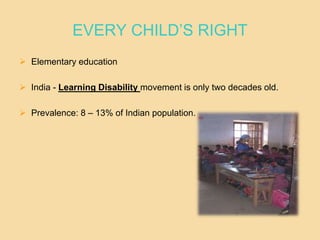
 Elementary education
 India - Learning Disability movement is only two decades old.
 Prevalence: 8 – 13% of Indian population.
EVERY CHILD’S RIGHT
WHY DO I NEED THIS SESSION
 Recognize learning difficulties
or learning difference
 Help them learn coping skills
and functional skills.
LEARNING DIFFICULTIES
A disorder manifested by a difficulty in learning
to read despite conventional instruction, adequate
intelligence, and socio cultural opportunity.
- Not linked with intelligence as there is independent
cognitive development. Cause unknown. Sometimes
due to genetics, pre and post natal trauma etc.
- Difficulty with input, integration, memory and output
AND WHAT IS NOT
• Behavioral issues.
• Disinterest or unmotivated
• Slow pace learning (slow learners).
Finally
Resource room is not for children whom the teacher
cannot cope with.
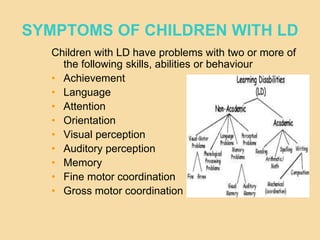
SYMPTOMS OF CHILDREN WITH LD
Children with LD have problems with two or more of
the following skills, abilities or behaviour
• Achievement
• Language
• Attention
• Orientation
• Visual perception
• Auditory perception
• Memory
• Fine motor coordination
• Gross motor coordination
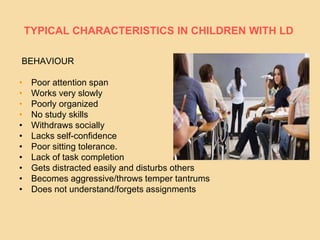
TYPICAL CHARACTERISTICS IN CHILDREN WITH LD
1. LANGUAGE - Trouble in:
 Following instruction
 Vocabulary development
 Grammatical phrasing
 Sequencing
 Organizing words to answer
 Understanding abstract ideas.
 Multiple meanings of words.
2. READING - Trouble in:
 Order of letters in words
 Letter recognition/letter-sound association
 Reading with expression and intonation
 Adequate speed of reading
 Blending sounds into word
 Using context clues
 Reading comprehension
USUALLY
 Guess words from the first letter
 Omit words, substitute words or add words to a sentence.
TYPICAL CHARACTERISTICS IN CHILDREN WITH LD
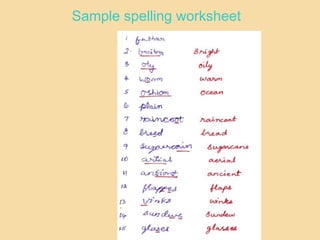
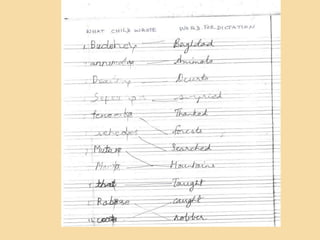
3. SPELLING
 Letter sound association.
 Reversal.
 Difficulty with irregular spelling.
 Leaving out letters.
 Adds extra letters.
 Mirror writing.
 Shortens words.
TYPICAL CHARACTERISTICS IN CHILDREN WITH LD
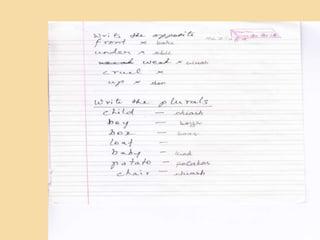
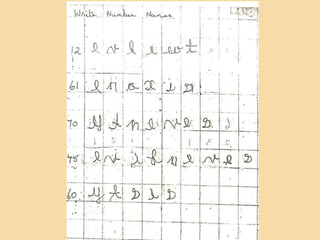
Sample spelling worksheet
TYPICAL CHARACTERISTICS IN CHILDREN WITH LD
4. COGNITIVE
 Difficulty in sticking to the main point.
 Rigid concepts.
 Doesn’t see patterns.
 Poor memory.
 Unable to classify/group
 Unable to transfer learning to other situations.
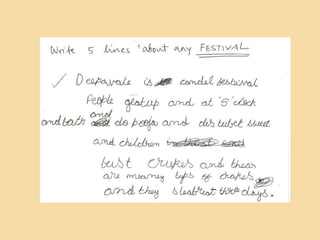
5. WRITING - Trouble in:
• Holding pencil appropriately
• Writing without ruled paper
• Writing activities
• Completing class notes
• Correct formation of letters
• Copying without errors
• Using punctuation
• Appropriate vocabulary, ideation, punctuation, grammar and
spelling
• Proof read and self correct written work
• Inverts/reverse letters
TYPICAL CHARACTERISTICS IN CHILDREN WITH LD
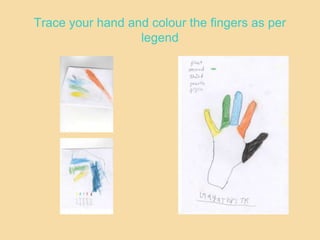
Trace your hand and colour the fingers as per
legend
6. MATHEMATICS - Trouble in :
 Sorting, matching, ordering
 Grasping concept of rational counting
 Language of math
 Basic computational skill and signs
 Problem Solving
 Estimation/comparison of time, quantity etc.
 Tables, formulas etc.
 Place value
 Geometric concepts.
TYPICAL CHARACTERISTICS IN LD CHILDREN
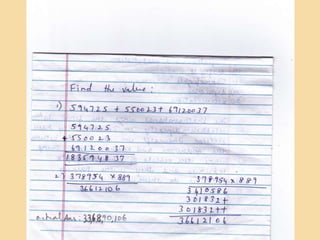
Error types
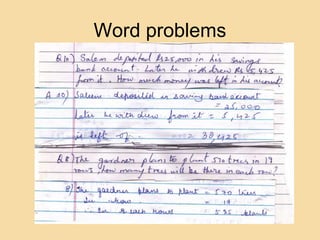
Word problems
TYPICAL CHARACTERISTICS IN CHILDREN WITH LD
BEHAVIOUR
• Poor attention span
• Works very slowly
• Poorly organized
• No study skills
• Withdraws socially
• Lacks self-confidence
• Poor sitting tolerance.
• Lack of task completion
• Gets distracted easily and disturbs others
• Becomes aggressive/throws temper tantrums
• Does not understand/forgets assignments
Class Teacher Observation
Child is
– Difficult
– Inattentive
– Fidgety
– Incomplete homework and class work
– Errors in spelling, inadequate content, inappropriate
language
Is it possibly Learning Difficulty?
Identified- What Next?
ASSESSMENT
• Parent enrolment: Be supportive, encouraging, optimistic
• Team Approach : Parent, Teacher and Professionals
 Formal assessment by a Psychologist
 Informal assessment by special educator
If needed inputs as required from:
 Developmental neurologists
 ENT
 Audiologists
 Speech therapists
 Behaviour therapists
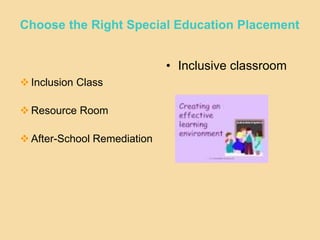
Choose the Right Special Education Placement
 Inclusion Class
 Resource Room
 After-School Remediation
• Inclusive classroom
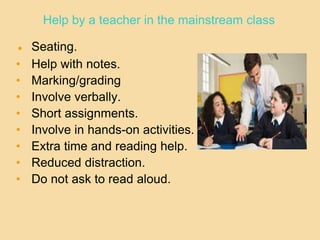
Help by a teacher in the mainstream class
● Seating.
• Help with notes.
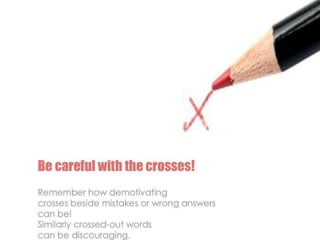
• Marking/grading
• Involve verbally.
• Short assignments.
• Involve in hands-on activities.
• Extra time and reading help.
• Reduced distraction.
• Do not ask to read aloud.
More Help
• Peer teaching – study buddy
• Over learning
• Appreciating even small achievements
• More oral evaluations
• Differentiated teaching-practical application
• Multi-sensory teaching- VAKT method-
• Using assistive technology where possible
• Special accommodations for test taking.
• Let the child know you are interested in him/her and willing to help
Homework Help
 Familiar homework
 Prepare schedules for after-school
 Write all home work on the black board
 Check assignment books
 Allow SMS access to the parent
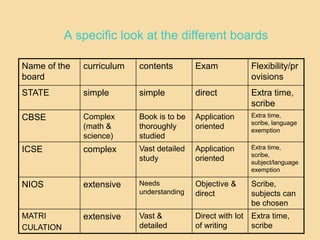
A specific look at the different boards
Name of the
board
curriculum contents Exam Flexibility/pr
ovisions
STATE simple simple direct Extra time,
scribe
CBSE Complex
(math &
science)
Book is to be
thoroughly
studied
Application
oriented
Extra time,
scribe, language
exemption
ICSE complex Vast detailed
study
Application
oriented
Extra time,
scribe,
subject/language
exemption
NIOS extensive Needs
understanding
Objective &
direct
Scribe,
subjects can
be chosen
MATRI
CULATION
extensive Vast &
detailed
Direct with lot
of writing
Extra time,
scribe
Let no child be demeaned
Or have his wonder diminished
Because of our ignorance or inactivity
Let no child be deprived of discovery
Because we lack the resources to discover his
problem
Let no child ever doubt himself or his mind
Because we are unsure of our commitment.

Annapoorani Chockalingam -- Learning Difficulties amongst Children

  • 1.
    Brindavan Education Trust No:456,9th main road, 2nd Block, Jayanagar, Bangalore-11 Ph: 08026567311, E-Mail: brindavansld@gmail.com Ms.Annapoorani Chockalingam
  • 2.
     Elementary education India - Learning Disability movement is only two decades old.  Prevalence: 8 – 13% of Indian population. EVERY CHILD’S RIGHT
  • 3.
    WHY DO INEED THIS SESSION  Recognize learning difficulties or learning difference  Help them learn coping skills and functional skills.
  • 4.
    LEARNING DIFFICULTIES A disordermanifested by a difficulty in learning to read despite conventional instruction, adequate intelligence, and socio cultural opportunity. - Not linked with intelligence as there is independent cognitive development. Cause unknown. Sometimes due to genetics, pre and post natal trauma etc. - Difficulty with input, integration, memory and output
  • 5.
    AND WHAT ISNOT • Behavioral issues. • Disinterest or unmotivated • Slow pace learning (slow learners). Finally Resource room is not for children whom the teacher cannot cope with.
  • 6.
    SYMPTOMS OF CHILDRENWITH LD Children with LD have problems with two or more of the following skills, abilities or behaviour • Achievement • Language • Attention • Orientation • Visual perception • Auditory perception • Memory • Fine motor coordination • Gross motor coordination
  • 7.
    TYPICAL CHARACTERISTICS INCHILDREN WITH LD 1. LANGUAGE - Trouble in:  Following instruction  Vocabulary development  Grammatical phrasing  Sequencing  Organizing words to answer  Understanding abstract ideas.  Multiple meanings of words.
  • 8.
    2. READING -Trouble in:  Order of letters in words  Letter recognition/letter-sound association  Reading with expression and intonation  Adequate speed of reading  Blending sounds into word  Using context clues  Reading comprehension USUALLY  Guess words from the first letter  Omit words, substitute words or add words to a sentence. TYPICAL CHARACTERISTICS IN CHILDREN WITH LD
  • 9.
    3. SPELLING  Lettersound association.  Reversal.  Difficulty with irregular spelling.  Leaving out letters.  Adds extra letters.  Mirror writing.  Shortens words. TYPICAL CHARACTERISTICS IN CHILDREN WITH LD
  • 10.
  • 12.
    TYPICAL CHARACTERISTICS INCHILDREN WITH LD 4. COGNITIVE  Difficulty in sticking to the main point.  Rigid concepts.  Doesn’t see patterns.  Poor memory.  Unable to classify/group  Unable to transfer learning to other situations.
  • 14.
    5. WRITING -Trouble in: • Holding pencil appropriately • Writing without ruled paper • Writing activities • Completing class notes • Correct formation of letters • Copying without errors • Using punctuation • Appropriate vocabulary, ideation, punctuation, grammar and spelling • Proof read and self correct written work • Inverts/reverse letters TYPICAL CHARACTERISTICS IN CHILDREN WITH LD
  • 16.
    Trace your handand colour the fingers as per legend
  • 18.
    6. MATHEMATICS -Trouble in :  Sorting, matching, ordering  Grasping concept of rational counting  Language of math  Basic computational skill and signs  Problem Solving  Estimation/comparison of time, quantity etc.  Tables, formulas etc.  Place value  Geometric concepts. TYPICAL CHARACTERISTICS IN LD CHILDREN
  • 19.
  • 20.
  • 21.
    TYPICAL CHARACTERISTICS INCHILDREN WITH LD BEHAVIOUR • Poor attention span • Works very slowly • Poorly organized • No study skills • Withdraws socially • Lacks self-confidence • Poor sitting tolerance. • Lack of task completion • Gets distracted easily and disturbs others • Becomes aggressive/throws temper tantrums • Does not understand/forgets assignments
  • 22.
    Class Teacher Observation Childis – Difficult – Inattentive – Fidgety – Incomplete homework and class work – Errors in spelling, inadequate content, inappropriate language Is it possibly Learning Difficulty?
  • 23.
    Identified- What Next? ASSESSMENT •Parent enrolment: Be supportive, encouraging, optimistic • Team Approach : Parent, Teacher and Professionals  Formal assessment by a Psychologist  Informal assessment by special educator If needed inputs as required from:  Developmental neurologists  ENT  Audiologists  Speech therapists  Behaviour therapists
  • 24.
    Choose the RightSpecial Education Placement  Inclusion Class  Resource Room  After-School Remediation • Inclusive classroom
  • 25.
    Help by ateacher in the mainstream class ● Seating. • Help with notes. • Marking/grading • Involve verbally. • Short assignments. • Involve in hands-on activities. • Extra time and reading help. • Reduced distraction. • Do not ask to read aloud.
  • 26.
    More Help • Peerteaching – study buddy • Over learning • Appreciating even small achievements • More oral evaluations • Differentiated teaching-practical application • Multi-sensory teaching- VAKT method- • Using assistive technology where possible • Special accommodations for test taking. • Let the child know you are interested in him/her and willing to help
  • 28.
    Homework Help  Familiarhomework  Prepare schedules for after-school  Write all home work on the black board  Check assignment books  Allow SMS access to the parent
  • 29.
    A specific lookat the different boards Name of the board curriculum contents Exam Flexibility/pr ovisions STATE simple simple direct Extra time, scribe CBSE Complex (math & science) Book is to be thoroughly studied Application oriented Extra time, scribe, language exemption ICSE complex Vast detailed study Application oriented Extra time, scribe, subject/language exemption NIOS extensive Needs understanding Objective & direct Scribe, subjects can be chosen MATRI CULATION extensive Vast & detailed Direct with lot of writing Extra time, scribe
  • 30.
    Let no childbe demeaned Or have his wonder diminished Because of our ignorance or inactivity Let no child be deprived of discovery Because we lack the resources to discover his problem Let no child ever doubt himself or his mind Because we are unsure of our commitment.