Multidisciplinary Nature
of Environmental Studies
(Dr.) Mirza Salman Baig
Assistant Professor (Pharmaceutics)
AIKTC, School of Pharmacy,New Panvel
Affiliated to University of Mumbai (INDIA)
Definition
• Environmental Studies deals with
every aspect that affects a living
organism.
• It is essentially a Multidisciplinary
approach that bring about an
appreciation of our natural world and
human impact on its integrity.
• It is an applied science as it seeks
practical solution to environment
related problems
Importance
• To clarify the idea that what is to
be done in the environmental context.
• To bring awareness and knowledge
about environment in individuals and
social groups.
• To make them participate in solving
the real- time environmental
problems.
Importance
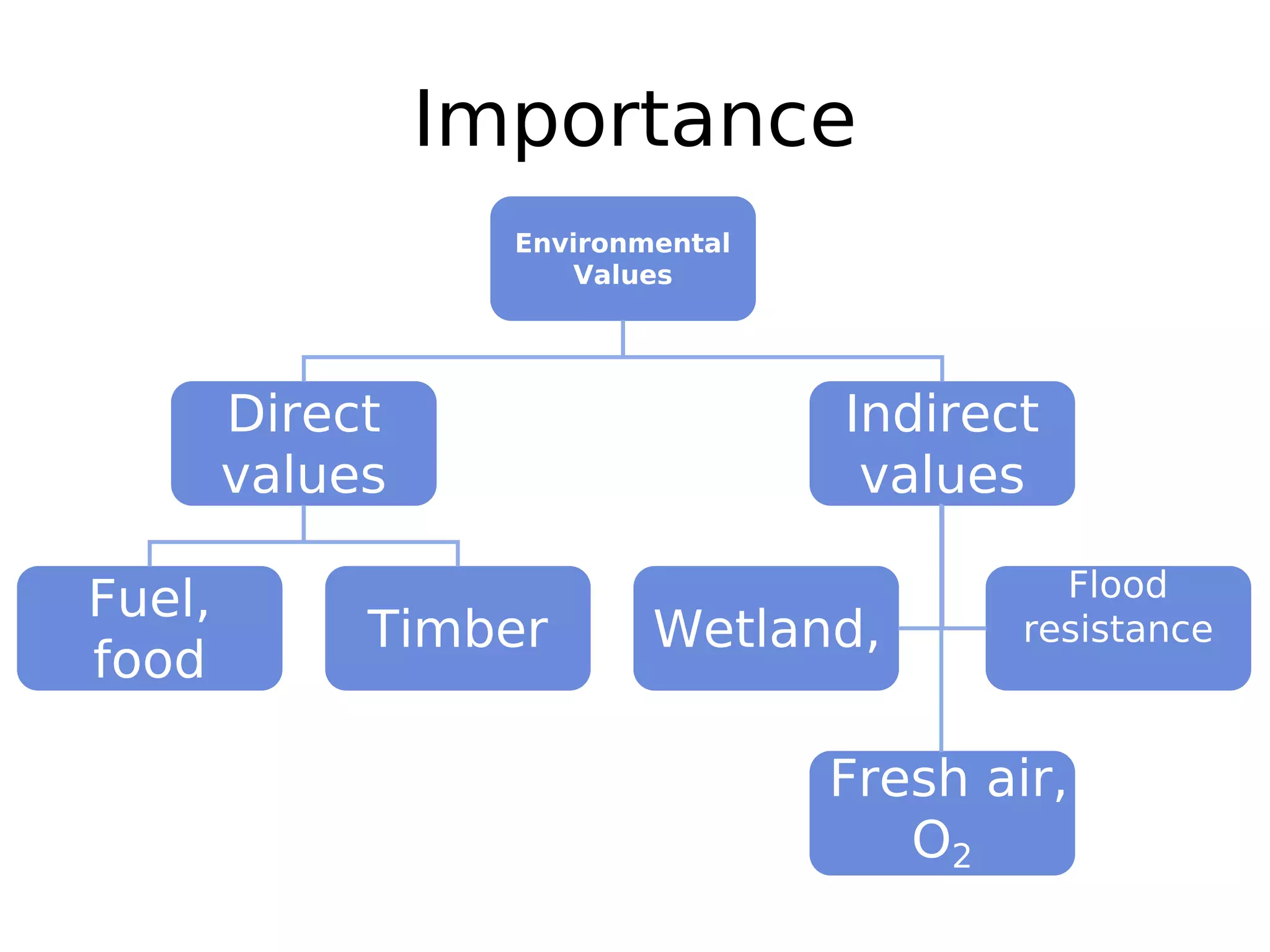
Environmental
Values
Direct
values
Indirect
values
Fuel,
food
Timber Wetland,
Flood
resistance
Fresh air,
O2
Scope of EVS
• Include science and social studies
• Our landscape in which we leave is mountain,
river, forest etc. which is modified by humans.
• Due to increase in population these resources are
getting depleted gradually
• But our needs like food, water depend on
existance of natural landscape in good condition
• If we continue to use natural resourses in
uncontrolled manner it will affect nature
negatively.... hence... there is need of...
Scope of Environmental Science
• Conservation of nature and natural
resources.
• Conservation of biological diversity.
• Control of environmental pollution.
• Stabilization of human population and
environment.
• Social issues in relation to development
and environment.
• Development of non-polluting renewable
energy system and providing new
dimension to nature’s security.
Scope of Environmental Science
• There is a need to understand make
ourselves aware of our natural assets and get
concerned about our environment and
sustainable utilize the resources.
• Scope of environmental studies is very wide
and nearly covers some aspects of every
major discipline (biology, chemistry, physics,
geography, resource management, economy,
etc.)
Objectives
•Awareness
•Knowledge
•Attitude
•Skill
•Participation
Need for Public Awareness
• Stress on natural resources and
quality of life due to development
activities and rapid urbanization.
• Deterioration the air and water
quality, high noise level, increasing
vehicular emission, etc.
• Protecting our environment is
economically more viable than
cleaning it up once it is damaged
Need for Public Awareness
• Pollution of different types (soil, air,
water) is growing day by day
• Awareness of these problem is
necessary to develop seance of
responsibility and ethics among
people
• This will help to tackle the
challanges related to environment
Institutions in
Environment
Bombay Natural History Society (BNHS),
Mumbai
– An NGO founded in 1883.
– Wildlife policy building, research, popular
publications and peoples action have been
unique features of this multifaceted society.
– Works towards conservation of wildlife
species and ecosystems.
– Publications: HORNBILL, journal on natural
history, Salim Ali handbook on birds, JC
Daniel’s book on Indian reptiles, SH Prater’s
book of Indian mammals and PV bole’s book
of Indian trees.
– Assisting government in framing of wildlife
related laws.
– ‘SAVE THE SILENT VALLEY’ campaign.
World Wide Fund for Nature (WWF-I),
New Delhi
– Initiated in 1969 in Mumbai and
then moved to new Delhi with
several branch offices all over India.
– Wildlife education and awareness.
– Organizes nature clubs of India
program for children.
– Works as a think tank and lobby
force for environment and
development issues.
Center for Science and Environment
(CSE), New Delhi
– Organizing campaigns, holding
workshops/conferences and producing
environment related publications are some
of its activities.
– It published ‘State of India’s Environment’,
the first of its kind to be produced as a
Citizen’s Report on the Environment.
– It publishes popular magazine ‘DOWN TO
EARTH’ a Science and Environment
fortnightly.
– It is also involved in publication of material
in the form of books, posters, video films
and also conducts workshops and
seminars on biodiversity related issues.
Salim Ali Center for Ornithology and
Natural History (SACON), Coimbatore
– Dr.Salim Ali wished to support a group of
committed conservation scientists on
permanent basis and that dream became
a reality only after his demise.
– It is an independent organization and is
based at Coimbatore since 1990.
– It has instituted a variety of field
programs that have added to the
country’s information on our threatened
biodiversity.
People in Environment
Salim Ali
– He has written several great books
including the famous ‘Book of Indian
Birds’.
– His autobiography,’Fall of a Sparrow’
should be read by every nature
enthusiast.
– He was our country’s leading
conservation scientist and influenced
environmental policies in our country for
over 50 years.
Indira Gandhi
- As a PM, she has played a highly significant role in
the preservation of India’s wild life.
– It was during her period as a PM, that the network
of protected areas (Pas) grew from 65 to 298!.
– The Wildlife Protection Act was formulated during
the period when she was PM and the Indian Board
for Wildlife was extremely active as she
personally chaired all its meetings.
– India gained a name for itself by being a major
player in CITES and other International
Environmental Treaties and Accords during her
tenure.
MS Swaminathan
– One of India’s foremost agricultural scientists
and has also been concerned with various
aspects of biodiversity conservation both of
cultivars and wild biodiversity.
– Founder of the MS Swaminathan Research
Foundation in Chennai, which does work on the
conservation of biological diversity.
Madhav Gadgil
– A well known ecologist in India.
– His interests range from broad ecological
issues such as developing Community
Biodiversity Registers and conserving sacred
groves to studies on the behavior of mammals,
birds and insects.
Natural resources
RESOURCES
• Any thing, which is useful man, or
can be transformed into a useful
product or can be used to produce a
useful thing, can be referred as
‘resources’.
• Example: rocks, minerals, soil, rivers,
plants & animal.
NATURAL RESOUCES
• Materials that come from the Earth.
• Something useful for humans need to
survive.
• Those resources that are drawn
directly from the nature and used
without modifications are called
Natural Resources.
• E.g.: air, water, minerals etc.
TYPES
• On the basis renewability
•  Renewable
•  Non-renewable
RENEWABLE RESOURCES
• There are some resources that cannot be
exhausted and are available in plentiful.
• These can be easily replenished through
natural processes in different ecosystems
and are often known as renewable natural
resources.
• For example, sunlight and wind are two
examples of renewable natural resources.
NON-RENEWABLE RESOURCES
• These are those resources which are not
renewed/replenished and are affected by
human activity
• Non renewable resources are exhaustible
and are extracted faster than the rate at
which they formed.
• For e.g. fossil fuels.
INEXHAUSTIBLE RESOURCES
• It is a natural resource that will never
run out so if we take advantage of
the greatest natural resources will
not be depleted and will continue to
exist, such as water, sunlight, tidal
energy, ocean energy and wind
energy.
• Wind power technology is one of
inexhaustible resources examples.
DEPLETION OF NATURAL
RESOURCES
• Resource depletion is the
consumption of a resource faster
than it can be replenished.
• Over a period of time, many of our
natural resources are being depleted.
• Many activities of human society are
responsible for this degradation of
the environment.
• Agricultural practises such as
indiscriminate use of fertilizers and
pesticides contaminate the soil.
• Urbanisation, overpopulation,
increase in use of carbon monoxide
producing automobiles, deforestation,
deterioration of water resources are
all factors contributing to this
depletion.
• Depletion of natural resources refers
to the exhaustion of raw materials
within a region.
• Natural resources are getting
depleted at a faster rate than they
are produced or renewed by nature.
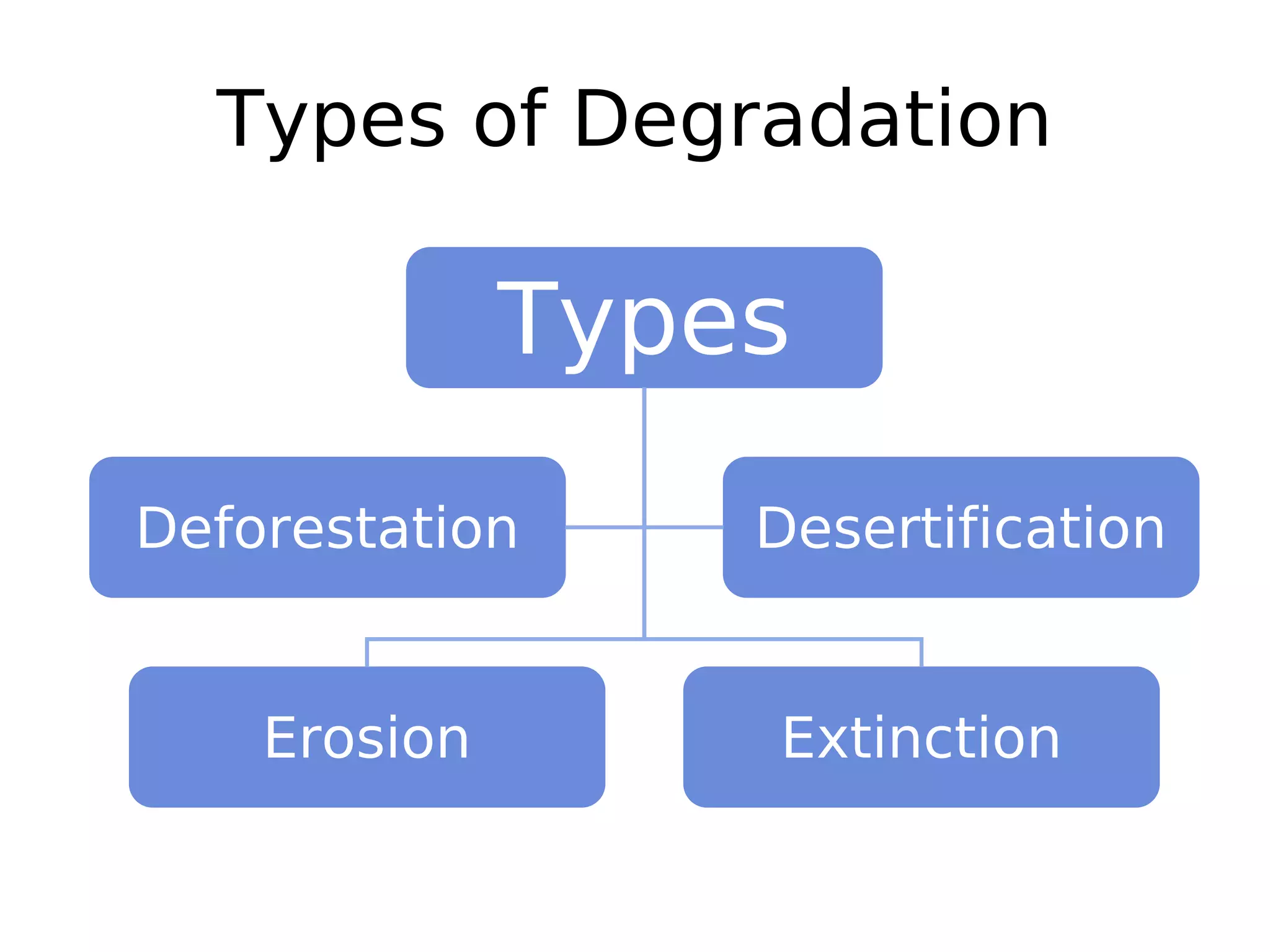
Types of Degradation
Types
Erosion Extinction
Deforestation Desertification
• DEFORESTATION : Deforestation is the
clearance of forests by logging and/or
burning.
• DESERTIFICATION: Desertification is a
type of land degradation in which a
relatively dry land region becomes
increasingly arid, typically losing its bodies
of water as well as vegetation and wildlife.
• EROSION: Erosion is the action of
exogenic processes (such as water flow or
wind) which remove soil and rock from one
location on the Earth's crust, then
transport it to another location where it is
deposited.
KINDS OF RESOURCES
• Forest Resources
• Water Resources
• Mineral Resources
• Soil Resources
FOREST RESOURCES
• Forest is an area with a high density of
trees, together with other plants, covering
a large area of land.
• Forests are home to 50% to 90% of earth’s
species.
• These forests not only produce
innumerable material goods, but also
provide several environmental services
which are essential for life.
Functions of Forest Resources
• Productive Functions
– Timber, bamboos, food, essential oils
– Latex, medicines etc.
– Conversation of soil and water
– Prevention of drought
– Protection against wind, cold, radiation,
noise .
• Regulative Functions
– Regulate gases and energy
WATER RESOURCES
• Water resources are sources of water
that are useful or potentially useful
to humans.
• Uses of water include agricultural,
industrial, household, recreational
and environmental activities.
• Virtually all of these human uses
require fresh water.
• Water is an essential natural resource for
sustaining life.
• Water forms 60% of our body weight.
• Water is a renewable and limiting resource.
• About three – fourth of earth’s surface is
occupied by oceans.
• About 97% of the earth’s water is strong
saline.
• The rest 3% is freshwater.
• Pure, usable water on land is only 0.3%.
WATER DEPLETION
• It is caused by over exploitation,
excessive use and unequal access to
water among different social groups.
• Increasing population, intensive
industrialization, deforestation and
mismanagement of water resources
have caused a crisis
Conservation of Water
• Conservation of water are essential for the
survival of mankind, plants and animals.
This can be achieved by adopting the following
methods:
• Constructing dams and reservoirs to regulate
supply of water to the fields, as well as to enable
generating hydroelectricity.
• Sewage should be treated and only the clear
water should be released into the rivers.
• Industrial wastes (effluents) should be treated to
prevent chemical and thermal pollution of fresh
water.
• Judicious use of water in our day-to-day life.
• Rainwater harvesting should be done by storing
rainwater and recharging groundwater.
MINERALS RESOURCES
• Minerals are naturally occurring, inorganic,
crystalline solids having a definite
chemical composition and characteristic
physical properties.
• Minerals are exhaustible and non-
renewable.
• Minerals are relatively plentiful.
• Minerals are over used by industries.
• Disposal of minerals have negative effects
on environment.
• Metallic minerals – e.g., iron, copper, silver,
gold
• Non-metallic minerals – e.g., sand, stone,
salt, phosphates
USE OF MINIRALS
• The main uses of minerals are as
follows:
• Development of industrial plants and
machinery.
• Generation of energy e.g. coal,
lignite, uranium.
• Construction, housing, settlements.
• Defence equipment weapons,
armaments.
• Transportation means.
SOIL (LAND) RESOURCES
• Communication- telephone wires, cables,
electronic devices.
• Medicinal system- particularly in Ayurveda
System.
• Agriculture – as fertilizers, seed dressings
and fungicides (e.g. Zineb: containing zinc,
Maneb: containing manganese etc.).
• Jewellery– e.g. Gold, silver, platinum,
diamond.
Contd...
• In the direct words ‘Natural resource in the
form of arable land.’
• Arable land (from Latin arabilis, "able to be
plowed") is land capable of being ploughed
and used to grow crops.
• Land is among the most important natural
resources.
• It covers up only 29% of the earth’s surface
and all parts of the land are not habitable.
• The uneven distribution of population in
different parts of the world is mainly due to
varied characteristics of land and climate.
Contd...
• The change in the characteristic and
quality of soil which adversely affect its
fertility is called as Degradation.
• Land degradation means:
1) Loss of natural fertility of soil because of
loss of nutrients.
2) Less vegetation cover
3) Changes in the characteristic of soil.
4) Pollution of water resources from the
contamination of soil through which water
sweeps into ground or runoff to the water
bodies.
5) Changes in climatic conditions because of
unbalance created in the environment.
Causes of land degradation
• Deforestation
• Soil erosion by wind or water
• Mining
• Industrialization
• Unsustainable Urban agricultural
practices expansion
CAUSES OF SOIL EROSION
• RAINFALL- raindrops directly strike the soil
surface and detach the soil particles.
• WIND- transportation of soil and sand
particle by wind by wind is best seen in
deserts and along the seashore.
• BIOTIC FACTORS- grazing by cattle, cutting
down of trees, agricultural activities,
construction of buildings and laying of
roads .
Conservation of Soil
• Soil conservation means checking soil erosion
and improving soil fertility by adopting various
methods. Let us know some of these methods.
• Maintenance of soil fertility: The fertility can be
maintained by adding manure and fertilizers
regularly as well as by rotation of crop.
• Make compost from your kitchen waste and use
it for your kitchen garden.
• Reforestation: Planting of trees and vegetation
reduces soil erosion by both water and wind.
• Do not irrigate the plants using a strong flow of
water as it would wash off the soil.
• Better use sprinkling irrigation.
Ecosystem
Contents
• Concept of ecosystem
• Components of an ecosystem
– Abiotic components
– Biotic components
• Movement of energy and nutrients
– Food chain
– Food webs
– Trophic levels,
– Egological pyramids
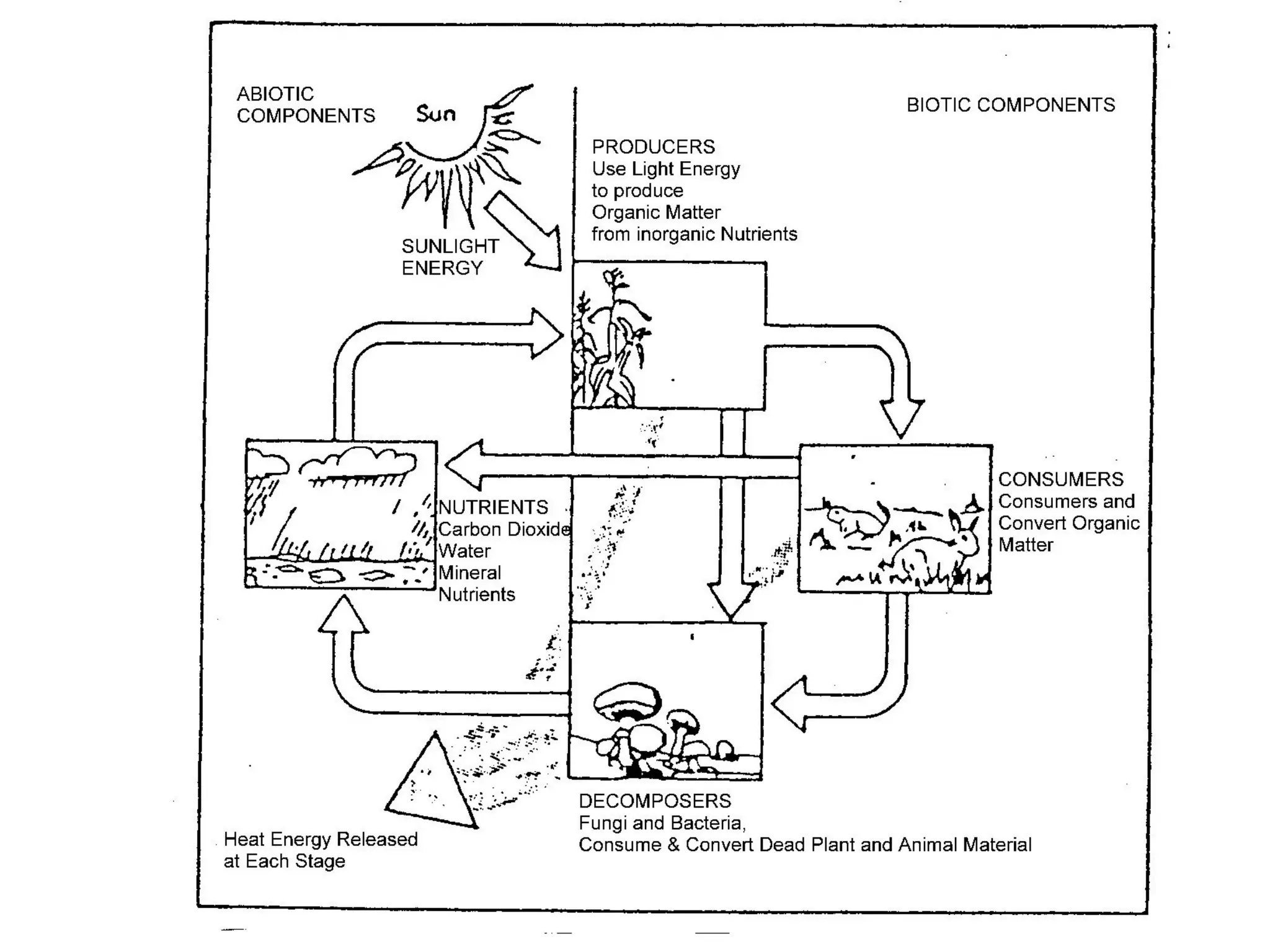
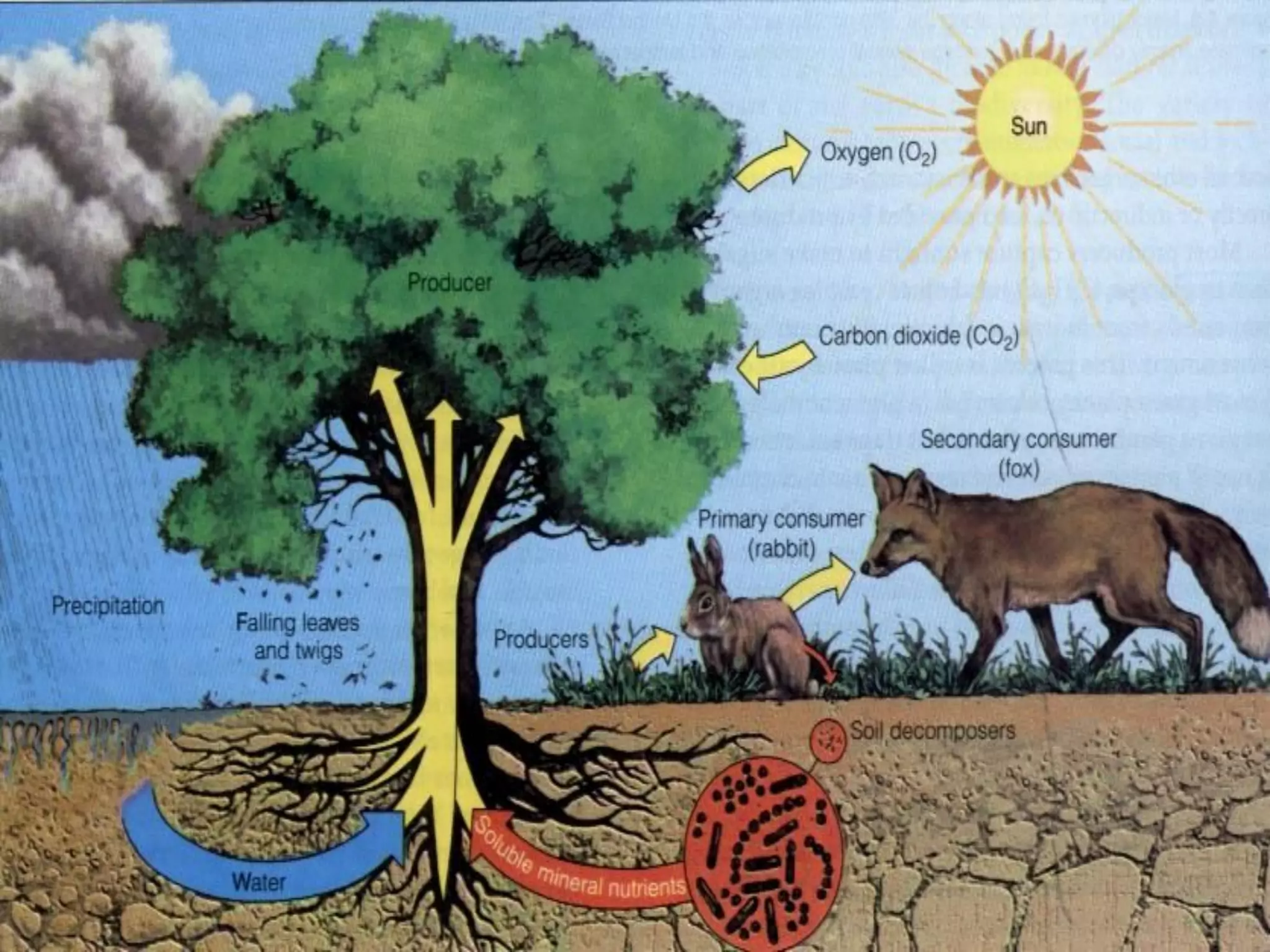
What is an ecosystem?
• Ecosystem is a region with specific
recognisable landscape such as forest,
grassland, desert etc.
• Biotic/Abiotic components
• There is a great variety of ecosystems
in existence, all of them are
characterized by general structural and
functional attributes
• Aquatic ecosystem, desert ecosystem.
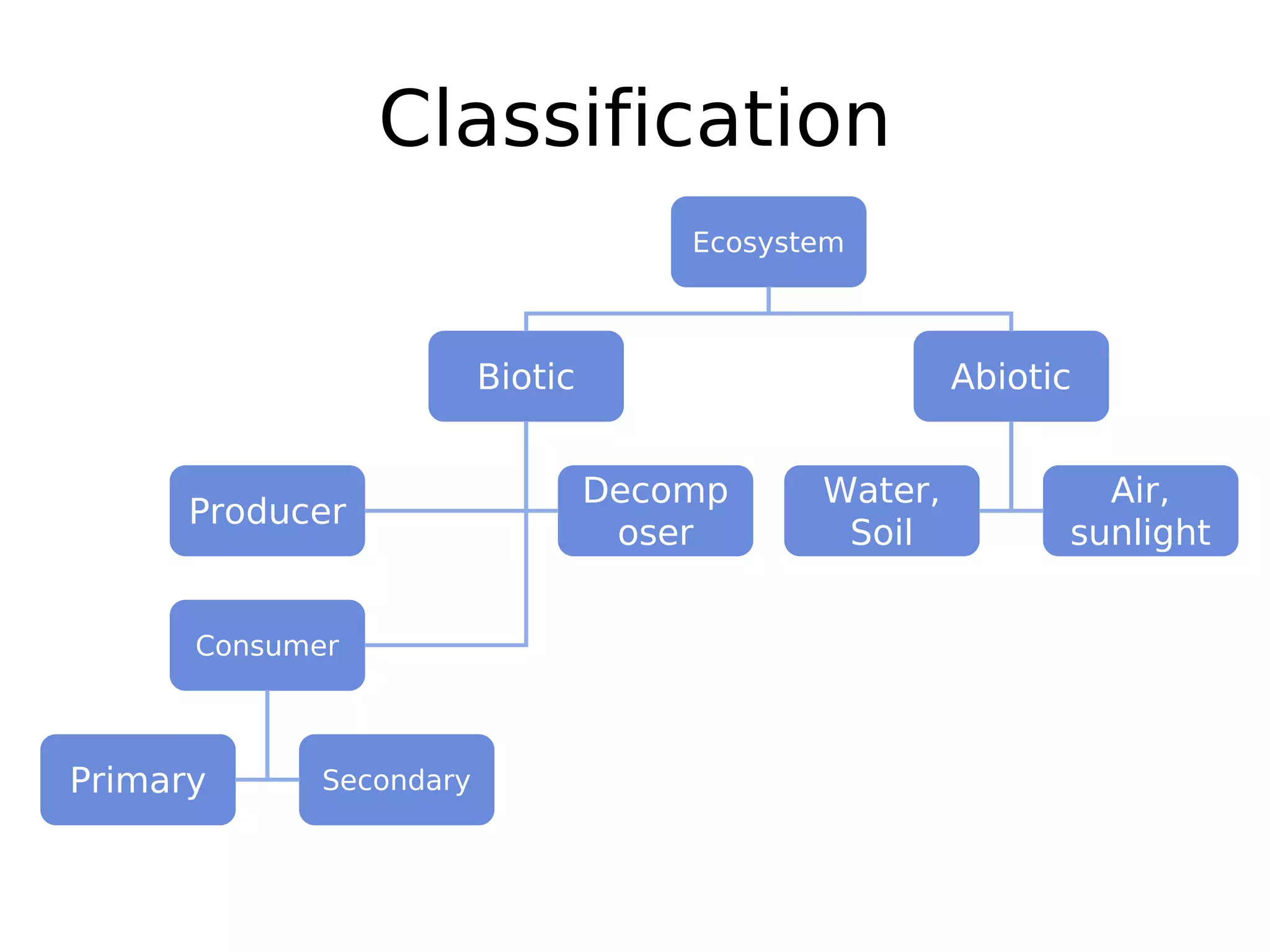
Classification
Ecosystem
Biotic Abiotic
Producer
Decomp
oser
Consumer
Primary Secondary
Water,
Soil
Air,
sunlight
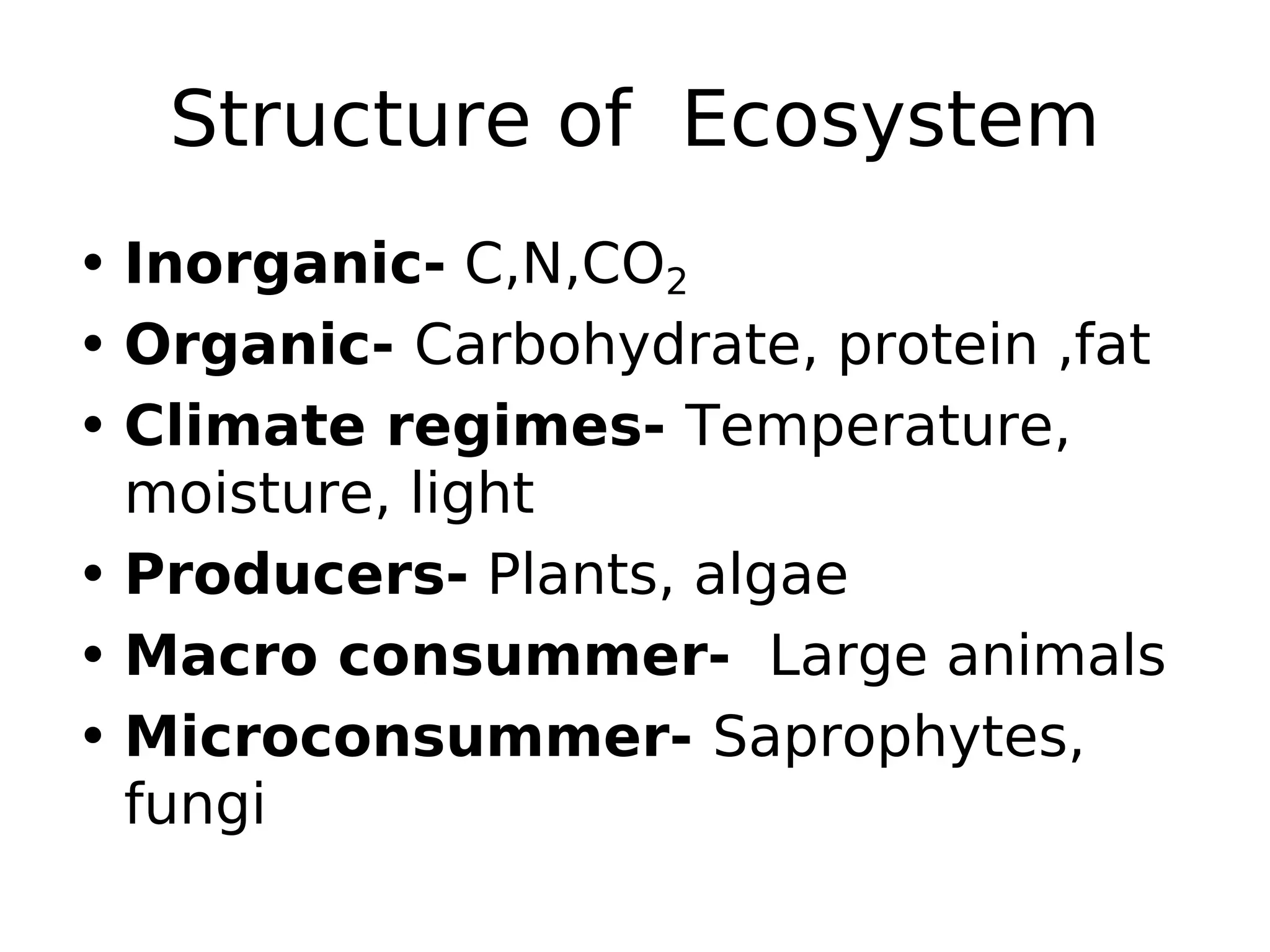
Structure of Ecosystem
• Inorganic- C,N,CO2
• Organic- Carbohydrate, protein ,fat
• Climate regimes- Temperature,
moisture, light
• Producers- Plants, algae
• Macro consummer- Large animals
• Microconsummer- Saprophytes,
fungi
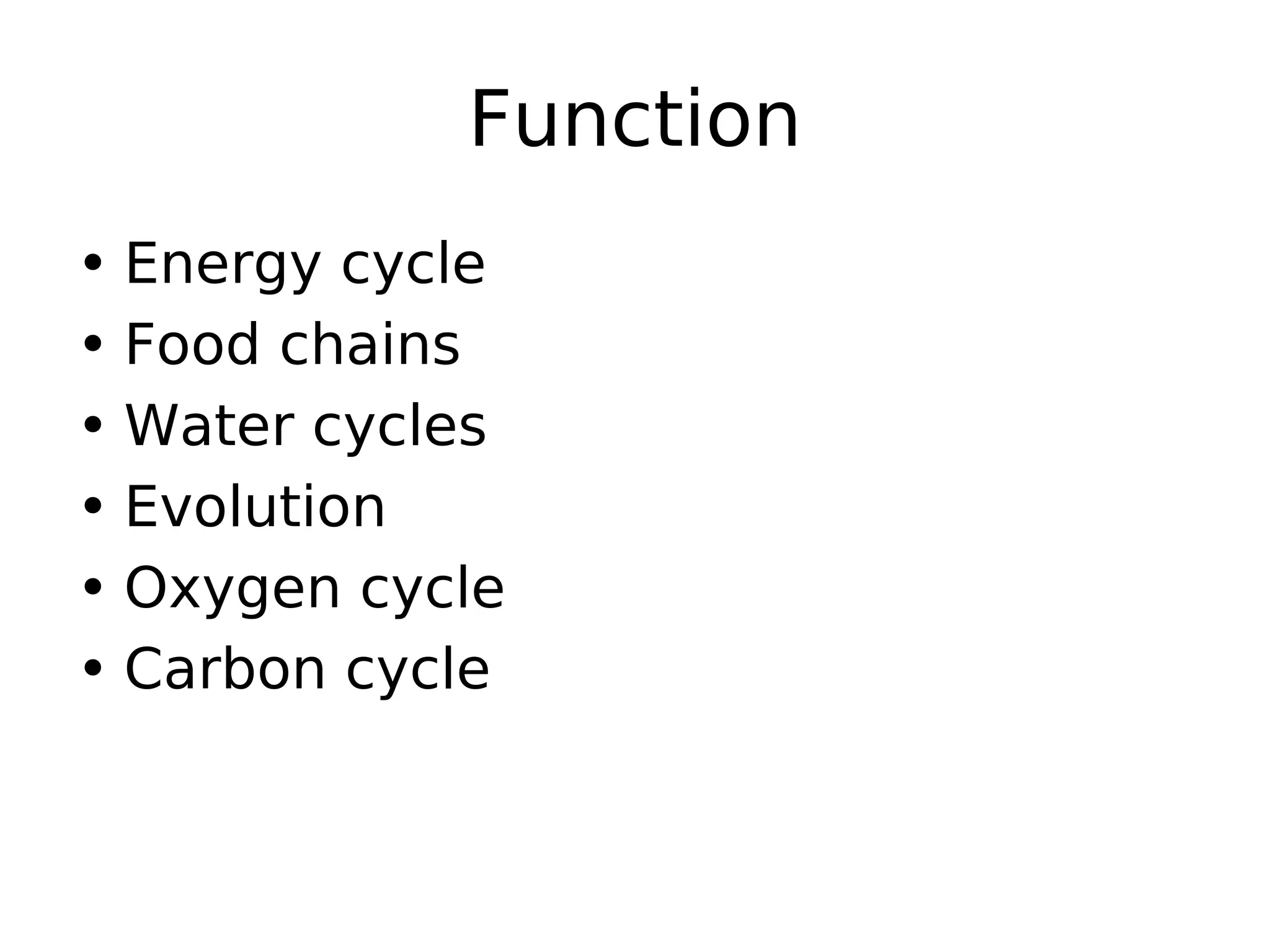
Function
• Energy cycle
• Food chains
• Water cycles
• Evolution
• Oxygen cycle
• Carbon cycle
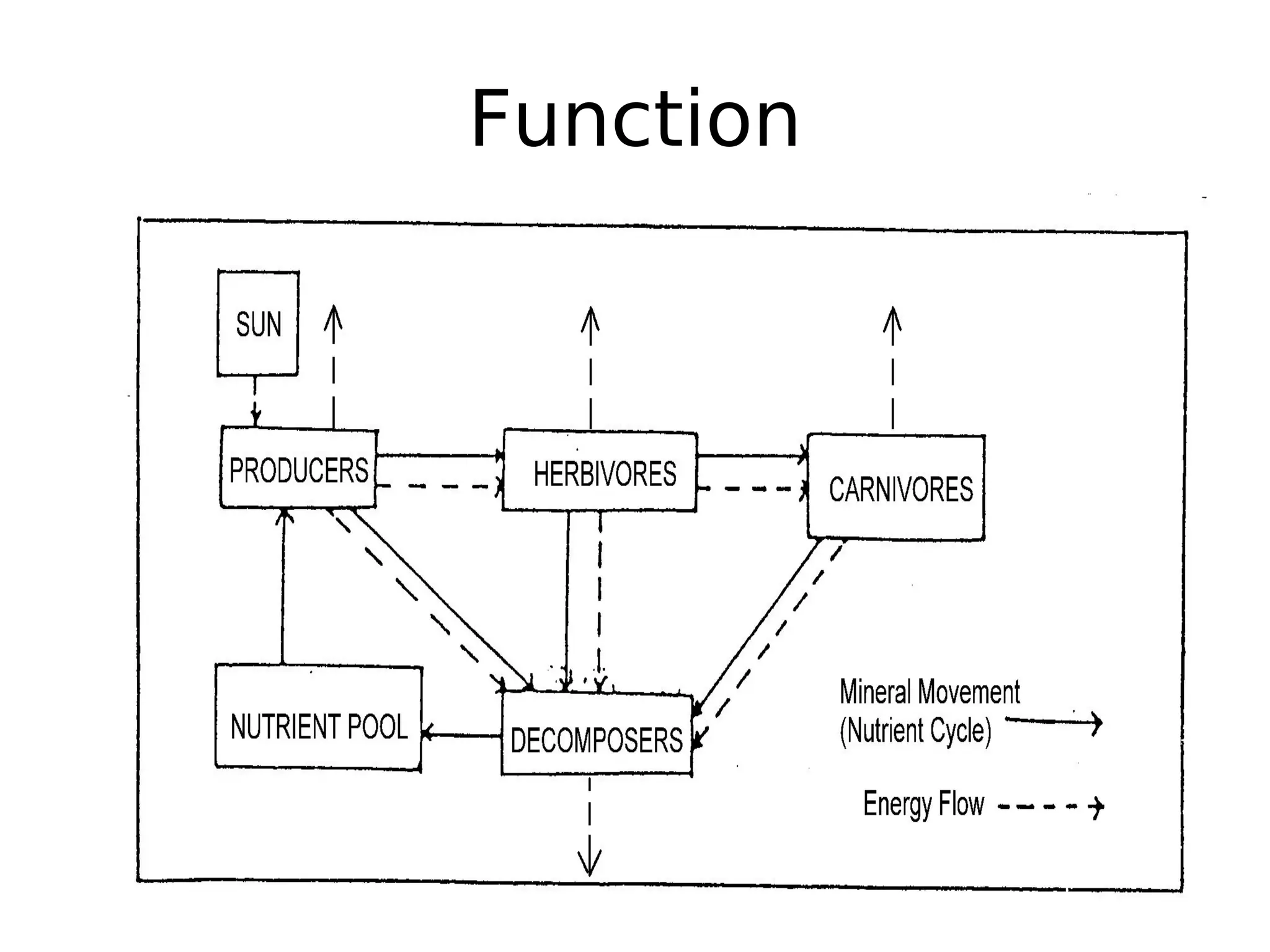
Function
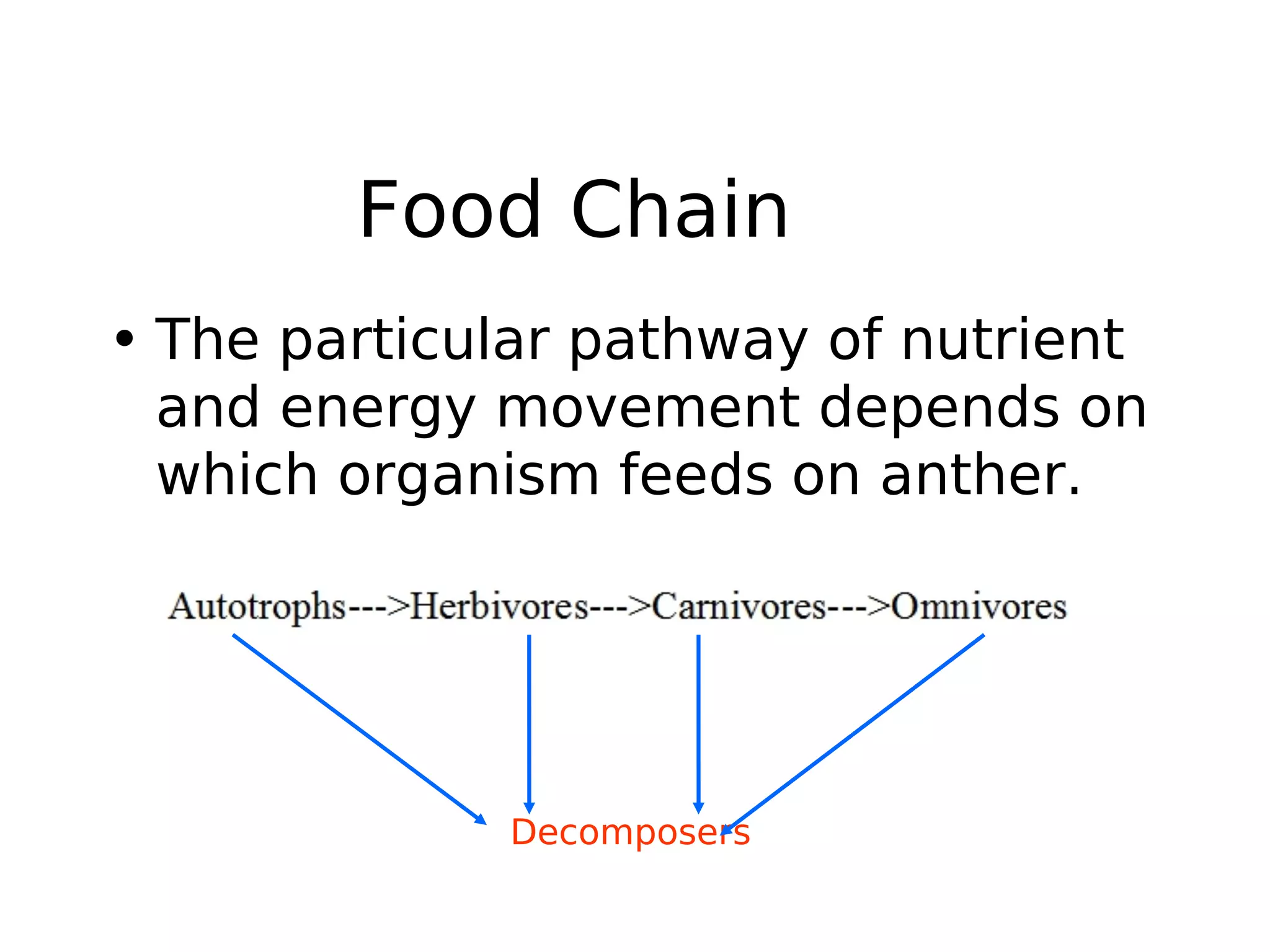
Food Chain
• The particular pathway of nutrient
and energy movement depends on
which organism feeds on anther.
Decomposers
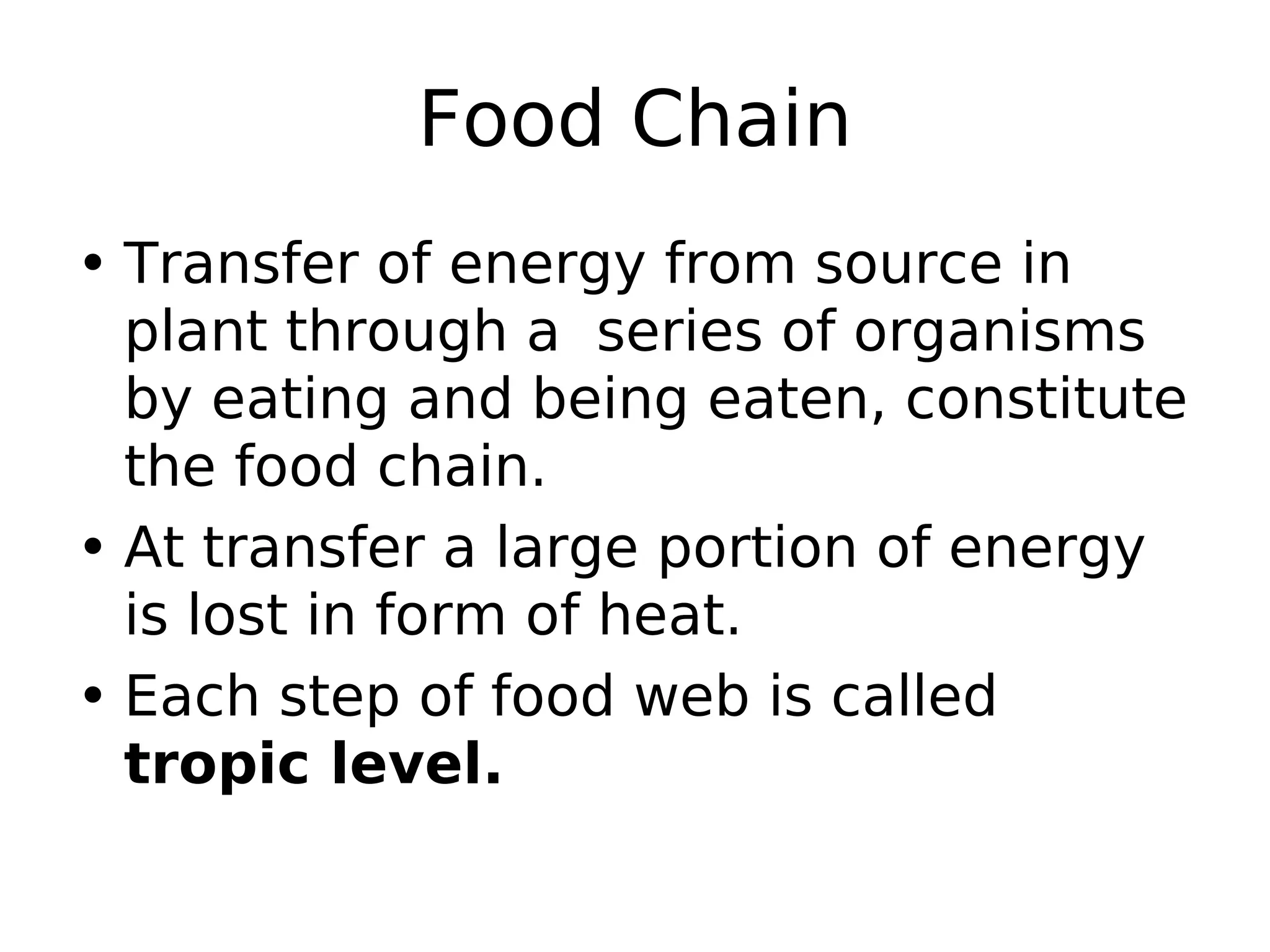
Food Chain
• Transfer of energy from source in
plant through a series of organisms
by eating and being eaten, constitute
the food chain.
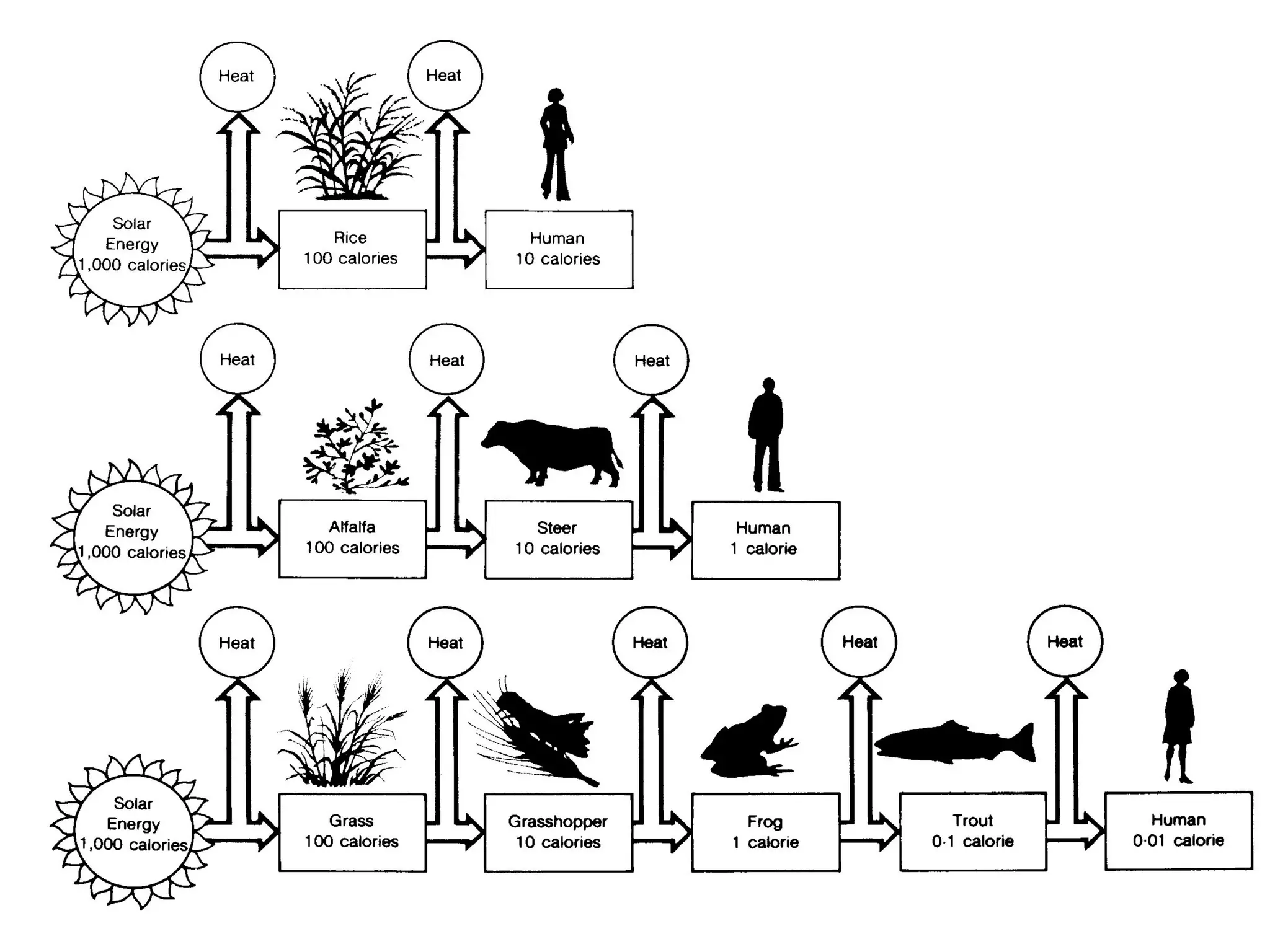
• At transfer a large portion of energy
is lost in form of heat.
• Each step of food web is called
tropic level.
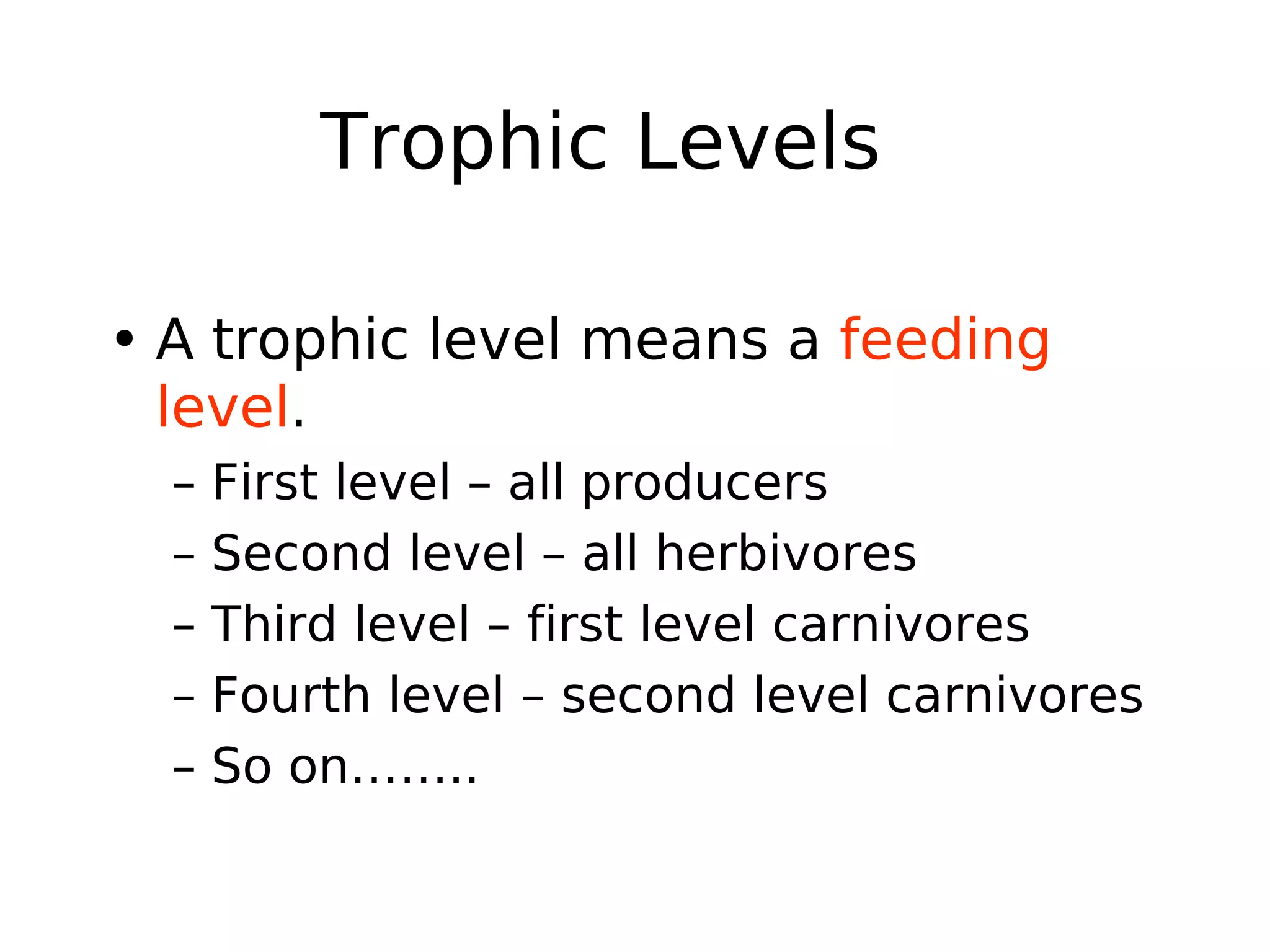
Trophic Levels
• A trophic level means a feeding
level.
– First level – all producers
– Second level – all herbivores
– Third level – first level carnivores
– Fourth level – second level carnivores
– So on……..
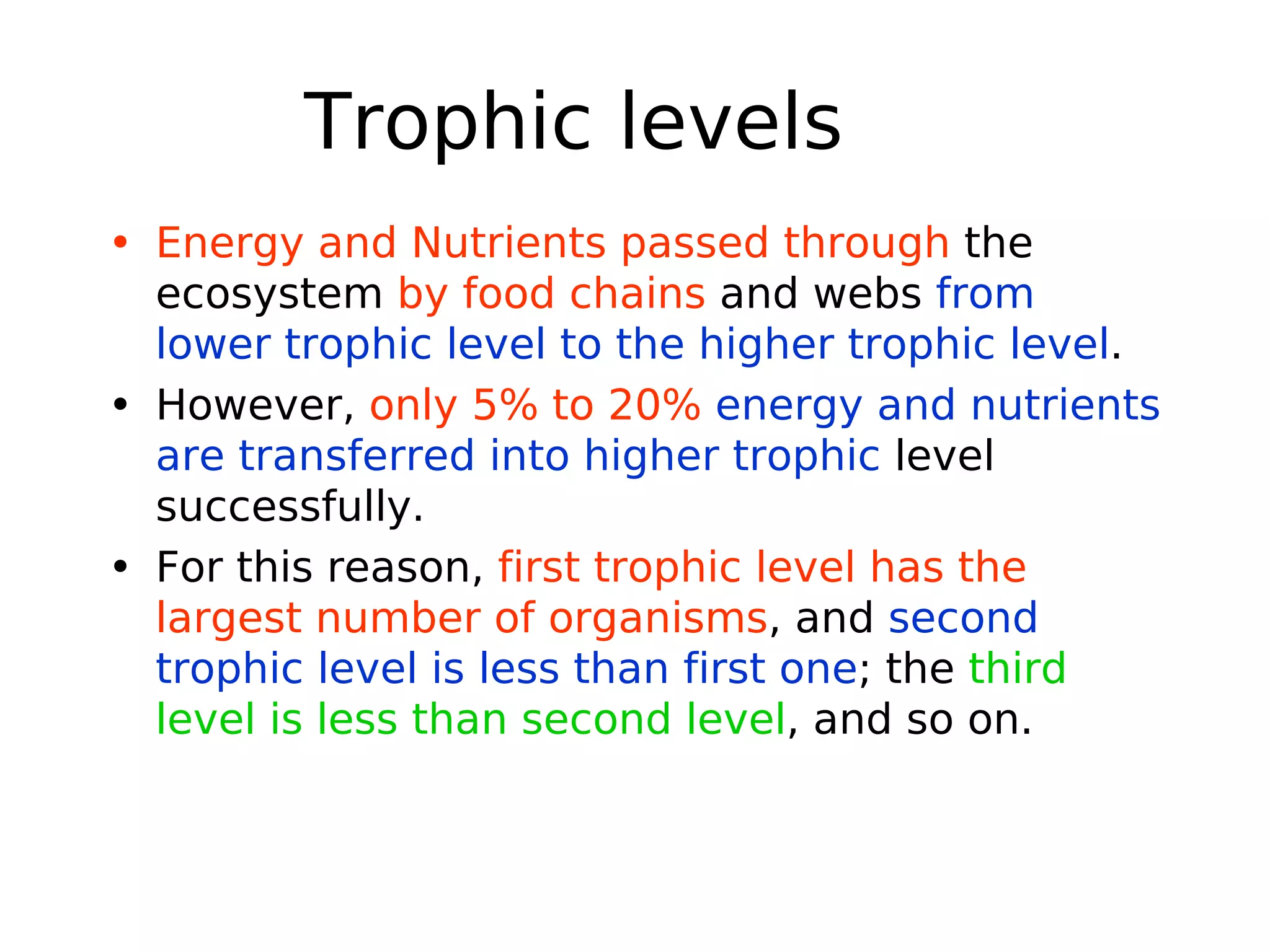
Trophic levels
• Energy and Nutrients passed through the
ecosystem by food chains and webs from
lower trophic level to the higher trophic level.
• However, only 5% to 20% energy and nutrients
are transferred into higher trophic level
successfully.
• For this reason, first trophic level has the
largest number of organisms, and second
trophic level is less than first one; the third
level is less than second level, and so on.
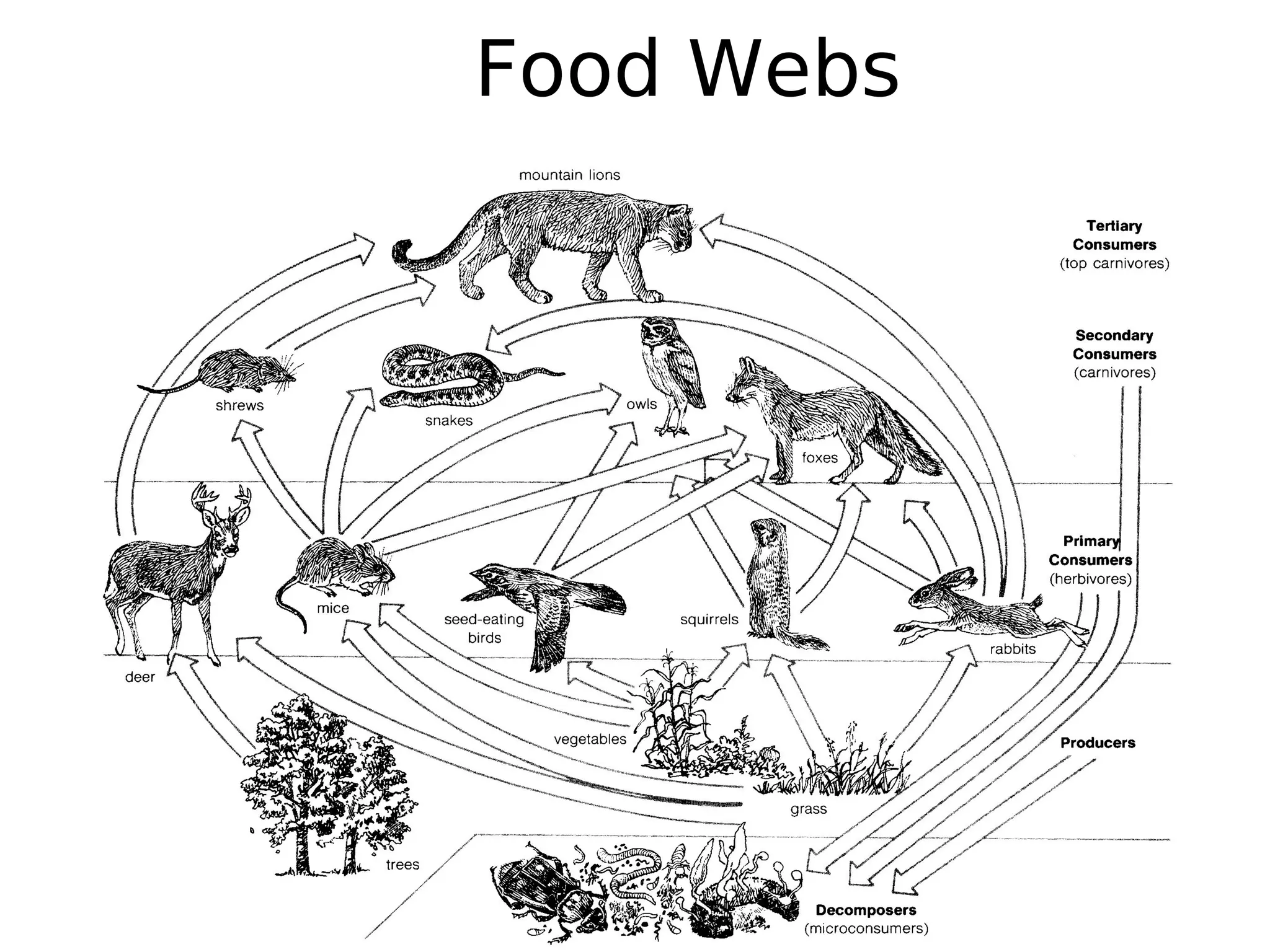
Food Web
• There is very largr no. of interlinnked
chains, togther these form food web.
• Disturbances in this due to human
activities cause extinction of spicise.
Food Webs
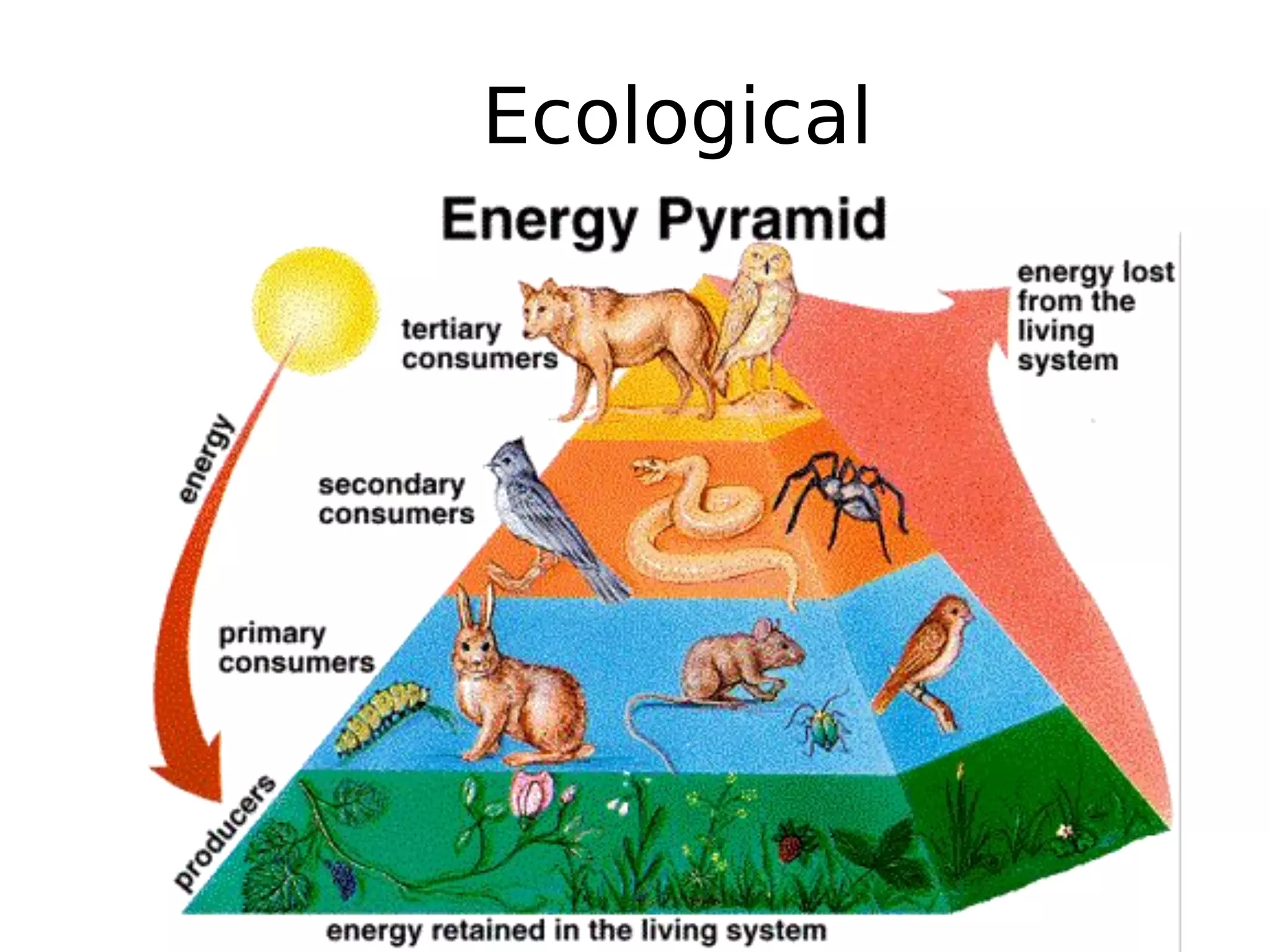
Ecological
Ecological Pyrimid
• Producer utilize energy directly from
sun and convert it to biomass
• Base of pyramid is made of first
trophic level organism (producers)
• Then Herbivores which eat on plants
• Then Second trophic level organisms,
carnivores
• Then predators third trophic level.
Thank You

Multidisciplinary nature of evs SB

  • 1.
    Multidisciplinary Nature of EnvironmentalStudies (Dr.) Mirza Salman Baig Assistant Professor (Pharmaceutics) AIKTC, School of Pharmacy,New Panvel Affiliated to University of Mumbai (INDIA)
  • 2.
    Definition • Environmental Studiesdeals with every aspect that affects a living organism. • It is essentially a Multidisciplinary approach that bring about an appreciation of our natural world and human impact on its integrity. • It is an applied science as it seeks practical solution to environment related problems
  • 3.
    Importance • To clarifythe idea that what is to be done in the environmental context. • To bring awareness and knowledge about environment in individuals and social groups. • To make them participate in solving the real- time environmental problems.
  • 4.
  • 5.
    Scope of EVS •Include science and social studies • Our landscape in which we leave is mountain, river, forest etc. which is modified by humans. • Due to increase in population these resources are getting depleted gradually • But our needs like food, water depend on existance of natural landscape in good condition • If we continue to use natural resourses in uncontrolled manner it will affect nature negatively.... hence... there is need of...
  • 6.
    Scope of EnvironmentalScience • Conservation of nature and natural resources. • Conservation of biological diversity. • Control of environmental pollution. • Stabilization of human population and environment. • Social issues in relation to development and environment. • Development of non-polluting renewable energy system and providing new dimension to nature’s security.
  • 7.
    Scope of EnvironmentalScience • There is a need to understand make ourselves aware of our natural assets and get concerned about our environment and sustainable utilize the resources. • Scope of environmental studies is very wide and nearly covers some aspects of every major discipline (biology, chemistry, physics, geography, resource management, economy, etc.)
  • 8.
  • 9.
    Need for PublicAwareness • Stress on natural resources and quality of life due to development activities and rapid urbanization. • Deterioration the air and water quality, high noise level, increasing vehicular emission, etc. • Protecting our environment is economically more viable than cleaning it up once it is damaged
  • 10.
    Need for PublicAwareness • Pollution of different types (soil, air, water) is growing day by day • Awareness of these problem is necessary to develop seance of responsibility and ethics among people • This will help to tackle the challanges related to environment
  • 11.
  • 12.
    Bombay Natural HistorySociety (BNHS), Mumbai – An NGO founded in 1883. – Wildlife policy building, research, popular publications and peoples action have been unique features of this multifaceted society. – Works towards conservation of wildlife species and ecosystems. – Publications: HORNBILL, journal on natural history, Salim Ali handbook on birds, JC Daniel’s book on Indian reptiles, SH Prater’s book of Indian mammals and PV bole’s book of Indian trees. – Assisting government in framing of wildlife related laws. – ‘SAVE THE SILENT VALLEY’ campaign.
  • 13.
    World Wide Fundfor Nature (WWF-I), New Delhi – Initiated in 1969 in Mumbai and then moved to new Delhi with several branch offices all over India. – Wildlife education and awareness. – Organizes nature clubs of India program for children. – Works as a think tank and lobby force for environment and development issues.
  • 14.
    Center for Scienceand Environment (CSE), New Delhi – Organizing campaigns, holding workshops/conferences and producing environment related publications are some of its activities. – It published ‘State of India’s Environment’, the first of its kind to be produced as a Citizen’s Report on the Environment. – It publishes popular magazine ‘DOWN TO EARTH’ a Science and Environment fortnightly. – It is also involved in publication of material in the form of books, posters, video films and also conducts workshops and seminars on biodiversity related issues.
  • 15.
    Salim Ali Centerfor Ornithology and Natural History (SACON), Coimbatore – Dr.Salim Ali wished to support a group of committed conservation scientists on permanent basis and that dream became a reality only after his demise. – It is an independent organization and is based at Coimbatore since 1990. – It has instituted a variety of field programs that have added to the country’s information on our threatened biodiversity.
  • 16.
  • 17.
    Salim Ali – Hehas written several great books including the famous ‘Book of Indian Birds’. – His autobiography,’Fall of a Sparrow’ should be read by every nature enthusiast. – He was our country’s leading conservation scientist and influenced environmental policies in our country for over 50 years.
  • 18.
    Indira Gandhi - Asa PM, she has played a highly significant role in the preservation of India’s wild life. – It was during her period as a PM, that the network of protected areas (Pas) grew from 65 to 298!. – The Wildlife Protection Act was formulated during the period when she was PM and the Indian Board for Wildlife was extremely active as she personally chaired all its meetings. – India gained a name for itself by being a major player in CITES and other International Environmental Treaties and Accords during her tenure.
  • 19.
    MS Swaminathan – Oneof India’s foremost agricultural scientists and has also been concerned with various aspects of biodiversity conservation both of cultivars and wild biodiversity. – Founder of the MS Swaminathan Research Foundation in Chennai, which does work on the conservation of biological diversity.
  • 20.
    Madhav Gadgil – Awell known ecologist in India. – His interests range from broad ecological issues such as developing Community Biodiversity Registers and conserving sacred groves to studies on the behavior of mammals, birds and insects.
  • 21.
  • 22.
    RESOURCES • Any thing,which is useful man, or can be transformed into a useful product or can be used to produce a useful thing, can be referred as ‘resources’. • Example: rocks, minerals, soil, rivers, plants & animal.
  • 23.
    NATURAL RESOUCES • Materialsthat come from the Earth. • Something useful for humans need to survive. • Those resources that are drawn directly from the nature and used without modifications are called Natural Resources. • E.g.: air, water, minerals etc.
  • 24.
    TYPES • On thebasis renewability •  Renewable •  Non-renewable
  • 25.
    RENEWABLE RESOURCES • Thereare some resources that cannot be exhausted and are available in plentiful. • These can be easily replenished through natural processes in different ecosystems and are often known as renewable natural resources. • For example, sunlight and wind are two examples of renewable natural resources.
  • 26.
    NON-RENEWABLE RESOURCES • Theseare those resources which are not renewed/replenished and are affected by human activity • Non renewable resources are exhaustible and are extracted faster than the rate at which they formed. • For e.g. fossil fuels.
  • 27.
    INEXHAUSTIBLE RESOURCES • Itis a natural resource that will never run out so if we take advantage of the greatest natural resources will not be depleted and will continue to exist, such as water, sunlight, tidal energy, ocean energy and wind energy. • Wind power technology is one of inexhaustible resources examples.
  • 28.
  • 29.
    • Resource depletionis the consumption of a resource faster than it can be replenished. • Over a period of time, many of our natural resources are being depleted. • Many activities of human society are responsible for this degradation of the environment. • Agricultural practises such as indiscriminate use of fertilizers and pesticides contaminate the soil.
  • 30.
    • Urbanisation, overpopulation, increasein use of carbon monoxide producing automobiles, deforestation, deterioration of water resources are all factors contributing to this depletion. • Depletion of natural resources refers to the exhaustion of raw materials within a region. • Natural resources are getting depleted at a faster rate than they are produced or renewed by nature.
  • 31.
    Types of Degradation Types ErosionExtinction Deforestation Desertification
  • 32.
    • DEFORESTATION :Deforestation is the clearance of forests by logging and/or burning. • DESERTIFICATION: Desertification is a type of land degradation in which a relatively dry land region becomes increasingly arid, typically losing its bodies of water as well as vegetation and wildlife. • EROSION: Erosion is the action of exogenic processes (such as water flow or wind) which remove soil and rock from one location on the Earth's crust, then transport it to another location where it is deposited.
  • 33.
    KINDS OF RESOURCES •Forest Resources • Water Resources • Mineral Resources • Soil Resources
  • 34.
    FOREST RESOURCES • Forestis an area with a high density of trees, together with other plants, covering a large area of land. • Forests are home to 50% to 90% of earth’s species. • These forests not only produce innumerable material goods, but also provide several environmental services which are essential for life.
  • 35.
    Functions of ForestResources • Productive Functions – Timber, bamboos, food, essential oils – Latex, medicines etc. – Conversation of soil and water – Prevention of drought – Protection against wind, cold, radiation, noise . • Regulative Functions – Regulate gases and energy
  • 36.
    WATER RESOURCES • Waterresources are sources of water that are useful or potentially useful to humans. • Uses of water include agricultural, industrial, household, recreational and environmental activities. • Virtually all of these human uses require fresh water.
  • 37.
    • Water isan essential natural resource for sustaining life. • Water forms 60% of our body weight. • Water is a renewable and limiting resource. • About three – fourth of earth’s surface is occupied by oceans. • About 97% of the earth’s water is strong saline. • The rest 3% is freshwater. • Pure, usable water on land is only 0.3%.
  • 38.
    WATER DEPLETION • Itis caused by over exploitation, excessive use and unequal access to water among different social groups. • Increasing population, intensive industrialization, deforestation and mismanagement of water resources have caused a crisis
  • 39.
    Conservation of Water •Conservation of water are essential for the survival of mankind, plants and animals. This can be achieved by adopting the following methods: • Constructing dams and reservoirs to regulate supply of water to the fields, as well as to enable generating hydroelectricity. • Sewage should be treated and only the clear water should be released into the rivers. • Industrial wastes (effluents) should be treated to prevent chemical and thermal pollution of fresh water. • Judicious use of water in our day-to-day life. • Rainwater harvesting should be done by storing rainwater and recharging groundwater.
  • 40.
    MINERALS RESOURCES • Mineralsare naturally occurring, inorganic, crystalline solids having a definite chemical composition and characteristic physical properties. • Minerals are exhaustible and non- renewable. • Minerals are relatively plentiful. • Minerals are over used by industries. • Disposal of minerals have negative effects on environment. • Metallic minerals – e.g., iron, copper, silver, gold • Non-metallic minerals – e.g., sand, stone, salt, phosphates
  • 41.
    USE OF MINIRALS •The main uses of minerals are as follows: • Development of industrial plants and machinery. • Generation of energy e.g. coal, lignite, uranium. • Construction, housing, settlements. • Defence equipment weapons, armaments. • Transportation means.
  • 42.
    SOIL (LAND) RESOURCES •Communication- telephone wires, cables, electronic devices. • Medicinal system- particularly in Ayurveda System. • Agriculture – as fertilizers, seed dressings and fungicides (e.g. Zineb: containing zinc, Maneb: containing manganese etc.). • Jewellery– e.g. Gold, silver, platinum, diamond.
  • 43.
    Contd... • In thedirect words ‘Natural resource in the form of arable land.’ • Arable land (from Latin arabilis, "able to be plowed") is land capable of being ploughed and used to grow crops. • Land is among the most important natural resources. • It covers up only 29% of the earth’s surface and all parts of the land are not habitable. • The uneven distribution of population in different parts of the world is mainly due to varied characteristics of land and climate.
  • 44.
    Contd... • The changein the characteristic and quality of soil which adversely affect its fertility is called as Degradation. • Land degradation means: 1) Loss of natural fertility of soil because of loss of nutrients. 2) Less vegetation cover 3) Changes in the characteristic of soil. 4) Pollution of water resources from the contamination of soil through which water sweeps into ground or runoff to the water bodies. 5) Changes in climatic conditions because of unbalance created in the environment.
  • 45.
    Causes of landdegradation • Deforestation • Soil erosion by wind or water • Mining • Industrialization • Unsustainable Urban agricultural practices expansion
  • 46.
    CAUSES OF SOILEROSION • RAINFALL- raindrops directly strike the soil surface and detach the soil particles. • WIND- transportation of soil and sand particle by wind by wind is best seen in deserts and along the seashore. • BIOTIC FACTORS- grazing by cattle, cutting down of trees, agricultural activities, construction of buildings and laying of roads .
  • 47.
    Conservation of Soil •Soil conservation means checking soil erosion and improving soil fertility by adopting various methods. Let us know some of these methods. • Maintenance of soil fertility: The fertility can be maintained by adding manure and fertilizers regularly as well as by rotation of crop. • Make compost from your kitchen waste and use it for your kitchen garden. • Reforestation: Planting of trees and vegetation reduces soil erosion by both water and wind. • Do not irrigate the plants using a strong flow of water as it would wash off the soil. • Better use sprinkling irrigation.
  • 48.
  • 49.
    Contents • Concept ofecosystem • Components of an ecosystem – Abiotic components – Biotic components • Movement of energy and nutrients – Food chain – Food webs – Trophic levels, – Egological pyramids
  • 50.
    What is anecosystem? • Ecosystem is a region with specific recognisable landscape such as forest, grassland, desert etc. • Biotic/Abiotic components • There is a great variety of ecosystems in existence, all of them are characterized by general structural and functional attributes • Aquatic ecosystem, desert ecosystem.
  • 52.
  • 53.
    Structure of Ecosystem •Inorganic- C,N,CO2 • Organic- Carbohydrate, protein ,fat • Climate regimes- Temperature, moisture, light • Producers- Plants, algae • Macro consummer- Large animals • Microconsummer- Saprophytes, fungi
  • 54.
    Function • Energy cycle •Food chains • Water cycles • Evolution • Oxygen cycle • Carbon cycle
  • 55.
  • 56.
    Food Chain • Theparticular pathway of nutrient and energy movement depends on which organism feeds on anther. Decomposers
  • 58.
    Food Chain • Transferof energy from source in plant through a series of organisms by eating and being eaten, constitute the food chain. • At transfer a large portion of energy is lost in form of heat. • Each step of food web is called tropic level.
  • 59.
    Trophic Levels • Atrophic level means a feeding level. – First level – all producers – Second level – all herbivores – Third level – first level carnivores – Fourth level – second level carnivores – So on……..
  • 60.
    Trophic levels • Energyand Nutrients passed through the ecosystem by food chains and webs from lower trophic level to the higher trophic level. • However, only 5% to 20% energy and nutrients are transferred into higher trophic level successfully. • For this reason, first trophic level has the largest number of organisms, and second trophic level is less than first one; the third level is less than second level, and so on.
  • 62.
    Food Web • Thereis very largr no. of interlinnked chains, togther these form food web. • Disturbances in this due to human activities cause extinction of spicise.
  • 63.
  • 64.
  • 65.
    Ecological Pyrimid • Producerutilize energy directly from sun and convert it to biomass • Base of pyramid is made of first trophic level organism (producers) • Then Herbivores which eat on plants • Then Second trophic level organisms, carnivores • Then predators third trophic level.
  • 66.