KAMLA NEHRU INSTITUTE OF PHYSICAL
AND
SOCIAL SCIENCES SULTANPUR
WELCOME TO SEMINAR
ON
Energy resources
PRESENTATION BY :-
Neha Singh
M.Sc.(final year)
Department of Environmental sciences
CONTENT
• Introduction
• Classification
• Renewable Energy Resources
• Non Renewable Resources
• Importance Of Energy Resources In India
• Application
• My View
• References
INTRODUCTION
Energy
Energy is capacity to do work . Energy can be
changed from one form to another but it neither
be created nor be destroyed.
Energy Resources
An energy resources is something that can
produce heat, power life , move objects ,or
produce electricity .matter that store energy is
called fuel .
CLASSIFICATION
RENEWABLE ENERGY RESOURCES
• The sources of energy which are renewed
again to again at a faster rate in nature are
known as renewable energy resources.
Example – Solar Energy , Wind Energy , Hydro
Energy ,Biomass Energy.
RENEWABLE ENERGY RESOURSES
SOLAR ENERGY
• Solar energy is available in large amount,
because ultimate sources of energy in an
ecosystem is sun . Thus considered major
future sources of energy .
it is incident on green plants , they carry
out photosynthesis in the presence of CO2 ,
water and sunlight and make their own food
,thus maintain life . Their death produces
biomass . Example – Solar light
Neworganizing.com/media /contentimages/energy.jpg
Photovoltaic
cell is
phenomenon
that
conversion of
solar energy to
electricity.
Photovoltaic cell
HYDRO ENERGY
• Water is made to fall from height to rotate turbine,
which help generate electricity ,is known as hydro
energy.
APPLICATION
Hydro power use the energy for moving water for a
variety of useful application , hydroelectricity
generates electricity by the gravitational force of
falling water . It use water in dams to drive turbines
and generates which turns Mechanical energy into
Electrical energy.
G
Greenrhinoenergy.com
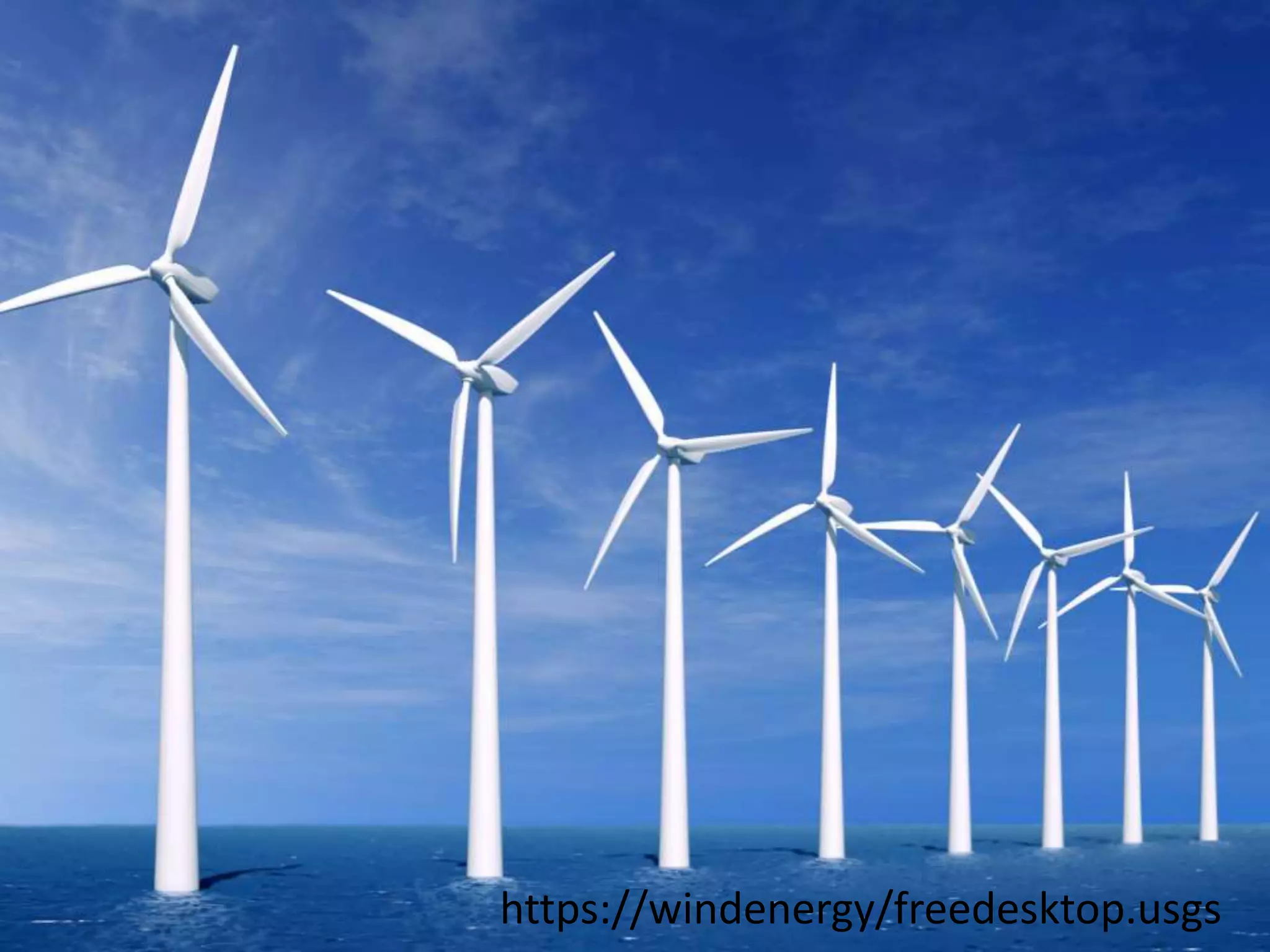
WIND ENERGY
• Wind is allowed to rotate the blades of wind mills ,
which rotates turbines to generate electricity.
APPLICATION
• The wind is a free clean and in exhaustible energy
sources . It has served human kind well for many
centuries by propelling ships and driving ,wind
turbines to grind grain and pump water .
• DENMARK was the first country to use wind for
generation of electricity.
https://windenergy/freedesktop.usgs
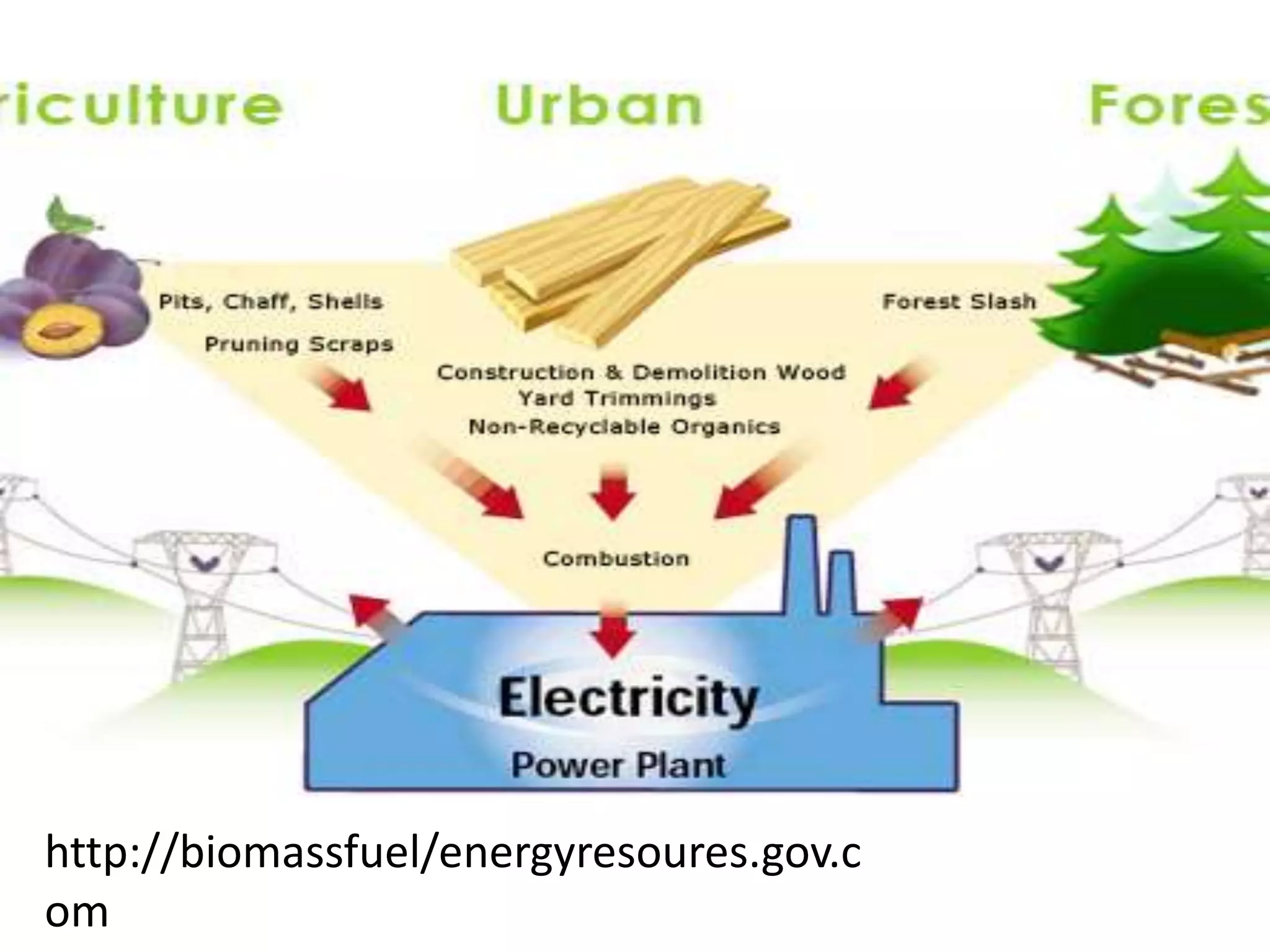
BIOMASS
• India is an agriculture based country .Agriculture
and dairy farming produced large amount of
biomass.
Example – Agricultural waste and Cow Dung
• Dead organic matter or dead plant and animal
parts are known as Biomass.
Example- wood, leaf parts and crop residue .
http://biomassfuel/energyresoures.gov.c
om
NON RENEWAABLE ENERGY
• These energy resources are formed inside the
earth crust at very high temperature and
pressure ,take a very long passage of time in their
formation .Thus they are present in limited
amount in nature’s reservoir.
Example – coal , petroleum , natural gas , timber ,
nuclear fuel. These included two types of energy
resources - Fossil fuel, Nuclear Energy.
FOSSIL FUEL
• Fossil fuel are found inside the earth crust where
they have formed through heat and compression
of forest waste and other organic matter, which
got buried due to Earthquake and landslide etc.
CLASSIFICATION OF FOSSIL FUEL
Solid ( Coal )
Liquid ( Petroleum )
Gaseous ( Natural gas )
COAL
• Coal is the most
abundantly found
fossil fuel in the world
.It contain Carbon ,
Water , Sulphur , and
Nitrogen . Coal meets
70% of the total
energy needs of the
world around. It is
used for cooking ,
industry, and thermal
power plant.
PETROLEUM
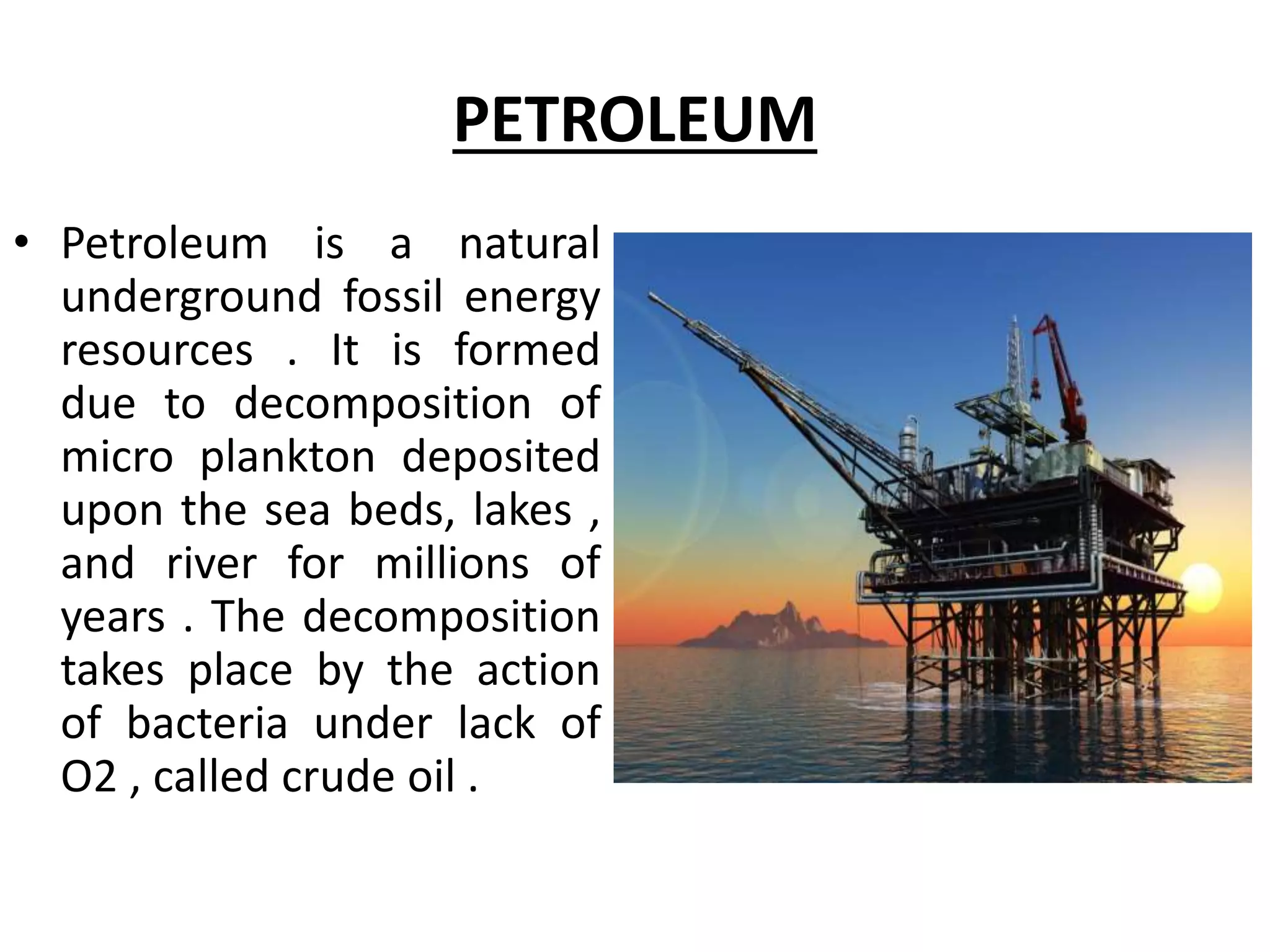
• Petroleum is a natural
underground fossil energy
resources . It is formed
due to decomposition of
micro plankton deposited
upon the sea beds, lakes ,
and river for millions of
years . The decomposition
takes place by the action
of bacteria under lack of
O2 , called crude oil .
NATURAL GAS
• It is a mixture hydrocarbon
gases trapped under the
earth surface. It is a mainly
consisting of methane (CH4)
,Propane (C3H8) , and
Butane (C4H10) .
• Natural gas can used in two
different forms -
LPG – ( Liquefied Petroleum Gas )
CNG – (Compressed Natural Gas)
NUCLEAR ENERGY
• It present nuclear power . It is a highly
developed alternative far energy production in
place of coal.
Nuclear energy can divided by two processes -
NUCLEAR FISSION
NUCLEAR FUSION
NUCLEAR FISSION
• The heavy nucleus on
bombardment with
neutron splits into lighter
nuclei (Barium and
krypton ) releases large
amount of energy .one
amu of U235 yield
energy equal to burning
of 15 metric tons of coal.
NUCLEAR FUSION
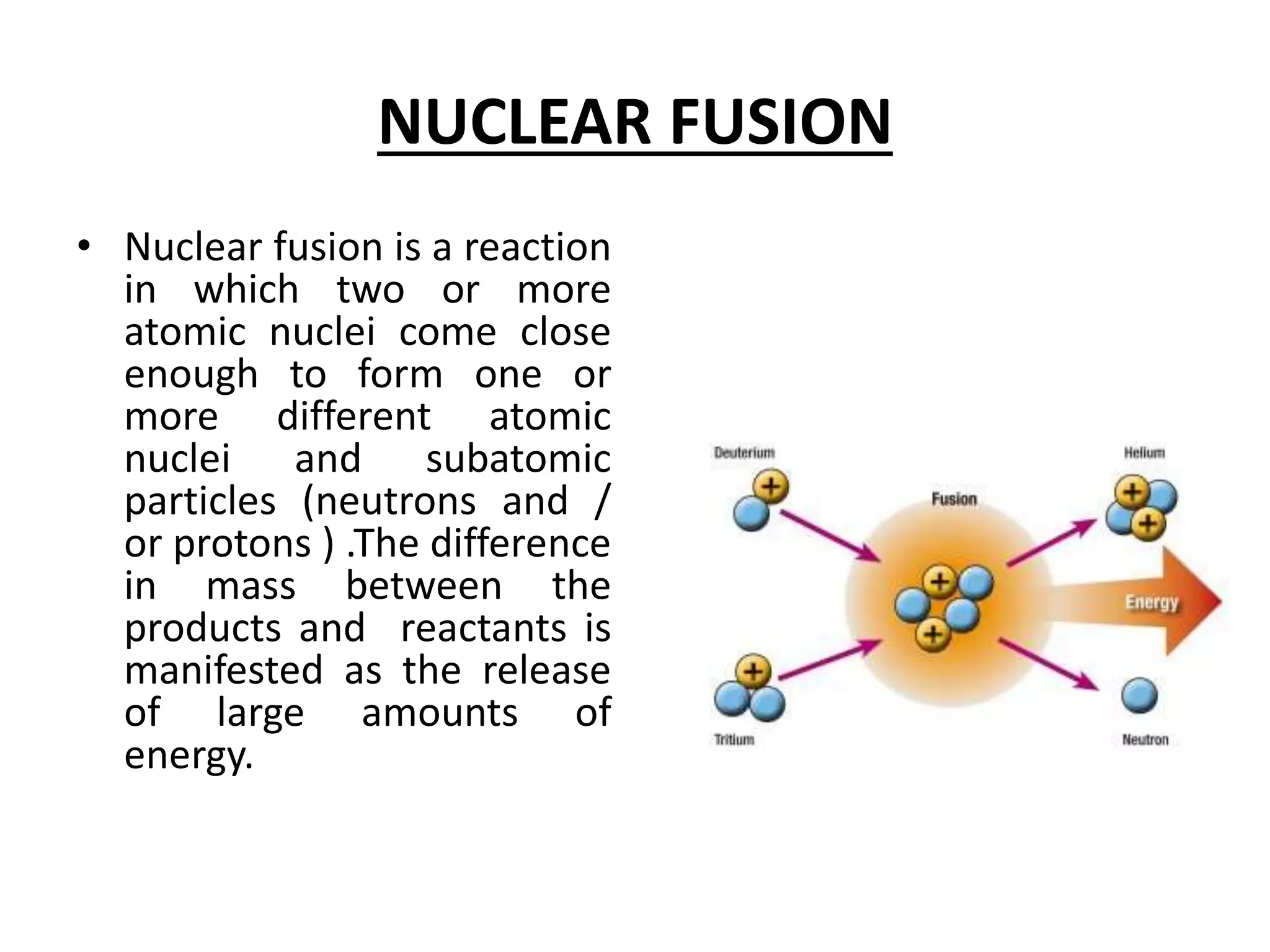
• Nuclear fusion is a reaction
in which two or more
atomic nuclei come close
enough to form one or
more different atomic
nuclei and subatomic
particles (neutrons and /
or protons ) .The difference
in mass between the
products and reactants is
manifested as the release
of large amounts of
energy.
IMPORTANCE IN INDIA
• In India there are still thousand of villages
where darkness is not dispelled by electricity .
These villages due to their remote location are
not likely to have access to electricity supply
from the grid for a very long time.
In the rural areas ,domestic energy
consumption especially for cooking ,
constitutes a significant part of energy
demand .
MY VIEW
• Human energy consumption has grown
steadily throughout human history . Early
human had modest energy requirement. Most
ly food and fuel for fires to cook and keep
warm . In today’s society human consume as
much as 110 times as energy per person as
early humans . In any event the exploitation of
all energy sources ultimately rely on material
on planet earth.
REFFERENCES
• www.worldenergy.org/workprogramme
• http://www.cleangreenenergyzone.org.com
• http://www.solarpowernotes.com
• http://www.Greenplanetethatics.com
• http://www.Science.nationalgeographic.com
THANK YOU
Uploaded By:- Ramesh Panadey
Email:- rameshpandey208@gmail.com

Energy resources

  • 1.
    KAMLA NEHRU INSTITUTEOF PHYSICAL AND SOCIAL SCIENCES SULTANPUR WELCOME TO SEMINAR ON Energy resources PRESENTATION BY :- Neha Singh M.Sc.(final year) Department of Environmental sciences
  • 2.
    CONTENT • Introduction • Classification •Renewable Energy Resources • Non Renewable Resources • Importance Of Energy Resources In India • Application • My View • References
  • 3.
    INTRODUCTION Energy Energy is capacityto do work . Energy can be changed from one form to another but it neither be created nor be destroyed. Energy Resources An energy resources is something that can produce heat, power life , move objects ,or produce electricity .matter that store energy is called fuel .
  • 4.
  • 5.
    RENEWABLE ENERGY RESOURCES •The sources of energy which are renewed again to again at a faster rate in nature are known as renewable energy resources. Example – Solar Energy , Wind Energy , Hydro Energy ,Biomass Energy.
  • 6.
    RENEWABLE ENERGY RESOURSES SOLARENERGY • Solar energy is available in large amount, because ultimate sources of energy in an ecosystem is sun . Thus considered major future sources of energy . it is incident on green plants , they carry out photosynthesis in the presence of CO2 , water and sunlight and make their own food ,thus maintain life . Their death produces biomass . Example – Solar light
  • 7.
  • 8.
    Photovoltaic cell is phenomenon that conversion of solarenergy to electricity. Photovoltaic cell
  • 9.
    HYDRO ENERGY • Wateris made to fall from height to rotate turbine, which help generate electricity ,is known as hydro energy. APPLICATION Hydro power use the energy for moving water for a variety of useful application , hydroelectricity generates electricity by the gravitational force of falling water . It use water in dams to drive turbines and generates which turns Mechanical energy into Electrical energy.
  • 10.
  • 11.
    WIND ENERGY • Windis allowed to rotate the blades of wind mills , which rotates turbines to generate electricity. APPLICATION • The wind is a free clean and in exhaustible energy sources . It has served human kind well for many centuries by propelling ships and driving ,wind turbines to grind grain and pump water . • DENMARK was the first country to use wind for generation of electricity.
  • 12.
  • 13.
    BIOMASS • India isan agriculture based country .Agriculture and dairy farming produced large amount of biomass. Example – Agricultural waste and Cow Dung • Dead organic matter or dead plant and animal parts are known as Biomass. Example- wood, leaf parts and crop residue .
  • 14.
  • 15.
    NON RENEWAABLE ENERGY •These energy resources are formed inside the earth crust at very high temperature and pressure ,take a very long passage of time in their formation .Thus they are present in limited amount in nature’s reservoir. Example – coal , petroleum , natural gas , timber , nuclear fuel. These included two types of energy resources - Fossil fuel, Nuclear Energy.
  • 16.
    FOSSIL FUEL • Fossilfuel are found inside the earth crust where they have formed through heat and compression of forest waste and other organic matter, which got buried due to Earthquake and landslide etc. CLASSIFICATION OF FOSSIL FUEL Solid ( Coal ) Liquid ( Petroleum ) Gaseous ( Natural gas )
  • 17.
    COAL • Coal isthe most abundantly found fossil fuel in the world .It contain Carbon , Water , Sulphur , and Nitrogen . Coal meets 70% of the total energy needs of the world around. It is used for cooking , industry, and thermal power plant.
  • 18.
    PETROLEUM • Petroleum isa natural underground fossil energy resources . It is formed due to decomposition of micro plankton deposited upon the sea beds, lakes , and river for millions of years . The decomposition takes place by the action of bacteria under lack of O2 , called crude oil .
  • 19.
    NATURAL GAS • Itis a mixture hydrocarbon gases trapped under the earth surface. It is a mainly consisting of methane (CH4) ,Propane (C3H8) , and Butane (C4H10) . • Natural gas can used in two different forms - LPG – ( Liquefied Petroleum Gas ) CNG – (Compressed Natural Gas)
  • 20.
    NUCLEAR ENERGY • Itpresent nuclear power . It is a highly developed alternative far energy production in place of coal. Nuclear energy can divided by two processes - NUCLEAR FISSION NUCLEAR FUSION
  • 21.
    NUCLEAR FISSION • Theheavy nucleus on bombardment with neutron splits into lighter nuclei (Barium and krypton ) releases large amount of energy .one amu of U235 yield energy equal to burning of 15 metric tons of coal.
  • 22.
    NUCLEAR FUSION • Nuclearfusion is a reaction in which two or more atomic nuclei come close enough to form one or more different atomic nuclei and subatomic particles (neutrons and / or protons ) .The difference in mass between the products and reactants is manifested as the release of large amounts of energy.
  • 23.
    IMPORTANCE IN INDIA •In India there are still thousand of villages where darkness is not dispelled by electricity . These villages due to their remote location are not likely to have access to electricity supply from the grid for a very long time. In the rural areas ,domestic energy consumption especially for cooking , constitutes a significant part of energy demand .
  • 24.
    MY VIEW • Humanenergy consumption has grown steadily throughout human history . Early human had modest energy requirement. Most ly food and fuel for fires to cook and keep warm . In today’s society human consume as much as 110 times as energy per person as early humans . In any event the exploitation of all energy sources ultimately rely on material on planet earth.
  • 25.
    REFFERENCES • www.worldenergy.org/workprogramme • http://www.cleangreenenergyzone.org.com •http://www.solarpowernotes.com • http://www.Greenplanetethatics.com • http://www.Science.nationalgeographic.com
  • 26.
    THANK YOU Uploaded By:-Ramesh Panadey Email:- rameshpandey208@gmail.com