LEC 1- MULTIDISCIPLINARY
NATURE OF ENVIRONMENTAL
STUDIES DEFINITION, SCOPE AND
IMPORTANCE. NATURAL
RESOURCES- RENEWABLE AND
NON RENEWABLE
Environmental studies
 The word environment is derived from the French
word “environ” meaning surroundings.
 The social, physical and cultural conditions that
surround, affect and influence the survival, growth
and development of people, animals and plants.
 The sum total of water, air and land, the inter-
relationships that exist among them and with the
human beings , other living organisms & materials”
(EPA, 1986)
 Environmental studies is essentially a
multidisciplinary approach that brings about an
appreciation of our natural world and human impacts
on its integrity.
Ecology and Ecosystem
 Ecology is the study of interaction among
living organisms (plants, animals,
microbes) as well as interaction with its
abiotic environment (temperature, water,
air, soil, light, etc.).
 An ecosystem is the structural and
functional unit of ecology. It is a
community of living organisms along with
the abiotic components interacting
together through energy flows and
nutrient cycles.
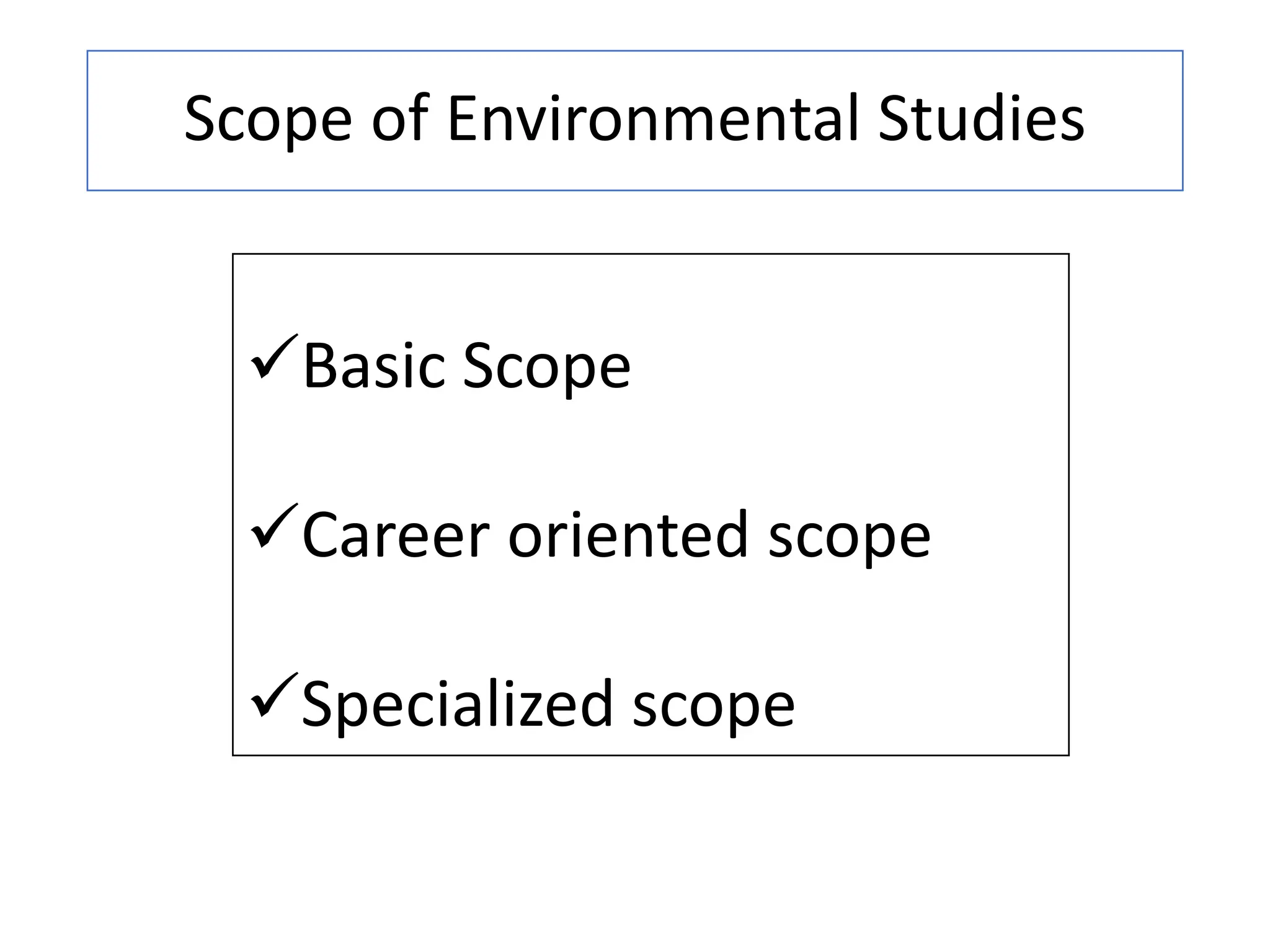
Scope of Environmental Studies
Basic Scope
Career oriented scope
Specialized scope
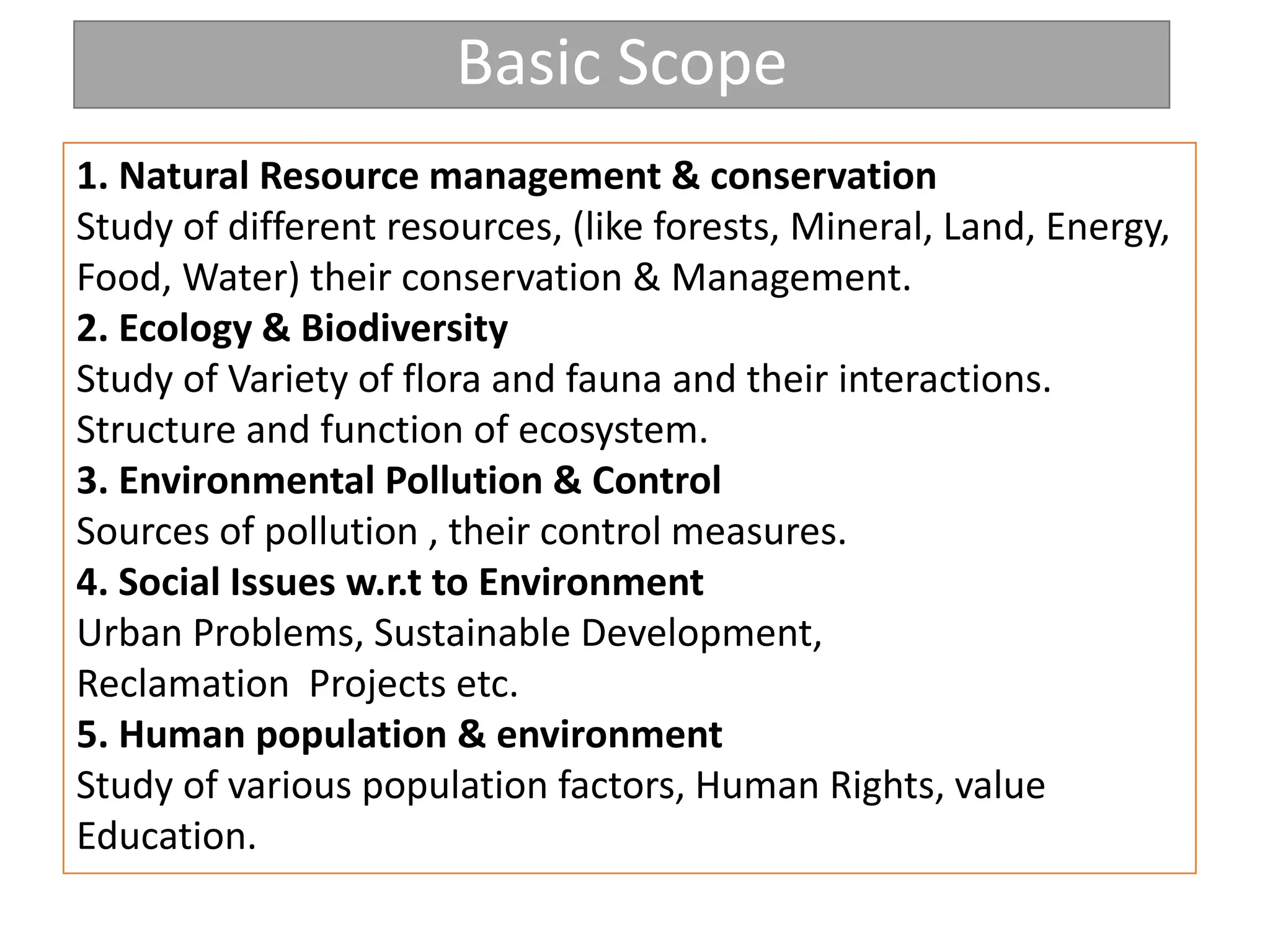
Basic Scope
1. Natural Resource management & conservation
Study of different resources, (like forests, Mineral, Land, Energy,
Food, Water) their conservation & Management.
2. Ecology & Biodiversity
Study of Variety of flora and fauna and their interactions.
Structure and function of ecosystem.
3. Environmental Pollution & Control
Sources of pollution , their control measures.
4. Social Issues w.r.t to Environment
Urban Problems, Sustainable Development,
Reclamation Projects etc.
5. Human population & environment
Study of various population factors, Human Rights, value
Education.
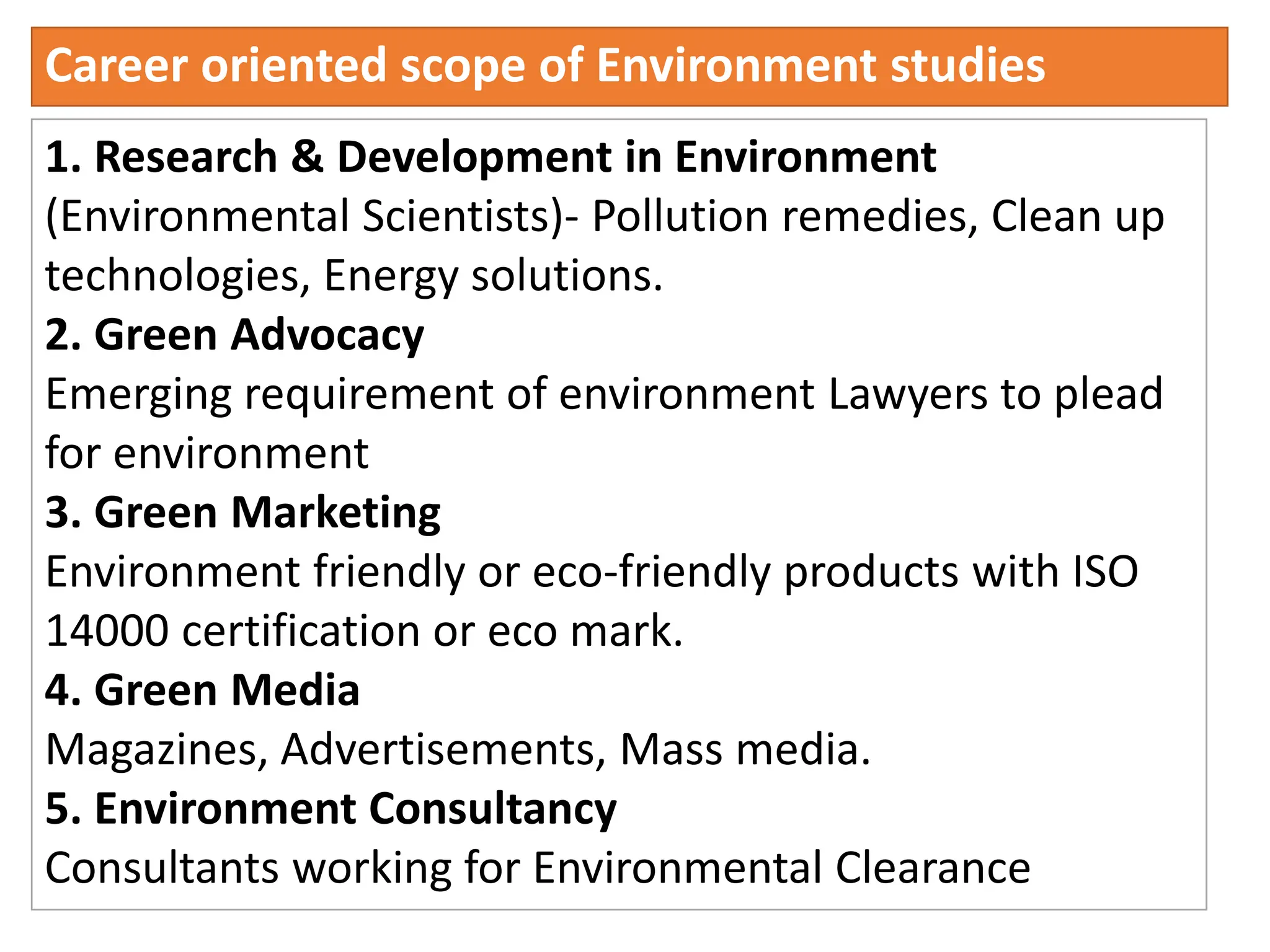
Career oriented scope of Environment studies
1. Research & Development in Environment
(Environmental Scientists)- Pollution remedies, Clean up
technologies, Energy solutions.
2. Green Advocacy
Emerging requirement of environment Lawyers to plead
for environment
3. Green Marketing
Environment friendly or eco-friendly products with ISO
14000 certification or eco mark.
4. Green Media
Magazines, Advertisements, Mass media.
5. Environment Consultancy
Consultants working for Environmental Clearance
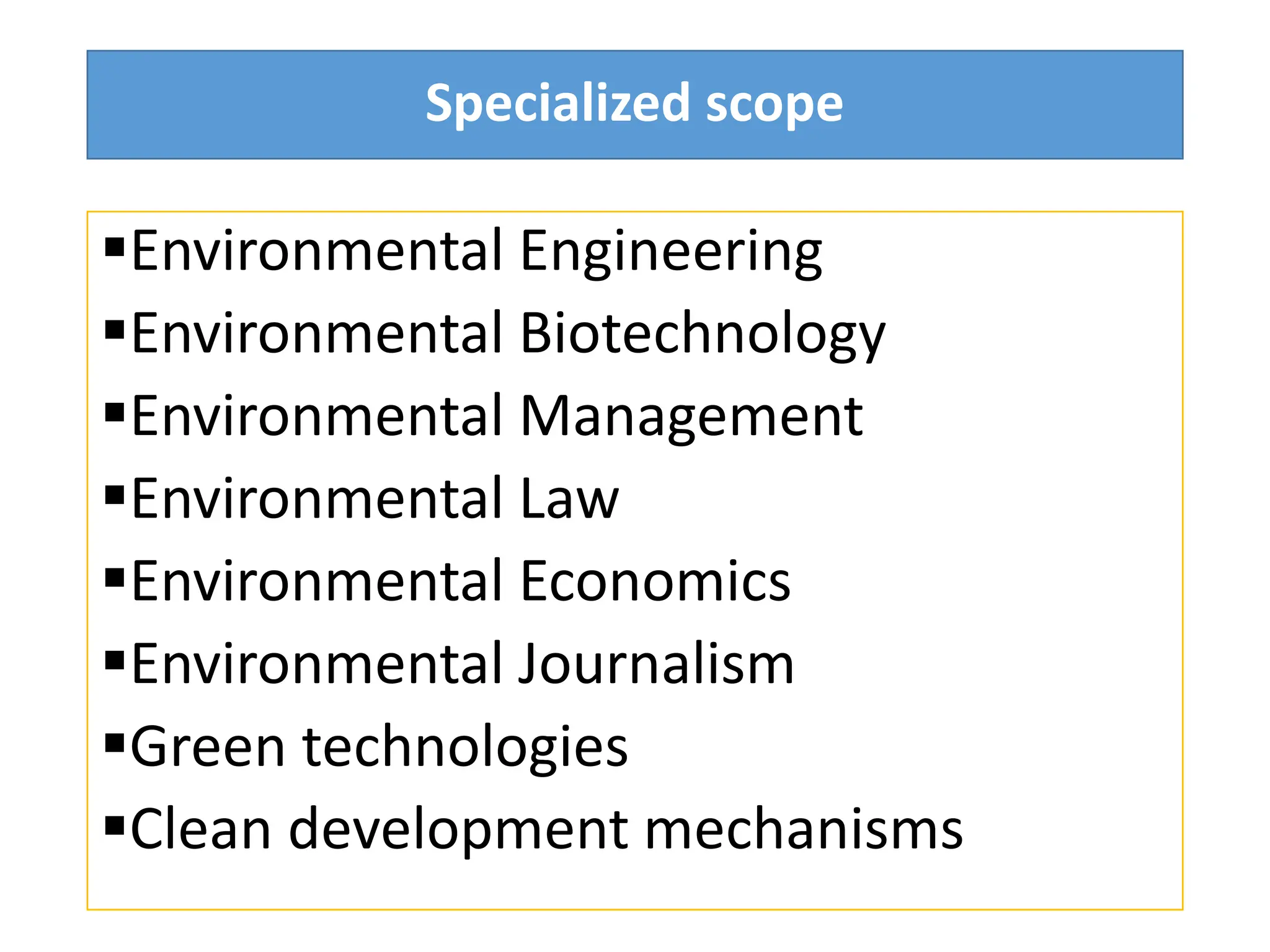
Specialized scope
Environmental Engineering
Environmental Biotechnology
Environmental Management
Environmental Law
Environmental Economics
Environmental Journalism
Green technologies
Clean development mechanisms
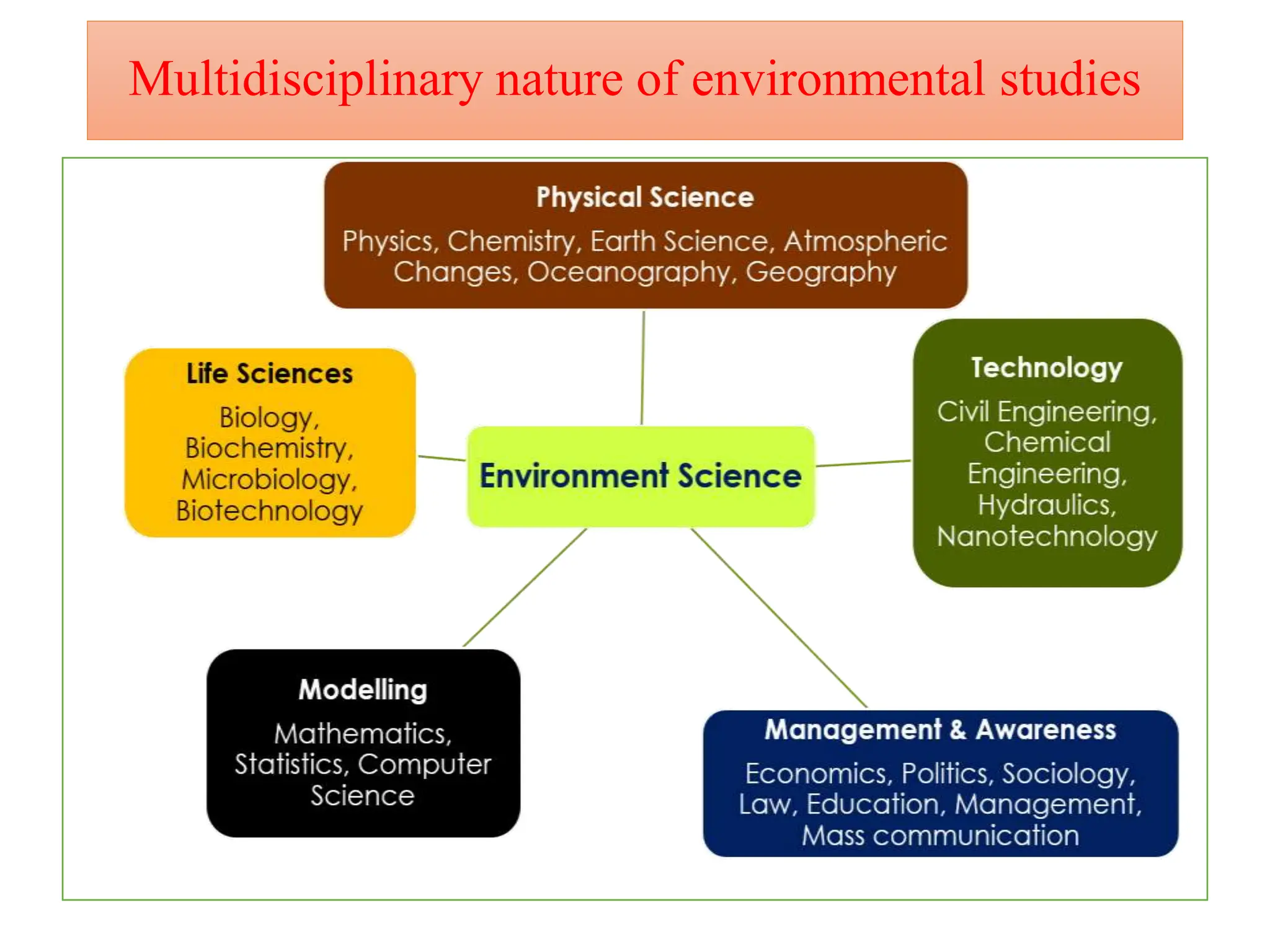
Multidisciplinary nature of environmental studies
In Life Sciences (Botany, Biochemistry, Microbiology, and Zoology) -
helps in understanding biotic components and its interaction with
surroundings.
Genetics and Biotechnology - Used for finding the solutions for various
environmental problems.
Maths, Statistics, Computer Science - used as an effective tool in
environmental modelling.
Economics, Management, Sociology - used for dealing with Socio-
economic aspects associated with variety of development activities.
Law - It provides guidelines and legal measures for effective
management and protection of environment.
Education - Teach in schools, colleges, universities, and awareness
programes.
Civil and Chemical Engineering, Hydraulics, Nanotechnology - Provides
technical solutions for environmental waste management and pollution
control.
Physical Sciences (Physics, Chemistry, Geography, etc.) - used to
understand the physical and chemical structure of abiotic components of
environment along with mass and energy transfer.
Importance of Environment studies
Environment Importance can be categorized at three
different levels
1. Global Level
Problems like global warming, ozone depletion, Dwindling
of Resources
2. Local Level
Issues which are area specific like mining problem in a
particular area, Problems of solid waste handling etc.
3. Individual Level
This level includes concerns at door step. Like safe
drinking water, hygienic vicinity, etc.
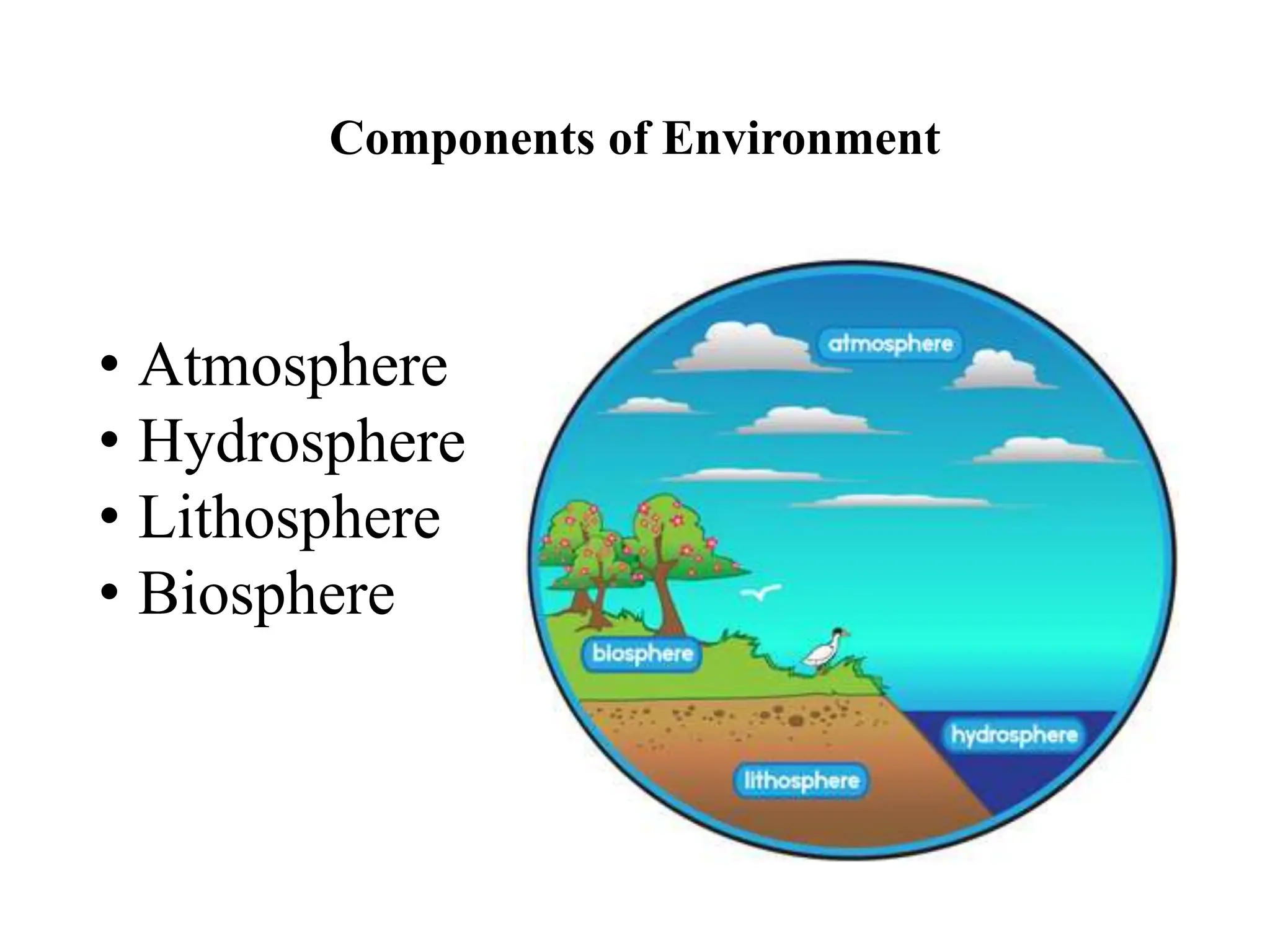
Components of Environment
• Atmosphere
• Hydrosphere
• Lithosphere
• Biosphere
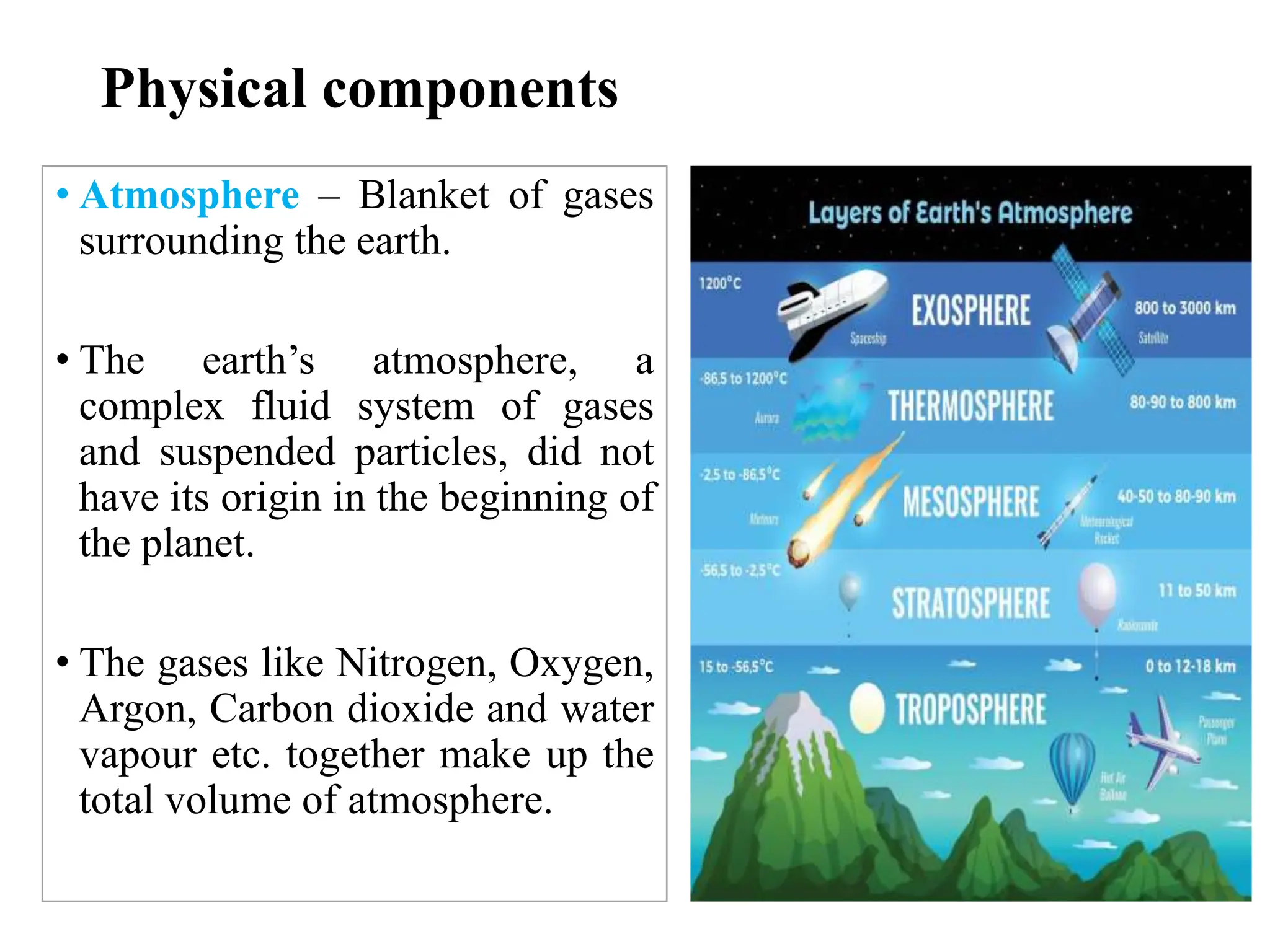
Physical components
• Atmosphere – Blanket of gases
surrounding the earth.
• The earth’s atmosphere, a
complex fluid system of gases
and suspended particles, did not
have its origin in the beginning of
the planet.
• The gases like Nitrogen, Oxygen,
Argon, Carbon dioxide and water
vapour etc. together make up the
total volume of atmosphere.
Hydrosphere
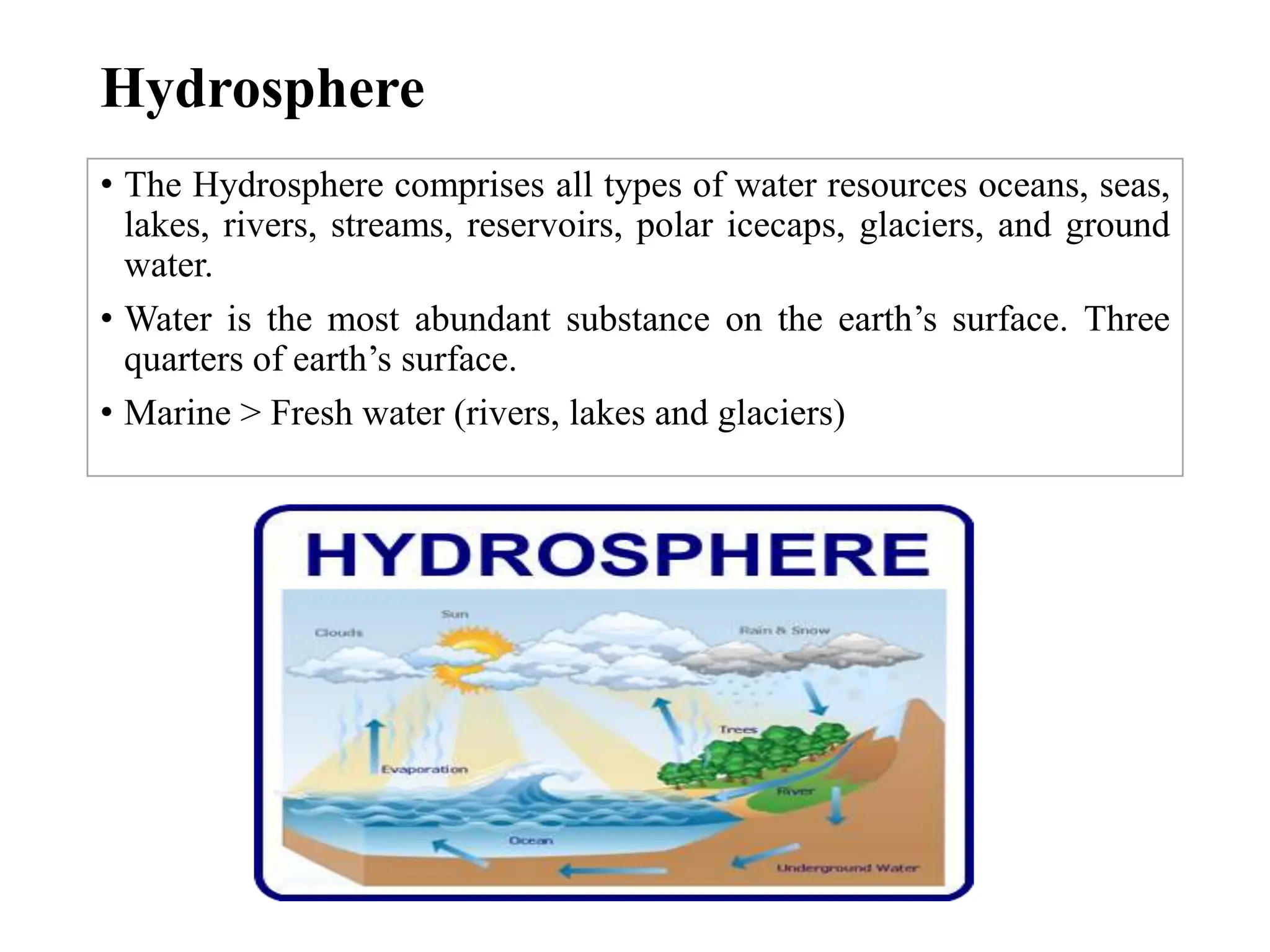
• The Hydrosphere comprises all types of water resources oceans, seas,
lakes, rivers, streams, reservoirs, polar icecaps, glaciers, and ground
water.
• Water is the most abundant substance on the earth’s surface. Three
quarters of earth’s surface.
• Marine > Fresh water (rivers, lakes and glaciers)
Lithosphere
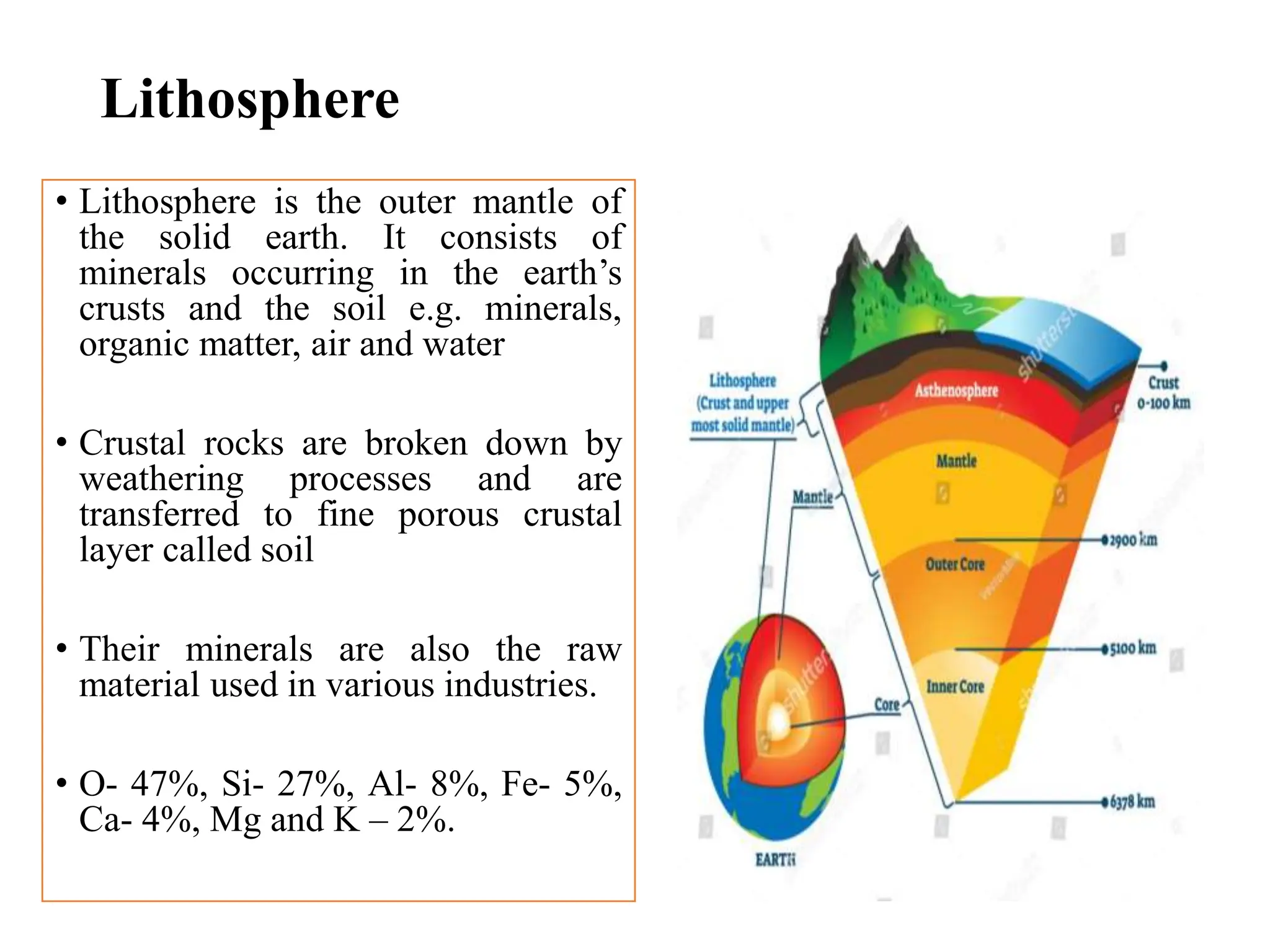
• Lithosphere is the outer mantle of
the solid earth. It consists of
minerals occurring in the earth’s
crusts and the soil e.g. minerals,
organic matter, air and water
• Crustal rocks are broken down by
weathering processes and are
transferred to fine porous crustal
layer called soil
• Their minerals are also the raw
material used in various industries.
• O- 47%, Si- 27%, Al- 8%, Fe- 5%,
Ca- 4%, Mg and K – 2%.
Biosphere
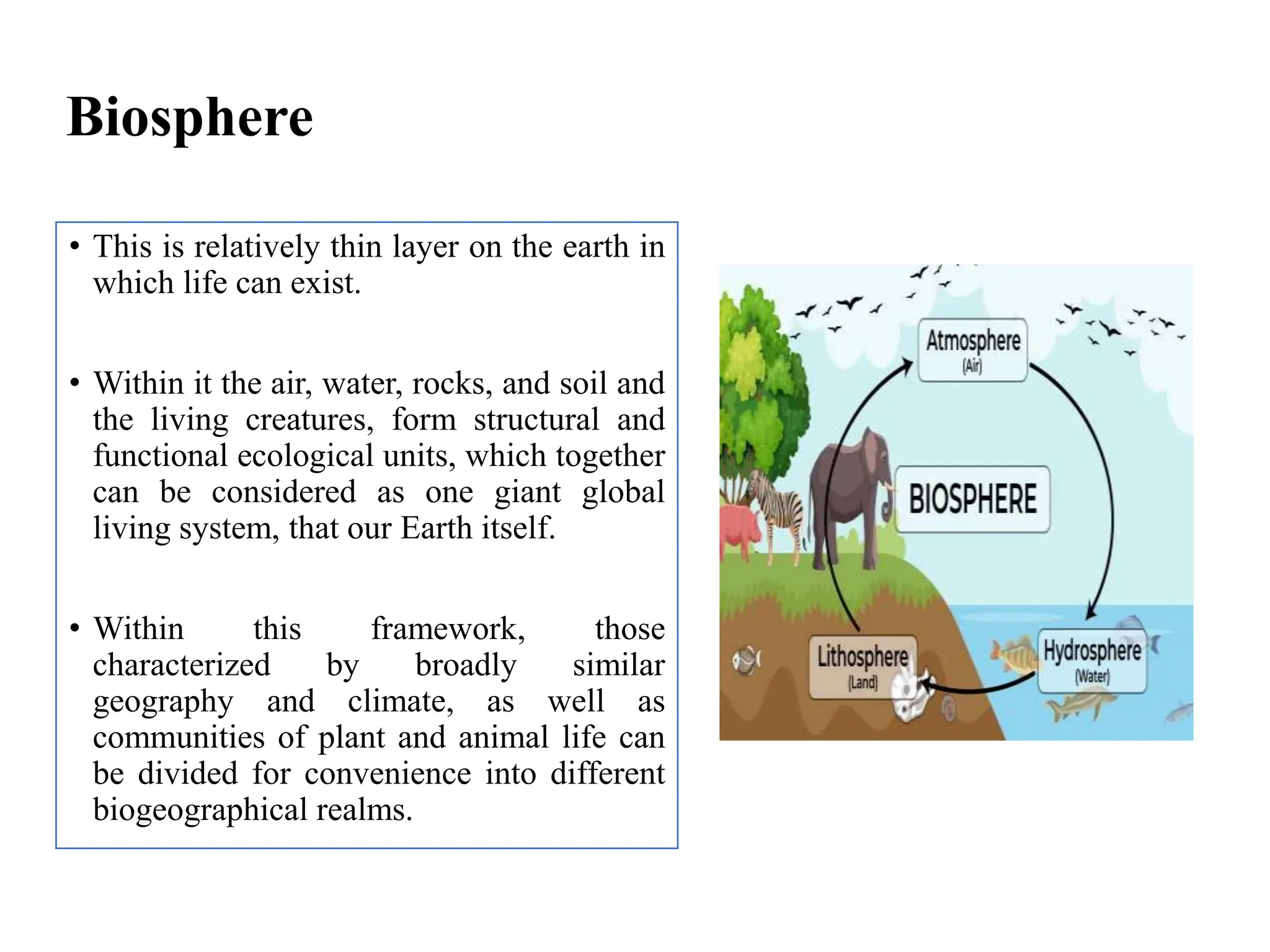
• This is relatively thin layer on the earth in
which life can exist.
• Within it the air, water, rocks, and soil and
the living creatures, form structural and
functional ecological units, which together
can be considered as one giant global
living system, that our Earth itself.
• Within this framework, those
characterized by broadly similar
geography and climate, as well as
communities of plant and animal life can
be divided for convenience into different
biogeographical realms.
Natural Resources
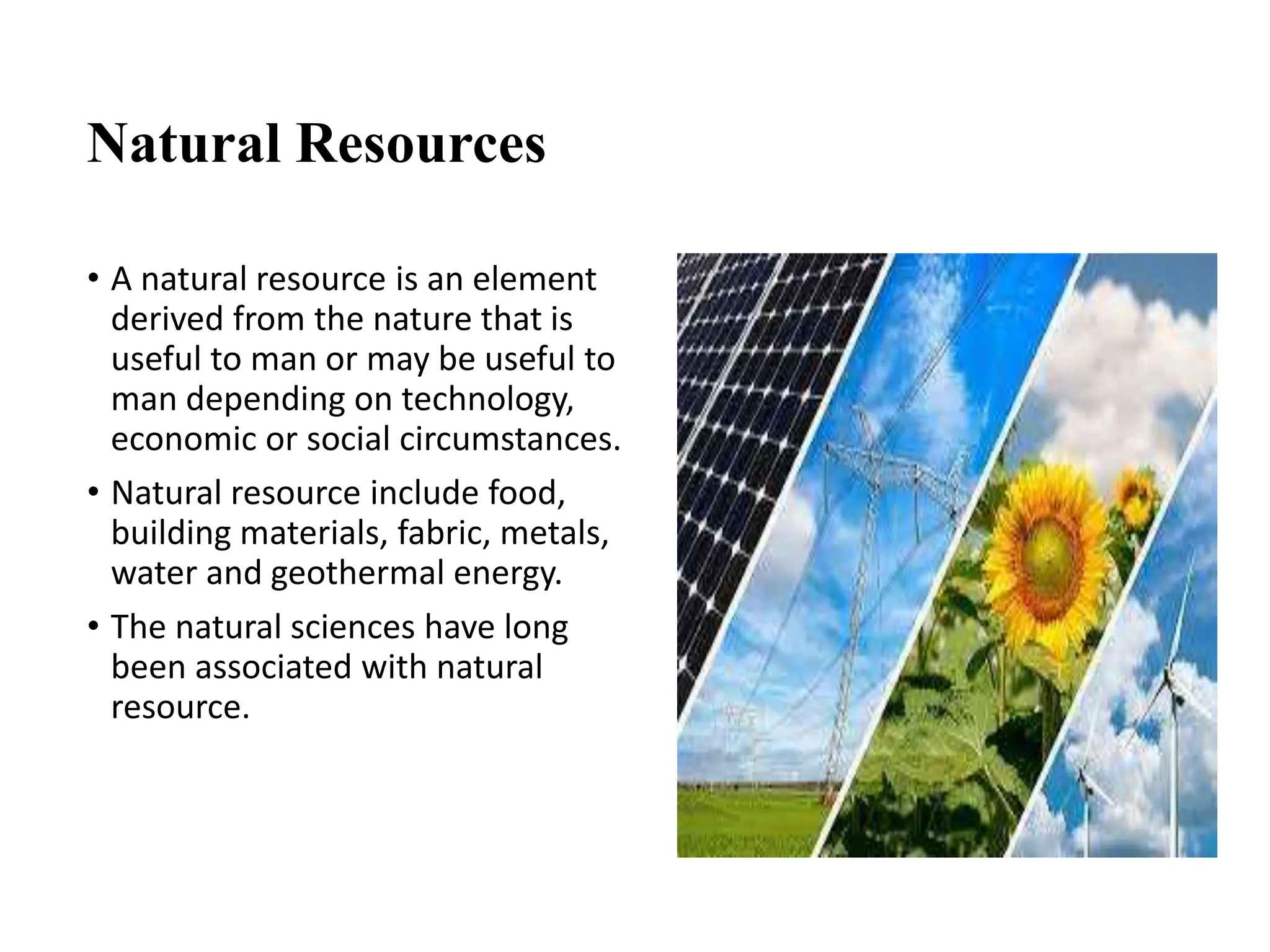
• A natural resource is an element
derived from the nature that is
useful to man or may be useful to
man depending on technology,
economic or social circumstances.
• Natural resource include food,
building materials, fabric, metals,
water and geothermal energy.
• The natural sciences have long
been associated with natural
resource.
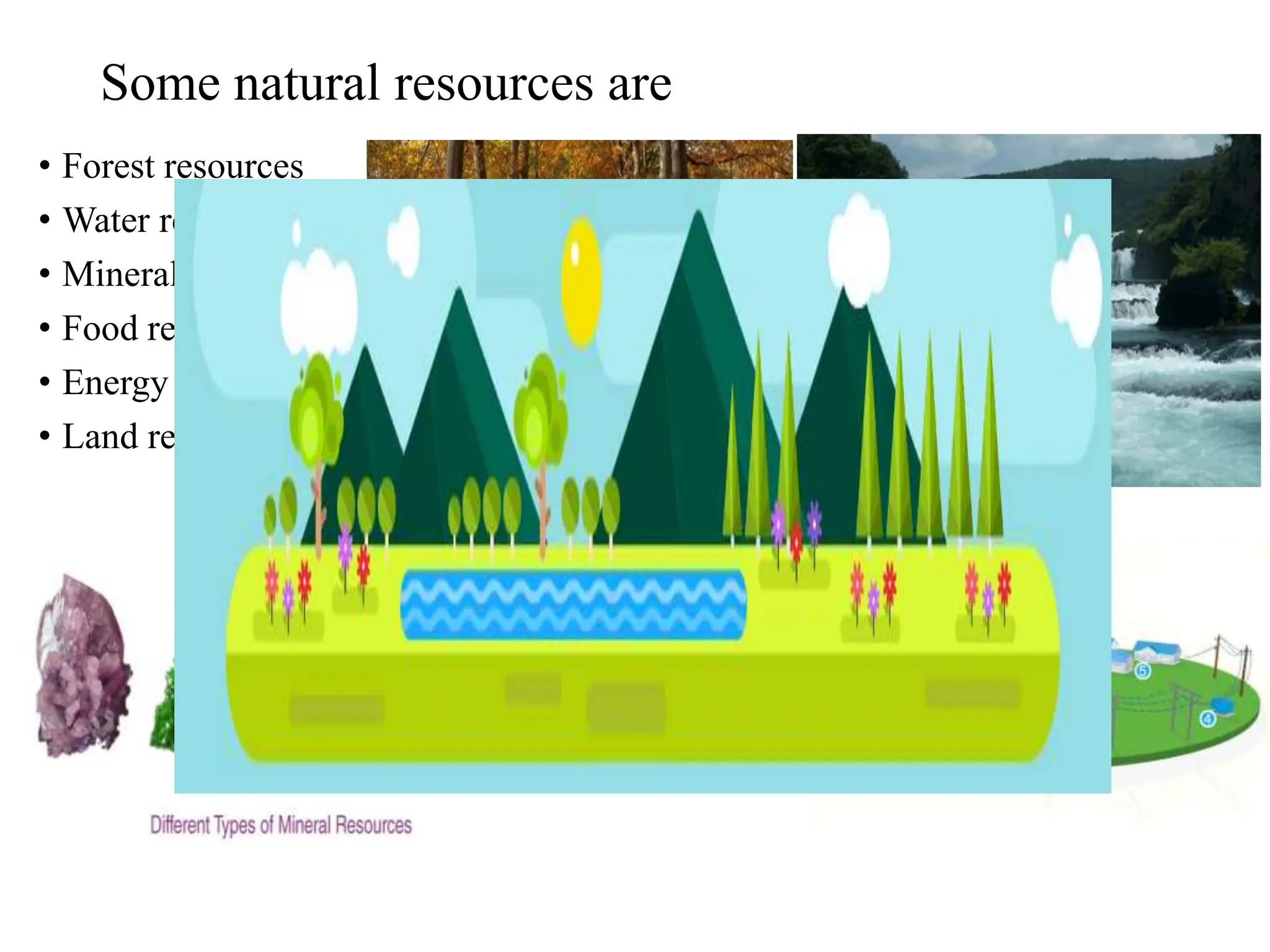
Some natural resources are
• Forest resources
• Water resources
• Mineral resources
• Food resources
• Energy resources
• Land resources
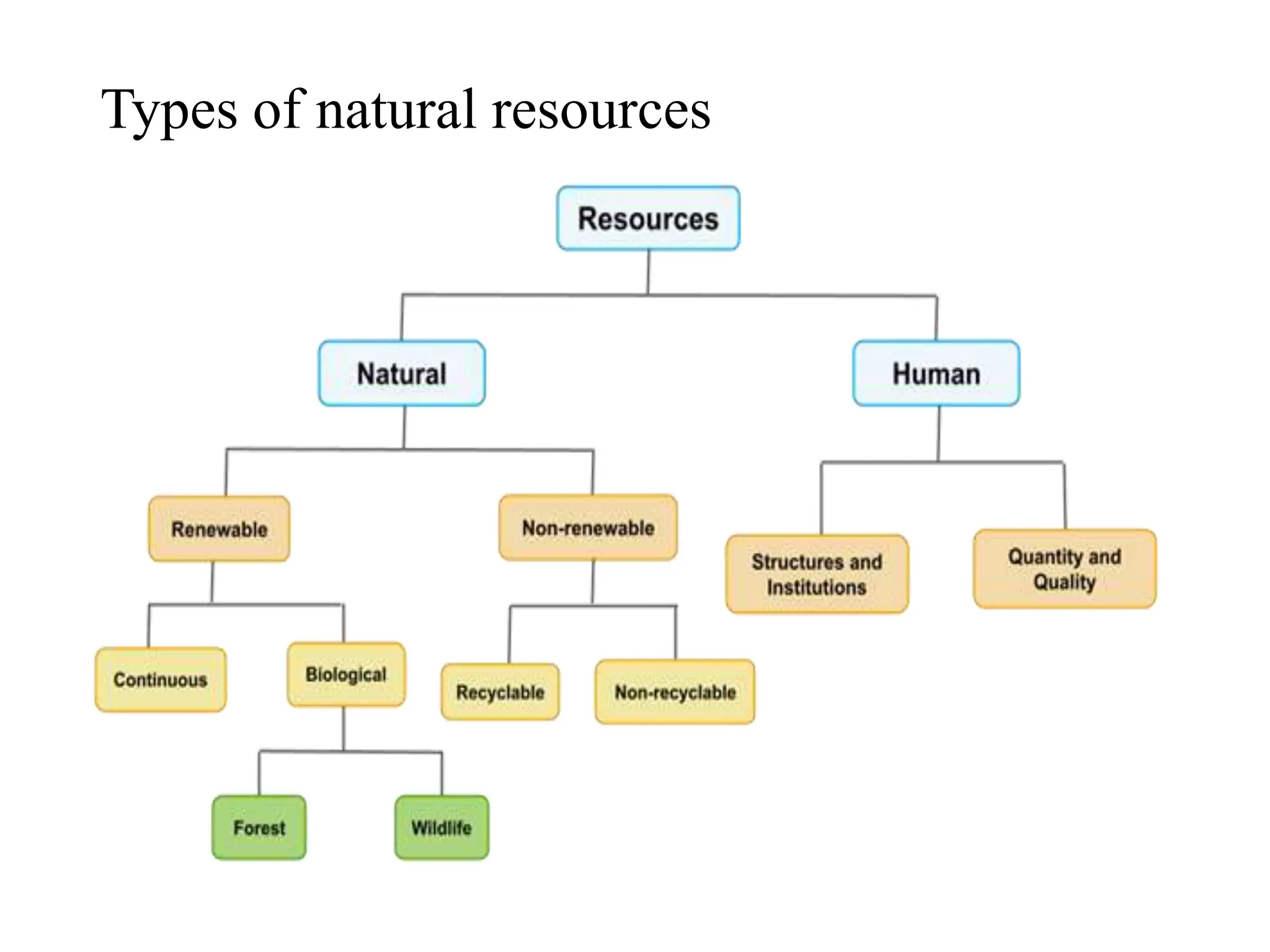
Types of natural resources
• Renewable resources - The resources that can be
replenished through rapid natural cycles are known as a
renewable resources. Ex. Crops and animals, water and soil
etc.,
• Non - Renewable resources – The resources that cannot be
replenished through natural processes are known as non-
renewable resources. These are available in limited amounts,
which cannot be increased. These resources include fossil
fuels (Petrol, coals..), metals etc.,
Based on availability of natural resource
Non renewable resources
Recyclable – These are non–renewable resources, which can
be collected after they are used and can be recycled. These
are mainly the non-energy mineral resources, which occur in
the earth’s crust (Ex. Ores of aluminum, copper, mercury,
etc.) and deposits of fertilizer nutrients (eg. Phosphate rock
and potassium and minerals used in their natural state
(asbestos, clay, mica, etc.)
Non-recyclable – These are non-renewable resources, which
cannot be recycled in any way. Ex. Fossil fuels and uranium,
provide 90 percent of our energy requirements.
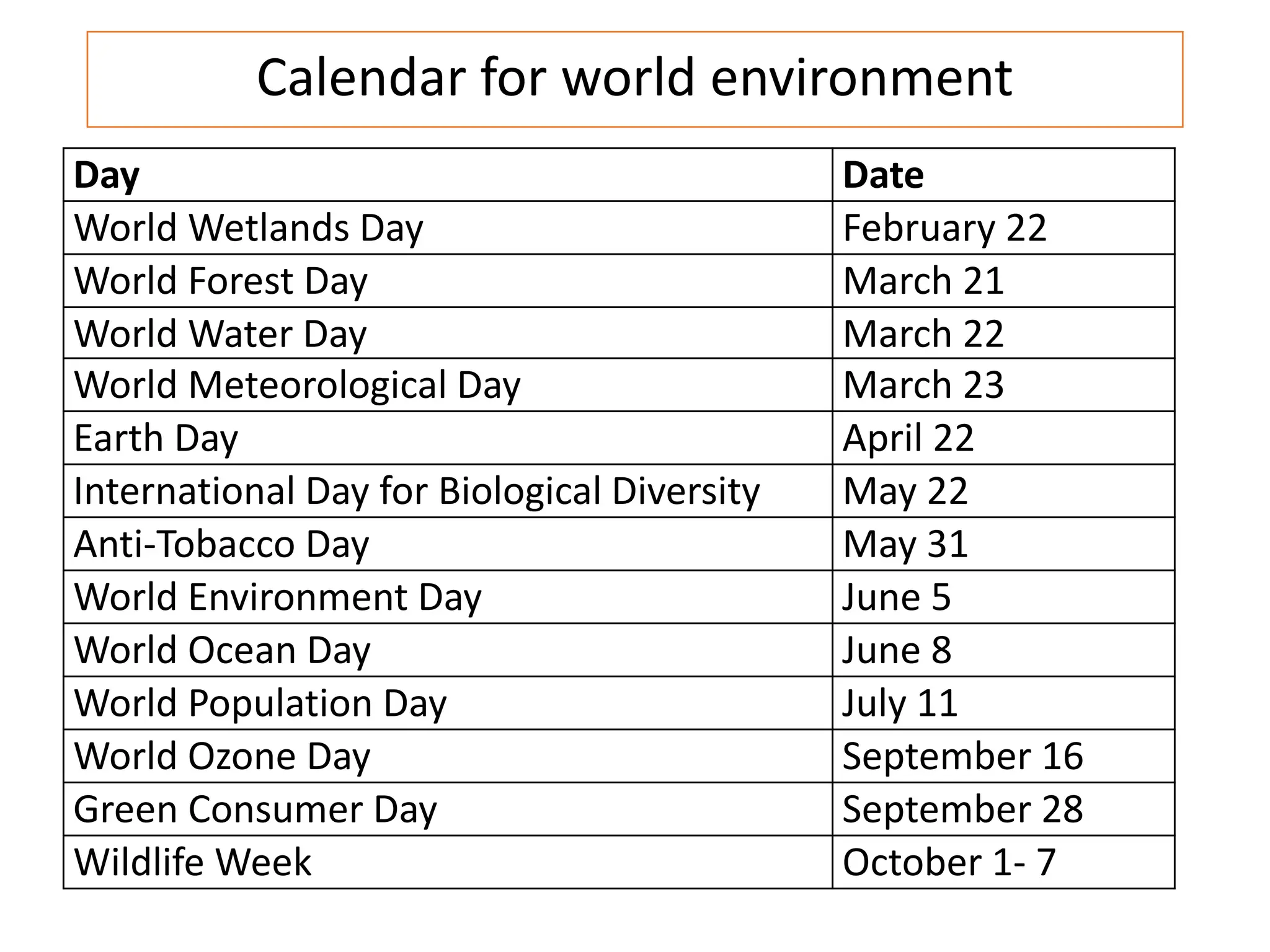
Calendar for world environment
Day Date
World Wetlands Day February 22
World Forest Day March 21
World Water Day March 22
World Meteorological Day March 23
Earth Day April 22
International Day for Biological Diversity May 22
Anti-Tobacco Day May 31
World Environment Day June 5
World Ocean Day June 8
World Population Day July 11
World Ozone Day September 16
Green Consumer Day September 28
Wildlife Week October 1- 7
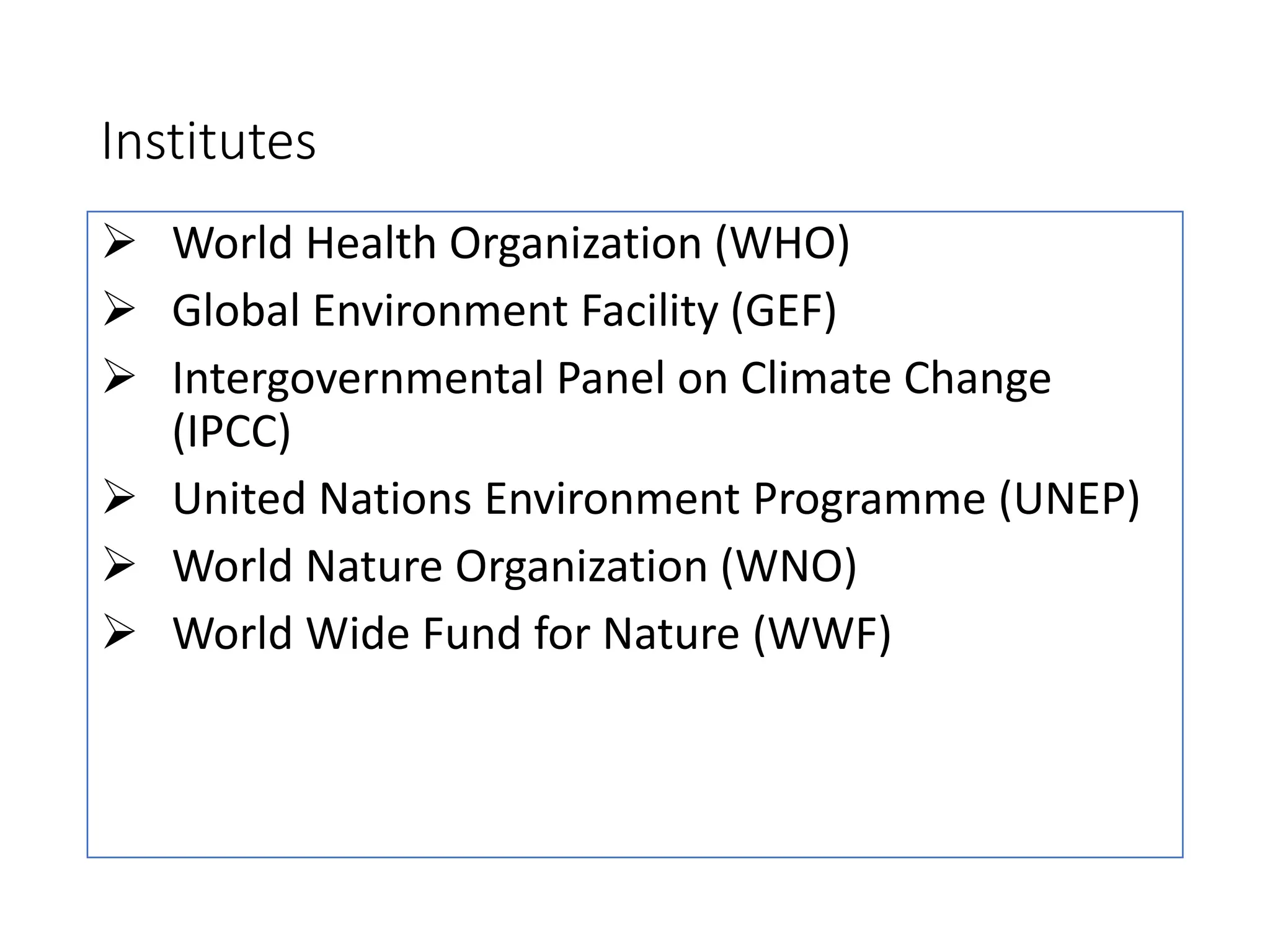
Institutes
 World Health Organization (WHO)
 Global Environment Facility (GEF)
 Intergovernmental Panel on Climate Change
(IPCC)
 United Nations Environment Programme (UNEP)
 World Nature Organization (WNO)
 World Wide Fund for Nature (WWF)
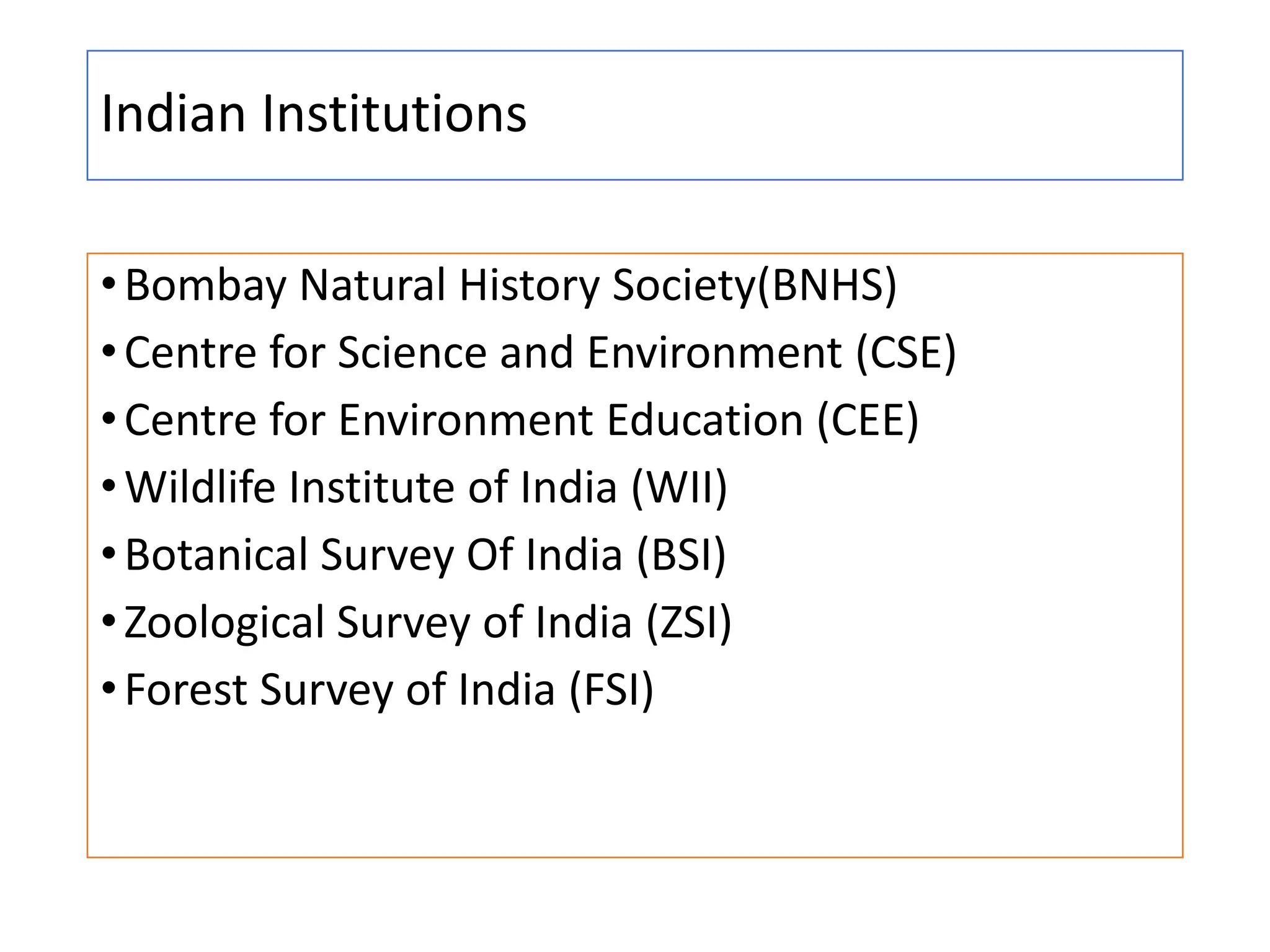
Indian Institutions
•Bombay Natural History Society(BNHS)
•Centre for Science and Environment (CSE)
•Centre for Environment Education (CEE)
•Wildlife Institute of India (WII)
•Botanical Survey Of India (BSI)
•Zoological Survey of India (ZSI)
•Forest Survey of India (FSI)

Multidisciplinary nature of environmental studies Definition, scope and importance. Natural Resources- Renewable and Non Renewable

  • 1.
    LEC 1- MULTIDISCIPLINARY NATUREOF ENVIRONMENTAL STUDIES DEFINITION, SCOPE AND IMPORTANCE. NATURAL RESOURCES- RENEWABLE AND NON RENEWABLE
  • 2.
    Environmental studies  Theword environment is derived from the French word “environ” meaning surroundings.  The social, physical and cultural conditions that surround, affect and influence the survival, growth and development of people, animals and plants.  The sum total of water, air and land, the inter- relationships that exist among them and with the human beings , other living organisms & materials” (EPA, 1986)  Environmental studies is essentially a multidisciplinary approach that brings about an appreciation of our natural world and human impacts on its integrity.
  • 3.
    Ecology and Ecosystem Ecology is the study of interaction among living organisms (plants, animals, microbes) as well as interaction with its abiotic environment (temperature, water, air, soil, light, etc.).  An ecosystem is the structural and functional unit of ecology. It is a community of living organisms along with the abiotic components interacting together through energy flows and nutrient cycles.
  • 4.
    Scope of EnvironmentalStudies Basic Scope Career oriented scope Specialized scope
  • 5.
    Basic Scope 1. NaturalResource management & conservation Study of different resources, (like forests, Mineral, Land, Energy, Food, Water) their conservation & Management. 2. Ecology & Biodiversity Study of Variety of flora and fauna and their interactions. Structure and function of ecosystem. 3. Environmental Pollution & Control Sources of pollution , their control measures. 4. Social Issues w.r.t to Environment Urban Problems, Sustainable Development, Reclamation Projects etc. 5. Human population & environment Study of various population factors, Human Rights, value Education.
  • 6.
    Career oriented scopeof Environment studies 1. Research & Development in Environment (Environmental Scientists)- Pollution remedies, Clean up technologies, Energy solutions. 2. Green Advocacy Emerging requirement of environment Lawyers to plead for environment 3. Green Marketing Environment friendly or eco-friendly products with ISO 14000 certification or eco mark. 4. Green Media Magazines, Advertisements, Mass media. 5. Environment Consultancy Consultants working for Environmental Clearance
  • 7.
    Specialized scope Environmental Engineering EnvironmentalBiotechnology Environmental Management Environmental Law Environmental Economics Environmental Journalism Green technologies Clean development mechanisms
  • 8.
    Multidisciplinary nature ofenvironmental studies
  • 9.
    In Life Sciences(Botany, Biochemistry, Microbiology, and Zoology) - helps in understanding biotic components and its interaction with surroundings. Genetics and Biotechnology - Used for finding the solutions for various environmental problems. Maths, Statistics, Computer Science - used as an effective tool in environmental modelling. Economics, Management, Sociology - used for dealing with Socio- economic aspects associated with variety of development activities. Law - It provides guidelines and legal measures for effective management and protection of environment. Education - Teach in schools, colleges, universities, and awareness programes. Civil and Chemical Engineering, Hydraulics, Nanotechnology - Provides technical solutions for environmental waste management and pollution control. Physical Sciences (Physics, Chemistry, Geography, etc.) - used to understand the physical and chemical structure of abiotic components of environment along with mass and energy transfer.
  • 10.
    Importance of Environmentstudies Environment Importance can be categorized at three different levels 1. Global Level Problems like global warming, ozone depletion, Dwindling of Resources 2. Local Level Issues which are area specific like mining problem in a particular area, Problems of solid waste handling etc. 3. Individual Level This level includes concerns at door step. Like safe drinking water, hygienic vicinity, etc.
  • 11.
    Components of Environment •Atmosphere • Hydrosphere • Lithosphere • Biosphere
  • 12.
    Physical components • Atmosphere– Blanket of gases surrounding the earth. • The earth’s atmosphere, a complex fluid system of gases and suspended particles, did not have its origin in the beginning of the planet. • The gases like Nitrogen, Oxygen, Argon, Carbon dioxide and water vapour etc. together make up the total volume of atmosphere.
  • 13.
    Hydrosphere • The Hydrospherecomprises all types of water resources oceans, seas, lakes, rivers, streams, reservoirs, polar icecaps, glaciers, and ground water. • Water is the most abundant substance on the earth’s surface. Three quarters of earth’s surface. • Marine > Fresh water (rivers, lakes and glaciers)
  • 14.
    Lithosphere • Lithosphere isthe outer mantle of the solid earth. It consists of minerals occurring in the earth’s crusts and the soil e.g. minerals, organic matter, air and water • Crustal rocks are broken down by weathering processes and are transferred to fine porous crustal layer called soil • Their minerals are also the raw material used in various industries. • O- 47%, Si- 27%, Al- 8%, Fe- 5%, Ca- 4%, Mg and K – 2%.
  • 15.
    Biosphere • This isrelatively thin layer on the earth in which life can exist. • Within it the air, water, rocks, and soil and the living creatures, form structural and functional ecological units, which together can be considered as one giant global living system, that our Earth itself. • Within this framework, those characterized by broadly similar geography and climate, as well as communities of plant and animal life can be divided for convenience into different biogeographical realms.
  • 16.
    Natural Resources • Anatural resource is an element derived from the nature that is useful to man or may be useful to man depending on technology, economic or social circumstances. • Natural resource include food, building materials, fabric, metals, water and geothermal energy. • The natural sciences have long been associated with natural resource.
  • 17.
    Some natural resourcesare • Forest resources • Water resources • Mineral resources • Food resources • Energy resources • Land resources
  • 18.
  • 19.
    • Renewable resources- The resources that can be replenished through rapid natural cycles are known as a renewable resources. Ex. Crops and animals, water and soil etc., • Non - Renewable resources – The resources that cannot be replenished through natural processes are known as non- renewable resources. These are available in limited amounts, which cannot be increased. These resources include fossil fuels (Petrol, coals..), metals etc., Based on availability of natural resource
  • 20.
    Non renewable resources Recyclable– These are non–renewable resources, which can be collected after they are used and can be recycled. These are mainly the non-energy mineral resources, which occur in the earth’s crust (Ex. Ores of aluminum, copper, mercury, etc.) and deposits of fertilizer nutrients (eg. Phosphate rock and potassium and minerals used in their natural state (asbestos, clay, mica, etc.) Non-recyclable – These are non-renewable resources, which cannot be recycled in any way. Ex. Fossil fuels and uranium, provide 90 percent of our energy requirements.
  • 21.
    Calendar for worldenvironment Day Date World Wetlands Day February 22 World Forest Day March 21 World Water Day March 22 World Meteorological Day March 23 Earth Day April 22 International Day for Biological Diversity May 22 Anti-Tobacco Day May 31 World Environment Day June 5 World Ocean Day June 8 World Population Day July 11 World Ozone Day September 16 Green Consumer Day September 28 Wildlife Week October 1- 7
  • 22.
    Institutes  World HealthOrganization (WHO)  Global Environment Facility (GEF)  Intergovernmental Panel on Climate Change (IPCC)  United Nations Environment Programme (UNEP)  World Nature Organization (WNO)  World Wide Fund for Nature (WWF)
  • 23.
    Indian Institutions •Bombay NaturalHistory Society(BNHS) •Centre for Science and Environment (CSE) •Centre for Environment Education (CEE) •Wildlife Institute of India (WII) •Botanical Survey Of India (BSI) •Zoological Survey of India (ZSI) •Forest Survey of India (FSI)