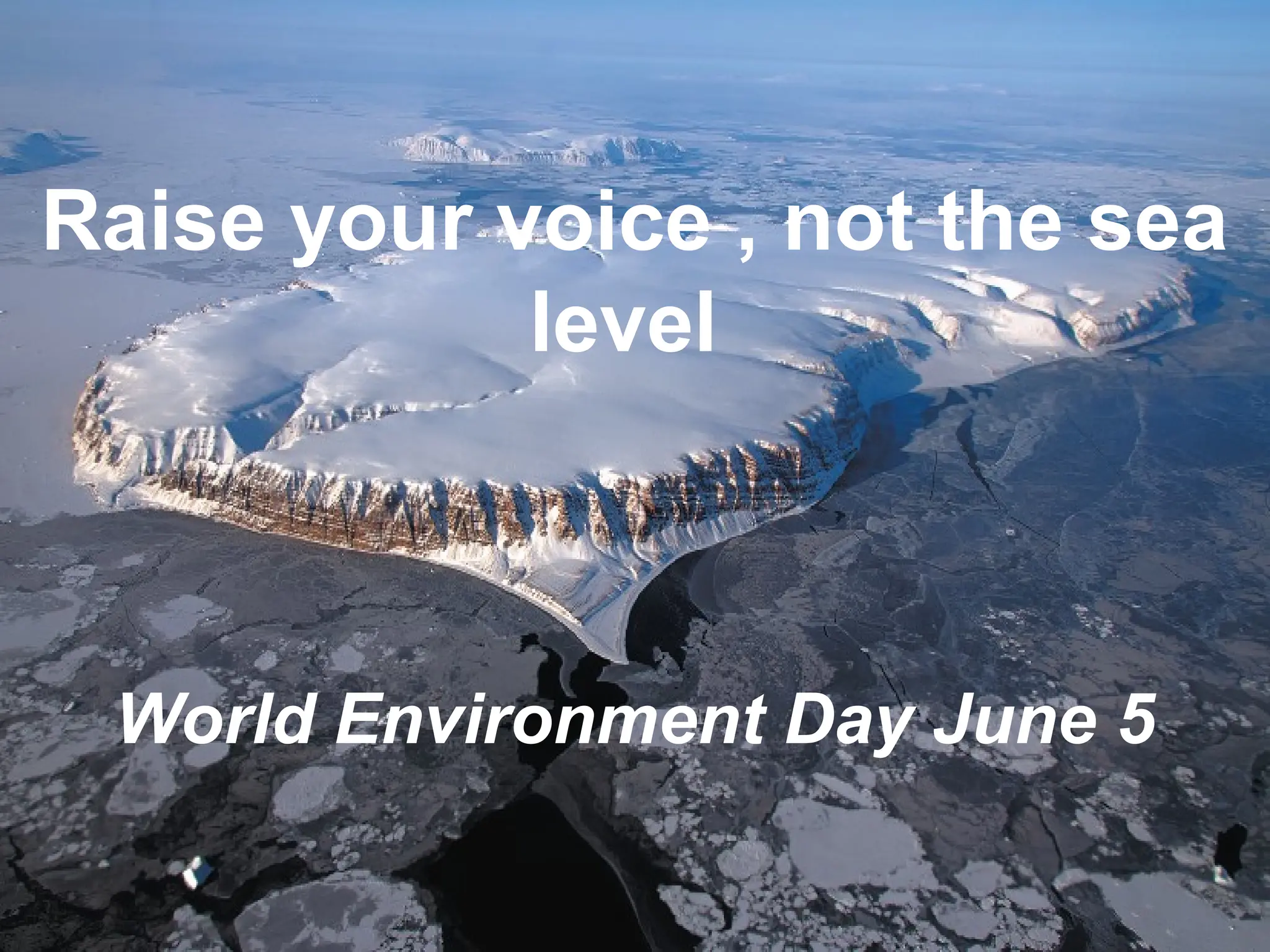
Raise your voice , not the sea
level
World Environment Day June 5
Course Modules
 The Multidisciplinary Nature of Environmental Studies
( Scope and importance)
 Natural Resources (Type, Use, problem and suggested measure)
 Ecosystem (concept, structure and function, type)
 Bio-diversity and its Conservation
 Environmental Pollution (Type, causes, effect and remedies)
 Social Issue and the Environment
 Human Population and Environment
The Multidisciplinary Nature of Environmental Studies
(Scope and importance)
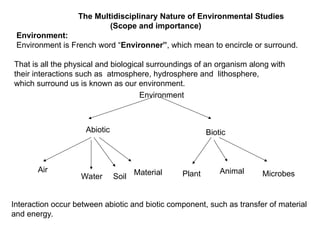
Environment:
Environment is French word “Environner”, which mean to encircle or surround.
That is all the physical and biological surroundings of an organism along with
their interactions such as atmosphere, hydrosphere and lithosphere,
which surround us is known as our environment.
Environment
Abiotic Biotic
Air
Water Soil
Material Plant Animal Microbes
Interaction occur between abiotic and biotic component, such as transfer of material
and energy.
Air, water and land, which surround us
influence us and we influence it by
overuse or over exploitation of resources
and also by discharge of pollutants.
The impact is bi-directional, the interaction
could be directly and indirectly.
Environmental Studies
Study of our environment which include both
physical and biological component, interaction
among its component, effect of these component
on human being and vice versa.
However, we can not study Environment in
isolation, environmental studies also had input from
various other discipline of sciences, engineering,
social science, Law, governance.
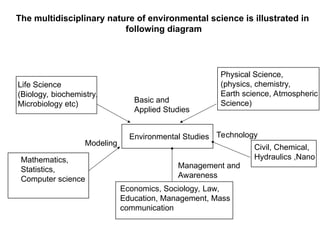
The multidisciplinary nature of environmental science is illustrated in
following diagram
Life Science
(Biology, biochemistry,
Microbiology etc)
Mathematics,
Statistics,
Computer science
Environmental Studies
Economics, Sociology, Law,
Education, Management, Mass
communication
Civil, Chemical,
Hydraulics ,Nano
Physical Science,
(physics, chemistry,
Earth science, Atmospheric
Science)
Basic and
Applied Studies
Technology
Management and
Awareness
Modeling
Scope of Environmental Studies:
Environmental Studies encompasses large number of areas
which mainly include:
Natural Resource- Conservation and Management
Ecology and Biodiversity
Environment Pollution and Control
Economic development and associate socio-cultural issues
Human population and environment.
It can also include highly specialized issues like Environmental
Science, Environmental Engineering and Environmental
Management
This subject had a wide field of application-
Research and Development: include research and development of
pollution control technology, clean fuel development, sustainable
agricultural practice, carbon credit
Green advocacy: Increase emphasis on implementation of various
acts and laws resulted in environmental lawyers, who could enforced
pollution, wildlife, forest protection related laws.
Green marketing : more emphasis on consumer good which are
more eco-friendly, Food products without contamination of pesticides,
insecticides. Increase use of products with ECO marks.
Green media: Mass media which include print media and electronic
media are Important means of spreading awareness about
environment pollution and conservation.
Importance of Environment studies:
Environmental studies have become significant for the following reason:
Environment Issues being of International Importance: environmental issues such
as global warming, ozone depletion, biodiversity loss, marine pollution etc have
a global implication.
Problems Cropped in The Wake of Development : rapid development in the
Selected area leads to Urbanization, Industrial Growth, Transportation
Systems, Agriculture and Housing etc which in turn leads to environmental pollution.
Rapid increase in Population: rapid growth of human population resulted into
tremendous increase in the demand of resources such as food resources, energy
resources ultimately leading to the environmental degradation.
Need for An Alternative Solution: recently their is a sense of feeling that current
way of economic development is not feasible for long term as resources base is
not unlimited giving rise to the concept of sustainable development.
Need To Save Humanity From Extinction: There is a grave threat on humanity due
to continuous degradation of its resource base which has implication on survival
and well being of human society.
Present state of our Environment
• Our earth’s resources are dwindling and our
environment is being increasingly degraded by human
activities.
What to DO to save our environment?
• Mass Public Awareness; newspapers, radio, TV, strong public opinion,
strong public supported movements.
• Join NGO, WWFI or environmental groups.
• Reading Newspaper articles related to environmental issues.
• Discussions with friends & relatives – “How to conserve resources?”
• Joining/ starting local movements to start supportive activities such as saving
trees, nature treks, recycling waste, promoting eco-friendly products, etc.
• Practicing & promoting good civic sense.
• Take part in events organized with Wildlife week, World Environmental Day,
etc.
• Visiting National Parks/ Sanctuaries/ nearby natural beauty, etc.
Need for public Awareness:
International efforts for environment: The subject of environment come into
international focus first with the Stockholm Conference held on 5th
1972, since then
we celebrate World Environment Day on 5th
June. It further got attention with the Earth
Summit took place in Rio de Janeiro in 1992. In this summit Agenda 21- a global
agenda for transition to sustainability in the 21st century. Beside that many International
treaty and protocol are done to safeguard environment:
Montreal Protocol on Substances: That Deplete the Ozone Layer, Montreal, 1989
Kyoto protocol: adopted in 1997, come in force in 2005.
Establishment of The Intergovernmental Panel on Climate Change (IPCC)
in 1988 by the World Meteorological Organization (WMO) and the United
Nations Environment Programme (UNEP) in recognition of the problem of global
warming.
Nobel peace prize in 2004 to Ms. Wangari Maathai (Green Belt Movement) and
Jointly to IPCC and Albert Arnold (Al) Gore Jr. in year 2007 also highlight the
importance of environment.
Public Awareness for Environment:
Without active people participation government cant force any policy so to make public
aware regarding environmental pollution and its conservation. This awareness can be
achieved by various mean:
Formal Environmental education:
at School level, University and post-graduation level, Higher research
Non-formal education and awareness Program:
• National Environment Awareness Campaign (NEAC)- Started in 1986 is a multimedia
campaign which uses activities such as seminar, workshops, camps, exhibitions, debate,
street theatre, tree plantation to promote awareness about environment.
• Eco Clubs of National Green Corps: Target audience are school student, 50,000 eco
clubs are set up till now, Govt. provide training and resources.
• Mass Awareness:
Through media including both print and electronic media. Campaign for banning plastic
Product, clean Yamuna campaign. Awareness activities by NGO’s and other institutions
on the occasion of Environment days like Earth day.
• Eco Mark: Eco-labelling of consumer products as Ecomark in 1991. It is an earthen
pitcher and awarded to product that is made, used or disposed off in eco-friendly manner.
NATURAL RESOURCES
• Those resources that occur naturally within the environments and are
relatively undisturbed by mankind, in a natural form.
• Many of them are essential for our survival while others satisfies our wants.
• As per United States Geological Survey – “The Nation’s natural resources
include its minerals, energy, land, water & biota.”
• Classified as;
– On the basis of origin
– Based on stage of development
– On the basis of renewability
– On the basis of availability
On the basis of Origin
• Biotic resources – Those obtained from the
biosphere such as forest resources, animals,
birds, marine organisms, mineral fuels, etc.
• Abiotic resources – Those obtained/ includes
non-living things such as land, water, air, ores,
etc.
Based on stage of development
• Potential resources – Those that exist in a
region and may be used in the future such as
petroleum, sedimentary rocks, etc.
• Actual resources – Those that are surveyed and
their quantity & quality have been determined
& are being used at present days. Eg:- Wood
processing.
On the basis of Renewability
• Renewable/Non-conventional resources
Those that can be replenished or reproduced
easily. Examples wind, air, sunlight, etc.
• Non-renewable/Conventional resources
Those that are formed over very long
geological periods. Minerals, fossil fuels, etc.
On the basis of Availability
• Inexhaustible natural resources – Those that
are present in an unlimited quantity & are not
likely to be exhausted easily by human activity.
Sunlight, air, etc.
• Exhaustible natural resources – Those whose
amounts are limited & can be exhausted by
human activity in a long run. Fossil fuels, etc.
EARTH RESOURCES
• Those resources on which the mankind is dependent.
• These are provided by the various spheres/ sources of the
earth.
– Atmosphere
– Hydrosphere
– Lithosphere
– Biosphere
ATMOSPHERE
• Forms a protective shell over the earth
• Lowest part – troposphere – 12km thick – which is
warm enough for our survival.
• Stratosphere – 50km thick – contains layer of
sulphates and responsible for formation of rain.
• Contains a layer of ozone that absorbs the UV rays &
helps in existence of life on earth.
• A complex dynamic system that leads to air flows and
variation in climate, temperature & rainfall in different
parts of earth.
• Presently human activity creates air pollution which
leads to regional & global effects – Green-house effects
& finally global warming.
HYDROSPHERE
• Covers three-quarters of the earth’s surface -
majority part (marine ecosystem) and small part
(fresh water).
• Fresh water is being renewed by evaporation &
rainfall and a small part of it stored in
underground aquifers.
• Human activities (deforestation, dumping of
waste from industry, sewage disposal, etc.) have
created serious changes in hydrosphere.
• This plentiful resource is now expensive &
becoming rare.
LITHOSPHERE
• Ago 4.6 billion years, a hot ball thereafter on
considerable cooling of earth ago 3.2 billion years
– life began on our planet.
• Out of 92 elements only 8 elements are common
in crustal rocks
• 47% (oxygen), 28% (silicon), 8% (aluminium),
5% (iron) & 4% (sodium, magnesium, potassium
& calcium) – total 200 mineral compounds.
• Rocks broken – soil – helps in agriculture.
• Minerals – raw material for industries.
BIOSPHERE
• Relatively thin layer on earth where life exist.
• Air, water, soil & living creatures forms
structural & functional ecological units –
creates a giant global living system(Earth).
• Within this framework – units with visible &
identifiable characteristics are described as a
continent, a country, a state, a district, hill
range, etc.
Natural Resources & Associated Problems
• Currently, majority of the natural resource is being
consumed by the developed countries & the developing
countries are overusing these resources due to their
greater human population.
• Consumption rate of developed countries is 50 times
greater than that of developing countries.
• Consumption rate of fossil fuels fuels & food is also in
a greater rate.
• Higher consumption rate as resulted in serious pressure
on the land resource ie, they have been converted on
the base of short term gains only not on long term.
• Hence the present scenario demands sustainable
lifestyles to be accepted and followed for the future
benefit of the human life and the earth as a whole life.
Major Natural resource:
Forest resource
Water resource
Mineral resource
Food resource
Energy resource
Land resource
Protective Functions
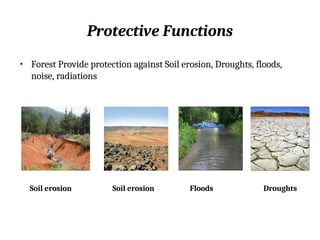
• Forest Provide protection against Soil erosion, Droughts, floods,
noise, radiations
Soil erosion Floods
Soil erosion Droughts
Productive Functions
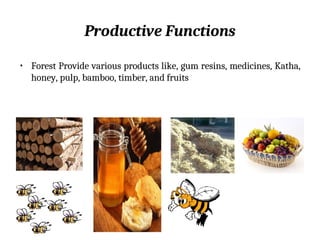
• Forest Provide various products like, gum resins, medicines, Katha,
honey, pulp, bamboo, timber, and fruits
Regulative Functions
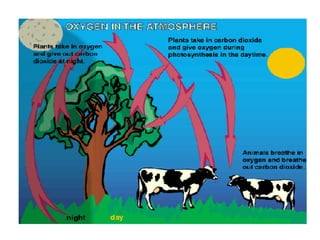
• The Forest regulates the level of Oxygen and carbon dioxide in
atmosphere. The forests also help in regulating temperature
conditions
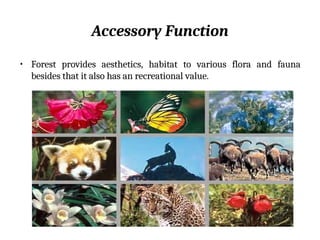
Accessory Function
• Forest provides aesthetics, habitat to various flora and fauna
besides that it also has an recreational value.
Ecological Importance or uses of
Forests
• Regulation of global climate and temperature
• Forest play a crucial role in regulation of global climate and
temperature as forest cover absorb the solar radiations that would
otherwise be reflected back into the atmosphere by bare surface of
the earth.
• Transpiration of plants increases the atmosphere humidity which
affects the rainfall, cools the atmosphere and thus regulate the
hydrological cycle
Reduction of Global Warming
•The main green house gas co2 is used by forests for photosynthesis
process the forest act as a sink for co2 there by reducing the green
house effect due to co2
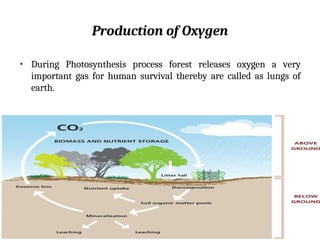
Production of Oxygen
• During Photosynthesis process forest releases oxygen a very
important gas for human survival thereby are called as lungs of
earth.
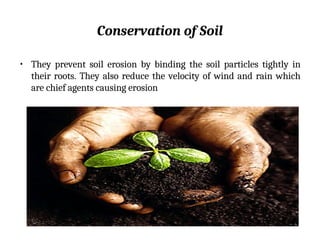
Conservation of Soil
• They prevent soil erosion by binding the soil particles tightly in
their roots. They also reduce the velocity of wind and rain which
are chief agents causing erosion
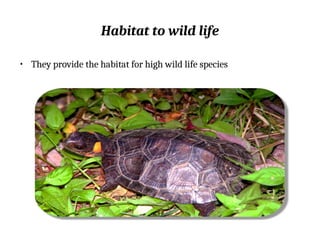
Habitat to wild life
• They provide the habitat for high wild life species
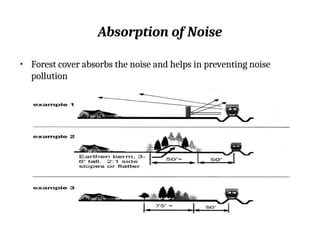
Absorption of Noise
• Forest cover absorbs the noise and helps in preventing noise
pollution
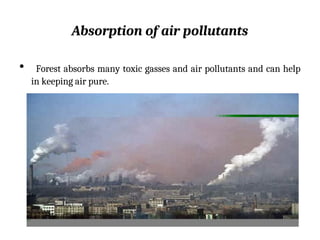
Absorption of air pollutants
• Forest absorbs many toxic gasses and air pollutants and can help
in keeping air pure.
Economical Importance of Forest
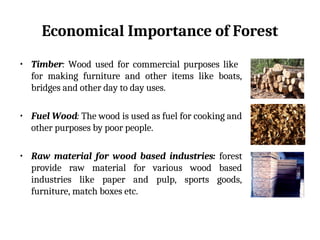
• Timber: Wood used for commercial purposes like
for making furniture and other items like boats,
bridges and other day to day uses.
• Fuel Wood: The wood is used as fuel for cooking and
other purposes by poor people.
• Raw material for wood based industries: forest
provide raw material for various wood based
industries like paper and pulp, sports goods,
furniture, match boxes etc.
• Food: Fruits, roots, leaves of plants and trees along with the meat of
forest animals provide the food to the tribal people.
• Miscellaneous Products: Miscellaneous products like, resin,
gums, oils, medicines, Katha, honey are provided by forests
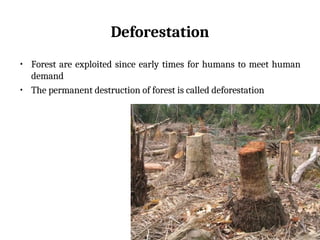
Deforestation
• Forest are exploited since early times for humans to meet human
demand
• The permanent destruction of forest is called deforestation
Causes of Deforestation
• Population explosion: Population
explosion is the root cause of all the
environmental problems, vast area of
forests are cleared for human settlement
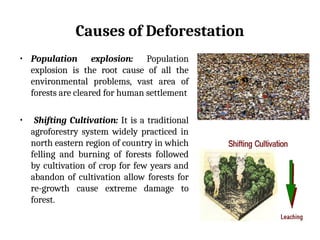
• Shifting Cultivation: It is a traditional
agroforestry system widely practiced in
north eastern region of country in which
felling and burning of forests followed
by cultivation of crop for few years and
abandon of cultivation allow forests for
re-growth cause extreme damage to
forest.
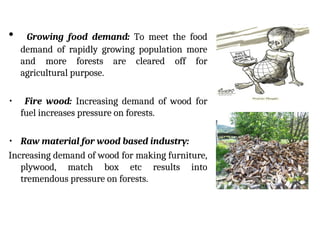
• Growing food demand: To meet the food
demand of rapidly growing population more
and more forests are cleared off for
agricultural purpose.
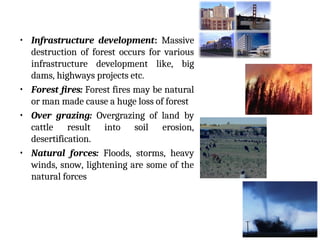
• Fire wood: Increasing demand of wood for
fuel increases pressure on forests.
• Raw material for wood based industry:
Increasing demand of wood for making furniture,
plywood, match box etc results into
tremendous pressure on forests.
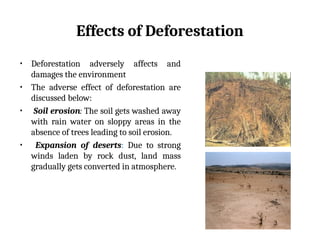
• Infrastructure development: Massive
destruction of forest occurs for various
infrastructure development like, big
dams, highways projects etc.
• Forest fires: Forest fires may be natural
or man made cause a huge loss of forest
• Over grazing: Overgrazing of land by
cattle result into soil erosion,
desertification.
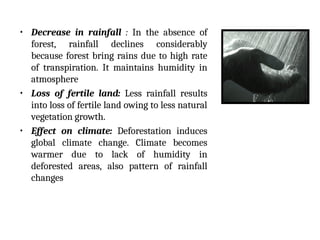
• Natural forces: Floods, storms, heavy
winds, snow, lightening are some of the
natural forces
Effects of Deforestation
• Deforestation adversely affects and
damages the environment
• The adverse effect of deforestation are
discussed below:
• Soil erosion: The soil gets washed away
with rain water on sloppy areas in the
absence of trees leading to soil erosion.
• Expansion of deserts: Due to strong
winds laden by rock dust, land mass
gradually gets converted in atmosphere.
• Decrease in rainfall : In the absence of
forest, rainfall declines considerably
because forest bring rains due to high rate
of transpiration. It maintains humidity in
atmosphere
• Loss of fertile land: Less rainfall results
into loss of fertile land owing to less natural
vegetation growth.
• Effect on climate: Deforestation induces
global climate change. Climate becomes
warmer due to lack of humidity in
deforested areas, also pattern of rainfall
changes
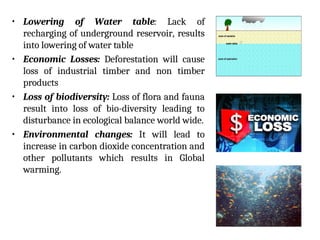
• Lowering of Water table: Lack of
recharging of underground reservoir, results
into lowering of water table
• Economic Losses: Deforestation will cause
loss of industrial timber and non timber
products
• Loss of biodiversity: Loss of flora and fauna
result into loss of bio-diversity leading to
disturbance in ecological balance world wide.
• Environmental changes: It will lead to
increase in carbon dioxide concentration and
other pollutants which results in Global
warming.
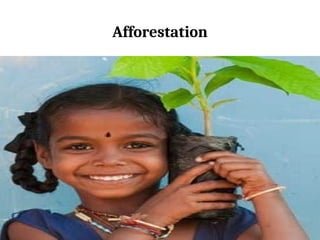
Afforestation
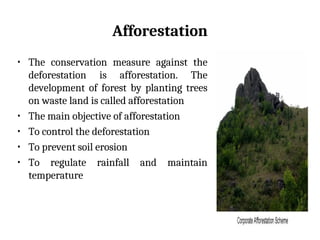
Afforestation
• The conservation measure against the
deforestation is afforestation. The
development of forest by planting trees
on waste land is called afforestation
• The main objective of afforestation
• To control the deforestation
• To prevent soil erosion
• To regulate rainfall and maintain
temperature
Timber Extraction
• It is estimated that India is losing 15 million
hectares of forests cover year
• Trees have been felled in large number of
fuel, fodder, valley projects etc.
• India consumes 70 million tonnes of
firewood annually, and 10-15 million
hectares of forests cover is being stripped
every year to meet fuel requirements.
• In the Himalayan range, the rainfall has
declined from 3 to 4 percent
Mining
• The process of extracting mineral
resources and fossil fuels like coal from
the earth
• Types of mining
1. Surface mining: mining of minerals from
shallow deposits
2. Underground mining: mining of minerals
from deep deposits
Steps involved in mining
• . Exploration
• . Development
• . Exploitation
• . Ore processing
• . Extraction and purification of minerals
Effects of Mining
• Pollute soil, water and air.
• Destruction of natural habitat.
• Continuous removal of minerals leads to the
formation of trench where water is logged which
contaminates the ground water.
• Vibrations cause earth quakes.
• Produces noise pollution
• Reduces shape and size of the forest.
• Some times land slides may also occur
Dams and their effects on Forest and Tribal
People
• When a dam is constructed across any river a huge artificial
lake is developed in the catchment area of that dam. It is also
known as back waters. The backwaters covering a large surface
area. Create a lot of ill-effects on the living environment. They
are as follows:
• It creates the loss of forest which are submerged under the back
waters of the dam.
• It creates danger to the habitat of the wild life. The wild life are
forced to migrate.
• It also affects the land under cultivation, in the catchment area
as the crops get submerged under water.
• The roads, already in existence are put under water after the
construction of dam. So the road network is damaged.
WATER RESOURCES
Global Overview
• While 67% of Earth’s surface is covered
by water, only less than 2.7% of global
water is freshwater. Most of the freshwater
(2.05%) are locked in ice caps and
glaciers. Only less than 0.7% is available
for human use
SOURCE OF WATER
• The sources of surface water are rainfall
and rivers. Underground water or ground
water is the result of seepage of a part of
the surface water
• . A part of the surface water seeps into the
soil and gets accumulated below the
surface of the ground
• Water in river, lake or freshwater wetland.
• Naturally replenished by precipitation & lost by
natural evaporation and surface seepage.
• Total quantity of water in a source depends on;
– Storage capacity in lakes
– Wetlands & artificial wetlands
– Permeability of the soil beneath the storage body
– Runoff characteristics of the land during watershed
– Rate of precipitation & evaporation
– All the above factors also affects the water loss.
SURFACE WATER
• Humans increase the storage capacity by;
– Constructing reservoirs
– Increases the runoff quantity & velocity by paving
the areas & channelizing the flow of water.
– Importing surface water from another watershed
through pipeline/ canal.
– Artificial augmentation
• But activities such as draining of wetlands,
pollution, etc makes the water unusable and
also decreases the quantity.
GROUND WATER
• Sub-surface water/ ground water/ fresh water
located within the pores of soils & rocks.
• Water that flows within the aquifers below the
water table.
• Main input to ground water – seepage from surface
water.
• Main outlets of ground water – springs & seepage
to oceans.
• Building reservoirs or detention of ponds increases
input to ground water.
• Substantial evaporation of surface water results in
salination of sub-surface water.
FROZEN WATER
• Obtained by melting of icebergs.
• Presently done only for novelty purposes.
• Himalayas, “The Roof of the World” – is rich
with glaciers & icebergs, hence pave path for
rivers & to people’s livelihood there.
• The temperature rise rate & global warming
has complicated the above source of water &
the factors benefitted with this source.
Uses of Surface & Ground Water
• Categorized as consumptive & non-consumptive
uses.
• If the water is not available immediately for another
use after a use – consumptive use.
– Loss of water via sub-surface seepage & evaporation
• If the water can be put to an additional use after one
– non-consumptive use.
– Returning of surface as sewage water after treatment of
once used water.
• General Uses:- Agricultural, Industrial, Household,
Recreational Uses, Environmental uses.
AGRICULTURAL USES
• Irrigation is necessary for growth of crop in some areas,
while at other areas it permits more profitable crops/
enhances yield.
• Factors that selects the irrigation methods: -
– Trade-off between crop yield
– Water consumption
– Capital cost of structures & equipment
• Furrow & overhead sprinkler irrigation – less expensive-
less efficient (most of the water evaporates & water runs off
/ drain below the root zone)
• Drip/trickle irrigation, surge irrigation, ground level
operated sprinklers – provides higher efficiency, minimizes
drainage, evaporation & run-off but expensive.
• Freshwater commercial fisheries & aquaculture
are also considered as growing agricultural use
of water.
• Issues faced;
– Salinization of sub-surface water
– Growth in global population & demand for food
INDUSTRIAL USES
• Uses 22% of the worldwide water available.
• The consumptive nature of the water usage varies, but its
lower than in agricultural use.
• Hydroelectricity generation – water is used as a power
source – electricity produced is low cost, non-polluting &
renewable.
• Cooling agent in machineries so as to prevent over
heating.
• Ore & oil refineries – in chemical processes.
• Manufacturing plants – as solvent
• Discharge of untreated water creates pollution
• Most of the industries adopts various methods to purify
water supply & discharge since they demands pure water
for many applications.
HOUSEHOLD USES
• 8% of the worldwide water is used.
• Includes drinking water, bathing, cooking, sanitation &
gardening.
• Drinking water – water of sufficient high quality so that absence
of immediate or long term harm(potable water).
• In developed countries, water supplied to household, industry &
commerce all do posses the standard of drinking water.
ENVIRONMENTAL USES
• Artificial lakes & wetlands intended to create wildlife habitat,
fish ladders & water release from reservoirs to help fish spawn.
• Non-consumptive in nature but may reduce water required for
other uses at specific time & place.
RECREATIONAL USES
• Uses a very small % of the total water use.
• Mainly related to reservoirs.
• Water released from reservoirs is used for
whitewater boating, anglers, water skiers, nature
enthusiasts & swimmers.
• Usually non-consumptive in nature
• Here also it may result in non-availability of the
water for needy at specific time & place.
Present World & State of Water
Sources!
• With growing population, demand for water to meet
basic need increases. But the requirement is not met in
many areas because the water resources are being over-
utilized.
– Wastage of water in human activities.
– Use of more water for agricultural activites than the
required.
– Pollution of the water resources due to over use of
chemical fertilizers & pesticides
– Releasing of liquid waste to water streams by industries on
aiming their short term economic gain alone.
• Public awareness increases the pressure on industries to be eco-
sensitive & produce eco-friendly products.
.
FLOODS
• Definitions:
– An overflow of an expanse of water that submerges the
land.
– In the sense of flowing water, it can also be said as an
inflow of tide.
– Overflow / breaks levees of the volume of water in a body
of water so that some of the water escapes its boundary.
– Floods may also take place in rivers ie, when flow exceeds
the channel capacity at bends or meanders.
• Effects of Floods:
– Causes damage to homes & business placed at the flood
plain of rivers
• Earlier people lived near to water, capitalizing the gains of cheap
& ease of travel commerce but nowadays inhabit such areas
because the perceived value of living exceeds the cost of repeated
periodic living.
Benefits of Flood
• Recharges ground water
• Makes soil more fertile & provides deficient
nutrients
• Provides water resource in arid & semi-arid
regions where uneven precipitation events occurs.
• Maintains ecosystems in river corridors.
• Key factor in maintaining floodplain biodiversity
• Flood prone regions possess higher viability for
hydrological based renewable sources of energy.
Demerits of Floods
• Physical damage
– Causes damage to bridges, cars, building, roadways, canals, etc.
• Casualties
– Livestock & people die due to drowning.
– Casualties due to epidemics & waterborne diseases.
• Contamination of water
– Scarcity of clean drinking water
• Diseases
– Spreading of waterborne diseases & unhygienic conditions
• Crop & food supplies
– Loss of harvest leads to shortage of food & crops.
• Trees
– Due to suffocation unhygienic & non-tolerant species get destroyed.
• Economic deduction
– Temporary decline in tourism, rebuilding cost, hike in price of food
products, etc. results in economic hardship.
DROUGHT
• Deficiency of its water supply in a region for an
extended period of month or years.
• An unpredictable climatic condition that occurs
due to failure of one or more monsoons.
• Mainly effects the ecosystem & agriculture of
the affected region.
• Its impact frequency varies with different parts
of the country.
Causes of Drought
• Failure of rainfall continuously is the root cause of drought.
• Triggered by;
– Due to prevalence of high pressure systems beyond an average
limit.
– Winds that carry continental mass rather than oceanic masses.
– Ridges of high pressure areas that may prevent/ restrict the
development of thunderstorm activity or rainfall.
• Oceanic & atmospheric weather cycles makes it a regular
recurring phenomenon in America.
• Human activities indirectly impacts the ability of the land to
capture & store water which thereby leads to global
warming effects & finally drought may be triggered.
• Some of the proposed solutions such as use of space
sunshade may increase the chance of drought.
Consequences of Drought
• The consequences varies with vulnerability of the drought.
• Reduces water quality – since low water reduces dilution of pollutants &
thereby increasing contamination rate.
• Diminishes crop growth, crop yield & carrying capacity for livestock.
• Generates dust bowls – leading to soil erosion and further erode of
landscape
• If drought occurs at an area with desertification & erosion then dust storms
are created.
• Lack of irrigation leading to famine.
• Affects the terrestrial & aquatic wildlife due to habitat damage
• Spreads diseases like malnutrition, dehydration, etc.
• Mass migration creating internal displacement & refugees.
• Reduces electricity production
• Industries faces shortage of water.
• Migration of snakes & increases snakebites.
• Creates war over natural resources like water & food
• Wildfires
• Social unrest.
DAM
• Other than the benefits of dams the main factor of concern is
the issue regarding the planning towards the construction of
a dam
• Dam floods millions of hectares of forests, results in
deforestation.
• Dams creates major environmental impact on the local
people at the dam site & at the entire river basin.
• It declines the natural river’s flora & fauna, increase health
hazards & leads to widespread human rights violation
( forced resettlement through physical & legal threats)
• Today there are more 45,000 dams that enhance the
economic & community development.
• 30-40% of irrigated land, 19% of hydroelectricity produced
are with the help of the water resources in these dams.
• China & India have built 57% of the world’s large dams.
Problems caused by Dams
• Physical transformation & fragmentation of rivers
• Lead to serious impact on river ecosystems
• Social consequences due to displacement of people
• Water-logging & Salinization of the surroundings.
• Damage to animal habitat & migratory routes
• Disruption of fishing & waterway traffic.
• Recent impact – emission of greenhouse gas due to rotting of
vegetation & carbon inflow from catchments.
• Affects the livelihood, cultural & spiritual existence of
indigenous & tribal people
• Social & environmental impacts due to failure of achieving the
targets & promising benefits.
• Conflicts due to loss of traditional & local controls over
equitable distribution.
Benefits of Dams
1. Water for drinking & industrial purpose
– Due to variation in hydrological cycle, during scarcity period
water stored in dams & its reservoirs are made in use.
– Properly designed & well-constructed dams meets the
requirements for drinking water.
– Water in reservoirs is used vastly for industrial uses.
– Regulated flow dilutes the harmful dissolved substance in river
waters thereby maintains & preserves the quality of water.
2. Irrigational purpose
– Surplus water stored during wet periods can be used for
irrigational purposes and can be regulated to various parts.
– Meets the irrigational requirements on a gigantic scale.
– 80% of additional food production can be achieved with the
help of water in dams & reservoirs.
– Demands more reservoir based dam projects has to be
furnished for improving the irrigation technology.
3. Controls Flood
– By regulating the river water flows downstream the dam.
– Designed & constructed in such a way that they routing the floods
without damaging the property & life
– Water stored at floods is used for irrigational & hydropower
generation purposes later.
4. Generation of hydropower
– Plays a key role & provides the advanced, cheap, clean &
economically viable resource of energy
– Beside hydropower generation, multi purpose hydroelectric projects
pace benefits in irrigation, drinking water requirements & controls
floods also.
5. Inland navigation
– Enhances the inland navigation due to comprehensive basin planning
& development.
6. Recreational purposes
– Presents a beautiful view of lake & at non-scarce or non-existent
areas reservoirs acts a great source of recreation.
– Recreational activities like boating, swimming, fishing, etc brings
economical benefits to the country.
Mineral Resources
• Mining refers to the extraction of minerals
from the earth, whether the minerals are
situated under the surface of the earth or
on the surface of the earth.
• Mining means the extraction of minerals
which are situated under the surface of
earth
Use and Exploitation of mineral
resources
• Development of industrial plants and
machinery. - Fe, Al & Cu
• Construction work – Fe, Al &Ni
• Generation of energy - coal, lignite,
uranium
• Designing defence equipments.
• Agricultural purposes – fertilisers and
fungicides – Zn & Mn
• Jewellery –Au, Ag & Pt
Environmental Effects due to
mining & extraction
• Devegetation :
o topsoil and vegetation are removed
o deforestation leads to several ecological
losses
o land scape badly affected
• Ground water contamination:
o Mining pollutes ground water , sulphur is
converted into sulphuric acid which enters into
the soil.
• Surface water pollution:
o Radioactive wastes and other acidic impurities
affect the surface water, which kills many aquatic
animals.
• Air pollution:
o Smelting and roasting are done to purify the
metal whih emits air pollutants and damage the
nearby vegetation. It causes many health
problems.
• Subsidence of land:
o Mainly underground mining results in cracks in
houses, tilting of buildings and bending of rail
tracks
Case study: Aravalli hills

emodule-1-EVM-UNIT1-FORESTATIN-SEMESTER2.ppt

  • 1.
    Raise your voice, not the sea level World Environment Day June 5
  • 2.
    Course Modules  TheMultidisciplinary Nature of Environmental Studies ( Scope and importance)  Natural Resources (Type, Use, problem and suggested measure)  Ecosystem (concept, structure and function, type)  Bio-diversity and its Conservation  Environmental Pollution (Type, causes, effect and remedies)  Social Issue and the Environment  Human Population and Environment
  • 3.
    The Multidisciplinary Natureof Environmental Studies (Scope and importance) Environment: Environment is French word “Environner”, which mean to encircle or surround. That is all the physical and biological surroundings of an organism along with their interactions such as atmosphere, hydrosphere and lithosphere, which surround us is known as our environment. Environment Abiotic Biotic Air Water Soil Material Plant Animal Microbes Interaction occur between abiotic and biotic component, such as transfer of material and energy.
  • 4.
    Air, water andland, which surround us influence us and we influence it by overuse or over exploitation of resources and also by discharge of pollutants. The impact is bi-directional, the interaction could be directly and indirectly.
  • 5.
    Environmental Studies Study ofour environment which include both physical and biological component, interaction among its component, effect of these component on human being and vice versa. However, we can not study Environment in isolation, environmental studies also had input from various other discipline of sciences, engineering, social science, Law, governance.
  • 6.
    The multidisciplinary natureof environmental science is illustrated in following diagram Life Science (Biology, biochemistry, Microbiology etc) Mathematics, Statistics, Computer science Environmental Studies Economics, Sociology, Law, Education, Management, Mass communication Civil, Chemical, Hydraulics ,Nano Physical Science, (physics, chemistry, Earth science, Atmospheric Science) Basic and Applied Studies Technology Management and Awareness Modeling
  • 7.
    Scope of EnvironmentalStudies: Environmental Studies encompasses large number of areas which mainly include: Natural Resource- Conservation and Management Ecology and Biodiversity Environment Pollution and Control Economic development and associate socio-cultural issues Human population and environment. It can also include highly specialized issues like Environmental Science, Environmental Engineering and Environmental Management
  • 8.
    This subject hada wide field of application- Research and Development: include research and development of pollution control technology, clean fuel development, sustainable agricultural practice, carbon credit Green advocacy: Increase emphasis on implementation of various acts and laws resulted in environmental lawyers, who could enforced pollution, wildlife, forest protection related laws. Green marketing : more emphasis on consumer good which are more eco-friendly, Food products without contamination of pesticides, insecticides. Increase use of products with ECO marks. Green media: Mass media which include print media and electronic media are Important means of spreading awareness about environment pollution and conservation.
  • 9.
    Importance of Environmentstudies: Environmental studies have become significant for the following reason: Environment Issues being of International Importance: environmental issues such as global warming, ozone depletion, biodiversity loss, marine pollution etc have a global implication. Problems Cropped in The Wake of Development : rapid development in the Selected area leads to Urbanization, Industrial Growth, Transportation Systems, Agriculture and Housing etc which in turn leads to environmental pollution. Rapid increase in Population: rapid growth of human population resulted into tremendous increase in the demand of resources such as food resources, energy resources ultimately leading to the environmental degradation. Need for An Alternative Solution: recently their is a sense of feeling that current way of economic development is not feasible for long term as resources base is not unlimited giving rise to the concept of sustainable development. Need To Save Humanity From Extinction: There is a grave threat on humanity due to continuous degradation of its resource base which has implication on survival and well being of human society.
  • 10.
    Present state ofour Environment • Our earth’s resources are dwindling and our environment is being increasingly degraded by human activities.
  • 11.
    What to DOto save our environment? • Mass Public Awareness; newspapers, radio, TV, strong public opinion, strong public supported movements. • Join NGO, WWFI or environmental groups. • Reading Newspaper articles related to environmental issues. • Discussions with friends & relatives – “How to conserve resources?” • Joining/ starting local movements to start supportive activities such as saving trees, nature treks, recycling waste, promoting eco-friendly products, etc. • Practicing & promoting good civic sense. • Take part in events organized with Wildlife week, World Environmental Day, etc. • Visiting National Parks/ Sanctuaries/ nearby natural beauty, etc.
  • 12.
    Need for publicAwareness: International efforts for environment: The subject of environment come into international focus first with the Stockholm Conference held on 5th 1972, since then we celebrate World Environment Day on 5th June. It further got attention with the Earth Summit took place in Rio de Janeiro in 1992. In this summit Agenda 21- a global agenda for transition to sustainability in the 21st century. Beside that many International treaty and protocol are done to safeguard environment: Montreal Protocol on Substances: That Deplete the Ozone Layer, Montreal, 1989 Kyoto protocol: adopted in 1997, come in force in 2005. Establishment of The Intergovernmental Panel on Climate Change (IPCC) in 1988 by the World Meteorological Organization (WMO) and the United Nations Environment Programme (UNEP) in recognition of the problem of global warming. Nobel peace prize in 2004 to Ms. Wangari Maathai (Green Belt Movement) and Jointly to IPCC and Albert Arnold (Al) Gore Jr. in year 2007 also highlight the importance of environment.
  • 13.
    Public Awareness forEnvironment: Without active people participation government cant force any policy so to make public aware regarding environmental pollution and its conservation. This awareness can be achieved by various mean: Formal Environmental education: at School level, University and post-graduation level, Higher research Non-formal education and awareness Program: • National Environment Awareness Campaign (NEAC)- Started in 1986 is a multimedia campaign which uses activities such as seminar, workshops, camps, exhibitions, debate, street theatre, tree plantation to promote awareness about environment. • Eco Clubs of National Green Corps: Target audience are school student, 50,000 eco clubs are set up till now, Govt. provide training and resources. • Mass Awareness: Through media including both print and electronic media. Campaign for banning plastic Product, clean Yamuna campaign. Awareness activities by NGO’s and other institutions on the occasion of Environment days like Earth day. • Eco Mark: Eco-labelling of consumer products as Ecomark in 1991. It is an earthen pitcher and awarded to product that is made, used or disposed off in eco-friendly manner.
  • 14.
    NATURAL RESOURCES • Thoseresources that occur naturally within the environments and are relatively undisturbed by mankind, in a natural form. • Many of them are essential for our survival while others satisfies our wants. • As per United States Geological Survey – “The Nation’s natural resources include its minerals, energy, land, water & biota.” • Classified as; – On the basis of origin – Based on stage of development – On the basis of renewability – On the basis of availability
  • 15.
    On the basisof Origin • Biotic resources – Those obtained from the biosphere such as forest resources, animals, birds, marine organisms, mineral fuels, etc. • Abiotic resources – Those obtained/ includes non-living things such as land, water, air, ores, etc.
  • 16.
    Based on stageof development • Potential resources – Those that exist in a region and may be used in the future such as petroleum, sedimentary rocks, etc. • Actual resources – Those that are surveyed and their quantity & quality have been determined & are being used at present days. Eg:- Wood processing.
  • 17.
    On the basisof Renewability • Renewable/Non-conventional resources Those that can be replenished or reproduced easily. Examples wind, air, sunlight, etc. • Non-renewable/Conventional resources Those that are formed over very long geological periods. Minerals, fossil fuels, etc.
  • 18.
    On the basisof Availability • Inexhaustible natural resources – Those that are present in an unlimited quantity & are not likely to be exhausted easily by human activity. Sunlight, air, etc. • Exhaustible natural resources – Those whose amounts are limited & can be exhausted by human activity in a long run. Fossil fuels, etc.
  • 19.
    EARTH RESOURCES • Thoseresources on which the mankind is dependent. • These are provided by the various spheres/ sources of the earth. – Atmosphere – Hydrosphere – Lithosphere – Biosphere
  • 20.
    ATMOSPHERE • Forms aprotective shell over the earth • Lowest part – troposphere – 12km thick – which is warm enough for our survival. • Stratosphere – 50km thick – contains layer of sulphates and responsible for formation of rain. • Contains a layer of ozone that absorbs the UV rays & helps in existence of life on earth. • A complex dynamic system that leads to air flows and variation in climate, temperature & rainfall in different parts of earth. • Presently human activity creates air pollution which leads to regional & global effects – Green-house effects & finally global warming.
  • 21.
    HYDROSPHERE • Covers three-quartersof the earth’s surface - majority part (marine ecosystem) and small part (fresh water). • Fresh water is being renewed by evaporation & rainfall and a small part of it stored in underground aquifers. • Human activities (deforestation, dumping of waste from industry, sewage disposal, etc.) have created serious changes in hydrosphere. • This plentiful resource is now expensive & becoming rare.
  • 22.
    LITHOSPHERE • Ago 4.6billion years, a hot ball thereafter on considerable cooling of earth ago 3.2 billion years – life began on our planet. • Out of 92 elements only 8 elements are common in crustal rocks • 47% (oxygen), 28% (silicon), 8% (aluminium), 5% (iron) & 4% (sodium, magnesium, potassium & calcium) – total 200 mineral compounds. • Rocks broken – soil – helps in agriculture. • Minerals – raw material for industries.
  • 23.
    BIOSPHERE • Relatively thinlayer on earth where life exist. • Air, water, soil & living creatures forms structural & functional ecological units – creates a giant global living system(Earth). • Within this framework – units with visible & identifiable characteristics are described as a continent, a country, a state, a district, hill range, etc.
  • 24.
    Natural Resources &Associated Problems • Currently, majority of the natural resource is being consumed by the developed countries & the developing countries are overusing these resources due to their greater human population. • Consumption rate of developed countries is 50 times greater than that of developing countries. • Consumption rate of fossil fuels fuels & food is also in a greater rate. • Higher consumption rate as resulted in serious pressure on the land resource ie, they have been converted on the base of short term gains only not on long term. • Hence the present scenario demands sustainable lifestyles to be accepted and followed for the future benefit of the human life and the earth as a whole life.
  • 25.
    Major Natural resource: Forestresource Water resource Mineral resource Food resource Energy resource Land resource
  • 26.
    Protective Functions • ForestProvide protection against Soil erosion, Droughts, floods, noise, radiations Soil erosion Floods Soil erosion Droughts
  • 27.
    Productive Functions • ForestProvide various products like, gum resins, medicines, Katha, honey, pulp, bamboo, timber, and fruits
  • 28.
    Regulative Functions • TheForest regulates the level of Oxygen and carbon dioxide in atmosphere. The forests also help in regulating temperature conditions
  • 30.
    Accessory Function • Forestprovides aesthetics, habitat to various flora and fauna besides that it also has an recreational value.
  • 31.
    Ecological Importance oruses of Forests • Regulation of global climate and temperature • Forest play a crucial role in regulation of global climate and temperature as forest cover absorb the solar radiations that would otherwise be reflected back into the atmosphere by bare surface of the earth. • Transpiration of plants increases the atmosphere humidity which affects the rainfall, cools the atmosphere and thus regulate the hydrological cycle
  • 32.
    Reduction of GlobalWarming •The main green house gas co2 is used by forests for photosynthesis process the forest act as a sink for co2 there by reducing the green house effect due to co2
  • 33.
    Production of Oxygen •During Photosynthesis process forest releases oxygen a very important gas for human survival thereby are called as lungs of earth.
  • 34.
    Conservation of Soil •They prevent soil erosion by binding the soil particles tightly in their roots. They also reduce the velocity of wind and rain which are chief agents causing erosion
  • 35.
    Habitat to wildlife • They provide the habitat for high wild life species
  • 36.
    Absorption of Noise •Forest cover absorbs the noise and helps in preventing noise pollution
  • 37.
    Absorption of airpollutants • Forest absorbs many toxic gasses and air pollutants and can help in keeping air pure.
  • 38.
    Economical Importance ofForest • Timber: Wood used for commercial purposes like for making furniture and other items like boats, bridges and other day to day uses. • Fuel Wood: The wood is used as fuel for cooking and other purposes by poor people. • Raw material for wood based industries: forest provide raw material for various wood based industries like paper and pulp, sports goods, furniture, match boxes etc.
  • 39.
    • Food: Fruits,roots, leaves of plants and trees along with the meat of forest animals provide the food to the tribal people. • Miscellaneous Products: Miscellaneous products like, resin, gums, oils, medicines, Katha, honey are provided by forests
  • 40.
    Deforestation • Forest areexploited since early times for humans to meet human demand • The permanent destruction of forest is called deforestation
  • 41.
    Causes of Deforestation •Population explosion: Population explosion is the root cause of all the environmental problems, vast area of forests are cleared for human settlement • Shifting Cultivation: It is a traditional agroforestry system widely practiced in north eastern region of country in which felling and burning of forests followed by cultivation of crop for few years and abandon of cultivation allow forests for re-growth cause extreme damage to forest.
  • 42.
    • Growing fooddemand: To meet the food demand of rapidly growing population more and more forests are cleared off for agricultural purpose. • Fire wood: Increasing demand of wood for fuel increases pressure on forests. • Raw material for wood based industry: Increasing demand of wood for making furniture, plywood, match box etc results into tremendous pressure on forests.
  • 43.
    • Infrastructure development:Massive destruction of forest occurs for various infrastructure development like, big dams, highways projects etc. • Forest fires: Forest fires may be natural or man made cause a huge loss of forest • Over grazing: Overgrazing of land by cattle result into soil erosion, desertification. • Natural forces: Floods, storms, heavy winds, snow, lightening are some of the natural forces
  • 44.
    Effects of Deforestation •Deforestation adversely affects and damages the environment • The adverse effect of deforestation are discussed below: • Soil erosion: The soil gets washed away with rain water on sloppy areas in the absence of trees leading to soil erosion. • Expansion of deserts: Due to strong winds laden by rock dust, land mass gradually gets converted in atmosphere.
  • 45.
    • Decrease inrainfall : In the absence of forest, rainfall declines considerably because forest bring rains due to high rate of transpiration. It maintains humidity in atmosphere • Loss of fertile land: Less rainfall results into loss of fertile land owing to less natural vegetation growth. • Effect on climate: Deforestation induces global climate change. Climate becomes warmer due to lack of humidity in deforested areas, also pattern of rainfall changes
  • 46.
    • Lowering ofWater table: Lack of recharging of underground reservoir, results into lowering of water table • Economic Losses: Deforestation will cause loss of industrial timber and non timber products • Loss of biodiversity: Loss of flora and fauna result into loss of bio-diversity leading to disturbance in ecological balance world wide. • Environmental changes: It will lead to increase in carbon dioxide concentration and other pollutants which results in Global warming.
  • 47.
  • 48.
    Afforestation • The conservationmeasure against the deforestation is afforestation. The development of forest by planting trees on waste land is called afforestation • The main objective of afforestation • To control the deforestation • To prevent soil erosion • To regulate rainfall and maintain temperature
  • 49.
    Timber Extraction • Itis estimated that India is losing 15 million hectares of forests cover year • Trees have been felled in large number of fuel, fodder, valley projects etc. • India consumes 70 million tonnes of firewood annually, and 10-15 million hectares of forests cover is being stripped every year to meet fuel requirements. • In the Himalayan range, the rainfall has declined from 3 to 4 percent
  • 50.
    Mining • The processof extracting mineral resources and fossil fuels like coal from the earth • Types of mining 1. Surface mining: mining of minerals from shallow deposits 2. Underground mining: mining of minerals from deep deposits
  • 51.
    Steps involved inmining • . Exploration • . Development • . Exploitation • . Ore processing • . Extraction and purification of minerals
  • 52.
    Effects of Mining •Pollute soil, water and air. • Destruction of natural habitat. • Continuous removal of minerals leads to the formation of trench where water is logged which contaminates the ground water. • Vibrations cause earth quakes. • Produces noise pollution • Reduces shape and size of the forest. • Some times land slides may also occur
  • 53.
    Dams and theireffects on Forest and Tribal People • When a dam is constructed across any river a huge artificial lake is developed in the catchment area of that dam. It is also known as back waters. The backwaters covering a large surface area. Create a lot of ill-effects on the living environment. They are as follows: • It creates the loss of forest which are submerged under the back waters of the dam. • It creates danger to the habitat of the wild life. The wild life are forced to migrate. • It also affects the land under cultivation, in the catchment area as the crops get submerged under water. • The roads, already in existence are put under water after the construction of dam. So the road network is damaged.
  • 54.
  • 55.
    Global Overview • While67% of Earth’s surface is covered by water, only less than 2.7% of global water is freshwater. Most of the freshwater (2.05%) are locked in ice caps and glaciers. Only less than 0.7% is available for human use
  • 56.
    SOURCE OF WATER •The sources of surface water are rainfall and rivers. Underground water or ground water is the result of seepage of a part of the surface water • . A part of the surface water seeps into the soil and gets accumulated below the surface of the ground
  • 57.
    • Water inriver, lake or freshwater wetland. • Naturally replenished by precipitation & lost by natural evaporation and surface seepage. • Total quantity of water in a source depends on; – Storage capacity in lakes – Wetlands & artificial wetlands – Permeability of the soil beneath the storage body – Runoff characteristics of the land during watershed – Rate of precipitation & evaporation – All the above factors also affects the water loss. SURFACE WATER
  • 58.
    • Humans increasethe storage capacity by; – Constructing reservoirs – Increases the runoff quantity & velocity by paving the areas & channelizing the flow of water. – Importing surface water from another watershed through pipeline/ canal. – Artificial augmentation • But activities such as draining of wetlands, pollution, etc makes the water unusable and also decreases the quantity.
  • 59.
    GROUND WATER • Sub-surfacewater/ ground water/ fresh water located within the pores of soils & rocks. • Water that flows within the aquifers below the water table. • Main input to ground water – seepage from surface water. • Main outlets of ground water – springs & seepage to oceans. • Building reservoirs or detention of ponds increases input to ground water. • Substantial evaporation of surface water results in salination of sub-surface water.
  • 60.
    FROZEN WATER • Obtainedby melting of icebergs. • Presently done only for novelty purposes. • Himalayas, “The Roof of the World” – is rich with glaciers & icebergs, hence pave path for rivers & to people’s livelihood there. • The temperature rise rate & global warming has complicated the above source of water & the factors benefitted with this source.
  • 61.
    Uses of Surface& Ground Water • Categorized as consumptive & non-consumptive uses. • If the water is not available immediately for another use after a use – consumptive use. – Loss of water via sub-surface seepage & evaporation • If the water can be put to an additional use after one – non-consumptive use. – Returning of surface as sewage water after treatment of once used water. • General Uses:- Agricultural, Industrial, Household, Recreational Uses, Environmental uses.
  • 62.
    AGRICULTURAL USES • Irrigationis necessary for growth of crop in some areas, while at other areas it permits more profitable crops/ enhances yield. • Factors that selects the irrigation methods: - – Trade-off between crop yield – Water consumption – Capital cost of structures & equipment • Furrow & overhead sprinkler irrigation – less expensive- less efficient (most of the water evaporates & water runs off / drain below the root zone) • Drip/trickle irrigation, surge irrigation, ground level operated sprinklers – provides higher efficiency, minimizes drainage, evaporation & run-off but expensive.
  • 63.
    • Freshwater commercialfisheries & aquaculture are also considered as growing agricultural use of water. • Issues faced; – Salinization of sub-surface water – Growth in global population & demand for food
  • 64.
    INDUSTRIAL USES • Uses22% of the worldwide water available. • The consumptive nature of the water usage varies, but its lower than in agricultural use. • Hydroelectricity generation – water is used as a power source – electricity produced is low cost, non-polluting & renewable. • Cooling agent in machineries so as to prevent over heating. • Ore & oil refineries – in chemical processes. • Manufacturing plants – as solvent • Discharge of untreated water creates pollution • Most of the industries adopts various methods to purify water supply & discharge since they demands pure water for many applications.
  • 65.
    HOUSEHOLD USES • 8%of the worldwide water is used. • Includes drinking water, bathing, cooking, sanitation & gardening. • Drinking water – water of sufficient high quality so that absence of immediate or long term harm(potable water). • In developed countries, water supplied to household, industry & commerce all do posses the standard of drinking water. ENVIRONMENTAL USES • Artificial lakes & wetlands intended to create wildlife habitat, fish ladders & water release from reservoirs to help fish spawn. • Non-consumptive in nature but may reduce water required for other uses at specific time & place.
  • 66.
    RECREATIONAL USES • Usesa very small % of the total water use. • Mainly related to reservoirs. • Water released from reservoirs is used for whitewater boating, anglers, water skiers, nature enthusiasts & swimmers. • Usually non-consumptive in nature • Here also it may result in non-availability of the water for needy at specific time & place.
  • 67.
    Present World &State of Water Sources! • With growing population, demand for water to meet basic need increases. But the requirement is not met in many areas because the water resources are being over- utilized. – Wastage of water in human activities. – Use of more water for agricultural activites than the required. – Pollution of the water resources due to over use of chemical fertilizers & pesticides – Releasing of liquid waste to water streams by industries on aiming their short term economic gain alone. • Public awareness increases the pressure on industries to be eco- sensitive & produce eco-friendly products. .
  • 68.
    FLOODS • Definitions: – Anoverflow of an expanse of water that submerges the land. – In the sense of flowing water, it can also be said as an inflow of tide. – Overflow / breaks levees of the volume of water in a body of water so that some of the water escapes its boundary. – Floods may also take place in rivers ie, when flow exceeds the channel capacity at bends or meanders. • Effects of Floods: – Causes damage to homes & business placed at the flood plain of rivers • Earlier people lived near to water, capitalizing the gains of cheap & ease of travel commerce but nowadays inhabit such areas because the perceived value of living exceeds the cost of repeated periodic living.
  • 69.
    Benefits of Flood •Recharges ground water • Makes soil more fertile & provides deficient nutrients • Provides water resource in arid & semi-arid regions where uneven precipitation events occurs. • Maintains ecosystems in river corridors. • Key factor in maintaining floodplain biodiversity • Flood prone regions possess higher viability for hydrological based renewable sources of energy.
  • 70.
    Demerits of Floods •Physical damage – Causes damage to bridges, cars, building, roadways, canals, etc. • Casualties – Livestock & people die due to drowning. – Casualties due to epidemics & waterborne diseases. • Contamination of water – Scarcity of clean drinking water • Diseases – Spreading of waterborne diseases & unhygienic conditions • Crop & food supplies – Loss of harvest leads to shortage of food & crops. • Trees – Due to suffocation unhygienic & non-tolerant species get destroyed. • Economic deduction – Temporary decline in tourism, rebuilding cost, hike in price of food products, etc. results in economic hardship.
  • 71.
    DROUGHT • Deficiency ofits water supply in a region for an extended period of month or years. • An unpredictable climatic condition that occurs due to failure of one or more monsoons. • Mainly effects the ecosystem & agriculture of the affected region. • Its impact frequency varies with different parts of the country.
  • 72.
    Causes of Drought •Failure of rainfall continuously is the root cause of drought. • Triggered by; – Due to prevalence of high pressure systems beyond an average limit. – Winds that carry continental mass rather than oceanic masses. – Ridges of high pressure areas that may prevent/ restrict the development of thunderstorm activity or rainfall. • Oceanic & atmospheric weather cycles makes it a regular recurring phenomenon in America. • Human activities indirectly impacts the ability of the land to capture & store water which thereby leads to global warming effects & finally drought may be triggered. • Some of the proposed solutions such as use of space sunshade may increase the chance of drought.
  • 73.
    Consequences of Drought •The consequences varies with vulnerability of the drought. • Reduces water quality – since low water reduces dilution of pollutants & thereby increasing contamination rate. • Diminishes crop growth, crop yield & carrying capacity for livestock. • Generates dust bowls – leading to soil erosion and further erode of landscape • If drought occurs at an area with desertification & erosion then dust storms are created. • Lack of irrigation leading to famine. • Affects the terrestrial & aquatic wildlife due to habitat damage • Spreads diseases like malnutrition, dehydration, etc. • Mass migration creating internal displacement & refugees. • Reduces electricity production • Industries faces shortage of water. • Migration of snakes & increases snakebites. • Creates war over natural resources like water & food • Wildfires • Social unrest.
  • 74.
    DAM • Other thanthe benefits of dams the main factor of concern is the issue regarding the planning towards the construction of a dam • Dam floods millions of hectares of forests, results in deforestation. • Dams creates major environmental impact on the local people at the dam site & at the entire river basin. • It declines the natural river’s flora & fauna, increase health hazards & leads to widespread human rights violation ( forced resettlement through physical & legal threats) • Today there are more 45,000 dams that enhance the economic & community development. • 30-40% of irrigated land, 19% of hydroelectricity produced are with the help of the water resources in these dams. • China & India have built 57% of the world’s large dams.
  • 75.
    Problems caused byDams • Physical transformation & fragmentation of rivers • Lead to serious impact on river ecosystems • Social consequences due to displacement of people • Water-logging & Salinization of the surroundings. • Damage to animal habitat & migratory routes • Disruption of fishing & waterway traffic. • Recent impact – emission of greenhouse gas due to rotting of vegetation & carbon inflow from catchments. • Affects the livelihood, cultural & spiritual existence of indigenous & tribal people • Social & environmental impacts due to failure of achieving the targets & promising benefits. • Conflicts due to loss of traditional & local controls over equitable distribution.
  • 76.
    Benefits of Dams 1.Water for drinking & industrial purpose – Due to variation in hydrological cycle, during scarcity period water stored in dams & its reservoirs are made in use. – Properly designed & well-constructed dams meets the requirements for drinking water. – Water in reservoirs is used vastly for industrial uses. – Regulated flow dilutes the harmful dissolved substance in river waters thereby maintains & preserves the quality of water. 2. Irrigational purpose – Surplus water stored during wet periods can be used for irrigational purposes and can be regulated to various parts. – Meets the irrigational requirements on a gigantic scale. – 80% of additional food production can be achieved with the help of water in dams & reservoirs. – Demands more reservoir based dam projects has to be furnished for improving the irrigation technology.
  • 77.
    3. Controls Flood –By regulating the river water flows downstream the dam. – Designed & constructed in such a way that they routing the floods without damaging the property & life – Water stored at floods is used for irrigational & hydropower generation purposes later. 4. Generation of hydropower – Plays a key role & provides the advanced, cheap, clean & economically viable resource of energy – Beside hydropower generation, multi purpose hydroelectric projects pace benefits in irrigation, drinking water requirements & controls floods also. 5. Inland navigation – Enhances the inland navigation due to comprehensive basin planning & development. 6. Recreational purposes – Presents a beautiful view of lake & at non-scarce or non-existent areas reservoirs acts a great source of recreation. – Recreational activities like boating, swimming, fishing, etc brings economical benefits to the country.
  • 78.
    Mineral Resources • Miningrefers to the extraction of minerals from the earth, whether the minerals are situated under the surface of the earth or on the surface of the earth. • Mining means the extraction of minerals which are situated under the surface of earth
  • 79.
    Use and Exploitationof mineral resources • Development of industrial plants and machinery. - Fe, Al & Cu • Construction work – Fe, Al &Ni • Generation of energy - coal, lignite, uranium • Designing defence equipments. • Agricultural purposes – fertilisers and fungicides – Zn & Mn • Jewellery –Au, Ag & Pt
  • 80.
    Environmental Effects dueto mining & extraction • Devegetation : o topsoil and vegetation are removed o deforestation leads to several ecological losses o land scape badly affected • Ground water contamination: o Mining pollutes ground water , sulphur is converted into sulphuric acid which enters into the soil.
  • 81.
    • Surface waterpollution: o Radioactive wastes and other acidic impurities affect the surface water, which kills many aquatic animals. • Air pollution: o Smelting and roasting are done to purify the metal whih emits air pollutants and damage the nearby vegetation. It causes many health problems. • Subsidence of land: o Mainly underground mining results in cracks in houses, tilting of buildings and bending of rail tracks Case study: Aravalli hills