MULTIDISCIPLIN
ARY
Dr. Pooja Walia
Assistant Professor
Department of Education
Mizoram University
OVERVIEW OF THE
PRESENTATION
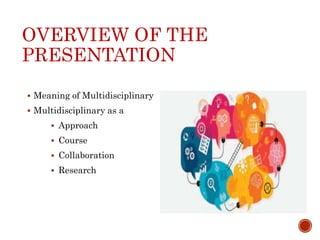
 Meaning of Multidisciplinary
 Multidisciplinary as a
 Approach
 Course
 Collaboration
 Research
NATURE OF DISCIPLINES
Monodisciplinary: Study of one Discipline
Interdisciplinary: Integration of more than
two subjects from same or different
disciplines.
Multidisciplinary: Combining or involving
several academic disciplines or professional
specializations in an approach to a topic or
problem.
MEANING OF
MULTIDISCIPLINARY
Multidisciplinary refers to knowledge
associated with more than one existing
academic discipline or profession.
 Multidisciplinary activities draw upon
insights from two or more disciplines.
Multidisciplinary work does not
typically lead to an increase in the
number of discipline.
MULTIDISCIPLINARY
APPROACH
The multidisciplinary approach involves
specialists from multiple academic
disciplines to redefine problems outside
normal boundaries and reach
appropriate solutions and encourages
collaboration. It enables learners to
develop critical thinking skills and
presents many “real world”
opportunities for growth.
EXAMPLE OF
MULTIDISCIPLINARY
APPROACH
 Historically the first practical use of the multidisciplinary
approach was during World War II by what became known as
the military-industrial complex. The Lockheed Aircraft
Company set up its own special projects operation nicknamed
as SKUNK WORKS- in 1943 to develop the XP-80 Jet fighter
in just 143 days.
 In the 1960’s and 1970’s the multidisciplinary approach was
successfully employed in the UK by architects, engineer, and
quantity surveyors working together on major public-sector
construction projects and together with planners, sociologists,
geographers and economist, on overseas regional and urban
planning projects.
MULTIDISCIPLINARY
APPROACH : NEP 2020
 Standalone institutions will be closed by 2030.
 Multidisciplinary institutions will be open widely.
 The flexibility to choose subjects from sciences and
humanities with the ability to also learn fine arts and sports will
given students a wide range of subjects to choose without
restrictions they faced earlier.
 With creative combination of subjects, cutting edge curriculum,
flexible options, and multiple entry and exit options during the
undergraduate course, students can explore their areas of
interest and also choose careers of their choice.
MULTIDISCIPLINARY
STUDIES/COURSE
 Multidisciplinary studies programs do not involve a
pre-determined set of courses like most degree
programs, but instead consist of a unique
combination of courses chosen by a student based
upon his or her specific educational and career
interests.
 The purpose of a multidisciplinary studies
curriculum is for students to design a program that
suits a specific career path. Therefore, job
possibilities are potentially available in many areas,
such as education, science, humanities, and
business.
MULTIDISCIPLINARY
STUDIES/COURSE
A student might choose a multidisciplinary studies
program if his or her specific goals and interests
cannot be met through a school's existing majors,
minors, and electives.
Multidisciplinary studies is also an option for
students who wish to combine completed coursework
from various disciplines into a single degree program.
Some programs are even available entirely online.
FOCUS AREAS FOR
MULTIDISCIPLINARY
STUDIES MAJORS
Possible focus areas for multidisciplinary studies majors vary
widely, but options include:
 Biology
 Criminal justice
 History
 Public administration
 Political science
 Spanish
 Sociology
GENERAL EDUCATION
COURSES
Although students are free to build their own course of study, a
set of required classes is common among most multidisciplinary
studies degree programs. These courses could include general
education courses in the following subject areas:
 Natural sciences
 Social sciences
 English
 Mathematics
 Communications
 Humanities
MULTIDISCIPLINARY
STUDIES/COURSE
In addition to the general education requirements, many
multidisciplinary studies programs offer concentrations in a specific
area of study. Concentrations allow a student to focus on a
particular topic or career option while still retaining the diverse
education of a multidisciplinary curriculum. A multidisciplinary
program with a concentration can help students learn about the
ways in which a variety of subjects influence their primary interest.
Some concentrations for multidisciplinary majors include:
 Human resource management
 Criminal justice
 Health systems management
 Accounting
 Business administration and management
 Computer science
MULTIDISCIPLINARY
RESEARCH
In multidisciplinary research, the subject under study is
approached from different angles, using differently disciplinary
perspectives. However, neither the theoretical perspective nor
the findings of the various disciplines are integrated in the end.
Multidisciplinary research involves a coordinated effort that
brings together several disciplines to provide complementary
contributions in the service of a common goal.
Multidisciplinary research needs collaboration with different
professionals in different disciplines with various backgrounds
and skills to find a solution in a multidimensional way which is
especially useful in the era of global competition to create
innovative values.
The different backgrounds of a multidisciplinary-team could
provide different viewpoints and experience for better
brainstorming across cultures.
EXAMPLE OF
MULTIDISCIPLINARY
RESEARCH
 The discovery of “Magnetic resonance imaging” by Paul
Lauterbur( a chemist) and Peter Mansfield( a physicist)-for
this they were awarded the 2003 Nobel prize in Physiology or
Medicine.
 An independent researcher designing and conducting their
own separate experiments would never have had these
opportunities.
MULTIDISCIPLINARY
COLLABORATION
Multidisciplinary collaboration consisting members with
different professional backgrounds and skills that can
compensate each other and work together toward the same
direction to achieve the same goals. e.g. Multidisciplinary
collaboration implies the involvement of many professionals who
focus on a set of issues and goals (Persily, 2013).
e.g. Physicians, nurses, social workers, other healthcare
professionals often collaborate to provide high-quality care to
patients.
Multidisciplinary approach is used to handle this pandemic
situation. It is a collaborative efforts of doctors, social workers,
pharma companies, bureaucrats and administrations.
SKILLS DEVELOPMENT IN
MULTIDISCIPLINARY
STUDIES
 Foster Intellectual Curiosity
 A critical thought process
 Self reflection
 Leadership and team work skills
 A sense of commitment
 Professionalism
 Sensitivity to one socio-cultural environment
CHARACTERISTICS OF
MULTIDISCIPLINARY
COMMUNITY
 A multidisciplinary community or project is made up of people
from different discipline and professions who are engaged in
working together as equal stakeholders in addressing a common
challenge.
 A multidisciplinary person can take the place of two or more
people in a multidisciplinary community or project team.
 A multidisciplinary community can be exceptionally efficient and
effective.
BENEFITS OF
MULTIDISCIPLINARY
 It encourages people to come forward and provide their contribution
to handle a situation or solve a problem and do innovations in
research.
 Multidisciplinary research leads to unusual scientific inventions.
 It develops better understanding of the collaborative process.
 It leads to better skills in communication, collaboration and
professional abilities as collaborators are forced to communicate
either to keep their ideas or to avoid complex programming efforts.
 It is useful because different backgrounds of a multidisciplinary
team could provide different viewpoints and experience for better
brain storming across cultures.
 It has a positive effect on future career development and sense of
achievement.
 It develops critical and synthesizing skills among the students.
 Multiple career options may remain open for the students who
studies multidisciplinary course.
MULTIDISCIPLINARY VS.
INTERDISCIPLINARY
 Interdisciplinarity analyzes, synthesizes and harmonizes links
between disciplines into a coordinated and coherent way.
 Multidisciplinary simply juxtaposes these insights and does
not attempt to integrate them.
 Multidisciplinary work does not typically lead to an increase in
the number of academic disciplines while Interdisciplinarity
increase the number of discipline.
poojawaliakuk@gmail.com

Multidisciplinary

  • 1.
    MULTIDISCIPLIN ARY Dr. Pooja Walia AssistantProfessor Department of Education Mizoram University
  • 2.
    OVERVIEW OF THE PRESENTATION Meaning of Multidisciplinary  Multidisciplinary as a  Approach  Course  Collaboration  Research
  • 3.
    NATURE OF DISCIPLINES Monodisciplinary:Study of one Discipline Interdisciplinary: Integration of more than two subjects from same or different disciplines. Multidisciplinary: Combining or involving several academic disciplines or professional specializations in an approach to a topic or problem.
  • 4.
    MEANING OF MULTIDISCIPLINARY Multidisciplinary refersto knowledge associated with more than one existing academic discipline or profession.  Multidisciplinary activities draw upon insights from two or more disciplines. Multidisciplinary work does not typically lead to an increase in the number of discipline.
  • 5.
    MULTIDISCIPLINARY APPROACH The multidisciplinary approachinvolves specialists from multiple academic disciplines to redefine problems outside normal boundaries and reach appropriate solutions and encourages collaboration. It enables learners to develop critical thinking skills and presents many “real world” opportunities for growth.
  • 6.
    EXAMPLE OF MULTIDISCIPLINARY APPROACH  Historicallythe first practical use of the multidisciplinary approach was during World War II by what became known as the military-industrial complex. The Lockheed Aircraft Company set up its own special projects operation nicknamed as SKUNK WORKS- in 1943 to develop the XP-80 Jet fighter in just 143 days.  In the 1960’s and 1970’s the multidisciplinary approach was successfully employed in the UK by architects, engineer, and quantity surveyors working together on major public-sector construction projects and together with planners, sociologists, geographers and economist, on overseas regional and urban planning projects.
  • 7.
    MULTIDISCIPLINARY APPROACH : NEP2020  Standalone institutions will be closed by 2030.  Multidisciplinary institutions will be open widely.  The flexibility to choose subjects from sciences and humanities with the ability to also learn fine arts and sports will given students a wide range of subjects to choose without restrictions they faced earlier.  With creative combination of subjects, cutting edge curriculum, flexible options, and multiple entry and exit options during the undergraduate course, students can explore their areas of interest and also choose careers of their choice.
  • 8.
    MULTIDISCIPLINARY STUDIES/COURSE  Multidisciplinary studiesprograms do not involve a pre-determined set of courses like most degree programs, but instead consist of a unique combination of courses chosen by a student based upon his or her specific educational and career interests.  The purpose of a multidisciplinary studies curriculum is for students to design a program that suits a specific career path. Therefore, job possibilities are potentially available in many areas, such as education, science, humanities, and business.
  • 9.
    MULTIDISCIPLINARY STUDIES/COURSE A student mightchoose a multidisciplinary studies program if his or her specific goals and interests cannot be met through a school's existing majors, minors, and electives. Multidisciplinary studies is also an option for students who wish to combine completed coursework from various disciplines into a single degree program. Some programs are even available entirely online.
  • 10.
    FOCUS AREAS FOR MULTIDISCIPLINARY STUDIESMAJORS Possible focus areas for multidisciplinary studies majors vary widely, but options include:  Biology  Criminal justice  History  Public administration  Political science  Spanish  Sociology
  • 11.
    GENERAL EDUCATION COURSES Although studentsare free to build their own course of study, a set of required classes is common among most multidisciplinary studies degree programs. These courses could include general education courses in the following subject areas:  Natural sciences  Social sciences  English  Mathematics  Communications  Humanities
  • 12.
    MULTIDISCIPLINARY STUDIES/COURSE In addition tothe general education requirements, many multidisciplinary studies programs offer concentrations in a specific area of study. Concentrations allow a student to focus on a particular topic or career option while still retaining the diverse education of a multidisciplinary curriculum. A multidisciplinary program with a concentration can help students learn about the ways in which a variety of subjects influence their primary interest. Some concentrations for multidisciplinary majors include:  Human resource management  Criminal justice  Health systems management  Accounting  Business administration and management  Computer science
  • 13.
    MULTIDISCIPLINARY RESEARCH In multidisciplinary research,the subject under study is approached from different angles, using differently disciplinary perspectives. However, neither the theoretical perspective nor the findings of the various disciplines are integrated in the end. Multidisciplinary research involves a coordinated effort that brings together several disciplines to provide complementary contributions in the service of a common goal. Multidisciplinary research needs collaboration with different professionals in different disciplines with various backgrounds and skills to find a solution in a multidimensional way which is especially useful in the era of global competition to create innovative values. The different backgrounds of a multidisciplinary-team could provide different viewpoints and experience for better brainstorming across cultures.
  • 14.
    EXAMPLE OF MULTIDISCIPLINARY RESEARCH  Thediscovery of “Magnetic resonance imaging” by Paul Lauterbur( a chemist) and Peter Mansfield( a physicist)-for this they were awarded the 2003 Nobel prize in Physiology or Medicine.  An independent researcher designing and conducting their own separate experiments would never have had these opportunities.
  • 15.
    MULTIDISCIPLINARY COLLABORATION Multidisciplinary collaboration consistingmembers with different professional backgrounds and skills that can compensate each other and work together toward the same direction to achieve the same goals. e.g. Multidisciplinary collaboration implies the involvement of many professionals who focus on a set of issues and goals (Persily, 2013). e.g. Physicians, nurses, social workers, other healthcare professionals often collaborate to provide high-quality care to patients. Multidisciplinary approach is used to handle this pandemic situation. It is a collaborative efforts of doctors, social workers, pharma companies, bureaucrats and administrations.
  • 16.
    SKILLS DEVELOPMENT IN MULTIDISCIPLINARY STUDIES Foster Intellectual Curiosity  A critical thought process  Self reflection  Leadership and team work skills  A sense of commitment  Professionalism  Sensitivity to one socio-cultural environment
  • 17.
    CHARACTERISTICS OF MULTIDISCIPLINARY COMMUNITY  Amultidisciplinary community or project is made up of people from different discipline and professions who are engaged in working together as equal stakeholders in addressing a common challenge.  A multidisciplinary person can take the place of two or more people in a multidisciplinary community or project team.  A multidisciplinary community can be exceptionally efficient and effective.
  • 18.
    BENEFITS OF MULTIDISCIPLINARY  Itencourages people to come forward and provide their contribution to handle a situation or solve a problem and do innovations in research.  Multidisciplinary research leads to unusual scientific inventions.  It develops better understanding of the collaborative process.  It leads to better skills in communication, collaboration and professional abilities as collaborators are forced to communicate either to keep their ideas or to avoid complex programming efforts.  It is useful because different backgrounds of a multidisciplinary team could provide different viewpoints and experience for better brain storming across cultures.  It has a positive effect on future career development and sense of achievement.  It develops critical and synthesizing skills among the students.  Multiple career options may remain open for the students who studies multidisciplinary course.
  • 19.
    MULTIDISCIPLINARY VS. INTERDISCIPLINARY  Interdisciplinarityanalyzes, synthesizes and harmonizes links between disciplines into a coordinated and coherent way.  Multidisciplinary simply juxtaposes these insights and does not attempt to integrate them.  Multidisciplinary work does not typically lead to an increase in the number of academic disciplines while Interdisciplinarity increase the number of discipline.
  • 20.