Psychomotor Domain
The psychomotordomain (Dave 1975) includes physical movement, coordination
and use of the motor skill areas. This is the third part of the taxonomy and includes
the manipulative and motor skill areas.
The psychomotor domain concerns itself with levels of attainment on neuro-
muscular coordination. As the level of coordination goes up, the action becomes
more refined, speedy and automatic. The physical actions involve in handwriting,
playing, using equipments, making outline, drawing figures and many others.
Development of these skills requires practice and is measured in terms of speed,
precision, distance, procedures or techniques in execution.
3.
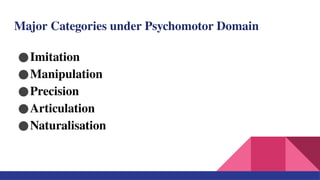
Major Categories underPsychomotor Domain
●Imitation
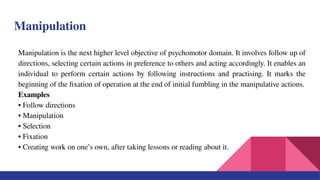
●Manipulation
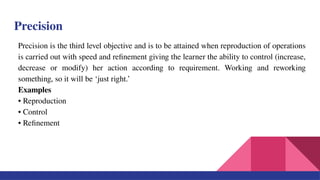
●Precision
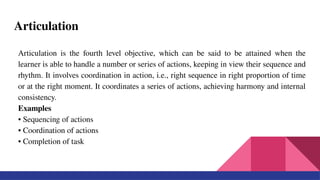
●Articulation
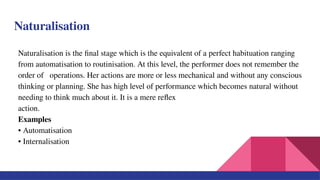
●Naturalisation
4.
Imitation
Imitation is thelowest level objective of psychomotor domain. It starts as an inner push or
impulse. It is represented by covert inner rehearsal of the muscular system which may be
taken to be more of an action at the mental level. Soon it may grow into an overt act with
capacity to repeat the performance with very rudimentary coordination. It involves
observing and patterning behaviour after someone else. Here performance may be of low
quality.
Examples
• Initiation
• Repetition
• Copying a work/task
5.
Manipulation
Manipulation is thenext higher level objective of psychomotor domain. It involves follow up of
directions, selecting certain actions in preference to others and acting accordingly. It enables an
individual to perform certain actions by following instructions and practising. It marks the
beginning of the fixation of operation at the end of initial fumbling in the manipulative actions.
Examples
• Follow directions
• Manipulation
• Selection
• Fixation
• Creating work on one’s own, after taking lessons or reading about it.
6.
Precision
Precision is thethird level objective and is to be attained when reproduction of operations
is carried out with speed and refinement giving the learner the ability to control (increase,
decrease or modify) her action according to requirement. Working and reworking
something, so it will be ‘just right.’
Examples
• Reproduction
• Control
• Refinement
7.
Articulation
Articulation is thefourth level objective, which can be said to be attained when the
learner is able to handle a number or series of actions, keeping in view their sequence and
rhythm. It involves coordination in action, i.e., right sequence in right proportion of time
or at the right moment. It coordinates a series of actions, achieving harmony and internal
consistency.
Examples
• Sequencing of actions
• Coordination of actions
• Completion of task
8.
Naturalisation
Naturalisation is thefinal stage which is the equivalent of a perfect habituation ranging
from automatisation to routinisation. At this level, the performer does not remember the
order of operations. Her actions are more or less mechanical and without any conscious
thinking or planning. She has high level of performance which becomes natural without
needing to think much about it. It is a mere reflex
action.
Examples
• Automatisation
• Internalisation
9.
Conclusion
Thus, in psychomotordomain the focus is on
development of motor skill. The physical actions
involved in handwriting, playing, using
equipment, making outline, drawing figures/
graphs are in the psychomotor domain.
10.
Contact me ifneeded:
poojawaliakuk@gmail.com
Explore the PPT on Educational Topic
https://www.slideshare.net/PoojaWalia6